i
SECURITY EQUIPMENT USING BIOMETRICS
MUHAMAD FIRDAUS BIN JUSOH
This Report Is Submitted In Partial Fulfillment of Requirement for the Bachelor Degree of Electronic Engineering (Computer) With Honours
Faculty of Electronics and Computer Engineering Universiti Teknikal Malaysia Melaka
ii
UNIVERSTI TEKNIKAL MALAYSIA MELAKA
FAKULTI KEJURUTERAAN ELEKTRONIK DAN KEJURUTERAAN KOMPUTER
BORANG PENGESAHAN STATUS LAPORAN
PROJEK SARJANA MUDA II
Tajuk Projek : SECURITY EQUIPMENT USING BIOMETRICS
Sesi
Pengajian : SESI 2012/2013
Saya MUHAMAD FIRDAUS BIN JUSOH mengaku membenarkan Laporan Projek Sarjana Muda ini disimpan di Perpustakaan dengan syarat-syarat kegunaan seperti berikut:
1. Laporan adalah hakmilik Universiti Teknikal Malaysia Melaka.
2. Perpustakaan dibenarkan membuat salinan untuk tujuan pengajian sahaja.
3. Perpustakaan dibenarkan membuat salinan laporan ini sebagai bahan pertukaran antara institusi
pengajian tinggi.
4. Sila tandakan ( √ ) :
SULIT*
*(Mengandungi maklumat yang berdarjah keselamatan atau kepentingan Malaysia seperti yang termaktub di dalam AKTA RAHSIA RASMI 1972)
TERHAD** **(Mengandungi maklumat terhad yang telah ditentukan oleh
organisasi/badan di mana penyelidikan dijalankan)
TIDAK TERHAD
Ditulis oleh: Disahkan oleh:
___________________________________ ___________________________________
Alamat : No 4, Lorong Air Putih 24, Jalan Air Putih, 25300, Kuantan, Pahang Darul Makmur.
Tarikh: ……….. Tarikh: ………..
iii
“I hereby declare that this is the results of my own paper except for quotes as cited in the references.”
Signature : _______________________
iv
“I hereby declare that I have read this report and in my opinion this report is sufficient in terms of the scope and quality for the award of Bachelor Degree of Electronic and Computer Engineering (Computer) with Honours.”
Signature : _________________________
v
vi
ACKNOWLEGDEMENT
Alhamdulillahirabbil „alamin washolatu wassalamu‟ala asrafil anbiyai wal mursalin, wa‟ala alihi waaskhabihi ajma‟in. praise to Allah S.W.T the most gracious and merciful for giving me the strength and wisdom in completing my Final Year Project (FYP). First and foremost, I want to perform my gratefulness to Allah S.W.T for keeping me in faith and show me guidance throughout the period of this study. I‟m also thankful to Him for easing out everything during the hard times.
Secondly, I would like to gratitude my parents, Jusoh Bin Che Omar and Zakiah Binti Mohamed Ghazalli for supporting me emotionally, morally and financially. They are the main catalyser that ignites me to study well and to do my best in my study.
Next, my appreciation to my supervisor, Mr. Muhammad Noorazlan Shah Bin Zainudin. Special thanks to him for giving my guidance in doing this study. He is also responsible in giving me useful and beneficial suggestions, ideas and reference materials.
vii
ABSTRACT
viii
ABSTRAK
ix
PAGE
TITLE i
PROJECT DECLARATION FORM DECLARATION
ii iii
APPROVAL iv
DEDICATION v
ACKNOWLEDGEMENT vi
ABSTRACT vii
ABSTRAK viii
TABLE OF CONTENT ix
LIST OF TABLE xii
LIST OF FIGURE xiii LIST OF APPENDICES xv
CHAPTER PAGE
I INTRODUCTION 1
1.1 Introduction 1
1.2 Introduction Of The Project
1.2.1 One Individual, Multiple Ids 1.2.2 One Id, Multiple Individual 1.2.3 Accuracy And Security
1 3 3 3 1.3 Biometrics Categories
1.3.1 Physical Biometrics 1.3.1.1Fingerprints 1.3.1.2Face Recognition 1.3.1.3Hand Geometry 1.3.1.4Iris Scan
x
1.3.3 Chemical Biometrics 9
1.4Multi Biometrics Systems 1.4.1 Multi Sensorial 1.4.2 Multi Modal 1.4.3 Multi Algorithmic 1.4.4 Multi Instance
9 10 10 11 11
1.5 Problem Statement 11
1.6 Project Objectives 12
1.7 Scope Of Work 12
1.8 Thesis Outlines 15
II LITERATURE REVIEW 17
2.1 Introduction 17
2.2 Brief History Of Fingerprint 18
2.3 Literature Review
2.3.1 Characteristics Of Fingerprints 2.3.2 Fingerprint Image Enhancement 2.3.3 Minutiae Based Matching Technique 2.3.4 Correlation Based Matching Technique 2.3.5 Ridge Feature Based Matching Technique 2.3.6 Image Based
19 19 22 23 25 27 28
2.4 Fingerprint Scanner 30
2.4.1 Capacitance Sensor 2.4.2 Optical Sensor
30 31 2.5 Visual Studio 31 2.6 Comparative Studies
33
III PROJECT METHODOLOGY 34
3.1 Introduction 34
3.2 Project Flowchart 35
xi
IV RESULT AND ANALYSIS 40
4.1 Introduction 40
4.2 RESULT
4.2.1 The Result Of Stored Database 4.2.2 Hardware
4.2.3 Gui Of Security System Using Biometric
40 41 42 43
V CONCLUSION 49
5.1 Conclusion 49
5.2 Future Work 50
REFERENCES 52
xii
LIST OF TABLE
TABLE NO.
TITLE PAGES
1.1
Comparative Study 33
4.1
xiii
LIST OF FIGURES
FIGURE NO.
TITLE PAGES
1.1 Types of Biometrics 2
1.2 Image of Fingerprint 5
1.3 Face Recognition 6
1.4 Hand Measurement 7
1.5 Iris Recognition 8
1.6 Stages of Gait Cycle 9
1.7 Multi biometrics Categories 10
1.8 Minutiae based matching technique 13
1.9 Image based matching technique 14
1.10 Correlation Based Technique 14
1.11 Ridge Features Based Technique 15
2.1 Type of Ridge Pattern 20
2.2 Local and Global Features 21
2.3 Fingerprint Distribution 21
2.4 Fingerprint Image 22
2.5 Bifurcation and Ridge Ending 24
2.6 Minutiae Based Workflow 24
2.7 Correlation Technique 26
2.8 Correlation Based Workflow 26
2.9 Ridge features based 27
2.10 Example of Image Matching Technique 28
2.11 Image Based Workflow 29
2.12 Capacitance Sensor 30
2.13 Optical Sensor 31
2.14 Visual Studio 32
3.1 Project Flowchart 35
xiv
3.3 Block Diagram for Fingerprint Reader 38
4.1 Access Database 41
4.2 Hardware Connection 42
4.3 Admin Form 43
4.4 Main GUI of Security System Using Biometric 44
4.5 Admin Mode Interface 46
4.6 Add Record process 47
4.7 Clear Record process 48
xv
LIST OF APPENDICES
NO. OF APPENDIX
TITLE PAGES
APPENDIX A
Database Operation Coding 54
APPENDIX B
Adding and Deleting Fingerprint Coding 60 APPENDIX C
Fingerprint Matching Coding 68
CHAPTER I
INTRODUCTION
1.1 Introduction
This chapter will cover introduction of the project. To outline the chapter, it is first discussed the introduction if the project then followed by the problem statement of the project that is trying to be improved. Then, the objectives are presented and the remaining section described the work scope and the structure of this report.
1.2 Introduction of the project
2
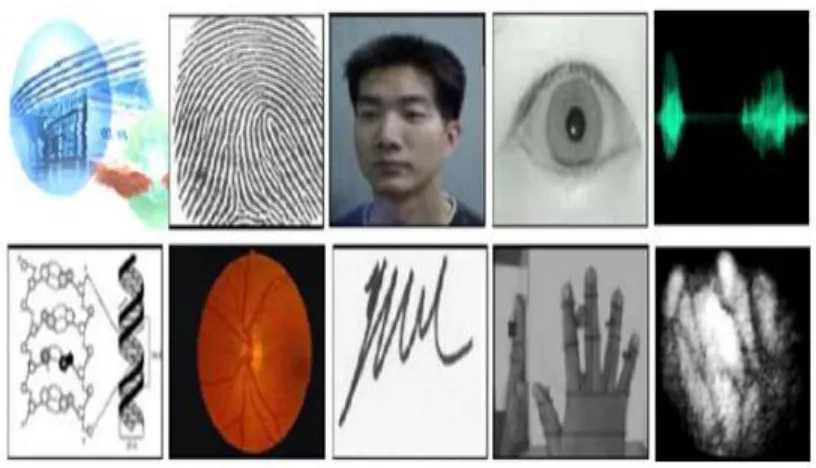
[image:17.612.126.534.216.450.2]categories such as physical and behavioral biometric. For physical biometrics, it can be classified to fingerprint, face recognition, iris scans and hand geometry meanwhile for behavioral biometrics is gait, handwriting, speech and signature [8]. Figure 1.1 show the example of biometrics types that were discussed earlier.
Figure 1.1 Types of Biometrics
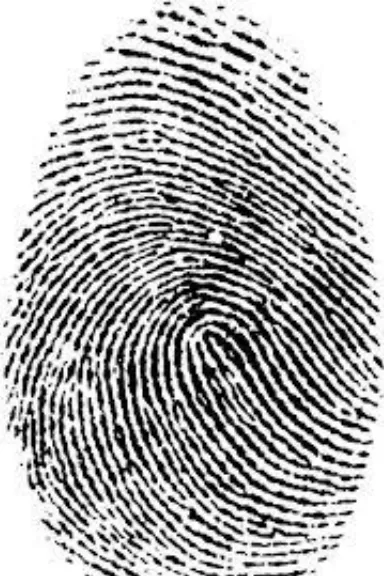
Fingerprint based security system is one of the most important biometric technologies which have drawn a substantial amount of attention recently. Fingerprint technology is so common on personal identification has been well established. Each human has unique own fingerprint, even the twin have different fingerprint. So, fingerprint recognition is useful in security and law application
3
1.2.1 One individual, Multiple IDs
Traditional security systems face the problem that they don‟t give solution to the problem of individuals having multiple IDs. For examples a person having multiple passports to enter a foreign country. Thanks to biometrics, they give us a system in which an individual can‟t possess multiple IDs and can‟t change his ID throughout his life time. Each individual is identified through a unique biometric identity throughout the world.[3]
1.2.2 One ID, Multiple Individual
In traditional security systems one ID can be used by multiple individuals. For example in case of a password based security system a single password can be shared among multiple individuals and they can share the resources allotted to a single individual. Biometric based security system doesn‟t allow such a crime. Here each individual has a single unique ID and it can‟t be shared with any other individual.[3]
1.2.3 Accuracy and Security
4
1.3 Biometrics Categories
Biometrics can be categorized in various categories as follow.
1.3.1 Physical Biometrics
This biometrics involves measurement of physical characteristics of individuals. The most prominent of these include
Fingerprints Face
Hand geometry Iris scans
1.3.1.1 Fingerprints
5
Figure 1.2 Image of Fingerprint
1.3.1.2 Face Recognition
6
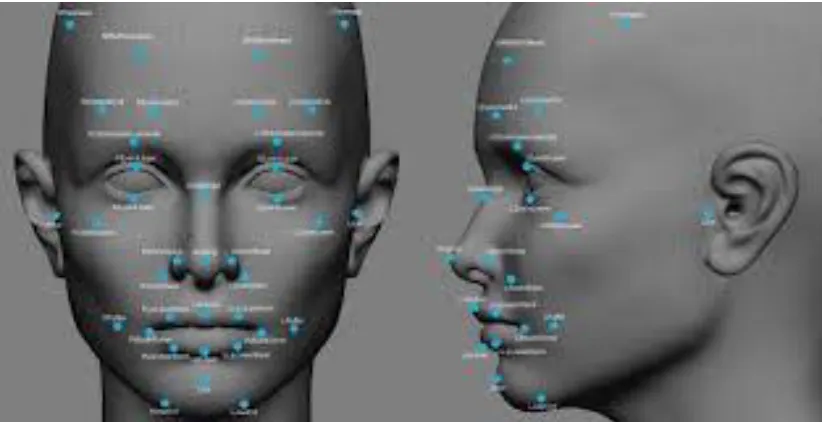
[image:21.612.122.533.154.365.2]Graph Matching using the Fisherface algorithm, the Hidden Markov model, the Multilinear Subspace Learning using tensor representation, and the neuronal motivated dynamic link matching. Figure 1.3 shows on how the face recognition worked.
Figure 1.3 Face Recognition
1.3.1.3 Hand Geometry
7
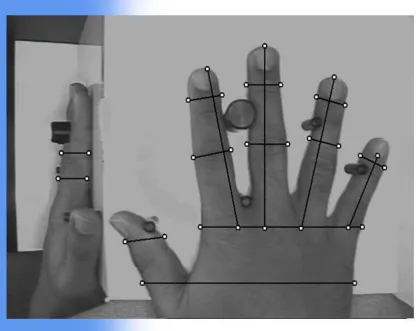
Figure 1.4 Hand Measurement
1.3.1.4 Iris Scan
8
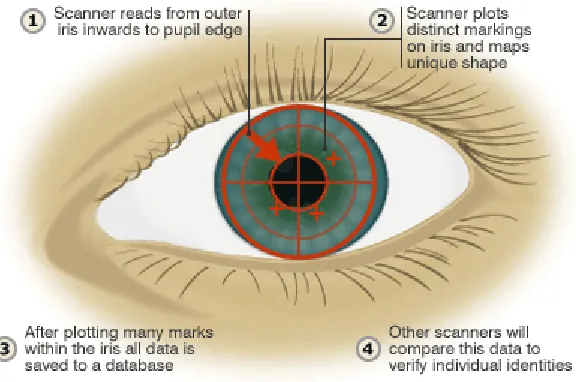
[image:23.612.185.473.222.413.2]chamber). Its color comes from microscopic pigment cells called melanin. The color, texture, and patterns of each person's iris are as unique as a fingerprint.[10] Figure 1.5 show step by step on how iris recognition work. First, the scanner will read from outer iris inward to pupil edge then the scanner plots distinct markings on iris and maps unique shape. After plotting many marks within the iris, all data will be saved to a database. Other scanners will compare this data to verify individual identities.
Figure 1.5 Iris Recognition
1.3.2 Behavioral Biometrics
This category of biometrics is temporal in nature. They are evolved during the lifetime of an individual. It involves measuring the way in which an individual performs certain tasks. Behavioral biometrics include
Gait
9
1.3.2.1 Gait
[image:24.612.113.543.239.384.2]Gait-based recognition involves identifying a person‟s walking style. Although these systems are currently very limited, there is a significant amount of research being conducted in this area. Furthermore, studies have shown that gait changes over time and is also affected by clothes, footwear, walking surfaces, and other conditions. Figure 1.6 outlines the various stages of a gait cycle.
Figure 1.6 Stages of Gait Cycle
1.3.3 Chemical Biometrics
This is a new emerging field. It involves measuring of chemical or biological composition of an individual different body parts such as
DNA
Blood glucose
1.4 Multi biometrics systems