Developing Local Assessment Toolkits
– a scoping study to look at developing
a standard model for
recording cemeteries and burial grounds
National Heritage Protection Plan:
NHPP 4D2 Cemeteries and Churchyards
Project Number: 6358
Harold Mytum
with contributions from James Cameron and Kate Chapman
A consultation exercise was conducted to scope the current state of digital data regarding cemeteries and burial grounds, and the requirements of a range of stakeholders in the use of digital data related to cemeteries and burial grounds. The study also assessed the volunteer interest in conducting digital recording of cemeteries and burial grounds, the ways in which this would feed into heritage management structures such as Historic Environment Records, and how the survey archives would be digitally curated and made freely accessible to the wide range of potential users.
Developing Local Assessment Toolkits – a scoping study to look at developing a standard model for recording cemeteries and burial grounds
SUMMARY REPORT
Executive Summary
Cemeteries and burial grounds are well known elements of the historic environment. They are of interest to a wide range of stakeholders, but have largely ‘fallen though the cracks’ given their unusual combination of issues linked to ownership (in both the legal and cultural sense), together with an anomalous legal position within secular and ecclesiastical law. These factors have meant that the unusual combination of below- and above-ground archaeology, the built environment, and culturally significant landscape is often poorly understood, with limited and often idiosyncratic statutory protection, and with a marginalised position in the planning system. This report summarises the results of wide consultation with many different interested parties, representing both professional and volunteer groups working within the heritage sector.
This scoping study has concluded that:
Cemeteries and burial grounds carry high cultural, symbolic and emotional value, and have both historic and current uses in burial and commemoration, and that this is appreciated by local communities responding to the survey.
The material remains in cemeteries and burial grounds are poorly recorded, yet they are important - highly contextualised - examples of popular material culture, particularly from the 17th- 20th centuries.
There is a widespread interest in the evidence residing in cemeteries and burial grounds from professional heritage managers, cemetery and burial ground
managers, and the public (ranging from Parochial Church Councils (PCCs), cemetery friends and local history groups to schools, family historians and ecologists).
The current state of data access within EH systems is inconsistent and extremely patchy, largely because of the poor knowledge base, ad hoc process of monument listing, and past recording criteria in RCHME. Graveyard monuments are also split between many monument classes, e.g. in PastScape, hindering data retrieval.
The current state of recording is extremely fragmented, inconsistent, and limited in scope beyond basic genealogical data. In most cases the material dimension is recorded only by a photograph. Fuller surveys (c.f.Mytum 2000), are rarely or partially undertaken. The materiality of memorials is appreciated but not well recorded or data easily recovered. There is no summarising of significance.
Of the surveys that have been completed, few are publicly accessible, beyond basic genealogical data in many records offices. Many cemetery friends groups with more advanced surveys are reluctant to share their data as they see these as a financially valuable asset. Groups yet to begin are generally happy for more public access.
Numerous web sites host genealogical data but most give no indication of data completeness, no site plans, and if there is a search facility it is limited to single person data; many charge for this service. Only some web sites provide monument images, and other landscape features are not recorded. These web sites are privately run and have no certainty of long-term viability.
Surveys reveal that neither county archives nor HERs are generally prepared to archive paper or digital resources, though the latter strongly desire summary reports.
Further study is necessary to establish detailed protocols for the digital recording of data from cemeteries and burial grounds, and to design management structures for the volunteer groups and for the digital data they generate, and with archiving protocols for ADS deposition.
The Consultation contacted a sample of:
HER officers through a short questionnaire, which has allowed assessment of the range of detail for cemeteries and burial grounds within existing HERs and also the current aspirations for level of detail in these systems.
Those responsible for managing cemeteries and burial grounds to assess the ways in which digital records would assist in future management decisions.
Archaeologists experienced in working with volunteer groups to understand the training and support frameworks necessary for successful project implementation.
Volunteer groups, particularly cemetery friends and some parish workers, to assess both willingness to record data digitally, and to engage with a large scale project within agreed frameworks.
Digital archive specialists, especially the Archaeology Data Service (ADS), to scope the deposition and curation issues associated with the digital databases and image data that would be compiled by volunteer groups.
Key Findings
Current state of data on cemeteries and burial grounds
There is a large amount of information that has already been collected, but this is extremely varied in its quality and its accessibility. There has been an emphasis on the genealogical information within inscriptions, and relatively little attention paid to the material character of memorials or the landscape of the burial ground, with its many cultural features (not only memorials) or of the ecology. Many ecological schemes have been concerned with encouraging diversity but rarely combine with the cultural heritage.
English Heritage data is variable in quantity and extent, and is extremely difficult to locate because of separation across many different keywords in databases such as Pastscape.
Genealogical data is held in many National and County archives facilities, but there is no standardisation in the data collected (some store only names, others full inscriptions, both with and without line breaks, but no indication of text size or lettering style). Some family history publications and web sites signpost archives and published lists, and hard copies of some graveyard genealogical data can be found in some County archives, but most of this data is not publicly available. It is seen as a private asset of the group, potentially a source of income with charges for searches; some cemetery friends groups resent any form of external involvement, seeing the site and the data as theirs, and not as part of a community resource.
individual on the monument. There is also a lack of overall burial ground site descriptions on all of these web sites.
Cemeteries and burial grounds in HERs
A survey of HERs (18% response rate) reveals extremely varied levels of data regarding cemeteries and burial grounds. These vary from little more than probably incomplete listings of sites and their locations, through to detailed monument records for every memorial in a particular burial ground.
Although a few HERs were willing and able to house full burial ground archives, most wished to have a suitable summary and signposts to the location of the full survey data elsewhere. Many HER officers recognised that the entries in their systems were insufficient, both in terms of quality and detail of data, and in terms of uniformity of format. The enhancement of cemetery and burial ground entries was seen by most HER officers as highly desirable, though a few considered that given the limited number of perceived threats they were not a priority. The creation of more complete and informed HER entries using uniform terminology and criteria would be a significant improvement to HERs, and any initiative that leads to enhanced data is desirable. The Church Historic Environment Record (CHER) is being designed by the Church of England at present, and the HER entries will populate CHER which will also be able to link to detailed digital archives.
Existing records in volunteer hands
There is no structure or system for deposition in any format, paper or digital, so most remains in private or group ownership and is rarely known about outside the group. Many parishes do not have transcripts or copies, even if these have been made, and may not even know they exist or who has them. A central repository of archaeological records, e.g. ADS, with lists distributed via Diocesan DACs and local authority cemetery managers would provide an important framework for access.
The recording toolkit – its potential content and structure
The combination of reviewing current volunteer practice and the previous forms of recording (both paper and digital) allows a proposed structure of the recording toolkit to be outlined. This should then be further refined and trialled in a further stage of the study.
The recording toolkit should link monument and landscape data through a plan, on which all features are numbered; each site should have a unique site code as a prefix for all records.
Records (whether monuments of planting and landscape features) can be numbered on the plan, and can be in digital format as either entries in spreadsheets or as images. Use of the unique site code and plan number will make all data identifiable and locatable.
Simple monument data should be collected in simple coded form; a suggested list would include:
Form (e.g. headstone, ledger, tomb, cross, kerb only, cremation plaque, other)
Decoration, with potential for more than one field (e.g. mortality, cherubs, urns, flowers, cross, coat of arms, occupation symbols, Masonic symbols)
Material (Sandstone, marble, granite, iron, ceramic)
Further optional data could be: state of preservation (simple scale of grading), measurements (height, width, thickness), presence of additional elements (e.g. kerbs, footstone, body stone, flower vase)
Non-monumental data is often also highly significant in terms of landscape and heritage significance, and also requires recording and would include:
Planting recording, each bush or tree having a description (ideally to species).rough height
Nature of paths
Any structures (e.g. stables, watch houses)
Entry points (e.g. gate posts, lych gates, gates)
The recording toolkit should allow the data to be collected either digitally in the field or on paper, and later transferred to digital format.
The protocols must have at least one, preferably two (field check and digital archive stage), stages of data checking, as experience shows that most recorders make errors in
transcribing, monument coding, and in data transfer.
The toolkit must have clear and simple protocols for data management; this is even more important with digital data which is much harder to manage than paper archives.
The format of proposed digital archives will require clear instructions on how to prepare the data, and the structure of the archive. This is essential if data is to be easily retrieved for heritage management purposes, or more than one site combined for analysis.
The final element of the protocol is the creation of a standard description of the burial ground as a high level summary to be deposited in the HER and the relevant owner / manager (e.g. DAC, local authority burial ground manager). If this summary is to include some qualitative assessment of significance, this is likely to require a small amount of expert consultant input as volunteer groups will not have the wider comparative and contextual knowledge to provide this.
Volunteer interest in collaboration in digital recording of cemeteries and burial grounds The involvement of volunteers in the collection of data that is then digitally stored, and uploaded to the web was considered in the light of both ecological and heritage projects. Whilst both cultural and natural heritage, each have their own priorities and criteria, volunteers do not necessarily separate them when dealing with their local burial grounds, and an inclusive approach could allow wider participation.
The consultation with cemetery friends groups and with parish and diocesan representatives indicates that there is widespread interest in the opportunities of participating in a project involving digital recording of cemeteries and burial grounds. In addition, those professionals experienced in the management of volunteer archaeological projects indicated that
graveyard and cemetery surveys would be both attractive and possible using the groups with which they are familiar.
The individual members of volunteer groups can vary in their levels of education, skills and confidence. In some cases the projects will gain from using existing expertise, but in many cases there will be a substantial skills-building element, involving training in a range of survey, decision-making, and IT skills which will be transferrable into employment, community engagement, and ability to access and use web-based resources.
Current social science research (Goraya et al 2012) indicates that understanding of, and access to, the digital world is limited amongst many underprivileged groups. A programme of digital cemetery and burial ground recording can be used as a vehicle to develop IT skills. Surveys have indicated that family and local history is a major incentive for the gaining of computer literacy skills amongst the older cohorts of the population; this project could enable many to gain or enhance their IT skills.
Management of volunteers in a national project
The international literature on the management of volunteers on heritage projects indicates that this is effective provided that aims and objectives are clearly established, and that training and support is provided. Consultation with those experienced in volunteer management indicated that communication is extremely important, and that this is required at the initial stages, in dealing with queries as work proceeds, and in the final stages to ensure quality of the record and the digital archiving.
Volunteers will require a knowledge base about graveyards, their monuments and
landscapes in order to appreciate and make informed decisions during any survey. They will also require training in the necessary skills to carry out the survey according to established protocols. Further training will be necessary to convert their records into a standardised digital archive suitable for deposition. The results from this survey reveal much lack of confidence, or independent, ad hoc, decision-making often leading to private collections of data not made available to anyone outside the group, and rarely archived. Much information can be provided on the national project web site, and short ‘how to’ videos can be prepared and available via YouTube.
Some form of training support will be highly desirable in order to maintain standards, possibly via local supporters, such as community archaeologists and Diocesan Advisory Committee (DAC) staff, who support groups ‘on the ground’. Regional or diocesan training sessions involving national and local staff could ensure widespread institutional support, and will enable expertise to be ‘rolled out’ efficiently. Regional or diocesan events where groups can report back and share problems, solutions, and results can create a supportive environment and encourage project completion, and showcase early projects to encourage others to participate. It is also essential to provide training and support beyond the initial fieldwork, which is clearly the most attractive to volunteer groups, with the later data checking, ordering and archiving often not taking place.
Curation, access and use of cemetery and burial ground digital data
The review of existing digital resources indicates that these are extremely uneven in quality and structure, and are often only accessible based on names of the deceased or monument by monument. Moreover, many web sites require payment for information. Where detailed archaeological surveys have been undertaken (e.g. using the CBA Handbook, Mytum 2000), there is no consistent location for deposition, and indeed many have not been placed in any public repository. Very few have been converted into digital forms. Some cemetery friends groups have digital burial data derived from burial registers, and some have large numbers of monument images. However, even in these cases accessibility is problematic and data management uncertain.
Consultation reveals that neither HERs nor County archives services are willing or able in many cases to accept and curate digital data from cemeteries and burial grounds, though they do welcome and require high level summary data of their contents. The same is the case for DACs. All would wish to have access to these resources, but many do not have the staff or expertise to curate digital archives. The executive summary could in part be provided by volunteer groups according to a set protocol, in which numbers of memorials, perhaps by set time periods, could be provided, together with basic summary (with some numerical data) of monument types (headstones, crosses, chest tombs etc), and so a descriptive summary of the burial ground landscape. However, groups would not be able to evaluate any relative significance of monuments or landscape because they would not have the necessary contextual information; this would have to be provided by someone with a wider comparative knowledge.
Service (ADS) is equipped to curate the diverse nature of digital data derived from recording projects at cemeteries and burial grounds, and it is essential that the necessary recording protocols are applied to the data and that budgets include the necessary level of support to cover the costs of long-term deposition.
Recommendations in summary
Review of existing recording methods reveals limited interest in recording the material remains of burial grounds, beyond the use of digital photography. Only those ultilising Mytum (2000) or simplified adaptations of this system record monument form, decoration, materials. It is clear from the adapted use of Mytum and limited take-up of even more complex recording systems in Scotland, that mass involvement should be based on a simple form, with additional advice if groups wish to go further. No popular recording methods as yet combine monument and landscape recording, beyond a plan, proposals should combine memorial and other data (e.g. plantings, other structures).
Recording and digital archiving protocols require development through a pilot project before any national volunteer programme can be implemented. This covers a varied range of levels of data recording, and the flexibility to include ecological as well as cultural data. The pilot also requires the development of support materials for the necessary skills sets required by the volunteer groups (e.g. training videos for YouTube). The data structures for curation and the necessary protocols for these also need to be formulated, in conjunction with ADS.
The volunteer recording should be designed to develop skill sets in the community through the digital recording project, ensuring wide public benefit beyond the recording itself.
Volunteers require support by regional archaeologists experienced in community involvement if a national recording system is to be followed. These professionals should be trained and supported by experienced graveyard recorders, who can assess overall progress, provide training to the professionals, deal with queries on applying the protocols, and spot check the data to ensure some level of national consistency.
A national centre or project consultant with wide-ranging expertise in graveyard recording and analysis would, via community archaeologists and DAC staff, be one way to support volunteer projects to enable the recording to take place. A
hierarchical structure of data management is also required, with some level of data checking at the national level prior to deposition with ADS, as experience with existing archives reveals frequent inconsistencies. Recording opportunities can be publicised by local professionals, but will be best initiated by a bottom-up approach.
A project to develop protocols and structures for effective recruitment, training and management should be developed, which will inform a Heritage Lottery Fund bid. This could be a Britain-wide bid, and the development of the protocols could also be in consultation with other interested parties in Scotland and Wales.
Contents
1. The Context for the Project
1.1 The report in relation to the project brief
1.2 Historiography and context of the project
2. The role of cemeteries and burial grounds in HERs
2.1 Question 1
2.2 Question 2
2.3 Question 3
2.4 Question 4
2.5 Conclusions
3. The Use of Volunteers in projects
3.1 Volunteers in projects
3.2 State of volunteer activity in burial ground recording
4. Management and curation of digital data
5. Recommendations
Annexe 1: Existing state of digital and web-based data on cemeteries and burial grounds
Annexe 2: HER Officers Questionnaire
Annexe 3: Cemetery friends consultation
Annexe 4: Archives services consultation
1 THE CONTEXT FOR THE PROJECT
1.1 The report in relation to the project brief
Cemeteries, churchyards, burial grounds, monuments, memorials and conservation are integral to English Heritage’s work. This project conducted an initial scoping study of existing recording programmes, assessed their current status and operation, and has reviewed how to maximise the conservation benefit to be gained from existing records. This will inform English Heritage in its national decision-making.
The project report also provides advice and recommendations on developing a Heritage Lottery Fund ( HLF) digital project bid to create a national toolkit and web-based database for volunteers. Their goal would be to objectively capture the current state of monuments and cemeteries (and include components such as cemetery gates and vegetation) at an appropriate and realistic level of detail, housed in a stable and accessible manner.
The project also sought to assess the state and location of existing cemetery and burial ground records, and the capacity for curation of digital archives in local government systems and in national repositories such as the Archaeology Data Service (ADS).
1.2 Historiography and context of the project
There has been a long tradition of recording historic monuments, from the 17th century
been listed. Only in recent decades has a more archaeological approach been developed which considers a wider range of monuments and other features as worthy of record, management and potential preservation.
Much activity in the past has led to the creation of paper records that have been dispersed to a wide range of locations, many of which are not publicly accessible. It was beyond the remit of this project to locate such data sets, but it is clear that current activity is not creating material that is any more accessible or effectively curated. In addition, many on-line resources and web sites that accept text and image data have sprung up in recent years. These reveal the interest in both participating in collecting and in using this data, but these online sites face some of the same issues as paper archives in terms of free access and curation.
This consultation is designed to consider the current state of knowledge of cemeteries and historic burial grounds, the nature of the records, and the ways in which the digital revolutions have affected what has already been done, is being done, and could be done. This is in the context of the greater involvement of volunteers in collective action linked to the media, seen in everything from political lobbying to contributions to collective recording sites such as OPAL. A review of the most significant digital community initiatives linked to heritage and cognate areas including ecology were reviewed (see Annexe 1 for details).
One project involving individuals recording data was English Rock Art (ERA), which forms a useful first stage in exploring public involvement (Annexe 1.1.1), but the scale of new data entry and the lack of group involvement means that it is only partly relevant. Crowd sourcing data can be seen through the Edina App (Annexe 1.1.2) which can geo-reference images, and link to other data. The Lichen Society (Annexe 1.1.3) is an example of the nationally-supported crowd sourcing of data. The OPAL initiative (Annexe 1.1.4) also allows uploading of data, but the amount from a graveyard survey would overwhelm that system, and also be extremely time-consuming to format and submit. Nevertheless, it demonstrates that there may be ways to create a system for preparation of data (e.g. Excell spreadsheets, pdf record forms, digital images) and uploading in standard structures to allow assessment, checking and then passing to Ads for archiving, though all this would have to be costed in any HLF bid.
These projects show the obvious advantages with digital capture when it comes to volunteer groups. It is a way of quickly disseminating the skills to interested people through a variety of media, and then ensuring that the data they upload is consistent and useable with existing data. What needs to be developed is a way of managing the huge amounts of data that a stone by stone recording of a graveyard, its monuments and other (cultural and natural heritage) features while maintaining a similar digital ergonomic.
The danger of ad hoc uploading of data through crowdsourcing is that many graveyards will contain entries only recording the large, impressive, or unusual monuments, or those relating to particular ancestors of the recorders, as seen on some of the sites discussed in Annexe 1.2. Even if standard data fields were required, the checking process would be problematic. Some of the most valuable elements of the data set for future management – the general graveyard description and evaluation, and the graveyard plan which is
necessary for informed ongoing management – is unlikely to be created through this format; some form of funding for consultancy or liaison with a national centre would allow rapid assessment and consistent summarising of each newly acquired dataset for deposition in the relevant HER and other databases.
The picture on the web is one of a patchy and largely ineffective resource, even for its primary purpose of genealogy. There are projects that record graveyards an
In England and elsewhere, the work that has been done is largely genealogical in nature, a mixture of projects done by passionate individuals, and those attempting to capitalise financially on the data desired by genealogists. The best of these sites promote a consistent form of recording, but this is rare, and marred by some of the criticisms levied above. There is a distinct lack of archaeologically satisfactory work being presented on-line within the graveyards field. Some of the projects above show that the public can be engaged in digital recording that allows for records that serve the purpose of both professional researchers and the public who are encouraged to contribute data. The challenge is to generate a robust system that takes the advantages from these various systems and applies and extends them to graveyard data, with the additional problems associated with the volume of data that will be created. It is likely that the simplest and most effective system will be to create files of images and spreadsheets, associated with pdf files, according to set protocols including naming formats. These can then be connected for a web-based use by ADS following a phase of checking prior to deposition. Some of the best summaries linked not to downloadable or searchable databases (rather than by name) are at
www.historicgraves.com , where professional archaeologists train and support volunteer groups through the whole process.
The status of graveyard and monument data in English Heritage systems
Graveyard and monument data was searched in a number of on-line English heritage resources to reveal data quality and extent. This revealed extremely patchy data presence and often limited in extent. Thus, a search for chest tombs in Gloucestershire (well known for its elaborate tombs, a number of which are listed) revealed only four, with very brief descriptions. In NHLE, a similar search produced 1,164 entries. However, these are individual or small groups of monuments as selected for listing, and do not provide any understanding of the wider context (other, unlisted monuments, vegetation, paths etc.). Graveyards or churchyards are not present in systems as a category.
This criticism of the limitations of the present systems reflects the past criteria for heritage significance, and thus the data available in AMIE. The splitting of even those assets in the system under many headings (e.g. tombs, headstones, crosses, coffin stones, mausolea) allows for some selective searching but makes other forms of evaluation even more problematic. A site based search provides some data but not a clear framework. Thus, St Mary’s Tetbury has 45 entries, most for single memorials but some for a group, but even then this does not provide an effective basis for management or analysis because of the partiality of the data and its lack of spatial and contextual information beyond the listed monuments. As burial grounds can contain numerous heritage elements such as protected trees (e.g. ancient yews), as well as having a landscape and collective cultural and heritage value, the present systems do not provide the necessary knowledge base for evaluation. The status of burial ground data within HERs is discussed in the following section.
2 THE ROLE OF CEMETERIES AND BURIAL GROUNDS IN HERs
expanded the questionnaire data. The discussion below is therefore based on a range of sources; individuals and authorities have not been identified.
Although no statistical pattern of quality and quantity of data held in HERs can be offered, the range of data and attitudes to it were successfully captured by the survey. This reveals an extremely varied provision, and clearly some form of enhancement and creation of a baseline level of record is highly desirable. This was an opinion expressed frequently in the responses, though a few considered this to be a low priority. The evidence is summarised in relation to each of the questions.
2.1 Question 1. - What is the extent and detail for the following categories in your HER?
2.1.1 Church of England burial grounds coverage was uneven and limited in detail. The average response indicated that whilst churches are included, especially if listed or with medieval origins, the entries often have little detail and there is even less description and assessment of the churchyards. Listed tombs are mentioned, as are archaeological interventions, but the level of detail is low and inconsistent. An individual burial ground record that could be separately plotted and have its own database entry was seen as desirable (but not yet achieved) in some cases. Some HERs have sections of the record that are of a higher quality, the enhancement being a by-product of initiatives such as town surveys. In very few HERs an historic interest has resulted more complex records being generated , with associated archives of monument surveys, images of monuments and burial ground plans. Given that such HER officers would have been more interested in the questionnaire, it is likely that these are a very small exception to the norm.
2.1.2 Other denominational burial grounds tend to have ad hoc records; many more of the burial grounds, now disused and potentially developed, do not even have known locations. There is a far more consistent approach to nonconformist chapels than to their burial grounds (which may be attached but are often physically separated). Even the most comprehensive HERs had extremely patchy coverage of these burial grounds.
2.1.3 Cemeteries are represented in the record, especially if they have listed structures or notable landscape qualities, but coverage is again inconsistent and usually brief, even in the most developed HERs. One HER officer is currently engaged in creating entries for cemeteries, which were previously absent, and some other HERs had no entries, except for listed structures.
2.2 Question 2. - What information would you like to have within the HER about these, and at what level of detail?
It is generally agreed that the level of detail in the HERs is too sparse. This is widespread across the categories discussed above, but can be divided into two elements. The first is actually having entries for burial grounds as entities at all (some such as cemeteries are not uniformly present, in other cases very few churchyards are given entries distinct from their associated church). The second is that size, landscape character, use dates, and above and below ground archaeological potential is not recorded at all. The listed monuments have no context, and sometimes little detail.
landscape assessment, condition survey and whether still in use. They wanted to be able to list archaeological interventions, and signpost to further resources.
A large minority of HERs desired much more detail on the range and condition of
monuments and information on planting schemes. A smaller minority desired much less than this, wanting only a brief historical summary.
Only a few HERs wished to hold graveyard survey records, and most wished to be able to point to where they were housed elsewhere. The same applies to DACs who have to manage the planning process within the remit of ecclesiastical exemption.
2.3 Question 3. - In what ways do you think that local groups in your area would be interested in collecting relevant data?
This response relies on the nature of the relationship between the HER officer and local groups (or knowledge of their colleagues’ involvement) as well as the state of local heritage activity. It was generally a quite short statement. A major theme was that this was not part of their remit and they had little time for such activities, but many responses suggested that local groups could well be interested, and a significant minority of cases listed potential groups. In other cases it was suggested that the County Archaeologist or some other team member would better know the local context. Whilst some did not answer this, none were negative about the potential – only their resources to initiate and manage (which was not what was asked). Some responses were keen to make existing collected data, and new data, known to the HER and in some way added in summary form. Clearly communication is a major issue, and this is where regional community archaeological support would be essential to make the whole project effective.
2.4 Question 4. - What types of digital data could be collected, stored, retrieved and used in your HER?
Most HERs provided only a short statement with regard to this question. The overwhelming majority did not wish for primary, detailed, burial ground survey data but wished for summaries and pointers to these sources. Digital resources in the form of pdf and Excell files were generally acceptable to those willing and able to take more data; a small number would take jpeg images. Most HERs suggested their County archives services as
repositories, though it was notable how few had any formal contact or detailed knowledge of their functions, policies, or abilities to curate such data (see Annexe 4).
2.5 Burial ground and cemetery management and planning control beyond the planning system
Whilst the heritage is managed at one level through development control, historic cemeteries and burial grounds have many threats that are not covered by this remit. Moreover,
ownership and day-to-day-management is fragmented and dispersed across the sector, and is made more complex by responsibilities delegated through ecclesiastical exemption. With the Church of England, each diocese has a Diocesan Advisory Committee (DAC) which assesses applications for changes within the curtilage of consecrated ground, and these are at a much lower threshold and greater level of detail and scrutiny than in the secular systems. With other denominations, arrangements vary considerably.
recent burials. Nonconformist burial grounds often have even poorer records and management infrastructure. None have anything in digital form.
DACs only have records linked to quinquennial inspections which give little attention to most graveyard features, and paperwork linked to faculty applications. Whilst at one level there is very fine-grained control and consideration at the planning level, there is no equivalent to HERs at a level to match the decision-making, which therefore relies on ad hoc personal knowledge. There is no digital archive or resource. Some DACs would welcome such information, and would use it in assessing applications for changes to graveyards.A Church Historic Environment Record (CHER) is under development by the Church of England which will address some of these issues. It will be linked to HERs and can be linked to any digital archives created through graveyard recording.
Cemetery managers have very varied amounts of information, from full digital resources (though often only for modern burial areas) in a few cases, to only historic paper records in most authorities. Their main concerns, however, are with current burial and general maintenance.
Whatever the management structure, it is clear that the main threat to the heritage within burial grounds and cemeteries lies within routine grounds maintenance, especially mechanical grass cutting damaging stones, strimming, control of trees, ivy and other vegetation. The removal of monuments or lying them flush with the ground because of health and safety concerns is the other major threat. In some areas vandalism is a problem, but where community involvement has been encouraged, this threat has reduced.
There is a balance to be struck between natural and cultural conservation, and to date the ecological agenda has dominated conservation, to the point that many managers do not even consider cultural/historic conservation in burial grounds at all. Collaboration with English Nature and other ecological organisations will allow building from existing knowledge and interest. Consultation suggests that those active in churchyard ecology are open to incorporation of cultural heritage elements within their management plans This integration will enable more informed consideration of grounds management and resolution of competing policies on a case by case basis.
Conclusions
Data within HERs is uneven for burial grounds, particularly nonconformist ones, and cemeteries of all types can be completely absent.
Churchyards do not have separate entries from churches, which may only mention listed structures.
A clear standardised structure for burial ground entries is widely desired.
Only some HERs are able to hold digital archives for burial grounds; most require a pointer to where these are held elsewhere.
Summaries of burial grounds are necessary starting points; these would be useful to HERs and DACs.
There should be project web sites that summarise activity and results.
Church authorities e.g. DACs do not have effective management data for churchyards but would use such a resource if available.
3 THE USE OF VOLUNTEERS IN PROJECTS
The project has considered two main issues concerning volunteers, the first regarding their effectiveness and management on survey projects, (especially with a digital component), and the second regarding volunteer group interest in burial ground recording, including current and past activity in this area. Evidence has come from various aspects of the scoping project, including cemetery friends responses, consultation meetings, project web pages, and the wider literature on volunteer involvement, particularly with heritage projects.
3.1 Volunteers in projects
The consultation provided considerable insights into the strengths and weaknesses of volunteer recording projects. The publications and web sites created by such groups were also accessed to consider the levels and nature of their activity. In addition the survey of cemetery friends groups revealed useful information, and the consultation meetings and other interactions provided important insights into the role of volunteers.
The existing records in volunteer hands
Information from survey was only collected via the cemetery friends questionnaire, though interaction with many parishes through other means reveals limited amount of information, and that of extremely varied character, reliability and accessibility. It is mainly genealogical, and the main role is to answer genealogical queries and to manage current and future interments by knowing who is buried where, location of vacant plots etc.
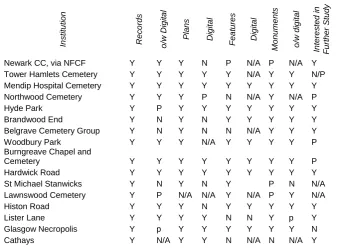
Existing cemetery records are largely those produced by the cemetery as a working institution – plans and burial records; these may be held by the cemetery friends, private cemetery company, or local authority now managing the cemetery (See Annexe 3). Some have CDs of some data (including some transcribed areas and images of monuments) but rarely are resources on-line. The website for the Friends of Northwood cemetery contains a searchable database of name similar to online graveyard resources discussed in Annexe 1. The Burngreave Chapel and Cemetery in Sheffield has the strongest online presence of the groups surveyed, with both a detailed burial record online and a downloadable plan to the cemetery. This information is locally hosted, and indicates that at least some cemetery friends groups also consider the benefits of making their records freely available.
No cemetery friends groups that responded are recording the archaeological and material aspects beyond taking of digital photographs; there is therefore no searchable data, or any available for analysis or management purposes.
Volunteers in wider heritage projects
Participants in heritage projects are diverse and numerous, as revealed through web searches and consulation with volunteer groups and heritage professionals, particularly iwth those involved with public archaeology. There is a great demand for community engagement and activity, as evidenced by the long waiting list for Archaeology Scotland’s Adopt-a-Monument scheme, and the take-up of HLF projects where community archaeologists are available in many regions.
integrated, though as any system spreads and the wider publicity and access benefits become clear, they may well join.
A set of clear protocols and a programme of supportive training are essential for all volunteer recording activity, and the provision of face-to-face interaction with experienced community archaeologists or other already trained and experienced advisors is essential for project success across the maximum range of socio-economic groups. Some volunteers, including ‘silver surfers’, are now IT literate, but a large number (30-40%) are not or do not have camera phones, etc. Short training videos on line could really help many volunteers with access. This ensures not only a level of quality assurance but also encourages project completion. This is particularly important for those aspects of the project that are not team-based external activities in the field, such as data sorting, checking entering and preparation of the archive.
Volunteers are stimulated by events and varied forms of dissemination of their results, so these need to be incorporated into the projects so that the archives can be known locally, and also a wider range of skills can be developed by the participants. Many projects could have on-site venues (parish churches, cemetery chapels) or local public facilities (village halls, schools) for such events. Web-based project pages are also important vehicles for dissemination, skills development, encouragement for the team, and a vehicle for feedback. Social science research has demonstrated that engagement with heritage – particularly local and family history – has been one of the main incentives for older individuals and groups to become computer-literate (Selwyn et al 2005). The development of a digital burial ground archive will allow the ‘silver surfers’ to enhance their knowledge, but will introduce basic skills to others. The integration of digital elements will also attract and motivate younger cohorts; many of these in disadvantaged communities have limited internet access and do not appreciate the potential of the web to beyond that of social networks.
The project can be seen as skills development and training, one user group in effect being those who do the recording – as they are learning]. There can be trickle down from local experts in a range of fields. With a hierarchical range of levels of data collection, self-selecting groups of volunteers can take different aspects of the recording and engage at whatever level they feel comfortable. Churchwarden training days can be a valuable and efficient way of reaching many communities in one go – 40 to 50 at a time- tapping into more networks. The use of on-line videos explaining particular recording and data downloading tasks can be inexpensive and highly effective at reaching distant or less institutionally recognised groups, and the outcome can be to the benefit of heritage management and social inclusion and upskilling of the population; these could be key features and outcomes of any HLF bid.
There is a wide range of experience in organising and running volunteer projects, including those with a digital component. There is also plentiful evidence of the social as well as heritage benefit that such projects, properly supported, can achieve.
3.2 State of volunteer activity in burial ground recording
Some graveyards have been recorded by a range of local and family history groups or by friends of parishes and cemeteries. Many graveyards have had at least their older stones transcribed, and these may be housed in the local County records office. Perusal of many County archive catalogues will reveal lists of inscriptions, and some County Archaeological Societies (e.g. Yorkshire Archaeological Society) have sections of their membership who have transcribes graveyards as contributions to family history.
In some counties even older antiquarian transcriptions exist, but these are always extremely selective, with a bias towards impressive monuments. These various levels and dates of transcription often disagree on readings, and rarely are there photographs or discussions regarding differences between later transcriptions and earlier ones (which can be caused by levels of recorders’ skill and dedication, lighting conditions during survey, state of vegetation growth, erosion over time, application of different methods e.g. rubbings, use of flour or foam to emphasise text; some of these can damage memorials),
Almost all groups contacted would not reveal in detail the nature of the records they produced, only their general content. This is part of the feeling of ownership, and the lack of personal, face-to-face contact necessary to develop mutual confidence in this survey. Most groups clearly had not had previous contact with academics or heritage professionals interested in their endeavours. Most of those who had not commenced recording welcomed any help, but those further advanced were wary of providing much detail, perhaps for fear of losing data or of criticism or interference in how the work might proceed. It also reveals the attitude that this data is private, a resource of the group, not of the wider community.
Some student and community recording projects have used simplified recording forms with only a few monument categories (headstone, ledger, cross etc.) and a limited number of other fields. Some groups create churchyard plans, either in sketch or measured form. Anglican parishes are meant to be producing burial plans for general management use, and these can therefore already exist for recorders to use, or be created jointly.
Cemetery groups have cemetery plans from which to work in terms of monument location (though these are not always as easy to use as might at first appear), but responses from cemetery groups were not specific on this matter. It is unclear to what extent the cemetery plot numbering system is incorporated into cemetery friends monument records. A full assessment based on the survey of friends groups is provided in Annexe 3.
Some groups have done recording using the forms supported by the CBA handbook (Mytum 2000), but often the forms are only partially filled in, and rarely is there a digital element. In Scotland, the detailed forms designed by the Carved Stones Advisor and Historic Scotland and supported through a three-year project, are still available on-line via Archaeology Scotland:
http://www.archaeologyscotland.org.uk/our-projects/scottish-graveyards/resources. However, in practice these forms again are often only partially filled in or groups design less formidable forms for recording for themselves. The deposition of graveyard recording archives, in paper or in digital form, is very rare. This may in part be because County archives services and HERs are unwilling to take them. In Scotland few have been deposited with Canmore, even though RCAHMS would be willing to take them. Some cemetery friends undertake recording, and this can include a digital element.
In general, beyond basic genealogical information in some cases, public archiving is absent. This is a combination of a sense of individual and group ownership of the data, lack of awareness of its wider significance and interest, no training as to what format an archive should take, and resistance from likely repositories to take such depositions. The numerous community projects already taken place in Ireland reveal a similar interest in the genealogical information and photographs, but little else. Only these elements are being incorporated into digital formats and made available on-line - see www.historicgraves.com. However, this is a web site owned by a commercial heritage organisation, not a more permanent institution .
Local volunteers will have strong affiliations with their burial grounds, and they hold important social, cultural and in some cases personal memories and significances. There is already the latent or actual feeling of ownership, which can be applied to the creation of a record. Experience has shown that wherever such surveys take place, the wider local community is positive and enthusiastic, and the consultation process has demonstrated that those
Summary of the strengths and weaknesses Strengths
Transcriptions have been frequent
Various models for recording have been proposed and offered (CBA, Historic Scotland)
Some community groups have undertaken surveys using these models,. Albeit often limiting the amount of data they collect
Many groups recognize the importance of the physical monuments, and may record this by photography
There is a widespread recognition of the potential of digital recording and data storage
Many groups welcome guidance and the open access format for data Weaknesses
Although existing models have had limited take-up in practice
Recording of physical monuments is patchy and is rarely coded or recoverable beyond looking through images
Digital databases beyond names and dates is extremely rare
Ordering and cataloguing digital images so that they can be linked to other records, or searched or ordered, is rare
There is limited understanding of the process of archiving paper or digital data
There are no protocols and no processes for data deposition and archiving
Conclusions
Many existing networks and structures can be used to publicise any digital recording system and protocols, e.g. Cemetery friends, DACs, CBA, Young Archaeologists Club, archaeology societies.
Training for volunteers is required so that they understand the importance of monuments beyond their inscriptions.
Support will be required for organising the digital data ready for deposition.
Ways in which data could have community use need to be explored.
‘Ownership’ is important for volunteers, as they chose the level of recording. The ethos will be for sharing, so the deposition of accessible archives is essential.
Future initiatives that develop skills and build communities through the collection and archiving of burial ground data may be rather more attractive to some funding bodies than ones which focus on data collection and archive creation.
4 MANAGEMENT AND CURATION OF DIGITAL DATA
The current state of management of digital burial ground and cemetery data was assessed through reviewing web-based resources, and through the various questionnaires and consultation meetings. No digital archives were directly consulted (apart from those on-line), as access was not offered (see comments above regarding sense of ownership), but in some cases an indication of their size and completeness was obtained in responses.
The amount and nature of digital data relating to cemeteries and burial grounds within HERs varied greatly, as did the capacity and willingness to store such data. It is generally clear that HERs are not the most effective locations for existing or future digital archives (see 2.4).
Whilst some County archives services are willing and able to house digital data in the form of pdf files, Excell spreadsheets and in some cases jpeg images, in most cases they are not (see Annexe 4). Although there was a poor response to the questionnaire regarding burial ground data in their care (especially given that supporting family history is one of their main activities), it would seem that the housing of the relevant paper or digital records would not be automatic, even if carried out within nationally set standards. It is therefore clear that no reliance should be placed on local provision for curation, even if in some cases copies could be so deposited.
Some cemeteries which are still in active use have commercial digital systems that manage burial data and can incorporate GIS mapping, databases, and images. These can incorporate historic data (such as 19th-century burial entries) in order to populate the databases, but they
are designed for current management and are often on a leased arrangement with no long-term archival security for the data. Whilst excellent for their intended use, these would therefore not seem to be a model for any heritage-based solution.
Many web sites offer to house text and images of burial ground monuments, but there is no standardisation, no clear curation policies or procedures, and issues regarding ownership and access (see Annexe 1). These sites are largely privately run, with only a few special-interest sites (such as the Maritime Museum) being institutionally situated. There generally seems to be no quality control, and many burial ground entries are ad hoc and incomplete. In only a few community-based site-specific sites is there spatial information with maps. In all cases only name data can be searched, as family history is seen as the primary use for the sites, even if monument form and motifs may be indicated in general introductory text and with selected images. No sites are designed to function in any wider heritage management or research context. Experience from Scotland, over a number of years and with numerous community groups, indicates that the lack of a centralised set of protocols and support in the creation of digital archives leads to fragmented and inconsistent curation strategies, and most projects having no effective digital dimension at all.
Conclusions
HERs would wish for clear standardised summaries for cemetery and burial ground sites, but this requires considerable enhancement.
Only some HERs are able to hold digital archives for burial grounds, and most would wish to act as a pointer to these; there should be project web sites where there are community projects.
The Church Historic Environment Record (CHER) will act as a Church of England equivalent of the HER, and will make similar uses of any archive as HERs.
County archive services have uneven and often limited capacity to hold the relevant digital data.
Existing commercial digital data management systems for cemeteries and the on-line repositories for monument data and images are inappropriate for wider heritage use, with issues regarding ownership, curation and limited interrogation capacities.
5 RECOMMENDATIONS
5.1 The establishment of a national recording system
5.1 National recording system
The creation of a simple recording system that is both quick and easy to implement by volunteer groups can provide baseline data for heritage management and public engagement. This information should include spatial data (via a site map, even if not accurately to scale), monument, landscape feature and people databases (the last given the great interest in genealogy, and also because it provides dating and other contextual information for the other elements of the record). The recording system should be designed to allow for more detailed information to be collected on a hierarchical basis, linked to volunteer groups interests and skills, but not require high levels of knowledge or skills.
The recording system should generate digital data (either directly in the field or via paper records) that can be archived in a standard format which will allow for use by heritage professionals and many interested parties; this would include a summary statement of the data for HERs.
It would also be highly desirable to have some evaluation of the heritage and cultural significance of the burial ground as a whole and any notable elements within it, but this would require professional consultant input, as volunteer groups would not have this wider knowledge.
5.2 National recording project
A national project to encourage and facilitate volunteer groups to digitally record cemeteries and burial grounds should be investigated further. Such an initiative will receive a positive response from heritage professionals involved with managing volunteer projects, numerous volunteer groups, and the various user groups including HERs, County archives services, researchers and many community groups as well as family historians.
National may mean England only, but positive reaction from those already involved in Scotland, and from a number of the Welsh archaeological trusts indicates that a pan-British project would receive widespread support.
A national project (however defined) can ensure data quality and compatibility and provide a structure for the spread of good practice, advice on unusual discoveries, access to
consultancy regarding enhanced summary data, and ensure archiving is consistent and passed over to ADS is a suitable format; after an initial project launch phase when training will be at its maximum, it could be supported through elements of each community HLF bid including the checking, expert summarising (e.g. for HERs), and deposition with ADS.
5.2 Development of recording and archiving protocols
Recording and digital archiving protocols require development through a pilot project before any national volunteer programme can be implemented. This covers a varied range of levels of data recording, and the flexibility to include ecological as well as cultural data. The pilot also requires the development of support materials for the necessary skills sets required by the volunteer groups. Projects such as the Great Yarmouth Borough Council involving trainees from the long-term unemployed as well as the broad experience in England and Scotland needs to be brought together to identify best practice. The data structures for curation and the necessary protocols for these also need to be formulated, in conjunction with ADS. Basic guidance needs to be given e.g. on digital image size, Excel spreadsheet cell formats, use of upper and lower case on text entry.
Data to be collected should be all linked to the unique burial ground site code and feature numbers, and at a minimum include:
Monuments: names and dates, simple coded data on form, decoration, material, presented in a spreadsheet, e.g. Excel
Landscape features: paths, vegetation, boundaries, entrances, structures, presented as coded data or using thesaurus terms in a spreadsheet, e.g. Excel
All numbered features should be located on a site map.
All numbered features should be photographed, the digital images being named with site code and feature number
The archive should also include summary data including:
Brief description of the burial ground landscape and its wider setting
List of all feature types present and their numbers
Date range of monuments and range of monument types
Hierarchical information could include more data on monument measurements, orientation, and state of preservation/legibility; higher level coding of monument form or decoration; more detailed geological identification; full inscription transcription; recording of lettering styles, forms of letter carving, use of paint/inlay; detailed planting species identification; ecological surveys. More advanced mapping could include accurately measured plans, available in CAD, and the most advanced could use GIS and link spatial, database and image data, though the expertise needed for this is at present beyond volunteer groups, and also presents archiving challenges. Digital data can be given Digital Object Identifiers (DOIs) which are fixed identifiers, wherever the data gets moved, and this will assist in and reduce costs of data migration in the long-term.
5.3 Recording of burial grounds can be a vehicle for skills development
Protocols for a national recording system should be easily accessible, and on-line resources could be made available to provide a baseline of training and support to carry out surveys. However, experienced public and community archaeologists indicate that volunteer groups often rely on personal contact and support to initiate conduct and complete recording projects.
However, through a national recording project that frameworks could be designed to develop skill sets in the community through digital recording, ensuring wide public benefit beyond the recording itself. There are many skills which would or could be taught or enhanced through such community projects. Feedback during the consultation reveals increasing confidence in the use of digital technology, but the need for specific training. The use of standard software but created as appropriate file types for data input and curation, is necessary to ensure standardisation and ease of use. Teamwork and technical skills can all form part of the training; participants can be encouraged to reflect on what skills they have learnt.
Skills development can be within the digital and IT elements, but also in teamwork, presentation, analysis, and development of skills in the actual recording process. The ways in which projects incorporate skills, and develop these through dissemination strategies beyond the deposition of a digital archive, could be locally selected to maximise impact and value to the participants and wider community. Examples of good practice can be collected nationally and presented on the main project web site.
The volunteers should be supported by regional archaeologists experienced in community involvement. These professionals should be trained and supported by a national centre with experienced graveyard recorders, who can assess overall progress, provide training to the professionals, deal with queries on applying the protocols, and spot check the data to ensure some level of national consistency.
Experience not only on graveyard recording projects but many other types of community engagement with heritage has highlighted that types of training and support required for effective project completion. Existing HLF schemes have provided plenty of exemplars, and also a cohort of community archaeologists who could be easily trained in the appropriate protocols for recording and curation. Other groups such as those working on the natural heritage such as God’s Acre also have extensive experience of working with and training volunteers groups in working within burial ground contexts.
5. A project to develop protocols, training materials and archiving structures is necessary prior to an HLF application
A project to develop protocols and structures for effective recruitment, training and management should be developed, which will inform a Heritage Lottery Fund bid. Experience in Scotland and elsewhere indicates that avoidance of the creation of ad hoc schemes is important, but the systems also need to allow for flexibility in levels of data capture, and allow incorporation of natural as well as cultural heritage data. This could be a Britain-wide bid.
The scoping study reveals demand both to conduct the surveys and to use their results. Although existing experience, e.g. through use of the CBA handbook in England and the various forms available in Scotland, is valuable, these do not provide immediately applicable protocols. Not only do past recording systems not integrate the digital element fully, they also do not offer a hierarchical recording structure which allows a spread from very simple to advanced levels of recording. Nor do the systems offer any option for integrating natural heritage information, or even pointing to its existence elsewhere. Now that the CBA have abandoned publication, and Mytum 2000 is out of print, it may be possible to negotiate a free version, suitably re-written for the new systems and current technological possibilities, without any problems of overlapping or conflicting interests between different national heritage bodies.
It would be therefore highly desirable that a project was developed that created the necessary protocols that ran from data collection in the field through to deposition in an archive, and also constructed a framework for training that included both the local
Annexe 1 Project context: Existing digital data related to cemetery and burial ground heritage
A large number of web sites were consulted to assess the ways in which web-based media are used to collect and use volunteer-collected data. Some of these are not related to graveyards (Section 1.1) but indicate the potential uses of the web. Most attention, however, was paid to the current state of access to burial data not only in Britain but also from an international perspective.
1.1 Digital Recording and Public Involvement
The following websites have similar characteristics: they specialise in digital data capture and public involvement. As current exemplars of the medium, they allow consideration of volunteer data capture and digital upload, and how that might inform a burial grounds project.
1.1.1 English Rock Art (ERA): http://archaeologydataservice.ac.uk/era/
This project, promoting the awareness of and public involvement in the preservation and recording of the Rock Art that is scattered across parts of Northern England, utilises digital capture and volunteer involvement.
The Northumberland and Durham Rock Art Pilot Project (NADRAP), 2004 – 2008, sought to use over 100 local volunteers and train them in the necessary techniques of data capture. This created a database whilst capitalising on volunteer activity to create and foster public interest in the resource. A downloadable handbook allows amateur groups to submit material to project standards, and an app leads those that download it to view known sites by providing information via an interactive map.
The applications of this sort of model are obvious. Interested non professionals were trained in the use of complex survey techniques, with data then uploaded to a central database. The handbook also means that untrained individuals who think they may have new data to contribute are well guided, and their data would be compatible with the rest of the digital archive.
This model is only partially applicable to graveyards, as individuals recording occasional new discoveries of rock art does not equate with the scale and complexity of data that would be generated by even one group involved in a graveyard survey. However, the central website is an excellent example of a project site, and it encourages, educates and informs people that might be interested in contributing. These are all features that should be developed for a graveyard recording site.
1.1.2 The Edina App ‘Field Trip GB’: (http://fieldtripgb.blogs.edina.ac.uk/)
This is a mapping tool that allows researchers to combine the data that they collect with high quality maps. It is designed for smart phones, and is linked to a drop box. A researcher can use the tool on the Field Trip website to author their own data submission forms.
What is innovative here is the concept of crowd sourcing or, as the authors of the Field Trip GB app put it, ‘informed crowd sourcing’ where already trained individuals such as a university class go out as individuals and run the app to capture data before sending it through a drop box to the group leader who edits the material into a single document for submission: ( http://fieldtripgb.blogs.edina.ac.uk/2013/04/22/collecting-data-as-a-group-using-fieldtrip-gb/).