Children’s Social Care Innovation Programme Evaluation Report 49
Evaluation of Pause
Research report
July 2017
Katie McCracken, Sarah Priest,
Ana FitzSimons, Kelly Bracewell,
Kasturi Torchia, and Will Parry
- Opcit Research
with Nicky Stanley
2
Contents
List of figures 3
List of tables 4
Executive summary 6
Summary of literature review 11
How Pause defines itself 13
Recruitment of the Pause cohort 14
The evaluation 15
Characteristics of the Pause cohort 19
Findings from baseline Client Monitoring Forms 19
Findings from baseline interviews 26
Is Pause effective in meeting its aims? 32
Impact on pregnancies 32
Impact on Pause women 33
How does Pause work? 42
Influencing partner agencies 42
Engaging women during a pregnancy-free period 45
Resource requirements 52
A cost benefit analysis of Pause 55
Implications and recommendations 58
Answers to the central evaluation questions 58
Recommendations 60
Appendix A: Evaluation limitations 63
Appendix B: Pause’s own baseline data 65
Appendix C: Analysis of impact on pregnancies 66
Appendix D: Summary of the Pause theory of change 73
Appendix E: Case studies 74
3
List of figures
Figure 1: Pregnancies prior to intervention 67
4
List of tables
Table 1: Summary of data collection 16
Table 2: Age range of Pause cohort 19
Table 3: Child removals 20
Table 4: Child contact 20
Table 5: Psychological wellbeing 21
Table 6: Domestic violence 22
Table 7: Higher risk alcohol use 23
Table 8: Problematic drug use 23
Table 9: Criminal justice involvement 24
Table 10: Housing 25
Table 11: Engagement with services 25
Table 12: Contraception use 26
Table 13: Impact on pregnancies 33
Table 14: Changes in incidents of domestic violence 36
Table 15: Changes in higher risk drinking 37
Table 16: Changes in problematic drug use 38
Table 17: Changes in housing 40
Table 18: Changes in contraception use 41
Table 19: Cost savings from removals avoided (Model 1) 56
Table 20: Cost savings from removals avoided (Model 2) 56
Table 21: Pregnancies in follow-up period, by group 68
Table 22: Model 1 (Pause vs. comparison) 69
5
Table 24: Model 2 (Pause vs. Pause) 71
Table 25: Cost savings from reductions in domestic violence 80
Table 26: Cost savings from reductions in higher risk alcohol use 81
Table 27: Cost savings from reductions in problematic drug use 82
6
Executive summary
Project
Pause is a voluntary programme for women who have experienced, or are at risk of, repeat removals of children from their care. It aims to reduce the number of children being removed into care by working with women who have had children removed to improve their wellbeing, resilience, and stability. Pause offers women an 18-month, individually-tailored, intensive package of support, delivered by a dedicated Practitioner, which is intended to address a broad range of emotional, psychological, practical, and behavioural needs. As a condition of beginning this voluntary programme, women agree to use an effective form of reversible contraceptive for the 18-month duration of the programme. This is intended to allow women the opportunity to reflect and focus on their own needs. In addition to providing support, Pause works in collaboration with partner agencies (such as health and domestic violence services), at operational and strategic levels, to improve the broader service response to Pause women. Pause began in Hackney in 2013, and received funding from the Department for Education Innovation Programme in 2015 to expand the pilot within Hackney, and to Doncaster, Greenwich, Hull, Islington, Newham, and Southwark. While most pilot Practices worked only with women who had had at least 2 children removed from their care, one Practice worked only with women who had had one child removed, and another – the first Pause Practice – worked with multiple (‘one child removed’ and ‘2 or more children removed’) cohorts.
Evaluation
This evaluation report assesses the impact of programme delivery, as well as the processes through which impact was achieved, for 125 women engaging with Pause at these 7 pilot Practices. It also offers an assessment of the fiscal costs and benefits of delivering the programme.
The evaluation period ran from March 2015 to September 2016. It should be noted that, due to the timing of the evaluation period, at the first Pause Practice only the ‘1 child removed’ cohort took part in the evaluation. In total, the evaluation cohort included 95 women who had had 2 or more children removed at 5 Practices, and 30 women who had had one child removed at 2 Practices.
The central evaluation questions were:
7
• to what extent does engagement with the Pause programme have a positive impact on women’s wellbeing, resilience and stability?
• how cost-effective is the Pause programme?
• how do individual elements of the Pause programme relate to its impact?
• what factors enable, or hinder, the achievement of Pause’s aims?
To address these questions, the evaluation team collected and analysed an extensive range of quantitative and qualitative data. Two statistical models were developed to estimate the impact of Pause on women’s pregnancy rates during their intervention, using data on pregnancy histories collected from the 125 women who were engaged with Pause, and 134 women in a comparison group. The team also developed Client
Monitoring Forms (CMFs) to measure a range of outcomes at quarterly intervals throughout women’s engagement with Pause. Statistical analyses were conducted of data from 326 Client Monitoring Forms, completed by 115 women, at up to 5 time-points. To understand delivery processes, women’s experiences of engagement, mechanisms of change, and key enablers of, and barriers to, the achievement of the programme’s
objectives, in-depth, semi-structured, one-to-one interviews were carried out with a broad range of respondents. These included 105 women, 25 Pause Practitioners, 8 Practice Leads, 6 Coordinators, and 34 professionals from partner agencies, including 10 local authority senior managers. The majority of respondents were interviewed at 3 time-points. In-depth case studies of 14 women were also completed, and 4 focus groups were conducted with a total of 33 women across 4 pilot Practices. Two group activity sessions and 5 Pause Board meetings were also observed.
Key findings
The main findings from this evaluation are summarised below.
Findings from qualitative and quantitative data suggest that Pause generally had a positive and significant impact on the women engaging with the programme, many of whom had complex, multiple, and mutually-reinforcing needs.
Counterfactual impact analysis suggests that Pause was extremely effective in reducing the number of pregnancies experienced by women during their 18-month interventions. While 2 women became pregnant during their time with Pause, it is estimated that
between 21 and 36 pregnancies would have occurred, had the cohort of 125 women not been engaged in the programme. Given the women’s histories, these pregnancies would have been likely to have resulted in removals.
8
estimated net cost savings of between £1.2 million and £2.1 million per year after the 18-month intervention period.
Qualitative data and data from CMFs indicate that women’s access to, and engagement with, services, including GP, housing, and substance misuse services, generally
increased over time, and was associated with improved outcomes for some women. CMF data indicate that, by the end of the evaluation period, 25.6% of women who began Pause living in insecure housing had moved to secure housing; 30.8% of those who had been drinking alcohol at high risk levels had reduced their consumption to safer levels; and 27.3% of those who had been experiencing problematic Class A substance misuse were no longer using Class A substances. Further, almost half (46.4%) of women who disclosed that they had experienced an incident of domestic violence during their
intervention reported that no further incidents had taken place during the final months of the evaluation.
Qualitative data show that significant improvements to levels of confidence and self-worth were experienced by women engaged in the programme. Women also reported the benefit of learning new skills, behavioural responses, and coping mechanisms, which had helped them address past traumas and ongoing, day-to-day challenges more effectively. Qualitative data show that, while many women began their interventions with limited aspirations for the future, by the end, many had formulated new goals, and were taking steps toward their achievement. This included entering employment, education, or volunteering.
Analysis of qualitative data on the processes through which these outcomes were achieved indicates the key mechanisms of change:
• the provision of an intensive, bespoke programme of support addressing women’s emotional, psychological, practical and behavioural needs, delivered on a one-to-one basis by a dedicated Practitione-to-oner during an 18-month pregnancy-free period
• direct advocacy to influence professional practice within partner agencies
• work at the strategic level to increase Pause women’s access to, and engagement with, partner agencies by adjusting systemic protocols
That each of these mechanisms operated simultaneously was often fundamental to women’s progress, enabling problems to be tackled holistically.
Recommendations
9
Commissioning
Given the positive impact of Pause on women, and the very high likelihood of investment in the programme resulting in very significant cost savings within a relatively short time period, there is good reason to continue and expand provision of the service, provided other key recommendations are met.
Programme delivery
The provision of support and advocacy to women by highly skilled, dedicated
Practitioners is key to effecting change. The flexibility of the programme, which enables Practitioners to use their professional judgement and skill in tailoring their approach to meet the unique needs of individual women, should be maintained.
Limits to Practitioners’ caseloads should remain at 6 to 8 women. This is necessary to allow for the intensity of work that is required to establish trusting relationships and support women to make sustainable changes.
Practitioners should continue to be equipped with a budget to spend on each individual woman, to facilitate the delivery of key elements of the support package, and enable Practitioners to buy in additional services where appropriate.
Management and strategic planning
To ensure continuous professional development, maintain wellbeing, and avoid burn-out, Practitioners should receive effective and ongoing training, managerial support, and supervision, including clinical supervision.
Highly skilled Practice Leads should be in place at all times, to provide Practitioners with appropriate opportunities for effective support, supervision, and professional
development, and to ensure Practitioners are safeguarded in their work.
Inter-agency collaboration at the strategic level is necessary to ensure services make the adjustments required to meet women’s fundamental needs, during and after their
interventions. Pause Boards should continue to foster active participation from key decision-makers within partner agencies at every Practice. Efforts should focus on implementing adjustments to improve access to health, housing, and alcohol and substance misuse services.
10
Pause materials
A comprehensive induction package for Practitioners would facilitate the replication of Pause in other areas.
Pause should continue to develop and trial materials and tools for the purpose of guiding reflective activities with women, and monitoring women’s progress.
Evaluation
11
Summary of literature review
A review of relevant research literature was conducted to help inform the design of the evaluation of the Pause pilot, including the development of research tools. An important finding from the review is that there is a lack of evidence regarding what works in
reducing multiple short-interval pregnancies that result in care proceedings. Other key findings from the review, which relate to repeat care proceedings, contraception, birth spacing, and the needs of women at risk of child removals, are summarised below to set the context for this report.
Broadhurst and colleagues (2015) found that, in England,15.5% of mothers involved in care proceedings were linked to 29% of all care applications between 2007 and 2013.1
A greater risk of unintended pregnancies has been identified for young women aged between 18 and 24 years, and women with lower levels of education or income.2
Long-acting, reversible contraceptives are an effective method for reducing unintended pregnancies.3 They are, however, under-used by the general population. The World
Health Organisation (WHO), and the National Institute for Health and Care Excellence (NICE), suggest there is a need for broader education about their use and efficacy, to increase uptake.
Crowne and colleagues (2012) suggest there is a relationship between close birth spacing and maltreatment of older children after the birth of a younger child. Their research found that close birth spacing is associated with significant negative outcomes for older children’s behaviour and development.4
To engage with women who experience, or are at risk of, unintended and repeat
pregnancies that result in child removals, professionals should work to build trusting and secure relationships with individual women, offer support in a flexible and open manner,
1Broadhurst, K., Shaw, M., Kershaw, K., Harwin, J., Alrouh, B., Mason, C., and Pilling, M. (2015)
‘Vulnerable birth mothers and repeat losses of infants to public care: is targeted reproductive health care ethically defensible?’, in Journal of Social Welfare & Family Law, Vol. 37, No. 1, Pp. 84–98.
2Brown, S., and Eisenberg, L. (Eds.) (1995) The best intentions: unintended pregnancy and the well-being of children and families, National Academies Press; Finer, L., and Henshaw, S. (2006) ‘Disparities in rates of unintended pregnancy in the United States, 1994 and 2001’, in Perspectives on sexual and reproductive health, Vol. 38, No. 2, Pp. 90-96; Gillespie, D., Ahmed, S., Tsui, A., and Radloff, S. (2007) ‘Unwanted fertility among the poor: an inequity?’, in Bulletin of the World Health Organization, Vol. 85, No. 2, Pp. 100-107.
3Blumenthal, P., Voedisch, A., and Gemzell-Danielsson, K. (2011) ‘Strategies to prevent unintended
pregnancy: increasing use of long-acting reversible contraception’, in Human reproduction update, Vol. 17, No. 1, Pp. 121-137.
4Crowne, S., Gonsalves, K., Burrell, L., McFarlane, E., and Duggan, A. (2012) ‘Relationship between birth
12
and recognise the emotional and time investment that is required for effective engagement.5
5Barlow, J., Kirkpatrick, S., Stewart-Brown, S., and Davis, H. (2005) ‘Hard-to-reach or out-of-reach?
13
How Pause defines itself
The following summary of Pause’s mission is based on Pause’s own management and promotional literature:
‘Pause aims to prevent the damaging consequences of thousands more children being taken into care each year, by working with women who have experienced, or are at risk of, repeated pregnancies that result in children needing to be removed from their care. It seeks to give women the chance to pause and take control over their lives, breaking a destructive cycle that causes both them and their children deep trauma, as well as costing the taxpayer hundreds of millions of pounds.
It offers an intense programme of emotional, psychological, practical and behavioural support. Highly skilled Practitioners work with small caseloads of 6-8 women, to promote and sustain change. Each woman has an individual programme designed around their needs looking at the various elements of their system. Pause works with women in a radically different way, addressing everybody in their lives, including the fathers of their children, family members, partners and friends, as well as professionals within social services, housing, the NHS and the justice system. Pause also works at a strategic level to foster inter-agency collaboration, which is necessary to ensure that services make the adjustments required to meet women’s fundamental needs both during and after their interventions.
Pause never gives up on the women, many of whom have been in care themselves. Nor does Pause label them according to their problems, such as drug or alcohol addiction, criminal conviction, domestic violence, or mental health. Instead, it is pioneering a new approach, offering women the support they need to gain better control of their lives, tackle destructive patterns, develop new skills, and avoid further trauma. This helps them set in place strong foundations on which they can build a more positive future for
themselves.
As a requirement of beginning this voluntary programme, women agree to take an effective, long-acting, reversible form of contraception for their time on Pause, under the careful monitioring of sexual health services. This allows them the opportunity to reflect and focus on their own needs, often for the first time in their lives.
Originating from Hackney, Pause secured funds from the Department for Education’s Innovation Fund to extend the pilot to a further 6 local authorities: Doncaster, Greenwich, Hull, Islington, Newham, and Southwark.’6
14
Recruitment of the Pause cohort
Pause Practices used varying criteria to determine which women they invited to engage in the programme. Notably, while most pilot Practices worked only with women who had had at least 2 children removed from their care, one Practice worked only with women who had had one child removed, and another – the first Pause Practice – worked with multiple (‘one child removed’ and ‘2 or more children removed’) cohorts. It should be noted that, due to the timing of the evaluation period, at the first Pause Practice only the ‘one child removed’ cohort took part in the evaluation. In total, the evaluation cohort included 95 women at 5 Practices who had had 2 or more children removed, and 30 women at 2 Practices who had had one child removed.
Pause Practices also employ exclusion criteria. Although each Practice considers a range of different factors before deciding whether to invite a woman to engage in the programme, Pause generally will not work with women who are currently pregnant (at least where it is uncertain that the unborn will be removed from their care), or women who currently have children in their care. Pause women are encouraged to prioritise their own needs, and, as such, the programme is not appropriate for those living with
dependents. Pause also seeks to work with those most at risk of removals, and so will not generally work with women who are not of child-bearing age, or women who have not experienced any child removals for several years.
While Pause receives referrals from partner agencies, most of the research cohort was identified through Pause’s own scoping exercises. During this process, social care
databases are searched for women who meet the basic criteria listed above. That data is triangulated with data sought from partner agencies, and staff then exercise their
professional judgement to identify those women with the most complex, multiple, and mutually-reinforcing needs. A key aspect of the recruitment and engagement process is ‘assertive outreach’: staff are persistent in locating and contacting the women shortlisted for invitation to the programme, even where, for example, contact details held by partner agencies are out of date.
15
The evaluation
Research questions
The evaluation team conducted evaluations of both the impact and process of the Pause programme. Pause aims to reduce the numbers of children removed from women’s care, by supporting women to make lasting positive changes in their lives. The evaluation sought to provide evidence of whether, and to what extent, it is successful in achieving this aim. The central questions of the impact element of the evaluation were:
• to what extent is the Pause model effective in reducing the numbers of children removed from women’s care?
• to what extent does engagement with the Pause programme have a positive impact on women’s wellbeing, resilience and stability?
• how cost-effective is the Pause programme?
An assessment of processes was also undertaken to determine how the impact of Pause is connected to specific mechanisms of programme delivery. The central questions of the process element of the evaluation were:
• how do individual elements of the Pause programme relate to its impact?
• what factors enable, or hinder, the achievement of Pause’s aims?
Research methods
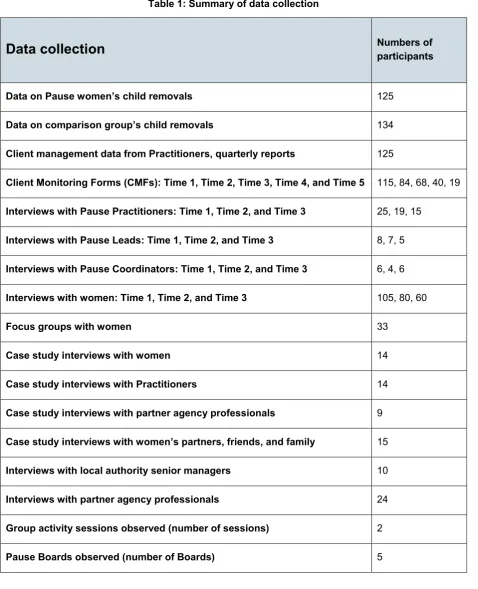
To address these questions, the evaluation team engaged in a very broad range of quantitative and qualitative research methods. The evaluation was commissioned to run over an 18-month period between March 2015 and September 2016: all data was
therefore collected and analysed during this evaluation period.
Two statistical models were developed to estimate the impact of Pause on women’s pregnancy rates during their intervention. The first model uses a comparison group of women who met the Pause programme selection criteria, but who lived in 2 local
16
Table 1: Summary of data collection
Data collection
Numbers of participantsData on Pause women’s child removals 125
Data on comparison group’s child removals 134
Client management data from Practitioners, quarterly reports 125
Client Monitoring Forms (CMFs): Time 1, Time 2, Time 3, Time 4, and Time 5 115, 84, 68, 40, 19
Interviews with Pause Practitioners: Time 1, Time 2, and Time 3 25, 19, 15
Interviews with Pause Leads: Time 1, Time 2, and Time 3 8, 7, 5
Interviews with Pause Coordinators: Time 1, Time 2, and Time 3 6, 4, 6
Interviews with women: Time 1, Time 2, and Time 3 105, 80, 60
Focus groups with women 33
Case study interviews with women 14
Case study interviews with Practitioners 14
Case study interviews with partner agency professionals 9
Case study interviews with women’s partners, friends, and family 15
Interviews with local authority senior managers 10
Interviews with partner agency professionals 24
Group activity sessions observed (number of sessions) 2
Pause Boards observed (number of Boards) 5
17
with services. Statistical analysis of the data captured from 115 women’s CMFs was conducted. CMFs completed at the start of women’s interventions provided baseline data on women’s situations. To analyse the impact of engagement with Pause, this baseline data was then compared to data provided by women in their CMFs at quarterly intervals throughout their intervention.
Analyses of the costs and benefits of the programme, and of the potential return on investment, were conducted, to identify the economic implications of the Pause model. These analyses used the impact measure of reductions in pregnancies as a proxy measure for reductions in care proceedings resulting in child removals, and calculated the cost savings to local authorities associated with these reductions. In addition, cost savings associated with reductions in women’s experiences of domestic violence, higher risk alcohol use, and problematic Class A drug use, which were identified through the evaluation’s impact analysis, were also calculated.
To understand women’s experiences of engagement, mechanisms of change, and key enablers of, and barriers to, the achievement of the programme’s objectives, in-depth, semi-structured, one-to-one interviews were carried out with a broad range of
respondents. These included 105 women and 39 Pause professionals, most of whom were interviewed at 3 time-points. Multiple interviews with women, at different time-points throughout their interventions (including baseline interviews held early on during their engagement), also enabled the evaluation team to identify women’s own views of the impact of their engagement with Pause, as well as changes in how they described their own lives. Focus groups were conducted with Pause women at 4 Practices. Two group activity sessions and 5 Pause Boards were also observed.
In-depth case studies of 14 women were conducted, in order to provide a richer,
individualised picture of the situations of some of the women involved in the programme, and the changes they made throughout their engagement. In most cases, developing these case studies involved conducting case study interviews with women, their
Practitioners, some of their friends, partners, or family members, and professionals with whom they had been working closely (such as specialist learning disability social
18
Pause Practitioners completed regular records of their work, including their phone calls with women, one-to-one direct work, and advocacy for women within services. These records were analysed to identify the type and frequency of work conducted.
19
Characteristics of the Pause cohort
Below, we present findings on women’s circumstances and characteristics at the start of their engagement with Pause. These findings are based on analysis of baseline data gathered though Client Monitoring Forms (CMFs), and interviews conducted with women, their Practitioners, and other professionals from Pause and partner agencies.
Findings from baseline Client Monitoring Forms
During the early stages of their engagement with Pause, 115 women (92% of the whole Pause cohort of 125 women) filled in a CMF. Analysis of Time 1 CMF data demonstrates that Pause women, as a cohort, have experienced high numbers of removals of children from their care, and high rates of domestic violence and abuse, ‘higher risk’ drinking, Class A drug use, and involvement with the criminal justice system. In terms of
psychological wellbeing, most women reported very high levels of grief associated with the loss of their children, and a significant majority reported that they had a mental health diagnosis. The data also suggest low levels of engagement with services, given the high level needs identified within the cohort. Pause’s own baseline data, drawn from social care case files during scoping exercises at each Practice, are outlined in Appendix B.
Age
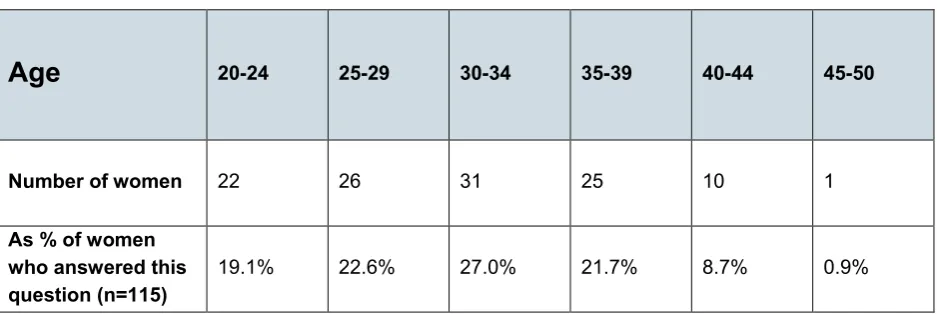
[image:19.595.61.530.482.639.2]The age ranges of the 115 women who filled in a CMF at Time 1 are given in the table below.
Table 2: Age range of Pause cohort
Age
20-24 25-29 30-34 35-39 40-44 45-50Number of women 22 26 31 25 10 1
As % of women who answered this question (n=115)
19.1% 22.6% 27.0% 21.7% 8.7% 0.9%
Children
20
[image:20.595.60.529.119.275.2](56.8%) were placed in local authority care, while 40.8% were placed with extended family.
Table 3: Child removals
Child removals
Number of childrenremoved
Number of children subject to care proceedings
Number of children placed in extended family
Number of children placed in local
authority care
Total 368 328 150 209
As % of children
removed (n=368) 100% 89.1% 40.8% 56.8%
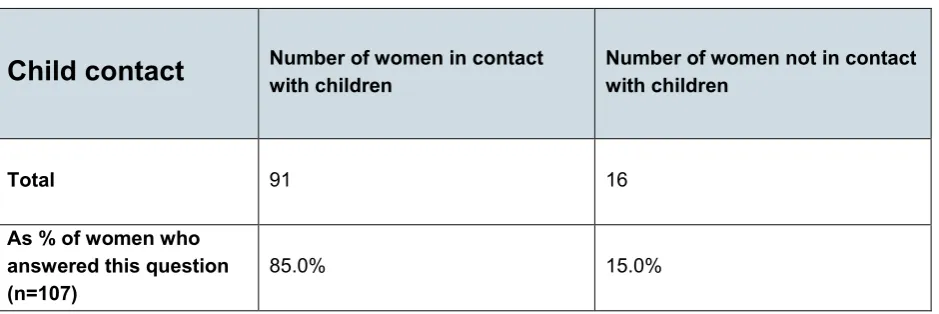
Women were also asked about child contact arrangements. The majority of women (91 out of 107 who filled in this section of the CMF, or 85.0%) had some form of contact with their children. Just under half of these women (41) had supervised face-to-face contact with their children, while 28 women had contact with adopted children through a letterbox service. Other, less common, forms of contact included unsupervised face-to-face
contact, and telephone contact.
Table 4: Child contact
Child contact
Number of women in contact with children Number of women not in contact with childrenTotal 91 16
As % of women who answered this question
(n=107) 85.0% 15.0%
Psychological wellbeing
[image:20.595.62.532.429.586.2]21
diagnoses were for depression (42 women), anxiety (11 women), bipolar (10 women), and personality disorder (10 women).
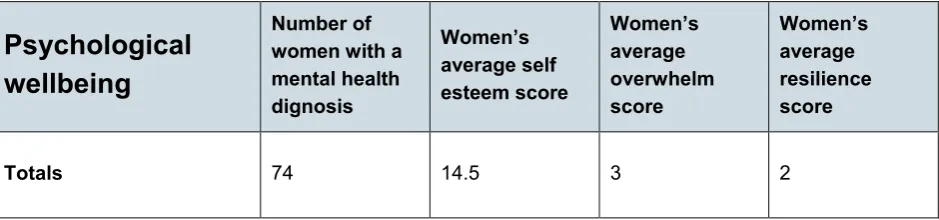
The CMF also asked women to answer a series of questions about various aspects of their self esteem, based on Rosenberg’s (1965) Self Esteem Scale.7 Their answers were
then analysed to produce self esteem scores on a scale ranging from 0 to 30. Scores between 15 and 25 are within the normal range, while scores below 15 suggest low self esteem. The mean average score for the Pause cohort was 14.5, indicating low self esteem.
Women were then asked about their feelings of loss and grief. Questions were in the form of standardized measures drawn from Machin’s (2001) Adult Attitude to Grief Scale.8 These questions were answered using a 5 point scale, from ‘strongly agree’ to
[image:21.595.61.531.410.520.2]‘strongly disagree'. Two outcomes were then calculated from the responses: feelings of overwhelm, and feelings of resilience. Answers were scored from 0 to 4. The higher the number, the greater the feelings of overwhelm or resilience. At Time 1, 86 women answered this section of the CMF. The mean average score for overwhelm was 3 (and the median, 4), out of a maximum score of 4, suggesting high levels of overwhelm. The mean average score for resilience was 2 (and the median, 2), out of a maximum score of 4, suggesting mid-low levels of resilience.
Table 5: Psychological wellbeing
Psychological
wellbeing
Number of women with a mental health dignosis Women’s average self esteem score Women’s average overwhelm score Women’s average resilience score
Totals 74 14.5 3 2
Domestic violence
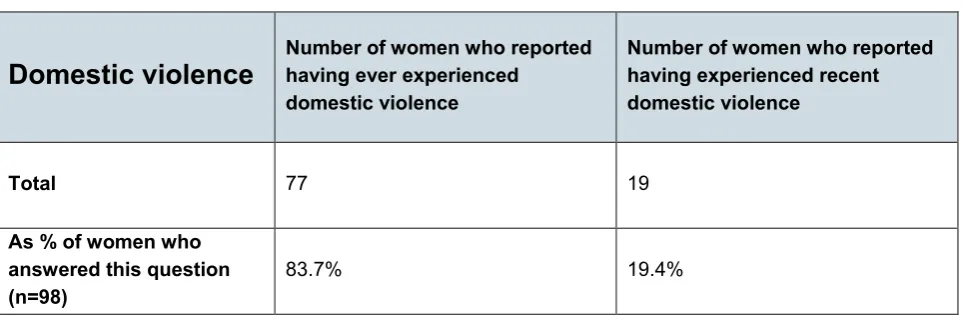
As the table below demonstrates, a very high percentage of women reported having experienced domestic violence at some point in their lives: 77 out of 92 women who responded to this question (or 83.7%). A significant proportion of women also reported that they had experienced some form of domestic violence during the previous 3 months: 19 out of 98 women who responded to this question (or 19.4%). Findings from interviews with women and their Practitioners (discussed in greater depth later in this report) reveal
7 Rosenberg (1965) http://www.yorku.ca/rokada/psyctest/rosenbrg.pdf
22
[image:22.595.55.537.149.307.2]that Pause women often faced a range of obstacles to exiting abusive relationships. These included financial and housing insecurity, inadequate support networks, and low levels of self esteem, which some women directly attributed to their experiences of abuse as children.
Table 6: Domestic violence
Domestic violence
Number of women who reported having ever experienced domestic violenceNumber of women who reported having experienced recent domestic violence
Total 77 19
As % of women who answered this question (n=98)
83.7% 19.4%
Higher risk alcohol use
CMFs asked women about their level of alcohol consumption. Collection of data on alcohol consumption was based on 3 questions from the Alcohol Use Disorders
Identification Tool (AUDIT).9 Scores were provided for each response and a total score
was calculated. A total score of 5 or more suggested women were in a ‘higher risk’ or ‘potentially dependent’ drinking category.10 Out of 115 women who filled in a CMF, 13
(11.3%) declined to answer questions about their alcohol consumption at baseline. Of the 102 women who did respond, 28 (27.5%) reported higher risk drinking. Most of these women reported in interviews that they used drinking – and, in some cases, had used it for many years – as a coping mechanism to deal with the grief and trauma associated with the removal of their children, and with the constant challenges of day-to-day life.
23
Table 7: Higher risk alcohol use
Alcohol
Number of women who reported higher risk drinking Number of women who reported no higher risk drinkingTotal 28 74
As % of women who answered this question (n=102)
27.5% 72.5%
Problematic drug use
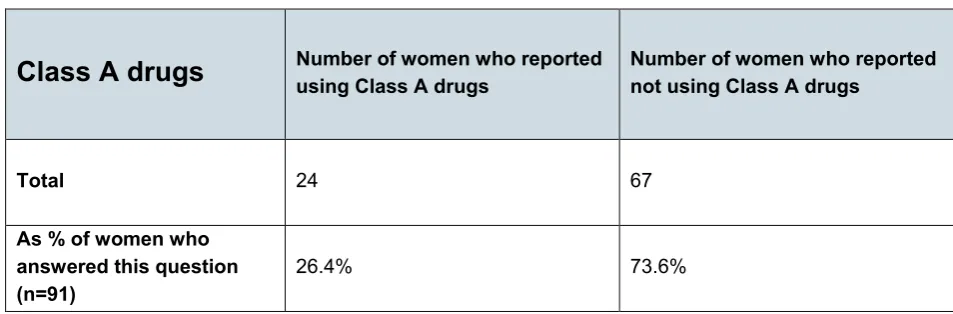
Out of 115 women who filled in a CMF, 24 (20.9%) declined to answer questions about illegal drug use at the start of their programme. Responses from the 91 women who did respond were analysed according to Singleton and colleagues’ methodology, and a binary outcome of ‘problematic drug use’ or ‘non-problematic drug use’ was developed for each woman.11 Of the 91 women who responded to these questions, 24 (26.4%)
[image:23.595.54.531.517.674.2]reported drug use falling into the ‘problematic’ category. Interviews with these women often revealed a tension between their desire to overcome addiction, and their (in some cases, long-standing) reliance on drugs as a coping mechanism. Some women also discussed a paradoxical connection between the removal of their children and their addiction: while the goal of being a better mother drove their motivation to stop taking drugs, the need for temporary relief or distraction from intense feelings of guilt and shame about their perceived failings as mothers, or of anger toward the services that implemented removals, propelled their choices to misuse.
Table 8: Problematic drug use
Class A drugs
Number of women who reported using Class A drugs Number of women who reported not using Class A drugsTotal 24 67
As % of women who answered this question (n=91)
26.4% 73.6%
11 Singleton et al. (2006) http://webarchive.nationalarchives.gov.uk/20110218135832/rds.homeoffice
24
Criminal justice involvement
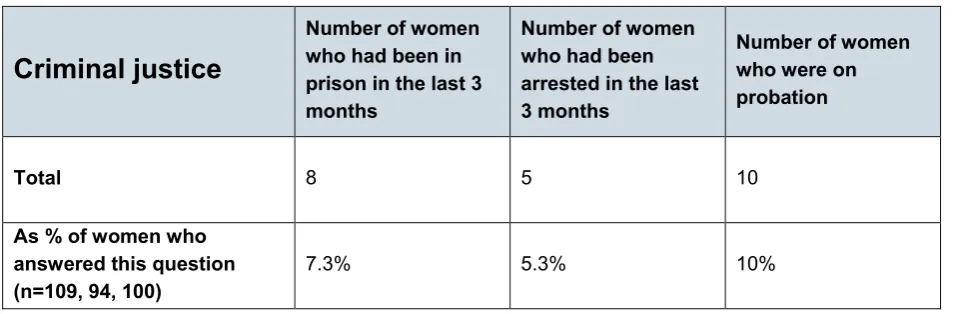
[image:24.595.58.535.213.370.2]Women were asked about their involvement with the criminal justice system. Of the 115 women who filled in a CMF, 8 (7.0%) reported having been in prison within the previous 3 months, and a further 6 (5.2%) declined to answer this question. Five women (4.3%) reported having been arrested within the previous 3 months, and a further 21 women (18.2%) declined to answer this question. Ten women (8.7%) reported that they were currently on probation, and 15 (13.0%) declined to answer this question.
Table 9: Criminal justice involvement
Criminal justice
Number of women who had been in prison in the last 3 months
Number of women who had been arrested in the last 3 months
Number of women who were on probation
Total 8 5 10
As % of women who answered this question (n=109, 94, 100)
7.3% 5.3% 10%
Housing
25
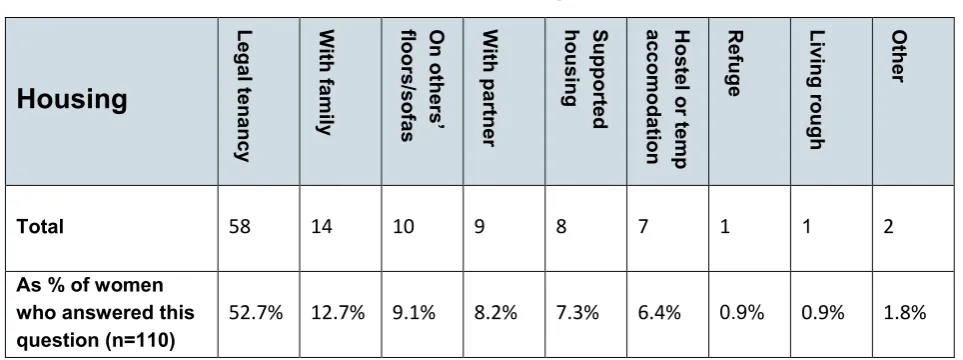
Table 10: Housing
Housing
Leg al ten an cy W ith fa m ily On ot he rs ’ floors /so fa s W ith pa rtne r Support ed hous ing H os te l or te m p acco m od at io n Refuge Living
rough
O
th
er
Total 58 14 10 9 8 7 1 1 2
As % of women who answered this question (n=110)
52.7% 12.7% 9.1% 8.2% 7.3% 6.4% 0.9% 0.9% 1.8%
Engagment with services
Women were asked about the services with which they were currently in contact. The service with which women reported being in contact most frequently was social care (31 women), followed by mental health services (23 women), drug and alcohol services (19 women), housing (14 women), employment (8 women), probation (7 women), GPs (6 women), education (2 women), and Independent Domestic Violence Advisor (IDVA) services (2 women). Given the high rates of mental health diagnoses, domestic violence, alcohol and drug misuse, and insecure housing identified above, baseline rates of
[image:25.595.58.534.471.646.2]engagement with the services set up to address these needs appear low.
Table 11: Engagement with services
Services
So cia l ser vi ce s M en tal h eal th D rugs and alcohol Hous
ing Em plo ym en t Proba tion G
P Educ
ati
on
ID
VA
Total 31 23 19 14 8 7 6 2 2
As % of women who answered this question (n=81)
38.3% 28.4% 23.5% 17.3% 9.9% 8.6% 7.4% 2.5% 2.5%
Contraception
26
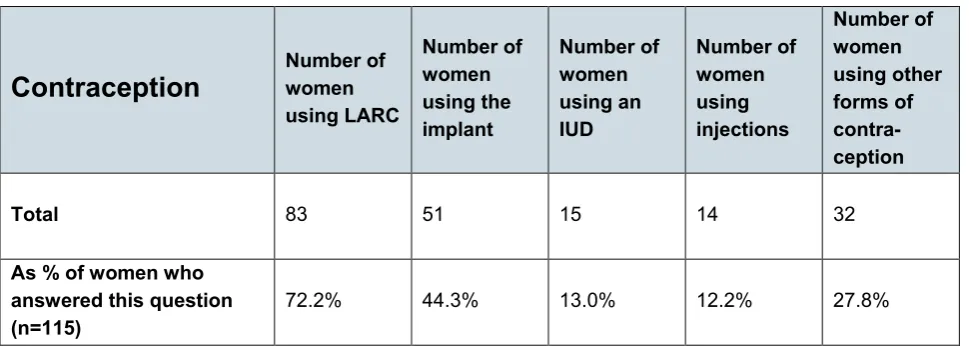
reversible contraception at Time 1 (83 out of 115 women who filled in this section, or 72.2%). It is important to note that, at the time of the first assessment, many women had already had some involvement with their Pause Practitioners, who aim, during the early stages of engagement, to encourage uptake of contraception. The high percentage of contraception uptake at Time 1 is therefore expected.
The most commonly-used form of long-acting, reversible contraception at Time 1 was the implant (51 women), followed by the intrauterine device (IUD) (15 clients), and injections (14 clients). 32 women used other forms of contraception, which were sometimes
[image:26.595.54.539.272.445.2]combined with long-acting, reversible contraception. The most commonly reported of these other forms of contraception were condoms (10 women) and birth control pills (9 women).
Table 12: Contraception use
Contraception
Number of womenusing LARC Number of women using the implant Number of women using an IUD Number of women using injections Number of women using other forms of contra-ception
Total 83 51 15 14 32
As % of women who answered this question (n=115)
72.2% 44.3% 13.0% 12.2% 27.8%
Findings from baseline interviews
During interviews held at an early stage of their interventions, women were asked about their current circumstances, and aspirations for the future. In particular, women were asked about what they wanted to achieve from working with Pause; important
relationships in their lives; their engagement with services; their attitudes toward contraception; and various aspects of their psychological wellbeing. A key finding from these interviews was that women’s thoughts and feelings about each of these issues were interconnected with their thoughts and feelings about parenthood, which were, in turn, profoundly affected by the trauma of having children removed from their care.
Aspirations and goals
When asked by the evaluation team at the start of their interventions what they wanted to achieve from their work with Pause, different women gave very different answers.
27
parenting. Nearly one-quarter of women (24.7%) stated that they wanted their children to be returned to them. A similar proportion (23.1%) reported that they wanted to improve their contact arrangements with their children (for example, by increasing frequency of contact, or by having unsupervised face to face contact). A smaller proportion of women (9.7%) stated that they definitely wanted to have, and maintain care of, a child in future, and 3.2% said that, if they had another child in future, they wanted to be able to maintain care.
These women reported that they hoped Pause would help them to pursue these goals. Some women felt that they needed to make improvements in their own lives before the desired arrangements could be made (for example, by becoming more emotionally or financially stable, overcoming addiction, or improving their housing), and that Pause would help them to do this. Others hoped Pause would play a role in enabling children’s services and the courts to understand them better, and to recognise that such
arrangements should be allowed. These findings demonstrate a degree of dissonance, at this early stage of engagement, between some women’s understanding of the function of Pause and Pause’s actual objectives. However, as helping women to assess their views and expectations of parenthood is an integral part of the programme, these differences might be expected.
In addition to these parenting-related goals, Pause women often expressed the view that working with Pause was an opportunity to get the focused support they needed to
improve their own current or future circumstances, and increase their own level of wellbeing. Examples of issues for which women wanted support included housing, benefits, debt, health, employment, volunteering, education, or access to particular services. Specific issues included the need to gather the required records and other paperwork to apply for a passport, open a bank account, or enroll in a college education course.
A common theme to emerge from interviews with women at the early stages of their interventions is a restricted sense of agency, often due to a range of complex and
intersecting reasons. Almost all women described instances or periods in their lives when they had been unable to prioritise their own needs, or evaluate the consequences of the different options available to them. Frequently, this was linked to a sense of the constant difficulties of daily life, including the ongoing trauma of losing their children, abusive or unhealthy relationships, insecure housing, financial insecurity, drug and alcohol misuse, and dealing with professionals toward whom they felt considerable hostility. These difficulties were often mutually reinforcing, and their cumulative effect, too overwhelming to overcome without support. They were also compounded by an absence of positive, fun activities, and, Practioners reported, women limiting their sphere of activity to the
28
Almost all women interviewed by the evaluation team explained that they had never had anything like Pause in their lives. They had never worked with any service they could trust to be on their side and to persevere in supporting them in all aspects of their lives.
Relationships
A pervading theme in many women’s lives prior to Pause was the absence of positive role models and supportive relationships, and the presence of unhealthy or abusive relationships. Women who had themselves experienced being in care as children commonly reported feeling a lack of reliable and loving parent figures. Women who reported experiencing abuse, often perpetrated by family members, as children, , or growing up witnessing domestic violence and abuse between parents or other family members, also reflected on the impact this abuse had had on their lives. For example, relating her current circumstances directly to her childhood experiences, one woman explained, ‘it’s because of my past and that. My mum sent me out prostituting when I was 14. That’s how it all came to us going into care’ (Client 33, Time 1). Practitioners also observed that many women had not had the benefit of security, stability and support during their development through childhood and adolescence.
As indicated by data from women’s CMFs, over five-sixths (83.7%) of women reported that they had been, or were currently, involved in violent intimate relationships. Forms of domestic abuse reported by women in interviews included physical, sexual, emotional, psychological, and financial abuse. Practitioners also reported cases in which they felt their clients were in abusive relationships but had not yet recognised or acknowledged the abuse.
Women’s lack of supportive relationships, or anyone to talk to about the issues they were facing, was a recurrent theme in interviews. For example, one woman explained her need to be listened to:
‘I’ve had depression, because I’ve been through domestic violence with my ex and that. He used to beat me up and everything. […] I just want someone to sit there, and talk to me, and just listen to what I’ve been through’ (Client 27, Time 1).
Another important finding is that, where women’s children were placed with members of their families or the families of the fathers, this could engender, or compound, women’s vulnerability to coercion or manipulation by their children’s carers. This frequently left women feeling disempowered by both their children’s carers and social care
29
Psychological wellbeing
The loss of their children into care was reported by all women as profoundly painful, and a cause of substantial ongoing emotional trauma. The psychological repercussions of child removals were described by the overwhelming majority of women in terms of marked grief and depression. One woman’s account provides a succinct summary of many others’: ‘when your children are taken, it feels like they have died, because that’s it. It is sort of a grieving process. They are gone’ (Client 61, T1).
In addition, acute feelings of guilt and shame following the removal of their children were frequently reported. For some, this was exacerbated by rejection from family and friends following removals, which left them feeling stigmatised and isolated.
Removals were often, therefore, reported by women and their Practitioners as having been a central cause or catalyst of a downward spiral in mental health and self-care more generally. Nonetheless, most women reported that, before engaging with Pause, they had not received any support to deal with the psychological impact of losing their children. In the words of one woman:
‘When I lost [my child], they said, ‘we'll get you counselling’ and stuff like that. They never did. They took my bairn and left me. […] I got depression, and then when I had [another child] I got postnatal depression, and that made the
depression even worse. Over the years I have just got worse’ (Client 40, T1). Women were asked in interviews about how they attempted to manage the pain of loss. Some tried not to think about it, while others engaged in various forms of self-harming behaviour. One woman reported:
‘I used to overdose and self-harm. But, instead of doing that now, because it marks my body, I decided to starve myself instead. It’s a way of dealing with my grief’ (Client 88, T1).
Several women also described feeling conflicted about whether having more children would help them to manage their sense of loss. As one explained:
‘Because I’m grieving for my kids, I just feel like I want to get pregnant, because it’s going to stop that feeling. And then I think about getting pregnant and having other kids, but I don’t want that to happen’ (Client 70, T1).
Engagement with services
30
provided adequate support during the processes that led to removals. Another common theme was the feeling that women had simply been dropped by services following child removals, rather than supported to access the help they needed. A perceived distinction between social services and Pause therefore emerges as an important mechanism for building trust between women and Practitioners. As one woman stated:
‘The social worker’s not my social worker. She’s the children's social worker. So it's all about the children, not me. Whereas [my Pause Practitioner] is for me. [She] supports me as a person’ (Client 18, T1).
A number of services were reported by women as being difficult for them to engage with. These included housing, the criminal justice system, health, education (including
colleges), social services, mental health services, services for people with experience of substance and alcohol misuse, and services for people who exchange sex.
Difficulties in accessing services were due, in part, to a range of complex and intersecting factors in women’s circumstances, but were often exacerbated where services did not follow a model requiring professionals to be flexible in making patient, persistent efforts to engage their clients. Professionals from both Pause and partner agencies reported, for example, that when women consistently missed appointments, they could sometimes be de-prioritised either by individual professionals or, indeed, by inflexible systemic protocols that put them to the back of the queue or removed them from waiting lists altogether. Factors in women’s individual circumstances that constituted barriers to accessing services included residual frustration with particular services, and anger and hostility toward particular professionals. Women with learning disabilities and difficulties reported that it was often challenging to navigate systems and follow processes without
appropriate support. Mental or emotional health issues, including anxiety, depression, and some forms of psychosis, often made it difficult for women to leave their homes, or face interacting with professionals. These issues could also make it difficult for women to spend long periods of time among strangers in waiting rooms. Similarly, substance or alcohol use could create difficulties in attending or engaging in appointments. Women who engaged in exchanging sex reported that, given the hours during which they did so, they faced specific difficulties in attending morning appointments.
Attitudes to contraception
31
I don't want another baby just yet’ (Client 45, T2). Of these women, nearly two-fifths (38.2%) were already using a long-acting, reversible form of contraception before they signed up with Pause, and the same proportion indicated that they did not want any more children in future. One woman noted:
‘I’ve been on it for a long while. […] Because my 2 are going through what they are going through, I can’t risk it [becoming pregnant]. So I went for the implant and I have had it ever since’ (Client 63, T1).
Three women reported to the evaluation team that they were seeking sterilisation before signing up to the Pause programme. One of these women explained:
‘I've had 6 kids, 16 miscarriages. […] The last 3 of my babies really […] affected my disability. Each one of them posed a real risk of me actually dying. So I've done my fair share of having babies. I didn't want anymore. I was supposed to have been sterilised about 2 years ago. I had a date and everything, and fell pregnant’ (Client 84, T1).
A minority of women (9.8%) reported a greater degree of ambivalence about
contraception, but ultimately made the decision to accept the requirement, despite initial reservations. One woman explained her decision in terms of making a mutual
commitment:
‘I was a bit shocked by the contraception bit. But once it was explained what the idea and the thinking was: ‘we want you to make a commitment to us, like we’re making a commitment to you,’ that's how it kind of felt to me. […] I was
absolutely fine with it’ (Client 79, T1).
Most women’s reservations centred on the side effects of contraception, including irregular bleeding. Women reported that having the opportunity to discuss their
32
Is Pause effective in meeting its aims?
Impact on pregnancies
One of the key mechanisms through which Pause seeks to achieve positive and sustainable change for women is the establishment of a pregnancy-free period in
women’s lives, during which they are supported to focus on meeting their own needs. A central element of the evaluation is, therefore, an assessment of the extent to which Pause achieved this goal. A counterfactual analysis, using 2 statistical models, was developed to estimate the impact of Pause on women’s pregnancy rates during their intervention12. Both models demonstrate a very significant reduction in pregnancies
experienced by Pause women, with a very high level of confidence that the reduction is directly attributable to women’s engagement with the programme. Two women became pregnant during their time with Pause, and were transitioned out of the programme. Nonetheless, the counterfactual analysis demonstrates that, had the cohort not been engaged with Pause, a far higher number of pregnancies would have occurred. Model 1 estimates how many pregnancies Pause women avoided, based on a
comparison group of women who met the Pause programme selection criteria at 2 local authorities, where no similar interventions to Pause were being delivered. A search of social care records at these local authorities was conducted to identify all women who had (recorded) child removals during 2 index years. Exclusions were then made where the social care files of the women, their children, and other family members indicated the women would not be engaged by Pause because they were pregnant, had children in their care, were not of child-bearing age, or had not experienced recent removals.13
Model 2 estimates how many pregnancies Pause women avoided based on extrapolation from their own pregnancy histories. Both models conditioned on pregnancy histories and age at intervention. Further information on the statistical methods used in this analysis is provided at Appendix C.
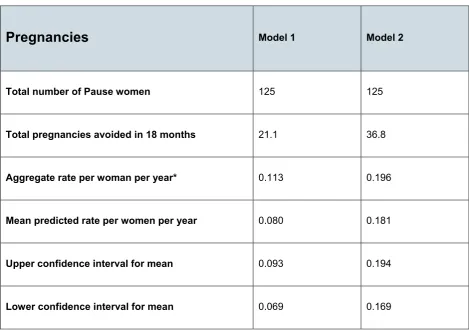
The results of the statistical analysis of the impact of Pause on women’s pregnancy rates during their intervention are summarised in the table below. Model 1 resulted in an
estimate of 21.1 pregnancies avoided during the 18-month intervention period (with an
12 An additional comparison was made to another project that appeared to have similar aims to Pause,
based in another city. However, analysis revealed there were too many differences between the population groups for the comparison to be meaningful. Reporting of this analysis was not possible, due to the need to maintain the project’s anonymity, which could not be guaranteed.
13 It should be noted that the Pause selection process involves triangulation of social care data with partner
33
[image:33.595.59.529.116.446.2]aggregate rate per woman per year of 0.113). Model 2 resulted in an estimate of 36.8 pregnancies avoided (with an aggregate rate per woman per year of 0.196).
Table 13: Impact on pregnancies
Pregnancies
Model 1 Model 2Total number of Pause women 125 125
Total pregnancies avoided in 18 months 21.1 36.8
Aggregate rate per woman per year* 0.113 0.196
Mean predicted rate per women per year 0.080 0.181
Upper confidence interval for mean 0.093 0.194
Lower confidence interval for mean 0.069 0.169
*Aggregate rate (a simple average) is affected by positive skew in outcome (count variable)
The 125 women in the Pause evaluation sample included 30 women who had had only one child removed. The remaining 95 women had had two or more children removed. A check was carried out on model 2, without the inclusion of the group of women who had had one child removed, to see if this changed the results of the analysis. This revealed that differences in the impact on pregnancies during the 18-month intervention period were not significant when women with a history of only one child removed were excluded from the analysis.
Impact on Pause women
34
an assessment of the extent to which Pause women achieved these changes during their engagement was undertaken. Longitudinal analyses were conducted of data on a range of measures from women’s CMFs, which they completed with Practitioners at the start of their interventions, and then at quarterly intervals. A total of 115 women completed Time 1 CMFs near the start of their engagement with Pause. Of these, 84 women completed a CMF at Time 2, 68 at Time 3, 40 at Time 4, and 19 at Time 5. As women began their engagement with Pause at different stages of the evaluation period, it was not possible to gather CMF data in the middle or final stages of some women’s interventions, as these went beyond the evaluation period.
The findings from these analyses indicate that the requirement to take an effective, long-acting, reversible form of contraception was met by the overwhelming majority of Pause women within the first few months of their engagement of the programme. The findings also suggest an increase over time in many women’s access to, and engagement with, the services they need to meet their basic needs, including GP and housing services. While a significant proportion of women began their engagement with Pause living in insecure housing, over one-quarter of these women were able to move into secure housing during their engagement with the programme.
In terms of domestic violence, the findings suggest that Pause women, as a cohort, have experienced relatively high levels of domestic violence, compared to women in the
general population. Analysis of the frequency of incidents during the programme produces a mixed picture: while some women reported fewer incidents as they
progressed through their intervention, others were still experiencing incidents of violence by the end of the evaluation period.
Analyses of alcohol and drug consumption indicate that most Pause women did not fall into established ‘higher risk’ or ‘problematic’ categories. However, the consumption levels of a significant minority either fluctuated into, or remained stable at, a high level.
Nonetheless, just under one-third of women who started their engagement with Pause with high levels of consumption of alcohol or drugs were found to have considerably reduced their intake. In some cases, these reductions occurred while women were engaging with alcohol and substance misuse services.
35
Psychological wellbeing
Women were asked a series of questions about various aspects of their self-esteem, and changes in reported levels of self-esteem over time were then analysed according to Rosenberg’s (1965) methodology.14 It should be noted that measures of self-esteem (and
of loss and grief, which are examined below) can inform only an imperfect assessment of changes in psychological wellbeing. To illustrate, recorded changes may result from developments in women’s ability to reflect on issues or their willingness to discuss issues with Practitioners, as well as from changes in how they relate to, or understand, their experiences.
The analysis of changes to self-esteem provides a mixed picture: while some women reported experiencing improvements over time, others reported no change, and some reported reductions in their self-esteem.
Of the 80 women who provided answered questions about their self esteem at Time 1, 45 provided follow-up data at Time 3. Of these 45 women, 20 (44%) experienced an
improvement in self-esteem, 18 (40%) experienced a decrease in self-esteem, and 7 (15%) experienced no change. Scores were based on a scale of 0 to 30. Where improvements between Time 1 and Time 3 were experienced, the average score increase was 3.8 points. Where decreases in self-esteem scores were noted, the average reduction was also 3.8 points.
At Time 4, 20 women provided follow up data on their self-esteem. Of these 20 women, 8 (40%) experienced an increase in self-esteem, compared to Time 1. Ten women (50%) experienced a decrease, and 2 (10%) experienced no change. Where an improvement was experienced, the average score increase was 4.8 points. Where a decrease was experienced, the average score reduction was 4 points.
Women were also asked to answer a series of questions on loss and grief. Although analysis of these data also presents a mixed picture, there generally appears to be a decrease in women’s feelings of overwhelm and an increase in feelings of resilience. Of the 86 women who had answered this question at Time 1, 21 (24.4%) provided data at Time 4, allowing an analysis of changes to these outcomes over time. Of these 21
women, 7 (33%) had reportedly experienced a reduction in overwhelm feelings, 10 (48%) had experienced no change, and 4 (19%) had experienced an increase. Where changes were reported, these were no greater than plus or minus one point in either direction. With regard to resilience, 13 of the 21 women (62%) who provided data at Time 4 reported an increase in resilience. Four women (19%) reported having experienced no
36
change in resilience, and the remaining 4 women (19%) reported a reduction in resilience.
A higher proportion of women provided follow up data at Time 3, compared to Time 4. At Time 3, 45 of the 86 women (52.3%) who had answered this question at Time 1 provided follow-up answers. While women had been engaging with Pause for a shorter length of time at this time-point, all would have been at least 6 months into their intervention. At Time 3, 18 women (40%) reported a decrease in feelings of overwhelm since Time 1, 14 (31%) reported no change, and 13 (29%) women appeared to have experienced an increase in feelings of overwhelm. In terms of feelings of resilience, 21 women (47%) had reportedly experienced an increase, 8 women (18%) had experienced no change, and 16 women (35%) had experienced a reduction in resilience.
Domestic violence
[image:36.595.55.535.391.549.2]Using CMF data recording whether women had experienced any recent incident of domestic violence (that is, any incident in the last quarter), a longitudinal analysis was conducted of changes to experiences of incidents of domestic violence. The table below indicates the total numbers of women who disclosed recent DVA at each time-point.
Table 14: Changes in incidents of domestic violence
Domestic
Violence
Time 1 Time 2 Time 3 Time 4 Time 5Number of women who
disclosed recent DVA 19 14 8 7 5
As % of women who answered this question
(n=98, 78, 65, 27, 13) 19.4% 17.9% 12.3% 25.9% 38.5%
Over the entire period of data collection, 28 women disclosed at least once that they had experienced an incident of domestic violence during the preceding quarter. Of these, 13 women (46.4%) reported no incidents at the latest time-point at which data were
collected, following at least one previous report of an incident.
37
qualitative findings demonstrate that the establishment of trust and openness in
relationships between women and Practitioners tended to occur over the first few months of engagement. This should bear on the interpretation of these increases in disclosures of domestic violence incidents: it is possible that such increases indicate greater
willingness to disclose, rather than a rise in the frequency of incidents.
Higher risk alcohol use
The section of the CMF asking women to record their alcohol consumption over the previous quarter was completed by 108 women at least once. Seven women who filled in at least one CMF declined to answer this section in every CMF they completed. Using 3 questions from the Alcohol Use Disorders Identification Tool (AUDIT), women’s
responses at each time-point were analysed to produce an outcome indicating whether or not women were in a ‘higher risk’ or ‘potentially dependent’ drinking category.15 The
[image:37.595.61.531.347.503.2]table below indicates the total numbers of women who disclosed higher risk drinking at each time-point.
Table 15: Changes in higher risk drinking
Higher risk
drinking
Time 1 Time 2 Time 3 Time 4 Time 5Number of women who disclosed higher risk
drinking 28 15 18 11 2
As % of women who answered this question (n=102, 74, 65, 32, 14)
27.5% 20.3% 27.7% 34.4% 14.3%
Longitudinal analysis of data on alcohol consumption across the entire period of data collection indicates that no higher risk drinking was identified for 47 women, for whom longitudinal data were available, and a further 22, who provided this data at only one time-point.
The analysis suggests that the remaining 39 experienced higher risk drinking at one or more time-points. A significant proportion of these women, 12 (30.8%), had reduced their alcohol consumption to a lower level of risk by the end of the recorded period. Of these, 6 recorded that they were in treatment at some point during their intervention.
38
However, 10 women reported higher risk drinking at the first and last recorded
time-points, while a further 6 reported higher risk drinking at one time-point, but did not provide longitudinal data on this question. Eleven women who were not in the higher risk
category at the start of their intervention had, by the latest recorded time-point, moved into the higher risk category. It is not certain, however, whether these changes were the result of increased willingness to report, rather than heightened risk.
Problematic drug use
The section of the CMF asking women about their illegal drug use was completed at least once by 99 women. Sixteen women who filled in at least one CMF declined to answer this section in every CMF they completed. Following Singleton and colleagues’
methodology, a binary outcome of ‘problematic drug use’ or ‘non-problematic drug use’ was developed for each woman at each time-point.16 The table below indicates the total
[image:38.595.58.532.331.485.2]numbers of women who disclosed problematic drug use at each time-point.
Table 16: Changes in problematic drug use
Problematic drug
use
Time 1 Time 2 Time 3 Time 4 Time 5Number of women who disclosed problematic
drug use 24 13 11 8 1
As % of women who answered this question (n=91, 69, 56, 30, 14)
26.4% 18.8% 19.6% 26.7% 7.1%
No problematic drug use was identified for 48 women for whom longitudinal data were available, or for a further 18, who provided this data at only one time-point.
The remaining 33 women experienced problematic drug use at one or more time-points. A significant proportion of these women – 9 (27.3%) – had moved out of the problematic drug use category at the latest recorded time-point during their Pause intervention, after having been in that category at any previous time-point. Of these women, 2 reported having been in treatment at some point during their intervention.
However, 6 women reported problematic drug use at the first and last recorded time-points. A further 11 reported problematic drug use at one time-point, but did not provide
16 Singleton et al. (2006) http://webarchive.nationalarchives.gov.uk/20110218135832/rds.homeoffice
39
longitudinal data on this question. Seven women had reportedly moved into the
problematic drug use category at the latest recorded time-point, having not been in that category at the start of their engagement.17
Criminal justice involvement
Longitudinal analysis of Pause women’s involvement with the criminal justice system did not identify any trends toward either a reduction or an increase in involvement. For example, a longitudinal analysis of self-reported recent arrests (those taking place within the last quarter) found that 5 women had been recently arrested at Time 1, 3 further women at Time 2, and one woman at both Time 2 and Time 3. That no significant trends emerged from this data may be due to the relatively low numbers of women reporting involvement with the criminal justice system.
Housing
A longitudinal analysis was conducted to determine changes to women’s housing situations. For the purpose of this analysis, secure housing was treated as comprising legal tenancies and supported housing, and all other housing (living rough; sleeping on others’ floors/sofas; living in a refuge; living in a hostel or temporary housing; living with a partner; and living with family) was treated as insecure. The table below indicates the total numbers of women living in secure and insecure housing at each recorded time-point.
The longitudinal analysis of women’s housing situations yielded mixed results. However, most changes in housing status represented improvements. There were 111 Pause women who reported on their housing status at least once. Of these women, 68 (61.3%) were living in secure housing at each recorded time-point. The remaining 43 women (38.7%) were living in insecure housing at least at one time-point. Thirty women were living in insecure housing at each recorded time-point, and 2 women moved from secure to insecure housing during their engagement with Pause. However, 11 women recorded a change from insecure to secure housing.
17 As with disclosures of domestic violence incidents and higher risk drinking, interpretation of this data
40
Table 17: Changes in housing
Housing
Time 1 Time 2 Time 3 Time 4 Time 5Number of women living
in secure housing 66 49 45 17 11
As % of women who answered this question (n=110, 81, 67, 32, 14)
60.0% 60.5% 67.2% 53.1% 78.6%
Number of women living
in insecure housing 42 29 21 15 3
As % of women who answered this question (n=110, 81, 67, 32, 14)
38.2% 35.8% 31.3% 46.9% 21.4%
Number of women living in ‘other’ (unspecified) housing
2 3 1 0 0
Engagement with services
Longitudinal analysis of engagement with services demonstrated a general trend of increasing engagement, particularly with GP, housing, social care, drug and alcohol, mental health and education services, at least up until Time 3. (There was some degree of fluctuation in rates of engagement at Times 4 and 5, but this is likely to be due to variations in sample sizes.) Importantly, 6 women reported at Time 1 that they were not registered at any GP practice. While 3 of these women did not complete a further CMF, the remaining 3 had all registered with a GP by Time 3.
Contraception
41
Table 18: Changes in contraception use
Contraception
Time 1 Time 2 Time 3 Time 4 Time 5Number of women using
long-acting contraception 83 82 64 31 14
As % of women who answered this question (n=115, 84, 67, 33, 14)
72.1% 97.6% 95.5% 93.9% 100%