University of Southern Queensland
Faculty of Engineering & Surveying
Nuclear Instruments in Mineral Processing
A dissertation submitted by
Timothy Willigen
in fulfilment of the requirements of
ENG4112 Research Project
towards the degree of
Bachelor of Engineering, (Instrumentation and Control)
Abstract
This research project was conceived out of the author’s own self-interest in seeking to
answer the following:
“Why use instruments that utilize ionising radiation as part of the
measurement system?”
This argument was heavily weighted by the author’s own safety concerns. Subsequently
the research parameters within this document were set on ascertaining the utility and
the appropriateness of instruments that use ionising radiation as part of the
measure-ment system.
Instruments utilizing ionising radiation as part of the measurement system are typically
labelled as “nuclear instruments”. This labelling at times is technically incorrect as not
all forms of ionising radiation are generated from the nucleus; notably this generalisation
has been continued throughout this document.
Importantly research has found that the use of ionising radiation as part of a
measure-ment system in a mineral processing application is a safe practice.
Nuclear instruments provide reliable measures for often difficult applications where
few genuine alternatives exist. These devices have significantly enhanced production
and reduced costs. Taking all things into consideration it may be argued that this
ii
The costs associated with regulatory compliance were found not to be oppressive to
large scale operations. However the extra burden of regulatory compliance on smaller
scale operations may pose a significant deterrent to the implementation of these
mea-surement systems.
Alternatives were found for the process measurements of in-pipe slurry density and
conveyor mass flow. For both process measurements the alternatives are believed to
provide better accuracies, thereby questioning the appropriateness of the use of nuclear
instruments in these applications.
The major parts of this dissertation cover;
• the fundamentals of radiation and its measurement,
• radiation safety and regulation,
• measurement applications,
• alternatives,
• recommendations, and
• the author’s conclusions.
The benefits bestowed by the use of nuclear instruments throughout industry are
im-pressive; greatly enhanced production at reduced cost, with the addition of close to
real-time assays. Arguments against the use of nuclear instruments appear superfluous
to the author, as efficient production on a large scale can not be envisaged without
University of Southern Queensland Faculty of Engineering and Surveying
ENG4111/2 Research Project
Limitations of Use
The Council of the University of Southern Queensland, its Faculty of Engineering and
Surveying, and the staff of the University of Southern Queensland, do not accept any
responsibility for the truth, accuracy or completeness of material contained within or
associated with this dissertation.
Persons using all or any part of this material do so at their own risk, and not at the
risk of the Council of the University of Southern Queensland, its Faculty of Engineering
and Surveying or the staff of the University of Southern Queensland.
This dissertation reports an educational exercise and has no purpose or validity beyond
this exercise. The sole purpose of the course pair entitled “Research Project” is to
contribute to the overall education within the student’s chosen degree program. This
document, the associated hardware, software, drawings, and other material set out in
the associated appendices should not be used for any other purpose: if they are so used,
it is entirely at the risk of the user.
Prof F Bullen
Dean
Certification of Dissertation
I certify that the ideas, designs and experimental work, results, analyses and conclusions
set out in this dissertation are entirely my own effort, except where otherwise indicated
and acknowledged.
I further certify that the work is original and has not been previously submitted for
assessment in any other course or institution, except where specifically stated.
Timothy Willigen
0050022986
Signature
Acknowledgments
First and foremost I would like to sincerely thank my wife Michelle, and my family for
their patience and understanding whilst I undertook this task. I wish to also thank Dr
Andrew Maxwell, who as my project supervisor gave me the confidence and
encour-agement when I needed it most. In addition I would like to express my thanks to the
staff of Newmont Mining for their assistance in completing my research project.
Timothy Willigen
Contents
Abstract i
Acknowledgments v
List of Figures xiii
List of Tables xvii
Nomenclature xix
Chapter 1 Introduction 1
1.1 Introduction . . . 1
1.2 Research aims and objectives . . . 3
1.3 Dissertation Outline . . . 6
Chapter 2 Literature Review 9
2.1 Chapter Overview . . . 9
CONTENTS vii
2.3 Radiation detection and measurement . . . 12
2.4 Nuclear instruments . . . 14
2.5 Radiation safety, legislation and regulation . . . 16
2.6 Non – nuclear instrument alternatives . . . 18
2.7 Questions raised from the literature review . . . 19
Chapter 3 Project Implementation 20 3.1 Chapter Overview . . . 20
3.2 Methodology . . . 21
Chapter 4 The Basics of Nuclear Physics 23 4.1 Chapter Overview . . . 23
4.2 Ionising Radiation . . . 23
4.3 Isotopes and Radioactive Decay . . . 24
4.4 Radioactive Decay Mechanisms . . . 32
4.4.1 Alpha emission . . . 34
4.4.2 Beta emissions and electron capture . . . 36
4.4.3 Spontaneous fission . . . 38
4.4.4 Gamma Emission, Internal Conversion and X-rays . . . 39
4.5 Quantum Numbers . . . 41
CONTENTS viii
4.7 Chapter Summary . . . 45
Chapter 5 Radiation’s Interaction with Matter 46 5.1 Chapter Overview . . . 46
5.2 Penetrating Power . . . 47
5.3 Interaction with Matter . . . 47
5.3.1 Heavy charged particles . . . 48
5.3.2 Electrons . . . 51
5.3.3 Positrons . . . 54
5.3.4 Gamma rays and x-rays . . . 54
5.3.5 Neutrons . . . 59
5.4 Chapter summary . . . 64
Chapter 6 Radiation units, intensity and attenuation 65 6.1 Chapter Overview . . . 65
6.2 Activity . . . 65
6.3 Intensity . . . 66
6.4 Exposure rate and Dose Equivalent rate . . . 71
6.5 Attenuation . . . 73
6.5.1 Linear and Mass attenuation coefficient methods . . . 73
CONTENTS ix
6.5.3 Transmission tables . . . 74
6.6 Chapter summary . . . 75
Chapter 7 Radiation safety, legislation and regulation 76 7.1 Chapter Overview . . . 76
7.2 Radiation Safety . . . 76
7.3 Legislation and regulation . . . 84
7.4 Chapter Summary . . . 86
Chapter 8 Radiation sources 87 8.1 Chapter Overview . . . 87
8.2 Naturally occurring radioactive materials . . . 87
8.3 Artificial isotopes . . . 88
8.4 X-rays . . . 91
8.5 Source sizing . . . 94
8.6 Chapter Summary . . . 96
Chapter 9 Detectors 97 9.1 Chapter Overview . . . 97
9.2 Geiger Muller tubes . . . 97
9.3 Scintillation Techniques . . . 103
CONTENTS x
9.3.2 Light detection . . . 107
9.4 Semiconductor techniques without scintillation . . . 113
9.5 Chapter Summary . . . 116
Chapter 10 Measurement 117 10.1 Chapter Overview . . . 117
10.2 Measurement fundamentals . . . 117
10.2.1 Measurement Model . . . 118
10.2.2 Statistics of Measurement . . . 119
10.2.3 Operational effects on error . . . 123
10.2.4 Signal processing . . . 123
10.3 Chapter Summary . . . 126
Chapter 11 Measurement Applications 127 11.1 Chapter Overview . . . 127
11.2 Nuclear Instruments in Mineral Processing . . . 127
11.2.1 Process Instruments . . . 128
11.3 Process Measurement . . . 129
11.3.1 Level . . . 129
11.3.2 Density . . . 133
CONTENTS xi
11.4 Analytical Instruments . . . 137
11.4.1 Concentration by direct radiation measurement . . . 137
11.4.2 X-ray fluorescence analysis . . . 138
11.4.3 Neutron Activation Analysis . . . 142
11.5 Chapter Summary . . . 144
Chapter 12 Evaluation, performance and alternatives 145 12.1 Chapter Overview . . . 145
12.2 Site review . . . 145
12.3 Evaluation of source type . . . 147
12.4 Cost of ownership . . . 150
12.5 On-pipe density . . . 152
12.6 Nuclear belt-weighers . . . 156
12.7 Chapter Summary . . . 159
Chapter 13 Recommendations 160 13.1 Introduction . . . 160
13.2 Source selection . . . 161
13.3 On-pipe density . . . 162
13.4 Nuclear belt-weighers . . . 163
CONTENTS xii
13.6 Maintenance . . . 165
13.7 Employee education . . . 165
Chapter 14 Conclusions and Further Work 166
14.1 Achievement of Project Objectives . . . 166
14.2 Conclusions . . . 168
14.3 Further work . . . 169
References 170
Appendix A Project Specification 177
Appendix B Dose Limits and Maximum Permissible Exposure Levels 179
Appendix C Australian Regulatory Authorities 183
List of Figures
4.1 Uranium–238 decay chain (Department of Mines and Petroleum (2010)) 26
4.2 Binding energy curve, plotting binding energy per nucleon against atomic
mass. (Massachusetts Institute of Technology (2006a)) . . . 30
4.3 Chart of nuclide stability in respect to half-life. (adapted from Nationial
Nuclear Data Centre, Brookhaven National Laboratory (2012)) . . . 31
4.4 Chart of Nuclides in respect to decay type. (adapted from Nationial
Nuclear Data Centre, Brookhaven National Laboratory (2012)) . . . 33
4.5 Energy level spectrum of12C. (Lawrence Berkeley National Laboratory
(2003)) . . . 42
4.6 Decay scheme of cobalt-60. (Left - Nationial Nuclear Data Centre,
Brookhaven National Laboratory (2012)) (Right - Massachusetts
Insti-tute of Technology (2006c)) . . . 44
5.1 Penetrating abilities of ionising radiation. (The Australian Journal of
Emergency Management, Colella, Logan, McIntosh & Thomson (2005)) 47
5.2 Bragg Plot for 1.8 and 4.3 MeV alpha particles in SiC.
(Kinoshita, Iwami, ichi Kobayashi, Nakano, Tanaka, Kamiya, Ohi, Ohshima
LIST OF FIGURES xiv
5.3 Transmission curves for beta particles emitted from35S,60Co and204Tl
sources using aluminium as an absorber. (Haemers, Fredrikze &
Wolter-beek (2007) Delft University of Technology) . . . 53
5.4 Gamma ray interaction processes with respect to photon energy and atomic numberZ. (Massachusetts Institute of Technology (2006b)) . . . 55
5.5 Compton scattering. (National Aeronautics and Space Administration, Science Mission Di-rectorate. (2010)) . . . 56
5.6 Attenuation of gamma and x-rays through air. (Massachusetts Institute of Technology (2006b)) . . . 58
5.7 Neutron interactions with respect to energy. (Hamilton (2006)) . . . 62
6.1 Radiation weighting factors for neutrons vs neutron kinetic energy. (In-ternational Commission on Radiological Protection (2007)) . . . 68
6.2 Transmission table for caesium-137 ( Omega (n.d.)) . . . 75
8.1 Radiation source physical view.(Berthold Technologies 2004) . . . 90
8.2 Radiation source sectional view.(Berthold Technologies 2004) . . . 90
8.3 Radiation source physical view.(Labspace n.d.) . . . 92
8.4 Operating principle of an x-ray tube.(U.S. Geological Survey 2001) . . . 93
9.1 Geiger Muller tube overview.(Gamma Geiger Counter 2012) . . . 98
9.2 Gas filled detector plot of ion multiplication against applied voltage; (a): 1 MeV β particles; (b): 100 keV β particles. (Podgorˇsak 2005) . . . 99
LIST OF FIGURES xv
9.4 Scintillator detection principle. . . 103
9.5 Photomultiplier tube assembly complete with scintillator. (Saint -
Gob-ain Crystals 2011) . . . 108
9.6 Operational view of a photomultiplier tube. (University of Illinois 2011) 109
9.7 Overview of a lithium drifted silicon detector. (Northern Arizona University
2006) . . . 115
9.8 Full width at half maximum for a Gaussian distribution. . . 115
10.1 Nuclear sensor model applicable to mineral processing environments. . . 118
10.2 Pulse counting circuit with discriminator. (Johansen & Jackson 2004,
Fig. 5.9) . . . 125
11.1 Application of point level switches. (Vega Grieshaber KG 2011) . . . 130
11.2 Continuous level measurement arrangements. (Berthold Technologies
2012) . . . 132
11.3 On-pipe density arrangement. (Berthold Technologies 2010) . . . 133
11.4 Nuclear belt weigher general arrangement.
(Ohmart/VEGA Corporation 2012) . . . 136
11.5 Uranium discriminator at the Ranger Uranium Mine. (OBrien 2010) . . 138
11.6 Principle of XRF analysis. (Tawada Scientific 2010) . . . 139
11.7 WDXRF and EDXRF methods for slurry analysis. (Outotec Oyj 2008) 141
11.8 EDXRF spectral plot, count-rate (x 1000) against energy for zinc slurry.
LIST OF FIGURES xvi
11.9 Neutron Activation Analysis spectral plot, count-rate against energy.
(University of Missouri Research Reactor 2008) . . . 143
11.10 PGNAA installed on a conveyor. (Thermo Fisher Scientific Inc. 2008) . 144
List of Tables
2.1 Literature review of Nuclear Physics . . . 11
2.2 Literature review of Radiation Dection and Measurement . . . 13
2.3 Literature review of Nuclear Instruments . . . 15
2.4 Literature review of Radiation safety, legislation and regulation . . . 17
2.5 Literature review of Non-nuclear measurement methods . . . 18
6.1 Inter-relationship between radiation measurement unit descriptors . . . 67
6.2 Radiation weighting factors. (International Commission on Radiological Protection (2007)) . . . 68
6.3 Radiation measurement units. . . 70
6.4 Exposure rate constants for gamma sources. (Knoll (2010, p. 57) and the Canadian Nuclear Safety Commission (2011)) 72 6.5 Dose rate constants for gamma sources. (Unger & Trubey (1982)) . . . 72
LIST OF TABLES xviii
7.2 Health risks associated with low doses. (Australian Radiation Protection
and Nuclear Safety Agency (2011a)) . . . 78
7.3 Typical values of effective dose for various medical x-rays. (Australian
Radiation Protection and Nuclear Safety Agency (2011a)) . . . 79
7.4 Shielding materials dependent on radiation type. . . 81
7.5 Radiation dose limits. ((Radiological Council 2012b)) . . . 83
8.1 Artificial isotopes used in mineral processing. (Nationial Nuclear Data
Centre, Brookhaven National Laboratory 2012) . . . 89
9.1 Properties of commonly used scintillators. Knoll (2010) and Cooper (1986)106
10.1 Confidence to standard deviation relationship for a Gaussian distribution.120
12.1 Nuclear installations at the Boddington Gold Mine. . . 146
12.2 Annual individual nuclear installation costs. . . 152
Nomenclature
Abbreviations
ALARA As low as reasonably achievable
ARPANSA Australian Radiation Protection and Nuclear Safety Agency
CSIRO Commonwealth Scientific and Industrial Research Organisation
EDXRF Energy Dispersive X-ray Fluorescence Analysis
FWHM Full Width at Half Maximum
GM Geiger Muller
ICRP International Commission on Radiological Protection
NAA Neutron Activition Analysis
NASA National Aeronautics and Space Administration
NORM Naturally Occurring Radioactive Material
PGNAA Prompt Gamma Neutron Activition Analysis
RSO Radiation Safety Officer
SG Specific Gravity
WDXRF Wavelength Dispersive X-ray Fluorescence Analysis
Nomenclature xx
Units of Measure
Bq becquerel; SI measurement unit of activity, with one becquerel
equal to a rate of one disintegration per second
C/kg coulomb per kilogram; SI measurement unit of exposure,
based on charge per volume
Ci curie; historical unit of activity: 1 Ci = 3.7 x 10¹⁰ Bq
eV electron volt; a standard energy measurement used in nuclear physics,
one electron volt is equal to the kinetic energy gained by an electron
from its acceleration through a potential difference of one volt.
1 eV = 1.602 x 10⁻¹⁹ J
Gy gray; SI measurement unit of absorbed dose, with one gray equal to
the absorption of one joule of energy per kilogram of the
absorbing material
R roentgen; historical unit of exposure: equates to approximately
2.08 x 10⁹ ion pairs/cm3 of air under standard conditions.
1 R = 2.58 x 10⁻⁴ C/kg
rad historical unit of absorbed dose: 1 rad = 1 x 10⁻² Gy
rem historical unit of equivalent dose: 1 rem = 1 x 10⁻² Sv
Sv sievert; SI measurement unit of equivalent dose, equal to the absorbed
dose in gray multiplied by the weighting factor prescribed for the
radiation form of interest
u atomic mass unit; 1 u is the equivalent mass of one twelfth of
Nomenclature xxi
Constants and Coefficients
c 3×10⁸ m/s
h Planck’s constant; 6.62×10⁻³⁴ J/s
γ radioactive decay constant
Γδ gamma constant
µ linear attenuation coefficient; cm−1
Chapter 1
Introduction
1.1
Introduction
The basis of this research project was to determine the utility and appropriateness of
ionising radiation measurement devices used within the mineral processing industries.
Judgements have been made in respect to process applications, safety and viable
al-ternatives. Mineral processing nuclear measurement systems exploit the properties of
ionising radiation to provide pertinent measurements and are primarily used for;
• process instrumentation,
• workplace safety, and
• environmental monitoring
Much of this subject matter is also applicable to the industries of coal, cement and
chemical production.
One of the main drivers of this project was to address the author’s own understanding
of what appeared to be a “dark science”. The words “radiation” and “nuclear” even in
these low exposure applications typically trigger unsubstantiated fears in the general
1.1 Introduction 2
radiation safety that addresses these fears; this has found that the biggest safety risks
appear to revolve around radiation source security, transport and disposal.
Undertaking this project substantially committed the author to gaining an
understand-ing of the applicable nuclear physics. This was an early requirement, so as the concepts
of detection, measurement and safety could be put into context. In addition this
knowl-edge also gave the author a foundation on which sound judgements could be made.
Coverage of the applicable physics can be found in the early parts of this dissertation.
Overall the acquirement of this knowledge took far longer than expected and consumed
approximately 40% of all research effort.
Initially instrument review was based on the systems installed at Newmont Mining
Corporation’s Boddington Gold Mine. Further investigation additionally found that
several more different applications exist in other mineral processing environments and
these too have been included as part of this research.
The review of current nuclear technologies and their use, with respect to themselves
and possible non-nuclear technologies will hopefully result in the implementation of
more favourable outcomes.
In regard to the technical content of this dissertation, instruments utilizing ionising
radiation as part of the measurement system are typically labelled as “nuclear
instru-ments”. This labelling at times is technically incorrect as not all forms of ionising
radiation are generated from the nucleus. The author has chosen to continue this
1.2 Research aims and objectives 3
1.2
Research aims and objectives
The scope of this research is based on the application of nuclear instruments within
the mineral processing industries. The primary aim and objective of this research was
to determine how useful and how appropriate nuclear instruments are in regard to the
measurements they are employed to undertake. The aims and objectives for this project
were compiled as follows:
Primary aim and objective
To successfully determine this primary aim and objective a method of judgement will
be implemented; this judgement will be based on the following considerations:
• Benefit to process
• Installation, operating and disposal costs
• Workplace and public safety
• Comparisons with non-nuclear instrument installations
The judgement considerations proposed are believed necessary in determining the
wor-thiness of an instrument with regard to a particular application. A breakdown of these
considerations follows:
1. Benefit to process. This is a measure of what value an instrument will bring to
the applicable process. Examples include the benefit a measurement will have
on process control and the benefit a measurement will bestow on process
man-agement. Furthermore this value may also be attributed to workplace safety and
environmental monitoring when taken in respect to operations involving naturally
occurring radioactive materials (NORM).
2. Installation, operating and disposal costs. This consideration covers the cost
of ownership of nuclear instruments; knowledge of this cost is essential when
viewed in respect to the cost benefit analysis of the device. With regard to
NORM applications such as workplace safety and environmental monitoring, it
is envisaged these costs would be based on the initial purchase cost and costs
of maintenance of the measurement devices. However most process and many
1.2 Research aims and objectives 4
include a substantial initial outlay, ongoing operational costs (including those in
respect to workplace safety) and substantial disposal costs.
3. Workplace and public safety. Implications in the use of nuclear instruments must
be taken in regard to workplace and public safety. The use of nuclear instruments
in the workplace may pose a risk to employees and the public. Subsequently safety
is paramount and is governed by legislation and codes of practice. Meeting these
requirements places additional costs on the user and these must be taken into
account when deciding the worthiness of a specific instrument.
4. Comparisons with non-nuclear instrument installations. The benefits of nuclear
instrumentation cannot be made unless a comparison is drawn in respect to
non-nuclear instruments. This comparison may be as basic as to state that no other
alternative exists, through to a comparison that reflects the superiority of one
device with respect to another.
Secondary aims and objectives
Delivery of the primary aim and objective will fulfil many of the secondary aims and
objectives. The secondary aims and objectives include:
• An introduction to applicable nuclear physics
• An education in the use and applications of nuclear instruments
• A survey of site specific nuclear installations
• Recommendations with regard to current nuclear installations
• Determination of alternative measurement solutions
A break down of the secondary aims and objectives follows:
1. An introduction to applicable nuclear physics. To understand the benefits and
downfalls of a nuclear instrument it is a necessity to gain and insight into the
fundamentals of nuclear physics; this coverage is an essential requirement if
quan-titative judgements are to be made. Furthermore this provides an educational
benefit to both the author and reader.
2. An education in the use and applications of nuclear instruments. The research
1.2 Research aims and objectives 5
with an insight into the usage and type of instruments readily found in a mineral
processing environment.
3. A survey of site specific nuclear installations. Although only a snapshot of one
particular processing plant, this should provide an indication of what nuclear
instruments may be typically found in most mineral processing plants. It will
also give some relevance to radioactive source type and the safety implications.
4. Recommendations with regard to current nuclear installations. These
recommen-dations will be predominantly generated from the site specific survey.
Recom-mendations may include a judgement on the instruments suitability for the task,
installation arrangements, maintenance and possible workplace safety issues.
5. Determination of alternative measurement solutions. Time permitting,
alterna-tive measurement methods may be proposed for the installations covered under
the site survey. These solutions may be innovative or readily available in the
marketplace.
Anticipated outcomes
It is expected that successful completion of the said aims and objectives may result in;
• making the world a safer place,
• improved instrument selection,
• a reduction in regulatory compliance, and
1.3 Dissertation Outline 6
1.3
Dissertation Outline
This dissertation has been completed over 14 chapters. An overview of the content
follows:
Chapter 2 – Literature review,details the primary sources of literature that were
used in the compilation of this dissertation. Sections include;
• applicable nuclear physics,
• radiation detection and measurement,
• industrial nuclear instruments,
• radiation safety and regulation, and
• non-nuclear measurement methods
Chapter 3 – Methodology, discusses the approach as to how this research project
was conducted.
Chapter 4 – The Basics of Nuclear Physics,introduces the fundamental concepts
of ionising radiation. These concepts include; the origins of radioactivity, the
different forms that occur and the associated energies.
Chapter 5 – Radiations interaction with matter, reviews the interaction that
different radiation forms have with matter. This chapter discusses the theory
behind radiation shielding and penetrability of matter with respect to radiation
type.
Chapter 6 – Radiation units, intensity and attenuation,presents the
measure-ment units associated with radiation. The intensity measuremeasure-ments of exposure,
absorbed dose and equivalent dose are explained and their derivation outlined.
Furthermore attenuation and the associated methods of calculation are defined.
Chapter 7 – Radiation safety, legislation and regulation, discusses radiation
safety in respect to everyday exposure and the effects that may occur due to all
levels of exposure. The issues of radiation source security are also raised. In
1.3 Dissertation Outline 7
Chapter 8 – Radiation sources,describes the sources of ionising radiation that may
be found in a mineral processing environment. Sources types include; naturally
occurring radioactive materials (such as uranium), radioactive isotopes and
x-rays.
Chapter 9 – Detectors, presents the types of radiation detectors typically used
within the mineral processing industry. Detector types include; Geiger-Muller
tubes, scintillation detectors and semiconductor techniques.
Chapter 10 – Measurement,introduces the fundamentals of radiation measurement.
Inclusive are the measurement model, the statistics of measurement, operational
effects and signal processing techniques.
Chapter 11 – Measurement Applications,presents the types of ionising radiation
process measurement and analytical instruments that can be typically found in
the mineral processing environments.
Chapter 12 – Evaluation, performance and alternatives, reviews instrument
installations in respect to the measurement applications. Where possible,
com-parisons are made against viable alternatives.
Chapter 13 – Recommendations,gives an account of what the author believes are
the best measurement solutions for current applications. In additional, issues
that have been raised from theory or from the site survey are addressed with
possible solutions.
Chapter 14 – Conclusions,notes research achievements against aims and objectives.
Key addition findings of this research are also presented. A section ”Further
works” is included that considers the author’s research and suggests the direction
in which any further work may be worthwhile.
Supporting documents of this research may be found in the following appendices:
Appendix A – Project Specification, details the project specification for this
1.3 Dissertation Outline 8
Appendix B – Dose Limits and Maximum Permissible Exposure Levels,
details the radiation dose limits set by the State of Western Australia.
Appendix C – Australian Radiation Regulatory Authorities, provides the
name and contact details of the radiation regulatory authorities within Australia.
Appendix D – Registration of Radioactive Substances,details the registration
requirements for radioactive substances and lists the fee schedule set by the State
Chapter 2
Literature Review
2.1
Chapter Overview
This chapter covers the literature that was most significant in aiding the completion
of this research project. This review has been segregated into parts that reflect the
differences in subject matter. These sections include:
• The applicable nuclear physics
• Radiation detection and measurement
• Nuclear instruments
• Radiation safety, legislation and regulation
• Non – nuclear instrument alternatives
• Questions raised from the literature review
Of significance in this review is the fact that books written by authors in the areas of
expertise remained the best and most dependable sources of information. Review has
also shown that in general; university, national and international organisation websites
2.2 The applicable nuclear physics 10
2.2
The applicable nuclear physics
Initially it was difficult to differentiate between the quality and the relevance of reference
materials with respect to the subject of “the applicable nuclear physics”. This was
primarily due to the subject in hand. In many cases the information was difficult to
understand as it is derived from the point of view of a nuclear physicist, whilst other
sources are too simplistic. Internet sources also often appeared dubious, with little
supportive evidence of content.
Taking into account the above difficulties, it was decided the best approach would be to
initially access information that would provide an introduction to the relevant nuclear
physics in hardcopy from a university library. Books were accessed from both the Edith
Cowan University and the University of Western Australia. Via this process, much of
the author’s initial understanding of nuclear physics has been derived from the book
“Nuclear Physics: principles and applications” by Lilley (2001).
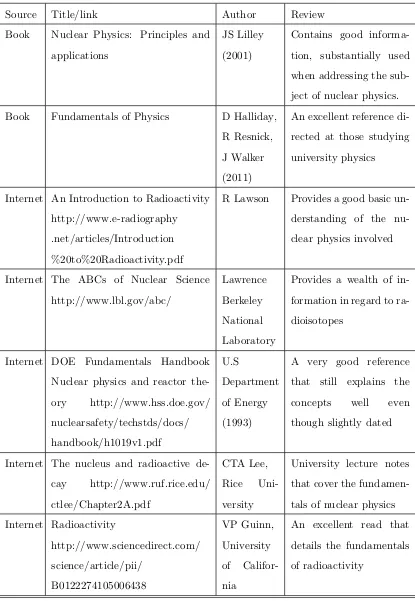
Table 2.1 shows the main sources of literature reviewed. From review, a good
under-standing of principles of radioactivity has been achieved and documented. Remarkably
the radiation source types available for mineral processing instrument applications are
limited; all are man-made, with many also being applicable for medical use.
Another unexpected revelation was the finding that gamma rays and x-rays are
indis-tinguishable from each other and therefore there is no known method of detecting the
difference between the two. Surprisingly the distinguishing difference between gamma
rays and x-rays is solely due to their source of origin. Furthermore it has been found
that gamma rays and x-rays can both share and cross over their designated sections of
2.2 The applicable nuclear physics 11
Table 2.1: Literature review of Nuclear Physics
Source Title/link Author Review
Book Nuclear Physics: Principles and
applications
JS Lilley
(2001)
Contains good
informa-tion, substantially used
when addressing the
sub-ject of nuclear physics.
Book Fundamentals of Physics D Halliday,
R Resnick,
J Walker
(2011)
An excellent reference
di-rected at those studying
university physics
Internet An Introduction to Radioactivity
http://www.e-radiography
.net/articles/Introduction
%20to%20Radioactivity.pdf
R Lawson Provides a good basic
un-derstanding of the
nu-clear physics involved
Internet The ABCs of Nuclear Science
http://www.lbl.gov/abc/
Lawrence
Berkeley
National
Laboratory
Provides a wealth of
in-formation in regard to
ra-dioisotopes
Internet DOE Fundamentals Handbook
Nuclear physics and reactor
the-ory http://www.hss.doe.gov/ nuclearsafety/techstds/docs/ handbook/h1019v1.pdf U.S Department of Energy (1993)
A very good reference
that still explains the
concepts well even
though slightly dated
Internet The nucleus and radioactive
de-cay http://www.ruf.rice.edu/
ctlee/Chapter2A.pdf
CTA Lee,
Rice
Uni-versity
University lecture notes
that cover the
fundamen-tals of nuclear physics
Internet Radioactivity http://www.sciencedirect.com/ science/article/pii/ B0122274105006438 VP Guinn, University of Califor-nia
An excellent read that
details the fundamentals
2.3 Radiation detection and measurement 12
2.3
Radiation detection and measurement
The detection of radiation and its measurement appears as a much specialised field; the
literature found was often secular on detection method with very few sources giving
adequate coverage. The review of many university sites revealed one consistent source
of information. This information source was the book “Radiation Detection and
Mea-surement” by Glenn F. Knoll (2010). Further review of this source led the author of
this research to purchase a copy of the latest edition (4th) from John Wiley & Sons,
Australia. This purchase has proven extremely worthwhile and has been extensively
used throughout this research project. This book would be a noteworthy addition to
any technical library.
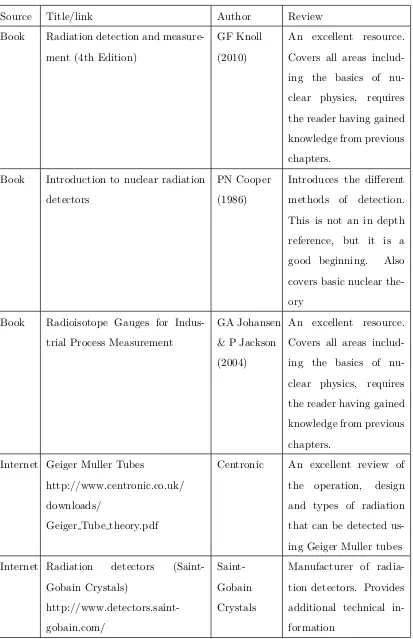
Table 2.2 is a compilation of sources that provided good information for this project.
Additionally close inspection of books by Cooper (1986) and Knoll (2010) found that
both have devoted sections to the statistics of detection; both clearly state that
radioac-tive decay is a statistical process and therefore the measuring process is also statistical.
Hence many measurements of the same sample are required to deliver a measured value
2.3 Radiation detection and measurement 13
Table 2.2: Literature review of Radiation Dection and Measurement
Source Title/link Author Review
Book Radiation detection and
measure-ment (4th Edition)
GF Knoll
(2010)
An excellent resource.
Covers all areas
includ-ing the basics of
nu-clear physics, requires
the reader having gained
knowledge from previous
chapters.
Book Introduction to nuclear radiation
detectors
PN Cooper
(1986)
Introduces the different
methods of detection.
This is not an in depth
reference, but it is a
good beginning. Also
covers basic nuclear
the-ory
Book Radioisotope Gauges for
Indus-trial Process Measurement
GA Johansen
& P Jackson
(2004)
An excellent resource.
Covers all areas
includ-ing the basics of
nu-clear physics, requires
the reader having gained
knowledge from previous
chapters.
Internet Geiger Muller Tubes
http://www.centronic.co.uk/
downloads/
Geiger Tube theory.pdf
Centronic An excellent review of
the operation, design
and types of radiation
that can be detected
us-ing Geiger Muller tubes
Internet Radiation detectors
(Saint-Gobain Crystals) http://www.detectors.saint-gobain.com/ Saint-Gobain Crystals
Manufacturer of
radia-tion detectors. Provides
additional technical
2.4 Nuclear instruments 14
2.4
Nuclear instruments
A literature review of nuclear instruments currently in use within the mineral
process-ing industries was commenced firstly based on the instruments found at the Boddprocess-ington
Gold Mine. Through review of these devices by manufacturer, it was further possible
to ascertain what other types of nuclear instruments may currently be in service
prin-cipally due to device synergies in manufacture. Table 2.3 covers the main information
sources that have been used. Very few references were found that even came close to
covering the full range of instruments available, notably the greatest coverage found
was given by the International Atomic Energy Agency’s (2005) publication
“Techni-cal data on nucleonic gauges”. The book “Radioisotope Gauges for Industrial Process
Measurement” by G. Johansen and P. Jackson (2004) has been included in the section
as well as the prior. This book would also be a noteworthy addition to any technical
2.4 Nuclear instruments 15
Table 2.3: Literature review of Nuclear Instruments
Source Title/link Author Review
Book Radioisotope Gauges for
Indus-trial Process Measurement
GA Johansen
& P Jackson
(2004)
An excellent resource.
Gives good insight into
the operational theory of
many applications.
Book Operating Manual Density Meter
LB444
Berthold
(2009)
O & M manual for an
on-pipe density gauge.
Covers the fundamentals
of operation well.
Internet Technical data on nucleonic
gauges
http://www-pub.iaea.org/
MTCD/publications/PDF/
te 1459 web.pdf
International
Atomic
En-ergy Agency
(2005)
An excellent
apprecia-tion of what devices are
currently used in general
industry
Internet Ronan Engineering
Measure-ments Division, Library of
technical documents. http://www.ronanmeasure. com/tn radiat.html Ronan En-gineering Measure-ments Division
An overview of process
instruments using
nu-clear techniques. It
also clearly states
sev-eral limitations with
re-gard to nuclear belt
weighers
Internet Berthold Technologies
https://www.berthold.com/
Berthold
Technolo-gies
Instrument
manufactur-ers’ web site
Internet Thermo Scientific http://www.
thermoscientific. com
Thermo
Sci-entific
Instrument
manufactur-ers’ web site
Internet Vega Americas
http://www.ohmartvega.com/
Vega
Ameri-cas
Instrument
manufactur-ers’ web site
Internet Ronan Measurements Division
http://ronanmeasure.com/pages/
Ronan
Mea-surements
Division
Instrument
2.5 Radiation safety, legislation and regulation 16
2.5
Radiation safety, legislation and regulation
The perusal of literature relevant to radiation safety, legislation and regulation has
found that within Australia the regulation of radioactive devices and radiation safety
is primarily a state and territory responsibility. On a Commonwealth level this role
is undertaken by the Australian Radiation Protection and Nuclear Safety Agency
(ARPANSA). Additionally codes of practice for Australian jurisdictions are published
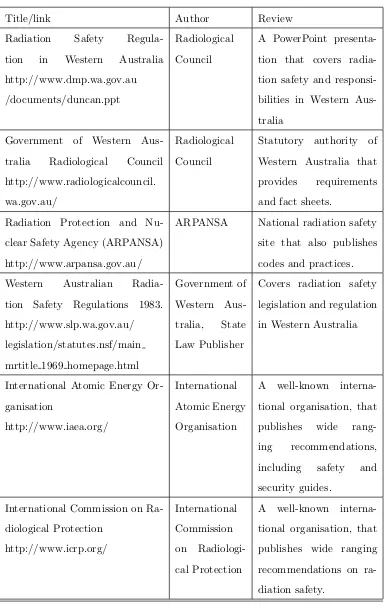
by ARPANSA and cover the areas of safety, transport, storage and disposal. Table 2.4
shows the information sources that were instrumental in completing this section of this
dissertation. Notably all are internet sources of high quality from highly respected or
2.5 Radiation safety, legislation and regulation 17
Table 2.4: Literature review of Radiation safety, legislation and regulation
Title/link Author Review
Radiation Safety
Regula-tion in Western Australia
http://www.dmp.wa.gov.au
/documents/duncan.ppt
Radiological
Council
A PowerPoint
presenta-tion that covers
radia-tion safety and
responsi-bilities in Western
Aus-tralia
Government of Western
Aus-tralia Radiological Council
http://www.radiologicalcouncil.
wa.gov.au/
Radiological
Council
Statutory authority of
Western Australia that
provides requirements
and fact sheets.
Radiation Protection and
Nu-clear Safety Agency (ARPANSA)
http://www.arpansa.gov.au/
ARPANSA National radiation safety
site that also publishes
codes and practices.
Western Australian
Radia-tion Safety Regulations 1983.
http://www.slp.wa.gov.au/
legislation/statutes.nsf/main
mrtitle 1969 homepage.html
Government of
Western
Aus-tralia, State
Law Publisher
Covers radiation safety
legislation and regulation
in Western Australia
International Atomic Energy
Or-ganisation
http://www.iaea.org/
International
Atomic Energy
Organisation
A well-known
interna-tional organisation, that
publishes wide
rang-ing recommendations,
including safety and
security guides.
International Commission on
Ra-diological Protection http://www.icrp.org/ International Commission on Radiologi-cal Protection
A well-known
interna-tional organisation, that
publishes wide ranging
recommendations on
2.6 Non – nuclear instrument alternatives 18
2.6
Non – nuclear instrument alternatives
Investigation into non-nuclear instrument alternatives found that once again good books
are a worthwhile asset when undertaking a task such as this. An excellent source of
information was the Instrument Engineers’ Handbook” by B.G. Lipt´ak. In principle
this large textbook is an extensive coverage of all process instruments, and covers the
theory of operation and applications. This book would stand proud in any Instrument
Engineers’ technical collection.
Additional alternatives were also found through the use of the internet and more
specifi-cally by perusal of process instrument manufacturers’ websites. Table 2.5 lists the most
[image:40.595.120.532.348.745.2]useful information sources reviewed.
Table 2.5: Literature review of Non-nuclear measurement methods
Source Title/link Author Review
Book Instrument Engineers’
Hand-book: Process Measurement and
Analysis
BG Lipt´ak
(2005)
An excellent in-depth
book that covers a
mul-titude of instrument
solutions.
Book Instrumentation for Process
Mea-surement and control
NA Anderson
(1997)
An older book that
cov-ers many traditional
con-cepts in process
measure-ment.
Internet Emerson Process Measurement
http://www2.emersonprocess.com Emerson Process Measure-ment Instrument manufactur-ers’ website.
Internet Krohne Messtechnik GmbH
http://krohne.com/ Krohne Messtech-nik GmbH Instrument manufactur-ers’ website.
Internet Vega Grieshaber KG
2.7 Questions raised from the literature review 19
2.7
Questions raised from the literature review
From the literature reviewed, the initial questions raised included:
• Is there a definitive requirement for the use of radioactive isotope sources and if so
are they necessarily the best selection? If gamma rays and x-rays are effectively
the same would it not be better to use x-ray sources that can be simply disabled
by the removal of power?
• Should the use of nuclear belt weighers be condoned?
• Should employees within mineral processing plants be given a better eduction in
regard to radiation safety?
• Are there significant statistical measurement issues with respect to the use of nuclear instruments?
Completion of this dissertation has answered these questions. Answers to these can
be found in the relevant sections on measurement and/or in the recommendations and
Chapter 3
Project Implementation
3.1
Chapter Overview
As a significant part of this research project was out of discipline, an additional
edu-cation in the applicable nuclear physics was required at the early stages of the project.
This in itself took an extensive period of time to complete and consumed a significant
amount of research resources. This education was completed in conjunction with the
initial review of the nuclear instruments installed at the Boddington Gold Mine.
Overall this research is based extensively on theory, and on the review of existing nuclear
and non-nuclear instruments available. The following section details the methodology
3.2 Methodology 21
3.2
Methodology
Successful project completion required the development of a strategy that was well
ordered and in the main required the acquisition of knowledge in certain areas before
the next task could be undertaken. The following details the task description, how the
task was achieved and the order of implementation:
1. Education in the relevant fields of nuclear physics. This was achieved through a
literature review with the appropriate knowledge documented in the dissertation.
2. Assessment of what nuclear instruments are used in the mineral processing
indus-tries. This was achieved by a site survey of Boddington Gold Mine and a wide
ranging review of industry literature.
3. Education in regard to the relevant nuclear measurement techniques. This was
achieved through a literature review with the appropriate knowledge also
docu-mented in the dissertation.
4. Education in the field of radiation safety. This was achieved by literature review
and where appropriate through discussion with the site Radiation Safety Officer.
5. Appraisal of nuclear instruments used within the mineral processing fields.
Judge-ments were made with regard to the following:
• Benefit to process.
• Inherent characteristics such as reliability and accuracy. This was achieved
via literature review of manufacture’s information, site history and
discus-sion with site personnel.
• Installation, operating and disposal costs. This required liaison with
suppli-ers and Boddington Gold Mine staff to determine costs.
• Workplace and public safety.
6. From the above processes a list of recommendations for the current nuclear
in-strument applications were generated. Recommendations include a judgement on
the instrument’s suitability for the task, installation arrangements, maintenance
3.2 Methodology 22
7. With regard to items 5 & 6, performance models for both nuclear and
tradi-tional instrumentation where applicable were developed. These are based on the
previous findings, literature review and discussion with specialists on site.
8. With time permitting, viable measurement/technology alternatives were proposed
for Boddington Gold Mine nuclear instrument installations. These were based on
the previous determined models, the literature review of alternative technologies
and the author’s own knowledge.
With project completion, it was found the above methodology was adequate. However
in respect to the total additional knowledge required for successful project completion,
Chapter 4
The Basics of Nuclear Physics
4.1
Chapter Overview
This chapter covers the basics of ionising radiation. Throughout the chapter the reader
is exposed to the origins, types and energies of these radiations. The concepts of
activity, decay and half-life are also introduced. In addition decay mechanisms are
covered to an extent that will give the reader the preliminary knowledge for upcoming
chapters that form the basis of radiation measurement. The writings of this chapter are
to a significant extent based on interpretation of the book Nuclear Physics, principles
and applications (Lilley 2001).
4.2
Ionising Radiation
To understand the measurement principles behind nuclear instruments one must first
have an understanding of ionising radiation. Ionisation energy as quoted by D.Halliday,
Resnick & Walker (2011, p. 1113) is “the energy required to remove the most loosely
bound electron from a neutral atom”. The amount of energy required to achieve this
depends on the atom type and ranges from approximately 4 to 24 eV (electron volts).
With reference to the definition; ionising radiation has enough energy to remove an
4.3 Isotopes and Radioactive Decay 24
two types, particulate and electromagnetic. In respect to this document the relevant
forms of ionising radiation are:
1. Particulate – alpha particles, beta particles and neutrons
2. Electromagnetic – gamma rays and x-rays
Sources of ionising radiation occur both naturally and through man’s application of
science. Background radiation is the natural sources of ionising radiation that we are
regularly exposed to in our day to day lives; the value of this radiation at any location
is variable and is primarily influenced by geology, latitude and altitude. The main
contributors of background radiation are the ongoing radioactive decay of the isotopes of
uranium and thorium, and cosmic rays. Uranium and thorium are a legacy of universal
creation, whilst cosmic rays consist predominately of protons and alpha particles from
outer space, which interact with the Earth’s atmosphere producing gamma rays and
electrons.
The majority of ionising radiation sources within the mineral processing industry are
radioactive isotopes; in a very few specialised applications x-rays are artificially
pro-duced through the use of x-ray tubes.
4.3
Isotopes and Radioactive Decay
Elements can have several different configurations know as isotopes. Isotopes of the
same element are distinguished from each other by their different mass number A. All
isotopes of a particular element have the same number of protons Z, but differ in the
number neutronsN they have within the nucleus. Notably as the isotopes of an element
have the same number of electrons they act chemically identical.
Protons and neutrons are particles of a nucleus and are regularly referred to as nucleons
(non-definitive particles of the nucleus). Therefore the mass number Ais equal to the
number of nucleons, which is in turn equal to the sum of protons and neutrons within
4.3 Isotopes and Radioactive Decay 25
Isotopes of an element can either be stable or unstable. Stable elements do not change
(mass number) over time. Unstable isotopes are known as radioactive isotopes and
are unstable due to the composition (the number of protons and neutrons) within the
nuclei.
According to quantum physics a nucleus can exist at several discrete energy states.
Nuclei at an excited state will de-excite. The nuclei of radioactive materials are in an
excited state and dependant on their energy state will emit electromagnetic radiation
(gamma rays) and or particulate radiation (alpha particles, beta particles and neutrons)
to obtain a lower energy state.
The energy unit associated with ionising radiation is the electron Volt, eV; as defined
by Knoll (2010, p. 3) one electron volt is “the kinetic energy gained by an electron by
its acceleration through a potential difference of one volt”. The equivalent energy value
in joules is: 1 eV = 1.602 x 10⁻¹⁹J
The spontaneous release of ionising radiation and the subsequent loss of energy is
known as radioactive decay. During radioactive decay the “Parent” nuclide (type of
nucleus identified by the number of protons and neutrons) alters to become a more
stable “Daughter” nuclide. This daughter nuclide may also be radioactive and if so,
the decay process will continue until stability is reached. When decay occurs through
many transformations, the process is a chain of events and this process is commonly
known as a decay chain. Some of these decay chains can be quite extensive and may take
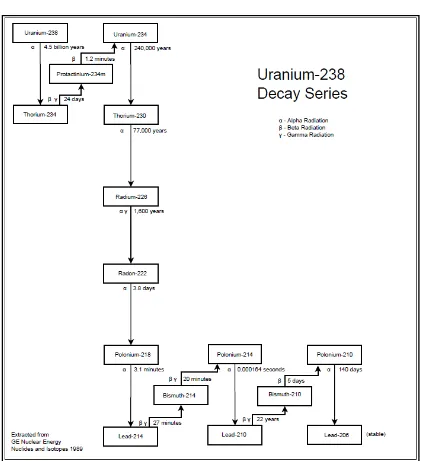
extremely long periods of time. An example is the radioactive decay of uranium-238
4.3 Isotopes and Radioactive Decay 26
4.3 Isotopes and Radioactive Decay 27
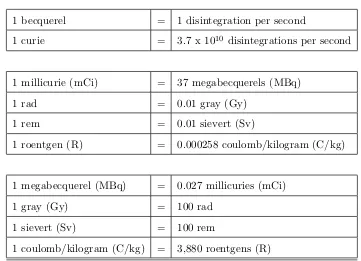
The rate of decay of a radioactive isotope is referred to as activity. This activity is
expressed in the SI unit becquerel (Bq), with one becquerel equal to a rate of one
disintegration per second. An older unit of measurement of activity is the curie, with
one curie equal to 3.7 x 10¹⁰Bq; it is still quite common to come across the use of this
unit and many older sources can be found marked with the source activity in mCi. The
rate of decay is based on probability and by using an isotope’s decay constantγ, the
rate of decay can be calculated with:
dN
dt =γN (4.1)
From the above the amount of radioactive nuclei after a period of time can be
deter-mined using the equation:
N(t) =N0e−γt (4.2)
whereN0 = the original number of radioactive nuclei att0
γ = decay constant
t = time; s
The common radioactive term half-life, is the amount of time required to pass until a
radioactive substance has half of its original activity. Half-life can also be calculated
using the decay constant as shown in the following formula:
t1/2=
ln 2
γ (4.3)
An additional term often used in regard to radioactivity is specific activity; this refers
to the activity per mass and is usually quoted in becquerels per gram (Bq/g).
Coulomb potential energy is a measure of the energy within a nucleus that is resultant
of the constant interaction between, the attractive nuclear forces of the neutrons and
the repulsive electromagnetic forces between protons. The Coulomb energy is greatest
near the edge of the nucleus creating a boundary referred to as the Coulomb barrier.
Isotopes that eject charged particles will have their half-lives altered by the effect of
the Coulomb barrier.
The energy required to break the nucleus into to its component parts is defined as its
4.3 Isotopes and Radioactive Decay 28
sum of its components. This difference in mass is known as the mass defect. Knowing
the mass defect and using Einstein’s equation of E = mc2 the binding energy of a
nucleus can be determined. The relevant equation in respect to binding energy is:
m(A, Z) =Zmp+N mn− B
c2 (4.4)
wherem(A, Z) = mass of the nucleus
Z = number of protons
mp = mass of a proton; 1.67262158×10⁻²⁷ kg or 1.007276 u N = number of neutrons
mn= mass of a neutron; 1.67492735×10⁻²⁷ kg or 1.008665 u B = binding energy (J or MeV)
c = speed of light; 3×10⁸ m/s
Note: 1 u = 1.6605×10⁻²⁷ kg. Nuclear and atomic masses are regularly referred to in atomic mass units (u), with 1 u the equivalent mass of one twelfth of a neutral carbon
atom’s mass. This has the benefit of easier energy calculations, with the mass of
1 u = 931.5 MeV/c2.
From the above it can be seen that in reference toE =mc2 the binding energy can be
calculated using:
B = ∆mc2 (4.5)
where B = binding energy (J or MeV)
∆m = the mass defect
c = speed of light; 3×10⁸ m/s
Calculating the binding energy using the alpha particle as an example:
1. Firstly using standard engineering units:
m(A, Z) = Zmp+N mn−B
c2
B
c2 = Zmp+N mn−m(A, Z)
B
c2 = (2×1.673×10
−27) + (2×1.675×10−27)−6.644×10⁻²⁷
4.3 Isotopes and Radioactive Decay 29
B = (0.0503×10−27)×(3×108)2 B = 4.527×10⁻¹² J
Converting to MeV:
B = 4.527×10−12 J× 1 MeV
1.602×10⁻¹³ J
B = 28.26 MeV
2. Secondly using atomic mass units and the conversion factor of 1 u = 931.5 MeV/c2:
m(A, Z) = Zmp+N mn− B
c2
B
c2 = Zmp+N mn−m(A, Z)
B
c2 = (2×1.007276 u) + (2×1.008665 u)−4.00150675 u
B = (0.0304 u)c2
B = (0.0304 u)c2×931.5 MeV
1 u×c2
B = 28.29 MeV
An increase of nucleons in a nucleus will result in an increase in binding energy.
Sub-sequently the binding energy is often expressed in binding energy per nucleon;
Binding energy per nucleon = total binding energy
number of protons and neutrons (4.6)
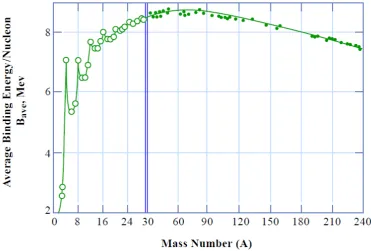
A binding energy curve for stable nuclei can be viewed in Fig. 4.2. In this figure
binding energy per nucleon is plotted in respect to the mass number. Cooper (1986,
p. 3) states “Atoms that are most stable have the highest value of average binding
4.3 Isotopes and Radioactive Decay 30
Figure 4.2: Binding energy curve, plotting binding energy per nucleon against atomic mass.
4.3 Isotopes and Radioactive Decay 31
Fig. 4.3 shows a “Chart of Nuclides” that depicts the stability of nuclei with respect
to half-life; nuclei are plotted in reference to their number of protons and neutrons.
Stability can be found to follow the middle of the band; this band is regularly referred
to as the “line or valley of stability”. Nuclei can have an equal number of neutrons
and protons, be neutron rich or neutron poor. Nuclei away from the line of stability
are unstable and achieve stability through the process of radioactive decay. Isotopes
with an atomic number greater than 83 are inherently unstable. The limiting atomic
number of naturally occurring isotopes is 92; all isotopes above these numbers are man
[image:53.595.122.519.306.588.2]made and are designated as transuranic elements.
Figure 4.3: Chart of nuclide stability in respect to half-life.
4.4 Radioactive Decay Mechanisms 32
4.4
Radioactive Decay Mechanisms
There are several different methods of radioactive decay. With respect to mineral
processing the following are relevant:
• Alpha decay
• Beta decay and Electron capture
• Spontaneous fission
• Gamma rays and Internal Conversion
• X-rays
Additionally other forms of radioactive decay include proton and neutron emissions.
The following brief description of proton and neutron emissions is based on the text
“Radiation Mechanics; Principles and Practice”(Hussien 2001, p. 39). Proton emission
may occur under the following two circumstances:
1. Beta-delayed proton emission - emission of a proton from a daughter nucleus that
is in a highly excited state after beta decay.
2. Extremely proton rich isotopes may emit protons to gain stability.
Proton emission is a rare form of decay and is only possible due to man made isotopes.
Additionally neutron emission is also a rare form of decay and may also occur in two
similar manners as with proton emission:
1. Beta-delayed neutron emission - emission of a neutron from a daughter nucleus
that is in a highly excited state after beta decay.
4.4 Radioactive Decay Mechanisms 33
Notably both proton and neutron emission are not possible without artificial isotopes.
Furthermore both emission types may also eject other types of particles from the
nu-cleus. Fig. 4.4 shows a “Chart of Nuclides” that depicts the decay type in reference to
[image:55.595.121.518.205.483.2]an isotope’s number of protons and neutrons.
Figure 4.4: Chart of Nuclides in respect to decay type.
4.4 Radioactive Decay Mechanisms 34
4.4.1 Alpha emission
The radioactive decay of most heavy nuclei (isotopes with an atomic number > 82)
results in the emission of alpha particles. Alpha particles are effectively the nuclei of
Helium atoms. The released energy of decay takes the form of kinetic energy shared
between alpha and daughter particles. Presuming the nucleus is at rest at the time
of decay, using the laws of energy conservation and momentum the kinetic energy of
product particles can be determined using the following equations:
Eα = Qα( mD mD+mα
) (4.7)
ED = Qα−Eα (4.8)
whereEα = alpha energy
ED= daughter energy
Qα = decay energy
mD= mass of the daughter particle
mα= mass of the alpha particle
As the alpha particle is much lighter than the daughter, the alpha particles energy
is usually approximately 98% of the total decay energy. Via the measurement of the
energies of decay it is possible to determine the parent nuclide, alternatively it is also
possible to determine the daughter product if the parent is known in conjunction with
the alpha energy value.
Determination of the energy of decay is best explained by way of example. Based on
the alpha decay of plutonium–239 (239Pu) to uranium–235 (235U):
4.4 Radioactive Decay Mechanisms 35
The energy released in decay can be calculated using two methods:
1. By calculating the difference in binding energy between parent and products.
Using the equation of:
Qα=ED+Eα−EP (4.9)
whereQα = decay energy
ED= daughter energy
Eα = alpha energy
EP = parent energy
with239Pu = 1806.914 MeV
235U = 1783.863 MeV
4He = 28.296 MeV
Qα = 1783.863 + 28.296−1806.914 Qα = 5.245MeV
2. By calculating the difference in mass energy between parent and final products.
Using the equation of:
Qα = (mP −mD −mα)c2 (4.10)
whereQα = decay energy
mP= mass of parent
mD= mass of daughter
mα= mass of alpha particle
c = 3×10⁸ m/s
with239Pu = 239.052157 u
235U = 235.043924 u
4He = 4.002602 u
Qα = (239.052 + 235.044−4.003)c2 Qα = 0.005631c2
Qα = 0.005631c2×931.5MeV
c2 (MeV conversion factor)
4.4 Radioactive Decay Mechanisms 36
Notably alpha decay always results in transmutation; the creation of a more stable
daughter element that may well also be radioactive. As previously mentioned the
half-lives of isotopes that emit charged particles are affected by the Coulomb barrier and this
therefore also holds true for alpha particle decay. The height of the Coulomb barrier is
associated with an increase in atomic number (protons). As the Coulomb barrier acts
as a barrier to alpha decay, increasing values will result in increased half-lives.
4.4.2 Beta emissions and electron capture
Unstable nuclei with an atomic mass less than 82 will generally decay by beta emission
or by electron capture.
Beta emissions can be positive or negative. Negative beta emissions release negatron
(e−) particles that are the equivalent of electrons, whilst positive beta emissions release
positrons (e+) the equivalent of positively charged electrons. Additionally positive beta
emissions are always accompanied to some degree with electron capture. Electron
cap-ture will occur on its own, if discharge energies are less than 1.02 MeV.
Neutron rich isotopes will decay via negative beta emission. In this process a neutron
within a nucleus will convert to; a proton, a negatron and an anti-neutrino (¯v).
Alter-natively proton rich isotopes will decay via positive beta emission, converting a proton
to; a neutron, a positron and a neutrino (v). Neutrinos and anti-neutrinos are particles
of minimal mass, with no charge and are additional particles created in the beta decay
process that maintain the energy/mass balance during decay.
The equations for negative and positive beta emission are as follows:
Negative beta n−→p+e−+ ¯v (4.11)
Positive beta p−→n+e++v (4.12)
The energy of beta emission differs from alpha decay, as the energy of negatrons and
positrons is spread over a spectrum, with the maximum value equal to that anticipated
from mass/energy calculations; subsequently average electron/positron energy values
are approximately one third of this value. The spread of the energy spectrum is due
4.4 Radioactive Decay Mechanisms 37
anti-neutrinos).
With beta decay the Coulomb barrier assists in the ejection of positrons and retards
the discharge of electrons from the nucleus. However the Coulomb barrier cannot be
used to give any indication of an isotope’s half-life, as it is only one of many complex
factors that require consideration when attempting calculation.
Beta emissions change the numbers of neutrons and protons within a nucleus, with the
charge of nucleus composition summarized as follows:
1. Positive beta emission maintains the mass number A, but decreases the atomic
numberZ by one.
2. Negative beta emission maintains the mass numberA, but increases the atomic
numberZ by one.
Electron capture is a process with may also occur as an alternative to positive beta
decay in a proton rich nucleus. This process captures an electron from one of the atom’s
electron shells, usually from the innermost “K” shell; the result is the conversion of a
proton in the nucleus to a neutron and neutrino. The process equation follows:
p+e−−→n+v (4.13)
As an electron is captured from one of the atom’s shells, a vacancy now exists that
will be filled by an electron from an outer shell, this effectively results in a cascade of
electrons, moving from shell to shell filling vacant positions. This process of electron
movement (change in energy level) gives rise to the emission of x-ray photons.
Electron capture is dissimilar to both positive and negative beta as the energy released
is not spread across a spectrum; the energy released with electron capture is at a
characteristic level and is bestowed on the neutrino.
Positive beta and electron capture often occur together and at different ratios that are
isotope dependent. It is even possible to have positive beta, negative beta and electron
4.4 Radioactive Decay Mechanisms 38
The energy released in negative beta and electron capture decay is calculated using the
difference between parent and daughter atomic masses and can be determined using
the following equation:
Qβ = (mP −mD)c2 (4.14)
whereQβ = decay energy
mP= mass of parent
mD= mass of daughter
c = 3×10⁸ m/s
Using atomic mass units (u) and applying the MeV conversion factor, the equation
becomes:
Qβ = ∆mc2×
931.5 MeV c2
Qβ = ∆m×931.5 MeV (4.15)
Whereas the energy released in positive beta is slightly less due to the emission of a
positron and neutrino; calculation is similar to above with a subtraction of 1.022 MeV
applied to the MeV conversion factor. Equation 4.15 in this instance becomes:
Qβ = ∆m×930.5 MeV (4.16)
An additional event that results from positive beta emissions is the production of
an-nihilation radiation. This occurs when the emitted positron combines with an electron
of an absorbing material as the positron comes to a stop and their combined mass is
converted to two 0.511 MeV gamma rays that travel in opposite directions.
Beta decay always ends in transmutation due to a change in the number of protons
within the nucleus.
4.4.3 Spontaneous fission
Very heavy nuclei may decay by spontaneous fission. When this occurs the heavier
parent is split into two lighter daughter nuclides. Nuclides that decay by spontaneous
4.4 Radioactive Decay Mechanisms 39
mass number A rises, the repulsive Coulomb forces due to neutron/proton interaction
become overwhelming, splitting the atom in two.
With useful heavy nuclei, alpha emissions significantly out weigh emissions due