A STUDY TO EVALUATE THE EFFECTIVENESS
ASSISTED TEACHING
CHILD ABUSE
SELECTED
The Tamil Nadu Dr. M.G.R. Medical University,
In Partial Fulfillment of the R
MASTER OF SCIENCE IN NURSING
A STUDY TO EVALUATE THE EFFECTIVENESS
ASSISTED TEACHING ON THE KNOWLEDGE REGARDING
CHILD ABUSE AMONG SCHOOL AGE CHILDREN
SELECTED SCHOOL, COIMBATORE.
Mrs. J.UMA Reg. No: 301618401
A Dissertation Submitted to
Tamil Nadu Dr. M.G.R. Medical University,
Chennai- 32.
Partial Fulfillment of the Requirement for the
Award of the Degree of
MASTER OF SCIENCE IN NURSING
BRANCH-II
PAEDIATRIC NURSING
2018
A STUDY TO EVALUATE THE EFFECTIVENESS OF VIDEO
REGARDING
SCHOOL AGE CHILDREN IN
COIMBATORE.
Tamil Nadu Dr. M.G.R. Medical University,
equirement for the
A STUDY TO EVALUATE THE EFFECTIVENESS OF VIDEO
ASSISTED TEACHING ON THE KNOWLEDGE REGARDING
CHILD ABUSE AMONG SCHOOL AGE CHILDREN IN
SELECTED SCHOOL, COIMBATORE
Mrs. J.UMA Reg. No:301618401
A Dissertation Submitted to
The Tamil Nadu Dr. M.G.R. Medical University,
Chennai- 32.
In Partial Fulfillment of the Requirement for the
Award of the Degree of
MASTER OF SCIENCE IN NURSING
BRANCH-II
PAEDIATRIC NURSING
A STUDY TO EVALUATE THE EFFECTIVENESS OF VIDEO
ASSISTED TEACHING ON THE KNOWLEDGE REGARDING
CHILD ABUSE AMONG SCHOOL AGE CHILDREN IN
SELECTED SCHOOL, COIMBATORE
By
Mrs. J.UMA Reg. No: 301618401
A Dissertation Submitted to The Tamil Nadu Dr.M.G.R. Medical University, Chennai, in Partial Fulfillment of Requirement for the
Degree of
MASTER OF SCIENCE IN NURSING
BRANCH-II
PAEDIATRIC NURSING
2018
A STUDY TO EVALUATE THE EFFECTIVENESS OF VIDEO
ASSISTED TEACHING ON THE KNOWLEDGE REGARDING
CHILD ABUSE AMONG SCHOOL AGE CHILDREN IN
SELECTED SCHOOL, COIMBATORE
APPROVED BY THE DISSERTATION COMMITTEE
RESEARCH GUIDE : ………
Prof. Dr. D.CHARMINI JEBAPRIYA, M.Sc (N)., M.Phil, Ph.D., Principal,
Texcity College of Nursing, Coimbatore - 23
SUBJECT GUIDE : ………
Prof.Mrs. THENMOZHI.P, M.Sc (N),M.Sc(Psy) Professor cum Vice Principal,
Texcity College of Nursing,
Coimbatore - 23.
MEDICAL GUIDE : ………
Dr. S.ANAND, M.B.B.S, DCH, Consultant Pediatrician,
CERTIFICATE
Certified that this is the bonafide work of Mrs.UMA.J, Texcity College of Nursing, Coimbatore, submitted as a partial fulfillment of requirement for the Degree of Master of Science in Nursing to The Tamilnadu Dr.M.G.R. Medical University, Chennai under the Registration No:301618401
College Seal
Prof.Dr. D.CHARMINI JEBAPRIYA, M.Sc (N).,M.Phil, Ph.D.,
Principal,
Texcity College of Nursing,
Coimbatore - 23.
TEXCITY COLLEGE OF NURSING
Podanur Main Road Coimbatore-23.
DECLARATION
I hereby declare that the dissertation entitled “A study to evaluate the effectiveness of video assisted teaching on the knowledge regarding child abuse among the school age children in selected school, Coimbatore”.
Submitted to the Tamilnadu, Dr. M.G.R. Medical University, Chennai, in partial fulfilment of the requirements for the award of the degree of Master of Science in Nursing is a record of original research work done by myself.
This is the study under the supervision and guidance of Prof. Thenmozhi.P, M.Sc (N)., M.Sc (Psy)., Vice Principal, Texcity College of Nursing, Coimbatore-23 and the dissertation has not found the basis for the award of any degree/diploma/associated degree/ fellowship or similar title to any candidate of any university.
SIGNATURE OF THE PRINCIPAL SIGNATURE OF THE GUIDE
THIS DISSERTATION IS
DEDICATED TO
God almighty who blessed me to finish this work successfully
I dedicate this book to my family members
For supporting and encouraging me to believe in myself
I also dedicate this book to my beloved husband
Mr.Thiagarajan
and kids
Hrishitha, Sanjay Ram
For their loving care, emotional and encouragement
ACKNOWLEDGEMENT
First and foremost, I give praise and thanks to the God, the Almighty, for His showers of blessings throughout my research and the courage to overcome all the difficulties and to complete the research successfully.
I express my heartfelt thanks to Haji. Janab. A.M.M. Khaleel, Chairman, Texcity Medical and Educational Trust, Coimbatore, for giving me an opportunity to utilize all the facilities in this esteemed institution.
Excellent teacher is a highly visible, provides support, effective listener , discreet and dedicated. It is my extensive felt desire to express my thanks to research
guide Prof.Dr.Charmini Jebapriya, M.Sc.(N)., M.Phil., Ph.D The Principal,
Texcity college of Nursing for her support, appreciation and encouragement which enabled me to reach my objective.
The skill set of a good guide is very rigorous, controlled, pro-active, good listener give solid feedback, valid and verifiable, empirical and critical. I express my sincere heart full thanks to my clinical guide Prof.P.Thenmozhi., M.Sc.(N), M.Sc(Psy), Vice Principal cum HOD Department of child health Nursing, for her constant support valuable suggestions and guidance during my study. This study could not have been presented in the manner it has been made and would have never taken up the shape.
I express my sincere thanks to Major H.M. Mubarak, Manager; Texcity
College of Nursing, for supporting me to complete this study, greater achievements comes from experience and success.
I extend my sincere thanks to Asst Prof. B. Anusha, M.Sc (N). Class Co-coordinator Texcity College of Nursing for her esteemed suggestions, constant support, timely help and guidance till the completion of this study.
I would like to extend my thanks to all the Nursing faculty for their help and support.
I express my sincere thanks to Mr. Annasamy M.sc (Bioch). M.Phil. PGDB.
Statistician for his necessary guidance in statistical analysis.
I would like to thank all the Experts who have done the content validity and contributed their valuable suggestion in modification of tool.
I extend my heartful thanks to Mrs.Muthu Malini Alice, M.A(Eng), B.Ed for her help in English editing.
I express my thanks to Mrs.Famy Carmel.F, M.Li.Sc, Librarian for her kind cooperation in providing the necessary materials.
I am pleased to convey my profound thanks to Principal, Kalaivani Model Matriculation High School for granting permission to conduct the study and helping me to complete my study successfully.
I extent my heartful thanks to all participants of this study, who are studying in Kalaivani Model Matriculation school.
Final and not the least my special thanks goes to my husband
Mr.C.Thiagarajan, for sparing his time and providing financial support for my study. Remembering my sweet children Hrishitha and Sanjay Ram for scarifying their loveable moments with me.
ABSTRACT
The main aim of the present study was “To evaluate the effectiveness of video assisted teaching on the knowledge regarding child abuse among school age children in selected school at Coimbatore”
OBJECTIVES
To assess the existing knowledge on child abuse among school age children
To evaluate the effectiveness of video assisted teaching regarding child abuse among the school age children
To find out the association between the pretest knowledge level of the school age children with their selected demographic variables.
HYPOTHESIS
H1: The mean post test knowledge level will be significantly higher than mean pre test knowledge level of the school age children.
H2: There will be significant association between the pretest knowledge level of the school age children with their selected demographic variables.
METHODOLOGY
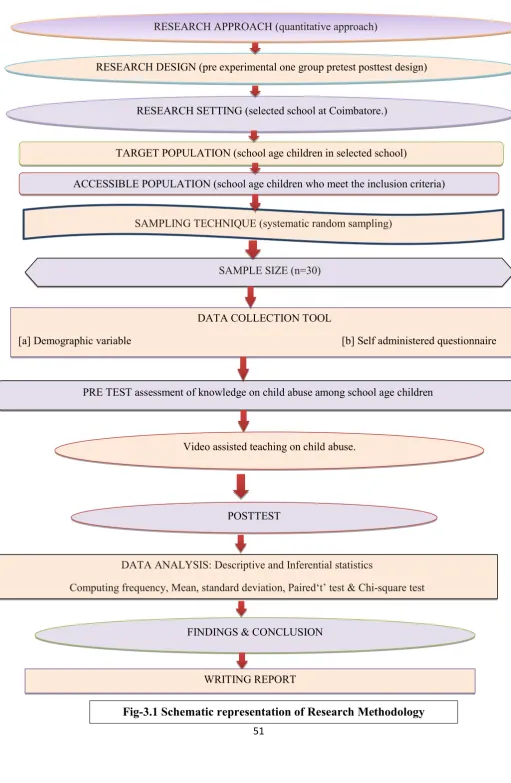
computing frequency ,percentage, mean ,standard deviation ,paired ‘t’ test and chi-square test.
RESULTS
The significant findings of the study are,
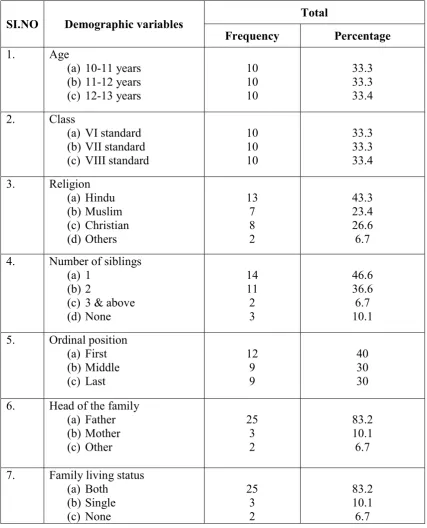
Among the samples with regards to the age 10-11years (33.3%) ,11-12 years
(33.3%) and 12-13 years (33.4%).
Among the samples with regards to class of study VI standard (33.3%) ,VII standard (33.3%)and VIII standard (33.4%).
Among the samples with regards to religion Hindus (43.3%) , Muslims (23.4%) Christians (26.6%) and others (6.7%).
Among the samples with regards to number of siblings, one (46.6%), two (36.6%) , three and above (6.7) and none (10.1%) .
Among the samples with regards to ordinal position in their family, first (40%), middle (30%) and last (30%).
Among the samples with regards to head of the family, father (83.2%), mother (10.1%) and other (6.7%).
Among the samples with regards to family living status, (83.2%) of children living with both the parents , (10.1%) living with single parent and (6.7%) living with relatives.
Among the samples with regards to ordinal position in their family, first child (40%), middle child (30%) and last child (30%).
Among the samples with regards to occupation of the father /guardian, professionals (23.4%), skilled (53.2%) and unskilled (23.4%).
Among the samples with regards to unhealthy habits of father/ guardian, alcoholism (20%), smoking (16.6%), both (10.1%) and none (53.3%).
Among the samples with regards to the type of family, nuclear family (63.3%), joint family (23.3%) and extended family (13.4%).
Among the samples with regards to number of family members, less than 4 members (50%), 4-6 members (33.4%) and more than 6 members (16.6%).
Among the samples with regards to the previous source of information on child abuse, (16.6%) received information from parent, (10%) from media, (6.7%) from health professionals and (66.7%) have not received any information regarding child abuse.
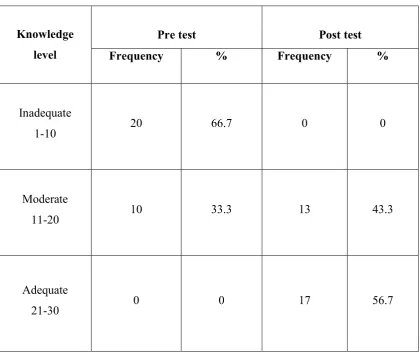
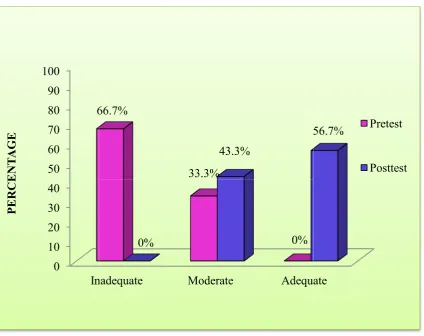
The findings shows that among the 30 school age children, 20 (66.7%) had inadequate knowledge, 10 (33.3%) had moderate knowledge and 0 (0%) had adequate knowledge in the pretest. The level of knowledge was improved after intervention and in the post test 13 (43.3%) had moderate knowledge and 17 (56.7%) had adequate knowledge.
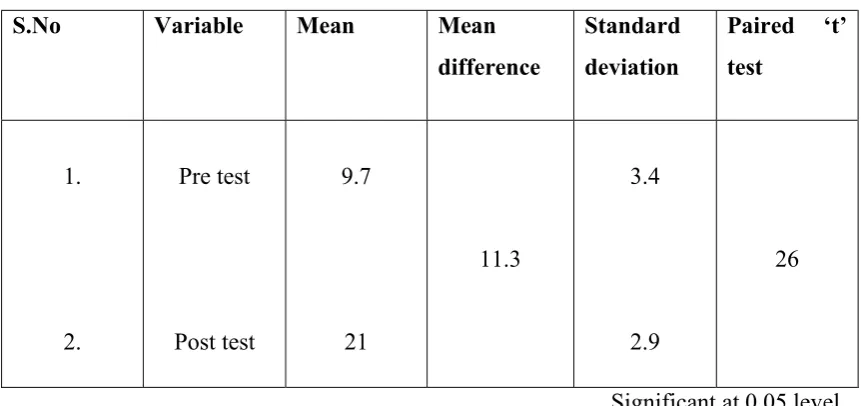
The findings revealed that, among the school age children the pretest mean was 9.7 and the posttest mean was 21, so mean difference 11.3 was a true difference and the standard deviation of pretest was 3.4 and posttest was 2.9.The calculated paired ‘t’ value was 26 was highly significant than the table value ( 2.6) at 0.05 level. Hence the stated hypothesis was accepted.
The findings suggested that there was a significant association between the pretest level of knowledge score with their selected demographic variables such as education of the parent and source of information.
TABLE CONTENTS
CHAPTER CONTENTS PAGE NO
I
II
III
INTRODUCTION
1.1 Background of the study 1.2 Significance of the study 1.3 Need for the study 1.4 Statement of the problem 1.5 Objectives
1.6 Hypotheses
1.7 Operational definition 1.8 Assumptions
1.9 Delimitations of the study 1.10 Projected outcome
1.11 Conceptual framework
REVIEW OF LITERATURE
2.1 Studies and literature related to incidence and prevalence of child abuse.
2.2 Studies and literature related to
teaching programme and
knowledge on prevention of child abuse.
RESEARCH METHODOLOGY
3.1. Research Approach 3.2. Research Design 3.3. Research variables 3.4. Setting of the study 3.5. Study Population 3.6. Sample
IV
V
VI
VII
3.7 Sample size 3.8. Sample Technique
3.9. Criteria for Sample Selection 3.10 Instrument and scoring
procedure
3.11 Validity and reliability 3.12 Pilot Study
3.13 Data Collection procedure 3.14 Plan for data analysis 3.15 Ethical consideration
DATA ANALYSIS AND INTERPRETATION
FINDINGS AND DISCUSSION
SUMMARY AND CONCLUSION
6.1 Summary 6.2 Conclusion 6.3 Implication 6.4 Limitation
6.5 Recommendation
LIST OF FIGURES
FIGURE
NO
TITLE
PAGE
NO
1.1
1.2
3.1
4.1
4.2
4.3
4.4
Child abuse prevention
Imogene Kings goal attainment theory: conceptual framework
Schematic representation of research methodology
Percentage distribution of samples in terms of religion
Percentage distribution of samples in terms of family living status
Percentage distribution of samples in terms of type of family
Percentage distribution of samples in terms of pretest and posttest knowledge level
4
24
51
56
57
58
LIST OF TABLES
TABLE
NO
TITLE
PAGE
NO
4.1
4.2
4.3
4.4
Frequency and Percentage Distribution of samples with their selected demographic variable.
Distribution of samples according to the knowledge level in pre -test and post --test.
Data on effectiveness of video assisted teaching on child abuse.
Data on association of the pre-test knowledge level with their selected demographic variable.
53
59
61
LIST OF APPENDICES
APPENDIX
TITLE
I
II
III
IV
V
VI
VII
VIII
IX
Copy of letter seeking permission to conduct study
Copy of letter requesting expert opinion to establish content validity
List of experts
Evaluation criteria check list for content validity
Evaluation criteria check list for content validity
( Teaching module)
Letter seeking consent of subjects for participation in this study
Certificate for English editing
Research tool
1
CHAPTER- I
INTRODUCTION
1.1
BACK GROUND OF THE STUDY
Child abuses are any threatening or violent interaction of physical, psychological or sexual nature, which may cause physical or psychological harm to the child. This includes neglect and withholding essential aid, medical care and education. Sexual and physical abuse are forms of physical violence .It is also addition to the forms of mental abuse exist. Forced marriage at a very young age and ritual circumcision of girls are also forms of child abuse. Children have the right to protection from all forms of maltreatment, abuse, neglect and violence.
The World Health Organization reports that an estimated 20 percent of all women are victims of sexual abuse. The effects of physical, emotional and sexual abuse and violence are far-reaching; not only their health but also the economic prospects of victims are affected. In conflict areas - where many refugees are given shelter - girls are particularly vulnerable to sexual abuse and assault.
An estimated 14.2 million girls are victim of child marriage each year. These children grow up in poverty, do not have access to education and most of the time they live in remote villages and rural areas. In countries such as Bangladesh, Nepal, and Pakistan child marriage exists on a large scale. Young girls become completely dependent of their husband and are pregnant before their body is fully developed. Often there is no medical care for these girls during their pregnancy. Baby and mother mortality rates are very high. Child marriages occur in South Asia, Sub-Saharan Africa (37%), Latin-America and the Caribbean.
2
in a position to do so (where resources available to the family or care giver; distinguished from poverty). Mostly neglect occurs in one or more area such as: health, education, emotional development, nutrition and shelter. ‘Child maltreatment’ sometimes referred to as child abuse and neglect, includes all forms of physical and emotional ill- treatment, sexual abuse, neglect, and exploitation that results in actual or potential harm to the child’s health, development or dignity. Within this broad definition, five subtypes can be distinguished—physical abuse; sexual abuse; neglect and negligent treatment; emotional abuse; and exploitation. Failure to ensure child right to protection adversely affects all rights. Besides, Child protection is critical to the achievement of Millennium Development goals (MDG). These MDGs can’t be achieved unless child protection is an integral part of program & strategies to protect children from child labour, street children, child abuse, child marriage, violence in school and various forms of exploitation.
Neha Gupta, N.K. Aggarwal(2010)After centuries of being shoved under the carpet, the truth is out. India has the largest number of children (375 million) in the world, nearly 40%of its population. 69% of Indian children are victims of physical, emotional, or sexual abuse (or read itas every 2 out of 3). New Delhi, the Nation’s capital, has an over 83% abuse rate. 89% of the crimes are perpetrated by family members. Boys face more abuse (>72%) than girls (65%). More than 70% of cases go unreported and unshared even with parents/family. Nearly five children die every day in America from abuse and neglect.3 In 2010, an estimated 1,560 children died from abuse and neglect in the UnitedStates.4 In the same year, Children’s Advocacy Centres around the country served over 266,000 child victims of abuse, providing victim advocacy and support to these children and their families. In2011, this number was over 279,000.
3
World Vision India National Director Cherian Thomas said here while launching a campaign to end child sexual abuse and exploitation by 2021.The campaign targets 10 million children across 25 states and one union territory. The campaign works through our area programs that deal with different issues of health care typically malnutrition and early illness, education, child rights and protection and the improvement of resilience in communities,”
“The area programs are based in 186 districts that we operate the campaign will draw people from all walks of life to ensure a safe environment for children. Children are given training in different aspects, where they are taught about the good touch and the bad touch and various other relevant aspects and 98% of rapes being committed by people known to the children and they are come under one banner and umbrella to focus our work around child protection and People are sensitized over the issue if economic resilience as most of these abuse cases are a result of inadequate economic resilience in communities and to work along with other civil society organizations, and child rights organizations. People are sensitized over the issue if economic resilience as most of these abuse cases area result of inadequate economic resilience in communities.
Historical studies suggest that child work was widespread in Europe and North America in the 19th century, but declined very rapidly at the turn of the 20th century. The available historical evidence seems consistent with the fact that industrialization in western countries initially increased the demand for child labour.
4
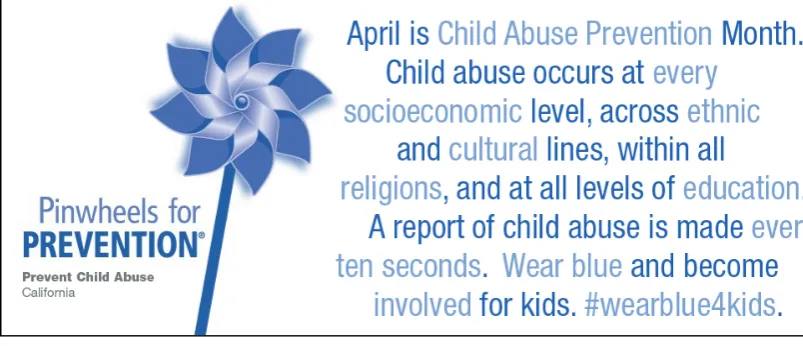
[image:26.595.110.512.167.340.2]Prevention of Child Abuse. APA developed the following fact sheet, "Violence Against Children in the US," with information on violence against children in the US. It includes tips for identifying and preventing child abuse, with an outline of the association's contributions to child abuse prevention.
Fig-1.1 Child abuse prevention (month)
National Child Abuse Prevention Month, also known as Child Abuse Prevention Month in America, is an annual observance in the United States dedicated to raising awareness and preventing child abuse. April has been designated Child Abuse Prevention Month in the United States since 1983.]U.S. President Barack Obama continued that tradition, and in 2016 issued a Presidential proclamation stating: "During National Child Abuse Prevention Month, we recommit to giving every child a chance to succeed and to ensuring that every child grows up in a safe, stable, and nurturing environment that is free from abuse and neglect.
Government of India study on child abuse (UNICEF) the findings of the Study on Child Abuse clearly indicate that a very large number of children in India are not even safe in their homes. It is here, in the home, that we must start tackling the problem of child abuse. Interventions are needed to bring about change in the ways family members behave towards children in the home.
5
6
1.2. SIGNIFICANCE OF THE STUDY
“The child is not a piece of stone that can be curved into any shape nor is a lump of clay that can be molded into any form”.
-Finkelhorand Korbin
Children have their own dynamic nature, seeking satisfaction. They have their own rights. They need adult care and protection. But now the scenario is changing and child abuse has emerged as a social issue involving a growing recognition of maltreatment as an unnecessary evil. They viewed child abuse as the portion of harm to children that results from human action that is proscribed (intentional), proximate and preventable.
Several surveys conducted by different government and non-government agencies revealed that child abuse is rampant in the country and especially in Kerala. The study of child abuse conducted by Pray as Institute of Juvenile Justice (2007) in Collaboration with the Ministry of Women and Child Development revealed that Two out of every three children were physically abused.
Over 50 percent of children in all the 13 sample states were subject to one or the other form of physical abuse. Out of 68.87 percent physically abused, 54.68 percent were boys. 88.60 percent were physically abused by parents.53.22 percent children reported having faced one or more forms of sexual abuse. 5.69 percent were sexually assaulted. Every second child (both boys and girls) reported facing psychological abuse. 53 percent of children were abused at home and in their families. 65 percent of school-going children faced corporal punishment.
7
Kottakkal in Malappuram district, parents of a 6th standard student were arrested. The parents are earned money by using their eleven year old daughter by prompting her for sexual abuse. The child is sexually abused by about 40 persons. Parents have been earning money for one and half year byusing their daughter (Madhyamam News Paper, July 7, 2015). On October 1, 2015 a seventeen year old girl was sexually abused at Manjeri in Malappuram district (Madhyamam Newspaper, October 1, 2015). These reports point out the prevalence of the child abuse in Malappuram district. Abused children showed less confidence and low self-esteem and decline in the intellectual functioning due to their attachment disturbance and subsequent lack of emotion competence in many situations (Erickson, 1989).
Child in the basic unit of the building block of the society . It is our duty to protect our children from Child Abuse. Most of the cases of Child Abuse remain unreported for various reasons such as fear of being accused, parental desire to curb publicity, fear of relation by the offenders or his friends and fear of police procedures. The lack of awareness and fear among the children amplify the intensity of Child Abuse. It is felt that abuses and its threats can be overcome through proper awareness about different types of Child Abuse. So the investigator intended to test the child abuse awareness among Higher Secondary School students in Malappuram district of Kerala. The study examines whether there exists any significant difference in the mean scores of Child Abuse Awareness among Higher Secondary School students based on gender.
W.H.O Child abuse or maltreatment constitutes all forms of physical and/or emotional ill-treatment, sexual abuse, neglect or negligent treatment or commercial or other exploitation, resulting in actual or potential harm to the child's health, survival, development or dignity.
Neilson (2014) Child abuse include physical assault, physical neglect, emotional abuse, and sexual assault that involves physical contact. Child abuse has far-reaching negative effects on its victims and on society. Survivors of child maltreatment are at greater risk for physical, emotional, work, and relationship problems throughout childhood and into adulthood.
8
exploitation, resulting in actual or potential harm to the child‘s health, survival development or dignity in the context of a relationship of responsibility, trust or power‘‘.
Richter & Dawes, (2008) potential harm and rests on actual harm being done to children…Flowing from above, child maltreatment or abuse can be categorized into physical abuse; emotional abuse; sexual abuse and neglect.
NATIONAL CHILD ABUSE STATISTICS
4 million child maltreatment referral reports received.
Child abuse reports involved 7.2 million children.
3.4 million children received prevention & post-response services.
207,000 children received foster care services.
75.3% of victims are neglected
17.2% of victims are physically abused.
8.4% of victims are sexually abused.
6.9% of victims are psychologically maltreated.
Highest rate of child abuse in children under one (24.2% per 1,000).
Over one-quarter (27.%) of victims are younger than 3 years.
Annual estimate: 1,670 to 1740 children died from abuse and neglect.
Almost five children die every day from child abuse.
80% of child fatalities involve at least one parent.
74.8% of child fatalities are under the age of 3.
72.9% of the child abuse victims die from neglect.
43.9% of the child abuse victims die from physical abuse.
9
Almost 60,000 children are sexually abused.
More than 90% of juvenile sexual abuse victims know their perpetrator.
Estimated that between 50-60% of maltreatment fatalities are not recorded on death certificates.
Child abuse crosses all socioeconomic and educational levels, religions,
ethnic and cultural groups.
Hindustan Times(2017) conducted a survey participated by more than 45,000 children in the 12- 18 age group, across 26 states in the country, revealed that one in every two children is a victim of child sexual abuse. The survey conducted by humanitarian aid organisation World Vision India with a sample of 45,844 respondents also revealed that one in every five do not feel safe because of the fear of being sexually abused. It also said one in four families do not come forward to report child abuse. “Despite one in every two children being a victim of child sexual abuse, there continues to be a huge silence. The magnitude of sexual violence against children is unknown,” World Vision India National Director Cherian Thomas said here while launching a campaign to end child sexual abuse and exploitation by 2021.
The “It Takes the World to End Violence against Children” campaign targets 10 million children across 25 states and one union territory.
“The campaign works through our area programmes that deal with different issues of health care typically -- malnutrition and early illness, education, child rights and protection and the improvement of resilience in communities,
10
1. The number of cases registered for child abuse raised from 8,904 in the year 2014 to 14,913 in the year 2015, under the POSCO Act. Sexual offences and kidnapping account for 81% of the crimes against minors
2. Preventive measures designed to ward off strangers (installing CCTV cameras and providing self-defence training) will be ineffective, as children do not know how to ward off unwanted sexual advances from their known relatives, acquaintances or workplace seniors, who they trust.
3. POSCO: State wise cases - Uttar Pradesh led the highest number of child abuse cases (3,078) followed by Madhya Pradesh (1,687 cases), Tamil Nadu (1,544 cases), Karnataka (1,480 cases) and Gujarat (1,416 cases).
BBC News (2017) reported that in India, a child is sexually abused every 15 minutes, according to the latest government figures. The National Crime Records Bureau report, released on Thursday, shows a steady rise in incidents of offences against children. According to the report on crimes in India for 2016, released by Indian Home Minister Rajnath Singh in Delhi, 106,958 cases of crimes against children were recorded in 2016. Of these, 36,022 cases were recorded under Pocso (Protection of Children from Sexual Offences) Act. The BBC's Geeta Pandey in Delhi says India is home to the largest number of sexually abused children in the world, but there is general reluctance to talk about the topic so the real number of cases could be much higher. According to a 2007 study conducted by India's ministry of women and child development, 53% of children surveyed said they had been subjected to some form of sexual abuse.
UNICEF (2016) revealed five shocking facts about child abuse in India;
Major abuse reported between the age group of 5 to 11 years
Boys, as compared to girls are equally at risk of abuse
Persons in trust and authority are major abusers, mostly parents
48.4% girls wished they were boys
11
One of the major problems in understanding the scope of the subject of 'child abuse' is that it is extremely difficult to get responses from children on such a sensitive subject because of their inability to fully understand the different dimensions of child abuse and to talk about their experiences. It is therefore difficult together data on abused children. Within countries, much less from country to country or region to region. Yet governments do estimate that the number of abused and neglected children is alarming, and unless governments get their act together and respond to the situation by way of both prevention and treatment, we will be doing a grave in justice to our children and would be denying them their basic rights.
Every year, thousands of families welcome a new baby into their home. The upcoming years are spent watching Disney movies, going to parks and petting zoos, buying ice cream from the truck, and finger painting with their family. Almost all those children brought into the world get to experience what it is to have a loving family, but for a small percentage, life is not so rosy. They are forced to deal with things that most of us would never imagine in our worst nightmares.
According to WHO (2010))It is estimated that 25-50% of children have suffered some forms of physical abuse and annually, there are 31, 000 homicides recorded among children under 15 years.
There are also widespread disparities in available estimates due to variations in operational definitions employed in studies on child abuse the quality of official statistics (WHO, 2010); different national reporting requirements and whether sample population consisted of potential perpetrators or victims of abuse.
These findings and assertions are in tandem with the recent South African Police Service‘s crime statistics report for 2011/2012 which showed that between
12
Rape 227,080 children are sexually abused each year. Assaults 811,000 children are physically abused each year. Hatred 97,320 children are emotionally abused each year. Neglect 2,011,280 children are neglected each year. Murder60,500 children die of child abuse each and every year. Child abuse is a state of emotional, physical, economic and sexual maltreatment meted out to a person below the age of eighteen and is a globally prevalent phenomenon.
Jewkes et al., ( 2009). In South Africa, according to a recent report by the South African Medical Research Council , child abuse is still a pervasive problem despite the protection offered by various legislative instruments enacted since the advent of popular democracy .
Andersson& Ho-Foster,( 2008) In the survey, male child sexual abuse was very common especially in rural areas with 44% of all the male children respondents reporting that they have been coerced into having sex.
Although parents have been raising children for thousands of years, it wasn't until the early seventies that child abuse was considered a crime in America, and in 2007 it remains the least recognized and least reported crime.
1.3 NEED FOR THE STUDY
“ IT SHOULD NOT HURT TO BE A CHILD”
Globally, child abuse and its consequences remain a major public health problem .Psychologists conducted a study in the United States in 2010 which examined over 200 regular church attendees from eleven different denominations of Christianity, most of whom were educated, upper-middle class White Americans, found that extrinsic religious orientation was associated with a greater risk of physical child abuse.
A 2010 article in the BBC reports that thousands of African children have been abandoned, tortured and murdered because they are believed to be witches.
13
high-income countries showed that 4-16% and about 10% of children have been physically abused and subjected to psychological maltreatment respectively.
In 2009 CBS News states that Unemployment and financial difficulties are associated with increased rates of child abuse. reported that child abuse in the United States had increased during the economic recession. It gave the example of a father who had never been the primary care-taker of the children. Now that the father was in that role, the children began to come in with injuries.
According to major countries, U.S. Department of Homeland Security(2013) Fresno area men among more than 250 child predators arrested during Operation of Guardian Investigators note ‘disturbing’ trends involving online enticement . Nine Fresno -area residents are among the 255 child predators arrested during a Five week operation conducted by U.S. Immigration and Customs Enforcement’s (ICE) Homeland Security Investigations (HSI) and Internet Crimes Against Children (ICAC) task forces across the United States and its territories Operation I Guardian, which ran May 28 to June 30, was a surge operation conducted as part of HSI’s Operation Predator to identify and rescue victims of online sexual exploitation and to arrest their abusers as well as others who own, trade and produce images of child pornography.
In surveying public school students in Grades 6, 9 and 12 in the United States. A further study in the United States found that 28% of physically abused adolescents used drugs compared to 14% of non-abused adolescents Compared to 22% of the non-abused group, 36% of physically abused adolescents also had high levels of alcohol use.
Recent study by the Centers for Disease Control (CDC) estimated the total lifetime economic burden resulting from child maltreatment in the United States to be as large as $585 billion (Fang, Brown, Florence, & Mercy, 2012).
14
between the potential risk factors of parental employment status, alcohol abuse, and family size within the abuse ratings. In three of the four countries, parental substance abuse was considerably correlated with the presence of child abuse, and although it was a lower percentage, still showed a relationship in the fourth country (Moldova). Each country also showed a connection between the father not working outside of the home and either emotional or physical child abuse.
SOMYA AGARWAL (2016) conducted a research on child abuse in India across various states of the country . The mojor findings of the research are,
Physical Abuse
1. Two out of every three children were physically abused.
2. Out of 69% children physically abused in 13 sample states, 54.68% were boys.
3. Over 50% children in all the 13 sample states were being subjected to one or the other form of physical abuse.
4. Out of those children physically abused in family situations, 88.6% were physically abused by parents.
5. 65% of school going children reported facing corporal punishment i.e. two out of three children were victims of corporal punishment.
6. 62% of the corporal punishment was in government and municipal school.
7. The State of Andhra Pradesh, Assam, Bihar and Delhi have almost
consistently reported higher rates of abuse in all forms as compared to other states.
8. Most children did not report the matter to anyone.
9. 50.2% children worked seven days a week.
Sexual Abuse
15
2. Andhra Pradesh, Assam, Bihar and Delhi reported the highest percentage of sexual abuse among both boys and girls.
3. 21.90% child respondents reported facing severe forms of sexual abuse and50.76% other forms of sexual abuse
4. Out of the child respondents, 5.69% reported being sexually assaulted
5. Children in Assam, Andhra Pradesh, Bihar and Delhi reported the highest incidence of sexual assault.
6. Children on street, children at work and children in institutional care reported the highest incidence of sexual assault.
7. 50% abuses are persons known to the child or in a position of trust and responsibility.
8. Most children did not report the matter to anyone.
Emotional Abuse and Girl Child Neglect
1. Every second child reported facing emotional abuse.
2. Equal percentage of both girls and boys reported facing emotional abuse.
3. In 83% of the cases parents were the abusers.
4. 48.4% of girls wished they were boys.
This study was conducted by reviewing medical literature, published between
16
of corporal punishments and cruelty to children at homes, schools, and juvenile centers, which ranged from 51-81%.
In Asia child abuse reports are certain child abuse and neglect issues are common in almost all countries at the global level such as physical abuse, sexual abuse, emotional and psychological abuse, abandonment and, increasingly, problems of street children , there are also many issues which are prevalent only in certain regions of the world. For instance, in Asia where population density is high, the issues of child labor and child sexual exploitation are also high. Prevention of child abuse and neglect is still an uncharted field in Asia. The largest population of children in the world live in South Asia and majority of these children lack access to proper healthcare, nutrition and education. This reflects the socio-economic reality of the developing countries of the Asian region. The main factors that contribute to the magnitude of the problem of child abuse are poverty, illiteracy, caste system and landlessness, lack of economic opportunities, rural-urban migration, population growth, political instability and weak implementation of legal provisions.
In India, Bangalore saw a number of cases of child sexual abuse in 2014
andpeople were out on streets protesting against the rise in crime against children. Out of 289 cases registered under Protection of Children Against Sexual Offenses Act (POCSO) in the last two years.
In India harmful traditional practices like child marriage, caste system, discrimination against the girl child, child labor and Devadasi tradition impact negatively on children and increase their vulnerability to abuse and neglect. Lack of adequate nutrition, poor access to medical and educational facilities, migration from rural to urban areas leading to rise in urban poverty, children on the streets and child beggars, all result in breakdown of families. These increase the vulnerabilities of children and expose them to situations of abuse and exploitation.
In India 33,098 cases of crimes against children were reported during 2011
17
According to the report published in 2005 on 'Trafficking in Women and Children in India', 44,476 children were reported missing in India, out of which 11,008 children continued to remain untraced. India, being a major source and destination country for trafficked children from within India and adjoining countries has, by conservative estimates, three to five lakh girl children in commercial sex and organized prostitution.
The population of children aged 0-6 years is 16.4 crores as per the 2007
Census. According to a UNESCO report, however, of the total child population, 2.07 crores (6%) are infants below one year; 4.17 crores (12%) are toddlers in the age group 1-2 years; 7.73 crores (22.2%) are pre-schoolers in the age group 3-5 years. The report highlights that only 29% of pre-primary age children are enrolled in educational institutions in India.
India has the world's largest number of sexually abused children, with a child below 16 years raped every 155th minute, a child below 10 every 13th hour and one in every 10 children sexually abused at any point of time. The National Crime Records Bureau (NCRB) reported 14,975 cases of various crimes against children in
2005. Services under the ICDS scheme covered only 3.41 crore children in the age group 0-6 years as in March 2004, which is around 22% of the total children in that age group. Supplementary nutrition too was being provided to 3.4 crore children, as against 16 crore children. Of these, 53% were reported to be under-nourished.
Child abuse in India, according to the NCPCR (National Commission for Protection of Child Rights) report, increased to 763 for 2009-10 from 35 in 2007-
Child abuse complaints included incidents of rape, trafficking, humiliation, physical and mental torture. As per the NCPCR report, in India, the maximum numbers of child abuse complaints were received from Uttar Pradesh, which stood at Delhi, Orissa, Bihar and Madhya Pradesh and West Bengal followed Uttar Pradesh from where 127,58,46,42 and 39 cases were received respectively. Northeastern states of India, Sikkim, Meghalaya, and Tripura reported no child abuse complaints.
18
knowledge of teachers in the selected school and give information Pamphlet to them so that they are benefitted. As today’s children are the future of our country so safeguarding the children is safeguarding the nation.
Review of related literature shows that Child abuse is an infringement of a child’s basic human rights (Kellog, Parra & Menard, 2007), which occurs across cultural and societal boundaries, despite variations in its incidence, form and definition. It is common in developing and developed countries (Finkelhor, 2000). In 1974, the US congress passed The Child Abuse Prevention and Treatment Act. They defined child abuse as “the physical mental injury, sexual abuse, negligence or maltreatment of the child, under the age of eighteen, by a person who is responsible for child’s welfare which indicates that child health and welfare is threatened thereby”.
Physical abuse is an act of another party involving contact intended to cause of feelings of physical pain, injury or other physical suffering or bodily harm. It is the inflicting of physical injury upon a child. This may include burning, hitting, punching, shaking, kicking, beating or otherwise harming a child. The parent or caretaker may not have intended to hurt the child. It may however, be the result of over-discipline or physical punishment that is inappropriate to the child’s age (WHO, 1999). Emotional abuse is also known as verbal abuse, mental abuse and psychological maltreatment. It includes acts or failure to act by parents or caretakers that have caused or could cause, serious behavioural, cognitive, emotional or mental trauma. Sexual abuse is defined as the involvement of dependent, developmentally immature children in sexual activities that they do not fully comprehend to which they are unable to give informed consent or that violate the social taboos of family roles. It includes pedophilia, incest and rape (Kempe et al, 1962). Neglect implies the failure of the parent to act properly in safeguarding health, safety and wellbeing of child. Child Abuse Awareness is the degree of information or knowledge about child abuse and understanding of different ways of responding in certain situations which may lead to the occurrence of abuse.
19
emotional abuse (10.8%), sexual abuse (12.6%), physical neglect (20%) and emotional neglect (30.6%). Both male and female affected sexual abuse. A study of child abuse awareness conducted by Usha&Remitha (2009) reveals that boys and girls significantly differ in their awareness about child abuse. Girls have more awareness than boys. Rural and Urban students also differ significantly in the awareness of child abuse. Gafoor&Gifty (2013) conducted a study Child Abuse in relation to Anxiety in Idukki District indicates that 97.7% children undergo severe or mild form of abuses.. The study reveals that the majority of abuses take place also within the family environment except sexual abuse from neighbours. All types of child abuses except sexual abuse and child labour ,more among in boys than girls. There is significant and positive relation between child abuses of all types, except child labour, and student’s Anxiety. Since child abuse is the major issue in our society, the researcher was interested to do the study on child abuse.
1.4 STATEMENT OF THE PROBLEM
A study to evaluate the effectiveness of video assisted teaching on the knowledge regarding child abuse among school age children in selected school Coimbatore.
1.5 OBJECTIVES
To assess the existing knowledge on child abuse among school age children
To evaluate the effectiveness of video assisted teaching regarding child abuse among the school age children
To find out the association between the pretest knowledge level of the school age children with their selected demographic variables.
1.6 HYPOTHESIS
H1: The mean posttest knowledge level will be significantly higher than mean pretest knowledge level of the school age children.
20
1.7 OPERATIONAL DEFINITION
Evaluate : An evaluation is an appraisal of something to determine its worth or fitness. In this study the information on knowledge of the school age children regarding child abuse was evaluated.
Effectiveness : It is the capability of producing a desired output. In this study, it refers to determine the extent to which the video assisted teaching has achieved the desired effect in improving the knowledge of the school age children regarding child abuse.
Child abuse : Child abuse is any form of physical, emotional and/or sexual mistreatment or lack of care that causes injury or emotional damage to a child
School age children : The age at which a child may or must begin to attend school and the years during which attendance at school is required or customary.
Video assisted teaching: Well organized teaching material prepared and taught by using video. In this video assisted teaching on child abuse was prepared for school age children.
Knowledge : Information gained through experience on education. It refers to correct response to school age regarding child abuses which is measured by structured questionnaire.
1.8 ASSUMPTIONS
This study assumes that,
School ages are at risk of child abuse
School ages are exposed to child abuse
School ages may have inadequate knowledge of child abuse
Education may help to improve the knowledge of child abuse
21
1.9 DELIMITATIONS OF THE STUDY
The study delimited to,
School age children
Knowledge will be assessed only through the structured questionnaire.
1.10 PROJECTED OUTCOMES
The findings of the study will help to improve the knowledge of the school age regarding child abuse.
The findings help to assess the effectiveness of video assisted teaching to improve the knowledge of school ages.
The findings help to reduce the incidence of child abuse.
1.11 CONCEPTUAL FRAMEWORK:
A conceptual framework is a group of related concepts and a set of propositions that spell out the relationship between them. It provides an overall view or orientation to focus thoughts. A conceptual framework is used in research to outline possible courses of action. Their overall purpose is to make specific findings meaningful and generalizable.
Conceptual framework facilitates communication and provides for a systematic approach to nursing research, education, administration and practice.
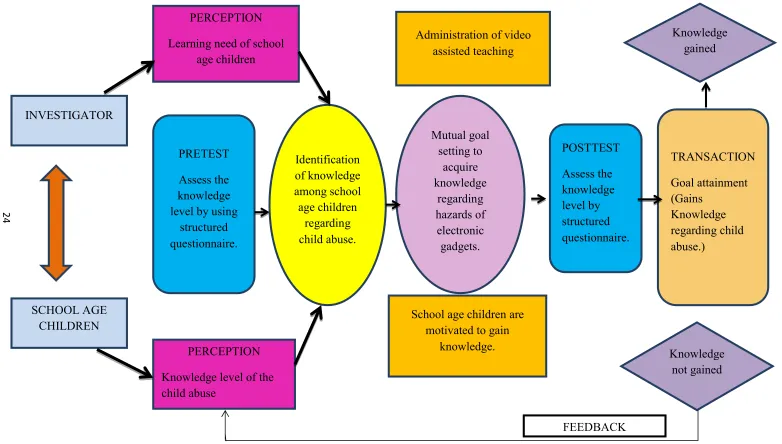
Conceptual framework selected for this study was based on Imogene King’s “Goal Attainment Theory: King stated that “the structure of a system may be reflected by a human being viewed as an open and dynamic system interacting with an environment. The major element of the theory of goal attainment are seen in the interpersonal systems in two people, who are usually strangers, come together in a healthcare organization to help and be helped to maintain a state of health that permits functioning in roles.
22
are interrelated in every nursing situation. These terms are defined as concepts of conceptual framework.
Interaction
Interaction is a kind of action that occurs as two or more objects have an effect upon one another. The idea of a two way effect is essential in the concept of interaction, as opposed to a one way casual effect. Video assisted teaching on child abuse.
Perception:
A person imports energy from the environment and transforms, processes and stores it. The individual then exports this energy as demonstrated by observable behavior. In this study, the investigator perceives learning needs of school age children regarding child abuse.
Communication:
It is a process whereby information is given from one person to another person either directly or indirectly. Investigator administers the structured questionnaire to assess the knowledge regarding child abuse.
Transaction:
It is an observable behavior of human beings interacting with that environment. in this study, through the video assisted teaching the school age children acquired knowledge regarding child abuse.
Role:
It is a set of behaviors expected of persons occupying a position in a social system. In this study, the knowledge gained out of the teaching makes the school age children to protect themselves from child abuse.
Stress:
23
completion of the teaching, the school age children are enriched with knowledge to handle the situation.
Growth and development:
The continuous changes in individuals at the cellular, molecular and behavioral levels of activities. In this study, the school age children mature through the knowledge obtained.
Time:
A person experiences a sequence of events that move toward the future. The school age children refine their practice in their life.
Space:
24
SCHOOL AGE CHILDREN
PERCEPTION Learning need of school
age children
PERCEPTION Knowledge level of the child abuse
Administration of video assisted teaching
School age children are motivated to gain
knowledge. PRETEST
Assess the knowledge level by using
[image:46.842.34.816.70.514.2]structured questionnaire. POSTTEST Assess the knowledge level by structured questionnaire. TRANSACTION Goal attainment (Gains Knowledge regarding child abuse.) Identification of knowledge among school age children regarding child abuse. Mutual goal setting to acquire knowledge regarding hazards of electronic gadgets. Knowledge gained Knowledge not gained INVESTIGATOR FEEDBACK
Fig: 1.2CONCEPTUAL FRAMEWORK ON IMOGENE KING’S GOAL ATTAINMENT THEORY
25
CHAPTER-II
REVIEW OF LITERATURE
“There is little doubt that child abuse and childhood experience of loss, when no Effective opportunity is provided for the child to make sense of these experiences constitutes unresolved trauma which is likely to manifest itself in some way at a later date”.
-Boswell, 1997:35
The literature review has been called the ‘‘Cinderella’’ of research, because it is often seen as the poor relation to primary research, or the dull but necessary prelude to a research report or proposal. Literature reviews are found in many places and are written for many reasons, including ‘‘proposals for funding and for academic degrees, in research articles, in guidelines for professional and evidence-based practice, and in reports to satisfy personal curiosity’’.
Review of Literature provides with the current theoretical and scientific knowledge about a particular problem and resulting synthesis of what is known and not known. Current information is received by regularly searching the literature on topics of particular interest. The review of literature in quantitative search is conducted to direct the planning and execution of a study. The major literature is performed at the beginning of the research process and a limited review provides a basic understanding of the study problem and evidence that the study conducted was appropriate as indicated by the current knowledge of this problem.
The Review of Literature further divided into 2 sections as follows:
Section A : Studies and literature related to incidence and prevalence of child abuse
26
2.1 SECTION A: Studies Related To Incidence And Prevelance of
Child Abuse:
Cawson et al, ( 2000) conducted a study to survey and suggest that one in six children across the UK experience serious abuse at some time during their childhood. It would now enable direct comparison with the proportion of the general population abused if a similar methodology were used with young people in custody. Child abuse is an international phenomenon. UK statistics obtained from the Child Protection Register in 1999 stated 42% of referrals reported cases of neglect and 31% reported physical injury .More recent figures from (2004/05) show a total of 25,900 children on the Child Protection register as of 31 March 2005: 11,400 for reasons of neglect ƒ 3,900 for physical abuse 2,400 for sexual abuse 5,200 for emotional abuse 3,000 for multiple reasons. However, it is accepted that annual registration figures cannot be taken as an accurate measure of child abuse alone – young people will feature on the registration list for being ‘at risk’ of abuse as opposed to having already experienced it, many are excluded when they are known to have been abused, and of course there are the young people whose abuse is not yet known and is therefore not recorded.
Skuse et al (2002) revealed that sexual abuse is possibly easier to define but often hard to identify, particularly among male victims, due to the stigma that surrounds it and the impact this has on people’s ability and willingness to disclose. The researcher reported to prevalence figures vary between (3% and 37% for boys, and 6% to 62% for girls).
According to the report published in 2005 on 'Trafficking in Women and Children in India', 44,476 children were reported missing in India, out of which 11,008 children continued to remain untraced. India, being a major source and destination country for trafficked children from within India and adjoining countries has, by conservative estimates, three to five lakh girl children in commercial sex and organized prostitution.
27
substance abuse and 103 (87%) boys had been employed as child laborers. Physical abuse was reported by 86 (72%) and sexual abuse by 42 (35%). Mental health problems were recognized in 83 (70%) boys, which included internalizing syndromes (59%) and externalizing syndromes (34%).
Carlos Blanco (2007) In this study examines the prevalence, correlates, and psychiatric disorders of adults with history of child sexual abuse (CSA).Data were derived from a large national sample of the US population. More than 34 000 adults 18 years and older residing in households were interviewed face-to-face in a survey conducted during the 2004-2005 period. Diagnoses were based on the Alcohol Use Disorder and Associated Disabilities Interview Schedule–Diagnostic and Statistical Manual of Mental Disorders, Fourth Edition, and version. Weighted means, frequencies, and odds ratios of sociodemographic correlates and prevalence of psychiatric disorders were computed. Logistic regression models were used to examine the strength of associations between CSA and psychiatric disorders, adjusted for sociodemographic characteristics, risk factors, and other Axis I psychiatric disorders. The prevalence of CSA was 10.14% (24.8% in men and 75.2% in women). Child physical abuse, maltreatment, and neglect were more prevalent among individuals with CSA than among those without it. Adults with CSA history had significantly higher rates of any Axis I disorder and suicide attempts. The frequency, type, and number of CSA were significantly correlated with psychopathology. The high correlation rates of CSA with psychopathology and increased risk for suicide attempts in adulthood suggest the need for a systematic assessment of psychiatric disorders and suicide risk in these individuals. The risk factors for CSA emphasize the need for health care initiatives geared toward increasing recognition and development of treatment approaches for the emotional sequelae CSA as well as early preventive approaches.
Ministry of Women and Child Development (2007) conducted a study related to physical abuse and sexual abuse, involving 12,447 children, reported that 69% were physically abused and 53% were subjected to one or more forms of sexual abuse.
28
was 22% faced severe sexual abuse, 6% sexually assaulted, 53% children report facing one or more forms of sexual abuse, 50% of sexual offenders were known to the victim or were in position to trust (family member, close relative, friend or neighbor), 5-12years group faced higher levels of abuse, largely reported, severest sexual abuse in age group of 11 to 16 years, 73% of sexual abuse victims were in age group of 11-18years.
Juana Gomez-Benito (2008) The purpose of this paper was to compare the prevalence rates of child sexual abuse. The results revealed that Thirty-eight independent articles were identified, corresponding to 39 prevalence studies; these articles report the prevalence of childhood sexual abuse in 21 different countries, ranging from 0 to 53% for women and 0 to 60% for men .Comparison of the present study with that of “The international epidemiology of child sexual abuse” shows a similarity between prevalence distributions; there appears to be a general pattern that remains more or less constant over the years, especially in women. The present study shows child sexual abuse is still a widespread problem in the society. In this research, carried out on 38 independent studies, there is new data for 21 countries over the world, being especially relevant the results obtained from other countries different from those pertaining to North America or Europe. It is important to point out the high prevalence found in most of the countries, so this information could be a new warning to make society and governments aware of this problem and undertake actions to prevent sexual abuse in childhood.
29
North American studies. The co-occurrence rates noted are salient enough to necessitate particular attention to diverse clinical clientele and need to be considered in future research exploring the risk factors of violence and its subsequent repercussions.
Harkness & Lumley, (2008) concluded in their seven large-scale studies, all studies showed a high association between child maltreatment and depression in adolescence. For example, the authors cited a longitudinal study by Brown and colleagues which found that children and adolescents who reported a history of abuse or neglect were three times more likely to exhibit a depressive disorder than non-maltreated children, 62% of children met the criteria for at least one mental health diagnosis.
Child abuse in India, according to the NCPCR (National Commission for Protection of Child Rights) reports, increased to 763 for 2009-10 from 35 in 2007-
Child abuse complaints included incidents of rape, trafficking, humiliation, physical and mental torture. As per the NCPCR report, in India, the maximum numbers of child abuse complaints were received from Uttar Pradesh, which stood at Delhi, Orissa, Bihar and Madhya Pradesh and West Bengal followed Uttar Pradesh from where 127,58,46,42 and 39 cases were received respectively. Northeastern states of India, Sikkim, Meghalaya, and Tripura reported no child abuse complaints.
Shenk & Putnam, (2009) concluded in their Meta-analyses of 21 studies of child sexual abuse reported that this form of abuse more than doubled the risk of adolescent pregnancy (i.e., prior to age 20 years).
Fergusson and colleagues (2010) found that young women (18 years of age) exposed to child sexual abuse had significantly higher rates of teenage pregnancy, increased rates of sexually transmitted diseases, and higher rates of multiple sexual partnerships and appeared to be more vulnerable to further sexual assault and rape.
30
concurrent or chart-review studies of children undergoing evaluation or treatment for sexual abuse. The evidence indicates that the majority of abused children do not reveal abuse during childhood. However, the evidence fails to support the notion that denials, tentative disclosures, and recantations characterize the disclosure patterns of children with validated histories of sexual abuse. These results are discussed in terms of their implications governing the admissibility of expert testimony on CSAAS.
In India 33,098 cases of crimes against children were reportedduring 2011as compared to 26,694 cases during 2010, suggesting a recent increase of 24.0 percent. Reports show that 53.22% of the abused children reported having faced one or more forms of sexual abuse.
Roberto Maniglio (2011) analysed large amount of studies and literature reviews on the consequences of child sexual abuse has appeared over the past twenty years. To prevent that the inconsistency in their conclusions along with their methodological differences and limitations may create interpretative difficulties, mistaken beliefs, or confusion among all professionals who turn to this literature for guidance, this paper addresses the best available scientific evidence on the topic, by providing a systematic review of the several reviews that have investigated the literature on the effects of child sexual abuse. Seven databases were searched, supplemented with hand-search of reference lists from retrieved papers. The author and a psychiatrist independently evaluated the eligibility of all studies identified, abstracted data, and assessed study quality. Disagreements were resolved by consensus. Fourteen reviews, including more than 270,000 subjects from 587 studies, were analyzed. There is evidence that survivors of childhood sexual abuse are significantly at risk of a wide range of medical, psychological, behavioral, and sexual disorders. Relationships are small to medium in magnitudes and moderated by sample source and size. Child sexual abuse should be considered as a general, nonspecific risk factor for psychopathology.
31
paper was to show that distress in this pattern of deprivation is manifested by the children in several ways and in different contexts: low school performance, drop-out from school, conflicts with teachers and peers, anxiety low self-esteem, tendency to feel depressed, apathy, suicidal behaviour, and substance abuse.
Trickett Penelope K. Mc Bride - Chang Catherine (2012) In this paper reviews and integrates research knowledge about the impact of different forms of child maltreatment-physical abuse, sexual abuse, and neglect. Both the short-term impact on the child and the long-term impact on the adolescent and adult are considered. A developmental perspective guides the review. Research studies on these forms of child maltreatment which meet certain criteria (e.g., an appropriate comparison group) are reviewed with the aim of understanding how the experience of child abuse or neglect interferes with development at the time it is experienced and how it may affect the resolution of later developmental processes or tasks as the individual goes through adolescence and then adulthood. Evidence about the role of other mediating factors such as gender and other individual difference variables, characteristics of maltreatment, and family environment is also presented. Gaps in knowledge are noted, and recommendations are made for future.
Mathews et al.,( 2012) released a recent crime statistics released by the South African Police Service showed that children are increasingly being targeted by abusers and common criminals alike. The crime statistics report for 2012 showed that 25862 children (representing 40.1% of sexual offences) were victims of sexual offences. During the same period, more than 23,000 children were assaulted with almost half of them suffering grievous bodily harm in the process. The results depicts Twenty of 365 studies (5.5%) yielded fractures involving the spine, hands, or feet. Of all positive skeletal surveys, 8.9% (20/225) had fractures involving the spine, hands, or feet.. The conclusion was the benefits of eliminating views of these regions from the initial skeletal survey should be carefully weighed against the cost of missing these potentially important injuries in at-risk pediatric populations.
32
anxiety and substance use and post traumatic stress disorders have an earlier age at onset, greater symptom severity, more co morbidity, a greater risk for suicide, and poorer treatment response than non maltreated individuals with the same diagnoses. Maltreated individuals also differ from others as a result of epigenetic modifications and genetic polymorphisms that interact with experience to increase risk for psychopathology. Phenotypic expression of psychopathology may be strongly influenced by exposure to maltreatment, leading to a constellation of eco phenotypes. While these eco phenotypes fit within conventional diagnostic boundaries, they likely represent distinct subtypes.
Loops NR, Williams LC, et,al;(2013) conducted a pediatric abusive head trauma as a form of physical abuse against infants and young children at Brazil, highlighting the prevalence, signs and symptoms, consequences, risk factors for its occurrence, and prevention. It occurs mainly in infants and children under 1 year of age and may result in severe consequences, from physical or mental disabilities to death. Although there are specific signs for this form of abuse, they can be mistaken for common illnesses in children or accidental head injury; thus, clinical training of professionals involved in the assessment of cases to attain the correct diagnosis is crucial. It is suggested that its incidence indicators be assessed at the national level.
33
conducted, the educational level of subjects, and the ethnic composition of the sample.
Nichols. J, Embleton, et.al;(2014) conducted a quantitative study to determine whether orphans are more likely to experience physical and/or sexual abuse compared to non-orphans at sub-Saharan Africa (SSA) The studies consisted of a total 17,336 participants (51% female and 58% non-orphans). Of those classified as orphans (n=7,315), 73% were single