Abstract: Cloud computing is today’s latest technology in computing for storing and managing data in IT sector. It is the upcoming era of registering what's more, a creating processing worldview in the present day industry, either might be government associations or people in general associations.
It is shifted from purchase of a product to pay as you go service, that is delivered to the users using internet and datacenters to store the data, known as Cloud, to store and maintain by different cloud service providers like ; Google, Salesforce etc. In cloud computing environment there should be an effectively and efficiently way to access the data with minimum time and limited resources with proper security, for this purpose, we can use the allocation and scheduling. To speed up the operations, various task scheduling techniques and algorithms were proposed so far but still most of them are not considering both Quality of Service (QoS) and virtual machine optimization factor, which is the upmost important parameter to satisfy the needs of user and effective utilization of resources.
By using the cloud simulator, we can create applications using different components like Datacenters to for cloud services, host, cloudlets, different types of users, virtual machines, and other utilities for configuration and analyzing the cloud computing environment. This paper presented a technological survey on task scheduling algorithms with specifying the important features on the CloudSim simulator.
Keywords: Cloud Computing, Scheduling, Task Scheduling, CloudSim, Pay as you go
I. INTRODUCTION
Cloud computing is a buzzword that means different things to different people. For some, it's just another way of describing IT (information technology) "outsourcing"; others use it to mean any computing service provided over the Internet or a similar network[2]; and some define it as any bought-in computer service you use that sits outside your firewall. Cloud computing is the most favorite and valuable technology adopted by today's IT industry. It companies migrate their services, infrastructure in cloud to provides services using large scale cloud environment. The cloud computing increases the reliability of services with cost effective way [1]. In basic terms we can define Cloud computing is collection of various servers that take into account need of diverse customers in light of their demands. Clouds have extremely capable data centers to deal with expansive number of client's demands. Cloud Computing has
Revised Manuscript Received on December 22, 2018.
Rahul Bhatt, Uttarakhand Technical University, Dehradun, India
Mayanak Agarwal, GurukulKangri University, Dehradun, India
become a spearhead in the field of industries and academia. The cloud is scalable and it can provide the access as per demand, due to this resource access requests are increasing, and submitted to the server. To man-age all request, scheduling is the solution to assign request with the quality of service. To avoid high operating cost, resource scheduling needs to be energy-aware.
As far as the IT Industry is concerned, it is pioneering the peculiar domains of clustering, virtualization, and grid computing. Traditionally, the complex computation nowadays, demands abundance of resources and computing facilities to perform operational tasks. Cloud computing provides user a new wave in procuring available resources. Cloud computing is prominent technology in the current era. Every company shifted their infrastructure on the cloud to speed up their operation in cost effective way.
The cloud computing is the innovation utilized over the Web. Cloud computing depends on the distributed computing giving versatile, hardware, software over the Internet. Cloud offers resources, for example, storage, network, and so on. It is the accumulation of servers appropriated over the all-regions of the world which give distinctive administrations on request. In the cloud registering, actual processing is finished by the remote servers. A cloud can be a public, private, or hybrid sort. These clouds give distinctive services to the end-clients on the request. The most basic administrations are Software as a Service (Saas), Platform as a Service (PaaS) and Infrastructure as a Service (IaaS) [1].
Cloud computing has started to gain extensive appreciation inside the corporate world as well, because it has given permission to access the required resources as Internet. The process of accessing and sharing of the resources is performed in a very virtual and protected way so that a general user is not aware of the task that is performed.
The primary goal of cloud computing are to share hardware resources, software resources , data resources through web to decreased general cost of the framework, to give better execution as far as normal response time and normal processing time, keep up the framework consistency and to give future adjustment in the system[3].
A Technological Review on Scheduling
Algorithm to Improve Performance of Cloud
Computing Environment
A. Cloud Computing Environment
Cloud is the source where we can store and retrieve the data, in cloud computing cloud is the internet which provides the services for computing at different level for the users in various ways. It is a shared infrastructure, that contains the everything at one place, like heterogeneous data, distributed virtualization etc., where users can take benefits for storing, managing data with unlimited data storage with variety of data in various formats via internet and that can be handled by own gadgets like mobile, laptops, desktop computer etc.
[image:2.595.311.541.53.183.2]Using cloud computing, different users can start their business without any physical infrastructure, they can use the cloud computing services as they required anytime anywhere with their own, Figure 1 shows the cloud computing environment [36]. In diagram cloud computing can be considered as three a) Datacenters for physical resources b) Different users and different services, and c) End-users for use these services.
Figure 1. Cloud Computing Environment
B. Cloud types
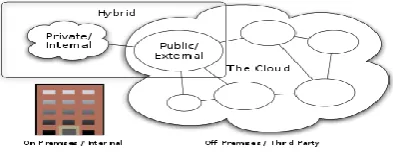
[image:2.595.52.287.279.411.2]The cloud computing architecture with different clouds are shown in Figure 2, it explains mainly three types of clouds a) First type of cloud is public, in which all data is available for the public service, they can use services, store data publically, communicate and share using web application or web services with the help of internet, b) Second type of cloud is private which can be used by authorized users, they can store data for personal use and which is secure as compared to public. C) In hybrid cloud some data can be used for public service and some data for personal use with proper authentication and authorization for most organization.
Figure 2 Types of Cloud Computing
C. Cloud reference architecture
Figure 3 shows SaaS, PaaS, and IaaS cloud service in cloud infrastructure, which provides the cloud services with secure environment with security issue analysis. Cloud computing have different characteristics that makes the cloud environment easy approachable for different types of uses and services.
Figure 3 Cloud computing services architecture
It is having many characteristics like pay as you go service, use any time anywhere with help of using mobiles, laptops, or desktops , sharing capability with many user at the same time with reliable data storage and recovery system, scalability feature with on demand facility with professional knowledge , it is also good for resource utilization and security.
To meet each changing business, require association need to contribute time and spending plan to scale-up IT framework, for example, equipment, programming, and administrations. In any case, if out-premises IT foundation, the scaling procedure can be moderate and associations are every now and again unfit to accomplish ideal usage of IT framework.
We have organized our paper as follows: In Section II, we have covered related work and background of our work, cloud computing, scheduling approaches and load balancing techniques in cloud. In Section III we have covered the simulation requirement in cloud computing with modeling of cloud, VL allocation, steps for simulation and working of CloudSim with some results using FCFS scheduling. Finally, we conclude in Section IV.
II. RELATEDWORKANDBACKGROUNDUNITS
A. Cloud computing and Scheduling
In the area of cloud computing, many researchers are working on different parameters of cloud computing uses and management. It is the way of delivering numerous computing services such as data recovery, security, database, software over the Internet, known as cloud[5][6].
Rodriguez and Buyyaet. al [7] given the task scheduling strategy with different constraints like deadline and cost minimization using meta-heuristic optimization technique. For optimization they have considered various parameters such as heterogeneity of resources, dynamic variations, and performance of Virtual Machines available were considered.
Abirami S.P.et. al[8] gives an algorithm to ensure that all resources are efficiently utilized and all jobs given by the end user are executed with smaller delays, they have also gives a technique to improve the throughput on different virtual machines, known as provisioning.
[image:2.595.70.267.576.656.2]They have used many algorithms with different scheduling algorithms like main scheduling like; first come first service, Round robin and Linear Scheduling for Tasks and Resources (LSTR).
Hong Sunet. al[10] and Lal Shri Vratt Singh [11] explains the task scheduling algorithms by considering Quality of service with constraint and issues related to cloud computing respectively and comparison of task scheduling.
Qi Cao, Zhi-bo Wei et. al [12] focuses on Activity based Costing algorithm for performance analysis of cloud computing using SimGrid simulator for complex conditions.
S.Selvaraniety. al [13] and Raghavan et al. [14] covers the Activity based costing algorithm and bat algorithm for scheduling algorithm for CloudSim1.0b is employed to carry out and simulate the tasks assignment algorithm.
Nallakumar. R et. al [15], proposed the CloudSim tool kit for modeling of cloud computing environment by creating all components of it with suitable resource provisioning policies.
Raj et al [16] promoted the process of resource isolation in order to guarantee shielding of data while processing, with the help of extrication processor caches inside the virtual machines, and the isolation of the virtual caches from the hypervisor cache is done here.
Youngmin Jung et al. [17] has given a proposal for an adaptive protection management sculpt for cloud computing environment. They recommended Role Based Access Control (RBAC) method, which is a malleable retrieval algorithm for choosing the control of accessing the resources.
B. Scheduling Approaches
Table 1 shows the job scheduling that includes first come first serve, round robin, max-min and task scheduling that includes static, dynamic, heuristic and real-time scheduling etc. [15].
Table I TYPES OF SCHEDULING Job Scheduling Task Scheduling 1.Batch mode Heuristic
Scheduling Algorithm
1.Workflow Scheduling
2. On-line mode
Heuristic Algorithm
2.Static and Dynamic Scheduling Algorithm
3. Dependency mode Heuristic Algorithm
3.Cloud Service Algorithm at user and system level
4.Real-Time
5.Heuristic approach like Genetic and Ant Algorithm
6.Opportunistic load balancing Scheduling
7.Agent Task Scheduling
C. Existing Load Balancing Techniques in Clouds
Many researchers are also working in the load balancing in clouds; we have done some literature review in this area.
A. Singh et al. [14] proposed a VectorDot for load balancing that is used to handle the complexity and hierarchy at across the network using cloud computing components.
Other approaches covered by many researchers like CARTON by R. Stanojevic et al. [18], Intra Cloud load balancing by Y. Zhao et al. [19], event-driven load balancing algorithm for real-time problems by V. Nae et al. [20] scheduling strategy on load balancing of VM resources by J.
Hu et al. [21] , CLBVM by A. Bhadani et al. [22], LBVS by H. Liu et al. [23], Two level task scheduling by Y. Fang et al. [24], honeybee-based load balancing technique by M. Randles et al. [25], ACCLB by Z. Zhang et al. [26] , OLB and LBMM by S.-C. Wang et al. [27], WCAP by H. Mehta et al. [28], server-based load balancing policy for web servers by A. M. Nakai et al. [29], Join-Idle Queue load balancing algorithm by Y. Lua et al. [30], lock-free multiprocessing load balancing by X. Liu et al. [31] , DBD-CTO by Lua Y., Xiea Q. et. al [30], swarm optimization based algorithm by Liu Xi et. al [31].
Armbrust M. et. al [32] they have given approach to minimizing the total transferring time and the time of execution with optimization of cost.
Pallis G et. al [33] develops an approach for scheduling workflow tasks over the available resources of cloud that minimized the execution time and execution cost under the given deadline and budget constraint. Rimal B.P et. all [34] gives the GA for high performance in cloud environment.
Cloud computing load balancing is based on following parameter, Response Time, Resource Utilization, Scalability, Performance to check the response time, efficiency of the approach.
Saxena, P., Sharma, S. K., & Verma [36] Explains Cloud computing is the storing, processing and management of applications, data and programs using the Internet and not through the hard drive of a personal computer.
Naseera, S [37] present a review on energy aware job scheduling algorithms existing 2 in the literature. This paper helps the readers to understand the functionality and parameters focus of various energy aware scheduling algorithms available in the literature.
Y. a. G. Alex [38] proposed an algorithm that is based on three aspects such as energy efficiency, cost reduction and maximum utilization of resources.
Guo, S et. al [39] covers the optimization problem, for distributed eDors algorithm. Chen, H et. al [40] proposed an approach to improve energy efficiency using cloud components. Singh, S et. al[41] , gives a cloud system for self-optimization of cloud computing energy-efficient resources. Gill, S. S et. al [42] considered the QoS for autonomic resource management approach.
III. SIMULATIONINCLOUDCOMPUTING ENVIRONMENT
Figure 4. Layered CloudSim Architecture
2. Cloud Modeling
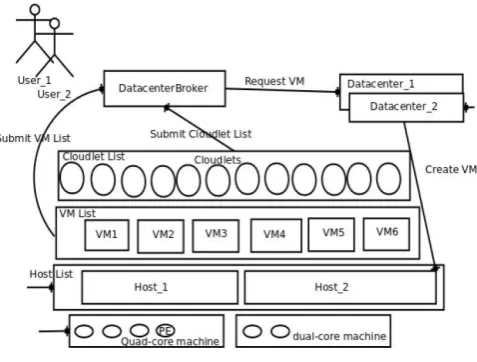
[image:4.595.302.568.51.167.2]Datacenter in CloudSim can simulate infrastructure as-a services (IaaS) in cloud environment. Working of the datacenter is shown in Figure 5. Datacenter is also responsible for Allocation of VMs to hosts using VmAllocationPolicy, which is a controller component. First Come First Serve scheduling algorithm is the by default approach in for allocating the virtual machine.
Figure 5 Working of the Data Center Broker
VMid- Virtual Machine unique id, MIPS-Million Instruction per Second, Size-image size in MB, RAM-vm memory in MB, BW-in MBPS, pesNumber-number of CPUs, VMM- name i.e. Xen
3. Modeling of the VM allocation
For simulation in CloudSim, for allocating the virtual machines to host, we have used two phases 1) host level to assign the processing power to each processing element to each machine and 2) VM level that allocates the fixed amount of processing power to services.
Figure 6 shows a simple VM provisioning scenario. In Figure 6, we have used two virtual machines, Two Cores or processing elements and four tasks. Here tasks t1, t2, t3, and t4 are hosted in VM1 and tasks t5, t6, t7, and t8 are hosted in VM2.
In Figure 6(a), Space-shared policy is used for both VMs and tasks, units, where VM2 is assigned after completing the execution by VM1 and vice-versa.
Figure 6 Different Provisioning Policies
In Figure 6(b), tasks are assigned dynamically using space-sharing and time-sharing policy for allocating VMs to hosts. In Figure 6(c), a time-shared provisioning is used for and lastly, in Figure 6(d) a time-shared allocation is applied to both VMs and task units.
4. Steps for Simulation
1. Initialization of CloudSim package- This is created before creating any entity such as a datacenter, VMs or Cloudlets.
2. Creating a Datacenter- These are the resource providers, and we have to list at least one for starting the simulation.
3. Creating a Broker- Datacenter Broker represents broker acting on behave of the user. It hides VM management. It responsible for mediating negotiation between user and Cloud provider.
4. Creation of a Virtual machine list VMs- Cloudlets are executed on Virtual machines. The Virtual machines have several parameters such as vmid, mips, number of PEs, RAM etc. This VM list is submitted to the broker. 5. Creation of a Cloud task list- Cloudlets also has certain
parameters such as length, id, file size etc. This Cloudlet List is also submitted to the broker.
6. Binding of the cloudlets to the VMs. In this way, the broker will submit the bound cloudlets only to the specific VMs. That means each cloudlet is assigned to one or other Virtual machine.
7. Starting the simulation.
8. Printing the results and stopping the simulation.
5. Working of CloudSim
By using the CloudSim, we can create following services Create a datacenter using one host and runs on single
cloudlet
Create a datacenter using one host and runs on double cloudlet
Create a datacenter using two host and runs on single cloudlet
Create a datacenter using two host and runs on double cloudlet
Create two datacenters using one host each and runs on two cloudlets
[image:4.595.50.289.345.526.2] Create the simulation with scalability to enhanced the performance
Dynamic simulation with GUI facilities like pausing and resuming with run time facility
Thus, we study the performance of these services in time shared scheduling environment. Price of services in cloud computing is calculated according to the usage of user. Debt for the CPU is calculated at cloudlet level. Debt is calculated using below equation:
Debt = Ram of VM*CostPerMem + Size of VM*CostPerStorage (1)
Here, we have taken the fixed values of CostPerMem as 0.05 and CostPerStorage as 0.001. As seen through the formula, it is clear that the debt of the CPU is mainly dependent on the Virtual Machine parameters.
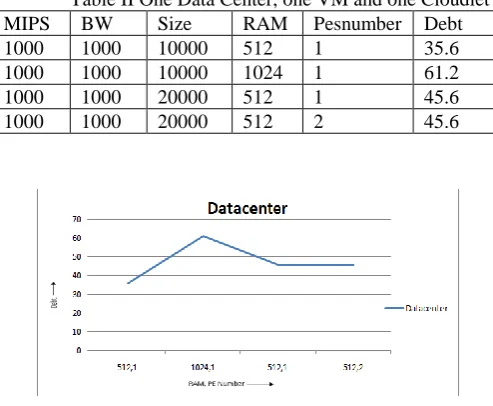
[image:5.595.45.292.364.567.2]This is the ideal condition when we have only one datacenter with one host, having single virtual machine on it and running single cloudlet (Table II). In this we very size, RAM and PEs number. As seen in last result, the debt does not very with the increased number of PEs, because this experiment is being performed for the single VM and single Cloudlet. Figure 7 shows the output of this ideal condition.
Table II One Data Center, one VM and one Cloudlet
MIPS BW Size RAM Pesnumber Debt
1000 1000 10000 512 1 35.6
1000 1000 10000 1024 1 61.2
1000 1000 20000 512 1 45.6
[image:5.595.309.539.413.574.2]1000 1000 20000 512 2 45.6
Figure 7: Graph between RAM, PE and Debt for ideal condition
Figure 8: Graph between RAM, PE and size of VM for ideal condition
Figure 9 A datacenter with one host and run one cloudlets on it.
Figure 9 and Figure 10 shows, the output for the basic services like creating a datacenter with one and running one cloudlet and creating a datacenter with two hosts and running two cloudlets on it. These are the output are obtained from the simulation over CloudSim toolkit.
Now, the performance in CloudSim is analyzed with different Virtual Machine (VM) capacity by varying the VM parameters like RAM and number of processors (Table 4). The memory i.e. RAM of 512 Mb, 1024 Mb, 2048 and the number of PEs can be varied from one to four. The MIPS and the bandwidth is maintained constant at 1000 each. The jobs arrival is Uniformly Randomly Distributed to get generalized set-up. The configuration of the cloud includes 2 Datacenters are created with 5 VM and 2 hosts. Total number of cloudlets used is 20.
Figure 10 A datacenter with two host and run two cloudlets on it.
[image:5.595.59.281.624.742.2]Here CPU scheduling algorithms come into existence. Every VM has a virtual CPU called Processing Element PE in CloudSim. The VM can have more than one PEs which simulates the original multi-core CPUs.
The experiments are performed with Sequential assignment which is default in CloudSim and with very common CPU scheduling algorithms i.e. first Come First Serve (FCFS). The simulations are conducted for different combinations of RAM and CPU.
Table III Scalable Simulation for Time-shared VM Allocation
MIP S
BW Size RA
M
Pesnu mber
Debt for Datace nter 1
Debt for Datace nter 2
1000 1000 1000
0
512 1 178 --
1000 1000 1000
0
1024 1 244.8 61.2
1000 1000 1000
0
[image:6.595.39.537.102.465.2]2048 1 224.8 224.8
Table IV: Scalable Simulation for Space-shared VM MIP
S
BW Size RA
M
Pesnu mber
Debt for Datace nter 1
Debt for Datace nter 2
1000 1000 10000 512 1 35.6 35.6
1000 1000 10000 1024 1 61.2 61.2
1000 1000 10000 2048 1 112.4 112.4
Allocation
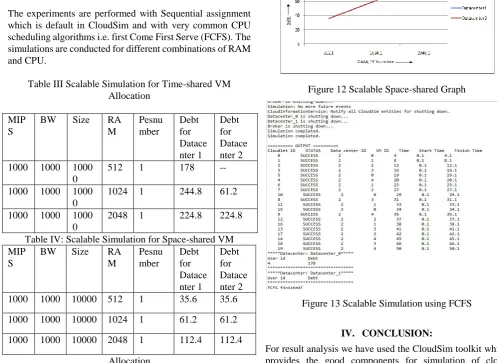
[image:6.595.50.404.212.466.2]In this experiment the first three results are obtained from time-shared VM allocation policy and the last three results are obtained from space-shared VM allocation policy. In space-shared policy only one VM is allowed to run on each PE. As each Host has only one PE, only one VM can run on each Host.
Figure 11 Scalable Time-shared Graph
Figure 12 Scalable Space-shared Graph
Figure 13 Scalable Simulation using FCFS
IV. CONCLUSION:
For result analysis we have used the CloudSim toolkit which provides the good components for simulation of cloud environment. The experiments are performed with Sequential assignment which is default in CloudSim and with very common CPU scheduling algorithms i.e. first Come First Serve (FCFS). The simulations are conducted for different combinations of RAM and CPU.
In this paper we have given steps for simulation and creation of different services using CloudSim with different components like Virtual Machine, Datacenters, Hosts, and Cloudlets.
It is observed from the Figure 6 to Figure 13 and Tables I-IV that by varying the VM characteristics affect the time taken for cloudlet execution, debt incurred. The debt is increased with the increase in capacity of RAM Further analyzes of scheduling policies are required to study the impact of VMs in cloud computing. Figure 13 shows a Scalable Simulation using FCFS using CloudSim.
[image:6.595.57.283.565.688.2]So, I n future there may be new scheduling algorithms that will optimize resources with multiple parameters in cloud environment with energy saving approaches and that will also fulfill all requirement of different users.
REFERENCES
1. Rajesh K. Bawa and Gaurav Sharma, "Reliable resource selection in grid environment”. International Journal of Grid Computing & Applications, March 2012, Volume 3, Number 1, pp. 1-10.
2. Mayanka Katyal and Atul Mishra “Application of Selective Algorithm for Effective Resource Provisioning In Cloud Computing Environment” International Journal on Cloud Computing: Services and Architecture (IJCCSA), Vol. 4, No. 1, February 2014.
3. Niranjan Lal, Shamimul Qamar, Mayank Singh “Detailed Dominant Approach Cloud Computing Integration with WSN “ International Conference on Heterogeneous Networking for Quality, Reliability, Security and Robustness QShine 2013 : Quality, Reliability, Security and Robustness in Heterogeneous Networks pp. 507-516. 2013. 4. B. Grobauer, T. Walloschek, and E. Stöcker, “Understanding Cloud
Computing Vulnerabilities,” 2011 IEEE Security and Privacy, pp. 50-57, DOI= March/April 2011.
5. R. Buyya, C. S. Yeo, S. Venugopal, J. Broberg, I. Brandic, “Cloud Computing and Emerging IT Platforms”, Vision, Hype, and Reality for Delivering Computing as the 5th Utility, Future Generation Computer Systems 25(6), 599–616 (2009).
6. M.A. Arfeen, K. Pawlikowski, A. Willig. A Framework for Resource Allocation Strategies in Cloud Computing Environment. Computer Software and Applications Conference Workshops (COMPSACW), IEEE 35th Annual, 2011, pp. 261 -266.
7. Rodriguez M A, Buyya R, "Deadline based Resource Provisioning and Scheduling Algorithm for Scientific Workflows on Clouds [J]", IEEE Transactions on Cloud Computing, vol. 2, no. 2, pp: 222-235, 2014. 8. Mayanka Katyal and Atul Mishra “Application of Selective Algorithm
for Effective Resource Provisioning In Cloud Computing Environment” International Journal on Cloud Computing: Services and Architecture (IJCCSA) ,Vol. 4, No. 1, February 2014
9. Dr. Amit Agarwal and Saloni Jain “Efficient Optimal Algorithm of Task Scheduling in Cloud Computing Environment” International Journal of Computer Trends and Technology (IJCTT) – volume 9 number 7– Mar 2014
10.] Hong Sun, Shi-ping Chen, Chen Jin, Kai Guo “Research and Simulation of Task Scheduling Algorithm in Cloud Computing” TELKOMNIKA, Vol.11, No.11, November 2013, pp. 6664~6672 e-ISSN: 2087-278X
11.Lal Shri Vratt Singh and Jawed Ahmed “A GREEDY ALGORITHM FOR TASK SCHEDULING & RESOURCE ALLOCATION PROBLEMS IN CLOUD COMPUTING” International Journal of Research & Development in Technology and Management Science –Kailash Volume – 21, Issue 1, ISBN - 978-1-63102-445-0 | March 2014.
12.QI CAO, ZHI-BO WEI and WEN-MAO GONG “An Optimized Algorithm for Task Scheduling Based On Activity Based Costing in Cloud Computing” 978-1-4244-2902-8/09/$25.00 ©2009 IEEE. 13.Mrs.S.Selvarani, and Dr.G.Sudha Sadhasivam “IMPROVED
COST-BASED ALGORITHM FOR TASK SCHEDULING IN CLOUD COMPUTING” 978-1-4244-5967-4/10/$26.00 ©2010 IEEE
14.Singh A., Korupolu M. and Mohapatra D. (2008) ACM/IEEE conference on Supercomputing.
15.Nallakumar. R, Dr. N. Sengottaiyan, Sruthi Priya K.S “A Survey on Scheduling and the Attributes of Task Scheduling in the Cloud” International Journal of Advanced Research in Computer and Communication Engineering Vol. 3, Issue 10, October 2014.
16.Raj, H., Nathuji, R., Singh, A. and England, P. “Resource management for isolation enhanced cloud services”, In proceedings of the 2009 ACM workshop on Cloud computing security, Chicago, Illinois, USA, pp. 77-84, 2009.
17.Youngmin, J. and Mokdong, C. “Adaptive security management model in cloud computing environment”, In the 12th International Conference on Advanced Communication Technology (ICACT), pp 1664-1669, 2010.
18.Stanojevic R. and Shorten R. (2009) IEEE ICC, 1-6.
19.Zhao Y. and Huang W. (2009) 5th International Joint Conference on INC, IMS and IDC, 170-175.
20.Nae V., Prodan R. and Fahringer T. (2010) 11th IEEE/ACM International Conference on Grid Computing (Grid), 9-17.
21.Hu J., Gu J., Sun G. and Zhao T. (2010) 3rd International Symposium on Parallel Architectures, Algorithms and Programming, 89-96.
22.Bhadani A. and Chaudhary S. (2010) 3rd Annual ACM Bangalore Conference.
23.Liu H., Liu S., Meng X., Yang C. and Zhang Y. (2010) International Conference on Service Sciences (ICSS), 257-262.
24.] Fang Y., Wang F. and Ge J. (2010) Lecture Notes in Computer Science, 6318, 271-277.
25.Randles M., Lamb D. and Taleb-Bendiab A. (2010) 24th International Conference on Advanced Information Networking and Applications Workshops, 551-556.
26.Zhang Z. and Zhang X. (2010) 2nd International Conference on Industrial Mechatronics and Automation, 240-243.
27.Wang S., Yan K., Liao W. and Wang S. (2010) 3rd International Conference on Computer Science and Information Technology, 108-113.
28.Mehta H., Kanungo P. and Chandwani M. (2011) International Conference Workshop on Emerging Trends in Technology, 370-375. 29.Nakai A.M., Madeira E. and Buzato L.E. (2011) 5th LatinAmerican
Symposium on Dependable Computing, 156-165.
30.Lua Y., Xiea Q., Kliotb G., Gellerb A., Larusb J. R. and Greenber A. (2011) Int. Journal on Performance evaluation.
31.] Liu Xi., Pan Lei., Wang Chong-Jun. and Xie Jun-Yuan. (2011) 3rd International Workshop on Intelligent Systems and Applications, 1-4. 32.Armbrust M., Fox A., Griffith R., Joseph A. D., Katz R., Konwinski A.,
Lee G., Patterson D., Rabkin A., Stoica I. and Zaharia M. (2009) Above the Clouds: A Berkeley View of Cloud Computing, EECS Department, University of California, 1-23.
33.] Pallis G. (2010) IEEE J. of Internet Computing, 14(5), 70-73. 34.Rimal B.P., Choi E. and Lumb I. (2009) 5th International Joint
Conference on INC, IMS and IDC, 44-51.
35.Rodrigo N. Calheiros, Rajiv Ranjan, Anton Beloglazov, C´esar A. F. De Rose and Rajkumar Buyya “CloudSim: a toolkit for modeling and simulation of cloud computing environments and evaluation of resource provisioning algorithms” Published online 24 August 2010 in Wiley Online Library (wileyonlinelibrary.com). DOI: 10.1002/spe.995 36. Saxena, P., Sharma, S. K., & Verma, N. K. An Analysis of Energy
Efficiency& Traffic Using Cloud Computing In Portable Devices. i-manager's Journal on Cloud Computing, 4(1), 1. 2017.
37.Naseera, S., & Jyotheeswai, P. A survey on energy aware job sched-uling algorithms in cloud environment. i-manager's Journal on Cloud Computing, 3(1), 30. 2015.
38. Y. a. G. Alex. Comparison of Resource Optimization Algorithms in Cloud Computing. International Journal of Pure and Applied Mathematics, pp. 847-854, 2017.
39.Guo, S., Xiao, B., Yang, Y., & Yang, Y. Energy-efficient dynamic offloading and resource scheduling in mobile cloud computing. In INFOCOM 2016-The 35th Annual IEEE International Conference on Computer Communications, IEEE pp. 1-9. 2016.
40.Chen, H., Zhu, X., Guo, H., Zhu, J., Qin, X., & Wu, J. Towards ener-gy-efficient scheduling for real-time tasks under uncertain cloud computing environment. Journal of Systems and Software, 99, pp. 20-35. 2015.
41.Singh, S., Chana, I., Singh, M., & Buyya, R. SOCCER: self-optimization of energy-efficient cloud resources. Cluster Computing, 19(4), pp. 1787-1800. 2016..