Chemistry Publications
Chemistry
4-2-2001
Evolution of Two-Dimensional Wormlike
Nanoclusters on Metal Surfaces
Woei Wu Pai
Oak Ridge National Laboratory
John F. Wendelken
Oak Ridge National LaboratoryC. R. Stoldt
Iowa State UniversityPatricia A. Thiel
Iowa State University, [email protected]
James W. Evans
Iowa State University, [email protected]
See next page for additional authors
Follow this and additional works at:
http://lib.dr.iastate.edu/chem_pubs
Part of the
Biological and Chemical Physics Commons
,
Condensed Matter Physics Commons
,
and the
Physical Chemistry Commons
The complete bibliographic information for this item can be found at
http://lib.dr.iastate.edu/
chem_pubs/55
. For information on how to cite this item, please visit
http://lib.dr.iastate.edu/
howtocite.html
.
Abstract
A pinch-off phenomenon is discovered in the evolution of 2D wormlike nanoclusters formed in
homoepitaxial adlayers. This feature is shown to distinguish mass transport via periphery diffusion from other mechanisms. Continuum modeling of such evolution accurately describes experimental observations, particularly if one incorporates the anisotropy in step-edge line tension.
Keywords
Ames Laboratory, Mathematics
Disciplines
Biological and Chemical Physics | Condensed Matter Physics | Physical Chemistry
Comments
This article is fromPhysical Review Letters86, no. 14 (2001): 3088–3091, doi:10.1103/PhysRevLett.86.3088.
Authors
Woei Wu Pai, John F. Wendelken, C. R. Stoldt, Patricia A. Thiel, James W. Evans, and Da-Jiang Liu
VOLUME86, NUMBER14 P H Y S I C A L R E V I E W L E T T E R S 2 APRIL2001
Evolution of Two-Dimensional Wormlike Nanoclusters on Metal Surfaces
Woei Wu Pai1,2,3 and John F. Wendelken1
1Solid State Division, Oak Ridge National Laboratory, Oak Ridge, Tennessee 37831 2Department of Physics, University of Tennessee, Knoxville, Tennessee 37996 3Center for Condensed Matter Sciences, National Taiwan University, Taiwan 106
C. R. Stoldt,4P. A. Thiel,4,6 J. W. Evans,5,6 and Da-Jiang Liu6
4Department of Chemistry, Iowa State University, Ames, Iowa 50011 5Department of Mathematics, Iowa State University, Ames, Iowa 50011
6Ames Laboratory, Iowa State University, Ames, Iowa 50011
(Received 21 November 2000)
A pinch-off phenomenon is discovered in the evolution of 2D wormlike nanoclusters formed in ho-moepitaxial adlayers. This feature is shown to distinguish mass transport via periphery diffusion from other mechanisms. Continuum modeling of such evolution accurately describes experimental observa-tions, particularly if one incorporates the anisotropy in step-edge line tension.
DOI: 10.1103/PhysRevLett.86.3088 PACS numbers: 68.35.Fx, 68.35.Bs, 68.35.Md
Propagation of boundaries and interfaces is central to a broad range of problems in classical fluid mechanics and materials science (especially metallurgy). Two long-studied phenomena have generated much interest recently, due to newly acquired experimental and theoretical techniques. One is the sintering of many clusters into an aggregate [1]; the other is the “breakup” of fluid flow into drops due to an instability first analyzed theoretically by Rayleigh, Plateau, and Maxwell [2]. These two seemingly opposite phenomena are sometimes intertwined in a single physical system and process [3], and are traditionally tackled by a continuum equation (e.g., the Navier-Stokes equation). From a mathematical perspective, there are extensive investigations of the simplest boundary propa-gation problem of the shortening of a curve (embedded in two-dimensional space), with the normal velocity propor-tional to the local curvature. Notable is Grayson’s theorem, which shows that allsimple closed curves will shrink to a point without breaking up [4]. Increasingly, there is an interest in describing such phenomena on smaller length scales to assess where continuum modeling must be aided or replaced by an atomistic description (see [5] for a study of pinch-off in nanojets). We pursue this direction here.
Evolution of structures on crystal surfaces is a variation of the situation addressed in the above mentioned fluid me-chanical problems. Instead of viscous surface flow, mass transport is usually governed by diffusion of adatoms (or other species), either across the surface or along the step edges. The continuum approach was first developed by Mullins [6]. More recently the kinetic Monte Carlo (KMC) simulation of atomistic models has gained some popular-ity. In this Letter, we report experiments and modeling of the evolution of wormlike monolayer vacancy nanoclus-ters. Experiments are performed for both Cu兾Cu(100) and Ag兾Ag(100) adlayers using time sequenced scanning-tunneling-microscopy (STM). Specifically, we report the first observations of a pinch-off phenomenon in 2D
sys-tems. This is the counterpart of the above mentioned and extensively studied 3D pinch-off. Extending ideas from Grayson’s theorem, we show that this feature implies mass transport is dominated by periphery diffusion (PD). In-deed, continuum models for evolution mediated by PD ac-curately describe observed pinch-off events, particularly if one accounts for anisotropy in the line tension of the step edge. The kinetic parameters, as well as the influence of fluctuations on evolution, are assessed using atomistic modeling and KMC simulations.
Diffusion and coarsening of adatom clusters formed by homoepitaxy on Cu(100) and Ag(100) at room temperature have been studied extensively [7,8]. Experiments show that for diffusion of clusters of sizes up to 1000 atoms, mass transport is dominated by diffusion of atoms along the cluster boundary, i.e., the PD mechanism [8]. The same mechanism is also expected to govern the evolution of far-from-equilibrium structures in these systems [9,10]. Cluster dynamics on metal(111) surfaces, including dif-fusion [11] and restructuring [12], has also been studied extensively. See Ref. [13] for a review of this subject.
In continuum models, the morphology of a two-dimensional cluster is described by a closed plane curve, represented parametrically as r共s兲 苷关x共s兲,y共s兲兴. Its evolution is determined by specifying its normal velocity. For PD, it is given by
yn共s,t兲苷 V=tJPD共s,t兲 (1a)
from local mass conservation. Here JPD is the atomic
flux along the periphery, =t 苷 共x2s 1ys2兲21兾2≠兾≠s is the
derivative with respect to the arc length t along the pe-riphery, andV is the area of a unit cell. From the linear response theory, one can write
JPD 苷2共kBT兲21sPD=tm, (1b)
wheremis the step-edge atom chemical potential measur-ing the energy cost for attachmeasur-ing atoms to the step, and
sPD is a coefficient measuring the mobility of step edge
atoms. In the continuum model,sPD andm depend only
on the local configuration. Specifically, one can write
m苷 Vb˜共u兲k共s兲, (1c)
where u苷 u共s兲 is the local azimuthal angle of the step edge, and k is the local curvature. The stiffness of the step edge,b˜, is related to step-edge energyb共u兲through
˜
b 苷 b共u兲 1 b00共u兲 [1]. Similarly, sPD 苷sPD共u兲 is in
general a function of the local azimuthal angle. The de-tailed forms of b共u兲 and sPD共u兲 depend on the
micro-scopic energetic and dynamical properties of the step edge. One important simplification is to assume that both sPD
andbare constant (theisotropic continuum model), where
yn 苷2共kBT兲21V2sPDb=˜ 2tk共s兲. (2)
Then, aside from a constant prefactor, Eq. (2) represents a purely geometry-driven reshaping problem. In our formal-ism,JPD has the dimension of (atoms)兾s, yn andsPD of
Å兾s, and b (orb˜) of eV兾Å.
The experimental procedures for the Cu兾Cu(100) and Ag兾Ag(100) systems are quite similar. A submonolayer film is deposited at room temperature with an e2-beam (for Cu) or a thermal (for Ag) evaporator. Post deposi-tion evoludeposi-tion is monitored by a commercial room tem-perature (Omicron) STM with a scanning rate of about 0.5 frames per minute (voltage苷0.5 1.5V, current 苷 0.5 0.7nA). The mean island separation is in the range of 10 – 20 nm for Cu and Ag. At low coverages (#0.3ML), the surface is mainly covered by isolated adatom islands. Subsequent evolution of the surface consists of mainly island diffusion, coalescence, and coarsening of islands. This regime has been studied previously [7,8].
[image:4.612.315.561.51.178.2]At a coverage of about 0.6 ML, the surface is covered by an incomplete layer with percolated vacancy clusters. Slightly above this coverage, there is a fairly sharp tran-sition from percolating vacancy regions to nonpercolating wormlike vacancy clusters [14]. Such wormlike vacancies are highly irregular; therefore, their reshaping processes yield extra insight as compared to the reshaping of adatom clusters with simpler geometries [10]. We note that adatom clusters cannot be readily prepared with these wormlike shapes. Figure 1 shows examples for Cu兾Cu(100) and Ag兾Ag(100). The characteristic length scale of the adlay-ers is controlled by island separation at lower coverages.
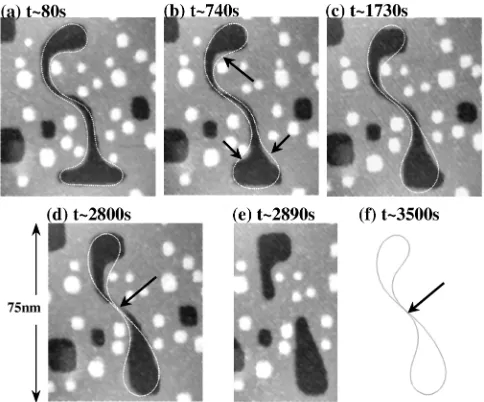
Figure 2 presents a sequence of composite images showing the experimental data for vacancy evolution in Cu(100) overlapped with prediction of the isotropic continuum model, Eq. (2). Dark areas are monolayer deep vacancies and bright areas are monolayer high adatom clusters. The two main parameters used in the model are obtained as follows. The typical line tension of Cu(100),
b 艐 0.11eV兾a(whereais the lattice spacing), is based onab initiocalculation and experiment [15]. The mobility coefficientsPDis estimated from a previous island
diffu-sion study [8] as sPD 艐70Ås21. We solve the partial
differential equation numerically by discretizing the curve
FIG. 1. Wormlike vacancy nanoclusters formed after de-position of ⬃0.6ml of film on the surfaces of (a) Cu(100); (b) Ag(100).
into a set of markers and derive a set of ordinary differen-tial equations (ODE) for the markers. The isotropic con-tinuum model predicts the reshaping process fairly well.
In Fig. 2 and several other cases, vacancy clusters with long and narrow necks eventually break into disconnected vacancy clusters. STM tip effects can be dismissed since they were previously assessed to be negligible in island dif-fusion and restructuring studies [8,9], and the breaking up occurs in all directions with respect to the scanning direc-tion. Effects from adatom clusters can also be discounted. Therefore what we observed is a phenomenon inherent in the curve reshaping problem driven by curvature gradi-ents.As mentioned in the introduction, Grayson’s theorem shows that for yn ~ k, all simple closed curves must
shrink to a round point, without breaking up. Here we
FIG. 2. A sequence of STM images showing the reshaping of a wormlike vacancy cluster. An earlier STM image (not shown) is used to produce the initial conditions att苷0. (a)t艐80s; (b) t艐740s; (c) t艐1730s; (d) t艐2800 s, the neck be-comes very thin as pointed by the arrow; (e) t艐2890s, the vacancy breaks into two separate vacancies. Predictions of the isotropic continuum model are shown in (a) – (d) overlapping the STM images, and in (f) where the curve crosses itself (thus develops a singularity) att艐3500 s. In (b), subtle differences between the model and experiment are indicated by arrows.
[image:4.612.316.558.421.622.2]VOLUME86, NUMBER14 P H Y S I C A L R E V I E W L E T T E R S 2 APRIL2001 give a heuristic argument that breakup is alsonotpossible
for evolution under the so-called evaporation-condensation (EC) mechanism [16], where the normal velocity of the curve is determined by the local curvature, i.e.,
yn 苷共kBT兲21VsEC共u兲b˜共u兲 共k 2 k0兲. (3)
HeresEC is the step-edge mobility due to the EC
mecha-nism, and k0 is a critical curvature beyond which the
islands will shrink. Just before a simple curve breaks into two parts, two points have to contact each other first, each having the same azimuthal angleu. Since bothb˜ andsEC
are functions ofuonly, the difference between the normal velocities of the two points is proportional to the difference between the curvatures. It can be shown that the effect of any curvature difference is to make the two points move away from each other, rather than cross.
For the so-called terrace diffusion (TD) mechanism [16], the motion of the step edge is influenced by its surround-ings and it is mathematically possible to have breakup. However, as EC evolution is often a very good approxima-tion to TD evoluapproxima-tion, we argue that breakup should be a very rare event for the TD mechanism. Experiments show that pinch-off of a wormlike vacancy cluster is a rather common phenomenon, thus supporting the view that PD is the dominant mass transport mechanism.
Comparison of several pinch-off events with simula-tions reconfirms that reshaping is mainly geometry driven. This is reflected both in the consistency in shape evolu-tion and the absolute pinch-off times. Three cases of va-cancy breakups with significantly different initial shapes in the Cu(100) system were examined. We found the experi-mentally observed pinch-off times (typically around 1 h) agree reasonably well with the isotropic continuum model (within 10 to 20 min). However, atomic scale fluctuations will inevitably introduce a stochastic nature to the reshap-ing process. Their importance will increase as the cluster size further decreases [5,10].
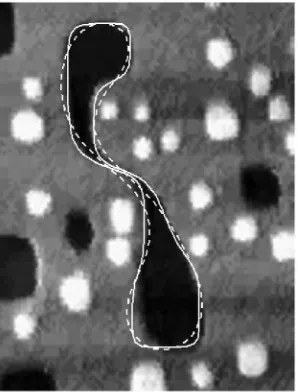
In Fig. 2(b), we also point out subtle differences between the experimental observation and the isotropic model. The discrepancies occur at the corners of the vacancy where the normal velocity in the isotropic model is overestimated. This is partly due to an overestimation of step stiffness at the corners, whereb˜ is actually smaller due to the openness of step structures. By incorporating the
u dependence of b˜ (and possiblysPD) in the continuum
model, the agreement of simulation can be substantially improved. Here, we first deal with the implementation of the anisotropy inb˜. For simplicity, we model the vacancy cluster (or adatom island) energetics via nearest-neighbor (NN) attractive interactions f on a square lattice for Cu(100) and Ag(100). The line tension has been solved analytically for this 2D Ising problem as [17]:
b共u兲苷kBT关jcosujsinh21共ajcosuj兲
1jsinujsinh21共ajsinuj兲兴, (4)
where a ⬃ 12e共f兾2kBT兲共11jsin2uj兲21兾2, and so b共u兲 ⬃
f
2共jcosuj1 jsinuj兲, askBT兾f !0. The result of
incor-porating energetic anisotropy with f苷 0.24eV for Cu [15] into our analysis is shown in Fig. 3. The improve-ment in agreeimprove-ment with experiimprove-ment (cf. Fig. 2) is evident. In the last part of this Letter, we examine the extent (and influence) of anisotropy insPDbased on analysis of
atom-istic PD models. Furthermore, we use KMC simulations of these models to explorefluctuationsfrom deterministic continuum model predictions. The form ofsPD depends
on the rates of all hopping processes that contribute to pe-riphery diffusion in the atomistic model. Ideally, the rates would be chosen based on precise ab initio calculations of the associated activation barriers, but these are rarely available. Instead, KMC studies often include reason-able choices based on semiempirical studies and detailed-balance constraints [10,18,19].
We assume that the effective barrier for an atom to de-tach from a cluster is prohibitively high so that this process can be neglected. A single atom attached to a close-packed step edge (with only one NN in-plane bond) can hop along the step with rate he, or hop around a kink (or corner)
with rate hr. Rates of other processes can be deduced
from those two rates by requiring detailed balance. For example, the rate for a kink atom to “escape” along the step isheexp关2f兾共kBT兲兴.
If he 苷hr, we find that sPD兾a艐heexp关2f兾共kBT兲兴
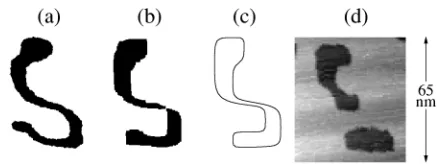
[image:5.612.363.512.487.683.2]is roughly independent of u [20]. Consequently, this choice will correspond to the continuum model using the Ising line tension and an isotropic mobility coefficient. Figure 4 shows corresponding KMC simulations of the evolution of a Ag(100) vacancy cluster consisting of about 8000 vacancy sites. We choose f 苷0.26 eV [10,21]. Figure 4(a) shows the initial configuration, and Fig. 4(b) shows the simulated configuration just after the cluster pinch-off. Figure 4(c) is the corresponding prediction of the continuum model with corresponding anisotropicb共u兲.
FIG. 3. Comparison between the vacancy cluster from experi-ment (gray-scale image), the isotropic continuum model (dashed line), and the continuum model with Ising line tension and con-stantsPD (solid line).
FIG. 4. (a) Initial configuration of a vacancy cluster on Ag(100); (b) Result of a Kinetic Monte Carlo simulation showing a pinch-off; (c) The prediction of the corresponding continuum model; (d) STM measurement after 38 min from (a).
It has a very thin neck (seven atoms wide), which be-comes even thinner and eventually pinches off as the sys-tem evolves under the continuum model. We performed 10 MC simulations starting from the same initial configu-ration. The pinch-off times have a standard deviation of about 30%. Fluctuations thus play an important role for features of this size and shape. Furthermore, it seems rea-sonable to suggest that fluctuations tend to break up the cluster “prematurely,” thus the pinch-off time predicted by the deterministic continuum model might be longer than in the real system, where fluctuations are present.
If hr ø he (corresponding to an extra barrier for
cor-ner rounding at island edges or kinks), our simulations show that the overall mobility decreases, and sPD also
exhibits strong anisotropy in its u dependence. For the cluster reshaping problem, the main effect of a lowerhris
the overall slowing down of the process. The effect of an anisotropy insPDon the reshaping process is not very
sig-nificant compared with the amount of fluctuations inherent in the system and the experimental sensitivity. As an aside, we note that such anisotropy may have a more dramatic ef-fect in a system that is being driven out of equilibrium [22]. Figure 4(d) is the STM measurement about 38 min af-ter Fig. 4(a), which shows a snapshot afaf-ter the clusaf-ter pinch-off. Using hr 苷he and he 苷nexp共2Ee兾kBT兲,
where n 苷 331012 s21 and the edge diffusion barrier Ee苷 0.26eV (and f 苷0.26 eV) [21,23], the physical
pinch-off time for our KMC simulations is far shorter (10 s). One way to account for the discrepancy in the pinch-off time between the experiment and the model with he 苷hr, i.e., model with isotropic mobility, is to increase
the barrier for kink escape, Ee 1 f, from 0.52 eV used
above to 0.66 eV. Another way is to retainEe 苷0.26 eV
andf苷 0.26eV, while decreasinghr by introducing an
extra corner rounding barrier about 0.16 eV. The first model is consistent with a recent STM experiment by Hoogemanet al.[24], and the second model is more con-sistent withab initioand semiempirical calculations.
In summary, we have demonstrated the capabilities of a continuum model to describe reshaping of nanoclus-ters with wormlike shapes. Behavior in the Cu(100) and Ag(100) systems is similar. The best match to experimen-tal pinchoff times in isotropic models is obtained by choos-ingsPD兾a苷34兾s for Cu and 17兾s for Ag (for similarf),
consistent with the 2– 3 times faster diffusion of large Cu
clusters [8]. A geometry driven pinch-off phenomenon, which is a signature of the periphery diffusion mechanism, is observed. More accurate description is achieved by con-sidering the underlying microscopic properties. Although we cannot extract a unique set of microscopic parameters, some constraints in various combinations of parameters can be established.
W. W. P. and J. F. W. were supported at Oak Ridge National Laboratory (USDOE) operated under Contract No. DE-AC05-00OR22725. W. W. P. was also supported by NSC89-2112-M-002-091, Taiwan. C. R. S., P. A. T., J. W. E., and D. J. L. were supported by NSF Grant No. CHE-0078596 at Ames Laboratory (USDOE), which is operated by ISU under Contract No. W-7405-Eng-82.
[1] C. Herring, inStructure and Properties of Solid Surfaces, edited by R. Gomer (Univ. of Chicago, Chicago, 1953). [2] J. Eggers, Rev. Mod. Phys.69,865 (1997).
[3] J. Eggers, Phys. Rev. Lett.80,2634 (1998).
[4] M. A. Grayson, J. Diff. Geom.26,285 (1987). The same is not true for the corresponding surface problem in 3D. [5] M. Moseler and U. Landman, Science289,1165 (2000). [6] W. W. Mullins, J. Appl. Phys.28,333 (1957).
[7] J.-M. Wenet al.,Phys. Rev. Lett.73,2591 (1994);76,652 (1996).
[8] W. W. Paiet al.,Phys. Rev. Lett.79,3210 (1997). [9] C. R. Stoldtet al.,Phys. Rev. Lett.81,2950 (1998). [10] A. M. Cadilheet al.,Phys. Rev. B61,4910 (2000). [11] K. Morgensternet al.,Phys. Rev. Lett.74,2058 (1995). [12] M. Eßeret al.,Surf. Sci.402 – 404,341 (1998); M. Giesen
and G. Schulze Icking-Konert,ibid.412/413,645 (1998). [13] G. Rosenfeldet al.,Appl. Phys. A69,489 (1999). [14] Actually the percolation threshold forjust-deposited
adlay-ers is around 0.8 ML. See M. C. Bartelt and J. W. Evans, Mater. Res. Soc. Symp. Proc.312,255 (1993). But perco-lating vacancies at *0.6ML quickly transform into non-percolating vacancy worms.
[15] G. Boisvert and L. J. Lewis, Phys. Rev. B 56, 7643 (1997) estimates a NN binding energy of f苷0.22eV. M. Giesen-Seibert et al., Surf. Sci. 329, 47 (1995) es-timate a kink creation energy of e 艐f兾2苷0.128eV. We set b共u苷0,T 苷0兲苷f兾2艐e to 0.12 eV, and bav共295K兲 艐0.11eV.
[16] For EC, evaporation and condensation at step edges are uncorrelated. For TD, they are correlated since evaporating atoms recondense by diffusing to nearby step edges. [17] C. Rottman and M. Wortis, Phys. Rev. B24,6274 (1981). [18] H. Shao, S. Liu, and H. Metiu, Phys. Rev. B 51, 7827
(1995).
[19] P. Jensenet al.,Eur. Phys. J. B11,497 (1999).
[20] J. Krug, H. T. Dobbs, and S. Majaniemi, Z. Phys. B97,
281 (1995) shows a strict independence for a dynamical solid-on-solid model.
[21] B. D. Yu and M. Scheffler, Phys. Rev. Lett.77,1095 (1996). [22] O. Pierre-Louis, M. R. D’Orsogna, and T. L. Einstein, Phys.
Rev. Lett.82,3661 (1999).
[23] U. Kürpick and T. S. Rahman, Phys. Rev. B 57, 2482 (1998).
[24] M. S. Hoogemanet al.,Surf. Sci.447,25 (2000).