INCORPORATING SPACE DIVISION AT INITIALIZATION PHASE OF
BEES ALGORITHM
This report is submitted in accordance with requirement of the University Teknikal Malaysia Melaka (UTeM) for Bachelor Degree of Manufacturing Engineering (Manufacturing
Management) (Hons.)
by
RATNADEVI A/P CHELLIAH B051310134
931017-05-5602
i
ABSTRAK
Bees Algorithm adalah algorithma pengoptimuman berasaskan populasi yang
mengilhamkan tingkah laku semulajadi lebah mencari makanan. Pada fasa permulaan Bees Algorithm, pengedaran rawak seragam digunakan di mana rawak membantu sistem untuk
memberi penyelesaian baru terutamanya dalam problem pengoptimuman yang kompleks seperti bidang komputer sains, kawalan kejuruteraan dan kejuruteraan mekanikal. Namun begitu, hal ini menyebabkan kelajuan konvergen lambat dalam memproseskan data. Oleh yang demikian, untuk meningkatkan kelajuan konvergen, teknik Search Space Division
digabungkan dengan Bees Algorithm. Search Space Division mempunyai keupayaan untuk
beroperasi dalam dimensi yang tinggi. Keberkesanan teknik baru dinilai dengan membandingkan kadar berjaya dengan Bees Algorithm dan quick Artificial Bee Colony. Kadar
berjaya teknik baru mengatasi algorithma yang lain. Keberkesanan teknik baru dibandingkan dengan Bees Algorithm di mana beberapa parameter berbeza diuji dengan didedahkan terhadap
pelbagai jenis ujian penanda-aras. Keputusan menunjukkan kesemua empat parameter berjaya memperoleh keputusan yang baik. Menurut perbandingan mean evaluation kedua-dua
algorithma menunjukkan teknik baru mempunyai kelajuan konvergen yang lebih baik daripada
Bees Algorithm. Walaubagaimanapun, ujian statistic t-test, kelajuan konvergen teknik baru
sama dengan Bees Algorithm. Oleh yang demikian, penggabungan Search Space Division
dalam fasa permulaan Bees Algorithm merupakan penyelidikan untuk mendedahkan kelajuan
ii
ABSTRACT
iii
DEDICATION
This thesis is dedicated to my respectful father, Chelliah my beloved mother, Sivakami my lovely sisters, Thenmoly and Ponnarasi
for their unconditional love, support, care and encouragement. I couldn’t have done this without you people.
iv
ACKNOWLEDGEMENT
First and foremost, I would like to thank God Almighty for giving me the strength, knowledge, ability and opportunity to undertake this research study and to persevere and complete it satisfactorily. Without his blessings, this achievement would not have been possible.
In my journey, I have found a teacher and a pillar of support in my Guide, my awesome supervisor, En.Nik Mohd Farid bin Che Zainal Abidin. I would like to thank him for having me as his Final Year Project student and guiding me all the way through my project with genuine care! Without his able guidance, this thesis would not have been possible and I shall eternally be grateful to him for his assistance.
I am extremely grateful to my parents for their love, prayers, caring and sacrifices for educating and preparing me for my future. Also I express my thanks to my lovely sisters for their love, support and valuable prayers.
v
TABLE OF CONTENT
Abstrak...i
Abstract………ii
Dedication………...iii
Acknowledgement………iv
Table of Contents………..v
List of Tables………viii
List of Figures………ix
List of Abbreviations……….xi
CHAPTER 1: INTRODUCTION 1.1 Project Background ... 1
1.2 Problem Statement ... 2
1.3 Objective ... 3
1.4 Scope of the project ... 3
1.5 Report Structure ... 4
CHAPTER 2: LITERATURE REVIEW 2.1 Optimization ... 5
2.2 Evolutionary Algorithm ... 7
2.2.1 Genetic Algorithm ... 9
2.3 Swarm Intelligence ... 13
2.3.1 Ant Colony Optimization ... 15
2.3.2 Particle Swarm Optimization ... 18
vi
2.4.1 Artificial Bee Colony ... 24
2.4.2 Bees Algorithm ... 27
2.5 Search Space Division ... 35
2.6 Summary ... 37
CHAPTER 3: METHODOLOGY 3.1 Research Processes ... 38
3.1.1 Defining problem, Objectives and Scopes ... 40
3.1.2 Literature Review... 40
3.1.3 Modification of BA using SSD ... 41
3.1.4 Benchmark Test Function ... 41
3.1.5 Statistical Test ... 47
3.2 Software ... 47
3.3 Summary ... 48
CHAPTER 4: RESULT AND DISCUSSION 4.1 Comparison of Success Rate of Proposed Algorithm with other Algorithms ... 49
4.2 Result of Bees Algorithm and Proposed Algorithm ... 51
4.2.1 Parameter 1 for Bees Algorithm and Proposed Algorithm ... 51
4.2.2 Parameter 2 for Bees Algorithm and Proposed Algorithm ... 53
4.2.3 Parameter 3 for Bees Algorithm and Proposed Algorithm ... 55
4.2.4 Parameter 4 for Bees Algorithm and Proposed Algorithm ... 57
4.3 Comparison between Mean Evaluation of Bees Algorithm and Proposed Algorithm ... 59
4.4 Statistical T-test Analysis ... 59
vii
CHAPTER 5: CONCLUSION AND RECOMMENDATIONS
5.1 Sustainability ... 66
5.2 Conclusions ... 67
5.3 Recommendations ... 67
viii
LIST OF TABLES
2.1 Basic parameters in BA 27
2.2 Applications of the BA 34
3.1 Comparison table sample 40
3.2 Benchmark function 42
4.1 Success rate over 25 run times 50
4.2 Result of parameter 1 for Bees Algorithm 51
4.3 Result of parameter 1 for SSDBA 52
4.4 Result of parameter 2 for Bees Algorithm 53
4.5 Result of parameter 2 for SSDBA 54
4.6 Result of parameter 3 for Bees Algorithm 55
4.7 Result of parameter 3 for SSDBA 56
4.8 Result of parameter 4 for Bees Algorithm 57
4.9 Result of parameter 4 for SSDBA 58
4.10 T-test performance of parameter 1 60
4.11 T-test performance of parameter 2 60
4.12 T-test performance of parameter 3 61
ix
LIST OF FIGURES
2.1 Optimization process 6
2.2 Structure of a single population EA 8
2.3 Structure of extended multi population EA 8
2.4 Basic pseudocode of GA 9
2.5 Different type of crossover 11
2.6 Mutation process 11
2.7 GA flowchart 12
2.8 Branches with same lengths 17
2.9 Branches with different lengths 17
2.10 Flowchart of PSO 19
2.11 Orientation of waggle dance with respect to the sun 22
2.12 Orientation of waggle dance with respect to the food source, hive and sun 22
2.13 The waggle dance and followers 23
2.14 Schematic representation of foraging activity 24
2.15 Flowchart of ABC algorithm 26
2.16 Flowchart of the basic BA 29
2.17 Pseudocode of the basic BA 29
2.18 Initially selected n patches and fitness value 30
2.19 Selection of elite and non-elite best patches 30
2.20 Recruitment of forager bees to the elite and non-elite best sites 31
2.21 Results after local and global search 31
2.22 Flowchart of improved BA 33
2.23 Initial solutions produced by SSD for FN=4 35
2.24 Population initialization based on search space division 37
3.1 Research flowchart 39
x
3.3 Sum of Different Power Function in 2D 43
3.4 Schewefel 2.21 Function in 2D 44
3.5 Quartic Function in 2D 44
3.6 Six Hump Camel Back Function in 2D 45
3.7 Griewank Function in 2D 45
3.8 Ackley Function in 2D 46
3.9 Schwefel 2.22 Function in 2D 46
xi
LIST OF ABBREVIATIONS
ABC - Artificial Bee Colony ACO - Ant Colony Optimization BA - Bees Algorithm
EA - Evolutionary Algorithm GA - Genetic Algorithm
PSO - Particle Swarm Intelligence SI - Swarm Intelligence
SSD - Search Space Division
1
CHAPTER 1
INTRODUCTION
This chapter discusses the project background, problem statement, objective and scope of the project. The title of this project is Incorporating Space Division at Initialization Phase of Bees Algorithm. This project will focus on Bees Algorithm.
1.1 Project Background
Optimization is a process of finding the best possible or desirable solution to solve a problem (Binitha and Sathya, 2012). In this advanced era, many real world engineering programs need the manipulation of a number of system variables in order to optimize a given quality parameter such as the value or performance of a product and the reliability and accuracy of a process (Pham and Castellani, 2009). Optimization algorithm can be categorized either as deterministic or stochastic in nature (Binitha and Sathya, 2012). Artificial Intelligence (AI) is a program developed to make machines do things that would require intelligence if done by human. It is applied in order to help engineers to solve problems related to engineering (Negnevitsky, 2002).
2
BA is a population-based optimization algorithm, developed in 2005 that mimics the natural foraging behavior of a swarm of bees (Pham et al., 2009). The algorithm performs two
types of search namely random explorative search and exploitative neighborhood search. BA is proven to be highly competitive in terms of learning speed and accuracy compared to the other swarm algorithms.
1.2 Problem Statement
At initialization phase in BA, uniform random distribution is used where the randomness help the system to sample new solutions particularly in complex problems. Unfortunately, this leads to slow convergence rate to the optimum solution in BA just like other stochastic algorithms (Alfi and Khosravi, 2012; Hussein et al., 2013).
To overcome this problem, instead of using a uniform random distribution for the local bees’ initialization, this project proposes the use of the Search Space Division (SSD). According to He et al. (2014), SSD is a novel initialization method which provides high
quality of initial solution. It has been used by other researchers in swarm-based optimizer such as He et al. (2014) in ABC algorithm and Tsutsui et al. (1997) in Genetic Algorithm (GA).
3
1.3 Objective
The objectives of this research are:
i. To demonstrate the use of Search Space Division in Bees Algorithm to improve its convergence speed.
ii. To compare the proposed algorithm with the standard Bees Algorithm and other swarm-based algorithms.
iii. To propose suitable parameter that suits the proposed algorithm.
1.4 Scope of the project
4
1.5 Report Structure
The remainder of the report of research is organized as follows:
Chapter 1 is the introduction of the research. Briefly, this chapter consists of project background, problem statement, objectives and scope of the project.
Chapter 2 is the literature review. This chapter discusses the theories that relevant and related to the title of this research. Apart from that, research on swarm-based algorithm done by others is also discussed.
Chapter 3 is the methodology of the report. This chapter presents and briefly discusses the review of the methodology for entire project that need to be carried out in order to achieve the objective of this project.
Chapter 4 is about project result and discussion. This chapter analyzes and compares the results obtained. Moreover discussion of the result is done by referring to other researcher papers.
5
CHAPTER 2
LITERATURE REVIEW
This chapter is about review of the previous related studies and research paper in the fields of swarm based optimization techniques findings and methodology. This chapter in detail discusses about the theories of Evolutionary Algorithm (EA), Genetic Algorithm (GA), Swarm Intelligence (SI), Ant Colony Optimization (ACO), Particle Swarm Intelligence (PSO), Artificial Bee Colony (ABC), Bees Algorithm (BA) and finally, Search Space Division (SSD).
2.1 Optimization
Basically optimization is used all over, from design of engineering to planning of business as well as from the routing of the internet to holiday planning. Among these activities, certain objectives or optimization of profit, quality and time tried to be achieved. As in real world application, time, money and resources are always limited. Thus, optimal solution is needed to utilize these valuable resources under different constraints (Yang, 2011).
6
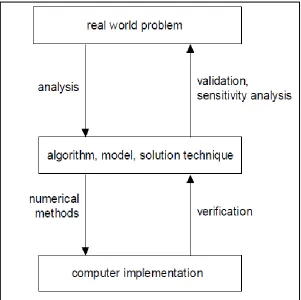
In an optimization process, usually will start with a real life problem with full of details and complexities. However, some are relevant while some are not. Based on this, essential elements are extracted. Then, an algorithm or solution technique is applied to it. Meanwhile, for practical problems, the computer will carry out the necessary calculations (Sinebe et al.,
[image:18.612.172.473.195.495.2]2014). Figure 2.1 shows the flow of optimization process.
Figure 2.1: Optimization Process (Sinebe et al., 2014).
7
is obtainable in real system. Sensitivity analysis determines how sensitive the model parameters can be varied, respectively (Chinneck, 2010).
Optimization algorithms are well known as search methods. The goal of the algorithm is to obtain an optimal solution to a problem. This is in order to fulfill one or more objective functions, perhaps subject to a set of constraint (Yuce et al., 2013). Bio inspired approaches
can solve an impressive array of problems and solve complex problems in entire keys of computer science. The two most successful and predominant algorithms of Bio Inspired Algorithm are Evolutionary Algorithms and Swarm based Algorithms. The algorithms take inspiration of natural evolution and collective behavior in animals (Binitha and Sathya, 2012). The algorithms discussed briefly in following sections.
2.2 Evolutionary Algorithm
Evolutionary algorithms (EA) are population based metaheuristic optimization algorithms that apply biology-inspired mechanisms in order to improve asset of solution candidates iteratively. Examples of biology-inspired mechanisms are mutation, crossover, natural selection, and survival of the fittest (Weise, 2009). At every generation, process of selection individuals develops a new set of estimations. The selection is carried out based on their performance of fitness in the problem domain. Then, process of breeding them together is carried out by utilizing operators borrowed from natural genetics. This process leads to the evolution populations of individuals that are fit better in their environment. This described as better compared to the individuals that were produced as in natural adaptation (Pohlheim, 2006).
8
[image:20.612.127.501.329.606.2]Figure 2.2: Structure of a single population EA (Pohlheim, 2006).
Figure 2.3: Structure of extended multi population EA (Pohlheim, 2006).
9
Algorithm created by Holland in 1970s and thoroughly reviewed by Goldgberg. Secondly, Rechenburg and Schwefel created Evolution Strategies (1960s) in Germany. Lastly, L.J.Fogel is the first person to develop Evolutionary Programming in 1960s and subsequently improved by D.B.Fogel (Weise, 2009). Genetic Algorithm will be discussed in more detail in next section.
2.2.1 Genetic Algorithm
According to Li et al. (2016), genetic algorithm (GA) is based on natural evolution of
Darwin’s theory, “survival of the fittest” and Mendels genetic variation theory. It was introduced by John Holland in 1970s which is a search and optimization algorithm. Basically, GA is a process of imitation of the way biological evolution works.
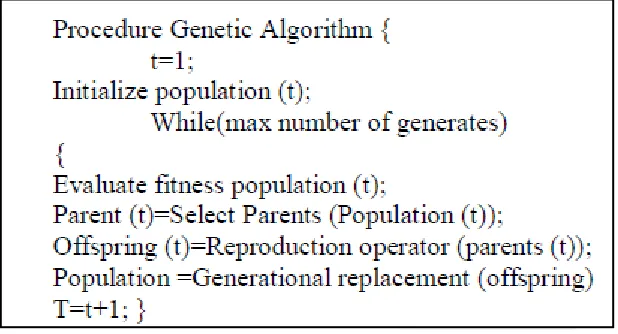
Better solutions evolve from generation to generation until solution close to optimal is obtained. GA uses three main operations to produce new generation from old ones. The operations are selection, crossover and mutation (Abuiziah and Shakarneh, 2013). However, there are still chances to utilize other operations such as colonization-extinction, regrouping, or migration in genetic algorithm (Akbari and Ziarati, 2011). Figure 2.4 shows the basic pseudocode of Genetic Algorithm.
[image:21.612.160.469.499.666.2]10
According to Jebari and Madiafi (2013), evolution begins from a randomly generated individuals population that been selected from search space which is an iterative process. The population is known as generation in every iteration. Objective function value in each optimization problem solved is fitness. Fitness of each individual in each generation is evaluated. The more fit individuals selected stochastically from existing population. Usually the algorithm will terminate when either satisfactory level has been achieved or maximum number of generations has been produced.
Although solutions are preferably represented in binary as strings of 0s and 1s, the other encodings are probable too. Every candidate solution represented as an array of bits. In GA, string will be tested to get score which indicate how good the solution is. The new generation is utilized for the following iteration of algorithm. Usually biologically reproduction based on the use of two parents. However, it is stated that more than two parents capable of generating higher quality chromosomes (Ting, 2005).
11
Single point crossover
Two points crossover
Intermediate (Uniform) crossover
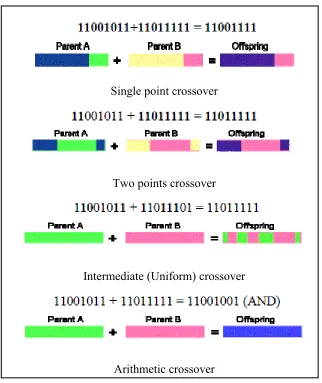
[image:23.612.149.471.73.456.2]Arithmetic crossover Figure 2.5: Different type of crossover (Abuiziah and Shakarneh, 2013).
Mutation occurred when randomly selected bits have been flopped. Usually mutation probability is small.
[image:23.612.147.495.564.655.2]12
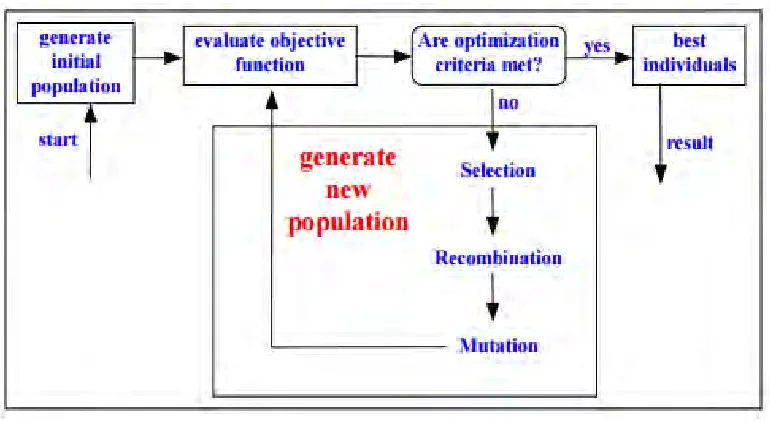
According to Abuiziah and Shakarneh (2013), simple GA follows these steps and is summarized in figure 2.7.
Step 1: Determine the initial population of creatures. Step 2: Determine the fitness of the population.
Step 3: Reproduce the population using the fittest parents of the last generation. Step 4: Determine the crossover point which can also be random.
Step 5: Determine if mutation occurs and if so on which creature(s).
Step 6: Repeat from step 2 with the new population until satisfied population is produced.
Figure 2.7: GA flowchart (Abuiziah and Shakarneh, 2013).