This is a repository copy of 2016 update of the EULAR recommendations for the management of early arthritis.
White Rose Research Online URL for this paper: http://eprints.whiterose.ac.uk/109081/
Version: Accepted Version
Article:
Combe, B, Landewe, R, Daien, CI et al. (20 more authors) (2017) 2016 update of the EULAR recommendations for the management of early arthritis. Annals of the Rheumatic Diseases, 76 (6). pp. 948-959. ISSN 0003-4967
https://doi.org/10.1136/annrheumdis-2016-210602
© The Author(s) 2016. Produced by BMJ Publishing Group Ltd (& EULAR) under licence. This is an author produced version of a paper published in Annals of the Rheumatic Diseases. Uploaded in accordance with the publisher's self-archiving policy.
[email protected] Reuse
Items deposited in White Rose Research Online are protected by copyright, with all rights reserved unless indicated otherwise. They may be downloaded and/or printed for private study, or other acts as permitted by national copyright laws. The publisher or other rights holders may allow further reproduction and re-use of the full text version. This is indicated by the licence information on the White Rose Research Online record for the item.
Takedown
If you consider content in White Rose Research Online to be in breach of UK law, please notify us by
2016 update of the EULAR recommendations for the management of early
arthritis
Bernard Combe1, Robert Landewe2, Claire I Daien1, Charlotte Hua1, Daniel Aletaha3, Jose María Álvaro-Gracia4 , Margôt Bakkers5, Nina Brodin6, Gerd R Burmester7, Catalin
Codreanu8, Richard Conway9, Maxime Dougados10, Paul Emery11, Gianfranco Ferraccioli12, Joao Fonseca13, Karim Raza14, Lucía Silva-Fernández15, Josef S: Smolen3, Diana Skingle5, Zoltan Szekanecz16, Tore K Kvien17, Annette van der Helm-van Mil18, Ronald van
Vollenhoven 19
1Rheumatology department, Lapeyronie Hospital, Montpellier University, UMR 5535,
Montpellier, France,
2 Department of Clinical Immunology & Rheumatology, Amsterdam Rheumatology Center,
Amsterdam and Zuyderland Medical Centre, Heerlen, The Netherlands
3 Division of Rheumatology, Department of Medicine 3, Medical University of Vienna,
Austria
4Biological Therapies Unit, Servicio de Reumatología. Hospital Universitario de la Princesa,
IIS-IP, Madrid, Spain
5 EULAR Standing Committee of People with Arthritis/Rheumatism in Europe (PARE),
Zurich, Switzerland
6 Division of Physiotherapy, Department of Neurobiology Care sciences and Society,
Karolinska Institutet, Huddinge, Sweden and Department of Orthopaedics, Danderyd Hospital, Stockholm, Sweden
7 Department of Rheumatology and Clinical Immunology, Charité - University Medicine
Berlin, Germany
8Center for Rheumatic Diseases, Department of Rheumatology, University of Medicine and
Farmacy, Bucharest Romania
9 Department of Rheumatology, Centre for Arthritis and Rheumatic Diseases, St Vincent's
University Hospital, Dublin Academic Medical Centre, Elm Park, Dublin Ireland
10 Paris Descartes University, Medicine Faculty; APHP, Rheumatology B Department,
11, Leeds NIHR Musculoskeletal Biomedical Research Unit,LTHT; Leeds Institute of
Rheumatic and Musculoskeletal Medicine, University of Leeds, UK
12 Fondazione Policlinico Gemelli Academic Hospital; Catholic University School of
Medicine, Rome, Italy
13 Rheumatology Department, Hospital de Santa Maria, Lisbon Academic Medical Centre,
Lisbon and Instituto de Medicina Molecular, Faculdade de Medicina Universidade de Lisboa,Portugal
14 Rheumatology Research Group, Institute of Inflammation and Ageing, University of
Birmingham, Birmingham, United Kingdom and Sandwell and West Birmingham Hospitals NHS Trust, Birmingham, UK.
15 Rheumatology Department, Complexo Hospitalario Universitario de Ferrol, A Coruña,
Spain
16 University of Debrecen, Faculty of Medicine, Department of Rheumatology, Debrecen,
Hungary
17 Department of Rheumatology, Diakonhjemmet Hospital, Oslo, Norway
18 Department of Rheumatology, Leiden University Medical Center, Leiden, & Department
of Rheumatology, Erasmus Medical Center, Rotterdam,
19 Academic Medical Center, Dept of Clinical Immunology & Rheumatology, 1100 DD
Amsterdam | The Netherlands
Correspondence to: Professor Bernard Combe, MD, PhD. Rheumatology department, Lapeyronie Hospital, Montpellier University - 34295 Montpellier cedex 5, France ; [email protected]
BC and RL are joint first authors
Key words: early arthritis, rheumatoid arthritis, management, recommendations, DMARDs, diagnosis
Funding: This initiative was supported by an unrestricted grant from the European League Against Rheumatism (EULAR)
Competing Interests: all the participants in this initiative have disclosed any conflict of interest. The individual declaration of conflicts of interest is available on demand at the EULAR secretariat and is summarised below:
BC, has received honoraria from BMS, Janssen, Lilly, Merck, Novartis, Pfizer, Roche-Chugai, Sanofi and UCB, and research grants from Pfizer, Roche-Roche-Chugai, and UCB. RL, has received honoraria and/or research grants from AbbVie, Ablynx, Amgen, Astra-Zeneca, Bristol Myers Squibb, Celgene, Janssen, Galapagos, Glaxo-Smith-Kline, Novartis, Novo-Nordisk, Merck, Pfizer, Roche, Schering-Plough, TiGenix, UCB,. RL is director of Rheumatology Consultancy BV,
CD, has received honoraria from BMS, Merck, Pfizer, Roche-Chugai, and UCB CH, none`
DA, has received honoraria from AbbVie, BMS, Centocor, Janssen, Eli Lilly, Medac, Merck, Pfizer, Roche, and UCB.
JMA, has received honoraria from AbbVie, BMS, MSD, Novartis, Pfizer, Roche, Sanofi and UCB, and research grants from MSD, Pfizer, Roche, and UCB.
NB, none
GRB, has received honoraria from AbbVie, BMS, Janssen, Lilly, MSD, Novartis, Pfizer, Roche-Chugai, and UCB, and research grants from Pfizer, Roche-Chugai, and UCB.
CC, has received speaker and consulting fees from AbbVie, Amgen, Angellini, Astra Zeneca, Bristol-Myers Squibb, Egis, MSD, Pfizer, Richter, Roche, Sanofi, Servier, Teva, UCB, Zentiva.
RC, has received honoraria from Abbvie, Roche, Pfizer, and Amgen.
MD, has received honorarium fees for participating at advisory boards or symposia organized by Pfizer, Abbvie, UCB, Roche, LillY, NovartiS, Sanofi, Merck, BMS. His department has received research grants from Pfizer,Abbvie,UCB,Roche,Lilly,NovartiS,Sanofi,Merck,BMS PE, has provided expert advice for Abbvie, Astra Zeneca, BMS, Lilly, Merck, Novartis, Pfizer, Roche, Sandoz, Samsung, UCB
JEF, has received unrestricted research grants or acted as a speaker for Abbvie, Amgen, BMS, Biogen, Celtrion, Celgene, Hospira, Janssen, MSD, Novartis, Novo Nordisk, Pfizer, Roche, UCB
KR, has received honoraria from AbbVie, Pfizer, Roche and Janssen and research grants from Abbvie.
JSS, has received grants for his institution from Abbvie, Janssen, Lilly, MSD, Pfizer, Roche and has provided expert advice to and/or had speaking engagements for Abbvie, Amgen, Astra-Zeneca, Astro, Celgene, Celtrion, Glaxo, ILTOO, Janssen, Lilly, Medimmune, MSD, Novartis-Sandoz, Pfizer, Roche, Samsung, Sanofi, UCB.
DS, none
ZS has received consultant and speakers fees from AbbVie, MSD, Bristol-Myers, Roche, Pfizer.TKK has received fees for speaking and/or consulting from Biogen, BMS, Boehringer Ingelheim, Celltrion, Eli Lilly, Epirus, Hospira, Merck-Serono, Novartis, Orion Pharma, Pfizer, Sandoz and UCB
AHM, none
RvV has received research support and grants from AbbVie, Amgen, BMS, GSK, Pfizer, Roche, UCB, and honoraria for consultancy from AbbVie, Biotest, BMS, Celgene, Crescendo, GSK, Janssen, Lilly, Merck, Novartis, Pfizer, Roche, UCB, Vertex
Acknowledgement:
Abstract
Objectives: Since the 2007 recommendations for the management of early arthritis have been presented, considerable research has been published in the field of early arthritis, mandating an update of the 2007 EULAR recommendations for management of early arthritis.
Methods: In accordance with the 2014 EULAR Standardised Operating Procedures, the expert committee pursued an approach that was based on evidence in the literature and on expert opinion. The committee involved 20 rheumatologists, 2 patients and 1 health professional representing 12 European countries. The group defined the focus of the expert committee and target population, formulated a definition of “management” and selected the research questions. A systematic literature research (SLR) was performed by 2 fellows with the help of a skilled librarian. A set of draft recommendations was proposed on the basis of the research questions and the results of the SLR. For each recommendation the categories of evidence were identified, the strength of recommendations was derived and the level of agreement was determined through a voting process.
Results: The updated recommendations comprise 3 overarching principles and 12 recommendations for managing early arthritis. The selected statements involve the recognition of arthritis, referral, diagnosis, prognostication, treatment (information, education, pharmacological and non-pharmacological interventions), monitoring and strategy. Eighteen items were identified as relevant for future research.
Peripheral inflammatory arthritis is among the most common features with which patients present in clinical rheumatology. Identifying the underlying disease can be difficult, particularly at an early stage. In clinical practice, early inflammatory arthritis is frequently undifferentiated (1). Early arthritis can develop into established rheumatoid arthritis (RA) or another definite arthropathy, can resolve spontaneously, or may remain undifferentiated for indefinite periods. To better evaluate diagnosis and outcome in arthritis, it has been proposed to first recognize inflammatory arthritis; then search for a definite diagnosis (e.g., peripheral or axial spondyloarthritis; psoriatic arthritis [PsA]; systemic lupus erythematosus…), and finally estimate the risk of developing persistent and/or erosive arthritis and propose an optimal therapeutic strategy (2, 3). Although the prognosis of early arthritis is still difficult to define, a combination of clinical, laboratory and radiographic parameters may help to predict patients’ outcomes with acceptable accuracy.
The management of early arthritis has changed considerably in the past few years under the influence of new concepts for diagnosis and new effective therapies. Conventional synthetic disease-modifying anti-rheumatic drugs (csDMARDs) have been shown to slow disease progression in chronic inflammatory arthritides such as RA and PsA (4–6). Furthermore, biological (b) DMARDs have demonstrated rapid and sustained disease control associated with an arrest of joint destruction (7,8). A large body of evidence points to the usefulness of very early DMARD-start for early chronic inflammatory arthritis, preferably before the onset of erosions, in order to reduce or even prevent the risk of (further) joint damage and disability (5,9,10). Also, the assessment and tight monitoring of patients with early arthritis serves to better adapt therapeutic strategies (9,11). Beyond doubt, the treatment goal of early arthritis should now be: clinical remission and prevention of joint destruction.
treatment strategies based on these findings. Furthermore, management of early arthritis should include more than drug treatment alone, with education, shared decision making and the role of allied health professionals as important themes.
A set of recommendations for the management of arthritis should address all these different aspects.
The EULAR recommendations for the management of early arthritis have been published in 2007 (9). In 2010, EULAR has presented recommendations for the management of RA with synthetic and biological DMARDs, which have been updated in 2013 and 2016 (12,13); in addition, recommendations for the management of PsA were recently published (6). While the latter recommendations focused on the pharmacological treatments of PsA and RA, both in advanced and in early disease, the 2007 recommendations for the management of early arthritis covered the entire spectrum of management of early arthritis, including the recognition of arthritis, referral, diagnosis, prognosis, classification, information, education, non-pharmacological interventions and monitoring of the disease process as well as pharmacological treatment. The systematic literature review (SLR) that has guided the 2007 EULAR recommendations included publications up to January 2005 (9). Between 2005 and 2015 research in early arthritis has been a major focus, and many studies have appeared in the peer-reviewed literature. This literature includes - but is not limited to - topics such as diagnosis and classification criteria, window of opportunity, imaging, prognostication, treatments and therapeutic strategies.
These developments mandated an update of the existing EULAR recommendations on early arthritis, which is reported here.
The update of the EULAR recommendations for the management of early arthritis has followed the 2014 EULAR Standardised Operating Procedures (14). The definitions (e.g., management and early arthritis) of and the target populations (rheumatologists, general practitioners, medical students, healthcare professionals, patients) addressed by the 2007 expert committee (9) were considered. Briefly, the term “management” was defined as “all organisational, diagnostic, medical and educational procedures related to patients seeking help for arthritis of a peripheral joint ”and“ early arthritis” was restricted to “early inflammatory joint disease”.
The expert committee
The expert committee comprised 20 rheumatologists, including 2 research fellows (CD and CH), 1 health professional and 2 patients, from 12 European countries.
Fifteen research questions derived from the 2007 process were proposed by the convenor (BC) and the methodologist (RL), and subsequently amended and approved by the whole committee. The selected topics included recognition of arthritis, referral, diagnosis, prognostics, classification, information, education, non-pharmacological interventions, pharmacological treatments, monitoring of the disease process, strategy and prevention.
Evidence-based approach
conferences were also considered. The search was completed by a hand search and by questioning experts for additional references. The SLR process is reported in detail in two separate articles (15,16).
Expert opinion approach
Each member of the expert committee obtained insight into the results of the literature search and the accompanying levels of evidence before a meeting in January 2016. During the meeting, the results of the SLR were presented to the committee in aggregated format. Three break-out groups, chaired by one expert, were formed to amend the 2007 recommendations (1-4; 5-8 and 9-12) and to propose new recommendations if considered appropriate. Each group then reported its proposals and wording to the entire committee for discussion and consensus, and the final formulation of the recommendations was obtained after a vote with at least 85% agreement for each item’s final wording.
After the meeting the recommendations were circulated by email to all expert committee members for further minor amendments if necessary. Categories of evidence and grades of recommendations were then determined (by CD, CH, RL, BC) according to the standards of the Oxford Centre for Evidence-Based Medicine (17). To determine the level of agreement with recommendations, an anonymized email-based voting on a 0–10 scale was performed, a vote of 0 indicating complete disagreement with a particular recommendation and 10 indicating complete agreement. The means and SDs for scores from the whole group were calculated.The recommendations are presented as a bulleted list and as a flow diagram of the various management steps (table 1; figure 1).
RESULTS
Overarching principles
The expert committee considered that some of the principles on the care of patients with early arthritis are generic and should be stated first and separated from individual recommendations on diagnosis, prognosis and treatment. The committee decided unanimously on the following 3 overarching principles (Table 1).
Principle A:
Management of early arthritis should aim at the best care and must be based on a shared decision between the patient and the rheumatologist.
The term “best care” is obviously a major principle in medicine. The wording “shared decision between the patient and the rheumatologist“ is more than informing the patient; it rather refers to the comprehensive process of communication, knowledge exchange and achieving consensus that should lead to a treatment decision that is optimal from the perspectives of both patient and clinical care provider.
Principle B:
Rheumatologists are the specialists who should primarily care for patients with early arthritis.
are well aware of the indications, contraindications and adverse effects of specific therapies. However, the expert committee intentionally added the term “primarily” to this statement for three reasons: 1) the management of patients with early arthritis includes the care by primary care physicians and other health professionals in a multidisciplinary approach; 2) in some places care by rheumatologists is not always available and accessible. Some countries have a shortage of rheumatologists, and in such situations patients should receive treatment from other health care providers with experience in the care of patients with inflammatory arthritis. 3) in some countries, task shifting from rheumatologists to other health professionals is actively supported in order to facilitate early access and optimal quality of care, and to make care cheaper. Such care is still primarily under the responsibility and supervision of rheumatologists, but may be provided by other care providers.
Principle C:
A definite diagnosis in a patient with early arthritis should only be made after a careful history taking and clinical examination, which should also guide laboratory testing and additional procedures.
Table 1:2016 update of the EULAR recommendations for management of early arthritis: Final recommendations based on evidence and expert opinion
Overarching principles
A. Management of early arthritis should aim at the best care and must be based on a shared decision between the patient and the rheumatologist
B. Rheumatologists are the specialists who should primarily care for patients with early arthritis
C. A definitive diagnosis in a patient with early arthritis should only be made after a careful history taking and clinical examination which should also guide laboratory testing and additional procedures
Recommendations
1. Patients presenting arthritis (any joint swelling, associated with pain or stiffness) should be referred to, and seen by, a rheumatologist, within six weeks after the onset of
symptoms.
2. Clinical examination is the method of choice for detecting arthritis, which may be confirmed by ultrasonography.
3. If a definite diagnosis cannot be reached and the patient has early undifferentiated arthritis, risk factors for persistent and/or erosive disease, including number of swollen joints, acute phase reactants, rheumatoid factor, ACPA and imaging findings, should be considered in management decisions.
4. Patients at risk of persistent arthritis should be started on DMARDs as early as possible (ideally within 3 months), even if they do not fulfil classification criteria for an
inflammatory rheumatologic disease.
5. Among the DMARDs, methotrexate is considered to be the anchor drug and, unless contraindicated, should be part of the first treatment strategy in patients at risk of persistent disease.
6. NSAIDs are effective symptomatic therapies but should be used at the minimum effective dose for the shortest time possible, after evaluation of gastrointestinal, renal, and cardiovascular risks.
7. Systemic glucocorticoids reduce pain, swelling and structural progression, but in view of their cumulative side effects, they should be used at the lowest dose necessary as
temporary (less than 6 months) adjunctive treatment. Intra-articular glucocorticoid injections should be considered for the relief of local symptoms of inflammation. 8. The main goal of DMARD treatment is to achieve clinical remission, and regular
monitoring of disease activity, adverse events and comorbidities should guide decisions on choice and changes in treatment strategies to reach this target.
9. Monitoring of disease activity should include tender and swollen joint counts, patient and physician global assessments, ESR and CRP, usually by applying a composite measure. Arthritis activity should be assessed at one to three month intervals until the treatment target has been reached. Radiographic and patient-reported outcome measures, such as functional assessments, can be used to complement disease activity monitoring. 10. Non-pharmacological interventions, such as dynamic exercises and occupational
11. In patients with early arthritis smoking cessation, dental care, weight control, assessment of vaccination status and management of comorbidities should be part of overall patient care.
12. Patient information concerning the disease, its outcome (including comorbidities) and its treatment is important. Education programs aimed at coping with pain, disability,
maintenance of ability to work and social participation may be used as adjunct interventions.
NSAIDs, non-steroidal anti-inflammatory drugs; ACPA, anti-citrullinated peptide antibodies; DMARD, disease-modifying antirheumatic drug; ESR, erythrocyte sedimentation rate; CRP, C-reactive protein
Recommendations
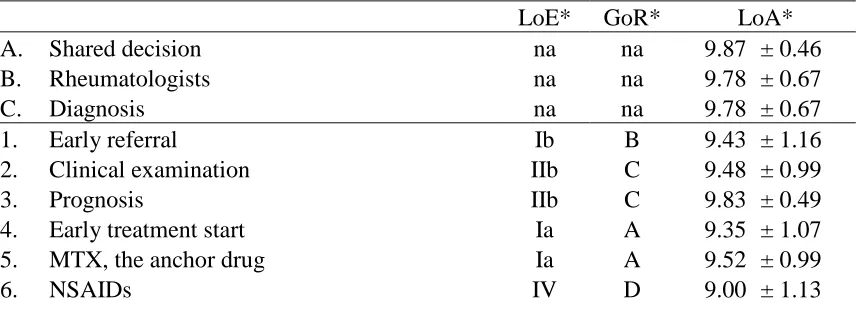
The discussions of the expert committee culminated into 12 recommendations (Table 1). In comparison with 2007, the previous recommendation 3 was transformed into overarching principle C, while a recommendation for prevention (No. 11) was added. In addition, the order of the bullet points was slightly amended in order to better assure a logical sequence (and not for reasons of prioritization). Table 2 displays the levels of evidence and grades for the following recommendations based on the Oxford Levels of Evidence assessment as well as level of agreement after anonymized voting by the expert committee.
Recommendation 1:
Patients presenting with arthritis (any joint swelling, associated with pain or stiffness) should be referred to, and seen by, a rheumatologist, within six weeks after the onset of symptoms.
specialist within 3 months show better outcomes in terms of drug-free remission, radiographic damage and (less) need for orthopaedic surgery than those with late referral.(15). This is also fully in line with standards of care developed for patients with RA and quality indicators as established by European Expert committees (21).On the basis of these data as well as the clinical experience of the committee members it was recommended that diagnosis and start of treatment, both by a rheumatologist, should be established within a relatively short period after the onset of complaints which justifies the wording “within 6 weeks” in this recommendation.
[image:16.595.72.501.610.768.2]Joint swelling not due to trauma or bony swelling suggests early inflammatory arthritis, especially if associated with pain and morning stiffness >30 min (22). Several referral questionnaires evaluating swelling, pain and stiffness have been developed to aid in the detection of early arthritis (15). These questionnaires have a good sensitivity (86-90%) and specificity (90%), but have been tested only in small patient samples and lack confirmation in independent validation cohorts. The committee was of the opinion that an appropriately validated tool to help general practitioners in adequately diagnosing and referring patients with early arthritis is currently lacking. The strength of this recommendation was considered ‘good’ (category B) (Table 2).
Table 2: Updated EULAR recommendations for management of early arthritis, with level of
evidence (LoE), grade of recommendation (GoR) and level of agreement (LoA)
LoE* GoR* LoA*
A. Shared decision na na 9.87 ± 0.46
B. Rheumatologists na na 9.78 ± 0.67
C. Diagnosis na na 9.78 ± 0.67
1. Early referral Ib B 9.43 ± 1.16
2. Clinical examination IIb C 9.48 ± 0.99
3. Prognosis IIb C 9.83 ± 0.49
4. Early treatment start Ia A 9.35 ± 1.07
5. MTX, the anchor drug Ia A 9.52 ± 0.99
7. Glucocorticoids Ia A 9.00 ± 1.28 8. Remission and treatment strategies Ib,IV** A,D 9.52 ± 0.9
9. Regular monitoring Ia,IV A,D$ 9.13 ± 1.06
10. Non-pharmaceutical interventions 1a B 8.96 ± 1.26
11. Prevention IIb,IV C,D$ 8.96 ± 1.19
12. Patient information Ia,Ib B 9.35 ± 0.98
* LoE and GoR are based on the recommendations of the Oxford Centre for Evidence-Based Medicine. LoA was based on an anonymized email voting system with a 0-10 scale by all members of the expert committee (data are mean ± SD; 100% of voters)
** The general statement is evidence-based.
$ The place in the treatment algorithm is based on expert consensus. na, not applicable; MTX, methotrexate
Recommendation 2:
Clinical examination is the method of choice for detecting arthritis, which may be confirmed by ultrasonography.
because the group considered that power Doppler should be part of every US joint examination anyway.
MRI has also been suggested to be more sensitive than clinical examination in the early detection of synovitis (23-25) but may face a lack of specificity as suggested by the prevalence of MRI abnormalities in the normal population (26). In contrast with US, which is now a common tool in many rheumatologist practices, the long scanning time, limited access and the relatively high costs limit the widespread use of MRI. Therefore, the expert committee considered that MRI should be proposed only in very difficult cases or in patients with specific forms of arthritis, and that further research is needed to better determine the place of this imaging modality in the diagnosis of patients with early arthritis. MRI was part of the 2007 recommendations but was deleted from the current set.
Recommendation 3:
If a definite diagnosis cannot be reached and the patient has early undifferentiated arthritis, risk factors for persistent and/or erosive disease, including number of swollen joints, acute-phase reactants, rheumatoid factor, ACPA and imaging findings, should be considered in management decisions.
in a multivariate manner in these studies, to test their independent contribution. Commonly tested dependent variables were persistence, erosiveness or radiographic progression.
In most of the studies, ACPA- and RF-positivity and ACPA- and RF-levels have shown some predictive value for the development of persistent and erosive arthritis. This observation was clearly highlighted by EULAR and ACR since ACPAs, in addition to RF, have obtained an important weight in the 2010 ACR/EULAR classification criteria for RA (27,28). In addition, several recent studies have confirmed the independent association of ACPAs with a diagnosis of RA as well as with radiographic progression in patients with early arthritis (29-33). RF has been assigned a similar weight as ACPAs in the 2010 ACR/EULAR classification criteria for RA, although recent publications stemming from early arthritis cohorts and observational studies have suggested a lower predictive and diagnostic value of RF compared to ACPAs but RF has a stronger association with disease activity independent of the presence of ACPA (15). The combination of RF and ACPAs does not provide additional value to RF or ACPAs alone (28). In addition to ACPA, the number of swollen joints and the level of CRP and ESR are independent contributory factors.
Early erosion typical of RA is still a major prognostic factor in early arthritis and automatically leads to a classification of RA (27,34). Synovitis and erosion detected by MRI or US may predict further joint damage in early arthritis, but false positivity has been reported (26, 35). MRI-detected bone marrow oedema and osteitis are independent predictors of radiographic progression in early RA (23,24), but data are limited in early arthritis. Finally, 2 recent studies have shown that hand flexor or extensor tenosynovitis on US (36) or MRI (25) may be a specific- though not very sensitive - marker for RA classification.
further research is warranted (15). Finally, it has been reported that substituting MRI for clinical examination in the 2010 ACR/EULAR criteria increases the sensitivity but decreases the specificity for a diagnosis of RA (15). MRI is therefore of limited value in making a diagnosis of RA and is not recommended as a standard procedure.
Recommendation 4:
Patients at risk of persistent arthritis should be started on DMARDs as early as possible (ideally within 3 months), even if they do not fulfil classification criteria for an inflammatory rheumatologic disease.
symptoms may be the longest allowable delay in prescribing the first DMARD. However, this maximum delay is still difficult to meet in daily practice, while most of the recent ‘early RA-cohorts’ allowed a delay of 6 months from the onset of symptoms (joint swelling usually) for inclusion (28,29,41). A delay of not more than 6 months was also proposed in recent RA guidelines (42). A delay of more than one year from symptom onset must not be considered “early” anymore.
Recommendation 5:
Among the DMARDs, methotrexate is considered the anchor drug and unless contraindicated, should be part of the first treatment strategy in patients at risk of persistent disease.
TEAR trial did not support a benefit of an intensive csDMARDs combination regimen over MTX-monotherapy either (49). In the absence of clear signals for superiority of a csDMARDs combination regimen, and guided by a trend towards lower tolerability for csDMARD-combination (16), the committee was of the opinion that the first treatment strategy should be MTX monotherapy with or without short term high dose glucocorticoids as bridging therapy for most patients. In that regard, dose optimization is an important aspect of first-line DMARD strategy, as previously reported (4,45) (MTX should be titrated rapidly to 20-30 mg/week, depending on clinical response and tolerability; parenteral administration should be considered in case of inadequate clinical response or intolerance).
The superiority of bDMARDs plus MTX over MTX monotherapy has been proven in many randomized controlled trials (RCTs) and was confirmed by 8 recent studies in the current SLR (16). In addition, 2 targeted synthetic DMARDs have recently demonstrated superiority to MTX, both used as monotherapy, in patients with early RA (50,51). Nevertheless, because the benefit-to-risk ratio of these biologic and targeted synthetic DMARDs was not convincingly favourable in patients with early disease, because tight monitoring is anyway part of the current treatment strategy to identify those in need of adding biologics and also because of their high cost, the expert committee considered their use as a first treatment strategy inappropriate, except in rare situations.
persistent disease. LEF and (to a lesser extent) SSZ are considered the best alternatives. Of note, SSZ is considered safe during pregnancy in contrast to MTX and LEF. Finally, the committee is of the opinion that antimalarial drugs, which have shown less clinical efficacy and may not retard radiographic progression in patients with RA but may have positive metabolic effects, can be considered as partner in combination therapy or as DMARD monotherapy in patients with mild disease and comorbidities or with persistent arthritis other
than RA (52)
.
Recommendation 6:
NSAIDs are effective symptomatic therapies, but should be used at the minimum effective dose for the shortest time possible, after evaluation of gastrointestinal, renal and cardiovascular risks.
The SLR did not yield new data on NSAIDs in patients with early arthritis. The expert committee felt that symptomatic therapy with NSAIDs is still of value in patients presenting with early arthritis, but only after a careful consideration of gastrointestinal, renal and cardiovascular contraindications. In addition to the previous item no 7 about NSAIDs, the group now reinforces the need to follow US Food and Drug Administration and European Medicines Agency guidelines about NSAIDs, that now includes wording about the shortest possible treatment duration, the minimum effective dose and the contra-indications for patients at risk (www.fda.gov; www.ema.europa.eu).
Recommendation 7:
Systemic glucocorticoids reduce pain, swelling and structural progression, but in view of their cumulative side effects, they should be used at the lowest dose necessary as temporary (less than 6 months) adjunctive treatment. Intra-articular glucocorticoid injections should be considered for the relief of local symptoms of inflammation.
RCTs in patients with ‘early RA’ has confirmed that systemic glucocorticoids (GC) improve clinical and radiographic outcomes (16, 53, 54). Preferably, therapy with systemic GC is temporary because of the risk of side-effects, including weight gain, hypertension, diabetes, cataracts and osteoporosis, which justify careful monitoring and appropriate prevention. New data stemming from registries, observational studies and extensions of RCTs have also suggested an increased risk of severe infections, cardiovascular events and mortality (16, 55-60). In addition, there is evidence that intra-articular steroids may be an effective adjunct to DMARDs in relieving joint symptoms in patients presenting with early arthritis and may improve disease activity up to 24 months (16).
The committee has reworded this item (No. 8 in the previous recommendations) in order to highlight the effectiveness of systemic GC for relieving symptoms and disease progression but also in order to point to the risks of cumulative side effects in the medium to long term. The committee is of the opinion that GC can only be justified if used at the lowest possible cumulative dose, and for the shortest possible duration, and exclusively as adjunct (or: bridge) therapy to csDMARDs. GC monotherapy may mask disease activity before a diagnosis has been established and should be avoided in patients with early arthritis, in order to expedite a proper diagnosis, and secure an adequate prognosis and a prompt DMARD treatment start. Despite a fierce debate this recommendation was finally approved by 95% of the members and obtained a high level of agreement (mean of 9.00 ± 1.28) with anonymous voting. The wording “low dose” and the optimal regimen (low daily dose or high dose then step-down or parenteral boosts) in early arthritis are still under debate and will be mentioned in the research agenda (table 3).
Recommendation 8:
The 2007 recommendations for patients with early arthritis were among the first guidelines to highlight clinical remission as the main objective in the care of these patients. In the past 10 years, accumulating data have supported this as a major goal for the treatment of RA and other inflammatory arthritides (6,9,11,13,61).
The expert committee has decided to keep the wording of the previous recommendation No. 10 unchanged. A few new studies have confirmed that achieving clinical remission as early as possible results in better clinical outcomes and quality of life, and helps to prevent further structural damage, functional disability and job-loss in patients with early arthritis and early RA (62). Which particular remission criteria should be used in practice remains unclear. Composite scores (DAS, DAS28, CDAI, SDAI) should be used, and the ACR-EULAR remission criteria (Boolean or SDAI) is likely the most stringent (63). An interesting definition for daily practice is “the absence of signs and symptoms of significant inflammatory disease activity”(11). Recent evidence has suggested that remission leads to a better outcome than low disease activity (LDA) (62, 64, 65), and the committee was of the opinion that clinical remission according to the ACR-EULAR Boolean or index-based definition is the target for every patient presenting with early arthritis. A low disease activity state (LDA) could be an appropriate alternative goal only in cases in which remission is considered unfeasible. In this respect, factors such as comorbidities, age or adverse events must be considered, and may determine the desired treatment target, which will form the basis for the process of shared decision making with the patient.
potential waste of societal resources (66); the SLR did not yield new information (15,16). Therefore, the expert committee suggested that the value of imaging remission should be part of the research agenda.
Finally, the committee felt that disease activity should be closely monitored in order to allow a timely change in DMARD therapy when necessary. The benefits of the treat-to-target approach have now amply been shown in patients with RA and PsA (11, 67)) and there is no reason to assume that the situation is different for early arthritis.
Recommendation 9:
Monitoring of disease activity should include tender and swollen joint counts, patient’s and physician’s global assessments, ESR and CRP, usually by applying a composite measure. Arthritis activity should be assessed at one to three month intervals until the treatment target has been reached. Radiographic and patient reported outcome measures, such as functional assessments can be used to complement disease activity monitoring.
In every patient with active arthritis, closely monitoring disease activity is now considered of particular importance in the therapeutic strategy to provide a good outcome and this is highlighted by all of the most recent recommendations (6, 9, 11, 13, 42, 61). Monitoring disease activity should be as frequent as the level of disease activity mandates, usually every 1 to 3 months, then potentially less frequently (such as every 6 to 12 months) once the treatment target has been achieved.
Nevertheless, three changes were proposed to this item (previously No. 12). First, a composite measure was recommended as the method of choice to monitor disease activity; second, a specific time frame for monitoring structural damage was deliberately left out; and third, patient-reported outcomes were expanded beyond functional assessments.
opinion that monitoring the occurrence of radiographic progression is useful in view of one of the key objectives of managing early arthritis: the prevention of joint destruction. The determination of an optimal window for monitoring progression was added as an item for the research agenda (table 3).
Finally, patient-reported outcomes such as quality of life, fatigue and physical function are key to evaluate outcome (71, 72) and the committee has mandated them as part of disease monitoring.
Table 3: Research agenda for management of early arthritis
Diagnosis and prognosis
1. Which tools could help general practitioners to diagnose early arthritis and prioritise referral?
2. Can we better define the diagnostic and prognostic value of ultrasonography in early arthritis?
3. Can we better define the diagnostic and prognostic value of MRI in early arthritis?
4. What is the diagnostic value of the systematic screening of antinuclear antibodies in early arthritis? 5. Which new biomarkers / multibiomarkers may help to better evaluate disease activity, the prognosis and t
arthritis?
Treatment and outcome
1. Can we develop prediction models to better define the therapeutic strategy in early arthritis? 2. Can we define at what level of risk (for developing persistent arthritis) different pharmacological
interventions have a favorable benefit to-risk ratios?.
3. Do combinations of csDMARDs provide a better benefit / risk ratio than csDMARD monotherapy in early arthritis ?
4. Can we better define “low dose”, and “short term” use of glucocorticoids for an optimal medium to long term benefit to risk ratio?
5. What is the optimal regimen (low daily dosage or high dose then step-down, or parenteral boosts) of glucocorticoids for better outcome in early arthritis ?
6. Does imaging remission have an added benefit to clinical remission in treatment decisions? 7. What is the optimal interval at which to monitor radiographic progression in early chronic
inflammatory arthritis?
8. What is the effectiveness of different non-pharmacological interventions in early arthritis ? 9. Can physical activity/exercise reduce cardiovascular risk in early chronic arthritis?
10. Which study designs can best be used to investigate the comparative effectiveness and cost-effectiveness of different therapeutic strategies?
11. Is smoking cessation, oral hygiene, diets, or psychological interventions beneficial for the outcome of patients with early arthritis ?
programs for early arthritis?
.
Recommendation 10:
Non-pharmacological interventions, such as dynamic exercises and occupational therapy, should be considered as adjuncts to drug treatment in patients with early arthritis.
This recommendation has remained almost unchanged. The efficacy of non- pharmacological therapy has not been investigated in early arthritis and can only be extrapolated from the results of several RCTs in established RA. Hydrotherapy in patients with RA has been evaluated in some studies (73, 74) but with insufficient evidence to support a strong recommendation; consequently, hydrotherapy was not included in the current statement but may be considered at the individual patient level. Previous RCTs have shown that joint-specific dynamic exercises may improve strength and physical function in RA, but the current SLR identified some controversial effects on disease activity (16, 74). Occupational therapy may improve functional ability and self-management but does not have a positive effect on disease activity; recent studies were not found (75).
Finally, psychological counselling can be considered in selected patients, but trials investigating the efficacy of psychological interventions are lacking, and the committee did not include counselling in the statement. Furthermore, the SLR did not identify appropriate trials that evaluated the effectiveness of diets.
Since dynamic exercises, occupational therapy and to a lesser extent hydrotherapy have been associated with symptom relief in patients with established RA, the expert committee has decided to include them as adjunct therapies to pharmaceutical therapies in patients with early arthritis.
In patients with early arthritis smoking cessation, dental care, weight control, assessment of vaccination status and management of comorbidities should be part of overall patient care.
This recommendation is new and largely based on expert opinion. The expert committee felt that during the last decade evidence has accumulated that highlights the importance of the management of comorbidities (e.g. cardiovascular diseases, metabolic conditions (e.g., hyperlipidaemia, diabetes), lung diseases, infections, malignancies, osteoporosis and depression) in the context of the management of early arthritis (76-82). Comorbidities may affect life expectancy and outcomes (physical function, quality of life) independently of disease activity in patients with inflammatory arthritis. In addition, coexisting diseases may affect the efficacy and safety of anti-rheumatic therapies (82). Obesity and smoking may affect the response to treatment in inflammatory arthritis (80). Prevention is now considered key in the management of chronic inflammatory rheumatic diseases, but comorbidities are still not optimally managed (76). Smoking is the best-established modifiable risk factor in the
development of RA and spondyloarthritis (83,84). Furthermore, tobacco use has been
associated with the presence of extra-articular manifestations such as rheumatoid nodules but
also serum RF and ACPAs. While smoking does not seem to be associated with the
perpetuation of disease activity or progression of RA (85), it may affect the outcome of
spondyloarthritis (84).
RA is associated with periodontal disease, although the direction of the relationship still remains unclear (86). The microbiome may play a role in chronic arthritis risk and progression, and Porphyromonas gingivalis infection could promote aberrant citrullination and a local breach of tolerance to citrullinated peptides. The potentially beneficial contribution of oral hygiene has been put on the research agenda.
unanimously of the opinion that a recommendation aiming at abolishing their potential influence on arthritis (and general health) would not harm patients and may convey some benefits.
In addition, the expert committee noted that fewer patients with chronic arthritis than recommended are currently vaccinated (87), and that this should be specifically mentioned.
Recommendation 12:
Patient information concerning the disease, its outcome (including comorbidities) and its treatment is important. Education programs aimed at coping with pain, disability, maintenance of ability to work and social participation may be used as adjunct interventions.
This recommendation was very similar to the previous item no. 6. Obviously, full transparency about the disease and its treatment options should be an integral part of the management of any chronic disease, and constitutes the core of overarching principle A. Other healthcare providers share the responsibility in the provision of information. Studies have suggested that adherence to treatment is dependent on the quality of information exchange and the quality of the interaction between the patient and health professionals, including rheumatologists (16).
The expert committee also felt that patients should be aware that comorbidities may affect the outcome and treatment of inflammatory arthritis, and that their screening and management should be part of the global management of early arthritis.
DISCUSSION
The update of the EULAR recommendations for the management of early arthritis followed the 2014 EULAR Standardised Operating Procedures (14). The committee has proposed an important revision of the items, but obviously most major recommendations have remained intact. These updated recommendations for management of early arthritis contain 3 overarching principles, 12 recommendations and 2 algorithms that integrate all the recent developments in the management of early arthritis. The definition of the term “management” was unchanged and includes all spectra of management of early arthritis, including referral, diagnosis, prognosis, classification, information, education, non-pharmacological interventions, and pharmacological treatmentsand monitoring of the disease. The term “early arthritis” was restricted to “early inflammatory arthritis” and mainly, but not only, focused on the risk of chronic arthritis.
disease duration). Not surprisingly, the 2 sets of recommendations are very congruent on these specific points.
These recommendations have important strengths including the composition of the expert committee comprising 20 rheumatologists, including 2 research fellows, from 12 European countries and new addition of 1 health professional and 2 patient-representatives. The committee chose to grade the level of evidence provided by every study, which was based on the methodology of the study, and took this grading into consideration when discussing the content and the strength of the recommendations. An important consideration in the discussions was always whether the type of study fitted the content of the research question that was at the basis of the literature search. The recommendations were based on the most recent evidence but also on expert opinion. For example, the expert committee felt that evidence supported comorbidities as possibly affecting the outcome of arthritis but also treatment efficacy and safety and should be considered in the management of all early arthritis cases. Despite the sparse evidence, the expert committee also wanted to indicate that smoking cessation and dental care could be proposed to patients with early arthritis, and that both patients and health professionals should be aware of the importance to improve vaccination coverage. In this respect, a new recommendation on prevention was added (item 11). Of note, the level of agreement among the experts was high for each item (means of 9.0 to 9.9), which support the appropriateness and validity of the recommendations.
strategic modalities in early arthritis, including the effectiveness of non-pharmacological interventions, need additional research.
References
1. Machado P, Castrejon I, Katchamart W, Koevoets R, Kuriya B, Schoels M, et al. Multinational evidence-based recommendations on how to investigate and follow-up undifferentiated peripheral inflammatory arthritis: integrating systematic literature research and expert opinion of a broad international panel of rheumatologists in the 3E Initiative. Ann Rheum Dis. 2011 Jan;70(1):15–24.
2. Huizinga TWJ, Machold KP, Breedveld FC, Lipsky PE, Smolen JS. Criteria for early rheumatoid arthritis: from Bayes’ law revisited to new thoughts on pathogenesis. Arthritis Rheum. 2002 May;46(5):1155–9. 3. Combe B. Early rheumatoid arthritis: strategies for prevention and management. Best Pract Res Clin
Rheumatol. 2007 Feb;21(1):27–42.
4. Gaujoux-Viala C, Nam J, Ramiro S, Landewé R, Buch MH, Smolen JS, et al. Efficacy of conventional synthetic disease-modifying antirheumatic drugs, glucocorticoids and tofacitinib: a systematic literature review informing the 2013 update of the EULAR recommendations for management of rheumatoid arthritis. Ann Rheum Dis. 2014 Mar;73(3):510–5.
5. Smolen JS, Aletaha D, Koeller M, Weisman MH, Emery P. New therapies for treatment of rheumatoid arthritis. Lancet Lond Engl. 2007 Dec 1;370(9602):1861–74.
6. Gossec L, Smolen JS, Ramiro S, de Wit M, Cutolo M, Dougados M, et al. European League Against Rheumatism (EULAR) recommendations for the management of psoriatic arthritis with pharmacological therapies: 2015 update. Ann Rheum Dis. 2016 Mar;75(3):499–510.
7. Nam JL, Ramiro S, Gaujoux-Viala C, Takase K, Leon-Garcia M, Emery P, et al. Efficacy of biological disease-modifying antirheumatic drugs: a systematic literature review informing the 2013 update of the EULAR recommendations for the management of rheumatoid arthritis. Ann Rheum Dis. 2014
Mar;73(3):516–28.
8. Avci AB, Feist E, Burmester G-R. Biologicals in rheumatoid arthritis: current and future. RMD Open. 2015;1(1):e000127.
9. Combe B, Landewe R, Lukas C, Bolosiu HD, Breedveld F, Dougados M, et al. EULAR recommendations for the management of early arthritis: report of a task force of the European Standing Committee for International Clinical Studies Including Therapeutics (ESCISIT). Ann Rheum Dis. 2007 Jan;66(1):34–45. 10. Monti S, Montecucco C, Bugatti S, Caporali R. Rheumatoid arthritis treatment: the earlier the better to
prevent joint damage. RMD Open. 2015;1(Suppl 1):e000057.
11. Smolen JS, Breedveld FC, Burmester GR, Bykerk V, Dougados M, Emery P, et al. Treating rheumatoid arthritis to target: 2014 update of the recommendations of an international task force. Ann Rheum Dis. 2016 Jan;75(1):3–15
12. Smolen JS, Landewé R, Breedveld FC, Dougados M, Emery P, Gaujoux-Viala C, et al. EULAR recommendations for the management of rheumatoid arthritis with synthetic and biological disease-modifying antirheumatic drugs. Ann Rheum Dis. 2010 Jun;69(6):964–75.
13. Smolen JS, Landewé R, Breedveld FC, Buch M, Burmester G, Dougados M, et al. EULAR recommendations for the management of rheumatoid arthritis with synthetic and biological disease-modifying antirheumatic drugs: 2013 update. Ann Rheum Dis. 2014 Mar;73(3):492–509.
14. van der Heijde D, Aletaha D, Carmona L, Edwards CJ, Kvien TK, Kouloumas M, et al. 2014 Update of the EULAR standardised operating procedures for EULAR-endorsed recommendations. Ann Rheum Dis. 2015 Jan;74(1):8–13.
15. Hua C, Daien CI, Combe B. Diagnosis, prognosis and classification of early arthritis : results of a systematic literature informing the 2016 update of the eular recommendations for the management of early arthritis. RMD Open.
16. Daïen CI, Hua, C, Combe B, Landewe R. Pharmacologic and non-pharmacologic therapies in early arthritis: results of a systematic literature informing the 2016 update of the eular recommendations for the management of early arthritis. RMD Open 2016. RMD Open. 2016;
17. OCEBM Levels of Evidence [Internet]. CEBM. 2016 [cited 2016 May 3]. Available from: http://www.cebm.net/ocebm-levels-of-evidence/
19. van der Linden MPM, le Cessie S, Raza K, van der Woude D, Knevel R, Huizinga TWJ, et al. Long-term impact of delay in assessment of patients with early arthritis. Arthritis Rheum. 2010 Dec;62(12):3537–46. 20. Feldman DE, Bernatsky S, Houde M, Beauchamp M-E, Abrahamowicz M. Early consultation with a
rheumatologist for RA: does it reduce subsequent use of orthopaedic surgery? Rheumatol Oxf Engl. 2013 Mar;52(3):452–9.
21. Stoffer MA, Smolen JS, Woolf A, Ambrozic A, Bosworth A, Carmona L et al. Development of patient-centred standards of care for rheumatoid arthritis in Europe: the eumusc.net project. Ann Rheum Dis 2014; 73:902-905.
22. Emery P, Breedveld FC, Dougados M, Kalden JR, Schiff MH, Smolen JS. Early referral recommendation for newly diagnosed rheumatoid arthritis: evidence based development of a clinical guide. Ann Rheum Dis. 2002 Apr;61(4):290–7.
23. Colebatch AN, Edwards CJ, Østergaard M, van der Heijde D, Balint PV, D’Agostino M-A, et al. EULAR recommendations for the use of imaging of the joints in the clinical management of rheumatoid arthritis. Ann Rheum Dis. 2013 Jun;72(6):804–14
24. Duer-Jensen A, Hørslev-Petersen K, Hetland ML, Bak L, Ejbjerg BJ, Hansen MS, et al. Bone edema on magnetic resonance imaging is an independent predictor of rheumatoid arthritis development in patients with early undifferentiated arthritis. Arthritis Rheum. 2011 Aug;63(8):2192–202.
25. Nieuwenhuis WP, Krabben A, Stomp W, Huizinga TWJ, van der Heijde D, Bloem JL, et al. Evaluation of magnetic resonance imaging-detected tenosynovitis in the hand and wrist in early arthritis. Arthritis Rheumatol Hoboken NJ. 2015 Apr;67(4):869–76.
26. Mangnus L, Schoones JW, van der Helm-van Mil AHM. What is the prevalence of MRI-detected inflammation and erosions in small joints in the general population? A collation and analysis of published data. RMD Open. 2015;1(1):e000005
27. Aletaha D, Neogi T, Silman AJ, Funovits J, Felson DT, Bingham CO, et al. 2010 Rheumatoid arthritis classification criteria: an American College of Rheumatology/European League Against Rheumatism collaborative initiative. Ann Rheum Dis. 2010 Sep;69(9):1580-8. doi: 10.1136/ard.2010.138461.
28. Funovits J, Aletaha D, Bykerk V, Combe B, Dougados M, Emery P, et al. The 2010 American College of Rheumatology/European League Against Rheumatism classification criteria for rheumatoid arthritis: methodological report phase I. Ann Rheum Dis. 2010 Sep;69(9):1589–95.
29. Mouterde G, Lukas C, Logeart I, Flipo RM, Rincheval N, Daurès JP, et al. Predictors of radiographic progression in the ESPOIR cohort: the season of first symptoms may influence the short-term outcome in early arthritis. Ann Rheum Dis. 2011 Jul;70(7):1251–6.
30. van den Broek M, Dirven L, Klarenbeek NB, Molenaar THE, Han KH, Kerstens PJSM, et al. The association of treatment response and joint damage with ACPA-status in recent-onset RA: a subanalysis of the 8-year follow-up of the BeSt study. Ann Rheum Dis. 2012 Feb;71(2):245–8.
31. Hetland ML, Stengaard-Pedersen K, Junker P, Østergaard M, Ejbjerg BJ, Jacobsen S, et al. Radiographic progression and remission rates in early rheumatoid arthritis - MRI bone oedema and anti-CCP predicted radiographic progression in the 5-year extension of the double-blind randomised CIMESTRA trial. Ann Rheum Dis. 2010 Oct;69(10):1789–95.
32. Degboé Y, Constantin A, Nigon D, Tobon G, Cornillet M, Schaeverbeke T, et al. Predictive value of autoantibodies from anti-CCP2, anti-MCV and anti-human citrullinated fibrinogen tests, in early rheumatoid arthritis patients with rapid radiographic progression at 1year: results from the ESPOIR cohort. RMD Open. 2015;1(1):e000180.
33. Akdemir G, Verheul MK, Heimans L, Boer KVCW, Goekoop-Ruiterman YPM, Oosterhout M van, et al. Predictive factors of radiological progression after 2 years of remission-steered treatment in early arthritis patients: a post hoc analysis of the IMPROVED study. RMD Open. 2016 Jan 2;2(1):e000172.
34. van der Heijde D, van der Helm-van Mil AHM, Aletaha D, Bingham CO, Burmester GR, Dougados M, et al. EULAR definition of erosive disease in light of the 2010 ACR/EULAR rheumatoid arthritis classification criteria. Ann Rheum Dis. 2013 Apr;72(4):479–81
35. Rezaei H, Torp-Pedersen S, af Klint E, Backheden M, Kisten Y, Györi N, van Vollenhoven RF. Diagnostic utility of musculoskeletal ultrasound in patients with suspected arthritis--a probabilistic approach. Arthritis Res Ther. 2014 Oct1;16(5):448. doi: 10.1186/s13075-014-0448-6.
36. Sahbudin I, Pickup L, Cader Z, Abishek A, Buckley CD, Allen G, et al. OP0015 Ultrasound-Defined Tenosynovitis is a Strong Predictor of Early Rheumatoid Arthritis. Ann Rheum Dis. 2015 Jan 6;74(Suppl 2):69–70.
38. Gremese E, Salaffi F, Bosello SL, Ciapetti A, Bobbio-Pallavicini F, Caporali R, et al. Very early rheumatoid arthritis as a predictor of remission: a multicentre real life prospective study. Ann Rheum Dis. 2013 Jun;72(6):858–62.
39. Lukas C, Combe B, Ravaud P, Sibilia J, Landew R, van der Heijde D. Favorable effect of very early disease-modifying antirheumatic drug treatment on radiographic progression in early inflammatory arthritis: Data from the Étude et Suivi des polyarthrites indifférenciées récentes (study and followup of early
undifferentiated polyarthritis). Arthritis Rheum. 2011 Jul;63(7):1804–11.
40. Söderlin MK, Bergman S, BARFOT Study Group. Absent “Window of Opportunity” in smokers with short disease duration. Data from BARFOT, a multicenter study of early rheumatoid arthritis. J Rheumatol. 2011 Oct;38(10):2160–8.
41. van Nies J a. B, Tsonaka R, Gaujoux-Viala C, Fautrel B, van der Helm-van Mil AHM. Evaluating relationships between symptom duration and persistence of rheumatoid arthritis: does a window of opportunity exist? Results on the Leiden early arthritis clinic and ESPOIR cohorts. Ann Rheum Dis. 2015 May;74(5):806–12.
42. Singh JA, Saag KG, Bridges SL, Akl EA, Bannuru RR, Sullivan MC, et al. 2015 American College of Rheumatology Guideline for the Treatment of Rheumatoid Arthritis. Arthritis Rheumatol Hoboken NJ. 2016 Jan;68(1):1–26.
43. Ramiro S, Gaujoux-Viala C, Nam JL, Smolen JS, Buch M, Gossec L, et al. Safety of synthetic and biological DMARDs: a systematic literature review informing the 2013 update of the EULAR recommendations for management of rheumatoid arthritis. Ann Rheum Dis. 2014 Mar;73(3):529–35. 44. Ramiro S, Smolen JS, Landewé R, van der Heijde D, Dougados M, Emery P, et al. Pharmacological
treatment of psoriatic arthritis: a systematic literature review for the 2015 update of the EULAR recommendations for the management of psoriatic arthritis. Ann Rheum Dis. 2016 Mar;75(3):490–8. 45. Visser K, Katchamart W, Loza E, Martinez-Lopez JA, Salliot C, Trudeau J, et al. Multinational
evidence-based recommendations for the use of methotrexate in rheumatic disorders with a focus on rheumatoid arthritis: integrating systematic literature research and expert opinion of a broad international panel of rheumatologists in the 3E Initiative. Ann Rheum Dis. 2009 Jul;68(7):1086–93
46. Verschueren P, De Cock D, Corluy L, Joos R, Langenaken C, Taelman V, et al. Methotrexate in combination with other DMARDs is not superior to methotrexate alone for remission induction with moderate-to-high-dose glucocorticoid bridging in early rheumatoid arthritis after 16weeks of treatment: the CareRA trial. Ann Rheum Dis. 2015 Jan;74(1):27–34.
47. den Uyl D, ter Wee M, Boers M, Kerstens P, Voskuyl A, Nurmohamed M, et al. A non-inferiority trial of an attenuated combination strategy (’COBRA-light’) compared to the original COBRA strategy: clinical results after 26 weeks. Ann Rheum Dis. 2014 Jun;73(6):1071–8.
48. de Jong PH, Hazes JM, Han HK, Huisman M, van Zeben D, van der Lubbe PA, et al. Randomised comparison of initial triple DMARD therapy with methotrexate monotherapy in combination with low-dose glucocorticoid bridging therapy; 1-year data of the tREACH trial. Ann Rheum Dis. 2014 Jul;73(7):1331–9. 49. Moreland LW, O’Dell JR, Paulus HE, Curtis JR, Bathon JM, St Clair EW, et al. A randomized comparative
effectiveness study of oral triple therapy versus etanercept plus methotrexate in early aggressive rheumatoid arthritis: the treatment of Early Aggressive Rheumatoid Arthritis Trial. Arthritis Rheum. 2012
Sep;64(9):2824–35.
50. Lee EB, Fleischmann R, Hall S, Wilkinson B, Bradley JD, Gruben D, et al. Tofacitinib versus methotrexate in rheumatoid arthritis. N Engl J Med. 2014 Jun 19;370(25):2377–86.
51. Fleischmann R, Takeuchi T, Schlichting DE. Baricitinib, Methotrexate, or Baricitinib Plus Methotrexate in Patients with Early Rheumatoid Arthritis Who Had Received Limited or No Treatment with Disease-Modifying Anti-Rheumatic Drugs (DMARDs): Phase 3 Trial Results [abstract]. In Arthritis Rheumatol.; 2015. p. 67 (suppl 10)
52. Katz SJ, Russell AS. Re-evaluation of antimalarials in treating rheumatic diseases: re-appreciation and insights into new mechanisms of action. Curr Opin Rheumatol. 2011 May;23(3):278–81.
53. Verschueren P, De Cock D, Corluy L, Joos R, Langenaken C, Taelman V, et al. Patients lacking classical poor prognostic markers might also benefit from a step-down glucocorticoid bridging scheme in early rheumatoid arthritis: Week 16 results from the randomized multicenter CareRA trial. Arthritis Res Ther [Internet]. 2015;17(1).
54. Seegobin SD, Ma MHY, Dahanayake C, Cope AP, Scott DL, Lewis CM, et al. positive and ACPA-negative rheumatoid arthritis differ in their requirements for combination DMARDs and corticosteroids: secondary analysis of a randomized controlled trial. Arthritis Res Ther. 2014;16(1):R13.
56. del Rincón I, Battafarano DF, Restrepo JF, Erikson JM, Escalante A. Glucocorticoid dose thresholds associated with all-cause and cardiovascular mortality in rheumatoid arthritis. Arthritis Rheumatol Hoboken NJ. 2014 Feb;66(2):264–72.
57. Listing J, Kekow J, Manger B, Burmester G-R, Pattloch D, Zink A, et al. Mortality in rheumatoid arthritis: the impact of disease activity, treatment with glucocorticoids, TNFα inhibitors and rituximab. Ann Rheum Dis. 2015 Feb;74(2):415–21.
58. Roubille C, Richer V, Starnino T, McCourt C, McFarlane A, Fleming P, et al. The effects of tumour necrosis factor inhibitors, methotrexate, non-steroidal anti-inflammatory drugs and corticosteroids on cardiovascular events in rheumatoid arthritis, psoriasis and psoriatic arthritis: a systematic review and meta-analysis. Ann Rheum Dis. 2015 Mar;74(3):480–9.
59. Ajeganova S, Svensson B, Hafström I. Low-dose prednisolone treatment of early rheumatoid arthritis and late cardiovascular outcome and survival: 10-year follow-up of a 2-year randomised trial. BMJ Open [Internet]. 2014;4(4).
60. de Hair M. Long-Term Adverse Events after Daily Concomitant Treatment with 10mg Prednisone in the 2-Year Computer Assisted Management in Early Rheumatoid Arthritis Trial-II [Internet]. ACR Meeting Abstracts. [cited 2016 May 10].
61. Smolen JS, Braun J, Dougados M, Emery P, Fitzgerald O, Helliwell P, et al. Treating spondyloarthritis, including ankylosing spondylitis and psoriatic arthritis, to target: recommendations of an international task force. Ann Rheum Dis. 2014 Jan;73(1):6–16.
62. Combe B, Logeart I, Belkacemi MC, Dadoun S, Schaeverbeke T, Daurès JP, et al. Comparison of the long-term outcome for patients with rheumatoid arthritis with persistent moderate disease activity or disease remission during the first year after diagnosis: data from the ESPOIR cohort. Ann Rheum Dis. 2015 Apr;74(4):724–9.
63. Felson DT, Smolen JS, Wells G, Zhang B, van Tuyl LHD, Funovits J, et al. American College of Rheumatology/European League Against Rheumatism provisional definition of remission in rheumatoid arthritis for clinical trials. Ann Rheum Dis. 2011 Mar;70(3):404-13. doi: 10.1136/ard.2011.149765.63. 64. Ruyssen-Witrand A, Guernec G, Nigon D, Tobon G, Jamard B, Rat A-C, et al. Aiming for SDAI remission
versus low disease activity at 1year after inclusion in ESPOIR cohort is associated with better 3-year structural outcomes. Ann Rheum Dis. 2015 Sep;74(9):1676–83.
65. Radner H, Smolen JS, Aletaha D. Remission in rheumatoid arthritis: benefit over low disease activity in patient-reported outcomes and costs. Arthritis Res Ther. 2014;16(1):R56.
66. Dale J, Stirling A, Zhang R, Purves D, Foley J, Sambrook M, et al. Targeting ultrasound remission in early rheumatoid arthritis: the results of the TaSER study, a randomised clinical trial. Ann Rheum Dis. 2016 Mar 29;
67. Coates LC, Moverley AR, McParland L, Brown S, Navarro-Coy N, O’Dwyer JL, et al. Effect of tight control of inflammation in early psoriatic arthritis (TICOPA): a UK multicentre, open-label, randomised controlled trial. Lancet Lond Engl. 2015 Dec 19;386(10012):2489–98.
68. Klarenbeek NB, Güler-Yüksel M, van der Heijde DMFM, Hulsmans HMJ, Kerstens PJSM, Molenaar THE, et al. Clinical synovitis in a particular joint is associated with progression of erosions and joint space
narrowing in that same joint, but not in patients initially treated with infliximab. Ann Rheum Dis. 2010 Dec;69(12):2107–13.
69. Gärtner M, Sigmund IK, Alasti F, Supp G, Radner H, Machold K, et al. Clinical joint inactivity predicts structural stability in patients with established rheumatoid arthritis. RMD Open. 2016;2(1):e000241. 70. Akdemir G, Markusse IM, Dirven L, Riyazi N, Steup-Beekman GM, Kerstens P, et al. Effectiveness of
four dynamic treatment strategies in patients with anticitrullinated protein antibody-negative rheumatoid arthritis: a randomised trial. RMD Open. 2016;2(1):e000143.
71. van Steenbergen HW, Tsonaka R, Huizinga TWJ, Boonen A, van der Helm-van Mil AHM. Fatigue in rheumatoid arthritis; a persistent problem: a large longitudinal study. RMD Open. 2015;1(1):e000041. 72. Gossec L, Dougados M, Dixon W. Patient-reported outcomes as end points in clinical trials in rheumatoid
arthritis. RMD Open. 2015;1(1):e000019.
73. Verhagen AP, Bierma-Zeinstra SM, Boers M, Cardoso JR, Lambeck J, De Bie R, et al. Balneotherapy (or spa therapy) for rheumatoid arthritis. An abridged version of Cochrane Systematic Review. Eur J Phys Rehabil Med. 2015 Dec;51(6):833–47.
74. Hurkmans E, van der Giesen FJ, Vliet Vlieland TP, Schoones J, Van den Ende ECHM. Dynamic exercise programs (aerobic capacity and/or muscle strength training) in patients with rheumatoid arthritis. Cochrane Database Syst Rev. 2009;(4):CD006853.