992
Palmprint Identification Based On Probabilistic
Rough Sets
B.Lavanya, H. Hannah Inbarani
ABSTRACT: Biometric-based identification is an emerging technology that can solve many security problems. Now-a-days, biometric palmprint has received wide attention from researchers because it is growing biometric feature for personal recognition. Palmprint presents the advantages like low resolution image, line features are stable, capturing device is low cost, and user-friendly. In this paper, palmprint biometric recognition method is proposed based on probabilistic rough set. Probability similarity between two palmprint image features is used for identification. One of the main advantages of probabilistic rough set in data analysis is that it does not need any preliminary information about data. Palmprint matching is mainly based on the feature representation of palmprint image. However, the palmprint images are transformed into a set of features called eigenpalms. These eigenpalm features are used for further processing of eigenpalm matching using probability rough set. The eigenpalm features are extracted using Principle components analysis(PCA). In Probabilistic Similarity Based rough set, this work has used all the features to define the Probabilistic similarity. Experimental results illustrate the effectiveness of the proposed model in terms of the recognition rate.
Keywords: Palmprint, eigenpalm, rough sets, probability rough set,
————————————————————
INTRODUCTION
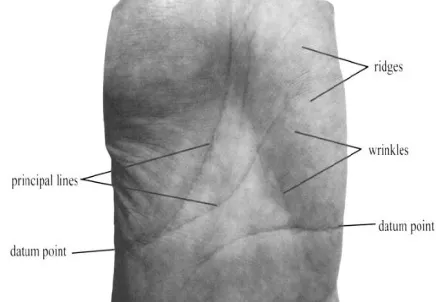
At present scenario, palmprints are more suitable in crime investigation, particularly for latent comparison, as recent studies have illustrated that more than thirty percentage of the latent prints found on a crime scene belong more likely to palms than fingers [17]. Person identification and verification is important in access control system. Recently biometric techniques are gaining much attention in these security services. Biometric technique is used to identify individuals based on physiological and behavioral characteristics. Palm is one of the physiological hand-based biometric characters. Palm has unique distinguishing line patterns which can be used to identify persons uniquely [9]. Palmprint identification can be seen as the capability to uniquely identify a person among others, by an appropriate algorithm using the palmprint features [17]. Palmprint identification is one of the most common and promising biometric modalities for forensic and commercial applications [36]. A palmprint can be either an online image or offline image taken with paper or ink respectively [2, 8, 26]. The palm is the inner surface of our hand from the wrist to the root of fingers. Palm is mostly acceptable biometric due to its permanence and uniqueness. Even identical twins have different principle lines, wrinkles, minutiae, datum point of features and texture images [26]. Palmprint referred to the rich features are lines, wrinkles and ridges appear in palm, as shown in figure 1. The basic idea behind palmprint identification is as follows; initially palm image is acquired from database. Then the palmprint image is preprocessed to determine the region of interest. This process includes segmentation and normalization. Once it is segmented , the features will be extracted for palm matching (i.e. identification). Identification can be addressed by classification to calculate degree of similarity of given palmprint images. In this paper, palmprint identification based on probability of matching is used in probabilistic rough set. Rough Set Theory has been applied to handle various challenges in the field of image processing and medical imaging [38,39]. It has been applied to various problems for image segmentation, feature reduction, and feature classification. In the rough set model proposed by Pawlak [22, 38], the lower and upper approximations are defined based on the relationships between an equivalence class and sets. The
lower approximation requires that the equivalence class is a subset of the set [34]. The upper approximation, the equivalence class must have a non-empty overlap with the set [22, 34]. A lack of consideration for the degree of their overlap unnecessarily limits the applications of rough sets and has motivated many researchers to investigate probabilistic generalizations of the theory. Probabilistic rough set approaches have observed a lot of methods, like the decision-theoretic rough set model, the variable precision rough set model, the Bayesian rough set model, information-theoretic analysis, probabilistic rule induction, and many related studies [1, 23, 31-35].
Figure 1: Different features from same palmprint image
993
RELATED WORK
This section describes the survey related to the unimodal biometrics of palmprint used for identification. N.Duta et al.[9] investigates the feasibility of person identification based on feature points extracted from palmprint images. They proposed following three paradigms used for palm matching. This set of feature points are extracted from palm lines; pairwise distance is computed for feature points and verifies the identity of palmprints. They also mention some limitations of palm print matching for further research. N. Duta [8] gives a survey on hand shape based biometric systems. The survey consists of review of component modules including the employed algorithms, system taxonomies, performance evaluation methodologies, summary of the accuracy results reported in the literature, testing issues, commercial hand shape biometric systems and evaluations. They have also mentioned few limitations of the hand shape biometric and provided some directions for future research. D. Zhang et al.,[36] presented online palm print identification using CCD cameras. A constant palmprint image is acquired by using a case and a cover. Due to the fixed background and uniform illumination, the palm images are segmented using otus method. They have proposed 2D Gabor phase for feature extraction and classified using tangent and bisector based techniques. They gave some future directions to reduce the size of the device and some other feature extraction code and different classifier to use for higher performance. C. L. Lin et al.[19] gives reliable and robust personal verification approach using palmprint features. Palm features does not require about objects and the parameters. Two finger-webs are automatically selected as datum points for region of interest (ROI) in palm images. Hierarchical decomposition method is applied for each extracted ROI of the palm features, which include directional information and multi-resolution decompositions. Finally verification method is applied for human verification. K. Tiwari et al.[26] present an automatic palmprint recognition using local structure tensor and force field transformation for human identification. The features have been created using eigen decomposition of each transformation. Euclidean distance between features of two palmprint has been used to make the decision on matching. C.Poon et al.[24] gives the selection and division of ROI for palmprint segmentation. L. Fei et al.[12] proposed Double Oriented Code(DOC) scheme for palmprint Recognition. The scheme of DOC represents the orientation feature of palmprint image. The authors used nonlinear angular match score for calculating the similarity between DOC’s. A.W.K. Kong et al.[14,15,16] provides the palmprint identification using low resolution image and texture based feature extraction methods. They have applied adjusted Gabor filter for extracting the texture information and identification can done at normalized hamming distance. X.Wu et al.[29] proposed automatic classification of low resolution palmprint using principal lines. Principal lines are positions and thickness of palm. They extract principle line in two ways that is line initial and recursive process. They outline the six categories based on the number of principal lines and their interactions. G.S. Badrinath et al.[2] presents human recognition based on palmprint. The author divided the palmprint image into several square blocks and these blocks are analyzed by PCA. The Hamming distance is used to calculate the match score between each block. Z.
Sun. et al.[25] gives palmprint based personal identification using orthogonal line ordinal features. Features like intensity, energy, contrast and texture features are used in this approach. These features are fused for classification. L. Fang et al.[11] proposed palmprint classification dealing with unbalance classes. Classification based on key line and boundary detection points are proposed in this work. Li.W et al.[18] proposed palmprint identification based on Fourier transform. They have converted the palm image from spatial domain to frequency domain and the extracted feature of frequency indexes are used for palm matching. X.Zhou et al.[41] proposed palmprint identification using 2D 2B 3B and wavelet decomposition. The wavelet features of low subband images are classified using Support Vector Machine (SVM). The researcher have also applied subspace or appearance based methods of Principal Component Analysis(PCA), Linear Discriminant Analysis(LDA) , Independent Component Analysis(ICA), wavelets, Gabor, discrete cosine transformation (DCT), and kernels in their methods[4, 10, 20, 21, 28]. J.Dai et al.[7] contributeed the palmprint recognition using ridge based palm matching. Researcher contribution includes statistics of palm feature, segment of skin distortion and discrimination of different palm regions and finally field based algorithm for palm matching. L.Zhang et al.[37] describe the 3D palmprint identification using block feature and collaborative representation. They have divided 3D palm print into set of blocks. These blocks are concatenated as feature vector and CR as classifier. S.Zhang et al.[38] proposed palmprint recognition based on neighborhood rough set(NRS). They have used NRS as feature extraction process and nearest neighbor as a classifier. S.Zhang et al.[39] proposed palmprint feature extraction and identification using ridgelet transforms and rough sets. Palmprints are converted into time-frequency domain using ridgelet transform and the rough set is used to remove the redundancy of feature matrix of transformation. SVM classifier is used for palm classification.
METHODOLOGY
Personal verification using palmprint biometric has received considerable attention and certain papers are reviewed for palmprint recognition and after reviewing them, the aimed methodology is proposed. The palmprint identification system includes three stages, i.e. preprocessing stage, feature extraction, and classification. Figure 2 shows the framework of palmprint identification. The proposed palmprint identification includes the following steps;
S1: Input a palm image S2: Extract ROI
S3: Get holds of a palmprint vector :{ pp1, pp2,
pp3……pp192} from ROI
S4: Apply Principal component Analysis:
S5: Obtain eigenpalm feature
S6: Measure and find out the similarity between two palmprint features using Probabilistic rough set. The conditional probability of an event X for a given event x.
p(X/[x]D]) = (p([x]D).p(X))/p([x]D).
994 S8: Measure identification accuracy between
palmprint images.
Figure 2: Flowchart of palmprint identification
PREPROCESSING Stage: ROI detection
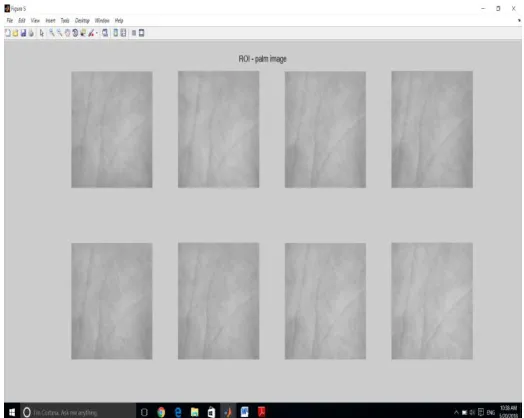
Generally, palmprint images are of different sizes, rotations and coordinations. Therefore preprocessing stage has been developed to correct the orientation of the image and also convert into the same size of palm images. The following steps are executed to find the ROI of palmprint images. Initially, color image of palmprint is transformed into a gray image. The central part of palmprint image is segmented as shown in figure 3. This central part of sub-image region is normalized to 192x192 pixels. The normalized ROI is used for further processing.
Figure 3: Region of Interest for sample Palmprint Image
FEATURE EXTRACTION Stage: EigenPalm
Once the region of interest is identified the features are extracted from it. The features of palmprint are extracted by Principal component analysis(PCA) which are globalfeatures of all palmprint images. The ROI of palmprint images are transformed into a small set of the features called eigenpalms[10]. The idea of eigenspace has been commonly used in face recognition [20] and it offers good characterization for palmprint recognition. The features of eigenpairs are extracted by projecting new palm image into sup space spanned by eigenpalm and applied for palmprint identification using probabilistic rough classifier. A palmprint image is represented as a two-dimensional array (N by N). In the eigenspace method, this can be defined as a vector of length called a palm vector. Generally, palmprints have similar structures like three principal lines and wrinkles, all palm vectors are located in a narrow image space, and thus they can be called by a relatively low dimensional space.
Let there are N palmprint sample images (X1, X2,
X3…….XN) in the training set with size N*N. The mean
palm image of the training set is defined as ∑ .
Each trained palmprint image differ from mean palm is defined by
. Then the covariance matrix is calculated by
∑
, Where X = ( ).
Then the eigenvector ( ) of the covariance matrix and eigen values ( ) of the covariance matrix are calculated by
Where is set of eigen vector associated with the eigenvalue .
Choose the principal components and form the feature vector
Transformed feature vector is calculated by
Every palmprint in the training set can be denoted by an eigenvector, the number of the eigenpairs is equivalent to the number of the users in the training set. But, the theory of principal component analysis states that it doesn’t need to select all of the eigenvectors as the base vectors and the mentioned eigenvectors that compare to the largest eigenvalues can denote the character of the training set. The probability similarity is calculated between mean input images i.e. an eigenimage of palmprint and projected palmprint image.
995 palmprint means to measure how different they are or to
decide whether they belong to the same individual or not[9, 12]. In this paper, a similarity measurement is determined by the probability of matching based on probabilistic rough set.
Probabilistic Rough set
Based on the rough set theory, the lower approximation set requires that the equivalence class is a subset of the target set, for the upper approximation set, the equivalence class must have a non-empty overlap with the target set. Accordingly, the rough set theory does not allow any uncertainty, in other words, the main drawback of the rough sets is lack of error tolerance [5, 27]. In order to overcome this limitation, Wong and Ziarko [23, 42, 43] grasped the probability approximation space into the rough set theory. An information system I=(U, A) where U is a nonempty, finite set of objects and A is a nonempty, finite set of attributes. The information function fa: U→Va for every
attribute a A. Va is nonempty, set of value for each
attribute [22]. An equivalence relation R on U and the probability measure p defined by a subset of U, the probabilistic approximation space P is defined as PA= (U, R,
P). A general form of probabilistic rough set approximations is using a threshold based on conditional probability. Suppose P(X|[x]) denotes the conditional probability of object X given that object x. The probability can never be greater than 1 and less than 0 i.e ≥ 1 and ≤ 0. The lower and upper approximations of X in PA is as follows
) ≥ 0.5 ) > 0.5 ) The probabilistic regions of positive, negative and boundary of PA are as follows:
PosPA (X) =
NegPA(X) = =
< 0.5)
BndPA(X) = =
= 0.5)
Palmprint matching is based on probabilistic rough set. Let x and y are two palmprint feature vectors. Let us consider the probability of matching between two objects x,y U on an attribute denoted by θa(x,y) which defines the
probability of that object x which takes the same value as object y on an attribute a[30]. The probability for perfect matching between two image features is one. The probability that the value of x matches with the value of y on a is given by
∑
When . Otherwise denote the conditional probability of given [30]. of objects U,
an equivalence relation on U, and a probabilistic
EXPERIMENTAL RESULTS AND ANALYSIS
In this section, Experimental result and performance analysis of personal identification based on palmprint is given. In order to evaluate performance analysis of the proposed algorithm three different set of palmprint databases have been considered from CASIA Palmprint Database, COEP Palm Print Database, and IIT Delhi palmprint database. Performance evaluation calculates the accuracy and usability of biometric algorithms. Performance measures are computed for palmprint identification approaches. The goal of our work is to improve the identification accuracy. The accuracy is determined by a number of palmprint images that are correctly matched.CASIA Palmprint database
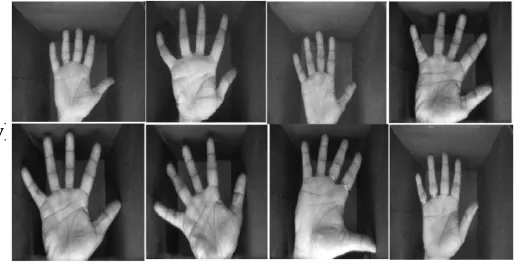
The Chinese Academy of Sciences Institute of Automation (CASIA) palmprint database (http://biometrics.idealtest.org/) contains 5502 images from 312 persons. Each person’s left and right-hand palm images are captured[3]. All the palm images have 8-bit gray level jpeg image format. Some of the sample palmprint images are shown in figure 4.
Figure 4: CASIA palmprint Database
IIT Delhi Touchless Palmprint Database
The IIT Delhi palmprint image database is made up of the palmprint images collected from the students and staff at IIT Delhi, New Delhi, India. It contains 235 subjects and all palmprint images are collected in the indoor environment and employ circular fluorescent illumination around the camera lens. The age group between each subject is 12-57 years. From each subject of the left and right hand, Images are acquired in varying hand positions. The resolution of these palmprint images is 800 X 600 pixels and all these images are available in bitmap format[13]. Sample IIT palmprint images are shown in figure 5.
996 COEP Palm Print Database
The College of Engineering, Pune (COEP) database consists of 8 different images of single-subject palm. The database consists of total 1344 images pertaining to 168 persons. The images are in jpg format. The images were captured using a digital camera. The resolution of images is 1600X1200 pixels[6]. Figure 6 shows the sample COEP palmprint database images.
Figure 6: COEP Palmprint database images
To analyze the performance of proposed approach, each sample in the database is matched against another palmprint in the same database. The analysis is performed by identifying a different set of images of the same person and a different person. The sample available in each database is divided into two sets that is training set and testing set. The performance parameters are false acceptance rate, false rejection rate, genuine acceptance rate and accuracy. False Acceptance Rate is a percentage
of falsely identifying the person by the biometric system and False Rejection Rate is a percentage of falsely rejecting the genuine person by the biometric system. Genuine acceptance rate is a percentage of genuine person which is identified by the biometric system. Accuracy is a percentage of efficiency of the biometric system in terms of capability to identify the person.
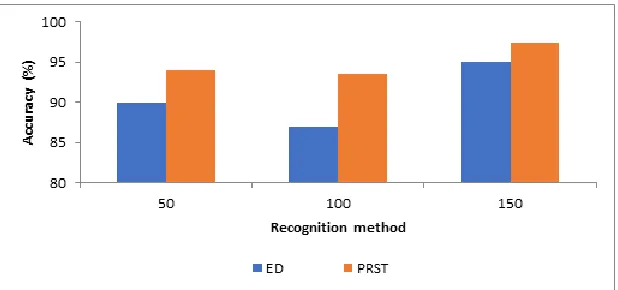
In palmprint identification, the performance analysis results of PCA-ED and PCA-PRST for different databases are shown in tables 1, 2, 3, 4. Table 1 refers to the recognition rates for IIT database. The proposed probabilistic rough set algorithm gives an average accuracy of 95% and other technique Euclidean distance gives 91%. Figure 7 shows the performance of the various similarity measures for various images in the IIT database.
Table 1: Comparison of Euclidean distance and Proposed PRST for IIT database samples
Method Total No.of Samples FAR(%) FRR(%) GAR(%) ACC(%)
Euclidean Distance
50 8.0 12.0 88 90
100 16.0 10.0 90 87
150 6.67 4.33 95.67 94.5
PRST
50 4.0 8.0 92 94
100 6.0 7.0 93 93.5
150 1.79 3.33 96.67 97.44
From Table 1, it is observed that the False Acceptance Rate is 8%, 16% and 6.67% for Euclidean distance at various sample size respectively 50,100,150. When compared to proposed Probabilistic rough set theory t,hese values are decreased to 4%, 6%, and 1.79%. False Rejection Rate is highest for Euclidean Distance and lowest for Probabilistic Rough Set Theory. It is equal to 12 %,10%, and 4.33% and it is reduced to 8%, 7% and 3.33%. Genuine Acceptance Rate is higher for a probabilistic rough set than for Euclidean distance.
997 Table 2 refers to the recognition rates for CASIA database.
The proposed probabilistic rough set algorithm gives an average accuracy of 97.05% and Euclidean distance gives
89.06%. Figure 8 shows the performance of the various similarity measures for various images in the CASIA database.
Table 2: Comparison of Euclidean distance and Proposed PRST for CASIA database samples
Method Total No.of Samples FAR(%) FRR(%) GAR(%) ACC(%)
Euclidean Distance
50 12 18 82 85
100 13 10 90 88.5
150 8 4.67 95.33 93.67
PRST
50 2.0 4.0 96 97
100 4.0 3.0 97 96.5
150 1.33 3.33 96.67 97.67
Figure 8: Comparison of Accuracy for palmprint recognition methods
Table 3 refers to the recognition rates for COEP database. The proposed probabilistic rough set algorithm gives an average accuracy of 94.83% and Euclidean distance gives 89.4%. Figure 9 shows the performance of the various similarity measures for various images in the COEP database.
Table 3: Comparison of Euclidean distance and Proposed PRST for COEP database samples
Method Total No.of Samples FAR(%) FRR(%) GAR(%) ACC(%)
Euclidean Distance
50 16 12 88 86
100 9 12 88 89.5
150 6.67 8 92 92.67
PRST
50 6 8.0 92 93
100 5.0 4.0 96 95.5
150 3.33 4.67 95.33 96
998 Table 4 refers to the recognition rate for the three palmprint
databases. The PRST algorithm gives the average accuracy of 97.5% and the Euclidean distance gives the
average accuracy of 93%. Figure 8 shows the performance analysis of the three databases. It also proves the efficiency of the proposed PRST algorithm.
Table 4: Recognition rate for three Palmprint databases
Method Database FAR(%) FRR(%) GAR(%) ACC(%)
Euclidean Distance
CASIA 4.80 6.41 93.59 94.39
IIT 10.63 4.25 95.75 92.56
COEP 5.36 7.14 92.86 93.75
PRST
CASIA 1.92 3.52 96.47 97.28
IIT 2.13 3.83 96.17 97.02
COEP 1.78 2.38 97.62 97.92
From Table 4 it is observed that the False Acceptance Rate is 4.8%, 10.63% and 5.36% for Euclidean distance at various databases respectively CASIA, IIT, COEP. When compared to proposed Probabilistic rough set theory, these values are decreased to 1.92%, 2.13%, and 1.78%. False Rejection Rate is highest for Euclidean Distance and lowest
for Probabilistic Rough Set Theory. It is equal to 6.41%, 4.25%, and 7.14% and it is reduced to 3.52%, 3.83%, and 2.38%. Genuine Acceptance Rate is higher for a probabilistic rough set then compare to the Euclidean distance.
Figure 8: Recognition rate for three palmprint databases using various similarity measures
CONCLUSION
In this paper, various techniques are studied like the identification of region of interest in the palm image, feature extraction and identification using palmprint images. For this purpose, the work includes principal component analysis for feature extraction and probabilistic rough set for palmprint identification. The probabilistic rough set model is formulated by using a conditional probability, which leads to flexibility and robustness while performing classification. The proposed probabilistic rough set method for palmprint identification produced high accuracy when compared with a standard technique like Euclidean distance. Different databases are used for this experiment and the results of the proposed probabilistic rough set gives better result at FAR and FRR as compared to other techniques. The further enhancement could be that different feature reduction technique and identification can be used for palmprint recognition.
REFERENCE
[1]. Azam, N. and Yao, J., 2014. Analyzing uncertainties of probabilistic rough set regions with game-theoretic rough sets. International journal of approximate reasoning, 55(1), pp.142-155.
[2]. Badrinath, G.S. and Gupta, P., 2012. Palmprint based recognition system using phase-difference information. Future Generation Computer Systems, 28(1), pp.287-305.
[3]. CASIA Palmprint image database: http://biometrics.idealtest.org/
[4]. Chu, R., Lei, Z., Han, Y., He, R. and Li, S.Z., 2007, November. Learning Gabor magnitude features for palmprint recognition. In Asian Conference on Computer Vision (pp. 22-31). Springer, Berlin, Heidelberg.
[5]. Ciucci, D. and Forcati, I., 2017, July. Certainty-based rough sets. In International Joint Conference on Rough Sets (pp. 43-55). Springer, Cham.
[6]. COEP Palmprint Database:
http://www.coep.org.in/resources/coeppalmprintdat abase
999 [8]. Duta, N., 2009. A survey of biometric technology
based on hand shape. Pattern Recognition, 42(11), pp.2797-2806.
[9]. Duta, N., Jain, A.K. and Mardia, K.V., 2002. Matching of palmprints. Pattern Recognition Letters, 23(4), pp.477-485.
[10]. Ekinci, M. and Aykut, M., 2007, July. Palmprint recognition by applying wavelet subband representation and kernel PCA. In International Workshop on Machine Learning and Data Mining in Pattern Recognition (pp. 628-642). Springer, Berlin, Heidelberg.
[11]. Fang, L., Leung, M.K., Shikhare, T., Chan, V. and Choon, K.F., 2006, October. Palmprint classification. In Systems, Man and Cybernetics, 2006. SMC'06. IEEE International Conference on (Vol. 4, pp. 2965-2969). IEEE.
[12]. Fei, L., Xu, Y., Tang, W. and Zhang, D., 2016. Double-orientation code and nonlinear matching scheme for palmprint recognition. Pattern Recognition, 49, pp.89-101.
[13]. IIT Delhi Palmprint image database: http://www4.comp.polyu.edu.hk/~csajaykr/IITD/Dat abase_Palm.htm
[14]. Kong, A., Zhang, D. and Kamel, M., 2006. Palmprint identification using feature-level fusion. Pattern Recognition, 39(3), pp.478-487. [15]. Kong, A.K. and Zhang, D., 2004, August.
Competitive coding scheme for palmprint verification. In Pattern Recognition, 2004. ICPR 2004. Proceedings of the 17th International Conference on (Vol. 1, pp. 520-523). IEEE.
[16]. Kong, W.K. and Zhang, D., 2002. Palmprint texture analysis based on low-resolution images for personal authentication. In Pattern Recognition, 2002. Proceedings. 16th International Conference on (Vol. 3, pp. 807-810). IEEE.
[17]. Li, S.Z. and Jain, A., 2015. Encyclopedia of biometrics. Springer Publishing Company, Incorporated.
[18]. Li, W., Zhang, D. and Xu, Z., 2002. Palmprint identification by Fourier transform. International Journal of Pattern Recognition and Artificial Intelligence, 16(04), pp.417-432.
[19]. Lin, C.L., Chuang, T.C. and Fan, K.C., 2005. Palmprint verification using hierarchical decomposition. Pattern Recognition, 38(12), pp.2639-2652.
[20]. Lu, G., Zhang, D. and Wang, K., 2003. Palmprint recognition using eigenpalms features. Pattern Recognition Letters, 24(9-10), pp.1463-1467. [21]. Lu, G.M., Wang, K.Q. and Zhang, D., 2004,
August. Wavelet-based independent component analysis for palmprint identification. In Machine Learning and Cybernetics, 2004. Proceedings of
2004 International Conference On (Vol. 6, pp. 3547-3550). IEEE.
[22]. Pawlak, Z., 1984. Rough probability. Bull. Pol. Acad. Sci. Math, 32, pp.607-615.
[23]. Pawlak, Z., Wong, S.K. and Ziarko, W., 1988. Rough sets: Probabilistic versus deterministic approach. International Journal of Man-Machine Studies.
[24]. Poon, C., Wong, D.C. and Shen, H.C., 2004, August. A new method in locating and segmenting palmprint into region-of-interest. In Pattern Recognition, 2004. ICPR 2004. Proceedings of the 17th International Conference on (Vol. 4, pp. 533-536). IEEE.
[25]. Sun, Z., Tan, T., Wang, Y. and Li, S.Z., 2005, June. Ordinal palmprint representation for personal identification [represention read representation]. In Computer Vision and Pattern Recognition, 2005. CVPR 2005. IEEE Computer Society Conference on (Vol. 1, pp. 279-284). IEEE.
[26]. Tiwari, K., Arya, D.K., Badrinath, G.S. and Gupta, P., 2013. Designing palmprint based recognition system using local structure tensor and force field
transformation for human
identification. Neurocomputing, 116, pp.222-230. [27]. Van Nguyen, D., Yamada, K. and Unehara, M.,
2013. Extended tolerance relation to define a new rough set model in incomplete information systems. Advances in Fuzzy Systems, 2013, p.9. [28]. Wu, X., Zhang, D. and Wang, K., 2003.
Fisherpalms based palmprint recognition. Pattern recognition letters, 24(15), pp.2829-2838.
[29]. Wu, X., Zhang, D., Wang, K. and Huang, B., 2004. Palmprint classification using principal lines. Pattern Recognition, 37(10), pp.1987-1998. [30]. Yamada, K. and Unehara, M., 2013, October. On
Probability of Matching in Probability Based Rough Set Definitions. In Systems, Man, and Cybernetics (SMC), 2013 IEEE International Conference on (pp. 449-454). IEEE.
[31]. Yao, Y., 2008. Probabilistic rough set approximations. International journal of approximate reasoning, 49(2), pp.255-271.
[32]. Yao, Y., 2010. Three-way decisions with probabilistic rough sets. Information Sciences, 180(3), pp.341-353.
[33]. Yao, Y., 2011. Two semantic issues in a probabilistic rough set model. Fundamenta Informaticae, 108(3-4), pp.249-265.
[34]. Yao, Y., Greco, S. and Słowiński, R., 2015. Probabilistic rough sets. In Springer Handbook of Computational Intelligence (pp. 387-411). Springer, Berlin, Heidelberg.
1000 [36]. Zhang, D., Kong, W.K., You, J. and Wong, M.,
2003. Online palmprint identification. IEEE Transactions on pattern analysis and machine intelligence, 25(9), pp.1041-1050.
[37]. Zhang, L., Shen, Y., Li, H. and Lu, J., 2015. 3D palmprint identification using block-wise features and collaborative representation. IEEE transactions on pattern analysis and machine intelligence, 37(8), pp.1730-1736.
[38]. Zhang, S. and Liu, J., 2010, August. Palmprint recognition based on neighborhood rough set. In International Conference on Intelligent Computing (pp. 650-656). Springer, Berlin, Heidelberg.
[39]. Zhang, S., Wang, S. and Li, X., 2008, September. Palmprint linear feature extraction and identification based on ridgelet transforms and rough sets. In International Conference on Intelligent Computing (pp. 1101-1108). Springer, Berlin, Heidelberg.
[40]. Zhou, B. and Yao, Y., 2013, October. Comparison of two models of probabilistic rough sets. In International Conference on Rough Sets and Knowledge Technology (pp. 121-132). Springer, Berlin, Heidelberg.
[41]. Zhou, X., Peng, Y. and Yang, M., 2006, August. Palmprint recognition using wavelet and support vector machines. In Pacific Rim International Conference on Artificial Intelligence(pp. 385-393). Springer, Berlin, Heidelberg.
[42]. Ziarko, W., 2005, August. Probabilistic rough sets. In International Workshop on Rough Sets, Fuzzy Sets, Data Mining, and Granular-Soft Computing (pp. 283-293). Springer, Berlin, Heidelberg.