1
Separation of Pet from Other Plastics by Froth Flotation Combined with Alkaline Pretreatment
1
2
1a* Fernando Pita
3
4
a Geosciences Centre, Department of Earth Sciences, Faculty of Sciences and Technology, University of Coimbra,
5
3030-790 Coimbra, Portugal.
6
7
*Corresponding author: [email protected]
8
9
Abstract
10
Plastics are naturally hydrophobic materials so, in order to employ flotation for the separation of plastic mixtures, the
11
use of appropriate wetting agents is mandatory. In this work, the effect of pretreatment with alkaline solutions of
12
sodium hydroxide on the floatability of four plastics (PET, PS, PMMA and PVC) was studied. The influence of
13
NaOH concentration, treatment time and temperature of the alkaline solution, and influence of particle size was
14
analyzed.
15
Results showed that alkaline treatment had a strong effect on PET floatability, some effect on floatability of PMMA
16
and PVC and no effect on floatability of PS. Plastics floatability decreased with the increase of NaOH concentration,
17
temperature and treatment time of the alkaline solution. Based on flotation behavior of simple plastics, flotation
18
separation after alkaline treatment of bi-component mixtures of PET with PS and PVC was achieved efficiently. The
19
best separation was obtained for PET/PS mixture, a floated with a grade of 98% in PS and a sunk with a grade of
20
100% in PET. PET/PMMA mixture led to the worst separation. For PET/PMMA and PET/PVC mixtures, flotation
21
separation improved with the decrease of the particles size.
22
23
Keywords: plastic; froth flotation; alkaline treatment; particle size.
24
25
1. Introduction
26
Since the discovery of plastic in the 50's of last century, its global production has been continuously rising,
27
gradually replacing materials, like glass and metal. In the last decade, the world production of plastics has been
28
grown around 3.5% per year, increasing from 230 million tonnes in 2005 to 359 million tonnes in 2017 [1]. Global
29
plastics consumption is predicted to continue to grow, reaching 400 million tonnes a year by 2025.
30
Despite the constant increase in plastic consumption, as a result of its versatility and excellent properties, over
31
time plastic has acquired a negative reputation and there is some public pressure on the use of plastics, due to its
32
difficult decomposition, since none of the commonly used plastics are biodegradable. Recently, the public pressure
33
has worsened with information about the enormous quantity of plastic waste dumped into the oceans and with the
34
images of marine animals wrapped in plastic or caught with items, like straws in their noses. About 8 million tonnes
35
of plastic enters the sea every year, and if we do not change the way we produce and use plastics, there will be more
36
plastics than fish in our oceans by 2050.
37
It is noted that landfills is the main final destination of plastic waste, and also the main source of plastic pollution.
38
Of the plastic waste produced between 1950 and 2015, only 9% was recycled, 12% was incinerated, and 79% was
39
was discarded, 25% was incinerated, and 20% was recycled [2]. However, it should be noted that in Europe, in 2017,
41
32.5% of plastic waste was recycled, 42.6% was recovered through energy recovery processes and 24.9% was
42
landfilled [1]. The vast majority of plastic waste ends up in landfills or the natural environment, or are incinerated,
43
causing serious environmental problems. Thus, it is urgent to substantially reduce our use of plastics, reduce plastic
44
waste by recycling and reusing as much as possible. However, in order to recycle plastic waste it is necessary to
45
separate the plastic mixtures into individual plastics, because different plastics cannot be recycled together due to
46
chemical incompatibilities, differences in melting point and thermal stabilities [3,4]. Froth flotation, the most
47
common separation process used by the mineral industry, is a possible alternative for separating plastic mixtures.
48
Froth flotation allows the separation of hydrophobic from hydrophilic material. However, since most plastics are
49
naturally hydrophobic, selective wetting components are required, which can be achieved by adsorption of wetting
50
agents or surface modification.
51
Several wetting agents, such as methyl cellulose, polyvinyl alcohol, polyethylene glycol, gelatin, tannic acid,
52
saponin, terpineol, triton X-100, calcium lignin sulfonate and sodium lignin sulfonate have been successfully used by
53
several authors [5-10]. Surface modification of plastics by treatment with alkaline solutions followed by froth
54
flotation were developed [3,11-22]. Plastic flotation is controlled not only by hydrophobicity, but also by the size of
55
the plastic particles [13,19,23-24].
56
In this study, an alkaline treatment of PET, PVC, PS and PMMA particles with sodium hydroxide (NaOH)
57
solutions followed by froth flotation was performed. The parameters analysed were the NaOH concentration,
58
temperature and treatment time of alkaline solution, and particle size.
59
60
2. Experimental
61
62
2.1 Materials
63
Four different kinds of post-consumer plastics were used: Polyethylene Terephthalate (PET, transparent),
64
Polyvinyl Chloride (PVC, light green), Polystyrene (PS, black) and Polymethyl methacrylate (PMMA, white). The
65
samples were previously ground and the sieve size fractions used in this study were 2.8-2 mm and 4-2.8 mm.
66
The density of these plastics, measured by an Ultra Pycnometer (AccuPyc 1330), are as follows: PET: 1.364
67
g/cm3; PVC: 1.326 g/cm3; PS: 1.047 g/cm3; and PMMA: 1.204 g/cm3.
68
Sodium hydroxide was used in the alkaline treatment as wetting agent, and Methyl isobutyl carbinol (MIBC)
69
(109916 Sigma Aldrich) was used as frothing reagent.
70
71
2.2. Alkaline pretreatment
72
Plastic samples were treated with NaOH solutions, using a Denver stirrer (400 rpm) with a plot plate. The
73
treatment was done in a 1 L glass beaker using 40 g of plastic at a solids concentration of 20 wt%. The beaker was
74
placed on a hot plate in order to adjust and control the temperature. The alkaline treatment was controlled by the
75
operating parameters: NaOH concentration, temperature and treatment time (Table 1). Plastic samples were treated
76
in alkaline solutions at NaOH concentrations of 2%, 6% and 10%, at a temperature range between 20 ºC and 80 ºC,
77
and a treatment time between 2.5 min and 30 min (Table 1). After alkaline pretreatment, the plastics were taken out
78
81
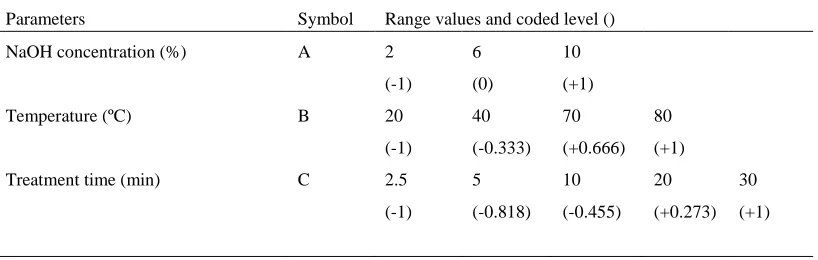
Table 1 – Experimental range and levels of the independent variables for the alkaline treatment.
82
Parameters Symbol Range values and coded level ()
NaOH concentration (%) A 2
(-1)
6
(0)
10
(+1)
Temperature (ºC) B 20
(-1)
40
(-0.333) 70
(+0.666) 80
(+1)
Treatment time (min) C 2.5
(-1)
5
(-0.818) 10
(-0.455) 20
(+0.273) 30
(+1)
-1: factor at low level; 0: factor at medium level; +1: factor at high level.
83
84
2.3 Flotation experiments
85
The froth flotation experiments were performed in a Denver cell, with a capacity of 3 dm3, at a low rotational
86
speed of 600 rpm. Each flotation test used 40 g of plastics previously treated with an alkaline solution and rinsed,
87
that was conditioned with the frother (MIBC) for about 2 minutes before the flotation tests. MIBC was added at a
88
constant concentration of 30x10-3 g/L in all experiments. After conditioning, the air valve was opened and the floated
89
product was collected over 6 minutes. Both the floated and the sunk (non-floated) were dried and weighed. Tap
90
water was used in the flotation tests.
91
The pH in the flotation cell was not adjusted, but it was measured periodically along the experiment. The pH
92
remained approximately constant, in the range of 7.0-7.3.
93
Firstly, flotation tests were carried out with one-component plastic samples previously treated with an alkaline
94
solution. According to the floatability of plastics, it was possible to separate the four plastics into two groups: the
95
first group constituted only by PET, which has low floatability, and the second group that includes the other three
96
plastics (PS, PMMA and PVC), which have similar floatability. Then, flotation separation of binary plastic mixtures
97
was performed using three bi-component mixtures: PET/PS, PE/PMMA and PET/PVC. Plastic mixtures were
98
previously treated with an alkaline solution, and each plastic contributed with 50% (20 g) for the total mixture
99
weight.
100
The effectiveness of the flotation tests was evaluated by the grade and recovery of each type of plastic in the
101
floated and in the sunk products, and by the separation efficiency, defined by Schulz [25]. In the flotation tests of the
102
plastic mixtures, the plastics type presented in the floated and the sunk were separated from each other by manual
103
sorting, weighed, and flotation recovery and grade were calculated based on mass balance. This was possible due to
104
differences in colours and shapes of the plastics particles. Experiments were done three times under similar operating
105
conditions.
106
A second order polynomial equation was chosen to investigate the effect of different operating parameters of the
107
alkaline treatment on the floatability of the plastics (Equation (1)):
108
109
Y = b0 + b1A + b2B + b3C + b12AB +b13AC + b23BC + b11A2 +b22B2 + b33C2 (1)
where, Y is the predicted response, b0 is model constant; b1, b2 and b3 are linear coefficients; b12, b13 and b23 are
112
the interaction coefficients; and b11, b22 and b33 are the quadratic coefficients. This model represents the effect of
113
NaOH concentration (A), temperature (B), treatment time (C) and their interactions on the plastics floatability. The
114
list of the independent variables (A, B and C) with their coded and levels are presented in Table 1. The significance
115
of model equation, individual parameters, and factor interactions were evaluated by analysis of variance (ANOVA)
116
at the confidence intervals of 95% (α = 0.05).
117
118
3. Results and discussion
119
120
3.1. Effect of alkaline pretreatment on PET floatability
121
Two size fractions (2-2.8 mm and 2.8-4 mm) of the four plastics were treated with different concentrations of
122
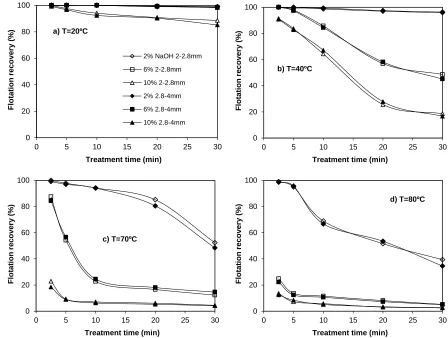
NaOH solutions, at different temperature and treatment time. Figure 1 shows the effect of NaOH concentration,
123
temperature and treatment time of the alkaline solution on the flotation recovery of PET of the two fractions. The
124
floatability of PET was strongly influenced by the NaOH concentration, temperature and treatment time. The
125
flotation recovery of PET decreased with increasing NaOH concentration, temperature and treatment time, of
126
alkaline solution. Also, Kangal et al. [3], Drelich et al. [11], Burat et al. [13], Nagy et al. [15], Wang et al. [10,19],
127
Guo et al. [20], verified that recovery of PET in the floated decreased with increasing NaOH concentration,
128
temperature and treatment time of alkaline solution. They found that alkaline treatment rendered the PET surface
129
more hydrophilic, which may be a result of the hydrolysis of ester bonds in PET chains.
130
The two size fractions showed similar results. This means that the effect of particle size was minimal. The effect
131
of NaOH concentration depended on the values of temperature and treatment time, and the effect of treatment time
132
depended on the values of NaOH concentration and temperature and vice versa (Figure 1). At higher temperature, the
133
NaOH concentration or treatment time needed to make PET hydrophilic was low. Also, at higher NaOH
134
concentration, the temperature or treatment time needed to make PET hydrophilic was low. The lowest recovery of
135
PET in the floated (2.5% for fraction 2.8-4 mm and 2.8% for fraction 2-2.8 mm) was obtained with the highest
136
NaOH concentration (10%), the highest treatment time (30 min) and the highest temperature (80 ºC).
137
When temperature was at the lowest value (20º C), a change in NaOH concentration or treatment time had a low
138
effect in PET recovery. PET is naturally hydrophobic since alkaline treatment with low NaOH concentration
139
solutions and at a temperature of 20 ºC, the flotation recovery of PET was about 100%. At a temperature of 20 ºC
140
and low NaOH concentration (2% and 6%), there was no hydrophilization of PET (Figure 1a).
141
At a temperature of 40 ºC temperature, when NaOH concentration was 2%, a change in treatment time had low
142
effect in PET recovery (Figure 1b). But when NaOH concentration was at 6% or 10%, flotation recovery of PET
143
decreased significantly with increasing treatment time.
144
At temperatures of 70 ºC and 80 ºC (Figure 1c and 1d), flotation recovery of PET decreased with increasing
145
treatment time. At a temperature of 80 ºC and for fraction 2.8-4 mm, the flotation recovery dropped from 98.6% to
146
34.5%, when the treatment time increased from 2.5 min to 30 min for a NaOH concentration of 2%. However, for a
147
higher concentration of NaOH (10%), the hydrophilization of PET was achieved for low treatment time.
148
0 20 40 60 80
0 5 10 15 20 25 30
Fl ot a ti on re c ov e ry ( % )
Treatment time (min) a) T=20ºC
2% NaOH 2-2.8mm
6% 2-2.8mm 10% 2-2.8mm 2% 2.8-4mm 6% 2.8-4mm 10% 2.8-4mm
0 20 40 60 80 100
0 5 10 15 20 25 30
Fl ot a ti on re c ov e ry ( % )
Treatment time (min) b) T=40ºC
150
0 20 40 60 80 1000 5 10 15 20 25 30
Fl ot a ti on re c ov e ry ( % )
Treatment time (min) c) T=70ºC
0 20 40 60 80 100
0 5 10 15 20 25 30
Fl ot a ti on re c ov e ry ( % )
Treatment time (min)
d) T=80ºC
151
Figure 1 - Influence of NaOH concentration, temperature and treatment time of the alkaline solution on floatability
152
of PET for fractions 2-2.8 mm and 2.8-4 mm.
153
154
To find the effect of the NaOH concentration, temperature and treatment time in PET recovery, statistical
155
analysis of the experimental data was done and models were developed for optimization of the parameters. A
156
quadratic relationship was shown to describe the dependence of the plastic floatability on the three operating
157
variables of the alkaline treatment. The equations presented are in terms of coded levels: the low levels of the
158
parameters were coded as -1 and the high levels as +1 (Table 1). Therefore, the relative impact of the NaOH
159
concentration, temperature and treatment time in PET recovery can be identified by comparing the coefficients of the
160
equation.
161
The analysis of variance (ANOVA) for the PET recovery model of the two size fractions is shown in Table 2.
162
Based on all statistical analysis, the model presented was considered adequate to the prediction of PET floatability
163
after alkaline treatment. The coefficients of determination (R2) obtained for the PET recovery of size fraction 2-2.8
164
mm and 2.8-4 mm were 0.8885 and 0.8881 respectively, showing that the fit was good. The significance level of
165
each independent variable, as well as their quadratic terms and interaction between the variables was evaluated based
166
on corresponding F-values and p-values. For the two size fractions the model F-value was about 44 at 99.99%
167
confidence level and the model Prob > F value is less than 0.05, shows that the model is significant.
168
Table 2 - Analysis of Variance (ANOVA) of the response surface quadratic model for PET recovery of the two size
170
fractions.
171
model A B C AB AC BC A2 B2 C2
2-2.8 mm p-value
Prob>F
<0.0001 <0.0001 <0.0001 <0.0001 <0.0001 0.9635 0.1169 0.0588 0.4583 0.1557
Sum of Square=79831; Mean of square= 8870; degree of freedom=9; Fmodel=44.3; R2=0.8885; Ajusted R2=0.8680
2.8-4 mm p-value
Prob>F
<0.0001 <0.0001 <0.0001 0.0002 <0.0001 0.8789 0.1242 0.0667 0.4283 0.2593
Sum of Square=79999; Mean of square=8889; degree of freedom=9; Fmodel=44.1; R2=0.8881; Ajusted R2=0.8680
172
The quadratic effect of the three variables and the interaction between NaOH concentration and time treatment
173
and between temperature and treatment time had no statistical significance, and hence can be neglected. The
174
variables that influenced PET floatability were the linear terms of NaOH concentration, temperature and time
175
treatment, and the linear term of interaction between NaOH concentration and temperature. For fraction +2-2.8 mm
176
and +2.8-4 mm, the model developed using these factors and their interaction is given in Eqs. (2) and (3),
177
respectively.
178
179
PET recovery (%) = 62.46 - 22.12A – 33.38B – 14.83C – 15.88AB (2)
180
PET recovery (%) = 61.83 - 22.10A – 33.70B – 15.10C – 15.27AB (3)
181
182
where A is the NaOH concentration (%), B the temperature (ºC), and C the treatment time (min). The coefficients of
183
the three parameters were negative values indicating a negative correlation between PET floatability and parameter
184
levels. For both size fractions, PET recovery presented an equal order of relative impact of the operating parameters.
185
The equation coefficients clearly showed that PET recovery was mainly affected by temperature, followed by NaOH
186
concentration, treatment time and interaction between the NaOH concentration and temperature. The quadratic effect
187
of the three variables was not significant, and therefore it was not considered.
188
189
3.2. Effect of alkaline pretreatment on PS floatability
190
Figure 2 shows the effect of NaOH concentration, temperature and treatment time of the alkaline solution on the
191
flotation recovery of PS, for fractions 2-2.8 mm and 2.8-4 mm. The floatability of PS was not influenced by alkaline
192
pretreatment, since for all tests the recovery in the float was 100%. For all tests of alkaline pretreatment, there was no
193
hydrophilization of PS.
194
0 20 40 60 80
0 5 10 15 20 25 30
Fl
ot
a
ti
on
re
c
ov
e
ry
(
%
)
Treatment time (min) a) T=20ºC
2% NaOH 2-2.8mm 6% 2-2.8mm 10% 2-2.8mm 2% 2.8-4mm 6% 2.8-4mm 10% 2.8-4mm
0 20 40 60 80
0 5 10 15 20 25 30
Fl
ot
a
ti
on
re
c
ov
e
ry
(
%
)
Treatment time (min) b) T=40ºC
196
0 20 40 60 80 100
0 5 10 15 20 25 30
Fl
ot
a
ti
on
re
c
ov
e
ry
(
%
)
Treatment time (min) c) T=70ºC
0 20 40 60 80 100
0 5 10 15 20 25 30
Fl
ot
a
ti
on
re
c
ov
e
ry
(
%
)
Treatment time (min) d) T=80ºC
197
Figure 2 - Influence of NaOH concentration, temperature and treatment time of the alkaline solution on floatability
198
of PS, for fractions 2-2.8m and 2.8-4 mm.
199
200
3.3. Effect of alkaline pretreatment on PMMA floatability
201
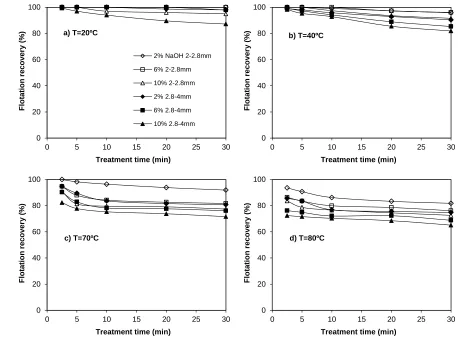
Flotation recovery of PMMA decreased slightly with increasing NaOH concentration, temperature and treatment
202
time (Figure 3). However, the effect of these three parameters on PMMA recovery was smaller than that observed
203
for PET. Temperature had a considerable effect on alkaline pretreatment of PMMA. At 20 ºC, for the three NaOH
204
concentrations and for all treatment times, there was no hydrophilization of PMMA, since PMMA recovery was
205
about 100%. The effect of NaOH concentration, temperature and treatment time of the alkaline solution on the
206
flotation recovery of PMMA for the two fractions (2-2.8 mm and 2.8-4 mm) was similar. However, PMMA recovery
207
of fraction 2.8-4 mm was lower than that observed for fraction 2-2.8 mm. Also, Shen et al. [5,23], Fraunholcz [12],
208
Wang et al. [19,21], Pita and Castilho [24], Marques and Tenório [26], found that large plastic particles were more
209
difficult to float than smaller ones.
210
The lowest recovery of PMMA in the floated was obtained with the highest NaOH concentration (10%), the
211
highest temperature (80 ºC) and the highest treatment time (30 min), with 67.6% recovery for fraction 2-2.8mm and
212
56.5% recovery for fraction 2.8-4 mm.
213
0 20 40 60 80 100
0 5 10 15 20 25 30
Fl
ot
a
ti
on
re
c
ov
e
ry
(
%
)
Treatment time (min) a) T=20ºC
2% NaOH 2-2.8mm 6% 2-2.8mm 10% 2-2.8mm 2% 2.8-4mm 6% 2.8-4mm 10% 2.8-4mm
0 20 40 60 80 100
0 5 10 15 20 25 30
Fl
ot
a
ti
on
re
c
ov
e
ry
(
%
)
Treatment time (min) b) T=40ºC
215
0 20 40 60 80 100
0 5 10 15 20 25 30
Fl
ot
a
ti
on
re
c
ov
e
ry
(
%
)
Treatment time (min) c) T=70ºC
0 20 40 60 80 100
0 5 10 15 20 25 30
Fl
ot
a
ti
on
re
c
ov
e
ry
(
%
)
Treatment time (min) d) T=80ºC
216
Figure 3 - Influence of NaOH concentration, temperature and treatment time of the alkaline solution on floatability
217
of PMMA, for fractions 2-2.8m and 2.8-4 mm.
218
219
A second order polynomial equation was chosen to describe the dependence of the PMMA floatability on the
220
three operating variables of the alkaline treatment. The analysis of variance (ANOVA) for PMMA recovery model of
221
the two size fraction is shown in Table 3. For size fractions of 2-2.8 and 2.8-4 mm, the R2 values of 0.9485 and
222
0.9584 respectively, implies that the model fit was good. For the two size fractions, the F-value at 99.99%
223
confidence level and the Prob > F value was less than 0.05, showing that the model was significant.
224
225
Table 3 - Analysis of Variance (ANOVA) of the response surface quadratic model for PMMA recovery of the two
226
size fractions.
227
model A B C AB AC BC A2 B2 C2
2-2.8 mm p-value
Prob>F
<0.0001 <0.0001 <0.0001 <0.0001 <0.0001 0.2060 0.0001 0.3750 <0.0001 0.086
Sum of Square=4316; Mean of square= 480; degree of freedom=9; Fmodel=102.4; R2=0.9485; Ajusted R2=0.9393
2.8-4 mm p-value
Prob>F
228
For fractions +2-2.8 mm and +2.8-4 mm, the equations (4) and (5), respectively, dictate that linear terms of the
229
NaOH concentration, temperature and treatment time, linear term of interaction between NaOH concentration and
230
temperature, and quadratic term of the temperature had a negative effect on PMMA floatability of the two size
231
fractions. Interaction between temperature and treatment time had a negative effect on PMMA floatability for the
232
size fraction +2.8-4 mm. The linear term of interaction between NaOH concentration and treatment time, and the
233
quadratic effect of NaOH concentration and treatment time had no statistical significance, and hence were not
234
considered.
235
236
PMMA recovery (%) = 95.12 – 3.35A – 9.01B – 3.17C – 2.79AB - 1.98BC – 5.23B2 (4)
237
PMMA recovery (%) = 89.08 – 3.65A – 11.63B – 4.64C – 1.30AB - 4.25B2 (5)
238
239
For both size fractions, PMMA recovery presented an equal order of relative impact of the three independent
240
variables. PMMA recovery was mainly affected by temperature, followed by NaOH concentration (A), treatment
241
time (C) and interaction between the NaOH concentration and temperature (AB).
242
243
3.4. Effect of alkaline pretreatment on PVC floatability
244
Floatability of PVC was influenced by NaOH concentration, temperature and treatment time (Figure 4).
245
However, this effect was very smaller than that observed for PET, and slightly smaller than that observed for
246
PMMA. PVC recovery for fraction 2-2.8 mm was greater than for fraction 2.8-4 mm. Flotation recovery of PVC
247
decreased slightly with increasing NaOH concentration, temperature and treatment time. Thus, the lowest recovery
248
of PVC in the floated was obtained with the highest NaOH concentration (10%), the highest temperature (80 ºC) and
249
the highest treatment time (30 min), with 87.8% recovery for fraction 2-2.8mm and 76.4% recovery for fraction
2.8-250
4 mm.
251
At a temperature of 20 ºC, for three NaOH concentrations and all treatment times, there was no hydrophilization
252
of PVC, since PVC recovery was about 100%. Also, at 40 °C, the hydrophilization of the PVC was small, since the
253
PVC recovery was close to 100%.
254
255
0 20 40 60 80 100
0 5 10 15 20 25 30
Fl
ot
a
ti
on
re
c
ov
e
ry
(
%
)
Treatment time (min) a) T=20ºC
2% NaOH 2-2.8mm 6% 2-2.8mm 10% 2-2.8mm 2% 2.8-4mm 6% 2.8-4mm 10% 2.8-4mm
..
0 20 40 60 80 1000 5 10 15 20 25 30
Fl
ot
a
ti
on
re
c
ov
e
ry
(
%
)
Treatment time (min) b) T=40ºC
0 20 40 60 80 100
0 5 10 15 20 25 30
Fl
ot
a
ti
on
re
c
ov
e
ry
(
%
)
Treatment time (min) c) T=70ºC
..
0 20 40 60 80 1000 5 10 15 20 25 30
Fl
ot
a
ti
on
re
c
ov
e
ry
(
%
)
Treatment time (min) d) T=80ºC
257
Figure 4 - Influence of NaOH concentration, temperature and treatment time of the alkaline solution on floatability
258
of PVC, for fractions 2-2.8m and 2.8-4 mm.
259
260
The analysis of variance (ANOVA) for PVC recovery model of the two size fractions is shown in Table 4. For
261
size fractions of 2-2.8 mm and 2.8-4 mm, the R2 values of 0.9282 and 0.8720 respectively, implies that the model fit
262
was good. Model F-value of size fractions 2-2.8 mm and 2.8-4 mm was 71.8 and 38.0, respectively, with a 99.99%
263
confidence level and the Prob > F value lower than 0.05, showing that the model was significant.
264
265
Table 4 - Analysis of Variance (ANOVA) of the response surface quadratic model for PVC recovery of the two size
266
fractions.
267
model A B C AB AC BC A2 B2 C2
2-2.8 mm p-value
Prob>F
<0.0001 <0.0001 <0.0001 <0.0001 <0.0001 0.1006 <0.0001 0.8151 <0.0001 0.0651
Sum of Square=406; Mean of square= 45.1; degree of freedom=9; Fmodel=71.8; R2=0.9282; Ajusted R2=0.9153
2.8-4 mm p-value
Prob>F
<0.0001 0.0005 <0.0001 <0.0001 0.0088 0.7543 0.0051 0.8912 <0.0001 0.3082
Sum of Square=1695; Mean of square= 188; degree of freedom=9; Fmodel=38.0; R2=0.8720; Ajusted R2=0.8495
268
The linear term of interaction between NaOH concentration and treatment time and the quadratic term of NaOH
269
concentration and treatment time had no statistical significance, and hence were neglected. For fractions +2-2.8 mm
270
and +2.8-4 mm, the equations (6) and (7), respectively, dictate that NaOH concentration, temperature, and treatment
271
time of alkaline pretreatment had a negative effect on PVC floatability of the two size fractions. Also, the interaction
272
between NaOH concentration and temperature, interaction between temperature and treatment time, and quadratic
273
term of temperature had a negative effect on the PVC floatability.
274
275
PVC recovery (%) = 99.01 – 0.75A – 2.64B – 1.29C – 0.97AB - 1.33BC – 1.81B2 (6)
276
PVC recovery (%) = 97.37 – 1.38A – 5.84B – 1.85C – 1.57AB - 1.42BC - 4.30B2 (7)
277
The three independent variables presented an equal order relative impact on PVC recovery for both size fractions.
279
PVC recovery was mainly affected by temperature (B). The three independent variables presented less impact on
280
PVC recovery than on PET recovery.
281
282
3.5 Separation of bi-component mixtures of PET with PS, PMMA and PVC
283
Previous results illustrated that alkaline treatment had a strong effect on PET floatability, some effect on
284
floatability of PMMA and PVC, but no effect on PS floatability. Thus, floatability of PET can be significantly
285
reduced in hot alkaline solutions, showing smaller floatability than the other three plastics, particularly than PS. So,
286
one can assume that the alkaline treatment is not efficient to separate PS, PMMA and PVC plastics from each other,
287
but may allow the separation of PET from PS, PMMA and PVC. In face of these results, further alkaline treatment
288
and flotation tests were developed using bi-component plastic mixtures of PET with PS, PMMA and PVC, in equal
289
proportions, for two size fractions (2-2.8 mm and 2.8-4 mm), in order to render the PET hydrophilic and maintain the
290
other component in a hydrophobic state. The alkaline treatment conditions chosen for each of the three bi-component
291
mixtures (PET/PS, PET/PMMA and PET/PVC) were those that led to maximum differences between PET
292
floatability and floatability of the other plastics, to obtain a selective separation.
293
For PET/PS mixture, alkaline treatment conditions that led to the maximum difference between floatability of PS
294
and floatability of PET were: NaOH concentration of 10%, temperature at 80 ºC and treatment time of 30 min. In
295
these conditions, PET floatability was minimized, while PS floated recovery was 100%. These were the conditions
296
used in the alkaline treatment of PET/PS mixture. The results of froth flotation tests are presented in Table 5.
297
For PET/PMMA and PET/PVC mixtures, alkaline treatment conditions that led to the most efficient separation
298
were: NaOH concentration of 10%, temperature at 70 ºC and treatment time of 20 min. Thus, these were the
299
conditions used in the alkaline treatment of plastic mixtures subsequently subject to flotation separation, whose
300
results are shown in Table 5.
301
The best result was obtained in the PET/PS mixture separation, having the highest separation efficiency (near
302
98%) and a sunk with a grade of 100% in PET and a floated with a grade of 98% in PS. On the other side,
303
PET/PMMA mixture had the lowest separation efficiency. These results were consistent with the floatability of
304
plastics observed in the mono-component tests (Figure 1, 2, 3 and 4).
305
The influence of the particle size on separation quality of the PET/PS mixture was not evident, since the two size
306
fractions presented similar results (Table 5). The effect of particle size on PET floatability was minimal, and PS
307
floatability was not influenced by particle size, since all PS particles floated.
308
Coarse fraction of PET/PMMA mixture had the worst results. The difference between floatability of PMMA and
309
floatability of PET was smaller for the coarse size fraction. The separation was more efficient for the fine fraction
310
because there was a great amount of PMMA recovered in the floated, leading to a sunk with a grade of 82.8% in PET
311
and a floated with a grade of 92.8% in PMMA.
312
For the PET/PVC mixture, the quality of separation worsened slightly with the increase of the particles size
313
(Table 5). PVC recovery in the floated decreased with the increase of the particles size, and PET recovery in the
314
floated was not affected by particles size. For the fine fraction, PET recovery in the sunk was 94.3%, with a grade of
315
97.0%; and PVC recovery in the floated was 97.1% with a grade of 94.5%.
316
Floatability of PS, PMMA and PVC increased with decreasing particle size, because their particles presented
317
lamellar shape and low weight. For the mixtures of PET/PMMA and PET/PVC, the worst results for coarse fraction
319
can be explained by the more regular shape of PMMA and PVC and by the higher weight of these particles that
320
hinders flotation. Thus, the particles size control is important for flotation separation of plastic mixtures.
321
322
Table 5 - Results of the flotation tests on the mixtures of PET with PS, PMMA and PVC for two size fractions.
323
324
Plastic
Mixtures
Fraction
(mm)
Products Recovery (%) Grade (%) Separation Efficiency (SE) (%)
PET OP* PET OP*
PET/PS 2-2.8 Floated 1.9 100 1.9 98.1 98.1
Sunk 98.1 0 100 0
2.8-4 Floated 2.2 100 2.2 97.8 97.8
Sunk 97.8 0 100 0
PET/PMMA 2-2.8 Floated 6.2 80.5 7.2 92.8 74.3
Sunk 93.8 19.5 82.8 17.2
2.8-4 Floated 5.5 73.8 6.9 93.1 68.3
Sunk 94.5 26.2 78.3 21.7
PET/PVC 2-2.8 Floated 5.7 97.1 5.5 94.5 91.4
Sunk 94.3 2.9 97.0 3.0
2.8-4 Floated 5.2 92.6 5.3 94.7 87.4
Sunk 94.8 7.4 92.8 7.2
OP* denotes the other plastics, namely PS, PMMA or PVC.
325
326
Conclusions
327
The four plastics (PET, PS, PMMA and PVC) are naturally floatable and thus, it was necessary a selective
328
wetting component to achieve a selective flotation separation of plastic mixtures. The effect of treatment of plastics
329
with alkaline solutions of NaOH on the floatability of the four plastics was studied. It was verified that alkaline
330
solutions had a strong influence on PET floatability, medium influence on PVC and PMMA floatability and no effect
331
on PS floatability. The flotation recovery of PET, PMMA and PVC decreased with increasing NaOH concentration,
332
temperature and treatment time of alkaline solution. From the statistical data analysis, the most significant factor
333
with respect to alkaline pretreatment on plastics floatability was temperature, followed by NaOH concentration, and
334
treatment time. Also, the interaction between NaOH concentration and temperature had a significant negative effect
335
on the plastics floatability.
336
After alkaline treatment of the plastics under optimal conditions, flotation separation of PET from PS, PMMA or
337
PVC was successfully achieved. The best result was obtained in the PET/PS mixture separation. PET recovery in the
338
sunk was about 98%, with a grade of 100%; and PS recovery in the floated was 100% with a grade of about 98%,
339
with the following pretreatment conditions: 10% NaOH concentration, temperature at 80 ºC, and treatment time of
340
30 min. For this mixture, the two size fractions (2-2.8 mm and 2.8-4 mm) presented similar results.
341
PET/PMMA mixture had the worst separation. For PET/PVC, a good separation was obtained. For these two
342
345
Acknowledgements: This work was supported by the Portuguese Foundation for Science and Technology
(FCT-346
MEC) through national funds and, when applicable, co-financed by FEDER in the ambit of the partnership PT2020,
347
through the following research projects: UID/Multi/00073/2013 of the Geosciences Center of the University of
348
Coimbra.
349
350
Conflicts of Interest: The author declares no conflict of interest.
351
352
References
353
1 PlasticsEurope, 2019 Plastics - the Facts 2019. An analysis of European Plastics Production, Demand and
354
Waste Data. Brussels, Belgium.
<https://www.plasticseurope.org/en/resources/publications/1804-plastics-facts-355
2019. (accessed 05.01.2020).
356
2 Geyer, R.; Jambeck, J.R.; Law, K.L. Production, use, and fate of all plastics ever made. Sci. Adv., 2017, 3(7),
357
e1700782.
358
3 Kangal, M.O. Selective flotation technique for separation of PET and HDPE used in drinking water bottles.
359
Miner. Process. Extr. Metall. Rev.2010, 31, 214-223.
360
4 Carvalho, M.T.; Ferreira, C.; Santos, L.R.; Paiva, M.C. Optimization of froth flotation procedure for poly
361
(ethylene terephthalate) recycling industry. Polym. Eng. Sci.2012, 52, 157-164.
362
5 Shen, H.; Pugh, R.J.; Forssberg, E. Floatability, selectivity and flotation separation of plastics by using a
363
surfactant. Colloids Surf. A. Physicochem. Eng. Asp.2002, 196, 63-70.
364
6 Basarová, P.; Bartovská, L.; Korínek, K.; Horn, D. The influence of flotation agent concentration on the
365
wettability and flotability of polystyrene. J. Colloid Interface Sci.2005, 286, 333-338.
366
7 Takoungsakdakun, T.; Pongstabodee, S. Separation of mixed post-consumer PET-POM-PVC plastic waste
367
using selective flotation. Sep. Purif. Technol.2007, 54, 248-252.
368
8 Abbasi, A.; Salarirad, M.M.; Ghasemi, I. (2010) Selective Separation of PVC from PET/PVC Mixture Using
369
Floatation by Tannic Acid Depressant. Iran Polym. J.2010, 19(7), 483-489.
370
9 Yenial, U.; Kangal, O.; Güney, A. Selective flotation of PVC using gelatin and lignin alkali. Waste Manag. Res.
371
2013, 31(6) 613-617.
372
10 Wang, C.Q.; Wang, H.; Fu, J.G.; Liu, Y.N.015. Flotation separation of waste plastics for recycling - A review.
373
Waste Manage.2015, 41, 28-38.
374
11 Drelich, J.; Payne, T.; Kim, J.H.; Miller, J.D. Selective froth flotation of PVC from PVC/PET mixtures for the
375
plastics recycling industry. Polym. Eng. Sci.1998, 38(9), 1378-1386.
376
12 Fraunholcz, N. Separation of waste plastics by froth flotation, Review, Part I. Miner. Eng.2004, 17, 261-268.
377
13 Burat, F.; Güney, A.; Kangal, M.O. Selective separation of virgin and post-consumer polymers (PET and PVC)
378
by flotation method. Waste Manage.2009, 29, 1807-1813.
379
14 Carvalho, M.T.; Durão, F.; Ferreira, C. Separation of packaging plastics by froth flotation in a continuous pilot
380
plant. Waste Manage.2010, 30, 2209-2215
381
15 Nagy, M.; Škvarla J.; Sisol, M. A Possibility of using the flotation process to separate plastics. Annals of
382
Faculty Engineering Hunedoara International Journal of Engineering. ANNALS of F.E.H. Int. J. of Eng. Tome
383
IX,2011, Fascicle 3. (ISSN 1584–2673).
16 Saisinchai, S. Separation of PVC from PET/PVC Mixtures Using Flotation by Calcium Lignosulfonate
385
Depressant. Engineering Journal, 2014, 18(1), 45-53.
386
17 Wang, C.Q.; Wang, H.; Liu, Q.; Fu, J.G.; Liu, Y.N. Separation of polycarbonate and acrylonitrile–butadiene–
387
styrene waste plastics by froth flotation combined with ammonia pretreatment. Waste Manage.2014, 34(12),
388
2656-2661.
389
18 Güney, A.; Özdilek, C.; Kangal, O.; Burat, F. Flotation characterization of PET and PVC in the presence of
390
different plasticizers. Sep. Purif. Technol.2015, 151, 47-56.
391
19 Wang, C.Q.; Wang,H.; Liu, Y.N. Separation of polyethylene terephthalate from municipal waste plastics by
392
froth flotation for recycling industry. Waste Manage.2015, 35, 42-47.
393
20 Guo, J.; Li, X.; Guo, Y.; Ruan, J.; Qiao, Q.; Zhang, J.; Bi, Y.; Li, F. Research on Flotation Technique of
394
separating PET from plastic packaging wastes. Procedia Environ. Sci.2016, 31, 178–184.
395
21 Wang, C.Q.; Wang, H.; Gu, G.H.; Lin, Q.Q.; Zhang, L.L.; Huang, L.L.; Zhao, J.Y. Ammonia modification for
396
flotation separation of polycarbonate and polystyrene waste plastics. Waste Manage.2016, 51, 13-18.
397
22 Negari, M.S.; Movahed, S.O.; Ahmadpour, A. Separation of polyvinylchloride (PVC), polystyrene (PS) and
398
polyethylene terephthalate (PET) granules using various chemical agents by flotation technique. Sep. Purif.
399
Technol.2018. 194, 368-376.
400
23 Shen, H.; Forssberg, E.; Pugh, R.J. Selective flotation separation of plastics by particle control. Resour.
401
Conserv. Recycl.2001, 33, 37-50.
402
24 Pita, F.; Castilho, A. Separation of plastics by froth flotation. The role of size, shape and density of the
403
particles. Waste Manage.2017, 60, 91-99.
404
25 Schulz, N.F. Separation efficiency. Transactions SME/AIME, 1970, 247, 81-87.
405
26 Marques, G.A.; Tenório, J.A.S. Use of froth flotation to separate PVC/PET mixtures. Waste Manage.2000, 20,
406
265-269.