R E S E A R C H
Open Access
CSPA: Channel Selection and Parameter
Adaptation scheme based on genetic algorithm
for cognitive radio Ad Hoc networks
Saleem Aslam and Kyung Geun Lee
*Abstract
The cognitive radio (CR) is evolved as the potential technology to solve the problem of spectrum scarcity and to meet the stringent requirements of upcoming wireless services. CR has two distinct features, the spectrum sensing and the parameter adaptation. The former feature helps the CR to find the vacant spectrum slots/channels in the radio band while the latter mechanism allows it to adjust the operating parameters (e.g. frequency band, modulation and power, etc.) accordingly. The primary user (PU) activity has serious effects on the overall
performance of the cognitive radio network (CRN).The CR should vacate the channel if it detects the arrival of the primary user (PU) in order to avoid the interference. The channel eviction/switching phenomenon severely degrade the quality of service (QoS) of the CR user and it is perhaps the key challenge for the CRN. In this paper, we propose the dynamic channel selection and parameter adaptation (CSPA) scheme based on the genetic algorithm to provide better QoS for the CR by selecting a best channel in terms of the quality, the power and the PU activity. The CSPA deals with the problem of channel switchings and it provides better QoS to the CR user. Simulation results prove that CSPA outperforms the existing schemes in terms of channel switchings, average service time, power and throughput.
Keywords:Cognitive radio, Genetic algorithm, QoS, Channel characteristics, PU activity
Introduction
The radio spectrum is the most precious resource in the wireless communication. Each wireless transmitter-receiver pair performs communication by occupying a specific portion of the radio spectrum. According to the latest research figures, the usage of the allocated spectrum band is very limited and it is around 15% to 25% [1,2]. On the other side of the picture, the current allocation state of the spectrum is overcrowded and there is a small portion of spectrum left available for new emerging wireless services. These factors incline the researchers to devise new ways for the efficient utilization of the existing spectrum. The most feasible and promising solution is the CRN.
The CR is an intelligent adaptive and opportunistic radio, which can increase the spectrum efficiency by dy-namic selection of the unused portion in the radio band
using the cognitive sensor (CS) and quick reconfigur-ation of the transmission-reception parameters using software defined radio (SDR). The CR utilizes the idle channels during the available time depending upon the information collected through spectrum scanning or spectrum sensing. In the current modeling of CRN, if the PU arrives on a the channel, then the CR immedi-ately shifts to another channel or remains silent to avoid the interference with the PU. The overall performance of the CRN directly depends upon the spectrum sensing, the PU activity and the variations in the quality of the channel during course of transmission.
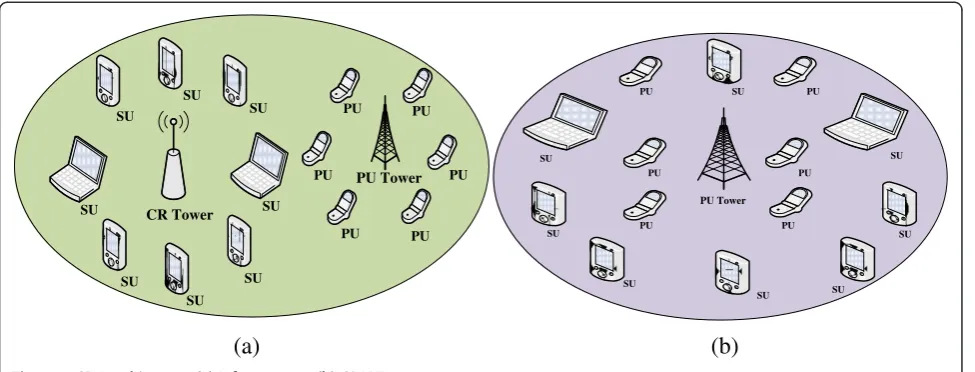
Wireless ad-hoc network consists of self-managing ra-dios that operate in a distributive pattern without the need of a central base station. The cognitive radio ad-hoc networks (CRAHNs) [3] allows the CRs to form a dynamic network without using a CR base station and a fixed spectrum as shown in Figure 1 (b). The CRAHNs are considered to be important because of their key applications in many practical areas including the * Correspondence:[email protected]
Department of Information and Communication Engineering, Sejong University, Seoul, Republic of Korea
communication in the disaster, the battle and the au-tonomous vehicles [3].
The channel selection is an important area in the CRAHNs. It enables the CR to choose the best channel among the pool of sensed channels. The current re-search in the area of channel selection relies on the lat-est observations of the channel state as a base knowledge for the selection mechanism. However, a channel that is to be utilized by the PU cannot be used for the transmission of the CR. Therefore, when the PU arrives, the CR should suspend its communication, and it should look for other channel to restart its communi-cation [4-6]. Such periodic suspensions in the transmis-sion of the CR user can cause severe degradation in their QoS. To deal with such disruptive scenarios, a new model is presented in [7-11]. In these schemes, each CR predicts the future arrival of the PU on dif-ferent channels and selects the best channels for its communication depending upon the least PU activity. The purpose of these schemes is to minimize the interference with the PUs. However, other factors are also important for the selection of the optimal channel such as the channel condition and the QoS require-ment of the CR. A robust channel selection scheme should accommodate all these factors for the perform-ance evaluation of the CRN. Moreover, these factors are contradictory in nature and demand an intelligent and an effective solution.
The genetic algorithm (GA) seems to be the best solu-tion owing to its multi-objective optimizasolu-tion capability [12]. It can be employed to solve the problems which have large search space and contradictory objectives. In the latest research models [13,14], the authors describe the cognitive decision making process (DMP) using the GA to solve the multi-objective optimization problem in the CRN. However, their schemes only consider the
channel condition as the prime factor and lacks in terms of the PU activity and CR QoS requirements.
Similar GA based schemes presented in [15-19] per-form the channel selection by considering the power (PWR), modulation (MOD), bit error rate (BER), band-width (B) and frequency as the basic genes. In these schemes, the objective function converges to the optimal value and then termination condition is achieved based on the desired criteria. Although theses schemes provide the detailed analysis and implementation of the channel selection scheme to optimize the factors such as data
rate (DR), PWR and BER but these schemes also don’t
consider the PU activity and CR QoS parameters. Another GA based parameter adaptation scheme is presented in [20]. It covers the detailed description of various GA parameters and provides a comprehensive simulation model for the parameter reconfiguration. The authors select the three basic objective functions such as minimize BER, minimize power and maximize through-put and provide the simulation results for two different
objective function’s weight scenarios termed as
emer-gency and low power. Although simulation results show better comparisons in terms of throughput, BER and power like [16-18], yet all of these schemes lack in ac-commodating the effects of the PU activity on the per-formance of the CRN.
In this paper, we propose a GA based channel selec-tion and parameter adaptaselec-tion (CSPA) scheme by con-sidering the PU activity, the QoS of secondary user (SU) and the channel condition and quality under one um-brella. According to best of our knowledge the PU activ-ity has not been considered in the context of GA based channel selection scheme. The CSPA scheme incorpo-rates the effects of the PU activity by predicting the fu-ture opportunity to CR user the sensed channels. We add this information as a new gene in the chromosome SU
structure of the CSPA scheme and show the effective-ness of our scheme in terms of channel switchings, aver-age service time, power and throughput using Matlab simulations. The main contributions of this paper can be summarized as follows:
i) We formulate the problem of channel selection and parameter adaptation in CRAHNs using GA by considering all the relevant parameters (BER, PWR, DR, etc.) and other important factors (Channel condition, the PU activity and the CR QoS requirement) from the perspective of both the PU and the CR. We provide an analysis of existing GA based schemes and discuss the challenges and issues involved in the design of such schemes. This is a valuable contribution for future research in this direction.
ii) We propose a method to model the arrival activity of the PU and also formulate the mathematical equation to compute the transmission opportunity index (TOI). The TOI represents the future channel availability to the CR without interruptions from the PU.
iii) Finally, we compare our proposed scheme with the existing random channel selection schemes in terms of the channel switchings, the service time,
throughput and the power consumption.
The rest of paper is organized as follows. Section Problem formulation describes the problem formulation of the CSPA scheme. The GA, its applications and its modeling with respect CRAHNs is presented in Section Genetic algorithm. Section Experimental results explains the experimental setup and simulation results of our proposed scheme. Fi-nally, Section Conclusion draws the conclusion and sets the
future research direction for the design of the channel selec-tion scheme in CRAHNs.
Problem formulation
We consider a network with m=1, 2, 3 . . .M PUs and
n=1,2,3. . .NCR users operating in a similar model as shown in the Figure 1 (b). The CR users operate in an ad hoc or distributive fashion with the prime objectives to maximize the overall spectrum usage, to minimize the channel switchings and to reduce the energy/power con-sumption. The entire operation of our CSPA system can be described as follows:
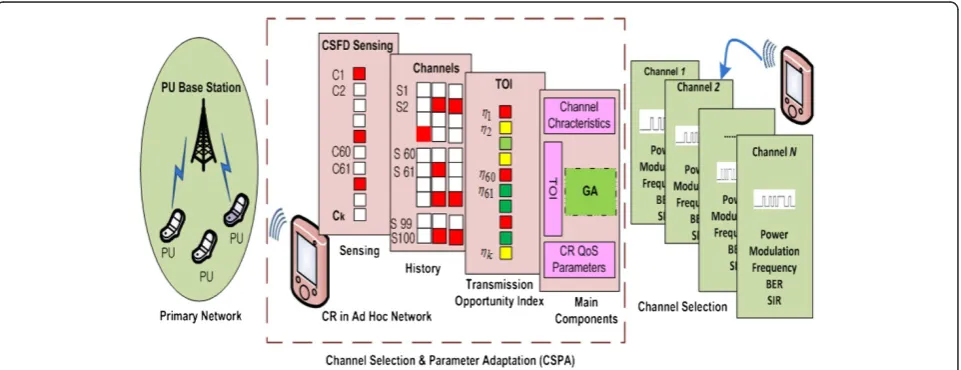
i) Each CR usern=1,2,3. . .Nperiodically senses the radio environment to gather the statistics about the PUs which are operating in the vicinity under the PU base station as shown in Figure2.
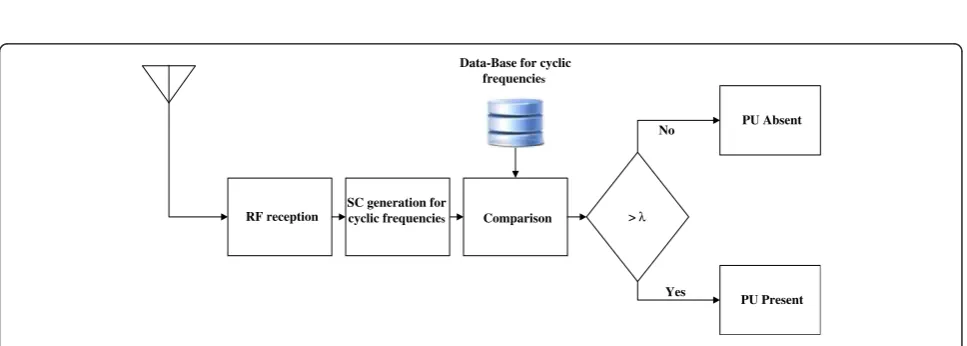
ii) For spectrum sensing, the CR user employs the cyclo-stationary feature detection (CSFD) scheme as shown in Figure2. We prefer CSFD sensing scheme for its two basic advantages as compared to the other transmitter based spectrum sensing schemes. Firstly, it can detect the presence of the PU transmitter reliably. Secondly, it can discriminate the waveform of different wireless technologies. In our case, reliable detection (low probability of false alarm and miss detection) is extremely important because each CR user needs to maintain the history of channel based on its sensing results. And, also discrimination property is desirable in our scheme because we are considering the CR network operating with multiple PU networks. The CSFD can easily differentiate between the PU signals of different technologies. For example, it can easily classify the signal of the CDMA and the GSM
technology. This discrimination property helps the CR to quickly adapt its parameters according to the desired technology. The entire working of CSFD can be represented by the following equations presented in [21-23] and depicted in Figure3. The threshold value ofλindicates about the presence or absence of the PU. The spectral contents of the waveform of the PU’s signal over the time interval [t-T/2, t+T/2] can be computed by the relationship given in [21] as follows
PTð Þ ¼t;v Z tþT=2
tT=2
p uð Þej2πvudu ð1Þ
where,vrepresents the evaluated frequency and it represents the spectral components with separation factorα.
The spectral correlation function can be represented by the two spectral components of the PU signal p (t) at the frequenciesv=f±α/2 can be represented
The spectral components of the PU signal can be measured in ideal condition using the equation (3).
Sαpð Þ ¼f Tlim!1Δlimt!1SαpTð Þf Δt ð3Þ
The decision about the cyclic frequency is taken depending upon the value of the coherence function depicted in the [20] and given in equation (4).
If the coherence function is greater than the certain threshold then it declares that theαiis the cyclic
frequency. After checking all possible values ofαi,
the CSFD collects the cyclic frequency and compare it with the waveform available in the data base and then provides indication about the presence or absence of the PU on the particular frequency f. iii) Each CR user maintains the channel history from
the sensing results obtained from the CSFD scheme.
Φk
s ¼ Φ1s;Φ2s;Φ3s;. . .;Φks
ð5Þ
where,Φskrepresent the PU activity vector during
time slotsandkindicates the particular channel.
Ψk
s ¼ Ψk1;Ψk2;Ψk3;. . .;Ψks
ð6Þ
whereΨsk, indicates the history vector of a particular
channelkforsnumber of time slots. The value ofs for our case is 100 as shown in Figure2.
TheHmatrix forms the history patterns for the PUs on theknumber of channels. The size of history matrix is k*s. The increase in the size increases the reliability but the system becomes more complex. We select the normal values for bothkandsto show the outcomes and advantages achieved through CSPA.
The history of each channel is maintained and then based upon the history we calculate the
transmission opportunity index (TOI) for each available channel as indicated in Figure2. The TOI quantifies the future availability of channel for the
>λ
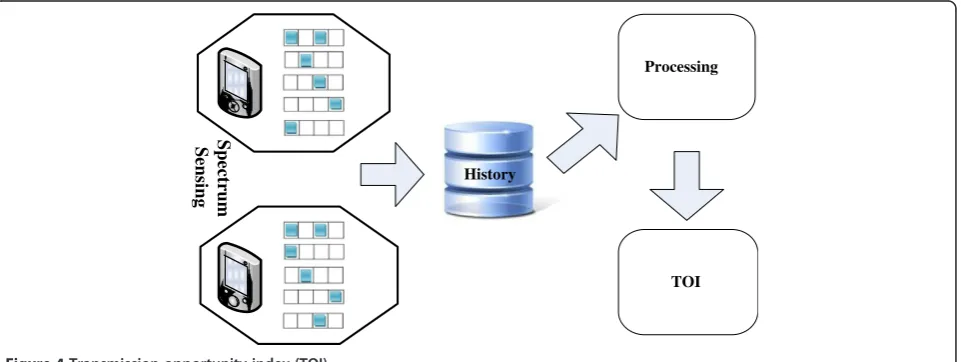
CR communication without PU interruptions. The TOI can be calculated by the procedure depicted in Figure4. Mathematically, TOI can be represented by the following equation (8)
ηk s ¼e
P s¼1
Ts
Ψk
s
Ts !
forΨks >0 ð8Þ
Whereηrepresents TOI andΨindicates the history pattern of the PU on the channel for Tsnumber of time slots and it is calculated using equation (5). The value of summation varies from 0 to 1 while the TOI (η) varies from 0.3697 to 1. The variables Ts andscan be used interchangeably and these are used together to improve clarity.
The TOI can help to achieve the following main objectives:
♦Minimization of switching overhead. ♦Minimization of the interference.
♦Minimization of energy by reducing channel switchings.
♦Better QoS to CR user.
iv) The CSPA selects the best channel in terms of the CR QoS requirement, the condition of channel and the activity of the PU. The CRN can be
characterized with three basic entities i.e. the PU, the CR and the channel. Each entity has unique features and the nature of these features strongly affect the overall performance of the CRN. The CR user has unique requirements from the channel depending upon its QoS parameters. However, the PU has prime concern from CR that it should operate under tolerable interference limit. The
Figure5depicts the main entities involve in the channel selection of CRN.
Genetic algorithm
This section covers the background and detailed descrip-tion of the genetic algorithm. Moreover, we also provide the gene and chromosome structure along with the ex-planation of the objective functions of CSPA algorithm in this section.
Application and background
The GA is a biologically inspired heuristic search tech-nique based on the phenomenon of natural genetics. The GA maintains the population of individuals that characterize the candidate solutions to the given prob-lem. Each individual chromosome in the population is evaluated to find its fitness level (how much it is close to the optimal solution) from the given objective functions. The chromosomes consist of different genes and these genes can be represented through the binary numbers [0,1].The complexity of chromosome is directly depends upon the number of genes and the bits/gene.
The GA performs well for large search space problems because it can work on a population in parallel instead of processing a single solution at a time. The parallel processing allows the GAs to explore several parts of the solution at same time [6] and also many real world pro-blems require simultaneous optimization of several ob-jective functions. Hence, these algorithms become suitable to solve these problems. However, the objective functions may have conflict in their objectives [22]. These contradictory requirements of different objective functions give rise to a set of possible solutions call par-eto optimal solutions instead of a single possible solu-tion. The main reason for the multiple possible solutions
Processing
History
TOI
Spectrum
Sensing
is that no single solution can be thought as the best one than the other solution in the optimal set. The working of GA can be described by the algorithm 1.
Algorithm 1: Basic steps in the GAs
1. Initialize the population of chromosomes. 2. Compute the fitness level of each chromosome to
rank them.
3. Select the best chromosomes in terms of their fitness.
4. Perform the crossover operation on selected chromosomes.
5. Perform the mutation function on selected chromosomes.
6. If stopping criteria is achieved terminate the GA otherwise move to step 2 of the algorithm.
The brief explanation of each step involved in the GA is as follow.
A. Initialization
An initial population withirandom chromosomes is generated. These chromosomes contain the available solutions to the given problem under analysis. B. Fitness Evaluation(FE)
FE represents the evaluation of fitness of random generated chromosomes.
C. Formation of New Generation
This component performs the following steps to re-produce the chromosomes until the next generation completes.
i) Selection: The chromosomes are selected in such a way to have the better level of fitness in the current available population.
ii) Crossover: The crossover is an operator to share information between chromosomes and to create new individuals from the incoming generation. iii) Mutation: The new created individual will be
mutated at a definite point in the chromosome.
Implementation of the GA in CRN
The channel selection and parameter adaptation is the important part in the implementation of the CRN. At one end, the CR should select the best channel in terms of the factors mentioned in Figure 5 while on the other end it needs to quickly adjust its operation parameters according to the selected channel. We focus on the
channel selection and parameter adaptation for
CRAHNs with a hypothesis that inputs are gathered through spectrum sensing, QoS of the CR and condition of channel. In order to provide the better QoS in terms of data rate, service time (delay) and minimal interrup-tions (channel switching), we add a new TOI gene inside the chromosome. The TOI gene helps to save transmis-sion power by reducing the number of retransmistransmis-sions that occurs because of the collisions with the PU. SU
Channel
PU
Oppotunistic Access
Legal Access
PU/SUInterference
Desired QoS
CR collisions Interference
PU activity Desired QoS
Data Rate BER Power Channel History
Chanel Chracteristics Bandwidth BER SIR TOI
Figure 6 explains the entire working of CSPA algorithm based on the GA. We explicitly show the channel history and TOI to clarify our contribution and to show how we incorporate the PU activity.
Encoding of chromosomes
The genes are the basic building blocks of the GAs. The combination of genes forms the chromosome. The chromosome depicts the entire information about the solu-tion of the given problem. In current article, we design the GA for an individual CR operating in an ad hoc fashion. There are seven genes including frequency band (FB), modulation (MOD), bit error rate (BER), power (PWR),
data rate (DR) interference to primary user (ITPU) and TOI. The combination of these seven genes forms a complete 30 bit solution (chromosome) and the encoding of the genes can be performed as follows.
i) Frequency band (FB)
The FB is the first gene in our proposed CSPA scheme used for the generation of chromosomes. In wireless communication, each transmitter requires a spectrum band for its operation. In current communication environment, each technology is assigned with fixed spectrum band while the CR can operate on any available band. In current scheme, we use the same spectrum band specifications that are given in IEEE 802.22. The FB varies from 54 MHz to 862MHz with step size of 8 MHz. Therefore, FB gene requires 7 bits for encoding process. The encoding variable varies from 0000000 to 01100011. The explanation of the FB gene is described in Additional file1: Table S1.
ii) Modulation (MOD)
The MOD is the second gene in our scheme. In wireless communication, Mod states the relationship between two different types of waveforms. In current scheme we use the same specification for the MOD that is given in IEEE 802.22. The four modulation schemes are BPSK, QPSK 8-QAM and 16-QAM and the encoding variable is varying from 00 to 11.
iii) Bit error rate (BER)
The next important parameter or gene for wireless communication is the BER. It defines the number of received bits that have been altered due to noisy channel or interference. Each application can tolerate BER up to the certain limit. For example, video streaming can tolerate the higher bit error rates while voice applications are very sensitive to BER. Moreover, BER is extremely important for wireless media owing to the more external noise and interference. In our work, BER ranges from 10
-1
to 10-16as mentioned in most of existing schemes [19,20] and the step size is 10-1and hence it requires 16 levels and four bit for the gene
representation. The detailed decimal representation of the BER gene is shown in Additional file1: Table S1.
iv) Data rate (DR)
The next important gene is the DR. It defines the number of bits transmitted in a unit time. It can be represented using bits per second (bps) or kilobits per second (kbps). Each application requires a reasonable DR and it varies across the applications. For example, video streaming requires higher data Start
Set objective function, Cost
function & GAP arameters
Generate Initial population
Select weights
Decode and Compute
fitness for each chromosome
Crossover
rate while voice applications require comparatively less data rate. The DR varies from 50 kbps to 1.65Mbps with step size of 50kbps. There are total 32 possible data rates and hence it requires 5 bits for encoding process. The encoding variable varies from 00000 to 11111. The gene structure for DR is described in Additional file1: Table S1.
v) Power (PWR)
The fifth important parameter for wireless system is the power. For current article we take the power range from 3 dBm to 48 dBm with step size of 3dBm. We convert the dBm values to miliwatts (mw) for simplicity and represent the simulation results in mw. This requires 16 levels to represent this gene of the chromosome in decimal format. The entire power band is shown in Additional file
1: Table S1. To get the desired power for an application, the CR user can input a decimal value. For Example, if the application desires 24 dBm of power then the CR user can specify its desired value as binary vector1000.
vi) Interference to primary user (ITPU)
Another important parameter for the CRN is the ITPU. It occurs because of the transmission of the CR on the ongoing communication of the PUs. The transmission power of the CR can degrade the performance of the PUs. For simplicity, we consider the ITPU gene from 0.0625 to 1 with step size of 0.0625. This requires 16 levels to represent this gene and explanation is given in Additional file
1: Table S1.
vii) Transmission opportunity index (TOI) The most important parameter for channel selection process is the random PU arrival activity. The TOI defines the future opportunity of a channel for the CR. The larger the value of the TOI, the large available time for the CR user and there will be less interruptions from the PU and hence the CR can get a reasonably good QoS for its communication. If the CR selects the channel without considering the PU activity on random bases then there are more chances of collisions with the PU. We maintained the history for the PU activity on each channel and then select the channel with least PU activity. The least PU activity corresponds to the higher value of TOI. . By selecting the channel based on the PU activity, throughput and minimal power significantly improves the QoS for the CR user. We consider the simplest gene structure for the TOI with 16 possible levels and details are given in Additional file1: Table S1.
viii) Bit level representation of chromosome The seven genes constitute the structure of
chromosome. The 30-bit chromosome represents the complete solution of CSPA scheme using 30 bits. The arrangement of all genes in the chromosome is shown in Figure7.
Fitness measure
The next important step after the formation and initialization of the population of the chromosomes is the fitness computation. Fitness measure indicates the capability of chromosome to solve the given problem. The fitness level can be represented by a number ran-ging from 0 to 1, where 1 represents the best fitness level. The fitness of a chromosome can be represented usingRn.
In order to form the next generation the selection process sorts out the chromosomes in descending order depending upon the value extracted through equation
(9). Suppose there are Nc number of chromosomes in
the initial stage and Nsrepresents the selected chromo-somes and Nsr indicates selection rate then the selected chromosomes can be represented as follows.
Ns¼NcNsr ð10Þ The selection rate depends upon the complexity and convergence time and we choose the selection rate equals to 1/2.
Crossover
The crossover is a process in which characteristics of a pair of parent chromosomes are exchanged with each other to form a pair of child chromosomes. This step is also known as reproduction. There exists several schemes such as single point, 2-point, multipoint and uniform crossovers. In this article 2-point crossover has been implemented. For example, the formation of two child chromosomes c1 and c2 from two parent chromosomes is depicted in Figure 8. The Figure 8 (a) indicates the bit level representation for the first par-ents while the Figure 8 (b) represpar-ents the parent 2 at bit level. The formation of the child 1 as a result of crossover between parent 1 and parent 2 is depicted in Figure 8 (c) and 8 (d).
Mutation
The mutation rate indicates that how many chromo-somes out of the total chromochromo-somes undergo the muta-tion process. For example, the mutamuta-tion rate of 0.03 indicates that 3 chromosomes out of total chromosomes undergo the mutation process.
Parameter adaptation
We consider the various adjustable parameters (APs) of cognitive radio which are denoted by a set p= [p1,
p2,p3⋯pr] where r denotes the number of adjustable parameters. These APs include FB, MOD, BER DR, PWR, ITPU and TOI. In order to select the optimal channel for communication, the CR should balance the multiple objectives with contradictory require-ments to meet CR QoS need and cater the dynamic changes occur in the condition of channel along with the handling of the PU activity. the PU. The objective functions are denoted by f= [f1,f2,f3⋯fq], where q represents the number of objective functions. For current case, the objective functions are DR, BER, PER, ITPU and TOI. To simplify the problem of PA
we convert the multi objective optimization with vari-ous contradictory objective functions into a single ob-jective function by using the relationship given in the [23] and normalizing the value of the objective func-tion to the range 0 to 1 as follows:
f ¼X
n
i¼1
wi:fi
¼wdr:fdrþwpow:fpowþwber:fberþwitpu:fitpuþwTOI:fTOI
ð11Þ
w¼w1þw2þw3⋯þwm ð12Þ
wi≥0 for i¼1;2. . .m ð13Þ
where, w= [w1,w2,w3⋯wm] is a weight vector. We consider the four transmission modes depending upon the weight given to each objective function.
FB MOD BER DR PWR ITPU TOI
Figure 7Chromosome structure.
0 0 0 1 0 1 0 0 0 0 1 1 0 1 0 1 1 1 0 0 1 1 1 0 1 1 0 1 1 1
(a)
Parent P1with two point of cross over0 1 0 1 0 0 0 0 1 0 1 0 1 0 0 1 0 0 0 0 1 0 1 0 0 1 0 0 1 0
1 2 3 4 5 6 7 8 9 10 11 12 13 14 15 16 17 18 19 20 21 22 23 24 25 26 27 28 29 30 1 2 3 4 5 6 7 8 9 10 11 12 13 14 15 16 17 18 19 20 21 22 23 24 25 26 27 28 29 30
1 2 3 4 5 6 7 8 9 10 11 12 13 14 15 16 17 18 19 20 21 22 23 24 25 26 27 28 29 30
1 2 3 4 5 6 7 8 9 10 11 12 13 14 15 16 17 18 19 20 21 22 23 24 25 26 27 28 29 30
(b)
Parent P2with two point of cross over0 0 0 1 0 1 0 0 0 0 1 1 1 0 0 1 0 0 0 0 1 1 1 0 1 1 0 1 1 1
(c)
Child C1as a result of crossover with bits from Parent P20 1 0 1 0 0 0 0 1 0 1 0 0 1 0 1 1 1 0 0 1 0 1 0 0 1 0 0 1 0
(d)
Child C2as a result of crossover with bits from parent P1Formulation of objective functions
This sub section describes the mathematical modeling for the objective functions that we have considered in CSPA scheme. The
In equation (14), the dr represents the desired data
rate and dc indicates the data rate available on channel [15]. The power optimization function is depicted in the
equation (15) where P indicates the power required for
the transmission on the given channel and Pmax is the
maximum power available to the CR user. The Pbe in
equation (16) represents the average BER of all the
chan-nels and Pminber is the minimum value of the BER
among the available channels [15]. The factor I shows
the ITPU on the given channel while Imax is the
max-imum interference limit to the PU. Similarlyηis the fu-ture opportunity for the CR on the given channel while
ηmax represents the maximum value of the opportunity
index. Depending upon the weightage given to each ob-jective function we define the four transmission modes as shown in the Additional file 2: Table S2.
Experimental results
This section describes experimental results along with the detailed explanation of different simulation para-meters. Moreover, it explains the significance of our simulation result in terms of channel switching, service time and power consumption.
Experimental setup
We consider the CRAHNs where each CR has capability of accurate sensing and history management. Although the given results are true for more generic cases yet we show our outcomes for specific values of the GA parameters. Additional file 3: Table S3 specifies the basic GA parameters that we have considered for our implementation.
The value of the crossover rate is 0.5 and it indicates that the six chromosomes are selected to form the next generation. The mutation rate is selected based upon the existing work in the channel selection process. The 200 iterations are performed to get the desired solution (chromosome).
The CR user requirements
The CSPA selects the channel according to the require-ment of the CR users, the PU activity and the QoS para-meters of CR. For the current case the desired QoS parameters of the CR are given in Additional file 4: Table S4. The CR user needs 265 kbps with maximum tolerable BER of 10-5to follow its transmission.
Simulation results
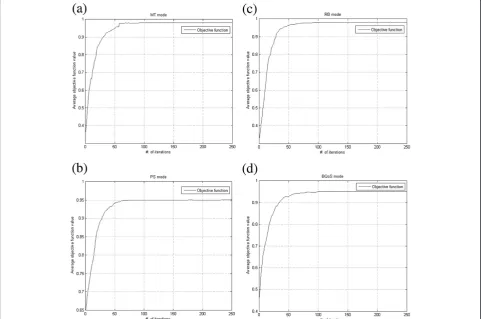
To find out how the objective function gets improved with the number of iterations, the simulation results are
repeated 100 times with the 200 GA’s iterations and
the best chromosome is selected. The sample solution of CSPA scheme considers the parameters given in Additional file 4: Table S4 and its values are shown in Figure 9. The given solution ensures the required QoS parameters for the CR users with the FB=400MHz,
MOD=QPSK, BER=10-9, PWR=3dBm, ITPU= 0.25,
TOI=0.9394. The TOI achieves its optimal value and hence provides the required level of DR and other objectives mention in the Additional file 4: Table S4.
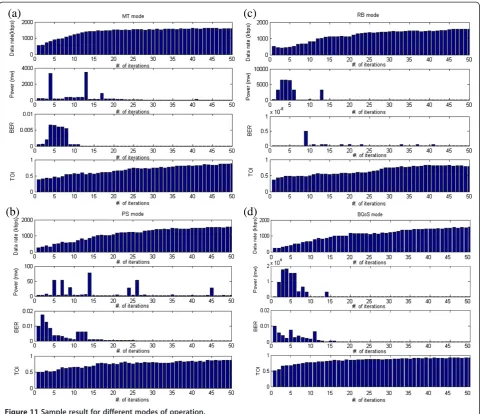
We also compute and plot the average objective func-tion values for four different operafunc-tion modes given in the Additional file 2: Table S2 to test the effectiveness of CSPA scheme. The 200 iterations are performed to find out the best solution. Each mode of operation focuses on different objectives and is appropriate for different application and situation. The MT mode in Figure 10 (a) maximizes the average throughput of the CR user. It is more appropriate for those application demanding higher data rates such as broad band video. The PS mode is effective for power sensitive application and suitable for the CR sensor networks and text messaging. The RB mode indicates the reliability mode and it helps to reduce the BER for different applications like emer-gency applications. The BQoS mode is the core develop-ment of this article and it helps to reduce number of interruptions/channel switchings with PUs. Moreover, it also helps to quickly serve the CR user and to save the extra power compared with PS mode by avoiding the re transmission owing to the collision occurs with the PU. The BQoS mode is suitable for CRAHNs and the cogni-tive radio sensor networks.
the variations of different genes across different iter-ation. The data rate objective function has the 60% weight hence the data rate starts maturing and maximiz-ing its value after a few iterations and reach close to the optimal value of 1.620 kbps after only 30 iterations. Al-though the maximum value of DR is 1.65 kbps but for simplicity, we assume the mid value for each level of DR. Based on this assumption the maximum possible value of DR is 1.62 kbps. However, the values of other genes are not ideal but optimal owing to the less weight to their objective functions. Similarly in PS mode, the more percentage weight is given to the objective func-tion of minimizing power and the required power reduces to few miliwatts (mw) very quickly in a few iterations. For simplicity we plot the power in mw. The BQoS mode in part (d) of Figure 11 shows the outcomes for our new added TOI gene. In this case 60% weight is given to the TOI gene which achieves its maximum
value after 25 iterations and the rest of parameters are also approaching to their respective optimal values. Hence, CSPA converges to the desired solution very quickly.
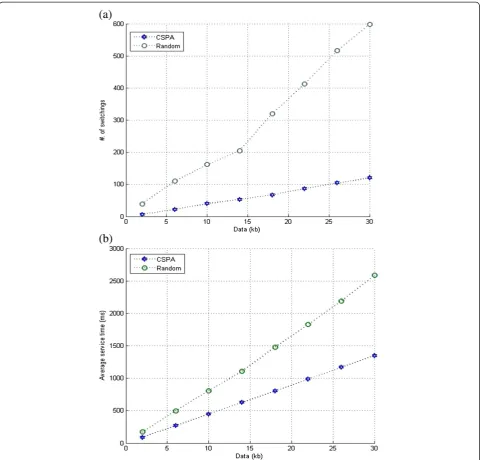
The comparison on the basis of the channel switching and average service time is shown in Figure 12. The CSPA shows significantly large improvement as com-pared to the random channel selection schemes. We show the comparison for six different file sizes of CR user.
In Figure 12 (a), the comparison is shown on the basis of channel switchings. To transmit a data file of size 2 Kb, by using the CSPA the CR needs to perform channel switching only 7 times while the random chan-nel selection scheme requires 39 switchings which is al-most 5.5 times higher as compared to CSPA scheme. The performance of CSPA is even much better for video application that needs to transmit large amount of data
FB MOD BER DR PWR ITPU TOI
0 1 1 1 0 1 0 0 1 1 0 0 0 1 1 1 0 1 0 0 0 1 0 0 1 1 1 1 1 0
Figure 9Sample GA provided solution using CSPA.
as CSPA shows better performance for large data files. Hence, the performance of the CSPA scheme is much better than the traditional random channel selection schemes in terms of the channel switchings.
In Figure 12 (b), the comparison is shown on the basis of the time taken to transmit a data of the CR user. For the transmission of 2 Kb data file, the CR takes only 84.5 milliseconds (ms) while the random channel selec-tion scheme requires 149.5 ms which is twice higher as compared to CSPA scheme. Moreover, the performance gain of the CSPA is even more significant for large data files. Although the GA consumes time in the selection of the best channel however GA selection time is consider-ably less as compared to the saving time.
Figure 13 depicts the outcomes and benefits of our new added genes in terms of number of channel switch-ings that the CR needs to perform on the arrival of the PU. It is clear from the line graph in Figure 13 that the
number of channel switchings decrease exponentially with the increase in the percentage weight of the TOI gene. By only giving the 10% weight to the TOI gene, the switchings are reduced by 54.2%. The channel switchings are reduced by 76.25% at the 40% TOI gene weight. Therefore, the given scheme is more robust against the issue of interruptions or collisions with the PUs.
In Figure 14 we have shown the effectiveness of our scheme in saving the transmission power using the B QoS mode with weight vector [w5=60%, w1= w2= w3=
w4=10%]. The CSPA reduces number of channel
switch-ings which helps to save the transmission power. For simplicity we use the average power factor for indicating the amount of saved power. The average power factor represents the power required to transmit the data in a given time slot and it is indicated byμ. The equation (19) describes the average power saving factor Psav achieved
through CSPA scheme. TheSRrepresents the switchings for random channel selection scheme andScspaindicates the switchings occur during the CSPA scheme. The fac-torμandβquantifies the average power per bit and data for a given time slot respectively. We have shown the fac-torPsavfor three different values of μand βto describe the power saving capability of CSPA scheme.
Psav¼ SRScspa
μβ ð19Þ
The given simulation results makes CSPA suitable for power sensitive applications like cognitive radio sensor networks.
Conclusion
the PU perspective, it is also desirable that the CR causes lease collisions and operates under tolerable interference range.
In this article, we proposed a channel selection and parameter adaptation scheme and formulate the prob-lem for CRAHNs using the GA by considering all the
important factors including the channel characteristics, the PU arrival activity and the QoS requirement of the CR users.
We also propose a method to model the activity of the PU and also formulate the mathematical equations to compute the transmission opportunity index which Figure 13Comparison based on the channel switchings by varying weight of TOI gene.
indicates the duration for the future availability of chan-nel to the CR without interruptions from the PU. We add this information in the chromosome to incorporate the effect of the PU activity inside GA based decision making process for selecting the optimal channel. The solution is evolved through GA which performs the gen-etic operation and then CR user adapts their parameters according to the selected channel. We also define four transmission modes depending upon the weight given to the respective objective function. The four modes are defined and their effectiveness is discussed according to their applications in the real implementation.
Simulation results show that including the PU activity within the gene structure helps to significantly reduce the number of channel switchings, minimizes the delay in the service time and saves the transmission power. The CSPA scheme shows a significant improvement in saving the transmission power that makes it suitable for power sensitive application such as cognitive radio sen-sor network.
In future, we are planning to develop a similar model using particle swarm optimization and show the com-parison with the genetic algorithm in terms of their con-vergence time. Moreover, we are also developing a model to incorporate the channel usage patterns of other CR users in the CRAHNs.
Additional files
Additional file 1:Table S1.Gene structure. Additional file 2:Table S2.Modes of operation. Additional file 3:Table S3.The GA parameters.
Additional file 4:Table S4.The QoS parameters of the CR.
Competing interests
The authors declare that they have no competing interests.
Acknowledgment
This research was supported by the MKE (The Ministry of Knowledge Economy), Korea, under the Convergence-ITRC (Convergence Information Technology Research Center) support program (NIPA-2012-C6150-1101-0003) supervised by the NIPA (National IT Industry Promotion Agency) and the Basic Science Research Program through the National Research Foundation of Korea (NRF) funded by the Ministry of Education, Science and Technology (2012009449).
Received: 3 April 2012 Accepted: 23 September 2012 Published: 21 November 2012
References
1. FCC,Second Report and Order And Memorandum Opinion and Order, ET Docket No. 08–260(2008)
2. IF Akyildiz, W Lee, MC Vuran, S Mohanty, NeXt generation/dynamic spectrum access/cognitive radio wireless networks: a survey. J. Comput. Netw50(13), 2127–2159 (2006)
3. IF Akyildiz, WY Lee, K Chowdhury, CRAHNs: cognitive radio ad hoc networks. J. Ad Hoc Netw.7(5), 810–836 (2009)
4. N Nie, C Comaniciu, Adaptive channel allocation spectrum etiquette for cognitive radio networks. in IEEE DySPAN, 269–278 (2005)
5. H Zheng, L Cao, Device-centric spectrum management. in IEEE DySPAN, 56–65 (2005)
6. A Saleem, L Kyung-Geun, Fair, efficient and power optimized spectrum sharing scheme for cognitive radio network. EURASIP J. Wirel. Commun. Netw (2011). doi:10.1186/1687-1499-2011-201
7. L Yang, L Cao, H Zheng, Proactive channel access in dynamic spectrum networks. J. Phy Commu1(2), 103–111 (2008)
8. H Marko, P Sofie, M Aarne, Performance improvement with predictive channel selection for cognitive radios. in IEEE CogART Workshop, 1–5 (2008) 9. S Ki Won, K Seong-Lyun, Z Jens, Temporal spectrum sharing based on
primary user activity prediction. IEEE Trans. Wirel. Commun.9(12), 3848– 3855 (2010)
10. T Vamsi Krishna, W Ping, N Dusit, Channel status prediction for cognitive radio networks. J. Wirel. Commun. Mob. Comput. (WCMC)10, 1–13 (2010) 11. T Christian James Rieser,Biologically inspired cognitive radio engine model
utilizing distributed genetic algorithms for secure and robust wireless communications and networking(Dissertation, Blacksburg, Virginia, 2004) 12. W Rondeaut, B Le, D Maldonado, D Scaperoth, C Bostian, Cognitive radio
formulation and implementation. in IEEE CrownCom, 1–10 (2006) 13. TR Newman, BA Barker, AM Wyglinski, A Arvin, Cognitive radio
implementation for wireless multicarrier transceivers. Wiley Wirel. Commun. Mob. Comput.6, 1–14 (2006)
14. H Qin, J Su, Y Du, Multiobjective evolutionary optimization algorithm for cognitive radio networks. in IEEE IEEC’09, 164–168 (2009)
15. K Jae Moung, S Sung Hwan, H Ning, Z Guanbo, K Young Min, L Joo Kwan, Cognitive radio software testbed using dual optimization in genetic algorithm. in IEEE CrowCom, 1–6 (2008)
16. S Chantaraskul, K Moessner, Implementation of a genetic algorithm-based decision making framework for oppertunistic radio. IET Commun4, 495–506 (2010)
17. C Si, TR Newman, EAM Wyglinski, Genetic algorithm-based optimization for cognitive radio networks. in Proc. 2010 IEEE Sarnoff Symposium, 1–6 (2010) 18. T Siddique, A Azam,Spectrum Optimization in Cognitive Radio Networks
Using Genetic Algorithm(Blekinge Institute of Technology, Sweden, 2010) 19. TR Newman, R Rakesh, AM Wyglinski, JB Evans, GJ Minden, Population
adaptation for genetic algorithm-based cognitive radios. in IEEE CrownCom, 279–284 (2007)
20. W Gardner, W Brown, Spectral correlation of modulated signal. Part I— analog modulation. IEEE Trans. CommunCOM-35, 584–594 (1987) 21. WA Gardner, W Brown, CK Chen, Spectral correlation of modulated signal.
Part II—digital modulation. IEEE Trans. Commun.COM-35, 595–601 (1987) 22. I Hong, SH Sohn, JK Lee, JM Kim, DFS algorithm with ranking based on
genetic algorithm in UHF portable system. in IEEE ISCIT, 454–459 (2009) 23. C You, H Kwon, J Heo, Cooperative TV spectrum sensing in cognitive radio
for Wi-Fi networks. IEEE Trans. Consum. Electron.57, 62–67 (2011)
doi:10.1186/1687-1499-2012-349
Cite this article as:Aslam and Lee:CSPA: Channel Selection and Parameter Adaptation scheme based on genetic algorithm for cognitive
radio Ad Hoc networks.EURASIP Journal on Wireless Communications and
Networking20122012:349.
Submit your manuscript to a
journal and benefi t from:
7Convenient online submission
7Rigorous peer review
7Immediate publication on acceptance
7Open access: articles freely available online
7High visibility within the fi eld
7Retaining the copyright to your article