© 2015, IRJET ISO 9001:2008 Certified Journal
Page 2004
Power Quality improvement of a three phase four wire system using
UPQC
D.Prathyusha , P.Venkatesh
1
M-Tech Student, EEE Dept , V.R.SIDDHARTHA Engineering College, Vijayawada, A.P, India.
2
Asst.Professor, EEE Dept, V.R.SIDDHARTHA Engineering College, Vijayawada, A.P, India
---***---Abstract
This paper presents two different controlstrategies applied to Unified Power Quality Conditioner (UPQC) to improve power quality in a three-phase, four-wire distribution system. The two control techniques are Unit Vector Template Generation (UVTG) technique and Synchronous Reference Frame (SRF). Generally, some topologies applied for three-phase, four-wire UPQC use active compensation for the mitigation of source neutral current along with other power quality (PQ) problems, while the uses of passive elements for the mitigation of source neutral current are advantageous over the active compensation due to ruggedness and less complexity of control. Hence, in this paper a star-delta transformer is connected in shunt near the load for mitigation of source neutral current, while three-leg voltage source inverters (VSIs) based shunt and series active power filters (APFs) of three-phase UPQC mitigate the current and voltage based distortions, respectively. Here two control techniques are compared in terms of Total Harmonic Distortion (THD).This
is done by using MATLAB/ Simulink.
Key Words:
Active Power Filter (APF) , PowerQuality(PQ),Unit Vector template Generation (UVTG),
Unified Power Quality conditioner (UPQC), three phase four
wire(3P4W) system, Synchronous Reference Frame (SRF).
1. Introduction
The main objective of electric utility companies is to supply their customers with uninterrupted sinusoidal voltage of constant magnitude. However this is becoming increasingly difficult to do, because the size and number of non-linear and poor power factor loads such as adjustable speed drives, computer power supplies, furnaces and traction drives are increasing rapidly. Due to their nonlinear nature, these solid state converters cause excessive neutral currents in three phase four wire systems. Moreover, in the case of the distribution system, the overall
load on the system is seldom found to be balanced. In the past, the solutions to mitigate these identified power quality problems were through using conventional passive filters. But their limitations such as, fixed compensation, resonance with source impedance and the difficulty in
tuning time dependence of filter parameters have ignited the need for active and hybrid filters. The rating of active filters is reduced through augmenting them with passive filters to form hybrid filters, which reduce overall cost. Also they can provide better compensation than either passive or active filters. If one can afford the cost, then a hybrid of two active filters provides the best solution and thus it is known as a unified power quality conditioner (UPQC) or universal active filter. Therefore, the development of hybrid filter technology has been from a hybrid of passive filters to a hybrid of active filters to provide a cost-effective solution and optimal compensation.
The function of unified power quality conditioner is to compensate supply voltage flicker/imbalance, reactive power, negative-sequence current, and harmonics. In other words, the UPQC has the capability of improving power quality at the point of installation on power distribution systems or industrial power systems. Therefore, the UPQC is expected to be one of the most powerful solutions to large capacity loads sensitive to supply voltage flicker/ imbalance. The UPQC consisting of the combination of a series active power filter (APF) and shunt APF can also compensate the voltage interruption if it has some energy storage or battery in the dc link.The proposed control technique has been evaluated and tested under unbalanced load conditions using MATLAB/ Simulink software.
© 2015, IRJET ISO 9001:2008 Certified Journal
Page 2005
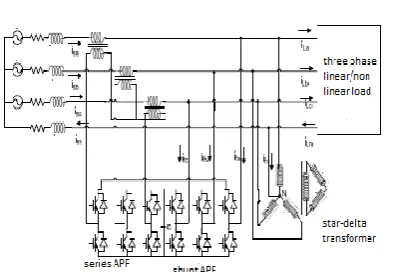
Fig.1 Basic system configuration of UPQC
In this paper unified power quality conditioner (UPQC)
is being used as a universal active power conditioning
combination of linear and non-linear unbalanced load. The series and shunt APFs are realized using two readily available three-leg VSIs. The dc links of both APFs are connected to a common dc link capacitor. The series APF is connected between the supply and load terminals througha three single phase transformers.
Fig.2 Detailed configuration of star-delta transformer supported UPQC
In this topology, a star-delta transformer is connected in shunt near the load for the mitigation of the source neutral current. The delta connected secondary provides a circulating path to the zero sequence current (io) in case of
unbalanced load and hence the supply neutral current is reduced to zero.
4. UVTG Control Strategy
4.1. Series Control Strategy:
A simple control algorithm based on UVTG [1] is used to control the series APF of proposed topology. The series is controlled in such a way that it injects voltages (vfa, vfb and Fig.3 Control Scheme of Series APF
In other words, the sum of supply voltage and the injected series filter voltage makes the desired voltage at the load terminals. The control strategy for the series APF is shown in Fig. 3.Three-phase distorted supply voltages are sensed and given to PLL which generates two quadrature unit vectors (sin θ, cos θ). The in-phase sine and cosine outputs from the PLL are used to compute the supply in phase, 1200 displaced three unit vectors (ua, ub and uc) using
eqn. as
...(1)
The computed three in-phase unit vectors then multiplied with the desired peak value of the PCC phase voltage (V*lm), which becomes the three-phase reference PCC
voltages as:
The computed voltages from reference voltages from equation above are then given to the hysteresis voltage controller along with the sensed three phase PCC voltages (vla, vlb and vlc). The output of the hysteresis controller is
switching signals to the six switches of the VSI of series APF. The hysteresis controller generates the switching signals such that the voltage at PCC becomes the desired sinusoidal reference voltage.
4.2. Shunt Control Strategy:
The control algorithm for shunt APF [1] consists of the generation of three-phase reference supply currents (i*sa,
© 2015, IRJET ISO 9001:2008 Certified Journal
Page 2006
Fig.4 Control Scheme of Shunt APF
This algorithm uses supply in-phase; 1200 displaced three
unit vectors computed in eqn. The amplitude of the
three in-phase reference supply currents are computed by multiplying their amplitude (I*sp) and in-phase unit
current vectors as:
The computed three-phase supply reference currents are compared with the sensed supply currents and are given to a hysteresis current controller to generate the switching signals to the switches of the shunt APF which makes the supply currents follow its reference values. In this control scheme, the current control is applied over the fundamental supply currents instead of the fast changing APF currents, thereby reducing the computational delay and number of required sensor. In addition to this, no extra control is required for the mitigation of source neutral current. The simulation model of three phase four wire Unified Power Quality Conditioner(UPQC) is shown in fig.5
5.SRF Control Technique
In the SRF-based APF applications in three-phase four-wire (3P4W) systems, voltage and current signals are transformed into the conventional rotating frame (d−q−0). In the SRF method, the transformation angle (ωt) represents the angular position of the reference frame which is rotating at a constant speed in synchronism with the three-phase ac voltage
.
5.1Reference voltage generation
:
The proposed SRF-based UPQC control algorithm can be used to solve the PQ problems related with source-voltage harmonics, unbalanced voltages, and voltage sag and swell
at the same time for series APFs. In the proposed method, the series APF controller calculates the reference value to be injected to the system by comparing the positive-sequence component of the source voltages with load-side line voltages. The supply voltages VSabc are transformed to
d−q−0 by using the transformation matrix T given below
components (v̅Sd and v̅Sq) under unbalanced source voltage
with harmonics. The oscillating components of vSd and vSq
consist of the harmonics and negative-sequence components.
The load reference voltages (VLabc) are calculated as
The produced load reference voltages (v_La, vLb, and vLc)
and load voltages (vLa, vLb, and vLc) are compared in
hysteresis controller to produce insulated-gate bipolar transistor (IGBT) switching signals and to compensate all voltage-related problems, such as voltage harmonics, sag, swell, voltage unbalance, etc., at the PCC.
Fig.5 Synchronous Reference Frame Control
5.2 Reference current generation:
© 2015, IRJET ISO 9001:2008 Certified Journal
Page 2007
voltages, source currents, and dc-link voltages. The sourcecurrents are transformed to d−q−0 coordinates
The dc-link voltage is compared with its reference value (VDC), and the required active current (idloss) is obtained by
a PI controller. The source current fundamental reference component is calculated by adding to the required active current and source current average component (i̅Sd),
which is obtained by an LPF,
In the proposed method, the zero- and negative-sequence components of the source current reference (is0 and iSq) in
the 0- and q-axes are set to zero in order to compensate the harmonics, unbalance, distortion, and reactive power in the source current. The source current references are calculated as
The produced reference-source currents ( and ) and measured source currents ( iSa, iSb, and iSc ) are
compared by a hysteresis controller to produce switching signals.
Fig.6 MATLAB model of star-delta transformer supported UPQC
6. Simulation Results
In this study, the control algorithm for the UPQC is evaluated by using MATLAB/Simulink software under combination of linear and nonlinear load conditions. The simulation results for the proposed three phase four wire system realized from a three phase three wire system utilizing UPQC are shown in below. Without UPQC load voltages are distorted with voltage THD of 28.28%.The
distorted voltage profile is shown in fig.6.The UPQC should maintain the voltage at load bus at a desired value and free from distortion. The plant load is assumed to be the combination of a balanced three-phase diode bridge rectifier followed by an R–L load, and three single-phase loads. The series APF injects the required compensating voltages through series transformer, making the load voltage free from distortion are shown in fig.7. The series APF injected profile is shown in fig.8. Simultaneously, the shunt APF injects the compensating currents to achieve the balanced source current, free from distortion, as discussed in the previous section. With UPQC source current waveform is shown in fig.9. Load neutral current and transformer neutral current are shown in fig.10 and fig.11 respectively. Transformer neutral current is exactly opposite to the load neutral current so that source neutral current reduced to zero.
0 0.05 0.1 0.15 0.2 0.25 0.3 0.35 0.4 -400
-300 -200 -100 0 100 200 300 400
Time(s)
L
o
a
d
v
o
lt
a
g
e
(
V
)
Fig.7 load voltage without UPQC
0.06 0.08 0.1 0.12 0.14 0.16 0.18 0.2 0.22 0.24 -400
-300 -200 -100 0 100 200 300 400
Time(s)
L
o
a
d
v
o
lt
a
g
e
(V
)
Fig.8 Load voltage with UPQC
0.15 0.16 0.17 0.18 0.19 0.2 0.21 0.22 0.23 0.24 -200
-150 -100 -50 0 50 100 150 200
Time(s)
In
je
c
te
d
v
o
lt
a
g
e
(V
)
Fig.9 Series Injected voltage
© 2015, IRJET ISO 9001:2008 Certified Journal
Page 2008
0.15 0.16 0.17 0.18 0.19 0.2 0.21 0.22 0.23 0.24 -40
-30 -20 -10 0 10 20 30 40
Time(s)
S
o
u
rce
C
u
rr
e
n
t(
A
)
Fig.10 source current
0.15 0.16 0.17 0.18 0.19 0.2 0.21 0.22 0.23 0.24 -6
-4 -2 0 2 4 6 8
Time(s)
L
o
a
d
n
e
u
t
r
a
l
c
u
r
r
e
n
t
Fig.11 load neutral current
0.15 0.16 0.17 0.18 0.19 0.2 0.21 0.22 0.23 0.24 -8
-6 -4 -2 0 2 4 6
Time(s)
T
r
a
n
s
fo
r
m
e
r
n
e
u
tr
a
l
c
u
r
r
e
n
t
Fig.12 transformer neutral current
0.15 0.16 0.17 0.18 0.19 0.2 0.21 0.22 0.23 0.24 -1
-0.5 0 0.5 1
Time(s)
S
o
u
r
c
e
n
e
u
tr
a
l
c
u
r
r
e
n
t(
A
)
Fig.13 source neutral current
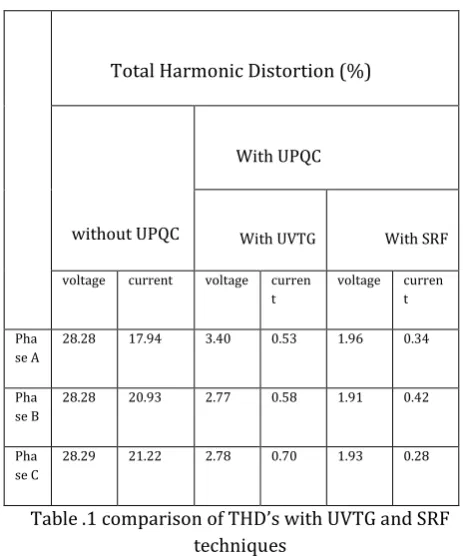
The harmonic spectrums of load voltage without UPQC is shown in fig.14 and it is having a harmonic distortion of 28.28%.After connecting UPQC with two control techniques the load voltage distortion is reduced and it is shown in fig.15 and fig.16.Source current THD is shown in fig.17 and fig 18.
Fig.14 THD of load voltage without UPQC
Fig.15 THD of load voltage with UVTG control
Fig.16 THD of load voltage with SRF control
© 2015, IRJET ISO 9001:2008 Certified Journal
Page 2009
Fig.18 THD of source current with SRF control
Total Harmonic Distortion (%)
without UPQC
With UPQC
With UVTG With SRF
voltage current voltage curren t
voltage curren t
Pha se A
28.28 17.94 3.40 0.53 1.96 0.34
Pha se B
28.28 20.93 2.77 0.58 1.91 0.42
Pha se C
28.29 21.22 2.78 0.70 1.93 0.28
Table .1 comparison of THD’s with UVTG and SRF techniques
7. CONCLUSION
The control of unified power quality conditioner (UPQC) is done by using two control techniques Unit Vector Template Generation (UVTG) and Synchronous Reference Frame (SRF) in a three phase four wire distribution system. This proposed topology would be very useful to expand the existing three phase three wire system to three phase four wire system where UPQC is installed to compensate the different power quality problems. The MATLAB/Simulink based simulation results show that the source currents and load voltages are perfectly balanced and are free from distortion by applying both control techniques. The star-delta transformer connected near the load effectively compensates the source neutral current. By connecting a star-delta transformer on the load side, the rating of the UPQC is reduced due to elimination of a fourth leg compared to three-phase four-leg VSI based three phase four wire UPQC. In addition to this, no extra control is required for the mitigation of neutral current; hence numbers of current sensors are reduced.
8. APPENDIX
The system parameters used are as follows: Supply voltage: 400V (Vrms)
Supply impedance: R=0.01Ω,L=0.01mH DC link capacitance value: 10mF
Three phase Transformer: 250MVA, 1240V/1900V/50V. Linear load:
6KW, 3KVar lagging load in phase ‘a’, 3KW, 900Var lagging load in phase ‘b’, 2KW, 2500Var lagging load in phase ‘c’. Non-Linear load:
Three-Phase Rectifier Load R=60 and L=5mH on dc side. Star-delta transformer: 5 KVA, 231V/231 V
REFERENCES
1. Yash Pal, A. Swarup, B. Singh “A New Topology of Three-Phase Four-Wire UPQC with a Simplified Control Algorithm” , Majlesi Journal of Electrical Engineering Vol. 6, No. 1, March 2012
2. Metin Kesler and Engin Ozdemir, “Synchronous Reference Frame based control method for UPQC under unbalanced and distorted load conditions” IEEE transactions on industrial electronics, vol. 58, no. 9, September 2011.
3. V. khadkikar and A. Chandra, “A novel structure for three-phase four wire distribution system utilizing unified power quality conditioner (UPQC),” IEEE Transaction on industry application, Vol.45,no.5,Sep/oct.2009.
4. Bhim Singh and Venkateswarlu .P, “A
Simplified Control Algorithm for Three-Phase, Four-Wire Unified Power Quality Conditioner”, Journal of Power Electronics, Vol. 10, No. 1, January 2010.
5. Paduchuri. Chandra Babu and
Subhransu.Sekhar.Dash, “Design of Unified Power Quality Conditioner (UPQC) Connected To Three Phase Four Wire System”, International Journal of Computer and Electrical Engineering, Vol.4, No.1, February 2012.
6. Metin Kesler and Engin Ozdemir, “A Novel Control Method for Unified Power Quality Conditioner (UPQC) Under Non-ideal Mains Voltage and Unbalanced Load Conditions” IEEE 2010.