DOI: 10.1126/science.1184819
, 876 (2010);
328
Science
et al.
Peter J. Mucha,
Multiscale, and Multiplex Networks
Community Structure in Time-Dependent,
This copy is for your personal, non-commercial use only.
.
clicking here
colleagues, clients, or customers by
, you can order high-quality copies for your
If you wish to distribute this article to others
.
here
following the guidelines
can be obtained by
Permission to republish or repurpose articles or portions of articles
(this information is current as of August 30, 2010 ):
The following resources related to this article are available online at www.sciencemag.org
http://www.sciencemag.org/cgi/content/full/sci;329/5989/277-c
A correction has been published for this article at:
http://www.sciencemag.org/cgi/content/full/328/5980/876
version of this article at:
including high-resolution figures, can be found in the online
Updated information and services,
http://www.sciencemag.org/cgi/content/full/328/5980/876/DC1
can be found at:
Supporting Online Material
found at:
can be
related to this article
A list of selected additional articles on the Science Web sites
http://www.sciencemag.org/cgi/content/full/328/5980/876#related-content
http://www.sciencemag.org/cgi/content/full/328/5980/876#otherarticles
, 3 of which can be accessed for free:
cites 19 articles
This article
http://www.sciencemag.org/cgi/content/full/328/5980/876#otherarticles
1 articles hosted by HighWire Press; see:
cited by
This article has been
http://www.sciencemag.org/cgi/collection/comp_math
Computers, Mathematics
:
subject collections
This article appears in the following
is a
Science
2010 by the American Association for the Advancement of Science; all rights reserved. The title
Copyright
American Association for the Advancement of Science, 1200 New York Avenue NW, Washington, DC 20005.
(print ISSN 0036-8075; online ISSN 1095-9203) is published weekly, except the last week in December, by the
Science
on August 30, 2010
www.sciencemag.org
Community Structure in
Time-Dependent, Multiscale,
and Multiplex Networks
Peter J. Mucha,1,2*Thomas Richardson,1,3Kevin Macon,1Mason A. Porter,4,5Jukka-Pekka Onnela6,7
Network science is an interdisciplinary endeavor, with methods and applications drawn from across the natural, social, and information sciences. A prominent problem in network science is the algorithmic detection of tightly connected groups of nodes known as communities. We developed a generalized framework of network quality functions that allowed us to study the community structure of arbitrary multislice networks, which are combinations of individual networks coupled through links that connect each node in one network slice to itself in other slices. This framework allows studies of community structure in a general setting encompassing networks that evolve over time, have multiple types of links (multiplexity), and have multiple scales.
T
he study of graphs, or networks, has a longtradition in fields such as sociology and mathematics, and it is now ubiquitous in academic and everyday settings. An important tool in network analysis is the detection of mesoscopic structures known as communities (or cohesive groups), which are defined intuitively as groups of nodes that are more tightly connected to each other than they are to the rest of the network
(1–3). One way to quantify communities is by a
quality function that compares the number of intracommunity edges to what one would expect
at random. Given the network adjacency matrixA,
where the elementAijdetails a direct connection
between nodesiandj, one can construct a
qual-ity functionQ(4,5) for the partitioning of nodes
into communities asQ=∑ij(Aij−Pij)d(gi,gj),
whered(gi,gj) = 1 if the community assignments
giand gjof nodesiandjare the same and 0
otherwise, andPijis the expected weight of the
edge betweeniandjunder a specified null model.
The choice of null model is a crucial con-sideration in studying network community
struc-ture (2). After selecting a null model appropriate
to the network and application at hand, one can use a variety of computational heuristics to assign
nodes to communities to optimize the qualityQ
(2,3). However, such null models have not been
available for time-dependent networks; analyses have instead depended on ad hoc methods to
piece together the structures obtained at different
times (6–9) or have abandoned quality functions
in favor of such alternatives as the Minimum
Description Length principle (10). Although tensor
decompositions (11) have been used to cluster
network data with different types of connections, no quality-function method has been developed for such multiplex networks.
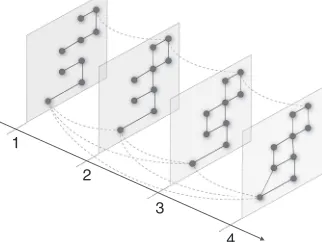
We developed a methodology to remove these limits, generalizing the determination of commu-nity structure via quality functions to multislice networks that are defined by coupling multiple adjacency matrices (Fig. 1). The connections encoded by the network slices are flexible; they can represent variations across time, variations across different types of connections, or even community detection of the same network at different scales. However, the usual procedure for establishing a quality function as a direct count of the intracommunity edge weight minus that
expected at random fails to provide any contribu-tion from these interslice couplings. Because they are specified by common identifications of nodes across slices, interslice couplings are either present or absent by definition, so when they do fall inside communities, their contribution in the count of intra-community edges exactly cancels that expected at random. In contrast, by formulating a null model in terms of stability of communities under Laplacian dynamics, we have derived a principled generaliza-tion of community detecgeneraliza-tion to multislice networks,
REPORTS
1
Carolina Center for Interdisciplinary Applied Mathematics, Department of Mathematics, University of North Carolina, Chapel Hill, NC 27599, USA.2Institute for Advanced Materials, Nanoscience and Technology, University of North Carolina, Chapel Hill, NC 27599, USA.3Operations Research, North Carolina State University, Raleigh, NC 27695, USA.4Oxford Centre for Industrial and Applied Mathematics, Mathematical Institute, University of Oxford, Oxford OX1 3LB, UK.5CABDyN Complexity Centre, University of Oxford, Oxford OX1 1HP, UK. 6Department of Health Care Policy, Harvard Medical School, Boston, MA 02115, USA.7Harvard Kennedy School, Harvard University, Cambridge, MA 02138, USA.
*To whom correspondence should be addressed. E-mail: [email protected]
1
2
3
4
Fig. 1.Schematic of a multislice network. Four slices
s= {1, 2, 3, 4} represented by adjacenciesAijsencode intraslice connections (solid lines). Interslice con-nections (dashed lines) are encoded byCjrs, specifying the coupling of nodejto itself between slicesrands. For clarity, interslice couplings are shown for only two nodes and depict two different types of couplings: (i) coupling between neighboring slices, appropriate for ordered slices; and (ii) all-to-all interslice coupling, appropriate for categorical slices.
nodes
resolution parameters coupling = 0
1 2 3 4
5
10
15
20
25
30
nodes
resolution parameters coupling = 0.1
1 2 3 4
5
10
15
20
25
30
nodes
resolution parameters coupling = 1
1 2 3 4
5
10
15
20
25
30
Fig. 2. Multislice community detection of the Zachary Karate Club network (22) across multiple resolutions. Colors depict community assignments of the 34 nodes (renumbered vertically to group similarly assigned nodes) in each of the 16 slices (with resolution parametersgs= {0.25, 0.5,…, 4}),
for w = 0 (top), w = 0.1 (middle), and w = 1 (bottom). Dashed lines bound the communities obtained using the default resolution (g= 1).
14 MAY 2010 VOL 328 SCIENCE www.sciencemag.org
876
CORRECTED 16 JULY 2010; SEE LAST PAGE
on August 30, 2010
www.sciencemag.org
with a single parameter controlling the interslice correspondence of communities.
Important to our method is the equivalence
between the modularity quality function (12) [with
a resolution parameter (5)] and stability of
com-munities under Laplacian dynamics (13), which
we have generalized to recover the null models for
bipartite, directed, and signed networks (14). First,
we obtained the resolution-parameter
generaliza-tion of Barber’s null model for bipartite networks
(15) by requiring the independent joint probability
contribution to stability in (13) to be conditional
on the type of connection necessary to step between two nodes. Second, we recovered the
standard null model for directed networks (16,17)
(again with a resolution parameter) by generaliz-ing the Laplacian dynamics to include motion
along different kinds of connections—in this case,
both with and against the direction of a link. By this generalization, we similarly recovered a null
model for signed networks (18). Third, we
interpreted the stability under Laplacian dynamics flexibly to permit different spreading weights on the different types of links, giving multiple reso-lution parameters to recover a general null model
for signed networks (19).
We applied these generalizations to derive null models for multislice networks that extend the existing quality-function methodology, including
an additional parameterwto control the coupling
between slices. Representing each network slices
by adjacenciesAijsbetween nodes iand j, with
interslice couplingsCjrsthat connect nodejin slice
rto itself in slices(Fig. 1), we have restricted our
attention to unipartite, undirected network slices
(Aijs=Ajis) and couplings (Cjrs=Cjsr), but we can
incorporate additional structure in the slices and couplings in the same manner as demonstrated for single-slice null models. Notating the strengths of
each node individually in each slice bykjs=∑iAijs
and across slices by cjs =∑rCjsr, we define the
multislice strength bykjs=kjs+cjs. The
continuous-time Laplacian dynamics given by
p˙is¼∑jrð
AijsdsrþdijCjsrÞpjr
kjr −pis ð1Þ
respects the intraslice nature of Aijs and the
interslice couplings ofCjsr. Using the steady-state
probability distributionp∗jr¼kjr=2m, where 2m=
∑jrkjr, we obtained the multislice null model in
terms of the probabilityris|jrof sampling nodeiin
slicesconditional on whether the multislice
struc-ture allows one to step from (j,r) to (i,s), accounting
for intra- and interslice steps separately as
risjjrp∗jr¼
kis
2ms
kjr kjrdsrþ
Cjsr
cjr
cjr kjrdij
kjr
2m ð2Þ
wherems=∑jkjs. The second term in parentheses,
which describes the conditional probability of motion between two slices, leverages the definition
of the Cjsr coupling. That is, the conditional
probability of stepping from (j,r) to (i,s) along
an interslice coupling is nonzero if and only ifi=j,
and it is proportional to the probabilityCjsr/kjrof
selecting the precise interslice link that connects to
slices. Subtracting this conditional joint probability
from the linear (in time) approximation of the exponential describing the Laplacian dynamics, we obtained a multislice generalization of modularity
(14):
Qmultislice¼ 1
2mijsr∑
h
Aijs−gskiskjs
2msdsr
þ
dijCjsr
i
dðgis,gjrÞ ð3Þ
where we have used reweighting of the conditional
probabilities, which allows a different resolutiongs
in each slice. We have absorbed the resolution pa-rameter for the interslice couplings into the
mag-nitude of the elements ofCjsr, which, for simplicity,
we presume to take binary values {0,w} indicating the absence (0) or presence (w) of interslice links. 1800 1820 1840 1860 1880 1900 1920 1940 1960 1980 2000
40PA, 24F, 8AA
151DR, 30AA, 14PA, 5F 141F, 43DR
44D, 2R 1784R, 276D, 149DR, 162J, 53W, 84other
176W, 97AJ, 61DR, 49A, 24D, 19F, 13J, 37other
3168D, 252R, 73other
222D, 6W, 11other
1490R, 247D, 19other
Year
Senator
10 20 30 40 50 60 70 80 90 100 110 CTME
MANH RIVT DENJ NYPA IL IN MIOH WIIA KSMN MONE NDSD VAAL ARFL GALA MSNC SCTX KYMD OKTN WVAZ COID MTNV NMUT WYCA ORWA AKHI
Congress #
A
B
Fig. 3.Multislice community detection of U.S. Senate roll call vote similarities (23) withw= 0.5 coupling of 110 slices (i.e., the number of 2-year Congresses from 1789 to 2008) across time. (A) Colors indicate assignments to nine communities of the 1884 unique senators (sorted vertically and connected across Congresses by dashed lines) in each Congress in which they appear. The dark blue and red communities correspond closely to the modern Democratic and Republican parties, respectively. Horizontal bars indicate the historical period of each community, with accompanying text enumerating nominal party affiliations of the single-slice nodes (each representing a senator in a Congress): PA, pro-administration; AA, anti-administration; F, Federalist; DR, Democratic-Republican; W, Whig; AJ, anti-Jackson; A, Adams; J, Jackson; D, Democratic; R, Republican. Vertical gray bars indicate Congresses in which three communities appeared simultaneously. (B) The same assignments according to state affiliations.
REPORTS
on August 30, 2010
www.sciencemag.org
Community detection in multislice networks can then proceed using many of the same com-putational heuristics that are currently available for single-slice networks [although, as with the stan-dard definition of modularity, one must be cautious
about the resolution of communities (20) and
the likelihood of complex quality landscapes that necessitate caution in interpreting results on real
networks (21)]. We studied examples that have
multiple resolutions [Zachary Karate Club (22)],
vary over time [voting similarities in the U.S. Senate
(23)], or are multiplex [the“Tastes, Ties, and Time”
cohort of university students (24)]. We provide
additional details for each example in (14).
We performed simultaneous community de-tection across multiple resolutions (scales) in the well-known Zachary Karate Club network, which encodes the friendships between 34 members of a
1970s university karate club (22). Keeping the
same unweighted adjacency matrix across slices
(Aijs=Aijfor alls), the resolution associated with
each slice is dictated by a specified sequence of
gsparameters, which we chose to be the 16 values
gs= {0.25, 0.5, 0.75,…, 4}. In Fig. 2, we depict
the community assignments obtained for
cou-pling strengthsw= {0, 0.1, 1} between each
neighboring pair of the 16 ordered slices. These results simultaneously probe all scales, includ-ing the partition of the Karate Club into four com-munities at the default resolution of modularity
(3,25). Additionally, we identified nodes that have
an especially strong tendency to break off from larger communities (e.g., nodes 24 to 29 in Fig. 2). We also considered roll call voting in the U.S. Senate across time, from the 1st Congress to the 110th, covering the years 1789 to 2008 and
includ-ing 1884 distinct senator IDs (26). We defined
weighted connections between each pair of sen-ators by a similarity between their voting, specified
independently for each 2-year Congress (23). We
studied the multislice collection of these 110 networks, with each individual senator coupled to himself or herself when appearing in consecutive Congresses. Multislice community detection un-covered interesting details about the continuity of individual and group voting trends over time that are not captured by the union of the 110 in-dependent partitions of the separate Congresses.
Figure 3 depicts a partition into nine communities
that we obtained using coupling w= 0.5. The
Congresses in which three communities appeared simultaneously are each historically noteworthy: The 4th and 5th Congresses were the first with political parties; the 10th and 11th Congresses occurred during the political drama of former Vice
President Aaron Burr’s indictment for treason; the
14th and 15th Congresses witnessed the beginning of changing group structures in the Democratic-Republican party amidst the dying Federalist party
(23); the 31st Congress included the Compromise
of 1850; the 37th Congress occurred during the beginning of the American Civil War; the 73rd and 74th Congresses followed the landslide 1932 election (during the Great Depression); and the 85th to 88th Congresses brought the major American civil rights acts, including the congressio-nal fights over the Civil Rights Acts of 1957, 1960, and 1964.
Finally, we applied multislice community detection to a multiplex network of 1640 college students at a northeastern American university
(24), including symmetrized connections from the
first wave of this data representing (i) Facebook friendships, (ii) picture friendships, (iii) roommates, and (iv) student housing-group preferences. Be-cause the different connection types are categorical, the natural interslice couplings connect an individ-ual in a slice to himself or herself in each of the other three network slices. This coupling between categorical slices thus differs from that above, which connected only neighboring (ordered) slices. Table 1 indicates the numbers of communities and the percentages of individuals assigned to one, two, three, or four communities across the four types of
connections for different values of w, as a first
investigation of the relative redundancy across the connection types.
Our multislice framework makes it possible to study community structure in a much broader class of networks than was previously possible. Instead of detecting communities in one static network at a time, our formulation generalizing the Laplacian
dynamics approach of (13) permits the
simulta-neous quality-function study of community struc-ture across multiple times, multiple resolution parameter values, and multiple types of links. We
used this method to demonstrate insights in real-world networks that would have been difficult or impossible to obtain without the simultaneous consideration of multiple network slices. Although our examples included only one kind of variation at a time, our framework applies equally well to networks that have multiple such features (e.g., time-dependent multiplex networks). We expect multislice community detection to become a powerful tool for studying such systems.
References and Notes
1. M. Girvan, M. E. J. Newman,Proc. Natl. Acad. Sci. U.S.A. 99, 7821 (2002).
2. M. A. Porter, J.-P. Onnela, P. J. Mucha,Not. Am. Math. Soc. 56, 1082 (2009).
3. S. Fortunato,Phys. Rep.486, 75 (2010). 4. M. E. J. Newman,Phys. Rev. E74, 036104 (2006). 5. J. Reichardt, S. Bornholdt,Phys. Rev. E74, 016110 (2006). 6. J. Hopcroft, O. Khan, B. Kulis, B. Selman,Proc. Natl.
Acad. Sci. U.S.A.101(suppl. 1), 5249 (2004). 7. T. Y. Berger-Wolf, J. Saia, inProceedings of the 12th ACM
SIGKDD International Conference on Knowledge Discovery and Data Mining(2006), p. 523 (10.1145/1150402.1150462).
8. G. Palla, A.-L. Barabási, T. Vicsek,Nature446, 664 (2007). 9. D. J. Fennet al.,Chaos19, 033119 (2009). 10. J. Sun, C. Faloutsos, S. Papadimitriou, P. S. Yu, in
Proceedings of the 13th ACM SIGKDD International Conference on Knowledge Discovery and Data Mining
(2007), p. 687 (10.1145/1281192.1281266). 11. T. M. Selee, T. G. Kolda, W. P. Kegelmeyer, J. D. Griffin,
CSRI Summer Proceedings 2007, Technical Report SAND2007-7977, Sandia National Laboratories, Albuquerque, NM and Livermore, CA, M. L. Parks, S. S. Collis, Eds. (2007), p. 87 (www.cs.sandia.gov/CSRI/ Proceedings).
12. M. E. J. Newman, M. Girvan,Phys. Rev. E69, 026113 (2004). 13. R. Lambiotte, J. C. Delvenne, M. Barahona, http://arxiv.
org/abs/0812.1770 (2008).
14. See supporting material onScienceOnline. 15. M. J. Barber,Phys. Rev. E76, 066102 (2007). 16. A. Arenas, J. Duch, A. Fernandez, S. Gomez,N. J. Phys.9,
176 (2007).
17. E. A. Leicht, M. E. J. Newman,Phys. Rev. Lett.100, 118703 (2008).
18. S. Gómez, P. Jensen, A. Arenas,Phys. Rev. E80, 016114 (2009).
19. V. A. Traag, J. Bruggeman,Phys. Rev. E80, 036115 (2009). 20. S. Fortunato, M. Barthélemy,Proc. Natl. Acad. Sci. U.S.A.
104, 36 (2007).
21. B. H. Good, Y.-A. de Montjoye, A. Clauset,Phys. Rev. E 81, 046106 (2010).
22. W. W. Zachary,J. Anthropol. Res.33, 452 (1977). 23. A. S. Waugh, L. Pei, J. H. Fowler, P. J. Mucha,
M. A. Porter, http://arxiv.org/abs/0907.3509 (2009). 24. K. Lewis, J. Kaufman, M. Gonzalez, A. Wimmer,
N. Christakis,Soc. Networks30, 330 (2008). 25. T. Richardson, P. J. Mucha, M. A. Porter,Phys. Rev. E80,
036111 (2009).
26. K. T. Poole, Voteview (http://voteview.com) (2008). 27. We thank N. A. Christakis, L. Meneades, and K. Lewis for
access to and helping with the“Tastes, Ties, and Time” data; S. Reid and A. L. Traud for help developing code; and A. Clauset, J.-C. Delvenne, S. Fortunato, M. Gould, and V. Traag for discussions. Congressional roll call data are from http://voteview.com (26). Supported by NSF grant DMS-0645369 (P.J.M.), James S. McDonnell Foundation grant 220020177 (M.A.P.), and the Fulbright Program (J.-P.O.).
Supporting Online Material
www.sciencemag.org/cgi/content/full/328/5980/876/DC1 SOM Text
References
17 November 2009; accepted 22 March 2010 10.1126/science.1184819
Table 1.Communities in the first wave of the multiplex“Tastes, Ties, and Time”network (24), using the default resolution (g= 1) in each of the four slices of data (Facebook friendships, picture friendships, roommates, and housing groups) under various couplingswacross slices, which changed the number of communities and percentages of individuals assigned on a per-slice basis to one, two, three, or four communities.
w communitiesNumber of Communities per individual (%)
1 2 3 4
0 1036 0 0 0 100 0.1 122 14.0 40.5 37.3 8.2 0.2 66 19.9 49.1 25.3 5.7 0.3 49 26.2 48.3 21.6 3.9 0.4 36 31.8 47.0 18.4 2.8 0.5 31 39.3 42.4 16.8 1.5 1 16 100 0 0 0
14 MAY 2010 VOL 328 SCIENCE www.sciencemag.org
878