• No results found

Fuzzy state space modeling for solving inverse problems in multivariable dynamic systems

N/A
N/A
Protected

Academic year: 2020

Share "Fuzzy state space modeling for solving inverse problems in multivariable dynamic systems"

Copied!
44
0
0

Loading.... (view fulltext now)

Full text

(1)

IN MULTIVARIABLE DYNAMIC SYSTEMS

RAZIDAH BINTI ISMAIL

(2)

RAZIDAH BINTI ISMAIL

A thesis submitted in fulfilment of the requirements for the award of the degree of

Doctor of Philosophy

Faculty of Science Universiti Teknologi Malaysia

(3)

To my husband

Mohd Aminudin bin Md Amin.

To my children

Mohd Hanif, Mohd Zharif, Nur Hanis,

Mohd ‘Afif, Nur Husna, Nurul Huda.

In memory of my parents

Hajah Rokiah binti Abdullah (deceased 10 August 2001) Haji Ismail bin Zainal

(deceased 4 January 2002)

(4)

ACKNOWLEDGEMENTS

In the Name of ALLAH s.w.t, The Most Beneficient, The Most Merciful. All praise is due only to ALLAH s.w.t, the Lord of the universe. Ultimately, only ALLAH s.w.t has given us the strength and courage to proceed with life in its entirety. His works are truly splendid and wholesome. His knowledge is truly complete with due perfection.

I am highly indebted to many people for their assistance in the preparation of this thesis. I wish to express my sincere gratitude to my supervisor, Assoc. Prof. Dr. Tahir Ahmad for his excellent supervision, invaluable guidance, helpful discussions and continuous encouragement. His enthusiasm and thoughtful considerations, and his valuable suggestion throughout the preparation of this thesis are greatly appreciated. I would also like to extend my sincere gratitude and appreciation to my co-supervisors, Assoc. Prof. Dr Shamsuddin Ahmad and Assoc. Prof. Dr. Rashdi Shah Ahmad, for their valuable suggestions and guidance.

Many thanks are also due to Assoc. Prof. Othman Ayob, from the Faculty of Mechanical Engineering, UTM and Prof. Dr. Mohd Nasir Taib from the Faculty of Electrical Engineering, UiTM for their valuable assistances and suggestions. I would also like to acknowledge with much appreciation the crucial role of the editors and referees or reviewers for all my publications. Their valuable comments and suggestions throughout the preparation of various publications have helped me to improve my work and are highly appreciated. My special thanks to Universiti Teknologi MARA (UiTM) and Jabatan Perkhidmatan Awam (JPA) for the financial support throughout the course of my study.

I would also like to express my appreciation to my family: my dearest husband, who has always provided the encouragement and support that I truly need; my lovely children, who have always been the source of inspiration and pleasure; my parents, brothers and sisters for their continuous prayers for my success.

(5)

ABSTRACT

(6)

ABSTRAK

(7)

TABLE OF CONTENTS

CHAPTER TITLE PAGE

THESIS STATUS DECLARATION SUPERVISOR’S DECLARATION

TITLE PAGE i

DECLARATION ii

DEDICATION iii

ACKNOWLEDGEMENTS iv

ABSTRACT v

ABSTRAK vi

TABLE OF CONTENTS vii

LIST OF TABLES xii

LIST OF FIGURES xiv LIST OF SYMBOLS xvii LIST OF APPENDICES xxi

1 INTRODUCTION 1

1.1 Background and Rationale 1

1.1.1 Approaches in Model Construction 4

1.1.2 Related Studies 8

1.2 Objectives of the Study 11

1.3 Implications of the Study 11

1.4 Scope of the Study 11

(8)

2 SYSTEM MODELING IN STATE SPACE 16 REPRESENTATION

2.1 Introduction 16

2.2 Systems and System Models 17

2.3 Mathematical Modeling of a Control System 19

2.4 The State Space Modeling 23

2.5 Solutions of State Equations 28 2.5.1 Analytical Solution of State Equations 28 2.5.2 Computer Simulation of State Equations 29 2.6 Structural Properties of a Dynamic System 33

2.6.1 Stability 33

2.6.1.1 Lyapunov Stability 33 2.6.1.2 Input-Output Stability 34 2.7 Controllability and Observability 36 2.8 Inverse Problems in System Modeling 38 2.9 Uncertainties in System Modeling 40

2.10 Summary 41

3 FUZZY NUMBER AND FUZZY ARITHMETIC 43

3.1 Introduction 43

3.2 Membership Functions 44

3.3 Fuzzy Sets: Basic Concepts 46 3.3.1 Operations on Fuzzy Sets 48 3.3.2 Relation among Fuzzy Sets 50

3.4 α-cuts of Fuzzy Sets 51

3.5 The Extension Principle 52

3.6 Fuzzy Numbers 53

3.7 Arithmetic Operations on Fuzzy Numbers 55

3.7.1 The α-cut Method 55

(9)

3.8 Fuzzy Systems 56

3.8.1 Fuzzification 58

3.8.2 Fuzzy Environment 58

3.8.3 Defuzzification 58

3.9 Fuzzy Modeling 59

3.10 Fuzzy Algorithms 60

3.11 Related Studies on Fuzzy Arithmetic 61

3.12 Summary 62

4 FUZZY STATE SPACE MODELING 64

4.1 Introduction 64

4.2 Terminology 65

4.3 Representation of Uncertainty 66 4.4 Development of the Fuzzy State Space Model 68 4.5 Fuzzy State Space Algorithm for a MISO system 72 4.6 Convexity and Normality of the Induced Solution

of FSSM 75

4.7 Modified Optimized Defuzzified Value Theorem 78 4.8 Fuzzy State Space Algorithm for a MIMO system 81 4.9 Extension of the Optimized Defuzzified Value Theorem 85

4.10 A Computational Tool 86

4.10.1 Programs for a MISO system 88 4.10.2 Programs for a MIMO system 89 4.11 Stability of a Fuzzy State Space System 90

(10)

5 IMPLEMENTATION OF FUZZY STATE SPACE MODEL

ON THE FURNACE SYSTEM 94

5.1 Introduction 94

5.2 Modeling the Furnace System of a

Combined Cycle Power Plant 95

5.3 The Furnace System 96

5.4 Model Assumptions 98

5.5 Mathematical Modeling of the Furnace System 99 5.6 State Space Modeling of the Furnace System 101 5.6.1 Development of the State Equation 102 5.6.2 Development of the Output Equations 103 5.7 The State Space Analysis of the Furnace System 105

5.7.1 Stability Analysis 107

5.7.2 Controllability and Observability 107 5.8 Implementation of the Fuzzy State Space Algorithm

in the Furnace System (MISO) 109 5.8.1 Algorithm applied to Qir 109

5.8.2 Algorithm applied to Qis, Qes, pG and Qrs 114

5.8.3 Optimized Input Parameters 119 5.9 Implementation of the Fuzzy State Space Algorithm

in the Furnace System (MIMO) 122 5.9.1 Algorithm applied to Qir and Qis 122

5.9.2 Algorithm applied to Qes and pG 126

5.9.3 Algorithm applied to Qrs 129

5.9.4 Optimized Input Parameters 131

5.10 Summary 134

6 SYSTEMS OF FUZZY STATE SPACE MODEL 136

6.1 Introduction 136

(11)

6.3 Properties of Induced Solution of FSSM in

Multi-connected Systems 140

6.3.1 Convexity and Normality 141 6.3.2 Optimized Input Value Parameter 142 6.3.3 Bounded-Input Bounded-Output Stability 143 6.4 Algebraic View of Systems of FSSM 144

6.4.1 Common Feeder 145

6.4.2 Relations 147

6.5 Summary 148

7 CONCLUSION AND RECOMMENDATIONS 150

7.1 Summary of the Research 150

7.2 Significant Findings and Contributions 152 7.3 Recommendations for Future Research 154

REFERENCES 156

(12)

LIST OF TABLES

TABLE NO. TITLE PAGE

5.1 Input parameters specification 110

5.2 α-cuts of input parameters 112

5.3 Output parameters specification (Qir) 112

5.4 Endpoints of interval for input parameters (Qir) 114

5.5 Output parameters specification (Qis, Qes, pG and Qrs) 115

5.6 Endpoints of interval for input parameters (Qis) 118

5.7 Endpoints of interval for input parameters (Qes) 118

5.8 Endpoints of interval for input parameters (pG ) 118

5.9 Endpoints of interval for input parameters (Qrs) 118

5.10 Calculated fuzzy value for the Furnace System (MISO) 119 5.11 Calculated norm for the Furnace System (MISO) 119 5.12 Optimized input parameters (MISO) 120 5.13 Calculated output parameters for Furnace System (MISO) 120 5.14 Comparison of optimized input parameters (MISO) 121

5.15 Output parameters specification (Qir and Qis) 124

5.16 Endpoints of interval for input parameters (Qir and Qis) 126

5.17 Output parameters specification (Qes and pG ) 127

5.18 Endpoints of interval for input parameters (Qes and pG ) 129

(13)

5.20 Calculated fuzzy value and norm for the

Furnace System (MIMO) 132

5.21 Optimized input parameters (MIMO) 132 5.22 Calculated output parameters for the

Furnace System (MIMO) 132

(14)

LIST OF FIGURES

FIGURE NO. TITLE PAGE

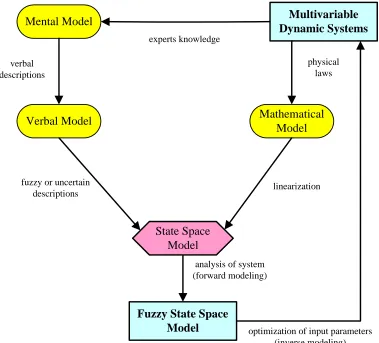
1.1 Construction of the Fuzzy State Space Model 5 1.2 Linearization of a nonlinear dynamic system 6

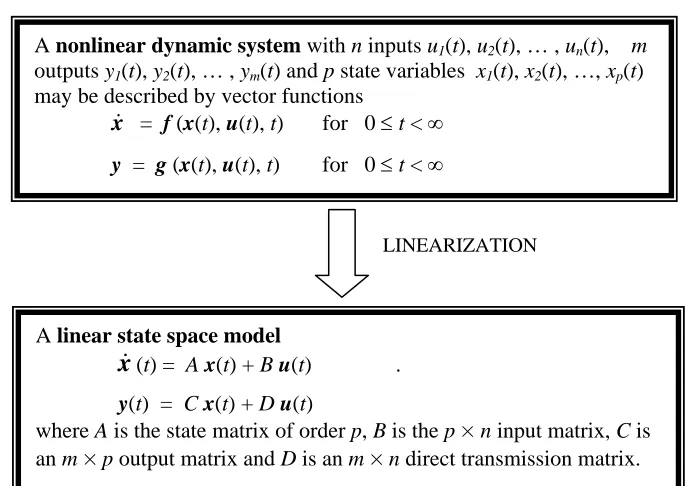
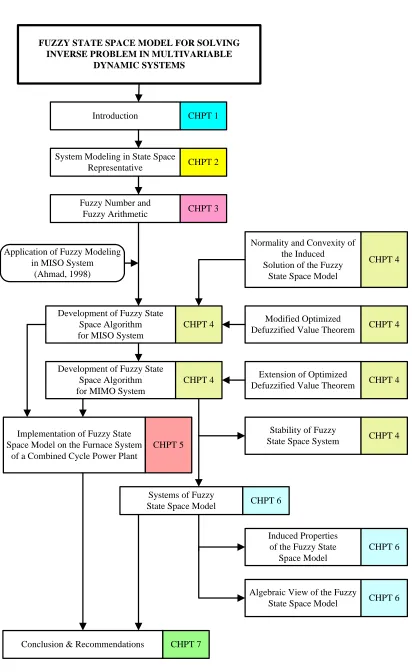
1.3 Organization of the Thesis 15

2.1 Principle of Superposition 19

2.2 Transfer function or Input-Output representation of a system 21 2.3 State space representation of a system 22 2.4 State space representation of a linear multivariable system 26 2.5 State space representation from governing equations 27 2.6 Plots of the state and output responses 32 2.7 Plots of responses due to step functions 32 2.8 Mathematical Modeling: (a) Forward Problems

(b) Inverse Problems 39

3.1 Crisp representation of “middle-aged” 45 3.2 Fuzzy representation of “middle-aged” 46 3.3 Features of the membership function 46 3.4 (a) convex fuzzy set (b) non-convex fuzzy set 48

3.5 Complement of fuzzy set A 49

3.6 Union of fuzzy sets A and B 49

(15)

3.8. The intersection of two convex fuzzy sets 50

3.9 Examples of Fuzzy Numbers 54

3.10 Block diagram of a Fuzzy System 58

4.1 A triangular fuzzy number 68

4.2 Phases in developing a fuzzy algorithm 70 4.3 Flowchart for a Fuzzy State Space Algorithm 71 4.4 The intersection of the fuzzy desired parameter

(a) on the maximum side of the induced parameter

(b) on the minimum side of the induced parameter 80 4.5 The intersection of the desired parameter on the maximum

side of the fuzzy induced parameter 87 4.6 The intersection of the desired parameter on the minimum

side of the fuzzy induced parameter 87

5.1 Schematic diagram of a Boiler 97

5.2 Simplified block diagram of the Furnace System 101 5.3 The state response of the Furnace System 106 5.4 The output responses of the Furnace System 106 5.5 The Furnace System subjected to step function 108 5.6 The Furnace System subjected to impulse function 108 5.7 Fuzzification of input parameters

(a) fuel flow (b) air flow (c) exhaust gas flow 111

5.8 Fuzzy value for the Furnace System (Qir) 113

5.9 Fuzzy value for the Furnace System (Qis) 116

5.10 Fuzzy value for the Furnace System (Qes) 116

5.11 Fuzzy value for the Furnace System (pG) 117

5.12 Fuzzy value for the Furnace System (Qrs) 117

5.13 Surface and contour plots for the Furnace System

(16)

5.14 Fuzzy value for the Furnace system (Qir and Qis) 125

5.15 Surface and contour plots for the Furnace system

(Qes and pG ) 128

5.16 Fuzzy value for the Furnace system (Qes and pG ) 128

6.1 An example of a simple multi-connected system 136 6.2 Multi-connected systems of type A 140 6.3 Multi-connected systems of type B 140

6.4 SgF1 is a feeder of SgF2 146

6.5 SgF is a common feeder of SgF1 and SgF2 146

(17)

LIST OF SYMBOLS

General symbols

{x1, x2, x3, …} - Set of elements x1, x2, x3,… {x | p(x)} - Set determined by property p (x1, x2, x3, …, xn) - n-tuple

[xij] - Matrix

[x1, x2, x3, …, xn ] - Vector

L - Euclidean norm

min [x1, x2, x3, …,xn] - Minimum of x1, x2, x3, …, xn max [x1, x2, x3, …,xn] - Maximum of x1, x2, x3, …, xn i, j, k - Arbitrary identifier (indices)

[a, b] - Closed interval of real numbers between a and b [a, b) - Interval of real numbers closed in a and open in b [a,∞) - Sets of real numbers greater than or equal to a (a, b) - Open interval of real numbers between a and b (a, b] - Interval of real numbers open in a and close in b

ℜ - Set of real numbers

+

- Set of positive real numbers n

- Set of n-tuple of real numbers

ℵ - Set of positive integers (natural numbers) U or X - Universal set

A, B, C, … - Arbitrary sets (crisp or fuzzy) A = B - Set equality

(18)

AB - Set union

A × B - Cartesian product of sets A and B

∅ - Empty set

f: XY - Function of f from X into Y f-1: XY - Inverse function of f from Y to X R (X, Y) - Relation on X × Y

⇒ - Implies

⇔ - If and only if

∈ - Element of

∉ - Not an element of

∋ - Such that

∃ - There exist (at least one)

∀ - For all

µA(x) - Membership grade of x in fuzzy set A

αA - α-cut of fuzzy set A

α+A - Strong α-cut of fuzzy set A sup A - Supremum of A supp A - Support of fuzzy set A h(A) - Height of fuzzy set A core(A) - Core of fuzzy set A a|b - a divides b

gcd(a, b) - Greatest common divisor of a and b gcf(a, b) - Greatest common feeder of a and b SgF - Fuzzy State Space Model

[u1, u2,…,un]T - Input vector [y1, y2,…,ym]T - Output vector

FIi (x) - Degree of desirability of using a particular value x Find - Fuzzy induced performance parameter

FSgF. - Desired performance parameter

SGF - A collection of interconnected FSSM systems SgF - Common feeder

(19)

Furnace System

CF - Fuel calorific value J/kg

cpg - Specific heat of exhaust gases at constant pressure Js/kgoK cgs - Combustion gas specific heat capacity Js/kgoK

wF - Fuel flow kg/s

wA - Air flow kg/s

wEG - Gas mass flow through the boiler kg/s wG - Exhaust gas (from the gas turbine) flow kg/s

win - Inlet mass flow kg/s

wou - Outlet mass flow kg/s

wg - Flow of substances entering combustion kg/s hG - Exhaust gas (from the gas turbine) specific enthalpy J/kg

hA - Air specific enthalpy J/kg

hEG - Gas specific enthalpy J/kg

href - Reference exhaust gases enthalpy J/kg hin - Inlet specific enthalpy J/kg hou - Outlet specific enthalpy J/kg Qir - Heat transferred by radiation to risers J/s Qis - Heat transferred by radiation to the superheater J/s Qrs - Heat transferred to reheater J/s Qgs - Heat transferred to superheater J/s Qes - Heat transferred to the economiser J/s

Qin - Incoming heat flow kg/s

Q - Heat flow J/s

Tg - Gas temperature oK

(20)

Tm - Metal temperature oK

Ts - Steam temperature oK

Rs - Stoichiometric air/fuel volume ratio (-) REG - Ideal gas constant for exhaust gases

y - The percentage excess air level %

V - Volume m3

VF - Combustion chamber volume m3 σ - Stefan-Boltzman constant

θ - Burner tilt angle 0< θ <1 (-)

γA - Content of fresh air in exhaust from gas turbine (-)

γ - Friction coefficient (-)

ρEG - Gas density kg/m3

ρ - Specific density kg/m3

pG - Gas pressure in furnace Pa

pin - Inlet pressure Pa

pou - Outlet pressure Pa

k - An attenuation coefficient (-) kgs - An experimental coefficient J/kgoK krs - An experimental coefficient J/kgoK kes - An experimental coefficient J/kgoK kf - A friction coefficient

K - A coefficient (-)

Abbreviations

(21)

LIST OF APPENDICES

APPENDIX TITLE PAGE

A Linearization of Nonlinear Equations 164

A.1 Linearizing Functions 164

A.2 Linearizing the State Model 166

B Block Diagram of a Boiler System 168

C M-Files for the State Space Analysis of the Furnace System 169 C1 To plot the graphs of state and output responses

of the state space model 169

C2 To plot the graphs of output responses of the

state space model using unit step input function 170 C3 To plot the graphs of output responses of the

state space models using impulse input function 171

D M-Files for the Fuzzy State Space Algorithms

of the Furnace System 172

D1 Program for the MISO system 172

D2 Program for the MIMO system 174

(22)

INTRODUCTION

1.1 Background and Rationale

The design of mathematical models of complex real-world systems is essential in many fields of science and engineering. The need for new approaches and philosophies in modeling and control of complex industrial systems is much influenced by recent advances in information technology, increased market competition, the demand for low cost operation and energy efficiency. In the

electricity industry for example, power generation plants need to operate optimally in order to stay competitive, as even a small improvement in energy efficiency would involve substantial cost savings. For a large complex system such as power generation plants, it is useful to decompose the system into subsystems or

components that can be analyzed and understood separately. The physical structure of the system often suggests a suitable subdivision. The inverse concept,

composition, is naturally applied to construct large systems from simple components or subsystems. These subsystems can be interconnected in a flat or hierarchical structure such that an output of one subsystem becomes an input to another subsystem.

(23)

poorly understood systems are considered. Another approach for building

mathematical models is called black-box modeling (Ljung, 1987). In this approach, the modeling problem reduces to postulating an appropriate structure of the

approximator, in order to correctly capture the dynamics and nonlinearity of the system. A severe drawback of this approach is that the structure and parameters of these models usually do not have any physical significance, and therefore are less useful for industrial practice. The limitations of these two approaches have led to the development of semi-mechanistic or grey-box modeling approaches (Lindskog, 1997; Babuska, 1998). This modeling technique combines the advantages of the white-box and black-box approaches. The known parts of the system are modeled using physical knowledge, and the unknown or less certain parts are approximated using process data and black-box modeling structures with suitable approximation properties.

Traditional grey-box approaches assume that the structure of the model is given directly as a parameterized mathematical function, which is based on physical principles. However, for many real-world systems a great deal of information is provided by human experts, who describe the system verbally through vague, uncertain or imprecise statements. The fact that humans are often able to manage complex tasks under significant uncertainty has stimulated the search for alternative modeling and control paradigms.

The most relevant information about any system comes in one of three ways, that is: a mathematical model, sensory input and output data or measurement, and human expert knowledge. The common factor in all these three sources is

(24)

for handling ill-conditioned or ill-posed problems, which exist as a result of combining measurements with engineering models. The inverse problem (Hensel, 1991), or more precisely the inverse modeling, is one type of conditioned or ill-posed problems. In inverse modeling, the desired responses are given and a model is used to estimate the input parameters. Thus, fuzzy models can be seen as logical models which use logical operators to establish qualitative relationships among the variables in the model. At the same time, at the computational level, fuzzy models can be regarded as flexible mathematical structures, which can approximate a large class of nonlinear systems to a desired degree of accuracy (Zeng and Singh, 1995). This duality allows qualitative knowledge to be combined with quantitative data in a complementary way.

Fuzzy sets were first proposed in the early 1960s by L. A. Zadeh as a general model of uncertainty encountered in engineering systems (Zadeh, 1965). He wanted to generalize the traditional notion of set and statement to allow grades of

memberships and truth values, respectively. His efforts were prompted by the two main complications that arise during physical modeling in the real world

(25)

Based on this background discussion, this research presents a new inverse modeling technique for multivariable dynamic systems, called the Fuzzy State Space Model (FSSM). The philosophy in the construction of this model is discussed in the next section. In this model, the flexibility of fuzzy modeling is incorporated with the crisp state space models proposed in the modern control theory. There are two important facts that make this modeling approach intuitively appealing. Firstly, there are always uncertain factors affecting the system in a real-world modeling situation. This indicates that a complete physical model can hardly ever be constructed. However, uncertain factors can be taken care of by employing a sufficiently flexible model. Secondly, the restriction on the flexibility to comply with prior knowledge is allowed in the modeling procedure.

1.1.1 Approaches in Model Construction

(26)

Mental Model

Verbal Model Mathematical

Model

Multivariable Dynamic Systems

Fuzzy State Space Model

verbal descriptions

fuzzy or uncertain descriptions

physical laws

linearization

analysis of system (forward modeling)

optimization of input parameters (inverse modeling) experts knowledge

State Space Model

(27)

For system analysis and engineering purposes, mathematical models are often constructed, for instance, based on algebraic and differential or difference equations which are derived from physical laws. For well-defined systems, these standard mathematical tools lead to good models, even though the modeling process is often very tedious. However, most of the real-world systems are complex and nonlinear. An analytical approach for such systems is available only to a very limited extent (Bossel, 1994). On the other hand, a well-developed set of analytical tools is readily available for linear systems. Thus, linearization of nonlinear systems into linear systems plays an important role in this study. The transformation of a nonlinear dynamic system into a linear state space model is presented in Figure 1.2.

A nonlinear dynamic system with n inputs u1(t), u2(t), … , un(t), m

outputs y1(t), y2(t), … , ym(t) and p state variables x1(t), x2(t), …, xp(t)

may be described by vector functions

x& = f (x(t), u(t), t) for 0 ≤t < ∞

y = g (x(t), u(t), t) for 0 ≤t < ∞

LINEARIZATION

A linear state space model

(t) = A x(t) + B u(t) . x&

y(t) = C x(t) + D u(t)

where A is the state matrix of order p, B is the p × n input matrix, C is an m × p output matrix and D is an m × n direct transmission matrix.

Figure 1.2 Linearization of a nonlinear dynamic system

The most important advantage of the crisp state space model is that the system dynamic properties are condensed in the model (Cao and Rees, 1995). For example, stability of the system is examined from the state matrix A, and a controller can be designed based on the system model (A, B). The system model gives both the external and internal behavior of the system. Furthermore, the state space

(28)

blending information of different kinds, qualitative as well as quantitative. It can adequately process not only the given data, but also the associated uncertainty.

The developed FSSM can be used to observe the influence of parameters on system behavior, and apply that knowledge to achieve a desired outcome. The desired outcome is the “known” information, whereas the input parameters to achieve that outcome need to be deduced. This is analogous to an inverse problem, where the measured response is given and a model is used to estimate input

parameters. Traditionally, such inverse problems have been addressed by repeated simulation of forward problems, for example Ordys et al. (1994), Ram and Patel (1998), which requires excessive computer time. Thus, an inverse methodology using Fuzzy State Space algorithms is developed, whereby the manipulation of imprecise, uncertain quantities is considered. This novel model provides algorithms that address inverse problem in multivariable systems directly. To facilitate the implementation of this model, the algorithms are coded using Matlab® software packages to form a semi-automated computational tool. Using this computational tool, the users can evaluate more alternatives in less time, and at the same time, the users can obtain more information on the performance of each of those alternatives.

The effectiveness of this modeling approach is illustrated by implementing it in a furnace system of a combined cycle power plant, which is regarded as an

important constituent in the heat treatment system of a boiler. The objective of optimization of a furnace system is to minimize energy losses and, at the same time, to keep variables within constraints. The theoretical basis that leads to the

formulation of the mathematical model for the furnace system can be found in Ordys et al. (1994). Based on this mathematical model, the state space model of the

(29)

In this study, the furnace system of the combined cycle power plant is used as an illustration, but in general, the FSSM is applicable to any multivariable dynamic systems as long as the governing equations of the systems can be transformed into linear state space representations.

1.1.2 Related Studies

The current literature on fuzzy modeling clearly exhibits a wealth of diverse approaches to fuzzy modeling, supporting various methodological points of view and embracing distinct classes of models (Pedrycz, 1995). The ideas of fuzzy models and fuzzy modeling have been formulated and analyzed from both the

methodological and experimental standpoints. There is no doubt that the methodology of fuzzy modeling is vital to any application of fuzzy sets.

The terminology “Fuzzy State Space Models” was first cited in a publication by Won et al. (1995), where stability analysis and stabilization of the linguistic models using the “If…Then…” rules are discussed. They deal with the fuzzy model proposed by Tanaka and Sugeno (1992) except that the fuzzy model is treated as a linear system having modeling uncertainties and the consequent part of each rule is represented by a state equation. Won et al. (1995) used the term “linguistic fuzzy state space models” to be synonymous to linguistic fuzzy dynamic models.

A few years later, Cao et al. (1999) proposed a new kind of dynamic fuzzy state space model based on dynamic fuzzy models (Cao and Rees, 1995), which are an extended structure of the fuzzy model used in Sugeno and Yasukawa (1993). They defined a dynamic fuzzy model for a single-input single-output system as follows:

Rl: IF z1 is F1l AND … z2n is F2nl

THEN x(t + 1) = Alx(t) + Blu(t) (1.1)

y(t) = Clx(t) + d l

(30)

where Rl denotes the lth approximation inference rule. m is the number of

approximation inference rules, y(t) and u(t) are the output and input variables of the system, x(t) are the state variables, (Al, Bl, Cl, d l ) represent the crisp input and output

relationship or dynamic properties of the system in the local region where , and z(t) = [y(t),…, y(t – n + 1), u(t),…, u(t – n + 1)] (1.2)

l F

= = n i l i l F F 2 1

= (z1, z2,…, z2n)

By using the fuzzy-inference methods described in Cao and Rees (1995), the dynamic fuzzy model (1.1) is expressed by the dynamic fuzzy state space model as follows:

x(t + 1) = Ax(t) + Bu(t)

y(t) = Cx(t) + D (1.3)

where

= µ = m l l lA A

1

=

µ = m l l lB B 1 ] 1 , 0 ,..., 0 , 0 [ = C

= µ = m l l ld D 1

In other words, the above dynamic fuzzy state space model (1.3) represents the evolution of the dynamic fuzzy model (1.1). Subsequently, a parameter estimator is developed for a plant that can be represented by a dynamic fuzzy state space model (Cho et al., 2001). The fuzzy controller is constructed from a fuzzy feedback linearization controller whose parameters are adjusted indirectly from the estimates of plant parameters. Thus far and to the best of our knowledge, work reported in the literature related to fuzzy state space models has focused on the direct or forward modeling techniques for designs of controllers.

(31)

Prade (1980), Kaufmann and Gupta (1985), Zimmerman (1985), Terano et al. (1987), Klir and Yuan (1995), Wang (1997). Various applications of fuzzy

arithmetic were reported in the literature, for example Dong and Wong (1987), Wood and Antonsson (1989), Giachetti and Young (1997), Hanss et al. (1998), Ahmad et al. (1997). In this study, the approach of using fuzzy numbers in developing a fuzzy algorithm for MISO system, which was introduced by Ahmad (1998) and published in Ahmad et al. (2004) is of special interest. He adopted the Level Interval

Algorithm (Wood and Antonsson, 1989) and used algebraic equations for optimizing parameters of microstrip lines with the aim of minimizing crosstalk.

In this study, we defined the Fuzzy State Space Model of a multivariable dynamic system as

SgF : x&(t) = A x(t) + B u~(t) .

y

~(t) = C x(t) (1.4) where u~(t) denotes the fuzzified input vector [u1, u2,…, un]T and ~y(t) denotes the fuzzified output vector [y1, y2,…, ym]T with initial conditions as t0 = 0 and

x0 = x(t0) = 0. T is the vector or matrix transposition. The elements of state matrix , input matrix , and output matrix are known to a specified accuracy. p

p

A × Bp×n Cm×p

The development of this new FSSM is elaborated in Chapter 4, where inverse Fuzzy State Space algorithms are formulated. The uncertain value parameters of the system are represented by fuzzy numbers with their membership function derived from expert knowledge. In many respects, fuzzy numbers depict the physical world more realistically than single-valued numbers, as the concept takes into account the fact that all phenomena have a degree of uncertainty. The ability of this novel method to address inverse problems in multivariable systems directly, is an outstanding

advantage especially in reducing computation time and cost. At the same time, some valuable properties and characteristics of the induced solution of the FSSM are also established. These properties are generalized to a multi-connected system of FSSM. In addition, we have laid some possible theory for systems of FSSM from the

(32)

1.2 Objectives of the Study

The objectives of this study are as follows:

(i) To develop a Fuzzy State Space Model for optimal input parameters estimation in a multivariable dynamic system.

(ii) To derive and prove some important properties of the induced solution of the Fuzzy State Space Model.

(iii) To implement the Fuzzy State Space Model in the furnace system of a combined cycle power plant.

(iv) To generalize the properties of Fuzzy State Space Model to multi-connected systems.

1.3 Implications of the Study

The most significant advantage of this study is the ability to assess the condition of the multivariable dynamic systems at the preliminary design stage. The Fuzzy State Space Model developed in this study can assist plant operators or

designers to recommend a rational and systematic measure for optimizing the input parameters of any multivariable dynamic system. The resulting model finally can be embedded into a special conception of fuzzy-model-based control. At the same time, the outcomes of this study will be disseminated at the national and international level through journals, seminars and conferences.

1.4 Scope of the Study

(33)

S1. Development of the Fuzzy State Space Model.

A new technique for optimal input parameters estimation for multivariable dynamic systems is developed, where the flexibility of fuzzy modeling is incorporated with the crisp state space models proposed in the modern control theory. This leads to the development of the inverse Fuzzy State Space algorithm for a MISO system, which requires a derivation of a theorem for optimization. A Modified Optimized Defuzzified Value Theorem is derived and proven. Subsequently, the inverse Fuzzy State Space algorithm is enhanced to address the optimization of input parameters for a MIMO system. For the MIMO system, an Extension of Optimized Defuzzified Value Theorem is derived and proven. In this study, a dynamic system is one whose inputs and outputs are related by a set of differential (or difference) equations.

S2. Software development of the Fuzzy State Space algorithm.

Matlab® programming facilities are used in the development of a semi-automated computational tool based on the inverse Fuzzy State Space

algorithm. For MISO and MIMO systems, two main programs are developed where the number of input parameters and the number of intervals used for accuracy are specified by the user. Obviously, these values will affect the computation time of the programs. Computation of the percentage errors for the input and output parameters are also included in the programs. This semi-automated computational tool allows users to evaluate easily more

alternatives in less time and at the same time; the users can obtain more information on the performance of each of these alternatives.

S3. Properties of the induced solution of the FSSM

(34)

S4. Implementation of FSSM in the furnace system of a combined cycle power plant

The theoretical concepts and the mathematical equations governing the process in the furnace system are used to develop the state space model. The dynamic behavior of the furnace system is studied through state space

analysis, which is similar to forward or direct modeling. Subsequently, a FSSM for the furnace system is developed and tested using steady state operating data. Next, the inverse Fuzzy State Space algorithms for MISO and MIMO systems are implemented in the furnace system. These results are compared to the normally accepted simulation method.

S5. Systems of FSSM

The properties of the induced solution of a single FSSM are generalized to multi-connected systems of FSSM. The induced properties considered in the present study are convexity, normality, BIBO stability and optimized input value parameter. In addition, some algebraic views related to the systems of FSSM are discussed. In particular, the characteristics of a system of FSSM are developed based on the basic properties of divisors and relations.

1.5 Outline of the Thesis

The thesis is organized into seven chapters: this introductory chapter, five main chapters and a chapter of overall conclusion. Each main chapter is self contained, starting with an introduction and culminating with a summary. The present chapter gives a description of the background and rationale in developing the new modeling technique, approaches in model construction, objectives, implications and the overall scope of the study. A literature review on work related to the study is also presented.

(35)

representation and state space analysis of a multivariable dynamic system. The chapter concludes with a description of uncertainties and inverse problems in system modeling, which are among the rationale behind the formulation of the system modeling framework in this study. Chapter 3 describes the theoretical concepts and principles in fuzzy sets, which are particularly useful in the development of the Fuzzy State Space Modeling for solving inverse problems in multivariable dynamic systems. This discussion includes the operations of fuzzy numbers and fuzzy arithmetic, as well as a literature review of some related studies on fuzzy arithmetic.

The main contributions of this study are presented in the next three chapters. Chapter 4 describes the development of a new modeling technique known as the Fuzzy State Space Model. The formulations of the Fuzzy State Space algorithms are presented in detail. To facilitate the implementation of this model, the algorithms are coded using Matlab® software package to form a semi-automated computational tool for MISO and MIMO systems. Five new theorems related to convexity, normality, optimized input value parameter and BIBO stability are derived and proven. To show the effectiveness of this new modeling technique, the inverse Fuzzy State Space algorithms are implemented in the furnace system of a combined cycle power plant. A detailed description of this procedure is illustrated in Chapter 5.

Subsequently, a comparison between the results obtained using the inverse Fuzzy State Space algorithms and the forward simulation approach is presented.

(36)

Introduction CHPT 1

System Modeling in State Space

Representative CHPT 2

Fuzzy Number and

Fuzzy Arithmetic CHPT 3

Development of Fuzzy State Space Algorithm for MISO System

CHPT 4

Development of Fuzzy State Space Algorithm for MIMO System

CHPT 4

Modified Optimized

Defuzzified Value Theorem CHPT 4

Extension of Optimized

Defuzzified Value Theorem CHPT 4

Stability of Fuzzy

State Space System CHPT 4 Implementation of Fuzzy State

Space Model on the Furnace System of a Combined Cycle Power Plant

CHPT 5

Systems of Fuzzy

State Space Model CHPT 6

Induced Properties of the Fuzzy State

Space Model

CHPT 6

Algebraic View of the Fuzzy

State Space Model CHPT 6

Conclusion & Recommendations CHPT 7 Application of Fuzzy Modeling

in MISO System (Ahmad, 1998)

Normality and Convexity of the Induced Solution of the Fuzzy

State Space Model

CHPT 4 FUZZY STATE SPACE MODEL FOR SOLVING

INVERSE PROBLEM IN MULTIVARIABLE DYNAMIC SYSTEMS

(37)

REFERENCES

Ahmad, T. (1998). Mathematical and Fuzzy Modeling of Interconnection in

Integrated Circuit. Ph.D. Thesis, Sheffield Hallam University, Sheffield, U.K.

Ahmad, T., Ghassemlooy, Z. and Ray, A.K. (1997). A Fuzzy Approach in Designing Microstrip Lines. Proc. 5th European Congress on Intelligent Techniques and Soft Computing (Eufit’97), Germany. 298 – 301.

Ahmad, T., Hossain, M.A., Ray, A.K and Ghassemlooy, Z.(2004). Fuzzy Based Design Optimization to reduce the Crosstalk in Microstrip lines. Journal of Circuits, Systems and Computers. 13(1): 121 – 136.

Babuska, R. (1998). Fuzzy Modeling: Principles, Methods and Applications, in

Fuzzy Logic Control – Advances in Methodology. Bonivento,C., Fantuzzi, C and Rovatti, R. (Eds). Singapore: World Scientific.

Babuska, R. and Verbruggen, H.B. (1996). An overview of Fuzzy Modeling for Control. Control Eng. Practice. 4(11): 1593 – 1606.

Bay, J.S. (1999). Fundamentals of Linear State Space Systems. New York: WCB/ McGraw-Hill.

Bossel, H. (1994). Modeling and Simulation. Wellesley, M.A.: AK Peters Ltd.

Cadenas, J.M. and Verdegay, J.L. (1997). Using Fuzzy Numbers in Linear Programming. IEEE Trans. on Systems, Man and Cybernetics. 27(6): 1016 – 1022.

(38)

Cao, S.G., Rees, N.W. and Feng, G. (1999). Analysis and Design of Fuzzy Control Systems using Dynamic Fuzzy-State Space Models. IEEE Trans. Fuzzy Systems. 7(2): 192 – 200.

Cho, Y.W., Park, C.W., Kim, J.H. and Park, M.(2001). Indirect Model Reference Adaptive Fuzzy Control of Dynamic Fuzzy–State Space Model. IEE Proc. Control Theory Appl. 148(4): 273 – 282.

Czogala, E and Pedrycz, W. (1981). On Identification in Fuzzy Systems and its Applications in Control Problems. Fuzzy Sets and Systems. 6: 73 – 83.

Disdell, K.J., Burnham, K.J. and James D.J.G. (1994). Developments in Furnace Control for Improved Efficiency and Reduced Emissions. IEE Colloquium on Improvements in Furnace Control, Digest 1994/018.

Dong, W. and Shah, H.C. (1987). Vertex Method for Computing Functions of Fuzzy Variables. Fuzzy Sets and Systems. 24(2): 65 – 78.

Dong, W.M. and Wong, F.S. (1987). Fuzzy Weighted Averages and Implementation of the Extension Principle. Fuzzy Sets and Systems. 21(2): 183 – 199.

Dubois, D. and Prade, H. (1980). Fuzzy Sets and Systems: Theory and Applications. New York: Academic Press.

Dutton, K., Thompson, S. and Barraclough, B. (1997). The Art of Control Engineering. Harlow: Addison-Wesley Longman.

Fantuzzi, C. (1998). Bases of Fuzzy Control, in Fuzzy Logic Control: Advances in Methodology. Bonivento, C (Eds). London: World Scientific.

Friedland, B. (1986). Control System Design: An introduction to state-space methods. New York: McGraw-Hill.

(39)

Gilbert, J. and Gilbert, L. (2000). Elements of Modern Algebra. 5th ed. Pacific Grove CA: Brooks/Cole Thomson Learning.

Glasko, V.B. (1984). Inverse Problems of Mathematical Physics. New York: Mascow University Publishing.

Glinkov, M.A. and Glinkov, G.M. (1980). A General Theory of Furnaces. Moscow: Mir Publishers.

Groetsch, C.W. (1999). Inverse Problems: Activities for undergraduate. Washington DC: Mathematical Association of America.

Guu, S.Y. (2002). Fuzzy Weighted Averages Revisited. Fuzzy Sets and Systems. 126: 411 – 414.

Hanss, M. (2002). The Transformation Method for the Simulation and Analysis of Systems with Uncertain Parameters. Fuzzy Sets and Systems. 130: 277 – 289.

Hanss, M., Willner, K. and Guidati, S. (1998). On Applying Fuzzy Arithmetic to Finite Element Problems. Proceedings of the 17th Int. Conf. of the North American Fuzzy Information Processing Society, Pensacola Beach, FL, USA: 365 – 369.

Hensel, E. (1991). Inverse Theory and Applications for Engineers. Englewood Cliffs, N.J.: Prentice Hall.

Hillman, A.P. and Alexanderson, G.L. (1994). Abstract Algebra: a first undergraduate course. 5th ed. Boston, MA: PWS Publishing.

Jamshidi, M. (1997). Large-Scale Systems: Modeling, Control, and Fuzzy Logic. Upper Saddle River, N.J: PTR Prentice-Hall.

Jamshidi, M., Vadiee, N. and Ross, T.J. (1993). Fuzzy Logic and Control – software and hardware applications. Englewood Cliffs, N.J: PTR Prentice-Hall.

(40)

Klir, G.J. (1997). Fuzzy Arithmetic with Requisite Constraints. Fuzzy Sets and

Systems. 91: 165 – 175.

Klir, G.J. and Yuan, B. (1995). Fuzzy Sets and Logic: Theory and Applications. New Jersey: PTR Prentice Hall.

Kroll, A. and Agte, A. (1997). Structure Identification of Fuzzy Models. Proc. of the 2nd International ICSC Symposium on Soft Computing, September 17 – 19, Nimes, France.

Lee, C.C. (1990). Fuzzy Logic in Control Systems: Fuzzy Logic Controller – Part 1,

IEEE Trans. Syst. Cyber. 20: 404 – 418.

Lindskog, P.(1997). Fuzzy Identification from a Grey Box Modeling Point of View. In Fuzzy Model Identification. Hellendoorn, H. and Driankov, D (Eds),

Springer-Verlaq, 3 – 50.

Ljung, L.(1987). System Identification: Theory for the User. Englewood Cliffs, N.J: Prentice-Hall.

Maffezzoni, C. (1992). Issues in Modeling and Simulation of Power Plants. Proc. of the IFAC symposium on Control of Power Plants and Power Systems, Munich. 19 – 27.

Momoh, J.A., Ma, X.W. and Tomsovic, K. (1995). Overview and Literature Survey of Fuzzy Set Theory in Power Systems. IEEE Transactions on Power Systems. 10(3): 1676 – 1690.

Nise, N.S. (1995). Control Systems Engineering. 2nd ed. Menlo Park, CA: Addison-Wesley.

Ogata, K. (1997). Modern Control Engineering. 3rd ed. Upper Saddle River: Prentice-Hall International.

Ordys, A.W., Pike, A.W., Johnson, M.A., Katebi, R.M. and Grimble, M.J. (1994).

(41)

Otto, K.N., Lewis, A.D. and Antonsson, E.K. (1993). Approximating α-cuts with the Vertex Method. Fuzzy Sets and Systems. 55: 43 – 50.

Pansini, A.J. and Smalling, K.D. (1994). Guide to Electric Power Generation. Lilburn: The Fairmont Press.

Pearson, D.W., Dray, G. and Peton, N. (1997). On Linear Fuzzy Dynamical Systems,

Proc. 2nd International ICSC Symposium (SOCO 97), 17-19 Sept. 1997, Nimes, France: 203 – 209

Pedrycz, W. (1994). Why Triangular Membership Functions?. Fuzzy Sets and Systems. 64: 21 – 30.

Pedrycz, W. (1995). Fuzzy Sets Engineering. Boca Raton, FL: CRC Press.

Pettersson, S. and Lennartson, B. (1997). An LMI Approach for Stability Analysis of Nonlinear Systems. Proceedings of ECC’97, Brussels, Belgium: 1 – 9.

Prilepko, A.I., Orlovsky, D.G. and Vasin, I.A. (2000). Methods for Solving Inverse Problems in Mathematical Physics. New York: Marcel Dekker, Inc.

Ram, B. and Patel, G. (1998). Modelling Furnace Operations using Simulation and Heuristics. Proc. of the 1998 Winter Simulation Conference. 957 – 963.

Razidah Ismail, Tahir Ahmad, Shamsuddin Ahmad and Rashdi S. Ahmad. (2002a). A Fuzzy Algorithm for Decision-Making in MIMO Systems. Proceedings of National Seminar on Decision Making, UUM Kedah, 22 – 23 July 2002, 134 – 139.

(42)

Razidah Ismail, Tahir Ahmad, Shamsuddin Ahmad and Rashdi S. Ahmad. (2004). An Inverse Fuzzy State Space Algorithm for Optimization of Parameters in a Furnace System, Proceeding of the Joint 2nd Int. Conf. on Soft Computing and Intelligent Systems and 5th Int. Conf. Symposium on Advanced Intelligent Systems (SCIS-ISIS2004), Yokohama, Japan. 21-24 Sept. 2004.

Saade, J.J.(1996). Mapping Convex and Normal Fuzzy Sets. Fuzzy Sets and Systems. 81: 251 – 256.

Smith, D.L. (1994). Introduction to Dynamic System Modeling for Design. New Jersey: Prentice-Hall.

Sugeno, M. and Kang, G.T. (1986). Fuzzy Modeling and Control of Multilayer Incinerator. Fuzzy Sets and Systems. 18: 329 – 346.

Sugeno, M. and Yasukawa, T. (1993). A Fuzzy-Logic-Based Approach to Qualitative Modeling. IEEE Transactions on Fuzzy Systems. 1(1):7 – 31.

Syau, Y.R.(2000). Closed and Convex Fuzzy Sets. Fuzzy Sets and Systems. 110: 287 – 291.

Takagi, T. and Sugeno, M. (1985). Fuzzy Identification of System and Its Application to Modeling and Control. IEEE Trans. Syst. Man, Cybern. 15:116 – 132.

Tanaka, K. and Sugeno, M.(1992). Stability Analysis and Design of Fuzzy Control Systems. Fuzzy Sets and Systems. 45: 135 – 156.

Tarantola, A. and Valette, B.(1982). Inverse Problems = Quest for Information.

Journal of Geophysics. 50:159 – 170.

Terano, T., Asai, K. and Sugeno, M. (1987). Fuzzy Systems Theory and its Applications. Boston: Academic Press.

(43)

Tomsovic, K. (1999). Fuzzy Systems Applications to Power Systems. Int. Conf. on Intelligent System Application to Power Systems. Rio de Janeiro, Brazil. 1 – 13.

Vanegas, L.V. and Labib, A.W. (2001). Application of New Fuzzy-Weighted Average (NFWA) Method to Engineering Design Evaluation. International Journal of Production Research. 39(6): 1147 – 1162.

Verbruggen, H.B. and Bruijn, P.M. (1997). Fuzzy Control and Conventional Control: What is (and can be) the real contribution of Fuzzy Systems?. Fuzzy

Sets and Systems. 90: 151 – 160.

Wang, L.X. (1994). Adaptive Fuzzy Systems and Control: Design and Stability Analysis. Englewood Cliffs, N.J: PTR Prentice-Hall.

Wang, L.X. (1997). A Course in Fuzzy Systems and Control. Upper Saddle River, N.J: Prentice-Hall.

Won, C.K., Sang, C.A. and Wook, H.K.(1995). Stability Analysis and Stabilization of Fuzzy State Space Models. Fuzzy Sets and Systems. 71: 131 – 142.

Wood, K.L. and Antonsson, E.K. (1989). Computations with Imprecise parameters in Engineering Design: Background and Theory. ASME Journal of

Mechanisms, Transmissions and Automation in Design. 111(4): 616 – 625.

Wood, K.L., Antonsson, E.K. and Beck, J.L. (1989). Representing Imprecision in Engineering Design – comparing Fuzzy and Probability Calculus. Research in Engineering Design. 1(3): 1 – 31.

Wood, K.L., Otto, K.N. and Antonsson, E.K. (1992). Engineering Design Calculations with Fuzzy Parameters. Fuzzy Sets and Systems. 52: 1 – 20.

Yang, H.Q., Yao, H. and Jones, J.D. (1993). Calculating Functions of Fuzzy Numbers. Fuzzy Sets and Systems. 55: 273 – 283.

(44)

Yang, X.M. and Yang, F.M. (2002). A Property on Convex Fuzzy Sets. Fuzzy Sets and System. 126: 269 – 271.

Zadeh, L.A. (1973). Outline of a New Approach to the Analysis of Complex Systems and Decision Processes. IEEE Trans. Systems. Man and Cybernetics. 3(1): 28 – 44.

Zadeh, L.A. (1965). Fuzzy Sets. Information and Control. 8(3): 338 – 353.

Zadeh, L.A. and Desoer, C.A. (1963). Linear System Theory: The State Space Approach. New York: McGraw-Hill.

Zeng, X.J. and Singh, M.G. (1995). Approximation Theory of Fuzzy Systems – MIMO case. IEEE Trans. Fuzzy Systems. 3(2): 219 – 235.

Figure

Figure 1.1   Construction of the Fuzzy State Space Model
Figure 1.2   Linearization of a nonlinear dynamic system
Figure 1.3   Organization of the Thesis

References

Related documents

The significant of this research is to highlight the complexity of fuzzy state space modeling which is use to present potential method with regard to

Abstract. This work presents a new GA-fuzzy method to model dynamic behavior of a process, based on recurrent fuzzy modeling through Mamdani approach, whose inference system