Starch degradability of maize kernels as influenced by type of endosperm and soil in 1
rumen fluid at different maturity stages 2
M. Ali a,b,c, , J.W. Cone b, W.H. Hendriks b, H.M.R. Javeed *c , R. Qamar d, M. Ali e, P.C. Struik a 3
a Centre for Crop Systems Analysis, Department of Plant Sciences, Wageningen University, PO
4
Box 430, 6700 AK Wageningen, The Netherlands 5
b Animal Nutrition Group, Department of Animal Sciences, Wageningen University, PO Box
6
338, 6700 AH Wageningen, The Netherlands 7
c Department of Environmental Sciences, COMSATS Institute of Information Technology,
8
Vehari-61000, Punjab, Pakistan 9
d Department of Agronomy, University of Sargodha, Sargodha, Punjab, Pakistan
10
e Institute of Animal Sciences, University of Agriculture, Faisalabad, 38040, Pakistan
11
12
13
14
15
16
17
18
19
20
21
22
23
24
* Corresponding author. Tel. +92 336 77 572 77, +92 311 5 66 11 22
25
E-mail address: [email protected] 26
Abstract 27
Starch is considered a major nutritional factor of maize (Zea mays L.) kernels, and can be 28
influenced by the type of endosperm. The effects of endosperm type (vitreous and non-vitreous) 29
and type of soil (clay and sand) on the starch content of kernels of maize, and on the in vitro 30
degradation ofstarch were investigated in the rumen fluid after harvesting at 6 different maturity 31
stages during 2008 and five different maturity stages in 2009. Starch degradation, in rumen fluid, 32
was determined after 6 h, 12 h and 20 h of incubation, using the technique of gas production. A 33
positive linear relationship was observed during gas production (ml gas/g organic matter) and 34
starch degradation (g kg-1 starch) at all incubation times, with starch contents of maize kernels to
35
a certain limit of starch accumulation (i.e. at starch contents 451-519 g/kg OM) and negative 36
relationship afterwards. This suggests significant effects of maturity on ruminal starch degradation 37
of maize kernels. At each harvest date, ruminal starch degradation of maize kernels was affected 38
by crop genotype as well as soil type. The in vitro ruminaldegradation potential of starch in maize 39
kernels was influenced by the nature of the endosperm, with a higher degradation of non-vitreous 40
kernels than of vitreous kernels. The rumen starch degradation was also influenced by type of soil, 41
with better degradation on clay than sandy soil. For all the incubation times and maturity stages 42
the effects of genotype, soil type and maturity stage were consistent in rumen fluid. 43
Key Words: Maize genotypes, starch degradation, soil, in vitro, ruminants 44
45
46
47
48
49
50
51
52
53
54
55
56
1. Introduction 58
The percentage and digestibility of starch contents are two important factors influencing 59
the nutritional motives of maize silage-based rations for ruminants. Starch is a very vital part of 60
maize kernels and provides the energy to ruminants. Starch is mainly comprised of amylopectin 61
amylose. Amylopectin is branched and more complex for digestion than amylose (Santacruz 62
2004). Starch diversity in maize is also associated with types of endosperm i.e. dent vs. flint 63
(Kotarski et al. 1992; Michalet-Doreau and Champion 1995). In a starch-zein protein matrix the 64
floury starch (dent) is not bound tightly, and hence, becomes indented at maturity level (Fox and 65
Manley 2009) and hence the kernel type is called dent. Whereas in horny or flint starch a thick, 66
hard, vitreous endosperm layer surrounding a small, soft granular center is present(T Ettle et al. 67
2001). Vitreous to floury endosperm ratio is called vitreousness (Fox and Manley 2009), thus is 68
used to determine the endosperm type of maize. Maize genotypes exhibit variations in their 69
vitreousness, and hence may differ in their nutritional value. Compared to kernels of flint maize, 70
dent maize kernels have relatively lesser proportion of vitreous-ness (C Philippeau et al. 1999). 71
These genetic variations may result in differences in the rate and extent of ruminal starch 72
degradability of maize, thus has a vital role in assessing nutritional values of maize kernels in 73
maize fodder for ruminants (J. Cone et al. 2008). 74
Crop growth can be influenced by type of soil or its composition. Although soil 75
composition is not directly a crop yield limiting factor, it significantly affects the final yield of a 76
crop. This is because it plays a vital role in mineral and nutrient availability, and water and air 77
supply to the roots. An ideal soil for plant growth can be with optimum numbers of pores for 78
storage of water, transmission of air, and pores in which roots of crop can grow(Veiga et al. 2009). 79
FAO (2007) classified soils, based on particle size, as sandy which is not tightly packed (Miles 80
2015), and has bigger particles (0.05–2 mm in diameter), silt has particles with medium size 81
(0.002–0.05 mm in diameter), clay which has very small and packed particles (<0.002 mm). 82
Clayey soils have higher water holding capacity and nutrient use efficiency as compared to sandy 83
soils. As clay particles have more plant nutrients carrying capacity than those of sand or silt (FAO, 84
2007). Therefore, different soils types can significantly influence the crop growth and yield. 85
Genotypes of maize show differences in maturation rate(Ali et al. 2014; Rebourg et al. 86
the interaction of genotype and growing conditions on accumulation of starch content and its 88
ruminal degradation (Thomas Ettle and Schwarz 2003). Normally, based on their maturity, the 89
maize genotypes could be ranked using their dry matter content (DM) as a tool (Marton et al. 2007; 90
Schwab et al. 2003). But these maize genotypes may differ in their nutritive value, even at the 91
same dry matter content(Hetta et al. 2012; Jensen et al. 2005). Moreover, vitreousness can increase 92
with advancing maturity, which may result in reduced starch degradability at later stages (Ali et 93
al. 2014; LM Johnson et al. 2002). Therefore, it is imperative to understand the relationship 94
between starch degradability and vitreousness at different maturity stages to assess the optimum 95
maturity stage for both vitreous and non-vitreous maize genotypes. The afore-mentioned 96
understanding may allow for improved selection of maize genotypes, resulting in better feeding 97
values for ruminants. 98
Therefore, the aims of current study were understanding of how soil type and genotypes 99
interact at different maturity levels to affect the in vitro ruminal starch degradation of maize 100
kernels. 101
2. Materials and methods 102
2.1. Field experiment 103
Four field studies, Exps 1-4, were carried out on clay and sandy soils in the vicinity of 104
Wageningen in 2008 and 2009. Recommended doses of nutrients were applied to plants on the 105
basis of soil analysis in all four field studies. Weeds were controlled by the application of 106
herbicides. 107
The plant density was 9.5 m–2 (Exp. 1 on clay soil and Exp. 2 on sandy during 2008) or 108
10.5 (Exp. 3 on clay soil and Exp. 4 on sandy during 2009) with a row to row distance of 75 cm 109
in all cases. In all experiments, two varieties (non-vitreous and vitreous) were sown using 110
randomized complete block design (RCBD) having four replications. Sowing dates were 6th of 111
May in 2008 and May 8 in 2009. The crop husbandry followed the recommended agronomic 112
practices. Individual plots had a net plot size of 15 m x 9 m in Exps 1 and 2, and 13 m × 9 m in 113
Exps 3 and 4. The time of silking and pollination was recorded as these two growth stages formed 114
Temperature data was obtained from the Weather Station of Wageningen University to 116
calculate accumulated thermal time. A base temperature of 8 °C was used to calculate accumulated 117
thermal time(Wilkens and Singh 2003). The temperature below which kernel growth is assumed 118
to be zero is the base temperature. Accumulated thermal time was calculated using formula given 119
below: 120
Accumulated Thermal Time (in °Cd) = Σ [(Tmax. + Tmin.)/2 − Tbase] 121
Whereas, Tmax and Tmin are the daily maximum and minimum temperatures, respectively and 122
Tbase is the base temperature in °C. 123
Sampling was done at six different times fom Exps 1 and 2, every fortnight during grain 124
filling (starting 14 days after silking) by the harvesting of 2 rows/plot of 1m length (1.5 m2) for 125
the intermediate harvests, keeping two guard rows between the samplings. Final harvesting was 126
carried out on two rows of 5 m length (7.5 m2). From the crops of experiments 3 and 4 (Exp 3 & 127
Exp 4) samples were collected five times, fortnightly during grain filling stage, starting 14 days 128
after silking by harvesting single row/plot of 1 m (0.75 m2) for the intermediate harvests, keeping 129
two guard rows between samplings. The final harvest was carried out on single row of 4m length 130
(3.0 m2). Manual harvesting was done in all the field experiments, by removing ears from the 131
plants, counting, shelling the cobs, and subsampling the shelled kernels to assess the dry matter 132
content (DM). Maize kernel samples used for present investigation were collected after 4,8,12 133
weeks (Exps. 1 and 2) and 2,6 and 10 weeks (Exps. 3 and 4). Dry matter (DM) contents were 134
recorded after drying the samples at 70 ºC temperature for 48 hours. A centrifugal mill was used 135
to ground the oven-dried samples over a 1 mm sieve (Retsch ZM 100, Haan, Germany). 136
2.2. Chemical analysis 137
Samples were oven dried for 4 hours at 103 ºC temperature to calculate the dry matter 138
content of maize kernels, gravimetrically (Standardization 2002), the ash contents were determined 139
by incineration of the samples at 550 °C for 3 h (ISO 2002). Starch contents were measured using 140
amylo-glucosidase method described by Keppler and Decker (1970). 141
Maize kernel samples were ground through 1 mm sieve and to measure gas produced from 143
incubated samples in buffered rumen fluid the gas production technique, described by J. W. Cone 144
et al. (1996), was used. Rumen fluid was collected from two rumen fistulated lactating cows, two 145
hours after the morning feeding. These cows were fed with a ration of maize, grass silage and 146
concentrate. Kernel samples (0.5 g of substrate) were incubated in 250 ml bottles, containing 60 147
ml of buffered rumen fluid. Samples were placed in a shaking water bath in duplicate, and 148
temperature was maintained at 39 ºC as per described by J. W. Cone et al. (1996). Gas production 149
was determined for 72 hours. For blank gas productions, the results were corrected, i.e. production 150
of gas in buffered rumen fluid without any substrate. In each run, consisting of 40 samples in 151
duplicate, to allow standardization a pure starch (control) and two standard maize samples i.e. 152
normal and gelatinized accompanied the test maize samples. T-tests showed non-significant 153
differences in the gas production between the runs for control (P > 0.53) and standard samples (P 154
> 0.21 and 0.48 for normal and gelatinized starch, respectively), and thus were not corrected for 155
the differences between runs. 156
Ruminal starch degradation was calculated for 6, 12 and 20 h of incubation times, based on the 157
volume of gas production at 6 h, 12 h and 20 h of incubation and the starch content of the samples, 158
using the equation of Chai et al. (2004) given below: 159
ℎ ( ⁄ )
160
= −191.6(±14.6) + 0.303 (±0.025) × starch content(g ⁄ kg OM)
161
+ 1.648 (±0.053) × gas produced at t (ml ⁄ g OM)
162
Degradation of starch per gram of Organic Matter (OM) was calculated as 163
ℎ ( ⁄ ℎ)= ℎ ( ⁄ )
ℎ ( ⁄ ) × 1000
164
2.4. Statistical analysis 165
The general analysis of variance procedure in Statistix (1985-2005) and the following 166
model was used to determine the effects of genotype and soil interaction on starch contents, 167
calculated ruminal starch degradation (after 6 h, 12 h or 20 h of incubation): 168
169
Yijk= µ + Gi + Sj + Rk + Gi Sj + Gi Rk + Sj Rk + ijk
170
Yijk = starch content or calculated rumen starch degradation at 6, 12 and 20 h; 172
µ = overall mean; 173
Gi= genotype; 174
Sj = soil type; 175
Rk = replication; 176
ijk = general error term. 177
3. Results 178
3.1. Starch Contents 179
Starch contents (g/kg OM) in maize kernels were significantly affected by the maize genotype (p 180
values ranging from< 0.0002 to 0.008) and soil (p values ranging from 0.001 to 0.008) at six 181
maturity stages of the maize crop in Exp. 1 and 2 (Table 1) and Exp. 3 and 4 (Table 2) during the 182
years 2008 and 2009, respectively. The maximum starch content was recorded in vitreous maize 183
genotypes, and minimum starch contents were noted in non-vitreous genotypes in all four 184
experiments (Tables 1 and 2; Fig. 1). Regarding the soil type, the highest starch contents were 185
recorded for clay soil in both years (Tables 1 and 2) while the lowest starch content was recorded 186
for sandy soil in both years. An irregular trend of differences in starch content and calculated 187
rumen degradation of starch between clay and sandy soil was found for non-vitreous and vitreous 188
genotypes for both years (Tables 1 and 2). 189
3.2. Starch degradation 190
The in vitro ruminal starch degradation (g/kg starch) of the ground maize kernels was 191
significantly different (P<0.05) in the genotypes and soil types, while it progressed with incubation 192
duration (Tables 1 and 2). The in vitro degradation of starch is plotted against the starch contents 193
(g/kg OM), which is a proxy for maturity in Figs 2 and 4, and against accumulated thermal time 194
(°Cd) in Figs 3 and 5 for all experiments. Non-vitreous genotypes, grown on clay soil at all three 195
incubation durations and maturity stages (thermal time) showed highest calculated degradation of 196
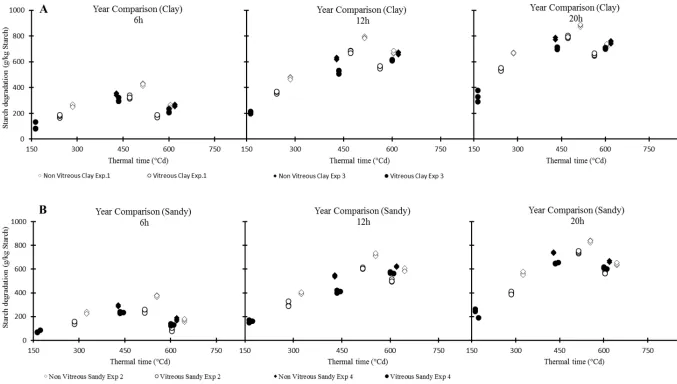
starch in all four experiments. The relationship of ruminal starch degradation of maize genotypes 197
against their starch contents (Figs 2 and 4) showed that the vitreous genotypes gave the lowest 198
contents (Figs 2 and 4), Also Tables 1 and 2 demonstrated that vitreous genotypes showed lower 200
values of starch degradation compared to the non-vitreous genotypes. 201
Thermal times (growing degree days, °Cd) also significantly affected the starch 202
degradation of both genotypes, on both soil types and incubation durations in Exps 1 and 2 (Fig. 203
3) and Exps 3 and 4 (Fig. 5). The highest starch degradation (g/kg starch) was noted at an 204
intermediate thermal time (500-600 °Cd), but the lowest starch degradation was noted at a 205
minimum thermal time of 150 °Cd in all four experiments at all incubation durations, soil types 206
and genotypes (Figs 3 and 5). The year comparison of ruminal degradation of starch of both 207
genotypes against their relative starch content percentages (Fig. 4), and the accumulated thermal 208
time (Fig. 5) showed similar trends for genotypes and soil types. Non-vitreous genotypes on clay 209
soil produced the highest starch degradation at intermediate thermal times, but its degradation 210
decreased during a further increase in thermal time in all experiments. 211
The in vitro ruminal starch degradation was significantly affected by maturity stage. 212
Ruminal degradation of starch declined as the maturation progressed, also at higher contents of 213
starch (Tables 1–2, Figs 2-5). The in vitro ruminal degradation of starch exhibited a linear 214
relationship, up to a certain maturity stage i.e. the starch degradation increased, with increasing 215
starch content. However, a negative effect was observed between rumen starch degradation and 216
starch content after a certain level of maturity, i.e. the rumen starch degradation started to decrease 217
as starch contents further increased. This trend was observed at all three incubation durations 218
during all experiments (Figs 2 and 4). 219
4. Discussion 220
In vitro ruminal degradation of starch in maize kernels (calculated from the gas produced)
221
was significantly affectsed by the starch content of maize kernels and endosperm types (i.e. 222
vitreous-ness) at all the incubation times in all the four experiments. All the variables strongly 223
depended on the type of endosperm in the different maize genotypes, types of soil and maturity 224
stages. Further, a higher starch degradability in rumen fluid can be associated with the starch 225
contents and also type of endosperm within a specific genotype (vitreous or non-vitreous)(Ali et 226
al. 2014; Kotarski et al. 1992; Christelle Philippeau et al. 1998). The types of endosperm (dent and 227
flint) are also genotype-specific. Accumulation of starch in maize kernels also depends upon the 228
the ruminal starch degradation. There was no significant interaction observed among soil type and 230
genotype. 231
Accumulation of starch was significantly influenced by the type of soil. Higher starch 232
contents were observed on clay than on sand in both years.This could be due to the better water 233
holding capacity and availability of water and nutrients for the maize crop (Mitchell et al. 2007; 234
Reddy et al. 2007). Other reason could be that sandy soil is loose and not tightly packed like clay, 235
which negatively influences its fertility due to lesser activities of microbes and higher 236
susceptibility to wind erosion and drought. This makes it less favorable for crop production and 237
consequently negatively influences maize crop growth, resulting in reduced starch accumulation 238
on sandy soil. 239
The results of the present study indicated that with increasing starch contents of the kernels 240
at all incubation times, the calculated ruminal starch degradation has increased to a specific stage 241
of maturity in both genotypes of maize. In the current study the lower ruminal starch degradation 242
in the vitreous maize genotype (Zea mays indurata) could be associated with its endosperm type 243
with higher vitreous-ness (Ali et al. 2014; Christelle Philippeau et al. 1998) than the non-vitreous 244
genotype. This could be because of the dense packing of starch granules in vitreous and also the 245
starch molecules are very close, hence making them less degradable than non-vitreous genotypes. 246
This dense network gets denser with increasing vitreous-ness, which results in less accessibility of 247
the granules to the degrading enzymes(Cui and Oates 1999; Svihus et al. 2005; Vesterinen et al. 248
2002). Moreover, vitreous (horny) maize kernels have a higher proportion of vitreous endosperm 249
(C Philippeau et al. 1999) and show a very low degradability and a slower rate of degradation in 250
the digestive track of ruminants, mainly due to very hard and thick starch content(Fox and Manley 251
2009). In contrast, non-vitreous (floury) maize kernel endosperms have a fast degradation ability 252
in ruminants, due to the loose, soft and less complex structure of the starch particles(T Ettle et al. 253
2001). Actually, the nature of endosperms are genetic characteristics of each cultivar and varies 254
among cultivars(Benefield et al. 2006), and used to determine the digestibility and nutritional 255
values of silage of maize kernels, therefore, different endosperm type maize kernels differ in their 256
energy compositions(Schwarz et al. 1996). So, it can be concluded from the present study that at 257
the same maturity stage, the non-vitreous starch structure results in a higher ruminal starch 258
The starch contents and calculated ruminal starch degradation also depend upon the stage 260
of maturity at which the maize kernels are harvested. The DM concentration of maize kernels 261
strongly depends on plant development and maturation whereas the relative contribution of the 262
various plant fractions to whole plant biomass could be determined by development and 263
maturation(Marton et al. 2007; Phipps and Weller 1979). These plant phenological variations may 264
influence the accumulation of starch and fiber (Jensen et al. 2005), hence influence the ruminal 265
degradation of starch. The maximum value of starch contents was calculated at the latest maturity 266
stage in both years (Hetta et al. 2012), but ruminal starch degradation of maize kernels showed 267
different trends at different maturity stages. Ruminal degradation of starch of the maize kernels in 268
both genotypes sown on clay and sandy soils showed similar trends, i.e. the non-vitreous genotype 269
gave higher values regarding rumen starch degradation than vitreous type of genotype. Ali et al. 270
(2014) concluded that rumen starch degradation of kernels of different maize genotypes has a 271
linear relationship with advancing maturity, up to a specific level, after which it reduces the rumen 272
degradability.The lower ruminal starch degradation, of both genotypes, at later maturity stages 273
could be due to the increased virtuousness of the maize kernels (T Ettle et al. 2001; Pereira et al. 274
2004; Tolera et al. 1998; Tolera and Sundstøl 1999). It suggested that lower the degree of vitreous-275
ness, higher will be the ruminal starch degradation and vice versa. The chemical composition of 276
maize kernels changes up to a certain maturity stage (Struik 1983), like an increased dry matter 277
content and reduced fiber content(L Johnson et al. 1999), which negatively influences the ruminal 278
starch degradation of maize kernels(Ali et al. 2014; T Ettle et al. 2001). It might be the reason of 279
the significant effect of maturity stage on ruminal starch degradation of maize kernels to a specific 280
maturity stage (i.e. at starch contents 451-519g/kg OM). Therefore, harvesting maize crops at a 281
proper maturity stage is vital for a better feeding value of maize kernels. 282
5. Conclusions 283
In vitro starch degradation of maize kernels in rumen fluid is affected by the maize
284
genotypes (type of endosperm; vitreous and non-vitreous), type of soil (clay and sandy) and 285
maturity stage of the plant (in terms of either starch content or thermal time). The vitreous 286
genotypes with hard endosperm showed a lower ruminal starch degradation at all the incubation 287
times (6 h, 12 h and 20 h), as compared to the non-vitreous type of genotypes (soft endosperms). 288
contents and increased degradation at all incubation times in rumen fluid. Crop maturation stage 290
can have both positive and negative effects on the ruminal degradation of starch of maize kernels, 291
depending on its range. This study also clearly showed that too early or too late crop harvesting 292
results in less ruminal degradation of starch, thus a lower nutritional value of kernels. 293
Conflict of interest statement 294
There are no conflicts of interest in this study. 295
Acknowledgements 296
This research was financially supported by the Higher Education Commission of Pakistan through 297
a PhD scholarship to M. Ali, and by the Dutch Dairy Product Board (Zoetermeer, The 298
Netherlands), Blgg AgroeXpertus (Wageningen, The Netherlands) and Wageningen University 299
References 301
Ali, M, et al. (2014), 'Starch degradation in rumen fluid as influenced by genotype, climatic conditions and 302
maturity stage of maize, grown under controlled conditions', Animal Feed Science and Technology, 303
193, 58-70. 304
Benefield, Brandon C, et al. (2006), 'NutriDense corn grain and corn silage for dairy cows', Journal of dairy 305
science, 89 (5), 1571-79.
306
Chai, WZ, Van Gelder, AH, and Cone, JW (2004), 'Relationship between gas production and starch 307
degradation in feed samples', Animal Feed Science and Technology, 114 (1-4), 195-204. 308
Cone, John W, et al. (1996), 'Influence of rumen fluid and substrate concentration on fermentation kinetics 309
measured with a fully automated time related gas production apparatus', Animal Feed Science 310
and Technology, 61 (1-4), 113-28.
311
Cone, JW, et al. (2008), 'Effects of forage maize type and maturity stage on in vitro rumen fermentation 312
characteristics', NJAS wageningen journal of life sciences, 55 (2), 139-54. 313
Cui, R and Oates, CG (1999), '+ The effect of amylose–lipid complex formation on enzyme susceptibility of 314
sago starch', Food Chemistry, 65 (4), 417-25. 315
Ettle, T, et al. (2001), 'Effect of harvest date and variety on ruminal degradability of ensiled maize grains 316
in dairy cows', Archives of Animal Nutrition, 55 (1), 69-84. 317
Ettle, Thomas and Schwarz, Frieder Jörg (2003), 'Effect of maize variety harvested at different maturity 318
stages on feeding value and performance of dairy cows', Animal Research, 52 (4), 337-49. 319
Fox, Glen and Manley, Marena (2009), 'Hardness methods for testing maize kernels', Journal of 320
agricultural and food chemistry, 57 (13), 5647-57.
321
Hetta, M, et al. (2012), 'Effects of hybrid and maturity on performance and nutritive characteristics of 322
forage maize at high latitudes, estimated using the gas production technique', Animal feed science 323
and technology, 171 (1), 20-30.
324
ISO (2002), 'Animal Feeding Stuffs–Determination of Crude Ash', International Organization for 325
Standardization.
326
Jensen, Charlotte, et al. (2005), 'Effect of maize silage maturity on site of starch and NDF digestion in 327
lactating dairy cows', Animal Feed Science and Technology, 118 (3-4), 279-94. 328
Johnson, L, et al. (1999), 'Nutritive value of corn silage as affected by maturity and mechanical processing: 329
A contemporary review', Journal of dairy science, 82 (12), 2813-25. 330
Johnson, LM, et al. (2002), 'Corn silage management I: Effects of hybrid, maturity, and mechanical 331
processing on chemical and physical characteristics', Journal of dairy science, 85 (4), 833-53. 332
Keppler, D and Decker, K (1970), 'Methoden der enzymatischen Analyse', (Verlag Chemie Weinheim). 333
Kotarski, Susan F, Waniska, Ralph D, and Thurn, Kerry K (1992), 'Starch hydrolysis by the ruminal 334
microflora', The Journal of nutrition, 122 (1), 178-90. 335
Marton, C, et al. (2007), 'Comparison of some methods for estimating vegetation periods in maize', Acta 336
Agronomica Hungarica, 55 (1), 1-5.
337
Michalet-Doreau, B and Champion, M (1995), 'Influence of maize genotype on rate of ruminal starch 338
degradation', Annales de zootechnie (44), 191-91. 339
Miles, Albie (2015), 'Teaching Organic Farming & Gardening'. 340
Mitchell, Charles C, Donald, James O, and Martin, John (2007), 'The value and use of poultry waste as 341
fertilizer', Agriculture & Natural Resources Agronomy, Alabama Cooperative Extension Service, 342
Auburn University, Alabama Available online at: http://hubcap. clemson. edu/$ blpprt/Aub-244.
343
html (accessed on May 29, 2008).
344
Pereira, Marcos Neves, et al. (2004), 'Ruminal degradability of hard or soft texture corn grain at three 345
Philippeau, C, Le Deschault de Monredon, F, and Michalet-Doreau, B (1999), 'Relationship between 347
ruminal starch degradation and the physical characteristics of corn grain', Journal of Animal 348
Science, 77 (1), 238-43.
349
Philippeau, Christelle, Landry, Jacques, and Michalet-Doreau, Brigitte (1998), 'Influence of the biochemical 350
and physical characteristics of the maize grain on ruminal starch degradation', Journal of 351
agricultural and food chemistry, 46 (10), 4287-91.
352
Phipps, RH and Weller, RF (1979), 'The development of plant components and their effects on the 353
composition of fresh and ensiled forage maize: 1. The accumulation of dry matter, chemical 354
composition and nutritive value of fresh maize', The Journal of Agricultural Science, 92 (2), 471-355
83. 356
Rebourg, C, et al. (2003), 'Maize introduction into Europe: the history reviewed in the light of molecular 357
data', Theoretical and applied genetics, 106 (5), 895-903. 358
Reddy, KC, et al. (2007), 'Cotton growth and yield response to nitrogen applied through fresh and 359
composted poultry litter', Journal of cotton science. 360
Santacruz, Stalin (2004), Characterisation of starches isolated from Arracacha xanthorriza, Canna edulis 361
and Oxalis tuberosa and extracted from potato leaf (486).
362
Schwab, Eric C, et al. (2003), 'Estimating silage energy value and milk yield to rank corn hybrids', Animal 363
Feed Science and Technology, 109 (1-4), 1-18.
364
Schwarz, FJ, Pex, EJ, and Kirchgessner, M (1996), 'Influence of different maize varieties on digestibility and 365
energy content of maize silage by cattle and sheep', Wirtschaftseigene Futter (Germany). 366
Standardization, International Organization for (2002), Animal Feeding Stuffs: Determination of the 367
Content of Fatty Acids (International Organization for Standardization).
368
Struik, Paul Christiaan (1983), 'Physiology of forage maize (Zea mays L.) in relation to its production and 369
quality', (sn]). 370
Svihus, Birger, Uhlen, Anne Kjersti, and Harstad, Odd Magne (2005), 'Effect of starch granule structure, 371
associated components and processing on nutritive value of cereal starch: A review', Animal Feed 372
Science and Technology, 122 (3-4), 303-20.
373
Tolera, Adugna and Sundstøl, Frik (1999), 'Morphological fractions of maize stover harvested at different 374
stages of grain maturity and nutritive value of different fractions of the stover', Animal Feed 375
Science and Technology, 81 (1-2), 1-16.
376
Tolera, Adugna, Sundstøl, Frik, and Said, Abdullah N (1998), 'The effect of stage of maturity on yield and 377
quality of maize grain and stover', Animal Feed Science and Technology, 75 (2), 157-68. 378
Veiga, Milton da, Reinert, Dalvan José, and Reichert, José Miguel (2009), 'Aggregate stability as affected 379
by short and long-term tillage systems and nutrient sources of a hapludox in southern Brazil', 380
Revista Brasileira de Ciência do Solo, 33 (4), 767-77.
381
Vesterinen, Elina, et al. (2002), 'Structural properties in relation to oral enzymatic digestibility of starch 382
gels based on pure starch components and high amylose content', Food hydrocolloids, 16 (2), 161-383
67. 384
Wilkens, Paul and Singh, Upendra (2003), 'A code-level analysis for temperature effects in the CERES 385
models', Modeling temperature response in wheat and maize, 1. 386
388
vitreous) and types of soil (sandy and clay) when harvested at three maturity stages (starch contents ranging from 185-729 g/kg OM) in Exp. 1 and 2.
(4 weeks after 50% silking) (8 weeks after 50% silking) (12 weeks after 50% silking)
Starch contents (g/kg OM)
Ruminal starch degradation (g/kg starch)
Starch contents (g/Kg OM)
Ruminal starch degradation (g/kg starch)
Starch contents (g/Kg OM)
Ruminal starch degradation (g/kg starch)
(Starch contents 185-309 g/kg OM)
(Starch contents 416-543 g/kg OM)
(Starch contents 587-729 g/kg OM)
6h 12h 20h 6h 12h 20h 6h 12h 20h
Genotype Vitreous 266a 164b 334b 471b 519a 288b 644b 768b 700a 135b 531b 612b
Non-vitreous 218b 246a 435a 618a 451b 401a 756a 860a 611b 215a 634a 687a
P 0.002 0.004 0.001 0.005 0.0002 0.005 0.001 0.0001 0.0002 0.004 0.001 0.003
Soil Clay 267a 220a 418a 606a 501a 377a 735a 838a 677a 220a 617a 693a
Sandy 217b 190b 351b 483b 469b 312b 665b 790b 634b 131b 548b 607b
P 0.002 0.03 0.002 0.007 0.003 0.02 0.003 0.002 0.004 0.003 0.003 0.002
Genotype*Soil 0.78 0.89 0.10 0.21 0.90 0.23 0.64 0.45 1.00 0.99 0.06 0.94
Genotype*Rep 0.22 0.23 0.11 0.80 0.13 0.63 0.21 0.75 0.84 0.19 0.67 0.29
Clay-Sandy1
Clay-Sandy
Clay-Sandy
Clay-Sandy
Clay-Sandy
Clay-Sandy
Clay-Sandy
Clay-Sandy
Clay-Sandy
Clay-Sandy
Clay-Sandy
Clay-Sandy
Vitreous 14 30 59 141 32 79 72 51 42 88 55 87
Non-vitreous 16 30 77 105 33 50 68 46 30 90 83 86
Means followed by different letters are significantly different (P<0.05). OM: Organic matter.
389
vitreous) and types of soil (sandy and clay) when harvested at three maturity stages (starch contents ranging from 71-632 g/kg OM) in Exp. 3 and 4.
(2 weeks after 50% silking) (6 weeks after 50% silking) (10 weeks after 50% silking)
Starch contents (g/kg OM)
Ruminal starch degradation (g/kg starch)
Starch contents (g/Kg OM)
Ruminal starch degradation (g/kg starch)
Starch contents (g/Kg OM)
Ruminal starch degradation (g/kg starch)
(Starch contents 71-107 g/kg OM) (Starch contents 369-471 g/kg
OM)
(Starch contents 530-632 g/kg OM)
6h 12h 20h 6h 12h 20h 6h 12h 20h
Genotype Vitreous 97a 87b 185b 283b 435a 270b 467b 681b 611a 175b 592b 658b
Non-vitreous 84b 129a 347a 418a 398b 323a 585a 764a 558b 221a 646a 709a
P 0.008 0.008 0.0005 0.006 0.002 0.008 0.004 0.001 0.003 0.004 0.004 0.005
Soil Clay 98a 119a 297a 493a 445a 328a 574a 747a 601a 241a 641a 730a
Sandy 83b 96b 236b 299b 389b 265b 478b 697b 568b 156b 596b 637b
P 0.006 0.025 0.003 0.009 0.001 0.006 0.005 0.004 0.008 0.001 0.005 0.002
Genotype*Soil 0.43 0.73 0.07 0.70 0.08 0.33 0.16 0.15 0.16 0.80 0.79 0.49
Genotype*Rep 0.25 0.16 0.21 0.08 0.16 0.57 0.54 0.53 0.30 0.10 0.80 0.53
Clay-Sandy1
Clay-Sandy
Clay-Sandy
Clay-Sandy
Clay-Sandy
Clay-Sandy
Clay-Sandy
Clay-Sandy
Clay-Sandy
Clay-Sandy
Clay-Sandy
Clay-Sandy
Vitreous 14 25 49 100 62 69 112 57 26 84 62 96
Non-vitreous 16 22 74 109 50 57 80 43 46 90 46 90
Means followed by different letters are significantly different (P<0.05). OM: Organic matter.
390
Fig. 1. Relationship between starch content and accumulated growth thermal time during grain filling.
391
Open markers are for clay and closed markers are for sandy soils.
393
Fig. 2. Relationship between rumen starch degradation (g/kg starch) of 6, 12 and 20 h incubated maize kernels against their starch 394
content (g/kg) at two different types of soils; panel A (clay Exp. 1 and sandy Exp. 2) and panel B (clay Exp. 3 and sandy Exp. 4). 395
Open markers are for clay (Exps 1 and 3), and closed markers are for sandy soil (Exps 2 and 4). 396
397
Fig. 3. Relationship between rumen starch degradation (g/kg starch) of 6, 12 and 20 h incubated maize kernels against their relative accumulated 398
thermal time (ºCd) at two different types of soil; panel A (clay Exp. 1 and sandy Exp. 2) and panel B (clay Exp. 3 and sandy Exp. 4). Open 399
401
Fig. 4. Year wise relationship between rumen starch degradation (g/kg starch) of 6, 12 and 20 h incubated maize kernels against their starch 402
contents (g/kg OM) at two different types of soils; panel A (clay Exp. 1 and sandy Exp. 3) and panel B (clay Exp. 2 and sandy Exp. 4). The 403
405
Fig. 5. Year wise relationship between rumen starch degradation (g/kg starch) of 6, 12 and 20 h incubated maize kernels against their relative 406
accumulated thermal time (ºCd) at two different types of soils; panel A (clay Exp. 1 and sandy Exp. 3) and panel B (clay Exp. 2 and sandy Exp. 407