Chart Parsing and Constraint Programming
Frank Morawietz
Seminar f¨ur Sprachwissenschaft
Universit¨at T¨ubingen
Wilhelmstr. 113
72074 T¨ubingen, Germany
[email protected]
Abstract
In this paper, parsing-as-deduction and constraint pro-gramming are brought together to outline a procedure for the specification of constraint-based chart parsers. Fol-lowing the proposal in Shieber et al. (1995), we show how to directly realize the inference rules for deductive parsers as Constraint Handling Rules (Fr¨uhwirth, 1998) by viewing the items of a chart parser as constraints and the constraint base as a chart. This allows the direct use of constraint resolution to parse sentences.
1
Introduction
The parsing-as-deduction approach proposed in Pereira and Warren (1983) and extended in Shieber et al. (1995) and the parsing schemata defined in Sikkel (1997) are well established parsing paradigms in computational lin-guistics. Their main strengths are their flexibility and the level of abstraction concerning control information inherent in parsing algorithms. Furthermore, they are easily extensible to more complex formalisms, e.g., aug-mented phrase structure rules or the ID/LP format.
Constraint Programming (CP) has been used in com-putational linguistics in several areas, for example in (typed) feature-based systems (Smolka, 1995), or condi-tional constraints (Matiasek, 1994), or advanced compi-lation techniques (G¨otz and Meurers, 1997) or special-ized constraint solvers (Manandhar, 1994). But none of these approaches uses constraint programming tech-niques to implement standard chart parsing algorithms directly in a constraint system.
In this paper, I will bring these two paradigms to-gether by showing how to implement algorithms from the parsing-as-deduction scheme by viewing the parsing process as constraint propagation.
The core idea is that the items of a conventional chart parser are constraints on labeled links between the words and positions of an input string. Then the inference rules allow for the deduction of new constraints, again labeled and spanning parts of the input string, via constraint propagation. The resulting constraint store represents the chart which can be accessed to determine whether the parse was successful or to reconstruct a parse tree.
While this may seem a trivial observation, it is not just another way of implementing deductive parsing in
yet another language. The approach allows for a rapid and very flexible but at the same time uniform method of implementation of all kinds of parsing algorithms (for constraint-based theories). The goal is not necessarily to build the fastest parser, but rather to build – for an ar-bitrary algorithm – a parser fast and perspicuously. For example, the advantage of our approach compared to the one proposed in Shieber et al. (1995) is that we do not have to design a special deduction engine and we do not have to handle chart and agenda explicitly. Furthermore, the process can be used in any constraint-based formal-ism which allows for constraint propagation and there-fore can be easily integrated into existing applications.
The paper proceeds by reviewing the parsing-as-deduction approach and a particular way of imple-menting constraint systems, Constraint Handling Rules (CHR) as presented in Fr¨uhwirth (1998). Then it shows how to implement several parsing algorithms very natu-rally with constraint propagation rules before concluding with an outlook on how to extend the technique to more advanced applications.
1.1 Parsing as Deduction
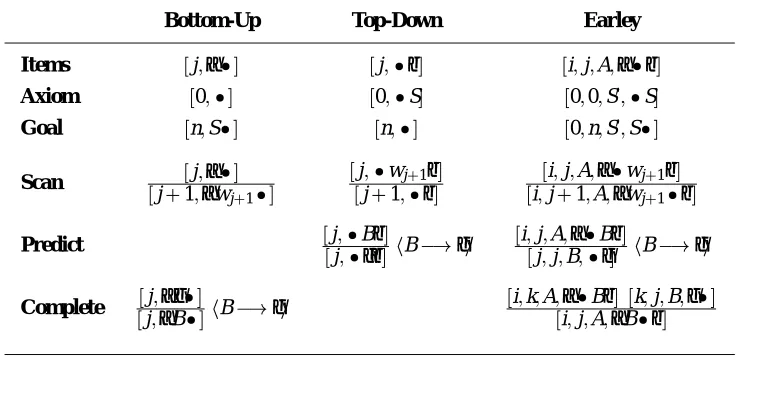
Although I assume some familiarity with parsing-as-deduction, I will recall some basic definitions for con-venience. The notations and the three basic algorithms are directly taken from Shieber et al. (1995).
As usual, strings w result from concatenation of sym-bols from some alphabet setΣ, i.e., w2Σ
. We refer to the decomposition of such a string into its alphabet symbols with indices. We fix this notation using w=
w1:::wn. Further notational conventions are: i;j2N, n for the length of the string to be parsed, A;B;C;::: for arbitrary formulas or nonterminals, a;b;c;::: for termi-nals,εfor the empty string andα;β;γ;::: for strings of terminals and nonterminals. Formulas used in parsing will also be called items or edges. A grammatical
deduc-tion system or, in Sikkel’s terminology a parsing schema,
is defined as a set of deduction schemes and a set of ax-ioms. These are given with the help of formula schemata which contain (syntactic) meta-variables which are in-stantiated with concrete terms on application of the rules. A deduction scheme R has the general form
A1:::An
Table 1: Parsing algorithms as Grammatical Deduction Systems
where the Ai and C are formula schemata. The Ai are
called antecedents and C the consequence. Note that de-duction schemes may refer to string positions, i.e., the indices within the input string, in their side conditions. Application of these schemata and derivations of formu-las are then defined as in the Shieber et al. article. In-tuitively, parsing uses the deductive rules – if their an-tecedents and the side conditions are met – to infer new items from the axioms and already generated items until no new ones can be derived. The parse was successful if a goal item was derived.
Therefore, all the parsing systems used in this paper are defined by specifying a class of items, a set of ax-ioms, a set of inference rules and a subset of the items, the goals. For better readability, I follow Shieber et al. in using the familiar dotted items for the presentation. The three classical example algorithms we will use to illus-trate our technique are given in Tab. 1. I assume famil-iarity with these algorithms.
Unless specified differently, we assume that we are given a context-free grammar
G
=hN;Σ;S;Piwith non-terminals N, non-terminalsΣ, start symbol S and set of pro-ductions P. For Earley’s algorithm we also assume a new start symbol S0which is not in N. Each production is of the form A !αwith A2N;α2(N[Σ)
. For examples I will use the simple PP-attachment grammar
G
given in Fig. 1 with the obvious sets of nonterminals and termi-nals, the start symbol S and productions P. It is left to the reader to calculate example derivations for the three algorithms for a sentence such as John hit the dog withthe stick.
1.2 Constraint Handling Rules
There are several constraint programming environments available. The most recent and maybe the most flexible is the Constraint Handling Rules (CHR) package included in SICStus Prolog (Fr¨uhwirth, 1998). These systems
S ! NP VP Figure 1: Example Grammar: PP-attachment maintain a constraint base or store which is continually monitored for possible rule applications, i.e., whether there is enough information present to successfully use a rule to simplify constraints or to derive new constraints. Whereas usually one deals with a fixed constraint domain and a specialized solver, CHR is an extension of the Pro-log language which allows for the specification of user-defined constraints and arbitrary solvers. The strength of the CHR approach lies in the fact that it allows for mul-tiple (conjunctively interpreted) heads in rules, that it is flexible and that it is tightly and transparently integrated into the Prolog engine.
In CHR constraints are just distinguished sets of (atomic) formulas. CHR allow the definition of rule sets for constraint solving with three types of rules: Firstly simplification rules (<=>) which replace a number of constraints in the store with new constraints; secondly propagation rules (==>) which add new constraints to the store in case a number of constraints is already present; and thirdly “simpagation” rules (<=>in com-bination with a nin the head of the rule) which replace only those constraints with new ones which are to the right of the backslash. Rules can have guards. A guard (separated from the rest of the body by aj) is a condition which has to be met before the rule can be applied.
note that logically, simplification rules are equivalences and propagation rules are implications if their guard is satisfied. Simpagation rules are special cases of simpli-fication rules. Soundness and completeness results for CHR are available (Abdennadher et al., 1996 Abdennad-her, 1998).
2
Parsing as Constraint Propagation
The basic observation which turns parsing-as-deduction into constraint propagation is simple: items of a chart parser are just special formulas which are used in an in-ference process. Since constraints in constraint program-ming are nothing but atomic formulas and constraint han-dling rules nothing but inference rules, the connection is immediate.In more detail, I will present in this section how to implement the three parsing algorithms given in Tab. 1 in CHR and discuss the advantages and drawbacks of this approach. Since CHR are integrated in SICStus Prolog, I will present constraints and rules in Prolog notation.
We use the following two types of constraints. The constraints corresponding to the items will be called
edge constraints. They have two arguments in case of the two naive algorithms and five in the case of Ear-ley’s algorithm, i.e.,edge(X,N)means in the case of the bottom-up algorithm that we have recognized a list of categoriesXup to positionN, in the case of the top-down algorithm that we are looking for a list of categories X
starting at position Nand in the case of Earley’s algo-rithmedge(A,Alpha,Beta,I,J) means that we found a substring fromItoJby recognizing the list of cate-goriesAlpha, but we are still looking for a list of cate-goriesBeta to yield categoryA. The second constraint,
word(Pos,Cat-Word), is used in the scanning steps.
It avoids using lexical entries in prediction/completion since in grammar rules we do not use words but their
categories.
For simplicity, a grammar is given as Prolog facts: lex-ical items aslex(Word,Category) and grammar rules
asrule(RHS,LHS)whereRHSis a list of categories
rep-resenting the right hand side andLHSis a single category representing the left hand side of the rule.
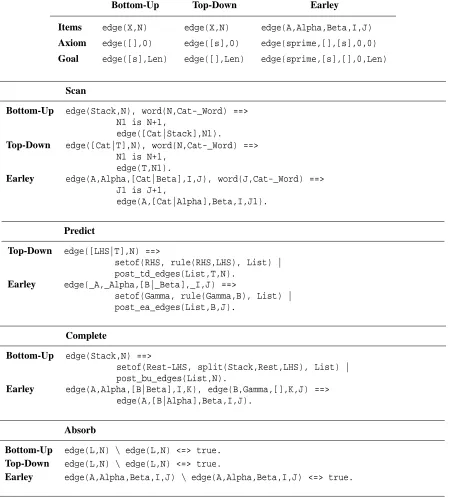
The algorithms are simple to implement by specify-ing the inference rules as constraint propagation rules, the axioms and the goal items as constraints. The infer-ence rules are translated into CHR in the following way: The antecedents are transformed into constraints appear-ing in the head of the propagation rules, the side condi-tions into the guard and the consequence is posted in the body. A summarization of the resulting CHR programs is presented in Tab. 2.
We use Earley’s algorithm for a closer look at the CHR propagation rules. In the scanning step, we can move the head of the list of categories we are looking for to those we already recognized in case we have an appro-priately matching edge and word constraint in our con-straint store. The result is posted as a new edge concon-straint
parse(InList):-axiom,
post_const(InList, 0, Length), report(Length).
post_const([], Len, Len).
post_const([Word|Str], InLen, Len):-findall(Cat, lex(Word,Cat), Cats), post_words(Cats, InLen, Word), NewLen is InLen + 1,
post_const(Str, NewLen, Len).
Figure 2: Utilities for CHR-based deductive parsing
with the positional index appropriately incremented. The prediction step is more complex. There is only one head in a rule, namely an edge which is still looking for some category to be found. If one can find rules with a matching LHS, we collect all of them in a list and post the appropriate fresh edge constraints for each element of that list with the predicatepost ea edges/3which posts edges of the following kind: edge(LHS,[],RHS,J,J). The collection of all matching rules in a call tosetof/3
is necessary since CHR are a committed choice lan-guage. One cannot enumerate all solutions via back-tracking. If there are no matching rules, i.e., the list of RHSs we found is empty, the call to setof in the guard will fail and therefore avoid vacuous predictions and nontermination of the predictor.
Lastly, the completion step is a pure propagation rule which translates literally. The two antecedents are in the head and the consequence in the body with appro-priate instantiations of the positional variables and with the movement of the category recognized by the passive edge from the categories to be found to those found.
In the table there is one more type of rule, called an absorption rule. It discovers those cases where we posted an edge constraint which is already present in the chart and simply absorbs the newly created one.
Note that we do not have to specify how to insert edges into either chart or agenda. The chart and the agenda are represented by the constraint store and therefore built-in. Neither do we need a specialized deduction engine as was necessary for the implementation described in Shieber et al. In fact, the utilities needed are extremely simple, see Fig. 2.
All we have to do for parsing (parse/1) is to post the axiom1 and on traversal of the input string to post the
word constraints according to the lexicon of the given grammar. Then the constraint resolution process with the inference rules will automatically build a complete chart. The call toreport/1will just determine whether there is an appropriate edge with the correct length in the chart and print that information to the screen.
Coming back to the issues of chart and agenda: the constraint store functions as chart and agenda at the same
Table 2: Parsing systems as CHR programs
Bottom-Up Top-Down Earley
Items edge(X,N) edge(X,N) edge(A,Alpha,Beta,I,J)
Axiom edge([],0) edge([s],0) edge(sprime,[],[s],0,0)
Goal edge([s],Len) edge([],Len) edge(sprime,[s],[],0,Len)
Scan
Bottom-Up edge(Stack,N), word(N,Cat-_Word) ==> N1 is N+1,
edge([Cat|Stack],N1).
Top-Down edge([Cat|T],N), word(N,Cat-_Word) ==> N1 is N+1,
edge(T,N1).
Earley edge(A,Alpha,[Cat|Beta],I,J), word(J,Cat-_Word) ==> J1 is J+1,
edge(A,[Cat|Alpha],Beta,I,J1).
Predict
Top-Down edge([LHS|T],N) ==>
setof(RHS, rule(RHS,LHS), List) | post_td_edges(List,T,N).
Earley edge(_A,_Alpha,[B|_Beta],_I,J) ==>
setof(Gamma, rule(Gamma,B), List) | post_ea_edges(List,B,J).
Complete
Bottom-Up edge(Stack,N) ==>
setof(Rest-LHS, split(Stack,Rest,LHS), List) | post_bu_edges(List,N).
Earley edge(A,Alpha,[B|Beta],I,K), edge(B,Gamma,[],K,J) ==> edge(A,[B|Alpha],Beta,I,J).
Absorb
Bottom-Up edge(L,N) \ edge(L,N) <=> true.
Top-Down edge(L,N) \ edge(L,N) <=> true.
Earley edge(A,Alpha,Beta,I,J) \ edge(A,Alpha,Beta,I,J) <=> true.
time since as soon as a constraint is added all rules are tried for applicability. If none apply, the edge will remain dormant until another constraint is added which triggers a rule together with it.2 So, the parser works incremen-tally by recursively trying all possible inferences for each
2Another way to “wake” a constraint is to instantiate any of its
vari-ables in which case it will be matched against the rules again. Since all our constraints are ground, this does not play a role here.
constraint added to the store before continuing with the posting of new constraints from thepost const/3 pred-icate. The way this predicate works is to traverse the string from left-to-right. It is trivial to alter the predicate to post the constraints from right-to-left or any arbitrary order chosen. This can be used to easily test different parsing strategies.
| ?- parse([john, hit, the, dog, with, the, stick]).
Input recognized.
word(0,pn-john), word(1,v-hit), word(2,det-the), word(3,n-dog), word(4,p-with), word(5,det-the), word(6,n-stick),
edge(sprime,[],[s],0,0), edge(s,[],[np,vp],0,0), edge(np,[],[det,nbar],0,0), edge(np,[],[pn],0,0), edge(np,[pn],[],0,1), edge(s,[np],[vp],0,1), edge(vp,[],[v,np],1,1), edge(vp,[],[v,np,pp],1,1), ...
edge(s,[vp,np],[],0,7), edge(sprime,[s],[],0,7)
Figure 3: A partial CHR generated chart
connection with the absorption rules. We absorb the newer edge since we can assume that all possible propa-gations have been done with the old identical edge con-straint so that we can safely throw the other one away.
As an example for the resulting chart, part of the out-put of an Earley-parse for John hit the dog with the stick assuming the grammar from Fig. 1 is presented in Fig. 3. The entire constraint store is printed to the screen after the constraint resolution process stops. The order of the constraints actually reflects the order of the construction of the edges, i.e., the chart constitutes a trace of the parse at the same time. Although the given string was ambigu-ous, only a single solution is visible in the chart. This is due to the fact that we only did recognition. No explicit parse was built which could have differentiated between the two solutions. It is an easy exercise to either write a predicate to extract all possible parses from the chart or to alter the edges in such a way that an explicit parse tree is built during parsing.
By using a built-in deduction engine, one gives up con-trol of its efficiency. As it turns out, this CHR-based ap-proach is slower than the specialized engine developed and provided by Shieber et al. by about a factor of 2, e.g., for a six word sentence and a simple grammar the pars-ing time increased from 0.01 seconds to 0.02 seconds on a LINUX PC (Dual Pentium II with 400MHz) running SICStus Prolog. This factor was preserved under 5 and 500 repetitions of the same parse. However, speed was not the main issue in developing this setup, but rather simplicity and ease of implementation.
To sum up this section, the advantages of the approach
lie in its flexibility and its availability for rapid prototyp-ing of different parsprototyp-ing algorithms. While we used the basic examples from the Shieber et al. article, one can also implement all the different deduction schemes from Sikkel (1997). This also includes advanced algorithms such as left-corner or head-corner parsing, the refined Earley-algorithm proposed by Graham et al. (1980), or (unification-based) ID/LP parsing as defined in Moraw-ietz (1995), or any improved version of any of these. Furthermore, because of the logical semantics of CHR with their soundness and completeness, all correctness and soundness proofs for the algorithms can be directly applied to this constraint propagation proposal. The main disadvantage of the proposed approach certainly lies in its apparent lack of efficiency. One way to address this problem is discussed in the next section.
3
Extensions of the Basic Technique
There are two directions the extensions of the presented technique of CHR parsing might take. Firstly, one might consider parsing of more complicated grammars com-pared to the CF ones which were assumed so far. Fol-lowing Shieber et al., one can consider unification-based grammars or tree adjoining grammars. Since I think that the previous sections showed that the Shieber et al. ap-proach is transferable in general, the results they present are applicable here as well.3 Instead, I want to consider parsing of minimalist grammars (Chomsky, 1995) as de-fined in recent work by Stabler (1997, 1999).4
3.1 Minimalist Parsing
We cannot cover the theory behind derivational minimal-ism as presented in Stabler’s papers in any detail. Very briefly, lexical items are combined with each other by a binary operation merge which is triggered by the avail-ability of an appropriate pair of clashing features, here noted ascat(C)for Stabler’s categoriescandcomp(C)
for=c. Furthermore, there is a unary operation move which, again on the availability of a pair of clashing fea-tures (e.g., -case, +case), triggers the extraction of a (possibly trivial) subtree and its merging in at the root node. On completion of these operations the clashing feature pairs are removed. The lexical items are of the form of linked sequences of trees. Accessibility of fea-tures is defined via a given order on the nodes in this chain of trees. A parse is acceptable if all features have been checked, apart from one category feature which spans the length of the string. The actual algorithm works naively bottom-up and, since the operations are at most binary, the algorithm is CYK-based.
3Obviously, using unification will introduce additional complexity,
but no change of the basic method is required. If the unification can be reduced to Prolog unification, it can stay in the head of the rule(s). If it needs dedicated unification algorithms, they have to be called explicitly in the guard.
4The code for the original implementation underlying the paper was
Table 3: Part of a CHR-based minimalist parser
Items edge(I, J, Chain, Chains)
Axiom edge(I, I, Chain, Chains) h[Chain|Chains] !εi,Ia variable
edge(I, I+1, Chain, Chains) h[Chain|Chains] !wi
+1 i
and there is no-Xin[Chain|Chains]
edge(J, J, Chain, Chains) h[Chain|Chains] !wi
+1
i,Ja variable and-X,IandI+1occur in[Chain|Chains]
Goal edge(0, Length, [cat(C)], [])
Merge edge(I,J,[comp(X)|RestHead],Ch0), edge(K,L,[cat(X)|RestComp],Ch1) ==> check(RestHead,NewHead,I,J,K,L,A,B,RestComp,Ch0,Ch1,Ch) |
edge(A,B,NewHead,Ch).
An initial edge or axiom in this minimalist parsing sys-tem cannot simply be assumed to cover only the part of the string where it was found since it could have been the result of a move. So the elements of the lexicon which will have to be moved (they contain a movement trig-ger-X) actually have the positional indices instantiated in the last of those features appearing. All other move-ment triggers and the position it will be base generated are assumed to be traces and therefore empty. Their po-sitional markers are identical variables, i.e., they span no portion of the string and one does not know their value at the moment of the construction of the axioms. They have to be instantiated during the minimalist parse.
Consider the set of items as defined by the axioms, see Tab. 3. The general form of the items is such that we have the indices first, then we separate the chain of trees into the first one and the remaining ones for better access. As an example for the actual edges and to illustrate the discussion about the possibly variable string positions in the edges, consider the lexical item it (as in believe it):
lex(it,I,[(K,K)=[cat(d),-case(I,J)]]):-J is I+1.
Since I=1 in the example the following edge results
edge(K, K, [cat(d),-case(1,2)]], []):We know
that it has been moved to cover positions1to2, but we do not know (yet) where it was base generated.
We cannot go into any further detail how the actual parser works. Nevertheless, the propagation rule for merging complementizers shown in Tab. 3 demonstrates how easily one can implement parsers for more advanced types of grammars.5
5The predicatecheckimplements the checking of the features and
indices and recomputes the new values for the resulting edge.
3.2 Compiling the Grammar Rules into the Inference Rules
A proposal for improving the approach consists in mov-ing the test for rule applicability from the guards into the heads of the CHR rules. One can translate a given context-free grammar under a given set of inference rules into a CHR program which contains constraint propaga-tion rules for each grammar rule, thereby making the pro-cessing more efficient. For simplicity, we discuss only the case of bottom-up parsing.
For the translation from a CF grammar into a con-straint framework we have to distinguish two types of rules: those with from those without an empty RHS. We treat the trivial case of the conversion first. For each rule in the CF grammar with a non-empty RHS we create a constraint propagation rule such that each daughter of the rule introduces an edge constraint in the head of the propagation rule with variable, but appropriately match-ing strmatch-ing positions and a fixed label. The new, propa-gated edge constraint spans the entire range of the posi-tions of the daughters and is labeled with the (nontermi-nal) symbol of the LHS of the CF rule. In our example, the resulting propagation rule for S looks as follows:
edge(I,K,np), edge(K,J,vp) ==> edge(I,J,s)
The translation is a little bit more complicated for rules with empty RHSs. Basically, we create a propagation rule for each empty rule, e.g.,A !ε, such that the head is an arbitrary edge, i.e., both positions and the label are arbitrary variables, and post new edge constraints with the LHS of the CF rule as label, using the positional vari-ables and spanning no portion of the string, resulting in CHR rules of the following type:
edge(I,J, Sym) ==> J is I+1 |
But obviously rules of this type lead to nontermination since they would propagate further constraints on their own output which is avoided by including a guard which ensures that empty edges are only propagated for every possible string position once by testing whether the edge spans a string of length one. Recall that storing and us-ing already existus-ing edge constraints is avoided with an absorption rule. Since these empty constraints can be reused an arbitrary number of times, we get the desired effect without having to fear nontermination. Although this is not an elegant solution, it seems that other alterna-tives such as analyzing and transforming the entire gram-mar or posting the empty constraints while traversing the input string are not appealing either since they give up the one-to-one correspondence between the rules of the CF grammar and the constraint program which is advan-tageous in debugging.
With this technique, the parsing times achieved were better by a factor of a third compared to the Shieber et al. implementation. Although now the process of the com-pilation obscures the direct connection between parsing-as-deduction and constraint propagation somewhat, the increase in speed makes it a worthwhile exercise.
4
Conclusion
In the paper, the similarity between parsing-as-deduction and constraint propagation is used to propose a flexible and simple system which is easy to implement and there-fore offers itself as a testbed for different parsing strate-gies (such as top-down or bottom-up), for varying modes of processing (such as left-to-right or right-to-left) or for different types of grammars (such as for example min-imalist grammars). Compared to the Shieber approach, the pure version seems to be lacking in efficiency. This can be remedied by providing an automatic compilation into more efficient specialized parsers.
While the paper has shown that existing constraint systems are powerful enough to allow chart parsing, more work has to be invested in the realization of such a larger system combining these techniques with con-straint solvers for existing concon-straint-based natural lan-guage theories to see whether further benefits can be got-ten from using parsing as constraint propagation. Due to the flexibility of the CHR system, one can now use the constraint propagation approach to drive other constraint solving or constraint resolution techniques (also imple-mented in CHR) resulting in a homogenous environment which combines both classical constraint solving with a more operational generator.
Specifically, one can use each created edge to post other constraints, for example about the well-formedness of associated typed feature structures. By posting them, they become available for other constraint handling rules. In particular, systems directly implementing HPSG seem to suffer from the problem how to drive the constraint resolution process efficiently. Some systems, as for ex-ample ALE (Carpenter and Penn, 1998) use a phrase
structure backbone to drive the process. The proposal here would allow to use the ID/LP schemata directly as constraints, but nevertheless as the driving force behind the other constraint satisfaction techniques. However, for the moment this remains speculative.
References
Abdennadher, S. (1998). Analyse von regelbasierten Constraintl¨osern, PhD thesis,
Ludwig-Maximilians-Universit¨at M¨unchen.
Abdennadher, S., Fr ¨uhwirth, T. and Meuss, H. (1996). On confluence of constraint handling rules, LNCS
1118, Springer.
Carpenter, B. and Penn, G. (1998). ALE: The attribute logic engine, version 3.1, User manual, Carnegie Mel-lon University, Pittsburgh.
Chomsky, N. (1995). The Minimalist Program, Vol. 28 of Current Studies in Linguistics, MIT Press.
Fr¨uhwirth, T. (1998). Theory and practice of constraint handling rules, Journal of Logic Programming 37. G¨otz, T. and Meurers, D. (1997). Interleaving universal
principles and relational constraints over typed feature logic, ACL/EACL Conference ’97, Madrid, Spain. Graham, G., Harrison, M. G. and Ruzzo, W. L. (1980).
An improved context–free recognizer, ACM
Transac-tions on Programming Languages and Systems 2 (3).
Manandhar, S. (1994). An attributive logic of set descrip-tions and set operadescrip-tions, ACL Conference ’94. Matiasek, J. (1994). Principle-Based Processing of
Nat-ural Language Using CLP Techniques, PhD thesis, TU
Wien.
Morawietz, F. (1995). A Unification-Based ID/LP Pars-ing Schema, ProceedPars-ings of the 4th IWPT, Prag. Pereira, F. C. N. and Warren, D. H. D. (1983). Parsing as
deduction, ACL Conference ’83.
Shieber, S. M., Schabes, Y. and Pereira, F. C. N. (1995). Principles and implementation of deductive parsing,
Journal of Logic Programming 24(1–2).
Sikkel, K. (1997). Parsing Schemata: A Framework for Specification and Analysis of Parsing Algorithms,
ETACS Series, Springer.
Smolka, G. (1995). The Oz programming model, in J. van Leeuwen (ed.), Computer Science Today, LNCS
1000, Springer.
Stabler, E. (1997). Derivational minimalism, in C. Retor´e (ed.), Logical Aspects of Computational Linguistics,
LNAI 1328, Springer.
Stabler, E. (2000). Minimalist grammars and recogni-tion, Presented at the Workshop Linguistic Form and
its Computation of the SFB 340 in Bad Teinach,