R E S E A R C H
Open Access
A novel fixed-point algorithm for constrained
independent component analysis
Guobing Qian
1,2, Lidan Wang
1*, Shiyuan Wang
1and Shukai Duan
1Abstract
Constrained independent component analysis (ICA) is an effective method for solving the blind source separation witha priorknowledge. However, most constrained ICA algorithms are proposed for the real-valued sources. In this paper, a novel constrained noncircular complex fast independent component analysis (c-ncFastICA) algorithm based on the fixed-point learning is proposed to address the complex-valued sources. The c-ncFastICA algorithm uses the augmented Lagrangian method to obtain a new cost function and then utilizes the quasi-Newton method to search its optimal solution. Compared with other ICA and constrained ICA algorithms, c-ncFastICA has better separation performance. Simulations confirm the effectiveness and superiority of the c-ncFastICA algorithm.
Keywords:Constrained ICA, Noncircular, Complex, Fixed-point
1 Introduction
Independent component analysis (ICA) [1–3] is very ef-fective in separating the linear mixture of independent sources. It has been widely used in many scenarios, such as in array signal processing [4], speech signal processing [5], and multivariate probability density function estima-tion [6]. During the past decades, a lot of ICA algorithms have been proposed for the separation of real-valued and complex-valued signals. These algorithms can be divided into the algebraic theory-based ones [7, 8], the
informa-tion criterion-based ones [9–12], and the iterative
projection-based ones [13, 14]. For example, Joint Ap-proximate Diagonalization of Eigenmatrices (JADE) [7] and alternating columns-diagonal centers (AC-DC) [8] are algebraic theory-based algorithms; FastICA [9], complex FastICA (cFastICA) [10], and noncircular complex FastICA (ncFastICA) [11] are information criterion-based algorithms; and auxiliary function-based ICA [13] is the it-erative projection-based algorithm. In addition,
independ-ent vector analysis (IVA) [15, 16] and independent
low-rank matrix analysis (ILRMA) [17] are the extensions of ICA to multidimensional cases. In many practical appli-cations, such as wind measurements and digital commu-nication, the sources are noncircular complex-valued [18,
19]. Thus, it is necessary to develop an efficient noncircu-lar complex ICA algorithm. Among the aforementioned ICA algorithms, one of the most effective and commonly used algorithms for noncircular complex sources is the ncFastICA algorithm [11]. It incorporates the noncircular information of the original sources into the fixed-point it-eration and provides better separation performance under the case of noncircular sources. However, ncFastICA only exploits the independence and noncircular property of the original sources. It does not utilize the prior knowledge to improve the separation performance.
To overcome the defect of the ICA, constrained ICA has been proposed in [20–22]. It combines the prior infor-mation and the statistical independence of the signals and thus achieves better separation performance than ICA. The constrained ICA algorithms are mainly derived from information criterion, e.g., kurtosis-based constrained ICA algorithm [23], and maximum likelihood (ML)-based con-strained ICA algorithm [24]. [23] shows better perform-ance in extracting the sources of the mechanical system. [24] extends the solution space and thus has better per-formance than other constrained algorithms. However, both algorithms need to choose the threshold parameter. To overcome this defect, Shi et al. proposed a new
con-strained ICA algorithm based on multi-objective
optimization recently [25]. The fixed-point learning is de-rived based on Kuhn-Tucker conditions, and it does not need to choose the threshold parameter. However, these
© The Author(s). 2019Open AccessThis article is distributed under the terms of the Creative Commons Attribution 4.0 International License (http://creativecommons.org/licenses/by/4.0/), which permits unrestricted use, distribution, and reproduction in any medium, provided you give appropriate credit to the original author(s) and the source, provide a link to the Creative Commons license, and indicate if changes were made.
* Correspondence:[email protected]
1Chongqing Key Laboratory of Nonlinear Circuits and Intelligent Information
Processing, College of Electronic and Information Engineering, Southwest University, Chongqing 400715, China
algorithms are suitable only for the real-valued signals, which severely limit their applications. To extend the ap-plication of constrained ICA to complex sources, Wang et al. [26] proposed a class of complex constrained ICA algo-rithms based on gradient descent method, in which circular complex signals are considered. However, the aforementioned constrained ICA algorithms are not suit-able for the general complex-valued signals.
In this paper, to improve the generality ability of the
constrained complex ICA, we propose a newconstrained
noncircular complex fast independent component analysis (c-ncFastICA) algorithm. In c-ncFastICA, a new cost func-tion is built using the augmented Lagrangian method. The prior information is then combined into the fixed-point it-eration based on a quasi-Newton method. Stability ana-lysis shows that the optimal solution corresponds to the fixed point of c-ncFastICA.
The rest of this paper is organized as follows: Section2
presents the system model, and Section 3 derives the
c-ncFastICA algorithm and gives the stability analysis. The superiority of the c-ncFastICA algorithm is verified by simulations in Sections4, and the conclusion is drawn in Section5.
2 System model
In this section, the complex ICA model and its con-strained model are introduced respectively.
2.1 Complex ICA model
The basic complex ICA model is [10].
z¼As ð1Þ
where z= [z1 ⋯ zM]T∈ℂM× 1 and s¼½s1 ⋯ sNT∈ ℂN1 denote M observation signals and N original
sources, respectively; A∈ℂM×N is the mixing matrix; and notationℂdenotes the complex domain.
It is noted that the sources and mixing matrix are complex-valued in complex ICA model, which is the main difference between the complex ICA model and real ICA model. In general, it assumes that the original sources are zero mean and unit variance. In addition,Ais of full-column rank, and at most one original source is Gaussian [27]. The purpose of complex ICA is to find a complex-valued demixing matrix w for z to recover the original signal, with^s¼wHzdenoting the recovered signal.
2.2 Constrained complex ICA model
The constrained complex ICA model is described by the complex ICA model with following constraints
hnðwn;rnÞ ¼ρn−εðwn;rnÞ≤0
and fnð Þ ¼wn 0 ð2Þ
where hn and fn are the inequality constriction and the
equality constriction, respectively;εandρnare the meas-urement function and the threshold for the inequality constriction; wn is the nth column of the demixing
matrixw;rnis a reference vector forwn.
Typically,εis a distance measurement and can be de-scribed by an inner product in practice [24]. Thus, it is chosen asεðwn;rnÞ ¼ jwHnrnj
2
in this paper.
3 Constrained ncFastICA algorithm
In this section, we incorporate the constraints into the ori-ginal ncFastICA algorithm and thus obtain a new algo-rithm, namely constrained noncircular complex FastICA (c-ncFastICA) algorithm. The stability analysis shows that the optimal solution corresponds to the fixed point of the new algorithm.
3.1 Whitening
Whitening is necessary for the c-ncFastICA algorithm,
which is to make the observation data z uncorrelated
and unit variance. It is implemented by the transform
x¼Vz; with V¼Λ−1=2UH ð3Þ
where V is the whitening matrix; x is the whitened data;Λis a diagonal matrix, withNlargest eigenvalues of R=E(z zH) as its entries; Uis a matrix consisting of the corresponding eigenvectors; andNis the source number.
After whitening, the demixing matrixwfor x is a uni-tary matrix and the recovered signal can be represented by ^s¼wHx. The relationship between wand w is wH
¼wHV.
3.2 Cost function
As shown in [11], the cost function of original ncFas-tICA algorithm is
Jð Þ¼wn E G wHnx
2
n o
ð4Þ
where G:ℝ+∪{0}→ ℝ is a smooth function, ℝ and ℝ+ correspond to the real domain and positive real domain, respectively; wn∈ℂN is the nth column of the demixing matrixw, with‖w‖2= 1.
In practice, there are three choices forG[11]:G1(u) =
log(0.1 +u), G2ðuÞ ¼
ffiffiffiffiffiffiffiffiffiffiffiffiffiffiffi
0:1þu p
, G3ðuÞ ¼12u2. G1andG2
provide more robust estimators, and G3is motivated by
kurtosis. By using the augmented Lagrangian method [24], the inequality constraint in (2) can be incorporated into the cost function.
Then, the new cost function can be derived as
Jcðwn;μnÞ¼E G wHnx
2
n o
þ 1
2γn max 0;γnhnðwn;rnÞ þμn
2
−μ2
n
whereμnand γnare the Lagrangian multiplier and positive learning parameter, respectively, with ‖wn‖2= 1. Thus, the equality constriction is expressed asfnðwnÞ ¼wnwHn−1¼0.
3.3 Fixed-point iteration
By using the quasi-Newton methods, we derive the one unit iteration of c-ncFastICA as
μn←max γnhnðwn;rnÞ þμn;0
and second-order derivative of G(u); m represents the number of iteration. The detailed derivation can be seen in Appendix A.
The one unit iteration can be extended to the whole
demixing matrix w by the symmetric way or the
defla-tion way [10]. In the symmetric way,wis orthogonalized by w←(wwH)1/2w. In the deflation way, w is orthogo-nalized by a Gram-Schmidt-like method. In this paper, we use the symmetric scheme.
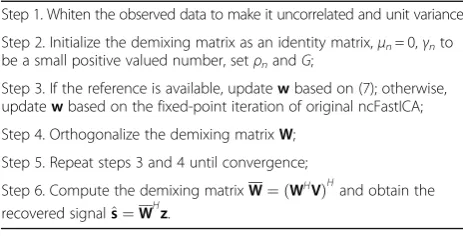
In short, the c-ncFastICA algorithm is summarized in Table1.
3.4 Stability analysis
In this subsection, we present the stability analysis of the fixed-point iteration. We show that the optimal solution to the c-ncFastICA algorithm corresponds to the fixed point of the (7). The detailed proof is shown as follows:
Proof By making the orthogonal transformation qn = (VA)Hwn, the fixed-point iteration for the constraint optimization problem (5) becomes
qðmþ1Þ
As we know, the optimal solution qn of c-ncFastICA
algorithm satisfies the conditions that only thenth elem-ent is non-zero and‖qn‖2= 1. Without loss of generality, the non-zero element is assumed to be ejθn. Thus, y
other elements are zero since the original sources are in-dependent. Thus, the first term is rewritten as−Efgðjsnj2Þ
jsnj2gq
ðmÞ
n . Similarly, for the third term in the right hand
of Eq. (9), thenth element isEfs2 ngEfg
0
ðjsnj2Þsn2gejθn and
other elements are zero. For the fourth term, the nth element is signðmaxfγnhnðqðnmÞ;rnÞ þμn;0gÞ 2γnejθn
and other elements are zero. Thus, (9) is rewritten as
qðmþ1Þ
fixed point of (10).
Remark
1) The parametersγn,μn, andρninfluence the convergence of the c-ncFastICA algorithm. IfγnhnðqðnmÞ;rnÞ þμn≤0, thenα4= 0. In this case, the constraints have no effect on the c-ncFastICA algorithm. Thus, the convergence of the
Table 1c-ncFastICA algorithm
Step 1. Whiten the observed data to make it uncorrelated and unit variance;
Step 2. Initialize the demixing matrix as an identity matrix,μn= 0,γnto
be a small positive valued number, setρnandG;
Step 3. If the reference is available, updatewbased on (7); otherwise, updatewbased on the fixed-point iteration of original ncFastICA;
Step 4. Orthogonalize the demixing matrixW;
Step 5. Repeat steps 3 and 4 until convergence;
c-ncFastICA algorithm is the same as the original ncFastICA algorithm. On the contrary, ifγnhnðqðnmÞ;
rnÞ þμn>0, thenα4= 2γn. In this case, the value ofγnshould be chosen to make sure the real-valued coefficientαis not equal or close to zero.
2) If the prior information is accurate enough, it is suggested to choose a bigρn; if the prior information is not accurate enough, it is suggested to choose a big ρnat the first several iterations and then choose a smallρnat the rest iterations. In practice, bothGand ρnare usually chosen by trials.
3) As a byproduct, we can also see that the assumptions for the constrained sources can be a little relaxed in the constrained complex ICA model, i.e., the constrained sourcesncan be Gaussian, sinceγn can be properly chosen to make sure the real-valued coefficient is not equal to zero even if the source is Gaussian (−Efgðjsnj2Þjsnj2g þEfg
4 Results and discussion
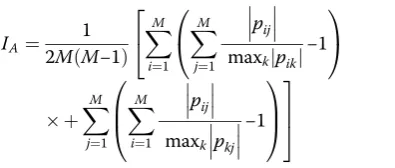
In this section, the superiority of the c-ncFastICA algo-rithm is demonstrated by some simulations. We employ the normalized Amari index [28] to measure the per-formance of the different algorithms
IA¼ the separation. For all the simulations, the Amari index is obtained by the average of 100 Monte Carlo trials. We compare the c-ncFastICA algorithm with the symmetric gradient descent method [26] since it is the only algo-rithm which can be applied to complex-valued signals among the constrained ICA algorithms in [20–26]. In addition, we also compare c-ncFastICA with the ncFas-tICA algorithm since it is widely used for the separation of noncircular signals.
In the first simulation, we use the complex generalized Gaussian distributed (cGGD) signals [11] as the original sources. For each trial, the source number is eight and half of the sources are made noncircular with the same noncir-cularity index. The shape parameters and noncirnoncir-cularity index for each source are listed in Table2. The sample size of the original sources varies from 250 to 1000. The
complex-valued mixing matrix A is 8 × 8 dimensional.
Each element is zero mean and unit variance, with the real part and imaginary part normally distributed. We use the third and seventh columns ofAas reference.
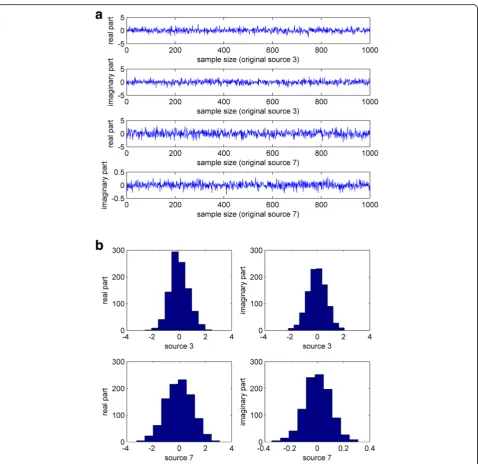
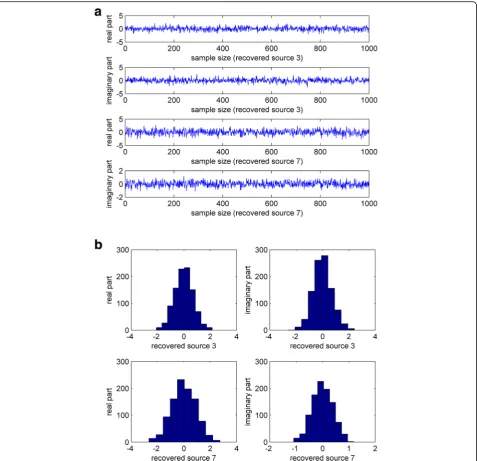
Figure 1 shows the time sequences and histograms of
original sources 3 and 7, and Fig. 2 shows the time se-quences and histograms of recovered sources 3 and 7 by c-ncFastICA algorithm, where ρn= 0.9, γn= 3, and the nonlinear function is selected asG3. One can see that the
constrained sources 3 and 7 are successfully recovered by c-ncFastICA even though they are almost Gaussian. Figure3depicts the separation results of c-ncFastICA al-gorithm, ncFastICA alal-gorithm, and the symmetric gradi-ent descgradi-ent method [26], where ρn= 0.9 and γn= 3. It shows that the c-ncFastICA algorithm performs signifi-cantly better than other two methods. This is due to the fact that ncFastICA does not take the constrained condi-tion into consideracondi-tion, and symmetric gradient descent method cannot make full use of the noncircular character-istic of the sources. Moreover, the performance gap widens slightly with the increase of the sample size. It also shows that the ncFastICA algorithm cannot perform well even when the sample size is 1000. This is due to the fact that source 1, source 3, and source 7 are almost Gaussian in this simulation. On the contrary, the c-ncFastICA algo-rithm can get desirable separation result in this case, which verifies the stability analysis in the Section 3. Figure4compares the convergence curves of c-ncFastICA under different nonlinear functions, with the sample size fixed at 1000. One can observe that c-ncFastICA con-verges quickly under different nonlinear functions. Figure5
shows the influence of ρn on the performance of
c-ncFastICA, with the sample size fixed at 1000. It can be seen that the algorithm performs better whenρnis bigger, which is due to the fact that the prior information is ac-curate in this simulation.
In the second simulation, we use three real-world frequency-modulated (FM) signals as the original sources. The powers of three sources are 1, 1, and 10, respectively. The first and third sources are the interference signals, and the second source is the desired signal. For each trial, the parameters for carrier frequency and maximum frequency deviation are set as 80 kHz and ± 75 kHz, respectively. The original FM sources are received by the linear uniform
Table 2The shape parameters and noncircularity index for the original sources
Source 1 2 3 4
Parameter,p 0.9 0.7 0.9 0.7
Noncircularity index 1 1 1 1
Source 5 6 7 8
Parameter p 2 2 1.1 2
array, and the sensor number is five. The array interval is equal to the half of the wavelength. In this case, the mixing matrix is related to the directions of arrival (DOAs) of the original sources. The DOAs of the original sources are 30o, −8o, and −7o, respectively. We assume that the DOA of desired signal can be roughly detected, and thus, the second column ofA(denoted asa2) is considered as a prior
know-ledge. The additive white Gaussian noise is added to the
re-ceiver and the variance is 0.1. Figure 6 depicts the
separation results of the c-ncFastICA algorithm, ncFastICA algorithm, and symmetric gradient descent method [26],
where ρn= 0.95 and γn= 3. One can see that the
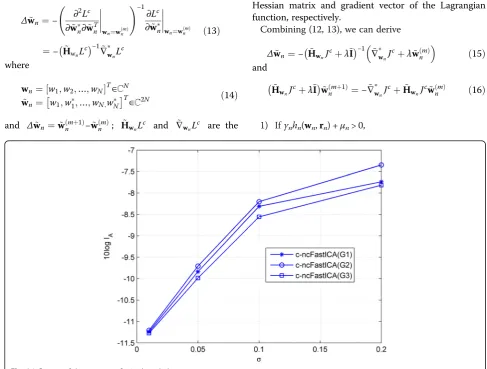
c-ncFastICA algorithm performs better than other two methods. Figure 7 shows the influence of ρn on the per-formance of c-ncFastICA algorithm. It can be seen that the performance of c-ncFastICA improves a lot whenρn≥0.85 (G1andG3) or ρn≥0.9 (G2). However, this does not mean
that the bigger theρn, the better the performance. Figure8 shows the influence of the accuracy of prior knowledge on the performance of c-ncFastICA, where ρn= 0.95, γn= 3, and the prior knowledge for each element ofa2is
5 Conclusion
The constrained ICA for complex sources is a challenging problem. In this paper, we focus on this problem and extend the noncircular complex FastICA (ncFastICA) algorithm to the constrained case. By adding the constrained conditions to the cost function and utilizing the quasi-Newton method, we derive a new fixed-point algorithm, namely constrained ncFastICA (c-ncFastICA) algorithm. Stability analysis shows that the optimal solution to constrained ICA corresponds to the fixed point of the c-ncFastICA algorithm. Simulations verify the correctness of the stability analysis and the super-iority of the c-ncFastICA algorithm.
6 Appendix
6.1 Derivation of the fixed-point algorithm
The Lagrangian function for the constrained ICA is
Lcðwn;λ;μnÞ ¼ Jcð Þ þwn λ wHnwn−1
ð12Þ
As the cost function is not analytic inwnbut analytic
in wn and wn independently [11], we derive the
Fig. 3Separation results for cGGD signals
Fig. 5Influence ofρnon the performance of c-ncFastICA
Δw~n¼− ∂
2Lc ∂w~
n∂w~Tn
wn¼wð Þm n
!−1
∂Lc ∂w~
n
wn¼wð Þm n
¼− H~wnL
c
−1~
∇wnL
c
ð13Þ
where
wn¼½w1;w2;…;wNT∈ℂN
~
wn¼ w1;w1;…;wN;wN
T
∈ℂ2N ð14Þ
and Δw~n¼w~nðmþ1Þ−w~
ðmÞ
n ; H~wnL
c and ∇~
wnL
c are the
Hessian matrix and gradient vector of the Lagrangian function, respectively.
Combining (12, 13), we can derive
Δw~n¼− H~wnJ
cþλ~I
−1 ~
∇wnJcþλw~ð Þnm
ð15Þ and
~
HwnJ
cþλ~I
~
wðmþ1Þ
n ¼−∇~
wnJ
cþH~
wnJ
cw~ð Þm
n ð16Þ
1) Ifγnhn(wn,rn) +μn> 0,
Fig. 7Influence ofρnon the performance of c-ncFastICA
~
Taking (20) and (21) into consideration, and retaining only the odd-numbered rows, we can obtain
HwnJwn¼E g
Similarly, we can get
Kwðmþ1Þ
Combining (23) and (24), we can obtain
Kwðmþ1Þ
At the optimal solution,
Kqn
Calculating the derivative of Lagrangian function for qnat the optimal solution
∂Lcðqn;λ;μnÞ
Therefore, K can be removed due to the constraints
‖wn‖= 1. The fixed-point iteration becomes
wðmþ1Þ¼−E g yj j2
Combining (33) and (34), we can get
wðmþ1Þ
Updating the μn using the gradient descent method,
we can obtain
μn←max γnhnðwn;rnÞ þμn;0
ð36Þ
Abbreviations
AC-DC:Alternating columns-diagonal centers; cFastICA: Complex FastICA; c-ncFastICA: Constrained noncircular complex fast independent component analysis; FM: Frequency modulated; DOAs: Directions of arrival;
ICA: Independent component analysis; JADE: Joint Approximate Diagonalization of Eigenmatrices; ML: Maximum likelihood; ncFastICA: Noncircular complex FastICA
Acknowledgements
The authors would like to thank the anonymous reviewers for their valuable comments and suggestions that helped improve the quality of this manuscript.
Funding
The work was supported by the National Natural Science Foundation of China under grant 61701419.
Availability of data and materials
Not available online. Please contact corresponding author for data requests.
Authors’contributions
Competing interests
The authors declare that they have no competing interests.
Publisher’s Note
Springer Nature remains neutral with regard to jurisdictional claims in published maps and institutional affiliations.
Author details 1
Chongqing Key Laboratory of Nonlinear Circuits and Intelligent Information Processing, College of Electronic and Information Engineering, Southwest University, Chongqing 400715, China.2School of Mathematics and Statistics, Southwest University, Chongqing 400715, China.
Received: 27 July 2018 Accepted: 29 March 2019
References
1. P. Comon, Independent component analysis, a new concept? Signal Process.36, 287–314 (1994)
2. A. Hyvarinen, J. Karunen, E. Oja,Independent Component Analysis(Wiley, New York, 2001)
3. A. Tharwat, Independent component analysis: an introduction. Appl. Comput. Inform. (2018)
4. H. Saruwatari, T. Kawamura, T. Nishikawa, et al., Blind source separation based on a fast-convergence algorithm combining ICA and beamforming. IEEE Trans. Audio, Speech, and Lang. Process.14, 666–678 (2006) 5. K. Mohanaprasad, P. Arulmozhivarman, Wavelet-based ICA using maximum
likelihood estimation and information-theoretic measure for acoustic echo cancellation during double talk situation. Circuits Systems Signal Process.34, 3915–3931 (2015)
6. M. Aladjem, I. Israeli-Ran, M. Bortman, Sequential independent component analysis density estimation. IEEE Trans. Neural Netw. Learn. Syst.99, 1–14 (2018) 7. J.F. Cardoso, A. Souloumiac, Blind beamforming for non-Gaussian signals.
IEEE Proceedings F140, 362–370 (1993)
8. A. Yeredor, Non-orthogonal joint diagonalization in the least-squares sense with application in blind source separation. IEEE Trans. Signal Process.50, 1545–1553 (2002)
9. A. Hyvärinen, Fast and robust fixed-point algorithms for independent component analysis. IEEE Trans. Neural Netw.10, 626–634 (1999) 10. E. Bingham, A. Hyvärinen, A fast fixed-point algorithm for independent
component analysis of complex valued signals. Int. J. Neural Syst.10, 1–8 (2000) 11. M. Novey, T. Adali, On extending the complex FastICA algorithm to
noncircular sources. IEEE Trans. Signal Process.56, 2148–2154 (2008) 12. P. Ablin, J.F. Cardoso, A. Gramfort, Faster independent component analysis
by preconditioning with Hessian approximations. IEEE Trans. Signal Process. 66(15), 4040–4049 (2018)
13. N. Ono, S. Miyabe, inInternational Conference on Latent Variable Analysis and Signal Separation. Auxiliary-function-based independent component analysis for super-Gaussian sources (Springer, Berlin, 2010), pp. 165–172
14. S. Gepshtein, Y. Keller, Iterative spectral independent component analysis. Signal Process.155, 368–376 (2019)
15. N. Ono, inApplications of Signal Processing to Audio and Acoustics (WASPAA), 2011 IEEE Workshop. Stable and fast update rules for independent vector analysis based on auxiliary function technique (2011), pp. 189–192 16. D. Kitamura, N. Ono, H. Sawada, et al., Determined blind source separation
unifying independent vector analysis and nonnegative matrix factorization. IEEE/ACM Trans. Audio Speech Lang. Proc.24(9), 1622–1637 (2016) 17. Y. Mitsui, N. Takamune, D. Kitamura, et al., in2018 IEEE International
Conference on Acoustics, Speech and Signal Processing (ICASSP). Vectorwise coordinate descent algorithm for spatially regularized independent low-rank matrix analysis (2018), pp. 746–750
18. Y. Xia, B. Jelfs, M.M. Van Hulle, J.C. Principe, D.P. Mandic, An augmented echo state network for nonlinear adaptive filtering of complex noncircular signals. IEEE Trans. Neural Netw.22(1), 74–83 (2011)
19. Y. Xia, D.P. Mandic, A full mean square analysis of CLMS for second order noncircular inputs. IEEE Trans. Signal Process.65(21), 5578–5590 (2017) 20. W. Lu, J.C. Rajapakse, Constrained independent component analysis. Adv.
Neural Inf. Process. Syst.13, 570–576 (2000)
21. W. Lu, J.C. Rajapakse, Approach and applications of constrained ICA. IEEE Trans. Neural Netw.16, 203–212 (2005)
22. J. Lee, K.L. Park, K.J. Lee, Temporally constrained ICA-based fetal ECG separation. Electron. Lett.41, 1158–1160 (2005)
23. J. Zhang, Z. Zhang, W. Cheng, X. Li, B. Chen, et al., Kurtosis-based constrained independent component analysis and its application on source contribution quantitative estimation. IEEE Trans. Instrum. Meas.63, 1842–1854 (2014) 24. P.A. Rodriguez, M. Anderson, X.L. Li, T. Adali, General non-orthogonal
constrained ICA. IEEE Trans. Signal Process.62, 2778–2786 (2014)
25. Y. Shi, W. Zeng, N. Wang, Z. Le, A new method for independent component analysis with priori information based on multi-objective optimization. J. Neurosci. Methods283, 72–82 (2017)
26. X. Wang, Z. Huang, Y. Zhou, et al., Approaches and applications of semi-blind signal extraction for communication signals based on constrained independent component analysis: the complex case. Neurocomputing101, 204–216 (2013)
27. D. Kitamura, S. Mogami, Y. Mitsui, et al., Generalized independent low-rank matrix analysis using heavy-tailed distributions for blind source separation. EURASIP J. Adv. Sign. Proc.28, 1–25 (2018)