Received 10 August 2001 and in revised form 10 December 2001
A watermarking scheme is presented in which the characteristics of both spatial and frequency techniques are combined to achieve robustness against image processing and geometric transformations. The proposed approach consists of three basic steps: estima-tion of the just noticeable image distorestima-tion, watermark embedding by adaptive spreading of the watermark signal in the frequency domain, and extraction of relevant information relating to the spatial distribution of pixels in the original image. The just no-ticeable image distortion is used to insert a pseudo-random signal such that its amplitude is maintained below the distortion sensitivity of the pixel into which it is embedded. Embedding the watermark in the frequency domain guarantees robustness against compression and other common image processing transformations. In the spatial domain most salient image points are characterized using the set of Hilbert first-order differential invariants. This information is used to detect geometrical attacks in a frequency-domain watermarked image and to resynchronize the attacked image. The presented schema has been evaluated exper-imentally. The obtained results show that the technique is resilient to most common attacks including rotation, translation, and scaling.
Keywords and phrases:watermarking, data hiding, image invariants.
1. INTRODUCTION
Conventional analog media distribution systems have an in-herent built-in defense against copying, alteration, and fraud. Each time a new copy is issued the quality of the duplicated content is degraded accordingly. In contrast to that, digital multimedia documents are completely susceptible to exact replication and alteration. This, together with the rapid pro-liferation of digital documents, multimedia processing tools and the world-wide availability of internet access have cre-ated an ideal medium for piracy, copyright fraud, and uncon-trollable distribution of high quality but unregistered multi-media content. Since digital watermarking can be seen as a solution to this problem, both the number of activities in this area and the recognition of the difficulties and challenges in-volved in this new technology have increased in the last few years [1, 2]. Basically, the major challenge is to find a strategy that satisfies the conflicting objectives of performing image changes that are imperceptible for the human eye and be-ing extremely robust against detection or removal either acci-dentally or intentionally. These two objectives are conflicting in nature because it is not possible to simultaneously maxi-mize robustness and imperceptibility. Indeed, maximization of robustness leads to the introduction of large distortions in the image or video and consequently strong perceivable image changes. On the other hand, keeping imperceptibility
means keeping the embed amount of information minimal and consequently very susceptible to removal or detection.
(a) (b) (c)
Figure1: Distortions introduced by the log-polar map. (a) Original image Lena, (b) log-polar map, and (c) recovered image from the log-polar map.
for decoding is lost. To deal with these attacks, a spa-tial watermark is more appropriate as it targets specific locations in the image. Watermarking in the spatial do-main is less resilient to common image processing oper-ations, since the watermark becomes undetectable when the intensity information is modified. However, spatial techniques allow relevant information relating to the spa-tial distribution of pixels to be extracted. With this in-formation, following geometric transformations such as rotation, the image can be resynchronized. The most com-mon strategy for detecting a watermark after geometric dis-tortion is to try to identify what the disdis-tortions are and then to invert them before applying the detector, for example, by introducing a template [7, 8]. This requires the insertion and the detection of two watermarks: one of which does not carry information but helps to detect geometric transformations and a second one in which the hidden information is repre-sented. This approach has two drawbacks: it further affects image fidelity and it increases the probability of false nega-tives. Additionally, in general this technique requires exhaus-tive searches thus resulting in a significant increase of work-load. Since the watermarking strategy should be public, it is rather easy to destroy the synchronization template.
A more elegant approach to achieve robustness against loss of synchronization is to use transformations that map the signal information into an invariant domain. The most commonly used transformations depend on the properties of the Fourier transform. They use well-established tech-niques in pattern recognition and the invariance properties of the Fourier-Mellin transform [9]. Combining the Fourier transform with a log-polar map result on invertible rotation, translation, and scale invariant representation. Nevertheless, as noted by, Ruanaidh and Pun [10] using this to achieve wa-termarking leads to difficulties. The main problem is that the exponential nature of the inverse log-polar mapping causes a loss of image information in the discrete space.
To illustrate this problem, in Figure 1 the original image Lena along with the log-polar representation and the
recon-structed image using the inverse log-polar mapping is shown. Although in these images a high resolution is used, the loss of image quality in the reconstructed image is clearly vis-ible. Another problem is that achieving high resolution in the log-polar space requires interpolation. This causes fur-ther numerical instabilities since interpolation behaves badly if the interpolation nodes are not of the same scale [10]. Re-cently, Lin et al. [11] proposed another approach based on the Fourier-Mellin transform. The main idea in this tech-nique is to use a noninvertible extraction function in or-der to overcome the instabilities arising when strong invari-ant representations are used. Although this approach tackle some implementation problems arising from the nature of the Fourier-Mellin transform, other aspects of robustness re-main unsolved. For instance, strong resilience against image processing operations like JPEG compression is severely af-fected using this technique.
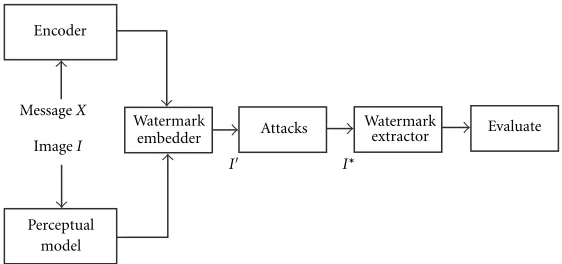
attacks. The proposed technique consists of three basic steps: (1) content based estimation of JND in the frequency do-main; (2) adaptive spreading of a pseudo-random watermark signal in the frequency domain; and (3) extraction of rele-vant information related to the spatial distribution of pixels in the original image in order to resynchronize a geometric distorted image. The useful combination of a frequency do-main watermarking approach with spatial information leads to a very robust system. The proposed system benefits from the advantages of both spread spectrum and image primitive invariance with respect to affine image transformations. In Figure 2, an overview of the implemented system is given.
In the first step, the image is analyzed in both the fre-quency and the spatial domain in order to detect the distor-tion sensitivity of the image according to its content. Local information derived from texture, edge, and luminance in-formation is used to define a measure of JND. The JND is used adaptively according to the image content to maximize the amount of information (signal) that will be embedded as the watermark. To insert the watermark signal the middle DCT-frequency band of a block-wise transformed image is used. To maximize the capacity a pseudo-random signal with amplitude just below the image distortion, sensitivity is cre-ated according to the JND mask. Thus, the watermark signal is spread over the whole host by keeping its amplitude below the noise sensitivity of each pixel.
By transforming the original image into a suitable fre-quency domain information, redundancy of the spatial do-main can be highly decorrelated and high-energy com-paction can be achieved. The popular DCT transform for coding and compression consists of dividing the image into smaller blocks of the same size, and then transforming each block to obtain equal-sized blocks of transform coefficients. These coefficients are then thresholded and quantized in or-der to remove subjective redundancies. Since one of the most common and useful image processing methods is compres-sion, it seems reasonable to exploit the knowledge about the processing methodology to generate a watermark scheme re-silient to this image modification. Basically, we use the mid-dle DCT-frequency band of a block-wise transformed im-age to insert the watermark signal. To maximize capacity, a pseudo-random signal with amplitude just below the image distortion sensitivity is created according to the JND mask.
Thus, the watermark signal is spread over the whole host by keeping its amplitude below the noise sensitivity of each pixel.
The spatial domain is used to resynchronize the image. This is implemented by applying primitive matching using point characterization according to Hilbert differential in-variants [12]. These inin-variants have been defined in the lit-erature for gray-level images, where good results can be ob-tained using differentials up to order three. For colour im-ages this characterization can be improved if the three colour planes are used. In this case, only first-order invariants are necessary. Using the colour information a more efficient characterization can be achieved, as only first-order deriva-tives are necessary. In this work a generalization of the Harris corner detector [13] is used to detect salient image points. Furthermore first-order Hilbert invariants [12] are selected to characterize the salient image primitives. Finally, to detect the affine transformations undergone by the attacked image, a matching technique is used in which the extracted image primitives are compared.
The paper is organized as follows: in Section 2, the method for extraction of the JND mask is described. Section 3 deals with the watermark insertion and extraction in the DCT domain. Correction of geometric distortions us-ing Hilbert invariants is described in Section 4. To assess the performance of the proposed watermarking method, sev-eral experiments have been conducted. The obtained results show that, this approach is resilient to most common dis-tortions due to image processing transformations including high compression, geometrical distortions as well as some malicious attacks. Selected results of computer simulations are reported in Section 5. The paper is closed with conclu-sions in Section 6.
2. JND-MASK GENERATION
(a) (b)
Figure3:DTvales for Baboon (a) and Lena (b).
without making the difference between the original and the altered one perceptible. This limit varies according to the im-age content and is calledjust noticeable distortion(JND). Sev-eral methods can be found in the literature to estimate JND masks in the context of compression and image quality as-sessment. Several perceptually-based algorithms have been proposed in the literature [14]. An overview of visual mod-els for signal compression is presented in [15]. Most of these models use both frequency sensitivity, and spatial masking based on image edges. The spatial masking is a modified ver-sion of the spatial masking model presented in [16]. The main principle of the spatial masking is that, edges in an image are able to mask signals of much greater amplitude than regions of near-constant intensity. For a given image, a tolerable-error level value may be formed for each pixel.
To estimate the JND mask, three image characteristics are considered: texture, edgeness, and smoothness. Accord-ing to several studies about the human vision system, it is well known that the distortion visibility in highly textured areas is very low. This means that these areas are the most suitable ones to hide the watermark signal. In fact textured regions present a very high noise-sensitivity level. In contrast to that, edge information of an image is the most important factor for the human image perception. Consequently, edges have the least noise sensitivity and it is essential to keep edge integrity in order to preserve the image quality. Edges have the lowest JND values. Similarly, smooth image areas have a general bandpass characteristic. They influence the human perception and consequently their JND values are also rel-atively low. The definition of a suitable JND mask depends essentially on the accurate extraction of image texture, edges, and smooth areas.
Texture information can be retrieved directly from the transformed domain by analyzing the DCT coefficients. Fol-lowing the JPEG and MPEG2 encoding strategies, the image is first split into 8×8 blocks. Each block is transformed in the DCT domain and the resulting 64 coefficients analyzed. It is well known that in high textured regions or along edges, the
signal energy concentrates in the high frequency coefficients while in uniform image areas the signal energy is concen-trated in the low frequency components. Thus, the energy of the AC coefficients can be used as a measure for texture within each block. Using the following formula for the en-ergy in the AC coefficients a measure for textureDT within each block is derived:
DT =log
63
i=1
v2
i −v02
, (1)
where vi,i = 0, . . . ,63, are the 64 DCT coefficients of the considered block. The obtained DT values are scaled to the range [0,64] and the resulting normalized values assigned to the corresponding blocks. The images in Figure 3 show the obtainedDTvalues for the two test images Lena and Baboon. In this representation theDT values have been scaled to the range [0,255] and rounded to the nearest integer.
Edges and smooth areas are extracted from the pixel do-main. The main difficulty here consists of discriminating be-tween relevant image edges and spurious edges due to noise and texture. Relevant edges are detected using either the Canny operator. The length of each single edge is calculated by traversing it. Edges whose length does not exceed a thresh-old are considered texture edges and are removed. Using the binary image containing the final edge information, edgeness is calculated block-wise according to the formula
DE= 64·PE
maxPE, (2)
wherePEis the cardinality of the set of pixels within the block and at edge locations and max(PE) is the maximum value of
PEover all the blocks in the image.
(a) (b)
Figure4: ExtractedDUvales for Baboon (a) and Lena (b).
smoothed image. Additionally, small picks are removed using a median filter over the binary image obtained after thresh-olding. The uniformityDU in a block is defined as the num-ber of pixels belonging to a uniform area within the block. The images in Figure 4 show the obtainedDU values for the two test images Lena and Baboon. In this representation the
DUvalues have been scaled to the range [0,255] and rounded to the nearest integer.
Using the three valuesDT,DE, andDU an initial estimate for the JND value over each block is calculated as
˜
J=DT−12DE+DU. (3)
Since the human vision system is more sensitive to inten-sity changes in the mid-gray region and its sensitivity fail parabolically at both ends of the gray scale, a correction to ˜J is used. The final JND values are obtained asJ=J˜+(128−I˜)2,
where ˜Iis the average of the luminance values within the con-sidered block.
3. WATERMARK EMBEDDING IN THE DCT DOMAIN
The method of watermark insertion is to modify selected DCT coefficients by embedding a sequence of pseudo-random numbers within them. This technique does not tar-get individual pixels but rather, upon inverse transforma-tion, the watermark will be dispersed over the entire image. The watermark itself consists of a sequence of real pseudo-random numbersX=x1, . . . , xm, withm≤64, satisfying the normal distribution η(0,1). The array of DCT coefficients obtained from the transformation consists of a sequence of valuesV=v1, . . . , v64.
The watermarkX=x1, . . . , xmis inserted intomselected coefficients from the middle frequency bands. This yields an adjusted set of valuesV=v1, . . . , v64 . The inverse of the DCT is then performed to obtain the watermarked imageI. To insert the watermark we use the formula
v
i=vi+α·J· |vi|xi, (4)
where α is a scaling parameter andJ is the distortion pa-rameter previously defined. If the watermarked image I is transformed, by processing or attacking, a new image I∗is generated.
The presence of the watermark can be detected in the transformed imageI∗by performing a correlation test
R= N1V∗·X, (5)
whereV∗is the vector containing those extracted DCT coef-ficients which have been modified andXis the original wa-termark. Since this is a statistical test we must be aware of the possibility of obtaining detection errors. To decide whether the watermark is authentic, we must determine some thresh-old T and test whether the obtained correlation coefficient is greater thanT. Setting the detection threshold is a deci-sion based on the desire to minimize both false positives and false rejections.
Figure 5a shows the watermarked image using this spread spectrum technique. Although high distortions have been in-troduced to some DCT values according to the JND mask the image quality has not been compromised. In Figure 5b the detector response is shown for the same image after JPEG compression using 50% quality factor. In Figure 6, similar re-sults are shown after digital-analog-digital conversion.
4. GEOMETRIC ATTACKS AND RESYNCHRONIZATION
(a)
Lena JPEG compressed 50%
Watermark 1
0.8 0.6 0.4 0.2 0
−0.2
−0.4
200 400 600 800 1000
Cor
re
la
ti
o
n
(b)
Figure5: Watermarked image and response of the watermark de-tector after JPEG-compression using 50% quality factor to 1000 randomly generated watermarks including the genuine watermark at position 188.
mathematician David Hilbert [12]. He showed that any in-variant of finite order can be expressed as a polynomial func-tion of a set of irreducible invariants. Although the invari-ant theory has been widely applied in pattern recognition and computer vision [18], it has not been used to recover transformation parameter and resynchronize signal in water-marking applications. In a gray-level image the fundamental set of irreducible invariants can be defined asI,Iη,Iηη,Iςη,
Iςς, with the unit vectorηgiven byη=∇I/|∇I|andς⊥η. Given an original imageI, the first step in generating a feature space with invariant attributes is to detect some key points that are robust to common image processing and geo-metrical transformations. We have chosen the Harris detec-tor which uses only first-order derivatives and is well known as one of the most stable and robust corner detectors in im-age processing. The Harris detector is defined as the positive local extreme of the following operator:
Det(M)−kTrace2(M), (6)
(a)
Watermark 6
5 4 3 2 1 0
−1
−2
−3
Cor
re
la
ti
o
n
200 400 600 800 1000
(b)
Figure 6: (a) Image obtained after printing, photocopying, and scanning the watermarked Lena and (b) response of the watermark detector to 1000 randomly generated watermarks including the gen-uine watermark at position 188.
where
M=C11 C12
C21 C22
, (7)
withC11=ΓσR2x+G2x+Bx2,C12=ΓσRx·Ry+Gx·Gy+Bx·By, C21=ΓσRx·Ry+Gx·Gy+Bx·By,C22=ΓσR2y+G2y+B2y,
k=0.04 is a scalar, andΓis the Gaussian convolution kernel of varianceσ.
As mentioned before the basic idea behind the strategy for defining an invariant feature space is to use first-order Hilbert invariants. For each corner point, the vector compris-ing the followcompris-ing eight differential primitives is calculated:
F=R,|∇R|2, G,|∇G|2, B,|∇B|2,∇R· ∇G,∇R· ∇BT. (8)
(a) (b)
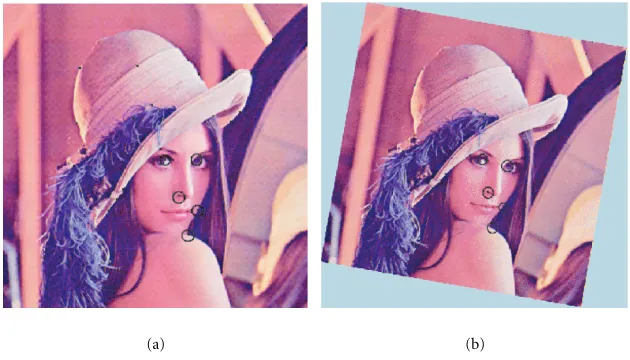
Figure7: (a) Selected relevant corners using the Harris detector and (b) matched corners using first order Hilbert invariants.
geometric transformations. It allows very robust characteri-zation with regard to noise, since only first-order derivatives are involved. Additionally, the complexity of the method re-mains very low since only simple pixel differences should be calculated. The use of higher-order derivatives involves heav-ier workload and would cause severe instabilities. Finally, the transformation parameters are detected by matching the cor-ners in the primitive space defined by (8). In the matching procedure the conventional Euclidean distance between the primitives is used as similarity measure.
5. EXPERIMENTAL RESULTS
Several experiments have been conducted to test the perfor-mance of the proposed system. In this section some selected results are reported. The images in Figures 5 and 6 show the watermarked image Lena after compression and format con-version as well as the detector response obtained using the technique described in Section 3.
Tests against geometric attacks such as cropping, rota-tions, scaling, and so forth, have been carried out. In most cases, good synchronization has been achieved. For cropping attacks the image must be padded to the original size before decoding. Thus frequency sampling is performed with the same step both by the encoder and the decoder. In this case, cropping robustness is obtained from the invariance of the magnitude spectrum to spatial shifting. In all cases, the pa-rameters describing the performed geometrical attack have been detected using the technique described in Section 4. Figure 7 shows the detected corners in the watermarked im-age. In this representation corners are highlighted as small black spots. For the sake of visibility in this representation, five corner points appear surrounded by circles. The image in Figure 7b has been rotated clockwise by 15 degrees. The corresponding corners are also represented by small black spots. Matching between image primitives using the Hilbert invariant features, described in Section 4, reveal the param-eters encoding the geometric transformations undergone by
Watermarks 1.2
1 0.8 0.6 0.4 0.2 0
−0.2
−0.4
Cor
re
la
ti
o
n
200 400 600 800 1000
Figure 8: Response of the watermark detector after re-synchro-nization.
the attacked image. In this case then rotation angle has been recovered accurately.
The recovered parameters have been used to re-syn-chronize the transformed image and to detect the watermark in the DCT domain. Figure 8 shows the response of the wa-termark detector for the rotated image in Figure 7b. Using the technique described in Section 4, the rotation angle has been estimated and the attacked image rotated back. The watermark detector has been applied to the resynchronized image.
6. CONCLUSIONS
image features to perform resynchronization. The spatial do-main is used to extract relevant information related to the pixels distribution in the original image. The underlying strategy consists of characterizing salient image points using first-order differential invariants. These primitives are invari-ant to orthogonal image transformations. To detect geomet-rical attacks in a frequency-domain watermarked image a ro-bust matching technique is applied. Features extracted from the original image are matched with those extracted from the attacked image. Their disparities reveal the transformation parameters and are used to re-synchronize the attacked im-age. Experimental results confirm the robustness of the pro-posed schema.
REFERENCES
[1] Signal Processing, “Special Issue on Watermarking,” vol. 66, no. 3, 1998.
[2] Proceedings of the IEEE, “Special Issue on Identification and Protection of Multimedia Information,” vol. 87, no. 7, 1999. [3] C.-T. Hsu and J.-L. Wu, “Hidden digital watermarks in
im-ages,” IEEE Trans. Image Processing, vol. 8, no. 1, pp. 58–68, 1999.
[4] R. B. Wolfgang, C. I. Podilchuk, and E. J. Delp, “Perceptual watermarks for digital images and video,” Proceedings of the IEEE, vol. 87, no. 7, pp. 1108–1126, 1999.
[5] M. Barni, F. Bartolini, V. Cappellini, A. Lippi, and A. Piva, “A DWT-based technique for spatio-frequency masking of digi-tal signatures,” inSecurity and Watermarking of Multimedia Contents, Electronic Imaging, vol. 3657 ofProceedings of SPIE, pp. 31–39, San Jose, Calif, USA, January 1999.
[6] A. Piva, M. Barni, F. Bartolini, and V. Cappellini, “DCT-based watermark recovering without resorting to the uncorrupted original image,” inProc. 4th IEEE International Conference on Image Processing (ICIP ’97), vol. 1, pp. 520–523, Santa Bar-bara, Calif, USA, October 1997.
[7] S. Pereira and T. Pun, “Fast robust template matching for affine resistant image watermarking,” inInternational Work-shop on Information Hiding, vol. 1768 ofLecture Notes in Com-puter Science, pp. 200–210, Springer-Verlag, Dresden, Ger-many, 29 September–1 October 1999.
[8] M. Kutter, “Watermarking resistance to translation, rotation, and scaling,” inSPIE Conf. on Multimedia Systems and Appli-cations, vol. 3528, pp. 423–431, 1998.
[9] R. D. Brandt and F. Lin, “Representations that uniquely char-acterize images modulo translation, rotation, and scaling,” Pattern Recognition Lett., vol. 17, no. 9, pp. 1001–1015, 1996. [10] J. J. K. O’Ruanaidh and T. Pun, “Rotation, scale and
transla-tion invariant spread spectrum digital image watermarking,” Signal Processing, vol. 66, no. 3, pp. 303–318, 1998.
[11] C.-Y. Lin, M. Wu, J. A. Bloom, M. L. Miller, I. J. Cox, and Y. M. Lui, “Rotation, scale, and translation resilient watermarking for images,” IEEE Trans. Image Processing, vol. 10, no. 5, pp. 767–782, 2001.
[12] D. Hilbert, Theory of Algebraic Invariants, Cambridge Math-ematical Library, Cambridge University Press, Cambridge, 1890.
[13] C. Harris and M. Stephens, “A combined corner and edge detector,” inProc. 4th Alvey Vision Conference, pp. 147–151, Manchester, 1988.
[14] I. S. Hontsch and L. J. Karam, “APIC: adaptive perceptual image coding based on sub-band decomposition with locally adaptive perceptual weighting,” inProc. 1997 IEEE Interna-tional Conference on Image Processing (ICIP ’97), vol. 1, pp. 37–40, Santa Barbara, Calif, USA, October 1997.
[15] N. S. Jayant, J. D. Johnston, and R. Safranek, “Signal com-pression based on models of human perception,”Proceedings of the IEEE, vol. 81, no. 10, pp. 1385–1422, 1993.
[16] B. Girod, “The information theoretical significance of spatial and temporal masking in video signals,” inProc. SPIE Human Vision, Visual Processing, and Digital Display, vol. 1077, pp. 178–187, Los Angeles, Calif, USA, 1989.
[17] E. Izquierdo, “Stereo image analysis for multi-viewpoint telepresence applications,” Signal Processing: Image Commu-nication, vol. 11, no. 3, pp. 231–254, 1998.
[18] P. Montesinos, V. Gouet, R. Deriche, and D. Pel´e, “Matching color uncalibrated images using differential invariants,”Image and Vision Computing, vol. 18, no. 9, pp. 659–671, 2000.
Ebroul Izquierdois a Lecturer in the De-partment of Electronic Engineering, Queen Mary University of London. He received the Dr. Rer. Nat. from the Humboldt Uni-versity, Berlin, Germany, in 1993. From 1990 to 1992 he was a Teaching Assistant at the Department of Applied Mathemat-ics, Technical University, Berlin. In 1993, Dr. Izquierdo joined the Heinrich-Hertz Institute for Communication Technology