Summarizing Audiovisual Contents
of a Video Program
Yihong Gong
NEC Laboratories America, Inc., 10080 North Wolfe Road, SW3-350 Cupertino, CA 95014, USA Email:[email protected]
Received 19 March 2002 and in revised form 22 October 2002
In this paper, we focus on video programs that are intended to disseminate information and knowledge such as news, documen-taries, seminars, etc, and present an audiovisual summarization system that summarizes the audio and visual contents of the given video separately, and then integrating the two summaries with a partial alignment. The audio summary is created by selecting spoken sentences that best present the main content of the audio speech while the visual summary is created by eliminating du-plicates/redundancies and preserving visually rich contents in the image stream. The alignment operation aims to synchronize each spoken sentence in the audio summary with its corresponding speaker’s face and to preserve the rich content in the visual summary. A Bipartite Graph-based audiovisual alignment algorithm is developed to efficiently find the best alignment solution that satisfies these alignment requirements. With the proposed system, we strive to produce a video summary that: (1) provides a natural visual and audio content overview, and (2) maximizes the coverage for both audio and visual contents of the original video without having to sacrifice either of them.
Keywords and phrases: video summarization, audiovisual summarization, partial audiovisual alignment, bipartite graph, minimum spanning tree, maximum bipartite matching.
1. INTRODUCTION
Video programs are voluminous, redundant, and are a time-sequential medium whose overall contents cannot be cap-tured at a glance. The voluminous and sequential nature of video programs not only creates congestions in computer systems and communication networks, but also causes bot-tlenecks in human information comprehension due to the limited human information processing speed. In the past
decade, great efforts have been made to relieve the computer
and communication congestion problems. However, in the whole video content creation, storage, processing, delivery, and utilization loop, the human bottleneck problem has long
been neglected. Without technologies enabling fast and eff
ec-tive content overviews, browsing through video collections or finding desired video programs from a long list of search results will remain arduous and painful tasks.
Automatic video content summarization is one of the promising solutions to the human bottleneck problem. A concise and informative video summary will enable the user to quickly figure out the general content of a video and help him/her to decide whether the whole video program is worth watching. On the Internet, a compact video summary can be used as a video thumbnail of the original video, which
re-quires much less efforts to download and comprehend. For
most home users with very limited network bandwidths, this type of video thumbnails can well prevent them from spend-ing minutes or tens of minutes downloadspend-ing lengthy video programs, only to find them irrelevant. For video content re-trieval, a video summary will certainly save the user’s time
and effort to browse through large volumes of video
collec-tions and to spot the desired videos from a long list of search results.
There are many possible ways for summarizing video contents. To date, the most common approach is to extract a set of keyframes from the original video and display them as thumbnails in a storyboard. However, keyframes extracted from a video sequence are a static image set that contains no temporal properties nor audio information of the video.
While keyframes are effective in helping the user to identify
the desired shots from a video, they are far from sufficient
for the user to get a general idea of the video content, and to judge if the content is relevant or not.
In this paper, we begin with the discussion of diff
latent semantic analysis technique to select representative spoken sentences from the audio track, while the visual content summarization is performed by eliminating dupli-cates/redundancies and preserving visually distinct contents from the image track of the given video program. A bipartite graph-based audiovisual alignment algorithm is developed
to efficiently find the best alignment solution between the
audio and the visual summaries that satisfies the predefined alignment requirements. With the proposed system, we strive to produce a motion video summary for the original video that (1) provides a natural and effective audio and visual con-tent overview and (2) maximizes the coverage for both au-dio and visual contents without having to sacrifice either of them. Such audiovisual summaries dramatically increase the
information intensity and depth, and lead to a more effective
video content overview.
2. RELATED WORK
To date, video content overview is mainly achieved by us-ing keyframes extracted from original video sequences. Many works focus on breaking video into shots and then finding a fixed number of keyframes for each detected shot. Tonomura
et al. used the first frame from each shot as a keyframe [1].
Ueda et al. represented each shot using its first and last frames
[2]. Ferman and Tekalp clustered the frames in each shot and
selected the frame closest to the center of the largest cluster as the keyframe [3].
An obvious disadvantage of the above equal-number keyframe assignment is that long shots in which camera pan and zoom, as well as object motion, progressively unveil the entire event will not be adequately represented. To address this problem, DeMenthon et al. proposed to assign keyframes of a variable number according to the activity level of the
cor-responding scene shot [4]. Their method represents a video
sequence as a trajectory curve in a high-dimensional fea-ture space and uses the recursive binary curve splitting al-gorithm to find a set of perceptually significant points to ap-proximate the video curve. This approximation is repeated until the approximation error comes below the user’s spec-ified value. Frames corresponding to these perceptually sig-nificant points are then used as keyframes to summarize the video contents. As the curve splitting algorithm assigns more points to a larger curvature, this method naturally assigns more keyframes to shots with more variations.
Keyframes extracted from a video sequence may contain duplications and redundancies. In a TV program with two talking persons, the video camera usually switches back and forth between the two persons, with the insertion of some global views of the scene. Applying the above keyframe selec-tion methods to this kind of video sequences will yield many keyframes that are almost identical. To remove redundan-cies from keyframes, Yeung et al. selected one keyframe from each video shot, performed hierarchical clustering on these keyframes based on their visual similarity and temporal dis-tance, and then retained only one keyframe for each cluster
[5]. Girgensohn and Boreczky also applied the hierarchical
clustering technique to group the keyframes into as many clusters as specified by the user. For each cluster, a keyframe is selected such that the constraints of an even distribution of keyframes over the length of the video and a minimum
distance between keyframes are met [6].
Apart from the above methods of keyframe selection, summarizing video contents using keyframes has its own limitations. A video program is a continuous recording of real-world events. A set of static keyframes by no means cap-tures the dynamics and main content of the video program. In viewing a movie or a TV program, the user may well pre-fer a summarized motion video with a specified time length to a set of static keyframes.
There have been research efforts that strive to output
motion video summaries to accommodate better content overviews. The CueVideo system from IBM provides the fast video playback function which plays long, static shots with a faster speed (a higher frame rate) and plays short, dynamic
shots with a slower speed (a lower frame rate) [7]. However,
this variable frame rate playback causes static shots to look more dynamic and dynamic shots to look more static, and therefore, it dramatically distorts the temporal characteris-tics of the video sequence. On the other hand, the Informe-dia system from CMU provides the video skim that strives to identify, and playback only the semantically important image segments along with the semantically important audio
key-words/phrases in the video sequence [8]. The importance of
each image segment is measured using a set of heuristic rules which are highly subjective and content specific. This rule-based approach has certainly put limitations for handling di-versified video images. Yahiaoui, et al. also proposed a simi-lar method that summarizes multi-episode videos based on statistics as well as heuristics [9].
3. THREE TYPES OF SUMMARIES
User input ofLsum, Lmin and video program name
Audio track
Speech recognition
Speech transcript summarization
Audio summary creation
Audiovisual alignment Image track
Shot boundary detection
Scene shot clustering
Face detection
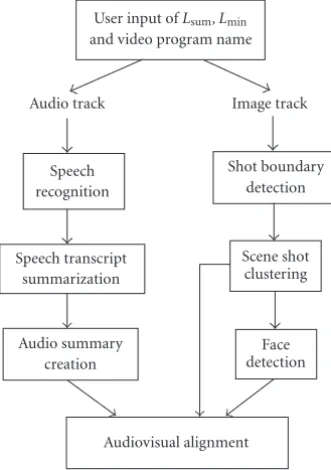
Figure1: System-block diagram.
image contents of the original video will be sacrificed in the summaries.
Conversely, there are certain video programs that do not have a strong synchronization between their audio and vi-sual contents. Consider a TV news program in which an au-dio segment presents information concerning the number of casualties caused by a recent earthquake. The corresponding image segment could be a close shot of a reporter in the field, of rescue teams working at the scene of a collapsed building, or of a regional map illustrating the epicenter of the quake. The audio content is related but does not directly refer to the corresponding image content. This kind of video production patterns are very common among such video programs as news, documentaries, seminars, and so forth. For this type of video programs, since there is no strong synchronization be-tween the associated audio and visual contents, we propose to summarize the audio and the visual contents separately and then integrate the two summaries with a partial align-ment. With this approach, we can maximize the coverage for both audio and image contents without having to sacrifice either of them. The following sections present our approach to the audiovisual summarization.
4. CREATING AUDIOVISUAL SUMMARIES
We strive to produce a motion video summary for the
origi-nal video that (1) provides a natural and effective audio and
visual content overview and (2) maximizes the coverage for both audio and visual contents of the original video without having to sacrifice either of them.
Figure 1is the block diagram of the proposed audiovisual content summarization system. The summarization process starts by receiving the user’s input of the video’s filename
and the two summarization parameters: the summary length
Lsum and the minimum time length of each image segment
Lmin in the summary. GivenLsum andLmin, the maximum
number of image segments a video summary can incorporate
equalsN = Lsum/Lmin. Here,Lmin provides the user with a
control knob to choose between the breadth- and the
depth-oriented visual summary. A small value forLminwill produce
a breadth-oriented summary that consists of more image
seg-ments, each is shorter in length, while a large value forLmin
will produce a depth-oriented summary that consists of less image segments, each is longer in length.
For the audio content summarization, speech recogni-tion is first conducted on the audio track of the original video to obtain a speech transcript which includes the recognized sentences along with their time codes within the audio track.
Next, the text summarization method described in [10] is
ap-plied to the speech transcript to create a text summary of the
user specified lengthLsum. This method creates a text
sum-mary by selecting sentences that best represent the main con-tent of the speech transcript. An audio summary is then cre-ated by taking the audio segments corresponding to the sen-tences comprising the text summary and then concatenating them in their original time order.
As for the visual content summarization, an ideal sum-mary should be the one that retains only visually important image segments of the original video. However, finding vi-sually important image segments requires an overall under-standing of the visual content, which is beyond our reach given the state of the art in current computer vision and im-age understanding techniques. On the other hand, it is rela-tively easy to identify duplicates and redundancies in a video sequence. For the purpose of visual content overviews, the video watching time will be largely shortened, and the orig-inal visual content will not be dramatically lost if we elimi-nate those duplicate shots and curtail those lengthy and static shots. Therefore, instead of relying on heuristically picking “important” segments for generating visual summaries, we choose to eliminate duplicates and redundancies while pre-serving visually distinct contents in the given video.
Our visual content summarization is composed of the
following major steps (seeFigure 1). First, shot boundary
de-tection is conducted to segment the image track into individ-ual scene shots. Next, shot clustering is performed to group
scene shots into the required numberN=Lsum/Lminof
clus-ters based on their visual similarities. The summary length
Lsum is then divided intoN time slots each of which lasts
forLminseconds, and each time slot is assigned to a suitable
shot from an appropriate shot cluster. The decision of assign-ing a time slot to which shot from which cluster is made by the alignment process to fulfil the predefined alignment
con-straints (seeSection 7for detailed descriptions). Once a shot
is assigned a time slot, its beginning portion (Lmin-second
For the alignment task, to achieve the summarization goals listed at the beginning of this section, we partially align the spoken sentences in the audio summary with the asso-ciated image segments in the original video. With video pro-grams such as news and documentaries, a sentence spoken by an anchor person or a reporter lasts for ten to fifteen seconds in average. If a full alignment is made between each spoken sentence in the audio summary and its corresponding image segment, what we may get in the worst case is a video sum-mary whose image part consists mostly of anchor persons and reporters. The summary created this way may look nat-ural and smooth, but it is at the great sacrifice of the visual content. To create a content-rich audiovisual summary, we propose the following alignment operations. For each spoken sentence in the audio summary, if the corresponding image segment in the original video displays scenes rather than the speaker’s face, perform no alignment operations and create the corresponding portion of the visual summary with shot segments from appropriate shot clusters; otherwise, align the spoken sentence with its corresponding image segment for
the firstLminseconds, and then fill the remaining portion of
the corresponding visual summary with shot segments from appropriate shot clusters. The decision of selecting which shot from which cluster is made by the alignment process to fulfill the predefined alignment constraints.
Detailed descriptions of the text summarization, scene shot clustering, and alignment operations are provided in the following sections.
5. TEXT SUMMARIZATION
In our audiovisual content summarization system, an au-dio summary is created by applying the text summarization method described in [10] to the speech transcript of the orig-inal audio track. This text summarization method uses the latent semantic analysis technique to select sentences which best represent the main content of the given text document. The process starts with the creation of a terms-by-sentences
matrix A = [A1 A2 · · · An], where each column vector
Ai=[a1i a2i · · · ami]Trepresents the term-frequency
vec-tor of sentenceiin the document, and each elementajiinAi
represents the weighted occurrence frequency of word jin
sentencei. If there are a total ofmterms andnsentences in
the document, then we have anm×nmatrixAfor the
doc-ument. Since every word does not normally appear in each sentence, the matrixAis usually sparse.
Given anm×nmatrixA, where without loss of generality
m≥n, the SVD ofAis defined as in [11]
A=UΣVT, (1)
where U = [ui j] is an m×n column-orthonormal
ma-trix whose columns are called left singular vectors, Σ =
diag(σ1, σ2, . . . , σn) is an n×n diagonal matrix whose
di-agonal elements are nonnegative singular values sorted in
descending order, and V = [vi j] is ann×northonormal
matrix whose columns are called right singular vectors. If rank(A)=r, thenΣsatisfies
σ1≥σ2· · · ≥σr> σr+1= · · · =σn=0. (2)
The interpretation of applying the SVD to the terms by
sentences matrix Acan be made from two different
view-points. From transformation point of view, the SVD derives
a mapping between the m-dimensional space spanned by
the term-frequency vectors and the r-dimensional singular
vector space with all of its axes linearly independent. This
mapping projects each column vectorAiin matrixA, which
represents the term-frequency vector of sentence i, to
col-umn vectorψi=[vi1 vi2 · · · vir]Tof matrixVT, and maps
each row vector j in matrix A, which tells the occurrence
count of a word j in each of the documents, to row vector
ϕj=[uj1 uj2 · · · ujr] of matrixU. Here, each elementvix
ofψianduj y ofϕjis called the index with theith and jth
singular vectors, respectively.
From the semantic point of view, the SVD derives the la-tent semantic structure from the document represented by
matrix A[12]. This operation reflects a breakdown of the
original document into r linearly independent base topics
or concepts. A unique SVD feature which is lacking in con-ventional IR technologies is that the SVD is capable of cap-turing and modeling interrelationships among terms (word combination patterns). Each salient word combination pat-tern usually defines and describes a major topic/concept of the document. It can be demonstrated that, in the singular vector space [10,12],
(1) each singular vector represents a salient topic;
(2) the singular vector with the largest corresponding sin-gular value represents the topic that is the most salient in the document;
(3) the sentence having the largest index with singular vec-toribest describes the topic represented by this singu-lar vector.
Leveraging the above observations, the text summarization using the latent semantic analysis technique is devised as fol-lows:
(1) decompose the documentDinto individual sentences,
and use these sentences to form the candidate sentence setS, and setk=1;
(2) construct the terms by sentences matrixAfor the
doc-umentD;
(3) perform the SVD onAto obtain the singularvalue
ma-trixΣand the right singular-vector matrixVT. In the
singularvector space, each sentenceiis represented by
the column vectorψi=[vi1 vi2 · · · vir]TofVT;
(4) select thekth right singular-vector from matrixVT;
(5) select the sentence which has the largest index value
with thekth right singular vector, and include it in
the summary;
(6) ifkreaches the predefined number, terminate the
op-eration; otherwise, incrementkby one and go to step
(4).
is equivalent to finding the column vectorψiwhosekth
el-ementvik is the largest. By the hypothesis, this operation is
equivalent to finding the sentence describing the salient
con-cept/topic represented by thekth singular vector. Since the
singular vectors are sorted in descending order of their
cor-responding singular values, the kth singular vector
repre-sents thekth important concept/topic. Because all the
sin-gular vectors are independent of one another, the sentences selected by this method contain the minimum redundancy.
6. CLUSTERING SCENE SHOTS
To find redundancies and duplicates in the image track of the original video, we segment the image track into
individ-ual scene shots, and then group them into N = Lsum/Lmin
clusters based on their visual similarities. The generated shot clusters meet the following two conditions:
(1) all the shots within the same cluster are visually simi-lar;
(2) any pair of shots from two different clusters is remark-ably different in terms of its visual contents.
After the shot clustering process, we pick one shot from each cluster and take a segment of this shot to compose the visual summary. The decision of selecting which shot from which cluster is made by the alignment process to fulfill the
pre-defined alignment constraints (seeSection 7for detailed
de-scriptions). Because the shot clustering process groups visu-ally similar shots into the same cluster and only a segment of one shot is selected from each cluster, this visual summariza-tion method ensures that duplicates and redundancies are di-minished and visually distinct contents are preserved within the visual summary.
In the literature, hierarchical clustering is a commonly used technique for dynamically grouping scene shots into a specified number of clusters. However, this technique does not meet the above conditions for the following reasons:
(1) the computation time isO(n3) for building up the
en-tire hierarchy, wherenis the number of scene shots;
(2) when the clustering hierarchy reaches certain heights,
some major, visually different scene shots will be
merged together;
(3) at the lower layers of the clustering hierarchy, many vi-sually similar shots have yet to be merged properly, and there are still some shot clusters that are visually simi-lar to one another.
If the summarization process has to take clusters from layers described in either (2) or (3), this summary will either drop some major shots or will contain many duplicates.
To solve the above problems, we propose a novel method that performs scene shot clustering using the minimum spanning tree algorithm, together with the upper-bound and the lower-bound thresholdsThighandTlow.
Minimum spanning tree (MST) is a special kind of graph that connects all its vertices using the shortest path [13]. Let
G=(V, E) be a connected, undirected graph, whereVis the
set of vertices andE is the set of possible interconnections
between pairs of vertices. For each edge (u, v)∈E, we define a weightw(u, v) specifying the cost to connectuandv. MST
of the graphG = (V, E) is defined asT = (V, P), whereP
is an acyclic subsetP ⊆Ethat connects all the vertices and
minimizes the total weight
w(P)=
(u,v)∈P
w(u, v). (3)
Construction of MSTT for a given graphG is not unique
and could have multiple solutions.
For our scene shot clustering problem, MSTT is
con-structed for such a graph G = (V, E), where each vertex
v∈Vrepresents a scene shot of the original video, and each
edge (u, v)∈Erepresents the distance between shotsuandv
in the image feature space. By definition,T=(V, P) connects
the shot set V with the shortest edge set P. Givena graph
G=(V, E), its MSTTcan be built in timeO(|E|lg|V|). The computation time is a dramatic improvement comparing to the timeO(|V3|) required for the hierarchical clustering.
Once an MSTT =(V, P) is constructed for the shot set
V, we sort all the edges in P in descending order of their
lengths. AsT is a tree structure, which means that any two
vertices inTare connected by a unique simple path, a cut at
any edge will break the tree into two subtrees. Therefore, if
Nshot clusters are required to compose the video summary,
we can cut T at its top (N−1) longest edges to obtain N
subtrees and to use each subtree to form a shot cluster. Let
LN−1denote the length of the (N−1)th longest edge ofT.
All of theNsubtrees obtained above have a property that the
distance between an arbitrary vertex and its nearest neighbor is less than, or equal to,LN−1. Because the (N−1)th longest
edge of T defines the upper-bound edge of the subsequent
Nsubtrees, to highlight its special role in the shot clustering process we call it the threshold edge for cutting the MST.
To achieve a shot clustering result meeting the two con-ditions listed at the beginning of this section using MST, we must put certain restrictions on cutting the tree. Our exper-iments have shown that, using image features with a rea-sonable discrimination power, we can easily find an
upper-bound thresholdThighand a lower-bound thresholdTlowthat
divide pairs of scene shots into three categories:
(1) the two shots are completely different when their
dis-tance in the feature space exceedsThigh;
(2) the two shots are similar when their distance in the fea-ture space is smaller thanTlow;
(3) when the distance is betweenThighandTlow, the two
shots could be judged as either similar or different de-pending on how strict the similarity criterion is.
The upper-bound and the lower-bound thresholds actually have created an ambiguous zone of judgment. This ambigu-ous zone provides us with a threshold range for cutting the MST. To ensure that the clustering process does not separate
visually similar shots into different clusters nor merge
com-pletely different shots into the same clusters, the length of the
threshold edge for cutting the MST must be between Thigh
Under the extreme circumstances where the required
number of clusters N is either very high or very low, and
cannot be generated without breaking the two conditions, we use eitherThighorTlowto generate clusters of numberNthat
best approachesN. IfN> N, we let the alignment process to determine which cluster to keep and which cluster to discard. IfN< N, we useNinstead ofNand evenly assign the total
summary lengthLsumamong theNshot clusters.
7. ALIGNMENT OPERATIONS
LetA(ti, τi) andI(ti, τi) denote the audio and image segments
that start at time instanttiand last forτiseconds, respectively.
The alignment operation consists of the following two main steps:
(1) for a spoken sentenceA(ti, τi) in the audio summary,
check the content of its corresponding image segment
I(ti, τi) in the original video. IfI(ti, τi) shows a closeup
face, and this face has not been aligned with any other component in the audio summary, alignA(ti, τi) with I(ti, τi) for Lmin seconds. Otherwise, do not perform
the alignment operation forA(ti, τi). ThisLmin-second
alignment between A(ti, τi) and I(ti, τi) is called an
alignment point;
(2) once all the alignment points are identified, evenly as-sign the remaining time period of the summary among the shot clusters which have not received any playback time slot. This assignment must ensure the following two constraints.
Single-assignment constraint.Each shot cluster can
re-ceive only one time slot assignment.
Time-order constraint. All the image segments
form-ing the visual summary must be in original time order.
The following subsections explain our approach to realizing the above alignment requirements.
7.1. Alignment based on bipartite graph
Assume that the whole time span Lsum of the video
sum-mary is divided by the alignment points into P partitions,
and the time length of partition i is Ti (see Figure 2).
Be-cause each image segment forming the visual summary must be at leastLmin-second long (a time duration ofLmin-second
long is called a time slot), partition i will be able to
pro-videSi = Ti/Lmintime slots, and hence the total number
of available time slots becomes Stotal =
P
i=1Si. Here, the
problem becomes as follows: given a total ofNshot clusters
andStotal time slots, determine the best matching between
the shot clusters and the time slots which satisfies the above two constraints. By some reformulation, this problem can be converted into the following maximum-bipartite-matching
(MBM) problem [13]. LetG = (V, E) represent an
undi-rected graph, where V is a finite set of vertices and E is
an edge set onV. A bipartite graph is an undirected graph
G = (V, E), in whichV can be partitioned into two sets L
andRsuch that (u, v)∈Eimplies eitheru∈Landv∈Ror
u∈Randv∈L. That is, all edges go between the two setsL
andR. A matching is a subset of edgesM ⊆Esuch that for
any vertex pair (u, v), whereu∈Landv ∈R, at most one
edge of Mconnects betweenuandv. A maximum
match-ing is a matchmatch-ingMsuch that for any matchingMwe have
|M| ≥ |M|.
To apply the MBM algorithm to our alignment problem,
we use each vertex u ∈ Lto represent a shot cluster and
each vertex v ∈ Rto represent a time slot. An edge (u, v)
exists if a shot clusteru is able to take time slotvwithout
violating the time-order constraint. If a shot cluster con-sists of multiple-scene shots, this cluster may have multiple
edges that leave from it and enter different vertices inR. A
maximum-bipartite-matching solution is a best assignment between all the shot clusters and the time slots. Note that a best assignment is not necessarily unique.
7.2. Alignment process illustration
Figure 2a illustrates the alignment process using a simple example. In this figure, the original video program is 70-second long and consists of 7 scene shots and 7 spoken sen-tences each of which lasts for 10 seconds. The user has set
Lsum = 20 seconds and Lmin = 3 seconds. Assume that
the audio summarization has selected two spoken sentences
A(0,10) andA(30,10), and that the shot clustering process
has generated five shot clusters as shown in Figure 2a. As
the audio summary is formed byA(0,10) andA(30,10), we
must first examine the contents of the corresponding im-age segmentsI(0,10) andI(30,10) to determine whether the
alignment operations are required. Suppose thatI(0,10) and
I(30,10) display the faces of the spoken sentencesA(0,10) and A(30,10), respectively, and thatI(0,10) and I(30,10) have not been aligned with other audio segments yet. Then, according to the alignment rules,I(0,10) will be aligned with
A(0,10), andI(30,10) withA(30,10) forLmin =3 seconds.
BecauseI(0,10) andI(30,10) have been used once, they will not be used in other parts of the visual summary. By these two alignment points, the remaining time period of the vi-sual summary is divided into two partitions, with each lasting for 7 seconds that can provide at most 2 time slots. Because there are three shot clusters and four time slots left for the alignment, we have a bipartite graph for the alignment task shown inFigure 2b. Since shot cluster 2 consists of two shots,
I(10,10) andI(50,10), it could take a time slot in either par-tition 1 or parpar-tition 2. IfI(10,10) is selected from cluster 2, it can take either time slot 2 or 3 in partition 1. On the other hand, IfI(50,10) is selected, it can take either time slot 5 or 6 in partition 2. Therefore, we have four edges leaving from cluster 2, each entering time slots 2, 3, 5, and 6, respectively. Similarly, there are four edges leaving from cluster 4 and two edges leaving from shot cluster 5, respectively.
There are several possible maximum matching solutions
for the bipartite graph inFigure 2b.Figure 3ashows one
A(0,10) A(10,10) A(20,10) A(30,10) A(40,10) A(50,10) A(60,10) Audio track 70 sec.
A(0,10) A(30,10) Alignment
points
20 sec. Audio summary
20 sec. Visual summary 3 sec. 3 sec.
1 2 3 4 5 6
Partition 1
T1sec.
Partition 2
T2sec.
1 2 3 4 5
I(0,10) I(10,10)
I(50,10) I(30,10)
I(20,10)
I(40,10) I(60,10) Shot clusters
I(0,10) I(10,10) I(20,10) I(30,10) I(40,10) I(50,10) I(60,10) Image track 70 sec. (a) Audiovisual alignment.
2
4
5
Shot clusters
2
3
5
6 Time slots
P
ar
tition
1
P
ar
tition
2
(b) Bipartite graph.
Figure2: An example of the audiovisual alignment and the corresponding bipartite graph.
available shot clusters is less than that of available time slots. To fill these unassigned time slots, we loosen the single-assignment constraint, examine those clusters with multiple scene shots, and select an appropriate shot that has not been used yet, and that satisfies the time-order constraint. In the above example, the blank time slot 3 is filled using the shot
I(20,10) in cluster 4 (coarse-dashed line inFigure 3b). In case when the number of available shot clusters is more than that of available time shots, some shot clusters will not be assigned to time slots within the visual summary. The MBM algorithm determines which cluster to discard and which cluster to take during its process of finding the best matching solution.
It is noticed that the MBM algorithm may generate some
false solutions, andFigure 3cshows such an example. Here,
because shotI(60,10) has been placed before shotI(50,10), it has violated the time-order constraint. However, this kind of false solutions can be easily detected and can be corrected
by sorting the image segments assigned to each partition into their original time order. In the above example, the time or-der violation can be corrected by exchanging the two image segments assigned to time slots 5 and 6 in partition 2.
In a summary, step (2) of the alignment operation (Section 7) can be described as follows:
(1) after the alignment points have been identified, deter-mine the number of shot clusters and time slots that are left for the assignment, and construct a bipartite graph accordingly;
(2) apply the MBM algorithm to find a solution;
(3) examine the solution with the time-order constraint and, if necessary, sort the image segments assigned to each partition into their original time order;
2
Figure3: Alignment solutions: the coarse lines represent the assign-ment of the shot clusters to the time shots; the notationI(·,·) on each coarse line tells which shot from the cluster has been selected, and assigned to the time slot.
8. SUMMARIZATION PERFORMANCES
Conducting an objective and meaningful evaluation for a
video summarization method is difficult and challenging and
is an open issue deserving more research. The challenges are mainly from the fact that research for video summarization is still at its early stage, and there are no agreed-upon met-rics for performance evaluations. These challenges are
fur-ther compounded by the fact that different people carry
dif-ferent opinions and requirements towards video summariza-tion, making the creation of any agreed-upon performance
metrics even more difficult.
Our audiovisual content summarization system has the following characteristics:
(1) the audio content summarization is achieved by using the latent semantic analysis (LSA) technique to select representative spoken sentences from the audio track; (2) the visual content summarization is performed by
eliminating duplicates/redundancies and preserving visually distinct contents from the image track; (3) the alignment operation ensures that the generated
au-diovisual summary maximizes the coverage for both audio and visual contents of the original video with-out having to sacrifice either of them.
In [10], systematic performance evaluations have been
conducted on the LSA-based text summarization method. The evaluations were carried out by comparing the machine-generated summaries with the manual summaries created by
three independent human evaluators, and the F-value was
used to measure the overlap degrees between the two types of summaries. It has been shown that the LSA-based text
sum-marization method achieved theF-value in a range of 0.57
and 0.61 for multiple test runs, the performance compati-ble with the top-ranking state-of-the-art text summarization techniques [14,15].
In the audiovisual content summarization process, as a visual summary is composed by first grouping visually sim-ilar shots into the same clusters, and then selecting at most one shot segment from each cluster, this visual summariza-tion method ensures that duplicates and redundancies are di-minished and visually distinct contents are preserved within the visual summary. Our evaluations have shown that 85% of the duplicates or visually similar shots have been properly grouped together using the clustering method based on the MST together with the upper-bound and the lower-bound thresholds.
Scene shots
SN: Shot number; KF: Keyframe CN: Cluster number
EN: Sentence number
TS: Time slot (Lminseconds long)
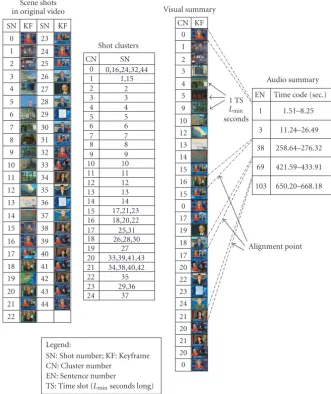
Figure4: Audiovisual summarization of a 12-minute news program.
summary which provides a richer visual content and a more natural audiovisual content overview. Such audiovisual sum-maries dramatically increase the information intensity and
depth, and lead to a more effective video content overview.
Figure 4 illustrates the process of summarizing a 12-minute CNN news program reporting the Anthrax threat after the September 11 terrorist attack. The news program consists of 45 scene shots in its image track, and 117 spo-ken sentences in its audio track. Keyframes of all the shots are displayed at the left-hand side of the figure in their origi-nal time order. Obviously, this news program contains many duplicated shots which arise from video cameras switching forth and back among anchor persons and field reporters.
The user has setLsum =60 seconds andLmin =2.5
sec-onds. The shot clustering process has generated 25 distinct shot clusters, and the audio summarization process has se-lected sentences 1, 3, 38, 69, and 103 for composing the audio summary. The clustering result is shown by the table in the middle ofFigure 4. It is clear from the clustering result that
all the duplicated shots have been properly grouped into the appropriate clusters, and there is no apparent misplacement among the resultant clusters. Because the total time length of these five sentences equals 70 seconds, the actual length of the produced audiovisual summary exceeds the user speci-fied summary length by 10 seconds.
Among the five sentences comprising the audio sum-mary, four sentences have their corresponding image seg-ments containing the speakers’ faces. Each of these four au-dio sentences has been aligned with its corresponding image
segment for Lmin =2.5 seconds. The dashed lines between
the audio and the visual summaries denote these alignments.
With the actualLsum =70 seconds andLmin =2.5
sec-onds, the audiovisual summary can accommodate 28 time slots. As there are a total of only 25 distinct shot clusters, some shot clusters were assigned more than one time slot (e.g., clusters 0, 15, 17, 20, 21). To find an alignment so-lution that fulfills the two alignment constraints listed in
slots and were consequently discarded by the alignment al-gorithm (e.g., clusters 6, 7, 8, 11). The configuration of the audio and the visual summaries are displayed at the right-hand side ofFigure 4.
Video summarization examples can be viewed at
http://www.ccrl.com/∼ygong/VSUM/VSUM.html.
REFERENCES
[1] Y. Tonomura, A. Akutsu, K. Otsuji, and T. Sadakata, “Videomap and videospaceicon: tools for anatomizing video content,” inProc. ACM INTERCHI ’93, pp. 131–136, Amster-dam, The Netherlands, April 1993.
[2] H. Ueda, T. Miyatake, and S. Yoshizawa, “Impact: An interac-tive natural-motion-picture dedicated multimedia authoring system,” inProc. ACM SIGCHI ’91, pp. 343–350, New Orleans, La, USA, April 1991.
[3] A. Ferman and A. Tekalp, “Multiscale content extraction and representation for video indexing,” inMultimedia Storage and Archiving Systems II, vol. 3229 ofProceedings of SPIE, pp. 23– 31, Dallas, Tex, USA, November 1997.
[4] D. DeMenthon, V. Kobla, and D. Doermann, “Video sum-marization by curve simplification,” Tech. Rep. LAMP-TR-018, Language and Media Processing laboratory, University of Maryland, College Park, Md, USA, July 1998.
[5] M. Yeung, B. Yeo, W. Wolf, and B. Liu, “Video browsing using clustering and scene transitions on compressed sequences,” in Multimedia Computing and Networking, vol. 2417 of Proceed-ings of SPIE, pp. 399–413, San Jose, Calif, USA, 1995. [6] A. Girgensohn and J. Boreczky, “Time-constrained keyframe
selection technique,” inIEEE International Conference on Mul-timedia Computing and Systems, vol. 1, pp. 756–761, Florence, Italy, June 1999.
[7] D. Ponceleon, A. Amir, S. Srinivasan, T. Syeda-Mahmood, and D. Petkovic, “CueVideo: automated multimedia indexing and retrieval,” inProc. ACM Multimedia, vol. 2, Orlando, Fla, USA, October 1999.
[8] M. A. Smith and T. Kanade, “Video skimming and character-ization through the combination of image and language un-derstanding techniques,” inProc. CVPR ’97, pp. 775–781, San Juan, Puerto Rico, USA, June 1997.
[9] I. Yahiaoui, B. Merialdo, and B. Huet, “Generating summaries of multi-episodes video,” inProc. IEEE International Confer-ence on Multimedia and Expo, Tokyo, Japan, August 2001. [10] Y. Gong and X. Liu, “Generic text summarization using
rel-evance measure and latent semantic analysis,” inProc. ACM SIGIR, New Orleans, La, USA, September 2001.
[11] W. Press, S. A. Teukolsky, W. T. Vetterling, and B. P. Flannery, Numerical Recipes in C: The Art of Scientific Computing, Cam-bridge University Press, CamCam-bridge, UK, 2nd edition, 1992. [12] S. Deerwester, S. Dumais, G. Furnas, T. Landauer, and
R. Harshman, “Indexing by latent semantic analysis,” Jour-nal of the American Society for Information Science, vol. 41, no. 6, pp. 391–407, 1990.
[13] T. H. Cormen, C. E. Leiserson, and R. L. Rivest, Introduction to Algorithms, MIT Press, Cambridge, Mass, USA, 1990. [14] J. Goldstein, M. Kantrowitz, V. Mittal, and J. Carbonell,
“Summarizing text documents: Sentence selection and evalu-ation metrics,” inProc. ACM SIGIR ’99, Berkeley, Calif, USA, August 1999.
[15] T. Firmin and B. Sundheim, “TIPSTER/SUMMAC summa-rization analysis participant results,” inProc. TIPSTER Text Phase III Workshop, Washington, D.C., USA, 1998.
Yihong Gong received his B.S., M.S., and Ph.D. degrees in electronic engineering from the University of Tokyo in 1987, 1989, and 1992, respectively. He then joined the Nanyang Technological University of Sin-gapore, where he worked as an Assistant Professor at the School of Electrical and Electronic Engineering for four years. From 1996 to 1998, he worked for the Robotics Institute, Carnegie Mellon University as a