Scholarship@Western
Scholarship@Western
Electronic Thesis and Dissertation Repository
4-30-2018 1:00 PM
Performance Enhancement by Exploiting the Spatial Domain for
Performance Enhancement by Exploiting the Spatial Domain for
Cost, Space and Spectrum Constraint 5G Communication
Cost, Space and Spectrum Constraint 5G Communication
Golara Zafari
The University of Western Ontario Supervisor
Wang, Xianbin
The University of Western Ontario
Graduate Program in Electrical and Computer Engineering
A thesis submitted in partial fulfillment of the requirements for the degree in Master of Science © Golara Zafari 2018
Follow this and additional works at: https://ir.lib.uwo.ca/etd
Part of the Systems and Communications Commons
Recommended Citation Recommended Citation
Zafari, Golara, "Performance Enhancement by Exploiting the Spatial Domain for Cost, Space and Spectrum Constraint 5G Communication" (2018). Electronic Thesis and Dissertation Repository. 5400.
https://ir.lib.uwo.ca/etd/5400
This Dissertation/Thesis is brought to you for free and open access by Scholarship@Western. It has been accepted for inclusion in Electronic Thesis and Dissertation Repository by an authorized administrator of
With everlasting increase of connectivity demand and high speed data communication, lots
of progresses have been made to provide a sufficient quality of services (QoS). Several
ad-vanced technologies have been the cornerstone of this trend in academia as well as in industry.
Nevertheless, there are some implementation challenges, which needs to be closely
investi-gated. In this thesis, among all challenges, we elaborate on those related to number of radio
frequency (RF) chains and resource scarcity.
The principle idea behind our proposed initial solution is to exploit the spatial domain as an
additional degree of freedom. To be more specific, we benefit from spatial domain and antenna
index in a multiple-input multiple-output (MIMO) system with dual-polarized (DP) antennas
to convey the information. We develop a two-stage algorithm to groups the antennas which
ends up to the optimum performance. Another advantage of this proposed algorithm is the
complete complexity reduction of exhaustive search over the whole available space.
Moreover, due to the continuous growth of demands which results in spectrum scarcity, we
investigate the extension of long term evolution (LTE) spectrum. Such a paradigm shift is
real-ized to offload part of the data to unlicensed band, which has been initially dedicated to other
standardizations such as wireless local area networks (WLAN). As both LTE and wireless
fi-delity (Wi-Fi) networks have been widely deployed with solid infrastructures, it is significantly
important to make their coexistence viable with a cost-effective approach which inherently
re-quires the minimum protocol modification. Thus, we take the advantage of spatially located
multiple antennas of base station (BS) and access point (AP) for the sake of beamforming and
interference reduction.
In addition to network coexistence, we approach the resource scarcity from the non-orthogonal
multiple access (NOMA) point of view, where users share the frequency and time resources
and are differentiated in power domain. In particular, we closely consider those users with
limited number of RF chains. Similar to our first approach, we utilize spatial modulation (SM)
in user end and after evaluating their performance, we propose to consider the capacity of SM
NOMA to elaborate the impact of pairing on the achievable sum rate performance.
Keywords: MIMO, SM, NOMA, antenna selection
This thesis has been written by Golara Zafari under supervision of Dr. Xianbin Wang. The
ma-terial presented in Chapter three and four have been published in IEEE Vehicular Technology
Conference as follows
G. Zafari, M. Koca, X. Wang and M. G. S. Sriyananda, “Antenna Grouping in
Dual-Polarized Generalized Spatial Modulation,” 2017 IEEE 86th Vehicular Technology Conference
(VTC-Fall), Toronto, ON, 2017, pp. 1-6.
G. Zafari and X. Wang, “Cognitive Co-Existence of Unlicensed Wireless Networks through
Beamforming,” 2017 IEEE 86th Vehicular Technology Conference (VTC-Fall), Toronto, ON,
2017, pp. 1-5.
First, I would like to express my sincere appreciation to my supervisor Dr. Xianbin Wang for
his guidance and support. I would like to express my gratitude to Dr. Wang for providing me
with the opportunity to work under his supervision. It was under his guidance and support that
I was able to accomplish the program. I would also like to thank the examining committee, Dr.
Shami, Dr. Badrkhani Ajaei, and Dr. Mao for their constructive suggestions on my research
and thesis.
Special thanks to Dr. Junghoon Suh, Dr. Edward Au, and Dr. Osama AboulMagd from
Huawei Corporation for their insightful hints and helpful discussions. My sincere appreciation
to Dr. Koca for all his encouragements and valuable suggestions.
Words cannot express how grateful I am to have my lovely family. I would like to thank my
parents for their endless love, support, and advice that always enlighten my way. Many thanks
to my dear brother Zafar and his wife Elahe for making me so determined to achieve all my
goals. I miss you all. I also feel so much fortunate to have my beloved husband, Behzad. His
stubborn integrity, his knowledge, and his stickler of perfection were a true inspiration for me
to accomplish this program.
Last but not least, I would like to thank all dear friends in our research team. Specially,
Hessam, Sabin, Hao, Monica, Yanan, and Shery for all time we spend together
Abstract ii
Co-Authorship Statement iii
Acknowlegements iv
List of Figures viii
List of Tables x
List of Abbreviations, Symbols, and Nomenclature xi
1 Introduction 1
1.1 Overview of Promising Communication Technologies . . . 1
1.2 Thesis Motivation . . . 2
1.3 Thesis Objectives . . . 3
1.4 Technical Contributions of the Thesis . . . 4
1.5 Scope of Thesis . . . 4
2 Principle and Detection Analysis of Spatial Modulation 6 2.1 Modulation in Space Domain . . . 6
2.1.1 Spatial Modulation Technique . . . 7
2.1.2 Multi-stream Generalized Spatial Modulation . . . 10
2.2 Detection Algorithms . . . 12
2.2.1 Low-complex Suboptimal Linear Detection . . . 12
Zero Forcing (ZF) Detection Algorithm . . . 12
Minimum Mean Square Error (MMSE) Detection Algorithm . . . 13
2.2.3 Optimal Maximum Likelihood Detection . . . 13
2.2.4 Log-Likelihood Detection Algorithm . . . 15
2.2.5 Performance Analysis of SM with Different Detection Algorithms . . . 19
3 Antenna Selection in Dual-Polarized Generalized Spatial Modulation 23 3.1 Introduction . . . 23
3.2 System Model . . . 25
3.2.1 TITO Scenario . . . 26
3.2.2 MIMO Scenario . . . 27
3.3 Proposed Antenna Grouping . . . 29
3.3.1 Selection of Group Indicators . . . 29
3.3.2 Selection of Inner Group Antennas . . . 30
3.3.3 Feasibility of the Algorithm . . . 30
3.4 Performance Analysis . . . 32
3.5 Simulation Results . . . 33
3.6 Conclusion . . . 35
4 Co-existence of LTE and Wi-Fi in Unlicensed Band 38 4.1 Introduction . . . 38
4.2 System Model . . . 40
4.3 Wi-Fi Received Power Minimization . . . 42
4.4 UE Received SNR Maximization . . . 44
4.5 Simulation Results . . . 45
4.6 Conclusion . . . 49
4.7 Proof of Proposition 4.3.1 . . . 50
5 NOMA-based Communication with Spatial Modulation 52 5.1 Introduction . . . 52
5.2 System Model . . . 54
5.3 Average Bit Error Rate Analysis . . . 55
5.4.1 User pairing in SISO NOMA . . . 60
5.4.2 User pairing in MIMO Scenario . . . 69
5.5 Capacity of SM-NOMA . . . 70
5.5.1 Simulation Results . . . 74
6 Conclusion and Future Work 76
Bibliography 77
Curriculum Vitae 84
2.1 Illustration of SM transmission algorithm [1]. . . 8
2.2 Successive interference cancellation approach [2]. . . 14
2.3 Block diagram of SM transmission and ML detection structure [3]. . . 15
2.4 Convolutional encoder with coding rate of 1/2 [4]. . . 18
2.5 Performance analysis based on LLR detection. . . 18
2.6 Comparison of spatial multiplexing and spatial modulation, 6 bits/subcarrier. . . 20
2.7 Comparison of spatial multiplexing and spatial modulation, 10 bits/subcarrier. . 20
2.8 Comparison of MRC and ML detection of SM. . . 21
2.9 2×2 SM-MIMO and SMX comparison based on LLR detection,R= 4. . . 22
2.10 4×4 SM-MIMO and SMX comparison based on LLR detection,R= 4. . . 22
3.1 DP antenna configuration with different number of antennas, a) Nt = 8 DP antennas, b)Nt =4 DP antennas. . . 29
3.2 An example of antenna grouping considering their distance and polarizations, assumingNt =32 DP antennas,m= 3, andNa= 2. . . 31
3.3 Performance comparison of the proposed algorithm with the optimum achiev-able ABEP and UP-GSM with different spatial correlation coefficients when Na =2, for a)R=3 bpcu, b)R= 4 bpcu. . . 36
3.4 Performance comparison of the proposed algorithm with the optimum achiev-able ABEP and UP-GSM with different spatial correlation coefficients when Na =3, for a)R=3 bpcu, b)R= 4 bpcu. . . 37
4.1 Networks coexistence and undesired interference from LTE-U on Wi-Fi. . . 41
4.2 Minimum received power by Wi-Fi AP vs. QoS threshold for UE, αg = −10 dB andαh ={−20,−10,0}. . . 47
dB andαg ={−20,−10,0}. . . 48
4.4 Maximum received SNR by UE vs. power threshold for Wi-Fi AP,αg = −10
dB andαh ={−20,−10,0}. . . 49
4.5 Maximum received SNR by UE vs. power threshold for Wi-Fi AP,αh = −10
dB andαg ={−20,−10,0}. . . 50
5.1 Principal of NOMA communication with SIC detection [5]. . . 53
5.2 Performance analysis of two users with NOMA transmission and same spectral
efficiencies, i.e.,R=4. . . 58
5.3 Performance analysis of two users with NOMA transmission and different
spectral efficiencies and different number of antennas. . . 59
5.4 Capacity comparison of NOMA and OMA, SISO,a2
n =1/5 anda2m= 4/5,K = 0. 61
5.5 Capacity comparison of NOMA and OMA, SISO,a2n =1/5 anda2m= 4/5,K = 5. 61
5.6 Capacity comparison of NOMA and OMA, SISO, a2
n = 1/5 and a2m = 4/5,
S NR=20 dB. . . 62
5.7 Probability of OMA outperforming NOMA vs. 1/N0,K = 0. . . 68
5.8 Probability of OMA outperforming NOMA vs. 1/N0,K = 5. . . 68
5.9 User pairing based on sum rate capacity,α2
1 =1/5 andα
2
2 = 4/5, Nt = Nr= 4. . 74
5.10 Capacity comparison between SM-NOMA and SM-OMA, α21 = 1/5 andα22 =
4/5,Nt = Nr= 4. . . 75
2.1 SM scheme, Mapping input bits to corresponding constellation symbols and
antenna space. . . 9
2.2 G-SM scheme, Mapping input bits to corresponding constellation symbols and
antenna space,Nt = 4,Na =2,m= 2, QPSK. . . 11
2.3 Simulation parameters. . . 17
3.1 Size of the search space for different values ofNaandm. . . 31
ABER Average bit error rate
AP Access point
bpcu Bits per channel use
BS Base station
CSMA/CA Carrier sense multiple access with collision avoidance
DIFS Distributed inter-frame space
DoA Direction of arrival
DP Dual-polarized
ES Exhaustive search
ESM Enhanced spatial modulation
FDMA Frequency division multiple access
GSM Generalized spatial modulation
G-SSK Generalized space shift keying
IAI Inter antenna interference
i.i.d Independent and identically distributed
IoT Internet of things
ISM Industrial, Scientific and Medical
LAA License-assessed access
LBT Listen before talk
LLR Log-likelihood ratio
LOS Line of sight
LTE Long term evolution
MIMO Multiple-input multiple-output
ML Maximum likelihood
MMSE Minimum mean square error
MRC Maximum ratio combining
NLOS Non line of sight
NOMA Non-orthogonal multiple access
PDMA Pattern division multiple access
QoS Quality of services
QSM Quadrature spatial modulation
RF Radio frequency
SIC Successive interference cancellation
SM Spatial modulation
SMX Spatial multiplexing
SNR Signal to noise ratio
SSK Space shift keying
TDMA Time division multiple access
TITO Two-input two-output
UE User equipped
U-NII Unlicensed National Information Infrastructure
UP Uni-polarized
Wi-Fi Wireless fidelity
WLAN wireless local area networks
XPD Cross-polar discrimination
ZF Zero forcing
Introduction
1.1
Overview of Promising Communication Technologies
It has been known that communication industry is the main leading industry for future life.
According to statistics [6], the global spending of this industry is estimated to approach 1428.9
billion U.S. dollars in 2018 and it keeps increasing even more in future. Applications of such
an industry demand for wide rang of requirements from high speed video streaming and
aug-mented reality to low-data/power-limited internet of things (IoT) devices and health-care
ser-vices. Obviously, providing such a diverse quality of service (QoS) including high speed, low
data rate, enhanced reliability and coverage neither can be achieved with the current wireless
infrastructure, nor by redesigning a single entity in mobile communication systems. Instead, it
can be achieved solely based on combination of several advanced transmission technologies.
To address the high data rate-centric demands, novel technologies such as small-cell
com-munication, densification, massive multiple-input multiple-output (MIMO) comcom-munication,
and millimeter wave communication have become the roadmap for telecommunication
indus-try and new standardizations [7].
Nevertheless, there are some bottlenecks in aforementioned technologies that make their
deployment to be challenging. The main challenges arise as a results of space limitation, power
restrain, and spectrum scarcity.
1.2
Thesis Motivation
As mentioned in the previous section, limited space, available power, and spectrum scarcity are
the main limitations in communication systems. As an example, massive MIMO is realized by
placement of the large number of antennas (in order of hundreds). Nevertheless, positioning
of these antennas together with all their analog elements (such as phase shifters and power
amplifiers) is subject to violate the cost and power limitation. On the other hand, packed
an-tenna implementation creates spatial correlation and degrades the performance of transmission.
Therefore, it is necessary to design a new transmission strategy with reduced radio frequency
(RF) chain while providing a reasonable data rate.
Another problem that arises with large number of antennas is energy consumption. To be
specific, every antenna element is accompanied by a RF chain and thus, increasing number of
antennas requires more RF chains. Moreover, each RF chain contains power amplifier (PA).
Considering the fact that 70% of the total energy in a base station (BS) is consumed by PA and
dissipated as heat [8], novel hardware design is a vital factor from energy/power efficiency point
of view. The significant of new power efficient technology with limited number of RF chains
becomes even more critical for applications such as low-power wearable and IoT devices. For
these reasons, designing a new transmission approach with sufficient trade-offbetween number
of RF chains and data rate needs to receive close study.
Spectrum scarcity is another limiting factor of future densified networks. One approach
to deal with this problem is to share the spectrum, which can be realized in either licensed or
unlicensed band. Spectrum sharing in licensed band has been widely studied under the main
category of horizontal and vertical sharing [9]. In horizontal spectrum sharing, entities have
the same priority while in vertical sharing, the secondary user has lower priority in comparison
with the primary user. Seeking the additional spectrum has further led to idea of benefiting
unlicensed band and offloading part of the long term evolution (LTE) data to the underutilized
unlicensed spectrum. Considering the fact that 2.4 GHz Industrial, Scientific and Medical
(ISM) and 5 GHz Unlicensed National Information Infrastructure (U-NII) bands are utilized by
low-power wireless local area networks (WLAN) enabled devices, shifting LTE to unlicensed
Another approach to cope with the resource scarcity and support the high traffic demand is
to create an overlap in the resources assigned to different users. In the conventional multi-user
techniques, orthogonal resources (non-overlapping resources) are assigned to different users
and thus the interference has been eliminated. Evidently, the number of users that can be served
is limited to the amount of resources. To address this restriction, a new direction of study,
namely non-orthogonal multiple access (NOMA) has become of broad and current interest.
Thanks to non-orthogonality aspect of NOMA, the number of users can be enlarged regardless
of available resources. It is worth mentioning that the space and power constraints as explained
earlier are even more emphasized in user ends, which highlights the significance of new energy
efficient transmission scheme which can be applied to users under NOMA transmission.
1.3
Thesis Objectives
The main objective of this thesis is to study the aforementioned challenges and difficulties of
next generation of wireless communication systems and develop novel approaches to alleviate
these problems. To be more specific, we aim to
• Design and evaluate a compact implementation of MIMO systems and reduce the number
of RF chains. Implementation of such a compact and energy efficient system is vital in
many applications specificly in low-power devices such as wearable devices and IoT
applications.
• Develop a spatially and efficient strategy for the coexistence of wireless fidelity
(Wi-Fi) and LTE networks in unlicensed band which barely depends on modification in the
current network infrastructure and protocols. In particular, we consider the interference
reduction of one network on the other one to provide a cost-effective concurrent networks
environment.
• Improve the network capacity with NOMA and for limited-power users who have
con-straint on the number of RF chains. It is crucial to achieve a sufficient capacity with
capac-ity by assigning the overlapped resources to the users while preserving the requirement
of energy-efficient single RF chain.
1.4
Technical Contributions of the Thesis
The main contribution of the thesis is as follows:
• In Chapter 3 we propose a novel two-stage optimum antenna grouping scheme in
gen-eralized spatial modulation (GSM) with dual-polarized (DP) antennas. In the first stage
of the proposed scheme, we select antennas with their polarizations as group indicators
followed by the second stage, which determines the potential antennas and polarizations
that can be selected within each group. The proposed algorithm directly chooses the
activated antennas and therefore, completely eliminates the necessity of search over an
extensive space.
• In Chapter 4, we propose to use the space dimension and beamforming to facilitate the
effective coexistence and inter-network coordination. Two distinct approaches to
eval-uate the proposed coexistence mechanism, namely, Wi-Fi received power minimization
and LTE user signal to noise ratio (SNR) maximization, have been investigated. The
two proposed algorithms are simulated to show the potential and effective feasibility of
coexistence between Wi-Fi and LTE in unlicensed spectrum.
• Chapter 5 focuses on muli-user scenario. We consider the uplink transmission where
each user is constraint with single RF chain due to the space consideration. We
imple-ment the non-orthogonal multiple access to enhance the network capacity. Doing so, we
first, analyze the performance of SM-based uplink NOMA transmission. Moreover, we
propose a capacity-based pairing strategy for users with SM transmission.
1.5
Scope of Thesis
The concept of SM (which is the fundamental building block for rest of the thesis) has been
discussed in Chapter 2 followed by literature survey. After that, various detection algorithms
have been introduced (including zero forcing (ZF), minimum mean square error (MMSE),
suc-cessive interference cancellation (SIC), maximum likelihood (ML), and log-likelihood ratio
(LLR)). At the end of the Chapter, performance analysis of SM with different detection
algo-rithms (together with their advantages and disadvantages) have been discussed.
In Chapter 3 we study the benefit of antenna selection in SM-MIMO system. In addition,
we consider two orthogonal polarization (whose dimension is twice the virtual system with
uni-polarized antennas) to make a compact deployment. Utilizing dual-uni-polarized antenna elements
is a promising solution to the problem of space limitation in MIMO system while creating a
sufficient inter-antenna correlation. Such a compact implementation is even more favorable in
scenarios when the number of antennas increases as in the case of massive MIMO.
In Chapter 4, we take advantage of inherent aspect of LTE anf Wi-Fi networks, i.e., multiple
antennas, to steer the beam into the desired direction and thus alleviate the inevitable impact
of LTE deployment in unlicensed band on the performance of Wi-Fi operators. To be more
specific, we start with the system model including the coexistence of networks and optimize the
beamforming weights in two different approaches, namely Wi-Fi received power minimization
and LTE user SNR maximization.
In Chapter 5, we investigate the uplink transmission with NOMA for the users with limited
number of RF chains. In particular, we consider the users utilizing SM and we apply the
suc-cessive interference cancellation to detect the massage. After that, we look into the achievable
Principle and Detection Analysis of
Spatial Modulation
2.1
Modulation in Space Domain
In communication systems, the characteristics of a signal does not, by nature, match the
char-acteristics of channel. That is why a transmitted signal is preprocessed before being conveyed,
so that it meets the essential properties of the channel. Modulation, is a process of modifying
signal such that it can be fit to channel. Conventionally, there are three main features of the
signal that can be exploited to carry different information resulting in the following modulation
schemes:
• Frequency modulation (FM)
• Amplitude modulation (AM)
• Phase modulation (PM)
Accordingly, in MIMO communication, every signal corresponding to a particular antenna is
being modulated individually. Nevertheless, MIMO systems are suffering from certain
chal-lenges, such as inter antenna interference (IAI), and synchronization error. Another difficulty
in MIMO communication is related to number of RF chains. On one side (depending on the
application and/or for economical and environmental reasons), there may not be enough space
for large number of RF chains. On the other side, each RF chain contains a power amplifier,
which is the most power hungry component of the circuit. Therefore, increasing number of
RF chains is prohibitive as it reduces the energy efficiency of the system, which is vital for
low-power applications such as in IoT devices.
In order to address these challenges while benefiting from space dimension, new
modu-lation scheme is required for the next generation of wireless communication systems. One
promising solution, which have become of broad and current interest, is known as index
mod-ulation. One approaches to implement index modulation is to solely utilize the antenna index
(instead of signal itself) for the sake of information conveyance. This method is known as space
shift keying (SSK) modulation [10], where the input bit stream enters into SSK mapper and
works as a switch between transmit antenna elements. In other words, only a single antenna
is used at any particular transmission instance to propagate the power and rest of the antenna
elements are de-active. More general form of SSK is proposed in [11] and is well-known as
generalized SSK (G-SSK) modulation. In this G-SSK, Na antennas are simultaneously
acti-vated to propagate the power.
While SSK and G-SSK benefit from simple and low-cost implementation, they suffer from
low data rates. Therefore, in order to increase the spectral efficiency, the active antennas at
SSK and G-SSK can be deployed to transmit a conventional constellation symbol. The idea
of transmitting a symbol constellation from single active antenna is proposed by Mesleh et
al.[12], which is recognized as spatial modulation (SM).
2.1.1
Spatial Modulation Technique
As mentioned earlier, unlike SSK modulation, where input bits operates as a switch to select
an antenna, in SM the input bit stream is divided into two portions as shown in Fig. 2.1a
by S1 and S2. Throughout the transmission, one part, say (S2), is used to switch between
antennas, i.e., assuming two transmit antennas, first and second antenna is switched on when
S2 is zero and one, respectively. Subsequently, the other part of data stream (S1) is mapped to
the constellation space, which will be further transmitted by the activated antenna.
(a) Using part of an input stream to switch between transmit antennas.
(b) Constellation symbols transmitted over different antennas at first transmission instant.
(c) Constellation symbols transmitted over different antennas at second transmission instant.
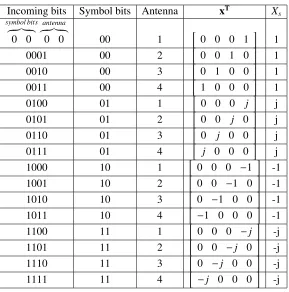
Table 2.1: SM scheme, Mapping input bits to corresponding constellation symbols and antenna space.
Incoming bits Symbol bits Antenna xT X
s symbol bits
z }| { 0 0
antenna
z }| {
0 0 00 1 h 0 0 0 1 i 1
0001 00 2 h 0 0 1 0 i 1
0010 00 3 h 0 1 0 0 i 1
0011 00 4 h 1 0 0 0 i 1
0100 01 1 h 0 0 0 j i j
0101 01 2 h 0 0 j 0 i j
0110 01 3 h 0 j 0 0 i j
0111 01 4 h j 0 0 0 i j
1000 10 1 h 0 0 0 −1 i -1
1001 10 2 h 0 0 −1 0 i -1
1010 10 3 h 0 −1 0 0 i -1
1011 10 4 h −1 0 0 0 i -1
1100 11 1 h 0 0 0 −j i -j
1101 11 2 h 0 0 −j 0 i -j
1110 11 3 h 0 −j 0 0 i -j
1111 11 4 h −j 0 0 0 i -j
constellation symbol. This example requires two bits of input for the spatial domain and
an-other two bits for the constellation symbol ( which results in transmission of 4 bits at each
transmission time). For the sake of illustration, assume the input bits in a particular
transmis-sion instant is 1110. Such an input can be further divided into 11 and 10 (as explained before).
The first part (11) is mapped to the antenna space and thus it activates the fourth antenna, which
is shown by color red. Notice that rest of the antennas are silent. The second part of the
in-put bits (10) is assigned to the constellation diagram, which correspond to the third symbol in
QPSK and is highlighted by color yellow in the Figure. As a result, the constellation symbol
corresponding to input 10 is transmitted over fourth antenna element.
Alternatively, Fig. 2.1c gives an example of another transmission instance, when the input
2.1.2
Multi-stream Generalized Spatial Modulation
As in the case of SSK and G-SSK, SM can be generalized to trigger 1 < Na < Nt antennas
and transmit more than one symbol at a given transmission attempt. As such, generalized
spatial modulation (G-SM) takes the advantages of conventional SM as well as benefiting from
diversity gain. It worth mentioning that, deciding on an appropriate number of active antennas
(Na) is an important factor as it brings a trade of between complexity and data rate. For the
purpose of illustration, notice that there are
Nt Na
different combinations to selectNaantennas
from the totalNttransmitters. On the other hand, consideringmbits to select a set of antennas
containingNaelements results in 2mchoices, which causes
M Na 2m
distinct options. As an
example, consider a system with 4 transmit antennas out of which only 2 active antennas are
required. Furthermore, assumem=2. In such an example, there exists
4 2
=6 sets including
two antennas among which only 2m = 22 = 4 sets can be used for the transmission. This
results in 6 4
= 15 different combinations. Notice that, increasing the number of transmit
antennas dramatically enlarges the number of combinations, each with different performance
[13]. Therefore, to address the challenge of selecting the optimum set of antennas by a feasible
approach, that eliminates the exhaustive search over entire set of combinations, is vital and
subject of the next Chapter.
An example of G-SM bit mapping strategy from input bits to antenna space and symbol
constellation is tabulated in Table 2.2. In this example, two activated antennas out of four
transmit antennas are used to convey a QPSK symbol.
In addition to enhanced spectral efficiency, G-SM has another advantage over SM
trans-mission. Particularly, unlike SM, where number of transmit antennas has to be a power of two,
G-SM does not have any constraint in this regard.
In addition to SSK/G-SSK and SM/G-SM, there are other methods to spatially modulate
the signal while increasing the spectral efficiency. Examples of these methods are quadrature
mention-Table 2.2: G-SM scheme, Mapping input bits to corresponding constellation symbols and
an-tenna space,Nt =4, Na= 2,m= 2, QPSK.
Incoming bits Symbol bits Antennas xT X
s symbol bits
z }| { 0 0
antenna index
z }| {
0 0 00 (1,2) √1
2
h
1 1 0 0 i 1
0001 00 (3,4) √1
2
h
0 0 1 1 i 1
0010 00 (2,3) √1
2
h
0 1 1 0 i 1
0011 00 (4,1) √1
2
h
1 0 0 1 i 1
0100 01 (1,2) √1
2
h
j j 0 0 i j
0101 01 (3,4) √1
2
h
0 0 j j i j
0110 01 (2,3) √1
2
h
0 j j 0 i j
0111 01 (4,1) √1
2
h
j 0 0 j i j
1000 10 (1,2) √1
2
h
−1 −1 0 0 i -1
1001 10 (3,4) √1
2
h
0 0 −1 −1 i -1
1010 10 (2,3) √1
2
h
0 −1 −1 0 i -1
1011 10 (4,1) √1
2
h
−1 0 0 −1 i -1
1100 11 (1,2) √1
2
h
−j −j 0 0 i -j
1101 11 (3,4) √1
2
h
0 0 −j −j i -j
1110 11 (2,3) √1
2
h
0 −j −j 0 i -j
1111 11 (4,1) √1
2
h
−j 0 0 −j i -j
ing that non of the aforementioned spatial modulation techniques requires any channel state
information at the transmitter.
In summary, deploying a MIMO system brings a number of challenges, some of which are
itemized as follows and can be eliminated by spatial modulation techniques:
• Transmission of multiple bit streams requires the inter- antenna synchronization at the
transceiver sides.
• Each RF chain consists of PA, which in turn is the most power hungry component of the
system. Therefore, as the number of RF chain increases, the energy and power-efficiency
decreases.
• Inter-channel interference, which is a result of conducting multiple antennas degrades
2.2
Detection Algorithms
While the benefits of MIMO systems are well known for the future communication systems,
yet another difficulty of MIMO systems arises at the receiver side during the signal detection.
In general, detection algorithms fall into two main categories, i.e., linear and non-linear
detec-tions, some of which are discussed in this Section.
2.2.1
Low-complex Suboptimal Linear Detection
Linear detection algorithms aim to detect all transmitted streams at once by reversing the effect
of channel. Nevertheless, detection of all streams together reduces the diversity order.
Zero Forcing (ZF) Detection Algorithm
In ZF detection algorithm, the received signal is multiplied by inverse of the channel matrix to
achieve
H−1y=x+H−1n. (2)
This equation can be further used to detect the transmitted signalx. In other words, the weight
matrix in ZF is defined as WZF = H−1. Notice that in some practical applications, different
number of antennas are located at the transmitter and receiver. In such cases, the inverse of the
channel matrix can be replaced by its psudo-inverse and thus
WZF =
HHH−1HH. (3)
It is also worth mentioning that, maximum ratio combining (MRC) approach is a spatial
case of ZF. In particular, in scenarios, where there are single transmit antenna and multiple
Minimum Mean Square Error (MMSE) Detection Algorithm
Considering the last term in (2), one can notice that when the channel is in deep fade, i.e.,
chan-nel coefficients are close to zero, noise component enhances and deteriorates the performance
of detection. Therefore, in order to alleviate noise enhancement, another approach has been
proposed to find the weight matrix at the receiver side, which is based on minimizing the mean
square error and can be written as
WM MS E = min
W E
n
kx−Wyk2o
=min
W E
n
(x−Wy)H(x−Wy)o.
Taking the derivative of the above equation with respect to Wand set it to zero results in the
WM MS Erepresented by
WM MS E =
HHH+N0I
−1
HH. (4)
2.2.2
Successive Interference Cancellation Detection
To further improve the detection performance with acceptable increase in complexity, a series
of linear detection algorithms can be deployed in a multi-stream communication systems. In
this approach, every stream is reduced from the received signal after being detected. This
method is well-known as successive interference cancellation (SIC). For the sake of illustration,
the block diagram of such an algorithm is shown in Fig. 2.2.
2.2.3
Optimal Maximum Likelihood Detection
Similar to SIC, maximum likelihood detection is a non-linear detection. Notice that likelihood
function of received signalyis defined as the following probability
P(y|H,x)= √ 1
2πN0
e
−||y−Hx||2
Figure 2.2: Successive interference cancellation approach [2].
in whichN0is the variance of noise. To detect the transmitted signal, likelihood function needs
to be maximized, which alternatively is equivalent to minimizing the following distance metric
ˆ
x=arg min
∀x
ky−Hxk2, (6)
for all possible constellation symbols.
Notice that although ML detection is computationally expensive (as it searches through
all possible constellations) in comparison with linear detection algorithms, implementation of
ML on SM (shown in Fig. 2.3) achives lower complexity compared to ML detection in spatial
multiplexing (SMX). To be more specific, MIMO-SM with ML detection has 200(Nt−1)/(2Nt+
1)% complexity reduction in comparison with ML detection in SMX with the same spectral
efficiency [3]. That means 40% and more than 66% complexity reduction for systems with two
Figure 2.3: Block diagram of SM transmission and ML detection structure [3].
2.2.4
Log-Likelihood Detection Algorithm
The above mentioned detection algorithms are known as hard decision algorithms.
Neverthe-less, in order to reduce the information loss, other detection algorithms have been proposed
based on soft information. An example of such an algorithm is log-likelihood ratio (LLR) [2].
In MIMO systems, it is convenient to deploy soft decision in two steps. In the first stage,
a linear decoder is deployed to separate different bit streams, each of which can be further
considered for LLR calculation. To illustrate, let us consider a received signal as
y =
h1· · ·hNt
x+n
= h1x1+· · ·+hNtxNt +n. (7)
Then, the received signal can goes through the linear combination (using wi) to separate the
i-th bit as
ˆ
xi = wiy
Notice that, as in the last Section,wiisi-th row of matrixWcorresponding to either MMSE or ZF. In (8), desired component, interference and noise component are
di = wihixi, (9)
Ii =
Nt
X
j=1, j, i
wihjxj, (10) and
ni =win, (11) respectively. In addition, considering independent noise and interference, the overall undesired
signal is a zero mean Gaussian random variable with variance of
σ2 i =
Nt
X
j= 1, j,i
wihj
2
E
xj
2
+kwik2σ2n. (12)
Therefore, the conditional probability of estimating the i-th symbol given the exact value is
obtained by
f ( ˆxi|xi)= 1
q
2πσ2 i
exp −|xˆi−di|
2
2σ2i
!
. (13)
Assuming L-ary modulation, each symbol contains log2(L) bits. Notice that, considering a
certain bit ini-th symbol, sayl-th bit (bi,l), theL-ary modulation space can be divided to two
subsets, i.e., those withbi,l = 0 and those withbi,l = 1, which can be represented byS0i,l and
S1
i,l. As such, the LLR corresponding to thel-th bit ofi-th symbol can be evaluated as
LLR bi,l = ln P x∈S1
i,l
f ( ˆxi|x) P
x∈S0
i,l
f ( ˆxi|x)
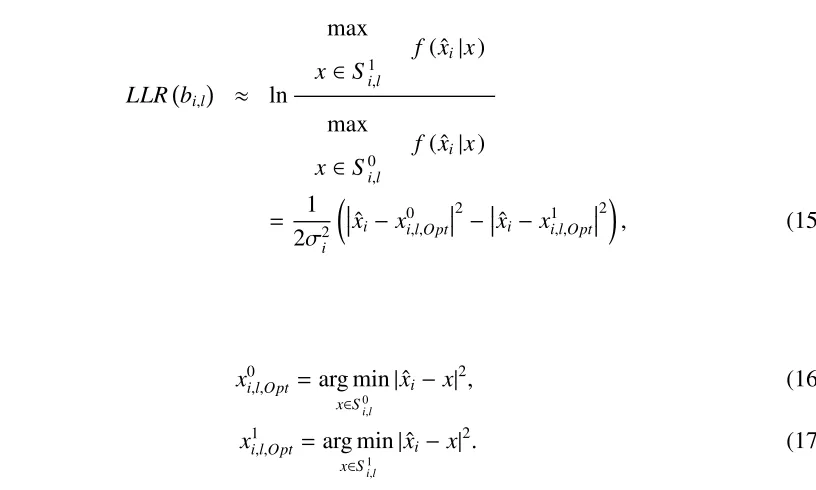
which can be approximated as
LLR bi,l ≈ ln
max
x∈S1i,l
f( ˆxi|x) max
x∈S0i,l
f( ˆxi|x)
= 1
2σ2i
xˆi−x
0 i,l,Opt
2
−
xˆi−x
1 i,l,Opt
2
, (15)
where
x0i,l,Opt =arg min x∈S0
i,l
|xˆi− x|2, (16)
x1i,l,Opt =arg min x∈S1i,l
|xˆi− x|2. (17)
Based on above equations and for the sake of illustration, we consider a 2×2 MIMO system
and evaluate the performance of LLR detection for different spectral efficiencies, namely, 8
bpcu and 4 bpcu. The results of Monte Carlo simulation is depicted in Fig. 2.5. We consider
the convolutional code with coding rate of 1/2, with block diagram shown in Fig. 2.4.
The channel is assumed to follow Rayleigh distribution and the Viterbi algorithm has been
deployed at the receiver with trace-back length of 32. These parameters are summarized in the
Table 2.3.
Table 2.3: Simulation parameters.
Parameter Value
Nt 2
Nr 2
Coding rate 1/2
Coding scheme Convolutional code
Trace back length for Viterbi algorithm 32
Polynomials 1111001=171(Oct)
Figure 2.4: Convolutional encoder with coding rate of 1/2 [4].
0 5 10 15 20 25 30
SNR(dB)
10-3 10-2 10-1 100
Average bit error rate
2 2 MIMO, 16QAM 2 2 MIMO, 4QAM
2.2.5
Performance Analysis of SM with Di
ff
erent Detection Algorithms
As explained earlier, in SM, as opposed to the conventional MIMO systems, a single antenna
is activated and the index of transmit antenna is used for the sake of information transmission.
As a result, one RF chain is needed. Thanks to single RF chain requirement, energy efficient
SM is a promising communication technology for future green transmission systems [1]. It is
also worth mentioning that in conventional MIMO systems, number of receive antennas needs
to be greater than those in transmitter, so that we can be able to apply MMSE or ZF.
Never-theless, as in the future wireless communication systems (such as in massive MIMO), where
number of transmit antennas is dramatically larger than number of receive antennas
(consider-ing downlink), SM becomes more favorable [3]. In addition to energy efficiency, SM reduces
the detection complexity. Maximum likelihood, which is known for its optimality and has
been proposed in [14], reduces the detection complexity fromO(MNt) in MIMO multiplexing
toO(MNt) in SM (assumingNt transmit antennas and constellation size ofM). Other types of
sub-optimal detection algorithms for SM-MIMO have been proposed, which further reduces
the complexity. Among all suboptimal detection approaches, [15] has proposed the separate
detection of the index information and symbol constellation and has become one of the most
important approaches. This separation and the fact that only a single antenna is activated allows
us to take advantage of simple MRC approach. As a result, the detection complexity reduces
toO(Nt+M).
In this section, we consider the performance of SM and compare the results with SMX
transmission having the same spectral efficiency. Notice that in SMX different antennas
trans-mit different bit streams and thus number of RF chains is equal to number of transmit antennas.
Let us start with the optimum detection algorithm, i.e., ML detection. In SM, the receiver uses
the ML to jointly detect the transmitted symbol as well as antenna indices.
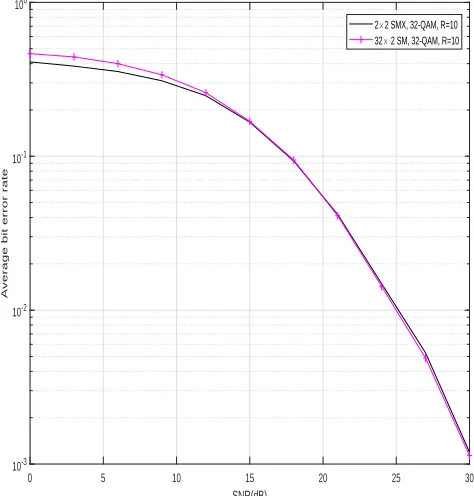
We have made the comparison for different spectral efficiencies, i.e., R=6 and 10 bits per
channel use (per subcarrier), which have been shown in Fig. 2.6 and Fig. 2.7, respectively. In
SMX, we consider MIMO configuration with 2 antennas at the transmitter and receiver sides
and the performance has been depicted with black line while different MIMO configurations
0 5 10 15 20 25 30
SNR(dB)
10-5 10-4 10-3 10-2 10-1 100
Average bit error rate
2 2 SMX, 8PSK, R=6 2 2 SM, 32-QAM, R=6 4 2 SM, 16-QAM, R=6 8 2 SM, 8PSK, R=6
Figure 2.6: Comparison of spatial multiplexing and spatial modulation, 6 bits/subcarrier.
0 5 10 15 20 25 30
SNR(dB)
10-3 10-2 10-1 100
Average bit error rate
2 2 SMX, 32-QAM, R=10 32 2 SM, 32-QAM, R=10
Considering spectral efficiency of 6, (Fig. 2.6), simulation results show that increasing the
number of antennas, while utilizing a single RF chain, SM outperforms the MIMO system with
SMX transmission. Likewise, for higher spectral efficiency, i.e., R=10 bpcu shown in Fig. 2.7,
large number of antennas enables SM to achieve the performance of SMX while benefiting
from low cost and power efficient implementation.
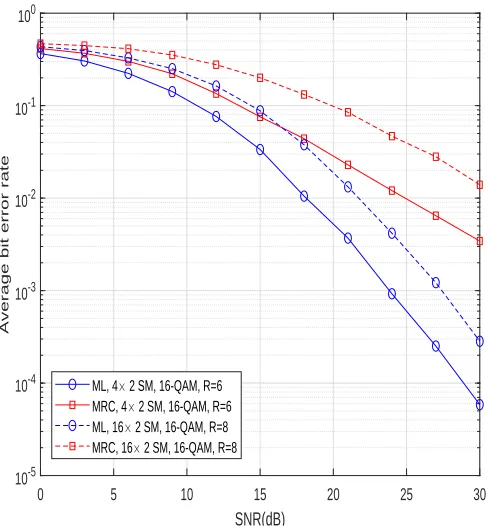
Fig. 2.8 shows the performance of SM in terms of ABER based on MRC detection and its
comparison with ML algorithm. Notice that, in SM with MRC algorithm, detection of
constel-lation symbols depends on the estimation of activated antenna index and thus if the antenna
index is detected erroneously, the symbol estimation would be highly incorrect. This results
can be seen in Fig. 2.8, where the joint detection of antenna index and symbol constellation,
i.e., ML detection, outperforms the MRC approach.
0 5 10 15 20 25 30
SNR(dB) 10-5
10-4 10-3 10-2 10-1 100
Average bit error rate
ML, 4 2 SM, 16-QAM, R=6 MRC, 4 2 SM, 16-QAM, R=6 ML, 16 2 SM, 16-QAM, R=8 MRC, 16 2 SM, 16-QAM, R=8
Figure 2.8: Comparison of MRC and ML detection of SM.
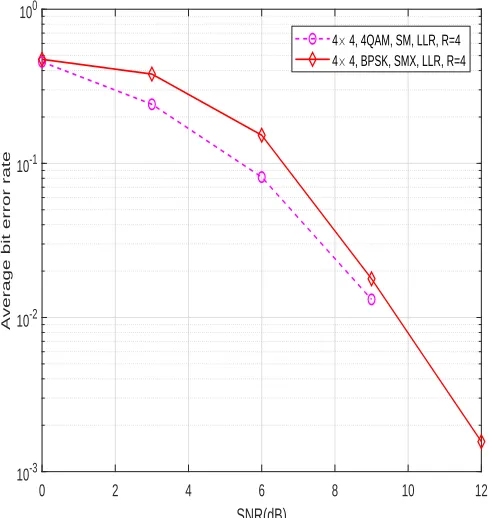
Finally, we have made the comparison of SM and SMX with LLR detection. Two different
MIMO configurations are shown in Fig. 2.9 and Fig. 2.10. Comparing two aforementioned
Figures, one can see that for the same spectral efficiency, increasing the number of antennas
0 2 4 6 8 10 12 14 16 18 20 SNR(dB)
10-3 10-2 10-1 100
Average bit error rate
2 2, 8QAM, SM, LLR, R=4 2 2, 4QAM, SMX, LLR, R=4
Figure 2.9: 2×2 SM-MIMO and SMX comparison based on LLR detection,R=4.
0 2 4 6 8 10 12
SNR(dB) 10-3
10-2 10-1 100
Average bit error rate
4 4, 4QAM, SM, LLR, R=4 4 4, BPSK, SMX, LLR, R=4
Antenna Selection in Dual-Polarized
Generalized Spatial Modulation
3.1
Introduction
The anticipated 1,000 times of dramatic capacity increase in 5-th generation (5G) wireless
networks has created many fundamental challenges. To meet the network capacity of 5G,
mas-sive multiple-input multiple-output (MIMO), which utilizes antenna array with a large number
of elements, has been widely considered as a critical enabling technology for 5G due to its
advantage of significantly increased spatial frequency reuse factor through the beamformed
spatial transmission. However, the number of RF chains (which dominates the implementation
cost of MIMO systems), needs to be equal to the number of antennas in conventional MIMO
systems. Consequently, this requirement will drastically increase the implementation cost of
massive MIMO systems due to a large number of antennas involved. As an alternative,
spatial-modulation emerges as one promising solution to benefit from a large number of antennas
while having limited number of RF chains, without sacrificing the data rate.
Spatial modulation (SM) is a relatively new transmission scheme, which uses the space
dimension of antenna array to convey part of the bit stream to be transmitted [12]. In
partic-ular, part of the input bits is used to select an antenna to be activated while the other part is
mapped onto the symbol that is transmitted through the selected antenna. Moreover, while SM
is deployed over the MIMO systems, it uses only one activated antenna, which significantly
reduces the complexity of the transceivers.
During the recent years, SM is widely considered in literature and its potential benefits
and challenges are evaluated [1]. The advantages of SM in large-scale MIMO systems is
considered in [16]. In addition, the gain achieved by antenna selection in SM is addressed
in [17] considering Euclidean distance and capacity of the system, while in [18], the authors
use circle packing algorithm to maximize the minimum geometric distance between antennas
to minimize the average bit error probability (ABEP) of SM-MIMO. Note that SM is a special
case of generalized SM (GSM), where more than one antenna are used to convey the bit stream
[19, 20]. As indicated in [21], as the number of transmit antennas increases, GSM outperforms
the conventional SM and therefore is preferable in massive MIMO. Nevertheless, the authors in
[13] show that the performance of GSM varies depending on the different antenna grouping and
not all of the antenna combinations benefit from sufficiently low ABEP. However, selecting an
antenna group which results in the best performance using the exhaustive search is intractable.
Therefore, to fill this gap, we present a novel and direct antenna grouping in GSM and remove
the necessity of search.
On the other hand, the performance of GSM-MIMO systems deteriorates substantially with
increased correlation among antennas due to insufficient inter-antenna spacing. In other words,
to have adequate uncorrelated channels, antennas should be implemented in the order of half
of the wavelength away from each other. However, by increasing the number of antennas in
large-scale MIMO systems, this space requirement cannot be met with the space constraint of
the transceivers. In addressing this, one promising approach to cope with the space limitation
is to use dual-polarized (DP) antennas [22–26]. Two orthogonal polarizations can be utilized
to differentiate the channels and impose an additional correlation due to the polarization
mis-match. The aforementioned correlation is known as cross-polar discrimination (XPD) and its
impact on the performance of antenna selection is considered in [27]. To take advantage of
DP-MIMO, while exploring the space dimension and benefiting from the performance of the
best antenna groups in GSM, we analyze a novel method to directly determine the optimum
antenna groups in DP-GSM.
The overall contributions of this Chapter are as follows: We analyze a MIMO system
GSM scheme, we propose a two-stage algorithm to determine the optimum antenna groups and
activate antennas within each group. In the first stage, we develop the procedure of selecting
a representative antenna and its polarization for each group. In the second stage, we establish
an algorithm to select antennas within each group to benefit from the advantages of GSM. We
use the average bit error probability (ABEP) of the system to evaluate the performance of the
proposed scheme and validate it by making a comparison with ABEP of the optimum antenna
grouping in DP-GSM, which is obtained by the exhaustive search. In addition, we compare the
performance of the proposed antenna grouping in DP-GSM system with the optimum
perfor-mance of the system with uni-polarized (UP) antennas, whose number of antennas are twice as
many as that of DP-MIMO.
The Chapter is organized as follows: In Section II, we introduce the system model and
characteristics of the DP channel. The proposed algorithm on DP GSM is provided in Section
III followed by the performance analysis in Section IV. We present the simulation results in
Section V and conclude the Chapter in Section VI.
3.2
System Model
We consider a MIMO system withNt and NrDP antennas at transmitter and receiver,
respec-tively, which leads to a 2Nt×2Nr dimensional channel between transmitter and receiver. We
useNt DP antennas to transmitm+`bits at each transmission instance. Therefore, the spectral
efficiency of such a system isR = m+` bits per channel use (bpcu). In other words, at each
transmission instant, m+` bits are chosen from the incoming bit stream. ` bits are mapped
onto theL-ary symbol space, where L=2`andX=
X1, . . . Xk, . . . XL
represents the
set of constellation symbols. The other m bits are used to select one antenna group
contain-ing Na antennas. In this work, we do not consider mapping optimization and therefore, both
bit-to-antenna and also bit-to-symbol are uniformly mapped. Notice that the transmitted signal
can be represented by a 2Nt ×1 vectorxu,s, whose entries are 0 in all butNa positions, which
denote the indices of activated antennas inuth group. We assume that allNaactivated antennas
transmit the same symbols ∈Xand therefore, the values of all non-zero elements of transmit
constraint of unity for transmitted signal, i.e.,Ex h
xu,sHxu,s= 1 i
.
The transmit signal vector,xu,s, is then transmitted over a DP-MIMO channel and received
by an array of 2Nrantennas as
y= √1
Na
Hxu,s+ν (1)
where division by √Na is for the purpose of power normalization. y andν are the 2Nr ×1
vectors representing received signal and channel noise, respectively. The elements of ν are
independent identically distributed (i.i.d.) complex Gaussian variables with zero mean and
varianceN0, i.e.,νk ∼ CN(0,N0) fork= 1, . . . ,2Nr, thus signal to noise ratio (SNR) is defined
byS NR = η = Es
N0 =
1
N0. Hrepresents the 2Nr×2Nt channel matrix between transmitter and
receiver whose elements are possibly correlated complex Gaussian random variables. Unlike
uni-polarized antennas, correlation in MIMO channel with DP antennas includes the
polar-ization effects within each DP antenna as well as spatial correlation due to the insufficient
space between antennas. To shed lights on the impact of different correlation matrices, we first
consider the single DP antenna at transmitter and receiver, which is also known as two-input
two-output (TITO) system in the following subsection and exhibit the effect of polarization
correlation. Consequently, we extend the TITO to MIMO scenario and present the impact of
spatial correlation.
3.2.1
TITO Scenario
We consider a TITO system, where only one dual-polarized antenna is deployed at the
trans-mitter and receiver. Therefore, the equivalent channel His a 2 ×2 matrix. If the channel is
not rich enough to adequately distinguish different polarizations, the channel would be affected
by the polarization correlation (XPC) between orthogonal polarization directions. However, as
stated in [28], the polarization correlations are small can be ignored in calculations for the sake
of simplicity. However, we consider it in our analytical derivations. The effect of polarization
correlation in transmitter and receiver can be represented in matrix form as
Πt =
1 γt
γ∗ t 1
, Πr =
1 γr
respectively, where
γt =
Enhip,iph
∗ ip,ip0
o
p
µ(1−µ) =
Enhip0,iph
∗ ip0,ip0
o
p
µ(1−µ) ,
γr =
Enhjp,jph
∗ jp0,jp
o
p
µ(1−µ) =
Enhjp,jp0h
∗ jp0,jp0
o
p
µ(1−µ) ,
and 0 < µ ≤ 1 represents the amount of power leakage from one polarization to the other. In
other words,
µ = E
hip,ip0
2 =E hip0,ip
2
, (3)
where hip,ip0 represents the channel coefficient between ith antenna with pth polarization and
ith antenna with its orthogonal polarization,p0. Similarly, the rest of the power is expressed as
1−µ = E
hip,ip
2 = E hip0,ip0
2
. (4)
The power ratio of co-polar to cross polar terms are characterized by XPD as described in [24]
and shown by
χ= 1−µµ. (5)
The amount of XPD is proportional to the capability of the channel to distinguish between the
two polarization directions.
3.2.2
MIMO Scenario
In this part, we consider the more general case with Nt and NrDP antennas at the transmitter
and receiver, respectively. Accordingly, the spatial correlation between antennas due to the
insufficient spacing of antennas at transmitter and receiver can be represented in a matrix form,
Σt and Σr, respectively. Notice that the correlation between separated antennas
amongith and jth antenna can be calculated as in [18] [Σt]i,j =α
di,j
t (6)
where|αt|< 1 anddi,jdenotes the distance betweenith and jth antennas.
Considering the effects of polarization correlation and spatial correlation, the generalized
2Nr×2Nt dual-polarized channel matrix can be written as [24]
H= 1Nr×Nt ⊗Γ
Ψ
r
1
2H
wΨt
1
2 (7)
whereΓis the leakage matrix which can be written as
Γ= p
1−µ √µ
√
µ p
1−µ
. (8)
The operatordenotes the element-by-element Hadamard multiplication. Hwis the size 2Nr×
2Nt matrix modelling the fading part of the channel. The elements of Hw are independent
and identically distributed (i.i.d.), circularly symmetric zero mean complex Gaussian variables
with unit variance. 1Nr×Nt is an all oneNr× Nt matrix and⊗denotes the Kronecker products.
Finally, it can be shown thatΨr =Σr⊗ΠrandΨt =Σt⊗Πt.
In order to adopt the antenna configuration as in [18], we assume the number of DP transmit
antennas is a power of 2, i.e., log2(Nt) is an integer. We assume the antennas are located in a
square manner, where the number of antennas,A, in each edge of the square can be calculated
as in [18] given by
A= √
Nt if log2(Nt) is even
3×
q Nt
8 if log2(Nt) is odd.
(9)
Notice that when the log2(Nt) is an odd number, Ainner =
q Nt
8 antennas (located at the center
of the square) are removed. Fig. 3.1 demonstrates the antenna configuration when number of
(a) (b)
Figure 3.1: DP antenna configuration with different number of antennas, a)Nt = 8 DP
anten-nas, b)Nt =4 DP antennas.
3.3
Proposed Antenna Grouping
In this section, we present the antenna grouping in DP-GSM MIMO systems and deduce the
framework to selectNaantennas within each group. In this regard, first we discuss the selection
of antennas together with their polarization, which are representative of different group.
Con-sequently, we consider the selection ofNaantennas within each group. Finally, the tractability
of the algorithm is compared with exhaustive search over all possible combinations of antenna
groups.
3.3.1
Selection of Group Indicators
Consideringmbits to select a group containingNaantennas as mentioned earlier, is equivalent
to having 2mgroups of antennas. As stated in [18], the optimum performance in terms of ABEP
can be achieved when these groups are chosen such that the correlation between them is low.
Nevertheless, unlike the uni-polarized system in [18] and as stated earlier in Section II, MIMO
systems with DP antennas are influenced not only by the spatial correlation but also by the
polarization correlation. As the polarization correlation is usually low [28] and thus ignorable,
the lowest correlations are among those antennas which have the most distance from each
other in geometrical point of view, while having orthogonal polarizations. In order to be able
indicators to follow the circle packing algorithm as in [18]. However, notice that adjacent
groups suffer from more spatial correlations. Therefore, to reduce the overall correlation we
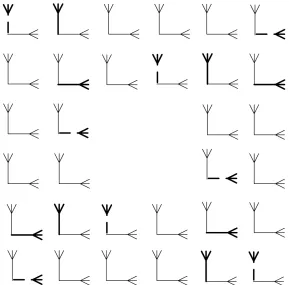
use different polarization from one group to its adjacent ones. For the sake of illustration, Fig.
3.2 presents an example of group’s indicators (including antenna location and its corresponding
polarization) by bold dashed lines. In this example, number of transmit DP antennas is 32, i.e.,
Nt =32. In addition, we assume the number of bits assigned to select a group is 3 (i.e.,m= 3),
which is equivalent to 23 = 8 groups of antennas.
3.3.2
Selection of Inner Group Antennas
Notice that there are Na antennas to be activated within each selected group. Therefore, we
suggest to select the Na antennas in each group in such a way that they are highly correlated
so that the overall correlation between different groups remains in its minimum level.
Con-sidering the fact that less spatial distance impose more spatial correlation among antennas and
as arrays with similar polarizations are impacted by higher polarization correlation, we select
Naantennas within each group as those which are close in terms of geometrical distance while
having the identical polarizations as those of the indicators . In Fig. 3.2 the activated antennas
in each group are shown as solid bold lines. We assume,Na= 2.
3.3.3
Feasibility of the Algorithm
In this Section, we evaluate the feasibility of the proposed algorithm and compare it with
the size of search space when considering the exhaustive search to find the optimum groups
of antennas to be activated. We illustrate the size of search space in exhaustive search via
an example. Suppose there are Nt antennas at the transmitter and Na activated antennas are
used to convey the information symbols. Therefore, there are
Nt Na
different combinations
of antennas. In addition, m bits from input bit stream being mapped to the antenna space is
equivalent to selection of 2mgroups of antennas out of the total
Nt Na
Figure 3.2: An example of antenna grouping considering their distance and polarizations,
as-sumingNt =32 DP antennas,m=3, andNa =2.
the search space of
Nt Na 2m
different combinations. Table 3.1 shows size of the search space
whenNt =16, and for different values ofNaandm.
m\Na 2 3
1 16 2 ! 2 = 7140 16 3 ! 2 =156520 2 16 2 ! 4 =8214570 16 3 ! 4
>4×10⁹
3 16 2 ! 8
>8×10¹¹
16 3 ! 8
>8×217
Table 3.1: Size of the search space for different values ofNa andm.
The large size of the search space in exhaustive search makes it intractable and highlights the
importance of proposed scheme. Unlike in exhaustive search, the proposed method directly
select the groups and antennas within each group together with their polarizations as explained
in Section II (sub-section A and B) and illustrated in Fig. 3.2. Consequently, the proposed
approach totally eliminates the search requirement.
Notice that Na = 1 is a special case indicating the conventional spatial modulation. In
such case, the proposed scheme reduces the dual-polarized version of the algorithm presented
in [18] which still requires following the polarization switch from one activated antenna group
to its adjacent groups.
3.4
Performance Analysis
To evaluate the accuracy of the proposed scheme, we consider the average bit error probability
(ABEP) using the well-known upper bounding relation of [29] as
¯
Pb≤ 1 2R
2m
X
u=1 2m
X
ˆ u=1
L X
s=1 L X
ˆ s=1
N(u,uˆ,s,sˆ)
R P¯s(u,uˆ,s,sˆ) (10)
where,Ris the spectral efficiency as defined before. N(u,uˆ,s,sˆ) is the number of bits in error
between the respective channel/polarization and symbol index pairs, and ¯Ps(u,uˆ,s,s) is the
corresponding average pairwise symbol error probability (APEP). Notice that each APEP is
expressed as
¯
Ps(u,uˆ,s,sˆ)= E Q r
kzk2 2 (11)
where z = √ 1
N0Na(Hxu,s −Hxuˆ,sˆ). For the sake of simplicity in the analytical derivation, we
alternatively represent thezvector in vectorized form as
z = √ 1
N0Na
Υvec 1Nr×Nt ⊗Γ
Ψ12
vec(Hw)
= √ 1
N0Na
Υdiag
vec 1Nr×Nt ⊗Γ
Ψ1 2vec(H
w)
whereΥ = xu,s−xuˆ,sˆ⊗IandΨ = ΨTt ⊗Ψr. As stated in [13], it can be shown thatzforms
a proper complex Gaussian random vector with its mean vector0and covariance matrix ofΛz
expressed as
Λz =
1
N0Na
ΥΓ0ΨΓ0†Υ†
(13)
whereΓ0 = diag
vec 1Nr×Nt ⊗Γ anddiag{.}represents a diagonal matrix. As given in [30],
the APEP in (9) can be computed by
¯
Ps(u,uˆ,s,sˆ)= 1
π
Z π2
0
Λz
4 sin2θ+I
−1
dθ. (14) Once each APEP term is computed via (14) the ABEP in (10) can be obtained conveniently.
3.5
Simulation Results
In this section, we present simulation results to evaluate the performance of the proposed
an-tenna grouping scheme in DP-GSM systems. To this end, we consider the derived ABEP in
the last Section. We assumeNt =8 andNr =1 DP transmit and receive antennas, respectively.
we assumeγ = 0.1, as larger values usually are not considered [24]. All Figures provide the
simulations for the scenarios when there are low and high spatial correlations among transmit
antennas. In all Figures, two sets of curves represent the performance of the system with low
spatial correlation between transmit DP antennas (depicted by the solid lines) and the highly
correlated DP antennas at the transmitter (dashed lines). In all simulations, we assumeαt = 0.1
for low spatial correlation and αt = 0.8 when the transmit DP antennas are highly correlated.
In all Figures and for both set of curves, we compare the performance of the proposed
algo-rithm and compare it with the best and the worst performances, which are obtained based on
exhaustive search. Thus for the sake of comparison and to achieve antennas which result in
the best and worst ABEP performances, we have evaluated the analytical derivations at a fixed
SNR, i.e., SNR=30 dB and consider exhaustive search (ES) over all possible antenna groups.
To this end and to be able to do the comparison, i.e., to make the exhaustive search tractable(
In Fig. 3.3 we assume two antennas are used (Na = 2) to transmit a QPSK and 8-PSK
symbols in different subfigure, i.e. R=3 and 4 bpcu in partaandb, respectively. Likewise, in
Fig. 3.4, we consider 3 activated antennas (Na= 3) conveying QPSK and 8-PSK constellations
in part a and b, respectively. The results indicate the tight match of the proposed antenna
grouping algorithm with the best performance. All simulated performances are compared with
the ABEP upper bounds; in the Figures, the simulated BER results are depicted only with the
markers while the ABEP upper bounds are plotted with lines.
In addition, we compare the proposed method in DP-MIMO with the best performance of
the equivalent channel with uni-polarized (UP) antenna elements. We use exhaustive search
to find the antenna groups which results in the best ABEP. Notice that the number of physical
channels in Nt × Nr DP-MIMO is equivalent to the those of the system with 2Nt ×2Nr
uni-polarized (UP) arrays. More specifically, we evaluate the performance of 16× 2 UP-MIMO
and compare it with 8×1 DP-MIMO. Notice that, since we consider the same antenna
con-figuration as in [18], 16 UP antennas occupies 4/3 more space in each edge of the square. In
other words, each edge contains 4 antennas in UP scenario while 3 DP antennas in DP-MIMO
systems. We make the comparison in both cases of low and high correlated antennas. The
per-formance of the UP-MIMO in Fig. 3.3 and Fig. 3.4 are depicted by bold lines. Notice that low
and high correlations between antennas indicate the inter-antenna spacing is large and small,
respectively.
As shown in the Figures, in low correlation channels, DP-GSM suffers for about 3 dB
performance loss while benefiting from the compact implementation. The advantages of
DP-GSM is more highlighted in high correlated channels. Notice that in practice, antennas are
implemented closed to each other (due to the space limitation), which impose higher
correla-tion between antennas. In this scenario, DP-GSM reaches the performance of UP-GSM and
yet take the advantage of close-packed deployment. These observations together with search
elimination to find the optimum antenna groups highlights the importance of the direct antenna
3.6
Conclusion
In this Chapter, we use antenna polarization to differentiate different channels while
achiev-ing compact implementation of wireless transceivers with multiple antennas. We propose a
two-stage antenna grouping scheme in generalized spatial modulation MIMO systems with
dual-polarized antennas, which leads to the lowest possible ABEP (optimum performance).
This algorithm directly selects the groups and activated antennas within each group, thus
elim-inating the requirement of searching for the groups with the best ABEP performance. The
ABEP performance of the proposed algorithm is validated by Monte Carlo simulations. We
also compare the ABEP of the proposed antenna grouping in DP-GSM with the optimum
an-tenna groups which are obtained by exhaustive search and the results from the two methods
are tightly matched. In addition, the simulation results validate the importance of the
algo-rithm to optimally group the antennas in DP-GSM as compared to UP-GSM. In particular,
when the channel is high correlated, the proposed method for DP-GSM reaches the optimum
performance of the UP-GSM with a twice as many as antennas in DP-MIMO. In low
correla-tion channels, DP-GSM is preferable in terms of physical space while suffering for about 3 dB
![Figure 2.2: Successive interference cancellation approach [2].](https://thumb-us.123doks.com/thumbv2/123dok_us/1946885.1256154/26.612.159.438.74.324/figure-successive-interference-cancellation-approach.webp)
![Figure 2.3: Block diagram of SM transmission and ML detection structure [3].](https://thumb-us.123doks.com/thumbv2/123dok_us/1946885.1256154/27.612.177.455.73.322/figure-block-diagram-sm-transmission-ml-detection-structure.webp)
![Figure 2.4: Convolutional encoder with coding rate of 1/2 [4].](https://thumb-us.123doks.com/thumbv2/123dok_us/1946885.1256154/30.612.157.438.404.659/figure-convolutional-encoder-coding-rate.webp)