ISSN 2286-4822
www.euacademic.org DRJI Value: 5.9 (B+)
An Assessment on the Level of Critical Thinking
Skills of BSIT Students at CEU-Malolos in Relation
to their Computer Programming and Mathematics
Academic Performance
JAY-ARR C. TAYAO
Asst. Professor III Centro Escolar University-Malolos College of Management and Technology City of Malolos, Bulacan Philippines
Abstract:
performance and to determine the relevance of first research conducted by the author entitled “The Relationship of Critical Thinking Skills and Problem Solving, Algorithmic-Logic Formulation Skills of Freshman Students of Bachelor of Science in Information Technology at Centro Escolar University-Malolos, S.Y. 2012-2013”
Key words: critical thinking skills, problem solving, analytical skills, logic formulation, algorithmic solution, programming, mathematics.
Introduction
The most important goal of schooling is to learn. And learning, as numerous educators have repeatedly pointed out, is a consequence of thinking. The learners’ success in school is thus heavily dependent on their inclinations as well as their abilities to think skillfully. This also holds true for success in the workplace and in most areas of civic and social life. One way to ensure that students learn more and better than they do now, and to help ensure their success in out – of – school life as well, is to help them improve the quality of their thinking (Beyer, 1997 and cited in Lopez, 2004).
unchallenging, uninteresting, and lower – order cognitive skills (Castillo, 2000).
According to Marcut (2005), promoting critical thinking and problem solving in mathematics education is crucial in the development of successful students. Critical thinking and problem solving go hand in hand. In order to learn mathematics through problem solving, the students must also learn how to think critically. There are four values of teaching through problem solving;
Problem solving focuses the student’s attention on ideas and sense making rather than memorization of facts. Problem solving develops the student’s beliefs that they
are capable of doing mathematics
It provides ongoing assessment data that can be used to make instructional decisions, helps students succeed, and inform parent
Teaching through problem solving is fun and when learning is fun, students have better chance of remembering it.
essential to the conclusion, (5) Evaluating these assumptions, accepting or rejecting the conclusion; (6) Constantly reexamining the assumptions that are behind their beliefs and actions.
Students also need to develop this thinking ability to advance their learning beyond memorization or passive acceptance. ”Critical thinking gives students a sense of commitment for students to give understanding in ideas until clarity and insights are achieved, without this commitment to critical thinking, the values of rationality truth and justice have little substance in the classroom (Danao, 2002)”.
The researcher considers teachers as responsible for creating environment that provides opportunities to develop critical thinking skills. Good critical thinking ability provides the students with the foundations needed for independent and life-long learning. The selected students of Bachelor of Science in Information Technology (BSIT) Centro Escolar University-Malolos Campus were selected as the respondents of this study because they are more exposed in problem solving skills, algorithmic-logic formulation skills, and programming and mathematical skills on their chosen careers.
Statement of the Problem
Statistics & Probability Theory. Specifically, the study aims to answer the following questions:
1. What is the level of performance of the respondents that requires Problem Solving, Analytical Skills, and Algorithmic-Logic Formulation Skills in the following Computer Programming and Mathematics subjects:
Computer Programming I Computer Programming II Computer Programming III Computer Programming IV Algebra
Statistics Calculus
Plane and Spherical Trigonometry Discrete Mathematics
Statistics and Probability Theory
2. What is the level of Critical thinking Skills of the respondents in terms of:
Deduction; Credibility; Assumptions; Induction;
Meaning/Fallacies; and
Critical Thinking Skills (as a whole)?
3. Is there a significant relationship between Critical Thinking Skills and their Academic Performance in Computer Programming and Mathematics Subjects that requires Problem Solving, Analytical Skills, and Algorithmic-Logic Formulation Skills?
enrolled in an ITE Academic Programs who exposed more on Computer Programming and Mathematics subjects.
Significance of the Study
The result of this study will give important information for consideration by some educational sector as basis for improvement of Critical Thinking skills in computer programming.
To the ITE Learners, this study will give them an idea on the importance of knowing critical thinking as one of the factor of student’s Computer Programming Performance. They can improve their performance in Computer Programming and in Mathematics by improving the level of their critical thinking. This study will serve as their basis on understanding their capacity in performing computer programming, Mathematics and other Computing Sciences subjects in an ITE Academic Programs.
To the Teachers, this study will serve as their guide in teaching Structural and Procedural Programming as well as the Object-Oriented Programming that requires high knowledge from the Structural and Procedural Programming as they develop the critical thinking skills of their students. Knowing the level of critical thinking skills of their students will help them to understand how they can improve their student’s Computer programming and Mathematics performance.
they will provide teachers with better directions to follow so that they can give quality education to their students.
To the Officials and Staff of Commission on Higher Education-Committee on Information Technology Education
(ITE) Programs/Curriculum Planner and Developer, this study
will give them an idea in formulating policies that can improve the critical thinking skills of the students enrolling in an ITE Programs: Computer Science, Information Technology, Information Systems and Multi-Media & Entertainment Computing.
To the Future Researchers and Text Book Writers, the result of this study may serve as guide to other similar studies in the future. They can apply the concept and importance of critical thinking in their research study.
Conceptual Framework
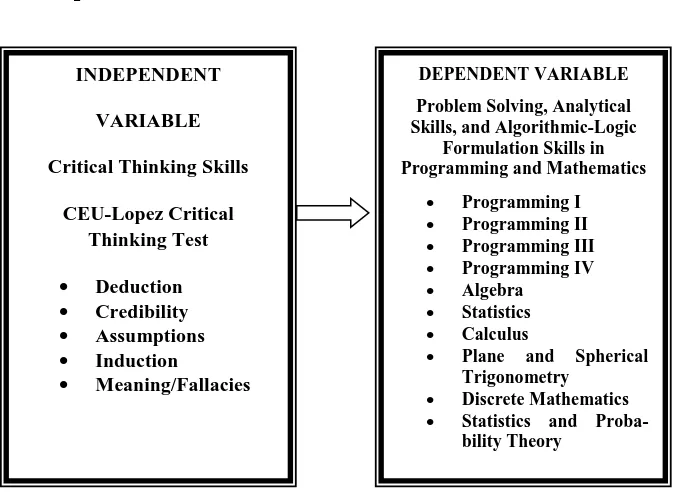
Figure 2 Conceptual Framework of the study INDEPENDENT
VARIABLE
Critical Thinking Skills
CEU-Lopez Critical Thinking Test
Deduction
Credibility
Assumptions
Induction
Meaning/Fallacies
DEPENDENT VARIABLE
Problem Solving, Analytical Skills, and Algorithmic-Logic
Formulation Skills in Programming and Mathematics
Programming I
Programming II
Programming III
Programming IV
Algebra
Statistics
Calculus
Plane and Spherical Trigonometry
Discrete Mathematics
The framework consists of two variables: Critical Thinking Skills and Problem Solving, Analytical Skills, and Algorithmic-Logic Formulation Skills in the subjects Computer
Programming and Mathematics. The researcher support that
by improving the critical thinking skills of each student, excellent programming and mathematics performance can be achieved.
It demonstrates in the figure through the one parallel single-headed line, the relationship among critical thinking skills and problem solving, analytical skills, and algorithmic-logic formulation skills. It presented that critical thinking skills and problem solving, analytical skills, and algorithmic-logic formulation skills are directly connected to each other. If the student has a low level of critical thinking skills then, poor programming and mathematics performance may be accomplish. And also, students can reach an excellent performance in programming and in mathematics if and only if they obtain a high level of critical thinking skills. It only shows how critical thinking skills of each student affect his/her performance in programming and in mathematics.
Research Methodology
Research Methodology describes the research design, the population and sample size of the respondents, the sampling technique, the description of the respondent, the research locale, the instrumentation, the data gathering procedure, and the statistical treatment of data used by the researcher.
Research Design
computer programming and mathematics performance, thus
the descriptive method will use and purposive sampling to
select the respondents. This method includes giving standardized critical thinking test to determine the profile, the grades and the level of critical thinking of the respondents.
According to Van Dalen and Meyer (1979), this method of research describes current status and identifies relationships that exist among phenomena or trends that appear to be developing. Moreover, Good (1984) claimed that the descriptive survey approach to problem solving seeks to answers questions as to the real fact relating to existing conditions.
The respondents come from the 76 freshmen BSIT students of Bachelor of Science in Information Technology (BSIT) of Centro Escolar University-Malolos, Computer Education Department in the S.Y. 2012-2013 an incoming sophomore in the S.Y. 2013-2014. To measure the critical thinking skills of the respondents, the researcher uses the CEU-Lopez Critical Thinking Test as the main data-gathering instrument in this study. And to measure the Academic performance in their Computer Programming and Mathematics subjects that requires Problem Solving, Analytical Skills, and Algorithmic-Logic Formulation Skills of the respondents, the researcher get the grades in their performance in the listed subjects of Computer Programming and Mathematics in the BSIT curriculum covering the preliminary period, mid-term period, and final period, and the final rating interpreted using the CEU Grading System.
there is a significant relationship between the two variables and using the t-test the researcher check if there is a significant difference between critical thinking skills and computer programming and mathematics academic performance.
Presentation, Analysis, and Interpretation of Data
This portion of the study presents and analyzes the data gathered in relation to the general problem of the study. It is organized in accordance with the sequence of sub-problems as stated in the Statement of the Problem.
1. The level of performance of the respondents that requires Problem Solving, Analytical Skills, and Algorithmic-Logic Formulation Skills in the following subjects:
Mean/Verbal Interpretation
Computer Programming I ( 2.99 = Barely Satisfactory)
Computer Programming II ( 2.99 = Barely Satisfactory)
Computer Programming III ( 2.78 = Fairly Satisfactory)
Computer Programming IV ( 3.00 = Barely Satisfactory)
Algebra ( 2.84 = Barely Satisfactory)
Statistics ( 2.85 = Barely Satisfactory)
Calculus ( 2.87 = Barely Satisfactory)
Plane and Spherical Trigonometry ( 2.65 = Fairly Satisfactory)
Discrete Mathematics ( 2.76 = Fairly Satisfactory)
Statistics and Probability Theory ( 2.89 = Barely Satisfactory)
The Level of academic performance of the respondents in
Computer Programming and in Mathematics that requires
Satisfactory (Over-All Performance both Computer
Programming and Mathematics Academic Performance).
2. The level of Critical thinking Skills of the respondents in terms of:
Dimension/ as a whole CT Skills Mean/Verbal Interpretation
a. Deduction; ( CT= 6.66, Challenge Thinker)
b. Credibility; ( CT= 6.12, Practicing Thinker)
c. Assumptions; ( CT= 5.30, Beginning Thinker)
d. Induction; ( CT= 3.87, Challenge Thinker)
e. Meaning/Fallacies; ( CT= 6.25, Beginning Thinker)
f. Critical Thinking Skills (CTS= 28.1974, Beginning Thinker)
The Level of Critical Thinking Skills shows that the over-all critical thinking skills performance of the respondents using the official norm of the CEU-Lopez Critical Thinking Test is
CTS= 28.1974 which means the respondents are Beginning
Thinkers.
Characteristics of Beginning Thinker (BT)
prolonged engagement in argument evaluation is needed to do the argument evaluation with ease and comfort ability. This is the stage that an individual has a beginning understanding of the necessary role of these critical thinking principles and criteria in evaluation of arguments and other propositions
3. The significant relationship between Critical Thinking Skills and their Academic Performance in Computer Programming and Mathematics Subjects that requires Problem Solving, Analytical Skills, and Algorithmic-Logic Formulation Skills.
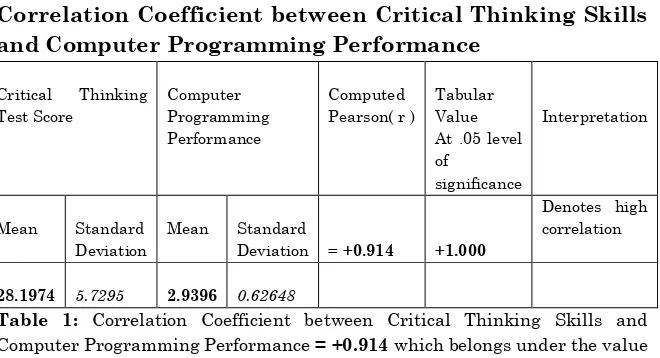
Correlation Coefficient between Critical Thinking Skills and Computer Programming Performance
Critical Thinking Test Score
Computer Programming Performance
Computed Pearson( r )
Tabular Value At .05 level of
significance
Interpretation
Mean Standard Deviation
Mean Standard
Deviation = +0.914 +1.000
Denotes high correlation
28.1974 5.7295 2.9396 0.62648
Table 1: Correlation Coefficient between Critical Thinking Skills and Computer Programming Performance = +0.914 which belongs under the value of r and its verbal interpretation which is H.C., SD= 0.62648.
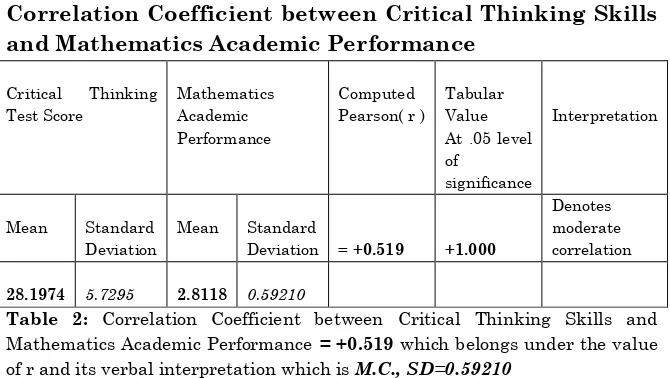
Correlation Coefficient between Critical Thinking Skills and Mathematics Academic Performance
Critical Thinking Test Score
Mathematics Academic Performance
Computed Pearson( r )
Tabular Value At .05 level of
significance
Interpretation
Mean Standard Deviation
Mean Standard
Deviation = +0.519 +1.000
Denotes moderate correlation
28.1974 5.7295 2.8118 0.59210
Table 2: Correlation Coefficient between Critical Thinking Skills and
Mathematics Academic Performance= +0.519 which belongs under the value
of r and its verbal interpretation which is M.C., SD=0.59210
Therefore there is a significant relationship between the two variables, and that is Moderate Correlation using the Pearson r Product Correlation. It is also an evident that the two variables have correlation to each other because the mathematics academic performance of the BSIT students in their six mathematics subjects is dependent on their Critical Thinking Skills.
Correlation Coefficient between Critical Thinking Skills and Computer Programming & Mathematics Academic Performance
Critical Thinking Test Score
Over-All Academic Performance in Computer
Programming and Mathematics Computed Pearson( r ) Tabular Value At .05 level of
significance
Interpretation
Mean Standard Deviation
Mean Standard
Deviation = +0.658 +1.000
Denotes high correlation
Table 3: Correlation Coefficient between Critical Thinking Skills and
Computer Programming and Mathematics Academic Performance = +0.658
which belongs under the value of r and its verbal interpretation which is H.C., Standard Deviation= 0.51434
Therefore there is a significant relationship between the two variables, and that is High Correlation using the Pearson r Product Correlation. It is also an evident that the two variables have correlation to each other because the computer programming and mathematics academic performance of the BSIT students in their four computer programming subjects and six mathematics subjects is dependent on their Critical Thinking Skills.
Conclusions and Recommendations
Conclusions
On the basis of the aforementioned findings of the study, the following conclusions were drawn:
2. The critical thinking skills levels of the respondents are not fully developed yet. They got a mean score that belongs to
Beginning Thinker in the Critical Thinking Skills Test using
the CEU-Lopez Critical Thinking Test. The test had proven that they did not attain the appropriate critical thinking level skills of a student in the Information Technology Education Academic Programs in the tertiary level.
3. There is a significant relationship between critical thinking skills and the computer programming and Mathematics academic performance that requires problem solving skills, analytical skills, and algorithmic-logic formulation skills of the BSIT students. Since computer programming and mathematics subjects requires higher order thinking skills, that is, to make the students analyze the problem first before presenting the result/output/solutions. It indicates that there is a need of infusing and developing critical thinking skills of the students as they move from one level to another.
4. Develop a comprehensive teaching and instructional materials such as multi-media contents materials including simulators and video tutorials, modules, laboratory manuals and text book that can improved analytical, logical, and problem solving skills needed in the critical thinking level skills of an Information Technology Education students in the tertiary level.
Recommendations
Based on the findings and conclusions of the study, the following recommendations were drawn:
1. Computer Programming and Mathematics
problem solving skills, algorithmic-logic formulation skills and critical thinking skills in their computer programming and mathematics subjects. They must organized the design of instructions to understand critical thinking at a deep level, and to realize that they must teach content through thinking, not content then thinking.
2. Attend trainings, workshops and seminars that will help enhancing and developing the critical thinking skills of the students using an outcomes-based education model for educators.
3. The administrators’ curriculum planner and developers can infuse the critical thinking skills in the curriculum. Hence, the instructors can give and construct a new teaching methodology in infusing the Critical Thinking skills along with the subject matter using the outcomes-based education model to meet the requirements in the 21st century education skills.
BIBLIOGRAPHY AND REFERENCES
A. Books
Bassham, Gregory. 2002. Critical Thinking: A Student’s
Introduction. Boston: McGraw Hill. 1-2.
Buenaflor, Lionel E. 2004. The Art of Critical Thinking: Logic
for Filipino Students. Mandaluyong City Books.
Chaffee, John. 2004. Thinking Critically: A Concise Guide.
Boston: Houghton Mifflin. 2.
Ennis, Robert H. 1996. Critical Thinking. New Jersey: Prentice-Hall, Inc. 4-9.
Moon, Jennifer. Critical Thinking: An exploration of Theory and
Rugierro, Vincent Ryan. 1995. The Art of Critical Thinking: A
guide to critical and creative thought. 4th edition. Harper
Collins Publisher. 1-12.
B. Journals
______. 2008. Eureka College of Arts and Communication
Starch and Research Journal. I (3): 25-32.
______. 2007-2008. Centro Escolar University City of Malolos
Official Faculty Research Journal. 13 (1): 1-7.
______. 2003-2004. Centro Escolar University City of Malolos
Official Faculty Research Journal. 9(1): 28-35.
Cuchapin, Erlinda D. 2002. “Types Of Questions Asked By Bse Student Teachers In Teaching Mathematics I.” Bayambang, Pangasinan. PSU-CRC Faculty Journal
1(1): 46.
Kamali. 2011. Journal of Language Teaching and Research 2: 104-111.
Saygo, Lita A. 2002. “Developing Critical Thinking Skills.” Bayambang, Pangasinan. PSU-CRC Faculty Journal
1(1): 7-8, 13.
C. THESES
Angeles, Analyn M. 2012. Personal and Environmental Factors as Correlates of Teacher’s Sense of Self- Efficacy.
Cabacang, Maria Cora. Critical Thinking through Sample Activities in English among freshman in the University of Eastern Philippines.
Estranero, Fernando N. 2007. Development of Critical Thinking Skills and Learning Skills in High School Mathematics.
Lopez, Marcos Y. 2008. Critical Thinking Ability, Language Proficiency, and Academic Performance of Pharmacy, Nursing, and Dentistry of CEU- City of Malolos.