Scholarship@Western
Scholarship@Western
Electronic Thesis and Dissertation Repository
8-26-2015 12:00 AM
Explaining the Evolution of the Arctic Council
Explaining the Evolution of the Arctic Council
Andrew Chater
The University of Western Ontario Supervisor
Elizabeth Riddell-Dixon
The University of Western Ontario Graduate Program in Political Science
A thesis submitted in partial fulfillment of the requirements for the degree in Doctor of Philosophy
© Andrew Chater 2015
Follow this and additional works at: https://ir.lib.uwo.ca/etd
Part of the International Relations Commons
Recommended Citation Recommended Citation
Chater, Andrew, "Explaining the Evolution of the Arctic Council" (2015). Electronic Thesis and Dissertation Repository. 3230.
https://ir.lib.uwo.ca/etd/3230
This Dissertation/Thesis is brought to you for free and open access by Scholarship@Western. It has been accepted for inclusion in Electronic Thesis and Dissertation Repository by an authorized administrator of
EXPLAINING THE EVOLUTION OF THE ARCTIC COUNCIL
(Thesis format: Monograph)
by
Andrew Chater
Graduate Program in Political Science
A thesis submitted in partial fulfillment of the requirements for the degree of
Doctor of Philosophy
The School of Graduate and Postdoctoral Studies The University of Western Ontario
London, Ontario, Canada
ABSTRACT
The Arctic Council is an international institution made up of the eight states that have territory in the Arctic, namely Canada, Denmark, Finland, Iceland, Norway, Russia, Sweden and the United States, as well as six indigenous peoples’ organizations. When states created the Council in 1996, it was a research institution that addressed environmental issues and a loosely defined version of sustainable development. It was a weak institution, without a permanent secretariat. By 2014, it had become a policy-making body, as well as a research body, that addressed a wide range of issues, with the aid of a permanent secretariat. New states and institutions sought to become a part of the Council, which potentially challenged the role of the indigenous peoples’ organizations. This thesis answers the following question: how can we
explain this evolution of the Arctic Council? It examines the Council’s evolving mandate, policy-making role, institutional capacity and membership. It addresses this question by
analyzing three international relations theories, namely functionalism, neorealism and neoliberal institutionalism. This thesis concludes that the economic opportunities in the region made possible by climate change best explain the evolution of the Arctic Council. Neoliberal institutionalism best explains the evolution of the Council, while neorealism provides the best explanation for the outcome of that process.
KEYWORDS
ACKNOWLEDGEMENTS
This project would not be possible without the contributions of many people. First, I would like to thank my supervisor, Elizabeth Riddell-Dixon, for her insight, support and guidance over the past five years. She retired from the University of Western Ontario in 2011, yet has continued to serve as my supervisor and give generously of her time, truly the mark of an excellent mentor.
I need to thank Adam Harmes, who went above and beyond to deliver many essential insights and a great deal of guidance. He gave generously of his time, certainly more than what is expected of a committee member. I also must thank Gordon McBean, who provided a great deal of support, especially during the fieldwork stage of this work.
I must thank all of those individuals who agreed to be interviewed for this project, giving freely of their time and providing indispensable information. Thanks goes to the Arctic
Athabaskan Council for allowing me to attend an Arctic Council meeting in October 2013 as part of its delegation. Special thanks goes to Cindy Dickson, Chief Gary Harrison, Terry Fenge, Chief Ruth Massie and David Roddick, who organized my attendance despite resistance from the Council chair.
I would like to thank Patricia Bell, as well Darlene Nuqingaq and the Iqaluit Music Society, who provided me with opportunities and support to travel to Iqaluit, Nunavut. These experiences provided essential inspiration for this project.
Lastly, I would like to thank my parents, Al and Susan Chater, for their endless support. This thesis would not be possible without their support, encouragement and devotion. Each proofread this thesis and provided great insight. I am truly lucky to have such wonderful parents.
---
TABLE OF CONTENTS
ABSTRACT ... i
ACKNOWLEDGEMENTS ... ii
TABLE OF CONTENTS ... iv
LIST OF TABLES ... vi
LIST OF ACRONYMS ... vii
CHAPTER 1: INTRODUCTION ... 1
1.1 – What is the Arctic Council? ... 2
1.2 – What is the History of the Arctic Council? ... 10
1.3 – What is the Arctic Council’s Mandate? ... 15
1.4 – How Does the Council Operate?... 16
1.5 – How is the Arctic Council Evolving? ... 24
1.6 – How Do Others Theorize the Arctic Council? ... 26
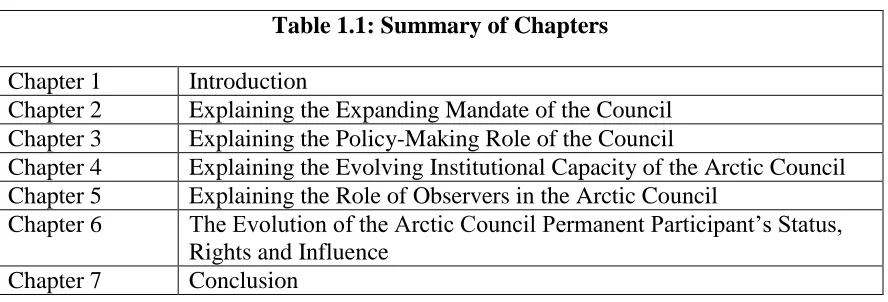
1.7 – How is the Thesis Structured? ... 31
1.8 – What Are the Contributions of the Thesis?... 34
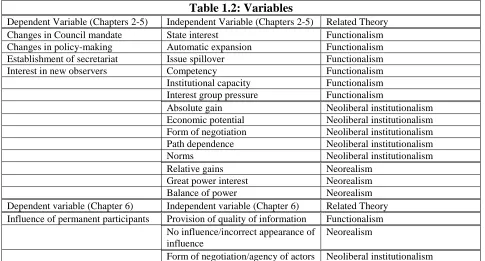
1.9 – What Methodology is Employed? ... 38
CHAPTER 2: EXPLAINING THE EXPANDING MANDATE OF THE COUNCIL ... 43
2.1 – Theorizing the Evolution of the Arctic Council ... 46
2.2 – Understanding the Evolution of the Council ... 55
2.2.1 – 1991-1996 ... 56
2.2.2 – 1996-2004 ... 74
2.2.3 – 2004-2007 ... 83
2.2.4 – 2007-2014 ... 88
2.3 – Analysis of the Evolution of the Arctic Council’s Mandate ... 94
Conclusion ... 110
CHAPTER 3: EXPLAINING THE POLICY-MAKING ROLE OF THE COUNCIL ... 112
3.1 – Theorizing the Evolution of the Arctic Council’s Policy-Making Role ... 115
3.2 – Understanding the Evolution of the Council’s Policy-Making Role ... 124
3.2.1 – 1991-1996 ... 124
3.2.2 – 1996-2004 ... 132
3.2.3 – 2004-2007 ... 140
3.2.4 – 2008-2013 ... 145
3.2.5 – 2013: The Future of Policy-Making in the Council ... 150
3.3 - Explaining the Evolution of the Arctic Council’s Policy-Making Role ... 154
Conclusion ... 169
CHAPTER 4: EXPLAINING THE EVOLVING INSTITUTIONAL CAPACITY OF THE ARCTIC COUNCIL ... 171
4.1 – Theorizing the Evolution of the Arctic Council’s Institutional Capacity ... 175
4.2 – The Evolution of the Council’s Institutional Capacity ... 182
4.2.1 – 1991-1998 ... 183
4.2.2 – 1998-2007 ... 187
4.2.3 – 2007-Present ... 195
4.3 – Analyzing the Evolution of the Arctic Council’s Institutional Capacity ... 203
CHAPTER 5: EXPLAINING THE ROLE OF OBSERVERS IN THE ARCTIC COUNCIL .. 213
5.1 – Theory on International Co-operation and Observers ... 216
5.2 – The Evolution of the Council’s Observers... 219
5.2.1 – 1991-1996 ... 219
5.2.2 – 1996-2004 ... 222
5.2.3 – 2005-Present ... 224
5.3 – Analysis Using International Relations Theory ... 234
Conclusion ... 237
CHAPTER 6: THE EVOLUTION OF THE ARCTIC COUNCIL PERMANENT PARTICIPANT’S STATUS, RIGHTS AND INFLUENCE... 238
6.1 – Theoretical Predictions on the Influence of Non-State Actors ... 242
6.2 – The Evolution of the Permanent Participants ... 246
6.2.1 – 1991 to 1998 ... 246
6.2.2 – 1998 to 2004 ... 260
6.2.3 – 2004: The Arctic Climate Impact Assessment ... 273
6.2.4 – 2005 to 2013 ... 276
6.2.5 – 2014: The Future Influence of Permanent Participants ... 291
6.3 – Analysis Using Theories of International Relations ... 294
Conclusion ... 298
CHAPTER 7 – CONCLUSION ... 299
7.1 – The History of the Arctic Council ... 299
7.2 – Contributions to Theory ... 309
7.3 – Directions for Future Research ... 311
Conclusion ... 314
APPENDIX A ... 316
APPENDIX B ... 318
BIBLIOGRAPHY ... 319
LIST OF TABLES
Table 1.1: Summary of Chapters………...……32
Table 1.2: Variables………...39
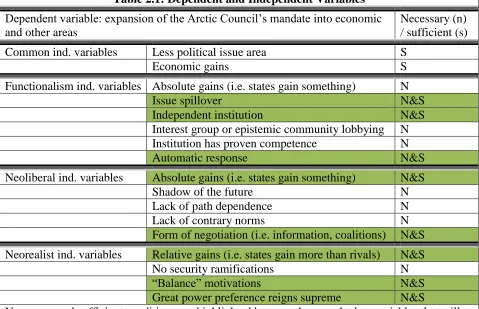
Table 2.1: Dependent and Independent Variables……….53
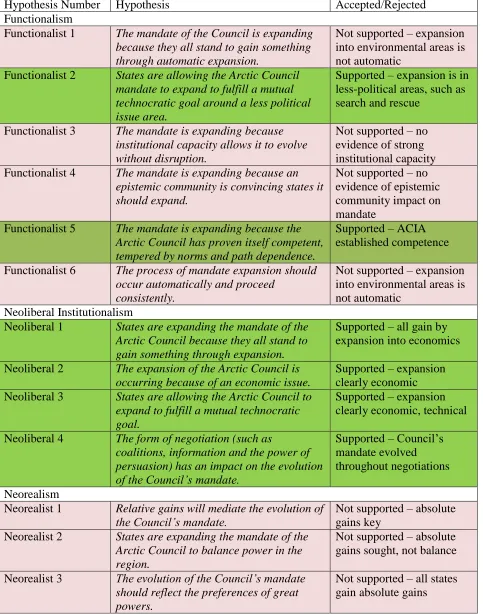
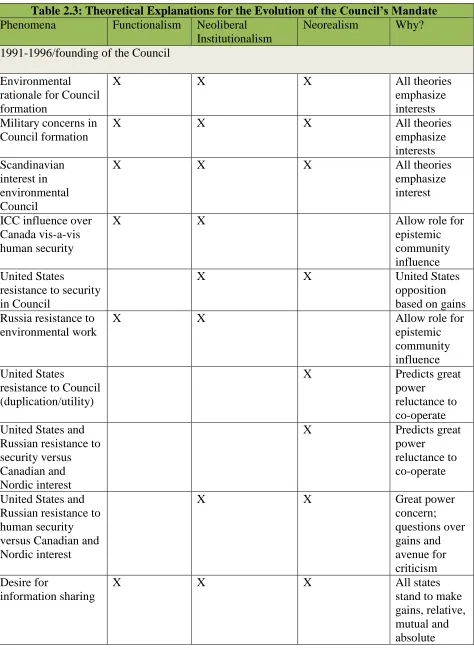
Table 2.2: Analysis………..103
Table 2.3: Theoretical Explanations for the Evolution of the Council’s Mandate………..104
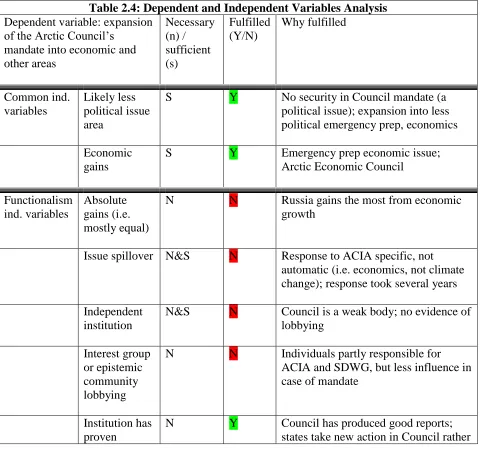
Table 2.4: Dependent and Independent Variables Analysis………106
Table 3.1: Dependent and Independent Variables………...121
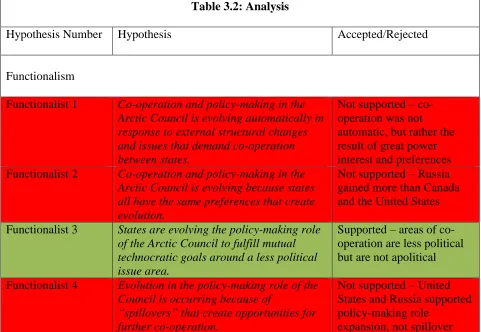
Table 3.2: Analysis………..162
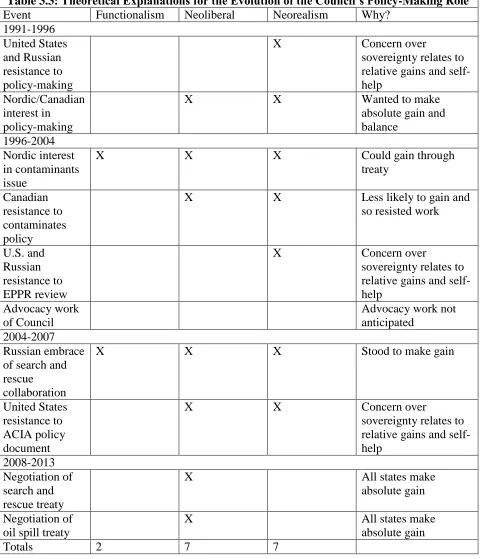
Table 3.3: Theoretical Explanations for the Evolution of the Council’s Policy-Making Role...164
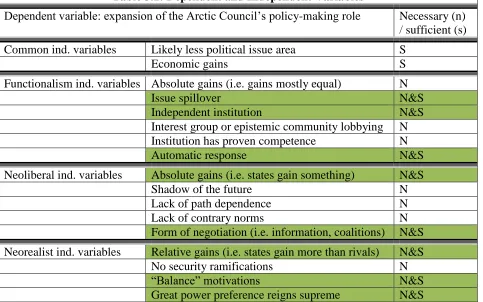
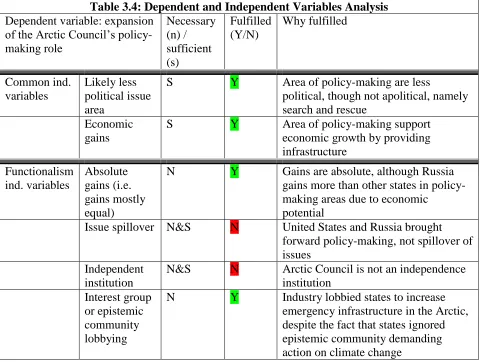
Table 3.4: Dependent and Independent Variables Analysis………165
Table 4.1: Dependent and Independent Variables………...180
Table 4.2: Analysis………..206
Table 4.3: Theoretical Explanations for the Evolution of Council Capacity……….…………..207
Table 4.4: Dependent and Independent Variables Analysis………208
Table 5.1: Council Observers as of 2015……….231
Table 5.2: Results……….234
Table 6.1: The Importance of Non-State Actors in International Institutions……….243
Table 6.2: Permanent Participant Participation, 1998-2004………273
Table 6.3: Permanent Participant Projects………...278
Table 6.4: Permanent Participant Participation………...283
LIST OF ACRONYMS
AIA – Aleut International Association AAC – Arctic Athabaskan Council ABA – Arctic Biodiversity Assessment ACIA – Arctic Climate Impact Assessment ACAP – Arctic Contaminants Action Program ACMM – Arctic Council Ministerial Meeting AEC – Arctic Economic Council
AEPS – Arctic Environmental Protection Strategy AMEC – Arctic Military Environmental Co-operation AMAP – Arctic Monitoring and Assessment Programme CAFF – Conservation of Arctic Flora and Fauna
DMM – Deputy Ministers Meeting D.C. – District of Columbia
EPPR – Emergency Prevention, Preparedness and Response GIS – Geographic Information Systems
GCI – Gwich’in Council International IPS – Indigenous Peoples’ Secretariat ICC – Inuit Circumpolar Council MM – Ministerial Meeting
NEFCO – Nordic Environmental Finance Corporation NATO – North Atlantic Treaty Organization
POP – Persistent Organic Pollutant PCB – Polychlorinated Biphenyl PSI – Project Support Instrument
PAME – Protection of the Arctic Marine Environment
RAIPON – Russian Association of Indigenous Peoples of the North SAO – Senior Arctic Official
SDWG – Sustainable Development Working Group USSR – Union of Soviet Socialist Republics U.S. – United States
CHAPTER 1: INTRODUCTION
In 1996, many Arctic policy-makers1 and activists believed the newly created Arctic Council was a weak, informal research institution offering limited opportunities to address issues that are important to people who live in the Arctic region.2 By 2013, the Council appeared more robust than ever as it created major international agreements that responded to the consequences of climate change in the Arctic. The major research question addressed in this thesis is: how can we explain this evolution of the Arctic Council? The Council is an international institution charged with the promotion of environmental conservation and sustainable development in the Arctic region. It is evolving from a research institution that addresses environmental issues to a forum for policy-making on a wide variety of issues. This institution is worthy of serious scholarly attention because the Council is the premier governance institution for the Arctic region and it addresses profoundly important global issues such as climate change. The evolution of this institution will have consequences for the global community. Thus, the trajectory of its evolution is of interest not only to those who study the region, but also to those concerned with broader global politics. This thesis explains the Council’s evolution by assessing the predictive validity and reliability of three theories of international co-operation: functionalism, neorealism and neoliberal institutionalism. This work argues that the Arctic’s economic potential has created an incentive for states to facilitate governance through the Council, though great powers are the
1 In this thesis, “policy-maker” refers to an official who attended Council meetings representing a state,
non-governmental organization, international institution or indigenous peoples’ organization. This group includes government officials, political activists, political actors (such as elected representatives) and scientists. I use the term “policy-maker” as a generic term because 1) all of these actors sought to contribute to the development of policy through the Council and 2) they were entrusted to represent the views of their organization in a diplomatic capacity.
2
most influential actors in this process. Chapter 1 outlines the scope and method of this project, as well as an overview of the necessary background information about the Council. It answers nine major questions. First, what is the Arctic Council? Second, what is the history of the Arctic Council and why did it come into being? Third, what is the mandate of the Arctic Council? Fourth, how does the Council operate? Fifth, how is the Arctic Council evolving? Sixth, how have others assessed the Council? Seventh, how is the thesis structured? Eighth, what is the contribution of this thesis? Finally, what methodology is employed? The thesis consists of seven chapters, including this introduction.
1.1– What is the Arctic Council?
The Arctic Council is an international institution comprising the eight countries that have some territory in the Arctic, namely Canada, Denmark, Finland, Iceland, Norway, Russia, Sweden and the United States. It is the only Arctic regional organization that includes all eight Arctic countries. It is also the only international institution that includes indigenous peoples’ organizations as members, albeit second-class members without voting rights. These groups have many of the same rights as states, as they are able, for example, to participate in all Council meetings,3 set the Council agenda4 and create Council projects.5
Six indigenous peoples’ organizations are members of the Council, although the rules of procedure allow up to seven indigenous members. They are referred to as “permanent
participants.” The Arctic Athabaskan Council (AAC) represents 32,000 Athabaskan people who
3
Arctic Council, Arctic Council Rules of Procedure (Iqaluit, Nunavut: Arctic Council Ministerial Meeting, 1998), Article 4 and Article 5.
live mostly in northwestern Canada and Alaska.6 The group formed in 2000, specifically to participate in the Arctic Council. It is currently the most recent group to join the institution. The Aleut International Association (AIA) represents 18,000 Aleutian people who live in Greenland, Russia and the United States.7 It formed in 1998, also to participate in the Council. The Gwich’in Council International (GCI) represents 9,000 Gwich’in people who live in the Canada and the
United States.8 The organization formed in 1999 to advocate for Gwich’in people in the Council. The Inuit Circumpolar Council (ICC) represents 150,000 Inuit people who live in Canada, Greenland, Russia and the United States.9 It came together in 1977 as a major international advocacy association. The Russian Association of Indigenous Peoples of the North (RAIPON) represents 300,000 Russian aboriginal peoples. It is an umbrella organization for 41 Russian aboriginal groups that are part of 35 different indigenous peoples’ organizations.10 The
organization formed in 1990, specifically to participate in the precursor of the Arctic Council, the Arctic Environmental Protection Strategy (AEPS). RAIPON was originally called the USSR Association of Small Peoples of the North. It was renamed in the wake of the collapse of the Soviet Union. The Saami Council, originally called the Nordic Saami Council at the founding of the AEPS in 1991, represents 150,000 people who live in Finland, Norway, Russia and
6 Arctic Council, “Arctic Athabaskan Council,” Permanent Participants, April 15, 2011,
http://www.arctic-council.org/index.php/en/about-us/permanent-participants/arctic-athabaskan-council-aac (accessed May 21, 2013).
7 Arctic Council, “Aleut International Association,” Permanent Participants, April 15, 2011,
http://www.arctic-council.org/index.php/en/about-us/permanent-participants/aleut-international-association-aia (accessed May 21, 2013).
8
Arctic Council, “Gwich’in Council International,” Permanent Participants, April 15, 2011, http://www.arctic-council.org/index.php/en/about-us/permanent-participants/gwich-in-council-international (accessed May 21, 2013).
9 Arctic Council, “Inuit Circumpolar Council,” Permanent Participants, April 15, 2011,
http://www.arctic-council.org/index.php/en/about-us/permanent-participants/inuit-circumpolar-council (accessed May 21, 2013).
10 Arctic Council, “Permanent Participant Article Series: RAIPON,” Arctic Peoples, 2012,
Sweden.11 The group was founded in 1956 and is thus the oldest indigenous peoples’ organization in the Council. Together, these groups represent 659,000 people from all the Council countries, except mainland Denmark and Iceland.
The Council also includes observers. The original observers of the precursor to the Arctic Council, the AEPS, were West Germany, Poland, the United Kingdom, the United Nations Economic Commission for Europe, the United Nations Environmental Programme and the International Arctic Science Committee.12 There are currently 32 permanent observers in the Council. The Council’s rules of procedure officially refer to them as “accredited observers,”
although they are often referred to as permanent observers.13 This group includes twelve states, eight international institutions and twelve non-governmental organizations.14 China, France and Germany are examples of state observers. International institution observers include the Nordic Council of Ministers and the United Nations Development Program. Examples of
non-governmental organizations are the Association of World Reindeer Herders and the World Wildlife Fund. Observers can attend Council meetings, unless uninvited by states, and make comments when states allow. They can propose, sponsor and participate in Council projects with the permission of states.15 State delegations re-approve all observers every two years, in
summative Ministerial Meetings.16 At this point, states can remove an observer, though this has never happened. In addition, Council meetings typically include “ad hoc observers” that can attend with special permission. They have all the same rights as permanent observers, though
11 Arctic Council, “Permanent Participant Article Series: The Saami Council,” Arctic Peoples, 2012,
http://www.arctic-council.org/index.php/en/arctic-peoples/indigenous-people/589-permanent-participant-article-series-saami-council (accessed January 14, 2013).
12
Arctic Environmental Protection Strategy, Declaration of the Protection of the Arctic Environment (Rovaniemi, Finland: Arctic Environmental Protection Strategy, 1991).
13 Arctic Council, Arctic Council Rules of Procedure, Article 37. 14
Arctic Council, “Observers,” About Us, April 27, 2011, http://www.arctic-council.org/index.php/en/about-us/arctic-council/observers (accessed July 17, 2014).
states need to re-approve their participation before every Council meeting.17 An example of a high-profile organization or state that frequently acts as an ad-hoc observer is the European Union. Typically, a new observer attends Council meetings for between two and five years before states approve its status as a permanent observer. Observers are typically international entities that have some broad interest in the Arctic region.
Most of the substantive work takes place in the Council’s working groups, of which there
are six: the Arctic Contaminants Action Program (ACAP); Arctic Monitoring and Assessment Programme (AMAP); Conservation of Arctic Flora and Fauna (CAFF); Protection of the Arctic Marine Environment (PAME); Emergency Prevention, Preparedness and Response (EPPR); and the Sustainable Development Working Group (SDWG). States formed the ACAP from an AMAP project in 2006. The AMAP, CAFF, PAME and the EPPR were working groups of the AEPS and so formed in 1991. States established the SDWG in 1996 along with the rest of the Council. The ACAP takes action to research and address contaminants in the Arctic region. The AMAP monitors levels of Arctic pollution. The CAFF researches levels of Arctic flora and fauna and also helps develop conservation strategies by providing baseline information. Studying Arctic marine pollution and developing strategies to combat pollution by providing baseline information is the responsibility of the PAME. The EPPR identifies safety issues in the Arctic and prepares for emergency situations. The SDWG broadly carries out projects to encourage human social, political and economic development in the Arctic region. Government scientists and academics serve in the working groups and usually meet bi-annually. The nature of the work completed by the working groups reveals that the Council exists to facilitate action on
environmental issues and sustainable development.
The official mandates of the working groups show they complete separate yet inter-related work. The ACAP exists to “reduce emissions of pollutants into the environment in order to reduce the identified pollution risks.”18 It prepares proposals and supplies information for technical projects to physically clean up contaminant sites, particularly in Russia. The mandate of the AMAP is to supply “reliable and sufficient information on the status of, and threats to, the Arctic environment, and providing scientific advice on actions to be taken in order to support Arctic governments in their efforts to take remedial and preventive actions relating to
contaminants.”19
Examples of its work include projects to monitor UV radiation, radioactivity and mercury levels in the Arctic.20 The CAFF exists to “address the conservation of Arctic biodiversity, and to communicate its findings to the governments and residents of the Arctic, helping to promote practices which ensure the sustainability of the Arctic’s living resources.”21
An example of its work is the ongoing Circumpolar Biodiversity Monitoring Program, which is “an international network of scientists, government agencies, indigenous organizations and
conservation groups working together to harmonize and integrate efforts to monitor the Arctic's living resources.”22
The mandate of the PAME is to “address policy and non-emergency pollution prevention and control measures related to the protection of the Arctic marine
environment from both land and sea-based activities.”23 An example of this work is the ongoing
18 Ibid.
19 Arctic Council, “Arctic Monitoring and Assessment Programme,” Working Groups, April 15, 2011,
http://www.arctic-council.org/index.php/en/about-us/working-groups/arctic-monitoring-and-assessment-programme-amap (accessed July 11, 2013).
20 Ibid.
21 Arctic Council, “Conservation of Arctic Flora and Fauna,” Working Groups, April 15, 2013,
http://www.arctic-council.org/index.php/en/about-us/working-groups/conservation-of-arctic-flora-and-fauna-caff (accessed July 11, 2013).
22 Conservation of Arctic Flora and Fauna, “Monitoring: The Circumpolar Biodiversity Monitoring Programme
(CBMP),” Monitoring, 2013, http://www.caff.is/monitoring (accessed July 12, 2013).
23 Arctic Council, “Protection of the Arctic Marine Environment,” Working Groups, April 15, 2013,
Arctic Marine Shipping Assessment, which is an evaluation of the level of Arctic shipping.24 The mandate of the EPPR is to “exchange information on best practices and conduct projects to include development of guidance and risk assessment methodologies, response exercises, and training.”25 An example of this work includes its ongoing Behaviour of Oil and Other Hazardous Substances in Arctic Waters project, which studies what would happen to oil should it spill in Arctic waters, thus helping states prepare for that possibility.26 These mandates all reveal a focus on research rather than policy-making, as their missions seek to “promote,” “exchange” and provide “advice” rather than to develop formal policy. They also emphasize that these groups
provide policy recommendations, particularly the mandates of the ACAP and the PAME. The ACAP, AMAP, CAFF, PAME and the EPPR have mandates that are environmental.
The SDWG has a different type of mandate than those of the other working groups in that it aims to “provide practical knowledge and contribute to building the capacity of indigenous peoples and Arctic communities to respond to the challenges and benefit from the opportunities emerging in the Arctic region.”27 Its work is broad and encompasses a wide variety of issue areas, all under the rubric of human development and human security. Human security is an understanding of security that emphasizes freedom from deprivation and threats to safety. The group does not limit its work to projects that concern sustainable development in the traditional sense. Sources often define sustainable development as “meeting the needs of today without
24 Protection of the Arctic Marine Environment, “About AMSA,” Arctic Marine Shipping Assessment, 2013,
http://www.pame.is/about-amsa (accessed March 1, 2013).
25
Arctic Council, “Emergency Prevention, Preparedness and Response,” Working Groups, April 15, 2013, http://www.arctic-council.org/index.php/en/about-us/working-groups/emergency-prevention-preparedness-and-response-eppr (accessed July 11, 2013).
26
Ibid.
27 Arctic Council, “Sustainable Development Working Group,” Working Groups, April 14, 2011,
compromising the needs of future generations.”28
In a practical sense, sustainable development typically refers to “any construction that can be maintained over time without damaging the environment.”29
However, the SDWG carries out the Council’s projects with the most direct human element that need not include a strong environmental element. Its current priorities are socio-economic problems, climate change adaptation, sustainable communities, resource development, human health, cultural survival and language.30 An example of this work is the 2011 report Comparative Review of Circumpolar Health Systems, which provides an overview of the contrasting qualities of health care in the Arctic region.31 It is a project with a strong human security element but not a strong environmental element. The SDWG carries out more human-centric work than do the other working groups.
The Council employs task forces to carry out research projects outside of the mandate of the working groups. Officially, there are four: the Task Force on Arctic Marine Pollution
Prevention, the Task Force on Black Carbon and Methane, the Scientific Co-operation Task Force and the Task Force to Facilitate the Circumpolar Business Forum.32 Marine pollution prevention, for example, is outside of the mandate of any one working group because it involves the work of the PAME, CAFF and the EPPR. In addition, its work is more policy-centric than those of the working groups. Black carbon and methane involves taking action on a type of air pollution not covered by the other working groups. The AMAP might have been a venue to address these issues, but it provides monitoring rather than policy action, which is a key goal of the task force. A circumpolar business forum is not an environmental issue or a human security
28
Environment Canada, “Sustainable Development,” Sustainable Development, July 7, 2014, http://www.ec.gc.ca/dd-sd/ (accessed July 22 2014).
29 Sustainable development, (n.d.), 21st Century Lexicon. 30
Arctic Council, “Sustainable Development Working Group.”
31 Ibid.
32 Arctic Council, “Task Forces of the Arctic Council,” Task Forces, December 29, 2011,
issue and so did not fit within any of the working groups. Three task forces have completed projects and ceased operations, namely the Task Force on Institution Issues (2011-2013), the Task Force on Search and Rescue (2009-2011) and the Task Force on Arctic Marine Oil
Pollution Preparedness and Response (2011-2013).33 The Council also has expert groups, made up of academics and scientists, to execute projects mandated by states on an ongoing basis, in contrast to temporary task forces that cease to exist when its project is completed. Currently, there is one Council expert group, the Ecosystem-Based Management Expert Group.34 Individual working groups have expert groups and task forces to carry out specific projects and provide advice for the broader working groups. Task forces are becoming increasingly common as the Council takes on policy-making work.
In September 2014, a new Council side-line institution came into being, called the Arctic Economic Council. 35 Its goal is to “foster business development in the Arctic,” to “engage in deeper circumpolar co-operation” and “provide a business perspective to the work of the Arctic Council.”36
Each Council member state and permanent participant sends three business
representatives to review Council programs and provide recommendations to the Council.37 The new institution represents an expansion of the mandate of the Council from an environmental and sustainable development institution to one that facilitates economic development. The new institution does not have an environmental component in that its work is to represent business interests. Chapter 2 discusses this shift in detail.
33 Arctic Council, “Past Task Forces,” Task Forces, November 4, 2013,
http://www.arctic-council.org/index.php/en/about-us/working-groups/task-forces/811-past-task-forces (accessed July 17, 2014).
34 Arctic Council, “EBM Experts Group,” Expert Groups, December 20, 2011,
http://www.arctic-council.org/index.php/en/about-us/working-groups/expert-groups (accessed July 17, 2014).
35 Nunatsiaq News, “Nunavut MP Picks Iqaluit for Arctic Economic Council’s Founding Meeting,” July 10, 2014,
http://www.nunatsiaqonline.ca/stories/article/65674nunavut_mp_picks_iqaluit_for_arctic_economic_councils_foun ding_meeting/ (accessed July 17, 2014).
36 Arctic Council, “Arctic Economic Council,” Arctic Economic Council, January 28, 2014,
http://www.arctic-council.org/index.php/en/about-us/working-groups/aec (accessed July 17, 2014).
1.2– What is the History of the Arctic Council?
It is necessary to understand why the Council came into being in order to understand its evolution. This chapter provides a brief history, with further elaboration provided in subsequent chapters. The Council was established as an environmental organization to facilitate co-operation in the wake of the end of the Cold War. From 1945 until 1989, the two Arctic great powers, the Soviet Union and the United States, stood at opposite ends of an ideological divide marked by the ever-present possibility of nuclear war. Canada, Denmark, Iceland and Norway were allies of the United States through North Atlantic Treaty Organization (NATO) membership. Finland and Sweden officially attempted to maintain neutrality, though these states were closer to the West than the East. Relations between the two superpowers improved throughout the 1970s during the period of détente, after strained relations in the 1960s. For example, the governments of the United States and Soviet Union held various negotiations beginning in 1969 to discuss limits on strategic arms, which resulted in the 1972 Anti-Ballistic Missile Treaty. The United States government issued an Arctic policy in 1983 indicating its openness to “mutually beneficial
international co-operation in the Arctic.”38 Still, tensions and military spending increased throughout the 1980s as a new hawkish United States presidential administration upped its rhetoric. The Arctic states, in particular the government of Finland, hoped that Arctic
co-operation would ease Cold War tensions between West and East. In 1985, an article by political scientist Oran Young proposed that the declaration of the Arctic as a “zone of peace” could ease
Cold War tensions.39 In October 1987, amid a weakening Soviet economy, the governments of the Soviet Union and United States signed a nuclear stockpile reduction agreement marking the
38
United States, “United States Arctic Policy,” National Security Decision Directive 90, April 14, 1983, http://fas.org/irp/offdocs/nsdd/nsdd-090.htm (accessed September 2, 2014) as quoted in Tornjorn Pedersen, “Debates Over the Role of the Arctic Council,” Ocean Development and International Law 43 (2012): 147.
beginning of the end of the Cold War. Meanwhile, Russian Premier Mikhail Gorbachev
delivered a speech in Murmansk, Russia, calling for the establishment of the Arctic as a “zone of peace” and new environmental co-operation.40
At the same time, there was considerable interest among policy-makers in international co-operation to understand the amount of pollution in Russia’s Arctic, which experts in the other Arctic states expected would be very high and would
have trans-boundary consequences.41 The 1986 Chernobyl nuclear disaster raised concerns over Russian environmental standards.42 The other Arctic governments doubted whether Gorbachev’s proposal for a “zone of peace” was serious.43
Murmansk is home to a large Russian military base, which Gorbachev did not propose to close as part of his initiative.44 The government of Finland, which sought to improve relations between the West and Russia, its closest neighbour, attempted to organize a conference in response to Gorbachev’s proposal, which finally occurred in Rovaniemi, Finland, in September 1989. The government of Finland had lobbied the United States and Russia to draft an agreement on nuclear submarines in the Arctic (in 1983) and held a summit on Cold War nuclear issues (in 1987). Three rounds of non-contentious negotiations, slowed by the collapse of the Soviet Union, resulted in the creation of the AEPS in June 1991.45
The AEPS was mandated to “protect the Arctic ecosystem including humans.”46 It was a joint research strategy, rather than an international institution. States created four working groups (the AMAP, CAFF, EPPR, PAME) staffed by government scientists and academics from each Arctic country, who would collect information and meet bi-annually to share their conclusions. Indigenous peoples’ organizations were mere observers in the organization, without any
40 Gordon Foundation, A Brief History of the Creation of the Arctic Council (Toronto: Gordon Foundation, 2010), 1. 41
Agence-France-Presse, news brief, September 19, 1996.
42 John English, Ice and Water: Politics, Peoples and the Arctic Council (Toronto Ontario: Allen Lane, 2013), 10. 43 Ibid.
44
Ibid., 6.
45 Ibid., 124.
46 Evan T. Bloom, “Establishment of the Arctic Council” The American Journal of International Law 93, no. 3
privileged status. The AEPS was successful in uncovering the dangerous level of pollution in the Russian Arctic, such as the fact that Russia had produced more than 180,000 tonnes of dangerous polychlorinated biphenol coolants in the Arctic region during the Cold War without proper environmental safety procedures.47 State officials also became aware that there were significant human security challenges in the Arctic.48 Perhaps most alarmingly, the life expectancy of indigenous peoples in Russia declined by 4.8 years between 1990 and 1995 due to poor
economic conditions leading to high stress levels and high alcohol consumption.49 From 1991 to 1996, indigenous peoples’ organizations lobbied governments to increase their role in Arctic
governance and to establish a more robust Arctic international institution to respond to these environmental and social problems. In particular, the ICC lobbied the Government of Canada to push such action.50 For example, its Canadian president at the time, Mary Simon, had access to the Government of Canada through her work negotiating and implementing the 1993 Nunavut Land Claims Agreement, which led to the creation of the Canadian northern territory Nunavut. She helped organize a meeting between Canadian foreign affairs officials and advocates to encourage Canada to create the Arctic Council in December 1992. This meeting did not yield immediate results,51 but, the Arctic Council, in part, emerged from the lobbying work of the ICC.
After years of lobbying by indigenous peoples’ organizations, Canadian Prime Minister Jean Chretien and United States President Bill Clinton held a meeting in February 1995, at which Chretien proposed that the AEPS become a formal institution.52 Clinton agreed to the proposal.53 The Canadian government brought the other Arctic states on-board and negotiations occurred in
47 Arctic Monitoring and Assessment Programme, PCBs in the Russian Federation: Inventory and Proposals for
Priority Remedial Actions (Oslo, Norway: Arctic Council, 2000), 14.
48 Arctic Council, Arctic Human Development Report (Reykjavik, Iceland: SDWG, 2004), 46-48 49 Ibid., 158.
50
English, Ice and Water, 172.
1995 around AEPS meetings and through informal communication as well as a meeting in Ottawa in June.54 There had been significant informal discussion among policy-makers to formalize the co-operation that had begun in the AEPS and so states at least tentatively undertook discussions to create the Arctic Council. State delegations debated and disagreed about six items: 1) whether security would be a part of the new institution, perhaps signalling a move toward earlier proposals for an Arctic “zone of peace;” 2) the role of human security and
sustainable development in the new institution, as the AEPS had increasingly dealt with sustainable development issues; 3) the policy-making role of the institution; 4) whether the institution would have a permanent secretariat; 5) the access of observers to the Council, and; 6) whether the permanent participants would be full members of the Council.55 Subsequent chapters elaborate on the process of these negotiations.
Canada and the Nordic delegations favoured a strong yet flexible Arctic Council that could take action on a wide range of Arctic issues, while the United States and Russian
delegations favoured a less formal Council that would facilitate targeted action in a small number of priority areas. Some negotiators characterized the United States and Russia as favouring the continuation of the AEPS with a new name.56 The 1995 negotiations did not make major headway on issues and gave way to three major formal negotiations in Ottawa in December 1995, as well as April and June 1996. The issue of the permanent participants dominated these negotiations, leaving little time to address the other items. Delegations made major
breakthroughs in June, resolving the permanent participants issue and agreeing in principle to resolutions on the other matters, allowing work to move forward on a document finalizing the Council’s structure.
54 Ibid.
55 Ibid.
The Council’s first meeting occurred in September 1996 in Ottawa, where state
delegations finalized the basic mandate and the structure of the Council. State officials agreed that: 1) traditional military security would not be part of the new Council’s agenda; 2)
sustainable development would be part of the institution through the creation of the SDWG, though its exact mandate would be negotiated over the next two years; 3) creating formal policy would not be an immediate goal of the Council; 4) the institution would not have a permanent secretariat because the rotating chair country would organize and host a rotating secretariat; 5) observers would be allowed to attend Council meetings with permission, and; 6) indigenous peoples’ organizations would be members of the Council but would not be able to vote on
Council matters. Each alignment could claim some success. Nothing prevented the Council from becoming a robust body in the future, though at its onset it was a small, flexible body in line with the preferences of the United States and Russian delegations. The Council had not yet developed formal rules of procedure, which it would do at five Council meetings in 1997 and 1998.57 In these years, it would transition the environmental work of the AEPS to the Council and establish the mandate for the sustainable development program.58 A key difference between the AEPS and Arctic Council was that the Arctic states’ environmental departments administered the AEPS and set state preferences, whereas departments of foreign affairs administered and organized the Council as well as determined official state positions.59 The Council emerged as an
environmental research institution with a new emphasis on human development issues through the sustainable development program.
57 Arctic Council, Joint Communique of the Governments of the Arctic Countries (Ottawa, Ontario: Arctic Council
Ministerial Meeting, 1996).
58 Ibid.
59 Terry Fenge, representative for Arctic Athabaskan Council and formerly Inuit Circumpolar Council, February 21,
1.3– What is the Arctic Council’s Mandate?
The Council’s mandate is to promote co-operation on environmental issues and
sustainable development in the Arctic region. It is found in the 1998 Iqaluit Declaration, the summative statement document that closed Canada’s inaugural two-year term as chair. The
Council is to “provide a means for promoting co-operation, coordination and interaction among the Arctic States . . . with the involvement of the Arctic indigenous communities and other Arctic inhabitants on common Arctic issues, in particular issues of sustainable development and
environmental protection in the Arctic.”60
As noted, the Council’s work may address any issue except military security.61 Its mandate allows it to discuss other types of security, such as human security or environmental security, though in practice the Council does not use the language of security to characterize issues. The mandate does not precisely define “sustainable development”
although it indicates it will include “areas of Arctic children and youth, health, telemedicine, resource management, including fisheries, cultural and eco-tourism, technology transfer to improve Arctic sanitation systems, and national sustainable development strategies.”62
The document establishes that all projects with a strong “human” element will fall under the rubric of sustainable development. In practice, about 80 per cent of the Council’s work is strongly
environmental in nature, as exhibited by the fact that only one of the Council’s six working
groups expressly addresses sustainable development. Increasingly, the Council’s work is economic in nature, although until the development of the Arctic Economic Council, all of the Council’s economic work had some environmental element. In some ways, the Council has a
broad yet narrow mandate, charged to focus on environment and sustainable development yet open to other issues.
60 Arctic Council, The Iqaluit Declaration (Tromsø, Norway: Arctic Council Secretariat, 1998). 61 Ibid.
1.4– How Does the Council Operate?
The chair of the Council rotates every two years. The first country to chair was Canada from 1996 until 1998, followed by the United States from 1998 until 2000, Finland from 2000 until 2002, Iceland from 2002 until 2004, Russia from 2004 until 2006, Norway from 2007 until 2009, Denmark from 2009 until 2011 and Sweden from 2011 until 2013. Canada was chair from 2013 until 2015, followed by the United States. The chair is responsible for organizing Council meetings and providing themes for Council work, though the other Council states have a lot of power to shape the agenda. The Council held 42 meetings from 1996 until 2013.63 It typically holds three meetings annually, usually in the spring and fall. There are three types of meetings. Senior Arctic Officials Meetings (also known as SAO meetings) usually occur twice a year. States send delegations of typically six to twelve officials, while permanent participants usually send two to six people. The head of the state delegations is referred to as the “Senior Arctic Official.” Ministerial Meetings (also known as MM meetings or ACMM meetings) occur every
other year in the spring. At these meetings, ministers of foreign affairs or other high-ranking officials review the Council’s previous two-year term and initiate a new research program. States
articulate the results by signing a declaration that sets the Council’s agenda for the next two years. Ministerial Meetings close a country’s turn as chair and pass the chair to another country.
Deputy Ministers Meetings (DMM) occur in the years that there is not a Ministerial Meeting. In these meetings, foreign affairs deputies from each Council state review progress, as well as permanent participant representatives. The first DMM was held in 2010. Canada has opted not to hold a DMM, indicating that they may not become permanent fixtures on the Council calendar. Working groups meet roughly two times a year, in between other Council meetings.
The substantive work of the Council occurs through projects. To accomplish goals, states sponsor projects, sometimes co-sponsored by permanent participants or observers. To sponsor a project, the sponsor must conceive of the project, design its contents, fund agreed-upon costs and execute the agenda. Projects might include a scientific assessment or a technical project such as a search and rescue practice exercise or a plan to clean up a contaminant. States and sponsors typically bring these projects to a Council working group for consideration. Other states, observers or permanent participants can join the leadership of a project by co-sponsoring. The working group adopts the project under the leadership of the sponsors, unless another state vetoes the project. The working group then presents the project at a SAO meeting, at which point states have another opportunity to veto the project. States then approve the project at the
Ministerial Meeting. At this point, working groups have likely carried out substantial work on the project, though a veto is still possible. After approval at the Ministerial Meeting, the working group completes the project between meetings and gives updates at its own meetings. As noted, the Council may establish a task force to complete a project at Ministerial Meetings or may defer the matter to an expert group.
The Council has a robust agenda, sponsoring dozens of projects. It undertook an average of 57 projects at a time from 1998 until 2004. This number tripled between 2004 and 2013, as currently the Council has more than 150 projects ongoing at any one time. About 90 per cent of Council projects proceed without negotiation or real debate. States, observers and permanent participants may provide statements of support for a project or technical suggestions, such as collaboration with a particular research program or employment of a certain database. In about ten per cent of cases, discussion turns into negotiations, with states vetoing projects in Council meetings, negotiating compromises or attempting to alter the intent of a project. An example of a project that proceeded without great political interference is the Survey of Living Conditions in the Arctic, which was a straightforward survey of Arctic residents. Chapter 6 discusses this project. An example of a project that provoked great debate, negotiation and compromise with threats of vetoes is the Arctic Climate Impact Assessment (ACIA), with the controversial issue being whether the final assessment would include a policy document. Chapters 2, 3 and 6 discuss this project. Major projects include the ACIA(2004) and the Arctic Human Development Report (2004). Other major projects include:
- The Circumpolar Biodiversity Monitoring Program (initiated 2006) (the CAFF) - Annual AMAP pollution assessments (2005-2013) (the AMAP)
- Sustaining Arctic Observing Networks (completed 2006-2008) (the AMAP) - Arctic Oil and Gas Assessment (published 2007) (the AMAP)
- Arctic Human Health Initiative (initiated 2008) (the SDWG)
- Agreement on Co-operation on Aeronautical and Maritime Search and Rescue in the Arctic (completed 2011) (Task Force)
- Arctic Marine Shipping Assessment (published 2009) (the PAME) - Arctic Biodiversity Assessment (published 2013) (the CAFF)
- Agreement on Co-operation on Marine Oil Pollution Preparedness and Response in the Arctic (completed 2013) (Task Force)
- Short-Lived Climate Forcers (initiated 2011) (Short-Lived Climate Forcers Task Force)
- Snow, Water, Ice and Permafrost Assessment (published 2013) (the AMAP) - Arctic Resilience Report (interim report 2013)
Each Council meeting agenda contains about 15 items. In other words, states discuss roughly 15 projects per meeting. In some cases, updates are brief and do not include discussion. In other cases, discussions can drag on for most of a meeting. States do not comment on every agenda item. For example, from 2004 until 2013, based on a sample of 10 meetings, states provided an average of 3.3 comments on 2.6 agenda items.64 Permanent participants commented on only one agenda item. About 15 observers attended each meeting, but only about five
provided comments and those five only commented approximately once.
A good case study to understand the process of a Council project is the assembly of the Arctic Biodiversity Assessment (ABA), a report synthesizing the state of, and threat to,
biodiversity in the Arctic region. It is a project that was not overly contentious as it was a
scientific assembly of data about biodiversity in a particular region, but had some small issues in its research design. State officials jointly authored the project between 2007 and 2013. The goal of the project was to “synthesize and assess the status and trends of biological diversity in the Arctic.”65
As with all Council projects, a state sponsored the assessment. Finland initially sponsored it in 2006, creating the work plan and providing initial funding. The United States, Denmark, Canada and Sweden contributed hundreds of thousands of dollars to the project and joined as co-sponsors in subsequent years. States organized the project between 2004 and 2007. The idea for the ABA originated from the CAFF in meetings between 2004 and 2006, during Russia’s term as chair, as a means to fulfill obligations under a previously approved project, the
Circumpolar Biodiversity Monitoring Program.66 It also emerged from a goal of states in the CAFF to initiate a project that would support the work studying the consequences of climate
64 The ten meetings were selected due to the availability of data. 65
Conservation of Arctic Flora and Fauna, Arctic Biodiversity Assessment: Status and Trends in Arctic Biodiversity
(Odder, Denmark: Narayana Press, 2013), 10.
66 Arctic Council, Report of Senior Arctic Officials to the Ministers to the Fifth Arctic Council Ministerial Meeting
change commenced under the ACIA.67 Finnish representatives in the CAFF initially conceived of the project as a reasonably apolitical environmental scientific assessment responding to these two priorities. The CAFF and Finland announced the idea for the project at the Ministerial Meeting in Salekhard, Russia, in October 2006. Finnish officials then commenced on the project work plan.68 There was brief discussion of the project at the April 2007 SAO meeting in Tromsø, Norway, initiated by sponsor Finland.69 During this discussion, officials from the AAC and the GCI urged approval of the project work plan, while officials from the RAIPON stated optimism about the project.70 There were technical suggestions, as well. ICC officials suggested that the CAFF coordinate the ABA work plan with International Polar Year projects (an international Arctic science program), while Finnish officials stated that the CAFF must ensure that the ABA does not overlap with other projects before approval of the work plan.71
The CAFF presented the work plan and states gave formal approval of the project at the November 2007 SAO meeting in Narvik, Norway.72 The CAFF was instructed to deliver the report in four phases, namely: 1) a summary to be delivered in 2010; 2) a scientific report in 2012; 3) a summary for policy-makers in 2013; and finally 4) policy recommendations later in 2013.73 This schedule meant that work occurred during Norway, Denmark and Sweden’s terms as chair. At the November 2007 meeting, the United States delegation offered to co-sponsor the project, which the Finnish delegation accepted, eager to obtain funding for it.74 United States officials wanted to co-sponsor the project because it was scientific in nature and so presented a
67 Ibid. 68 Ibid.
69 Arctic Council, Arctic Council Meeting of Senior Arctic Officials, Tromsø, Norway, 12-13 April 2007 (Tromsø,
Norway: Arctic Council Secretariat, 2007).
70 Ibid. 71 Ibid. 72
Arctic Council, Meeting of Senior Arctic Officials Final Report, 28-29 November 2007, Narvik, Norway (Tromsø, Norway: Arctic Council, 2007).
good opportunity to fulfill Council obligations. There were no problems getting further
consensus on the project. The permanent participants did not protest against the project and the CAFF stated specifically that the project would include traditional indigenous knowledge.75 Delegations from Denmark, Canada and Russia all directly stated support for the project.76 The delegations from Norway, Iceland and Sweden did not state support or exercise a veto at this meeting. It was unclear whether these countries supported the project, though it was the type of scientific assessment they would likely support. The lack of explicit support could have indicated disapproval but an unwillingness to exercise a veto; however, such a situation was not the case. Norway’s delegation expressed support for the project at the November 2008 SAO meeting in
Kautokeino, Norway.77 Delegations from Iceland and Sweden stated support for the project in October 2010 in Torshavn, Denmark, and contributed data to the project before that point.78
The project proceeded smoothly and no contentious negotiations resulted. A steering committee of eight people directed the project, comprising representatives from Sweden, Iceland, the AAC, Canada, Finland, Denmark, Russia and the U.S.79 Sixteen people worked on the
steering committee at various points, including representatives from the GCI and the United Nations Environment Program.80 There were 35 authors, drawn from every Council country, as well as non-Arctic countries.81 The project included contributions from more than 240 authors.82
75 Ibid.
76
Ibid.
77 Arctic Council, Meeting of Senior Arctic Officials Final Report, 19-20 November 2008, Kautokeino, Norway
(Tromsø, Norway: Arctic Council, 2008).
78 Arctic Council, Meeting of Senior Arctic Officials Final Report, 19-20 October 2010, Torshavn (Tromsø,
Norway: Arctic Council Secretariat, 2010).
79 Conservation of Arctic Flora and Fauna, “Acknowledgments,” Arctic Biodiversity Assessment, 2013,
http://www.arcticbiodiversity.is/about/acknowledgements (accessed September 9, 2014).
80
Ibid.
81 Conservation of Arctic Flora and Fauna, “About,” Arctic Biodiversity Assessment, 2013,
http://www.arcticbiodiversity.is/about/authors (accessed September 9, 2014).
Updates on progress were given at nine Council meetings between 2008 and 2012.83 Council state and permanent participants gave statements of support and offered kudos for the progress made at these meetings, such as providing technical comments on drafts, making financial as well as personnel contributions and suggesting how the CAFF might disseminate the report. For example, at the November 2009 SAO meeting in Copenhagen, Denmark, representatives from the RAIPON suggested that some of the information regarding reindeer herding was
inaccurate.84 The CAFF delegates said that they would contact the World Reindeer Herders Association, an international reindeer herding organization, to verify the data.85 In these
meetings, more sponsors emerged as progress proceeded smoothly and the project looked to be of a high quality. The Danish delegation announced Denmark would join the ABA as a co-sponsor at the April 2008 SAO meeting in Svolver, Norway.86 Canada and Sweden joined as a co-sponsor in October 2010 in Torshavn, Denmark, after making financial contributions to the project.87 Funding ultimately came from every Arctic country, except Iceland and Russia, and additional funds came from the Nordic Council of Ministers, to which Iceland contributes.88
The report revealed that 21,000 species are found in the Arctic and that climate change threatens the biodiversity of the region.89 Finland’s policy-makers conceived of the project as a scientific assessment within the existing mandate of the Council that would not create formal policy for states. The report included 17 policy recommendations, most of which are reasonably
83 These were the April 2008 SAO meeting in Svolver, Norway, the November 2008 SAO meeting in Kautokeino,
Norway, the April 2009 ACMM in Tromsø, Norway, the November 2009 SAO in Copenhagen, Denmark, the October 2010 SAO in Torshavn, Denmark, the May 2011 ACMM in Nuuk, Greenland, the November 2011 SAO in Lulea, Sweden, the May 2012 DMM in Stockholm, Sweden, and the November 2012 SAO meeting in Haparanda, Sweden.
84 Arctic Council, Meeting of Senior Arctic Officials Final Report, 12-13 November 2009, Copenhagen (Tromsø:
Arctic Council Secretariat, 2009).
85 Ibid.
86 Arctic Council, Meeting of Senior Arctic Officials Final Report, 23-24 April 2008, Svolver, Norway (Tromsø,
Norway: Arctic Council, 2008).
87 Arctic Council, Meeting of Senior Arctic Officials Final Report, 19-20 October 2010. 88 Conservation of Arctic Flora and Fauna, “Acknowledgments.”
unspecific, offering directions for further work and research. For example, the report
recommends that states “actively support international efforts addressing climate change, both reducing stressors and implementing adaptation measures, as an urgent matter,” to “require the
incorporation of biodiversity objectives and provisions into all Arctic Council work and
encourage the same for ongoing and future international standards, agreements, plans, operations and/or other tools specific to development in the Arctic” and to “reduce the threat of invasive
alien/non-native species to the Arctic by developing and implementing common measures for early detection and reporting, identifying and blocking pathways of introduction, and sharing best practices and techniques for monitoring, eradication and control.”90
Each of these
recommendations is relatively vague. The report does not indicate how states should “support” international climate change policy. The incorporation of “biodiversity measures” into all
Council projects is not binding on states or other Council groups. It says states should develop “measures” to “reduce the threat of invasive” species, but does not initiate this process or
indicate what these measures should include.
This case illustrates a typical four-stage process in the development of a Council project. First, a state conceives a project in a working group and presents it to other Council states for approval. Second, the sponsor organizes and designs the project. Third, a working group completes the project between meetings by directing a steering committee or a group of researchers. During this stage, the working group or sponsoring nation updates other Council countries about the progress between meetings. Other countries can give comments or co-sponsor the project as it unfolds, pending vetoes and objections. Fourth, once state delegations approve of a project at a ministerial meeting, the project is complete.
90 Conservation of Arctic Flora and Fauna, “Policy,” Arctic Biodiversity Assessment, 2013,
1.5– How is the Arctic Council Evolving?
This section examines the five ways in which the Council is evolving. First, the Council’s mandate is growing to include economic issues. The 2004 Arctic Climate Impact Assessment highlighted that climate change will make the Arctic more accessible to potential resource extraction and shipping. It found that, “The average extent of sea-ice cover in summer has
declined by 15-20 per cent over the past 30 years.”91 The Arctic has more than 90 billion barrels of oil in reserve as well as trillions of cubic metres of natural gas.92 As a result, after 2004 Arctic states increasingly emphasized emergency preparedness and search and rescue projects, which this dissertation will show are partly economic issues.93 The government of Canada has stated that its priorities are to encourage “responsible Arctic resource development,” “safe Arctic shipping” and “sustainable communities.”94
As noted, the Council is establishing the Arctic Economic Council, its first overtly economic project without a strong environmental element.95
Second, the policy-making role of the Council is growing. “Policy-making role” refers to action undertaken to facilitate the creation of formal agreements or policy. When states created the Council, there was the hope or expectation among some commentators that the Council would be a strong body that would create policy, as demonstrated in Chapter 3. It became clear that this would not be the case soon after the Council began operations. The United States and Russia, in particular, opposed a policy role for the Council. The Council became a research
91
Arctic Council, Arctic Climate Impact Assessment: Impacts of a Warming Climate (Cambridge, UK: Cambridge University Press, 2004), 10.
92 United States Geological Survey, Circum-Arctic Resource Appraisal: Estimates of Undiscovered Oil and Gas
North of the Arctic Circle (Washington, D.C.: United States Department of the Interior/United States Geological Survey, 2008).
93 For example, see Russia’s discussions of search and rescue in the Arctic Council, Arctic Council Meeting of
Senior Arctic Officials, Reykjavik, Iceland, November 22-23, 2004 (Tromsø, Norway: Arctic Council Secretariat, 2001).
94 Government of Canada, Development for the People of the North: The Arctic Council Program During Canada’s
Chairmanship (2013-15) (Kiruna, Sweden: Arctic Council, 2013).
institution and a policy-recommendation body but it did not facilitate the creation of policy. Take, for example, the ACIA. It is a research assessment that collected information about climate change. It contains a set of policy recommendations, but it does not impose any obligations on states.96 States could have created an agreement on climate change in the Council, but did not. In fact, state policy-makers never seriously considered this option. However, in 2009, states began work on the creation of an agreement on Arctic search and rescue, followed by an agreement on response to oil spills in 2011. Earlier, states did not create formal policy in the Council on principle. Today, states are more willing to use the Council as a policy-making forum.
Third, the institutional power of the Council is evolving in that states created a permanent Council secretariat in 2011. The Council did not have a strong bureaucratic structure to organize and implement action for most of its history. The Council secretariat rotated between member countries every two years prior to April 2007, when Norway, Sweden and Denmark announced a temporary secretariat over six years that the three countries would host together in Tromsø, Norway. The Council announced that Norway would host a permanent secretariat when this temporary arrangement ended in 2013. (All of the working groups had permanent secretariats. The permanent participants had the Indigenous Peoples Secretariat, formed, funded, at a cost of more than one million dollars a year, and hosted by Denmark since 1994.)97 This development of a permanent secretariat could give the Council a greater ability to initiate programs and organize action between Council countries. The bureaucratic robustness of the Council is increasing and thus the institutional capacity of the Council is growing.
96 Arctic Climate Impact Assessment, Arctic Climate Impact Assessment Policy Document (Reykjavik, Iceland:
Fourth Arctic Council Ministerial Meeting, 2004).
97 Arctic Council, “History of the Arctic Council Permanent Participants,” Arctic Peoples, 2012,
Fourth, an increasing number of observers wish to join the Council. The European Union, in particular, is seeking to become a permanent observer, creating controversy about what
countries and organizations should be part of the Council and what they should be able to do.98 This interest in the Council is challenging ideas about which actors can participate in Arctic politics, as well as the power of states and indigenous peoples in the region.
Fifth, it is less clear if the role of permanent participants is evolving. There was optimism among many onlookers that permanent participants would be equal in influence with states when states founded the Council in 1996 with help from these groups.99 However, the permanent participants have faced numerous obstacles to their full participation, such as states being unwilling to treat them as equals and consider their contributions, and a lack of funds and
resources to contribute to Council projects and meetings, as well as a new flood of observers and interest in the Council that demands even greater resources that these groups mostly do not have.100 The permanent participants are only able to contribute to about 20 per cent of Council projects.101 Each of the major evolutionary changes are discussed in its own chapter.
1.6– How Do Others Theorize the Arctic Council?
How do other authors understand the Arctic Council? The Council represents an instance of international co-operation and many theories attempt to understand why states co-operate. Three such theories are functionalism, neoliberal institutionalism and neorealism.
98 For example, see Mary Simon, “ ‘Canada’s North and Beyond’ – the EU and the Arctic Council,” Mary Simon’s
Blog, October 18, 2011, https://www.itk.ca/blog/6/mary-simon/2011/oct/%E2%80%9Ccanada%E2%80%99s-north-and-beyond%E2%80%9D-%E2%80%93-eu-and-arctic-council (accessed November 5, 2012).
99 For example, Lisa Rosborou, “Arctic Council a Lifesaver,” Winnipeg Free Press, September 23, 1996. Another
example is Howard Schneider, “Facing World’s Pollution in the North: An Arctic Council is Created to Protect Native People, Wildlife,” Washington Post, September 21, 1996.
Functionalists argue that states are rational and seek to solve problems.102 States will co-operate to solve problems automatically, without prompt, especially to address issues that spill over from other instances of co-operation.103 They will begin to co-operate on areas of low politics, which are issue areas where vital state interest and survival is not at stake.104
Functionalist scholar David Mitrany writes that part of the explanation for international co-operation
is the “general wish for a collective security system . . . after the shock of the two World wars.”105
According to Mitrany, co-operation in areas less vital than collective security builds trust between states, which leads to further co-operation in more political issue areas.106 For example, in the words of noted functionalist scholar Ernst B. Haas, “The [European] Community began life with
the collective commitment to change the basic rules of industrial development by widening the
market for producers.”107
The theory first emerged in the 1950s to explain the emergence of the
European Union. Haas writes, “Converging practical goals provided the leaven out of which the
bread of European unity was baked.”108
Functionalist Karl W. Deutsch adds that it is possible to
“abolish finally national conflict by speeding up economic growth and intercommunication
everywhere.”109
According to functionalists, international institutions will evolve automatically when new problems emerge.
102 Bastiaan van Apeldoorn, Henk Overbeek and Magnus Ryner, “Theories of European Integration: A Critique,” in
A Ruined Fortress?: Neoliberal Hegemony and Transformation in Europe, eds. Alan W. Cafruny and Magnus Ryner (Oxford: Rowan and Littlefield, 2003), 21.
103
Ibid.
104 Ernst B. Haas, “Turbulent Fields and the Theory of Regional Integration,” International Organizations 30, no. 2
(1976): 176.
105 David Mitrany, “The Prospect of Integration: Federal or Functional,” Journal of Common Market Studies 4, no. 2
(1965): 137.
106 Ibid.
107 Haas, “Turbulent Fields,” 181. 108
Ernst B. Haas, “The Uniting of Europe and the Uniting of Latin America,” Journal of Common Market Studies 5, no. 4 (1967): 322.
109 Karl W. Deutsch, “Medieval Unity and the Economic Conditions for an International Civilization,” The