Post-Quantum Forward-Secure Onion Routing
(Future Anonymity in Today’s Budget)Satrajit Ghosh† Aniket Kate‡
†Indian Statistical Institute (ISI), Kolkata, India ‡CISPA, Saarland University, Germany
[email protected] [email protected]
Abstract
The onion routing (OR) network Tor provides anonymity to its users by routing their encrypted traffic through three proxies (or nodes). The key cryptographic challenge, here, is to establish symmetric session keys using a secure key exchange between the anonymous user and the selected nodes. The Tor network currently employs a one-way authenticated key exchange (1W-AKE) protocolntorfor this purpose. Nevertheless,ntoras well as other known 1W-AKE protocols rely solely on some classical Diffie-Hellman (DH) type assumptions for their (forward) security, and privacy of today’s anonymous communication cannot be ensured once quantum computers arrive.
In this paper, we demonstrate utility of lattice-based cryptography towards solving this problem for onion routing. In particular, we present a novel hybrid 1W-AKE protocol (HybridOR) that is secure under the lattice-based ring learning with error (ring-LWE) assumption or the gap DH assumption. Due to its hybrid design,HybridORis not only resilient against quantum attacks but also allows the OR nodes to use the current DH public keys and subsequently requires no modification to the current Tor public key infrastructure. Moreover, thanks to the recent progress in lattice-based cryptography in the form of efficient ring-based constructions, our protocol is also computationally more efficient than the currently employed 1W-AKE protocolntor, and it only introduces manageable communication overhead to the Tor protocol.
Keywords:Tor, Onion routing, Forward anonymity, Learning with errors, Compatibility
1
Introduction
Lattice-based cryptographic constructions have drawn an overwhelming amount of research attention in the last decade [7, 34, 36, 39, 43]. Their strong provable worst case security guarantee, apparent resistance to quantum attacks, high asymptotic efficiency and flexibility towards realizing powerful primitives (e.g., fully homomorphic encryption [21]) have been the vital reasons behind their popularity. Although the powerful primitives such as fully homomorphic encryption are still very far from being ideal for practical use, several recent efforts have demonstrated that performance of lattice-based constructions for basic encryption and authentication primitives is comparable with (and sometimes even better than) performance of correspond-ing primitives in the classical RSA or DLog settcorrespond-ings [25,32,34]. As a result, some work has started to appear towards developing lattice-based version of real-world cryptographic protocols [6, 40, 48]. In this work, we explore the utility of plausibly quantum-secure yet highly efficient lattice-based cryptography to anonymous communication networks (ACNs).
Over the last three decades, several ACNs have been proposed and few implemented [11, 12, 16, 23, 41, 44]. Among these, with its more than two million users and six thousand onion routing (OR) proxies
spread all across the world, the OR network Tor [16, 47] has turned out to be a huge success. Today, along with anonymous web browsing and service hosting, Tor is also extensively used for censorship-resistant communication [14].
A typical realization of an OR network (such as Tor) consists of an overlay network of proxies (or nodes) that routes their users’ traffic to their Internet-based destinations. A user chooses an ordered sequence of OR nodes (i.e., a path) through the OR network using a path selection strategy, and constructs a cryptographic
circuitusing a public-key infrastructure (PKI) such that every node in the path shares a symmetric session key with the anonymous user. While employing the circuit to send a message anonymously to a destination, the user forms anonionby wrapping the message in multiple layers of symmetric encryption such that upon receiving the onion every node can decrypt (or remove) one of the layers and then forward it to the next node in the circuit.
From the cryptographic point of view, the key challenge with an OR protocol is to securely agree upon the required session keys so that a user can individually authenticate the nodes in her circuits while main-taining her anonymity (except from the first node). Since its inception, Tor employed an interactive forward-secret key-exchange protocol called the Tor authentication protocol (TAP) to agree upon those session keys in atelescoping (or multi-pass)construction [16]. Due to its atypical use of CPA-secure RSA encryption, TAP was considered weaker in terms of performance as well as security [22]. Recently, Goldberg, Stebila and Ustaoglu [24] formalized the OR key agreement security by introducing the concept of one-way au-thenticated key exchange (1W-AKE), and designed a provably secure 1W-AKE protocol calledntor. With its significantly better computation and communication efficiency,ntorhas since replaced TAP in the real-world Tor implementation [15].
Security of ntorand other 1W-AKE protocols [3, 10, 27–29] requires some variant of Diffie–Hellman (DH) assumption in the classical discrete logarithm (DLog) setting. As the DLog problem and all of its weaker DH variants can be solved in polynomial time (in the security parameter) using quantum computers, the security of these 1W-AKE constructions and subsequently the confidentially and anonymity of the OR communications will be broken in the post-quantum world. Importantly, the current 1W-AKE protocols are alsonotforward-secure against the quantum attacks; the confidentially and anonymity of eventoday’sOR communications can be violated once quantum computers arrive.
Although this raises concern regarding the privacy of today’s anonymous communication in the future, making drastic modifications to the current OR infrastructure by replacing the current 1W-AKE construction with a lattice-based construction may be injudicious; e.g., in Tor, this will require completely changing the public key infrastructure (PKI). As a result, it presents an interesting challenge to define a lattice-based 1W-AKE protocol that offers forward security in the post-quantum world without significantly affecting the current cryptographic infrastructure and performance.
Our Contribution.In this paper, we resolve this challenge by presenting a novel hybrid 1W-AKE protocol (HybridOR) that combines lattice-based key exchange with the standard DH key exchange. The channel security ofHybridORrelies on the (standard) ring variant of learning with error (ring-LWE) assumption or the gap Diffie–Hellman (GDH) assumption, while its forward secrecy and the security against an man-in-the-middle impersonator rely respectively on the ring-LWE assumption and the GDH assumption. Moreover, while achieving this enhanced security properties, HybridOR does not require any modifications to the current Tor public keys or directory infrastructure.
2
Background
In this section, we present a brief overview of the OR protocol, the GDH assumption in the DLog setting, and describe the lattice-based learning with errors problem.
2.1 Onion Routing
In the original OR protocol [41] circuits were constructed in a non-interactive manner. In particular, a user created an onion where each layer contained a symmetric session key for an OR node and the IP address of the successor OR node in the circuit, all encrypted with the original node’s public key such that each node can decrypt a layer, determine the symmetric session key and forward the rest of the onion along to the next OR node. Unless public keys are rotated frequently, this approach cannot guarantee forward security for the anonymous communication; thus, in the second generation OR network [16] (i.e., Tor), circuits are constructed incrementally and interactively, where symmetric session keys are established using a forward-secure authenticated Diffie–Hellman (DH) key exchange involving the OR node’s public key. In the second generation Tor protocol, circuits are constructed using the Tor authentication protocol (TAP) involving a CPA-secure RSA encryption and a DH key exchange. Currently, the third generation Tor network employs the provably secure (against the GDH assumption [37]) and significantly more efficientntorprotocol [24].
In related efforts, Backes et al. [2] observe that, with minor modifications, universally composable (UC) security [8] is possible for the existing Tor protocol, if the employed key agreement protocol is a one-way authenticated key exchange [24].
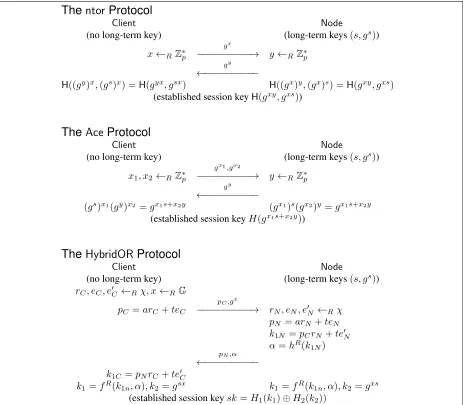
One-way Authenticated Key Exchange—1W-AKE.Goldberg et al. introduce a security definition of (one-way anonymous) one-(one-way authenticated key exchanges (1W-AKE) to facilitate design of provably secure session key agreement protocols for onion routing [24]. (See Section 3 for a complete 1W-AKE definition.) They also fixed a key agreement protocol proposed in [38] to obtain a provably secure construction called thentorprotocol, which has replaced the TAP protocol in the current Tor network. Inntor, the client sends a fresh ephemeral keygxto the node. The node computes and sends a fresh ephemeral keygy to the client and calculates the session key asH((gx)y,(gx)b), wherebis the long term secret key of the node.
Recently, Backes, Kate, and Mohammadi [3] introduced a 1W-AKE protocol Ace that improves upon the computational efficiency ofntor. InAcethe client sends two fresh ephemeral keysgx1 andgx2 to the node. The node sends one fresh ephemeral keygy to the client. The client and node compute the shared secret asgx1b+x2y = (gb)x1(gy)x2 = (gx1)b(gx2)y. The source of efficiency inAcecomes from the fact that one can do two exponentiations at the same time using a multi-exponentiation trick. (See Figure 4 in Appendix A for a pictorial illustration ofntorandAce.)
In contrast to the above interactive 1W-AKE protocol, a single-pass construction using a non-interactive key exchange is possible as well. However, achieving forward secrecy without regularly rotating the PKI keys for all Tor nodes is not possible [29], and periodic public key rotation should be avoided for scalability reasons. There have been attempts to solve this problem in the identity-based cryptography setting [29] or the certificate-less cryptography setting [10]. Nevertheless, as discussed in [2], key authorities required in these constructions can be difficult to implement in practice.
2.2 Gap Diffie-Hellman—GDH
LetGbe a multiplicative group with large prime orderpandg ∈ Gbe the generator of the group. Given
a triple(g, ga, gb)fora, b∈r Z∗p, the gap version of Diffie-Hellman (GDH) problem is to find the element
gab with the help of a Decision Diffie-Hellman (DDH) oracle [37]. The DDH oracleOddh takes input as
or not. For the security parameterλ, solvingGDH problem inGis assumed to be a hard problem. More
formally,
Definition 1(GDH Assumption). For all algorithmA, the advantage of solvingGDH in the groupGis defined as,
AdvAgdh= Pr[AOddh(p, g, ga, gb) =gab,(a, b)∈rZ∗p
2 ].
TheGDH assumption states that AdvAgdh is a negligible function of the security parameterλfor all PPT algorithmsA.
2.3 Learning With Errors—LWE
Learning with errors (LWE) is a problem of distinguishing noisy random linear equations from truly random ones, for a small amount of noise. It has been shown to be as hard as some worst case lattice problems [43], and its different variants have been employed in designing lattice-based cryptosystems [33, 35, 42, 43]. The main drawback of schemes based on LWE [43] is that they are based on matrix operations, which are quite inefficient and result in large key sizes. To overcome these problems, in last few years, special lattices with additional algebraic structures are used to construct cryptographic protocols.
LWE for Polynomial Ring. To reduce computation, communication and storage complexity, Lyuba-shevsky [34] propose an algebraic variant of LWE,ring-LWE, the problem is defined over a polynomial ring.
Let Zq be the set of integers from b−q/2c to bq/2c, and let Z[x]be the set of polynomials with
co-efficients inZ. Considerf(x) = xn+ 1 ∈ Z[x], where the degree of the polynomialn ≥ 1 is a power
of2, which makesf(x)irreducible over theZ. LetR = Z[x]/hf(x)ibe the ring of integer polynomials
modulo f(x) such that elements of R can be represented by integer polynomials of degree less thann. Letq ≡1 mod 2nbe a sufficiently large public prime modulus (bounded by a polynomial inn), and let Rq = Zq[x]/hf(x)ibe the ring of integer polynomials modulo both f(x)andq. The ringRqcontains all
the polynomials of degree less thannwith coefficient inZq, along with two operations, polynomial addition
and multiplication modulof(x).
Letχbe the error distribution overR, which is concentrated onsmallelements ofR. See [34] for details of the error distribution for the security and the correctness of the system. We denoteDs,χas the ring-LWE
distribution overR2q, obtained by choosing uniformly randoma←Rqande←χ, and outputs(a, a·r+e)
for somer←Rq.
Decision ring-LWE problem. The decision version of ring-LWE is to distinguish between two distribu-tions,Ds,χ, for uniformly random s ← Rq and a uniformly random distribution inRq ×Rq (denoted by
URq×Rq), given apoly(n)number of independent samples. More formally,
Definition 2(Decision ring-LWE Assumption). The decision ring-LWE problem forn, q, χis to distinguish the output ofODs,χoracle from the output of an oracleU
Rq×Rq that returns uniform random samples from Rq×Rq. IfAis an algorithm, the advantage ofAis defined as
AdvAdrlwe=|Pr[AODs,χ(·)]−Pr[AOURq×Rq(·)]|.
The decision ring-LWE assumption states that for given values ofn,q, andχ, for every PPT adversaryA,
AdvdrlweA is negligible in the security parameterλ.
It is important to note that ring-LWE samples are pseudorandom even when the secret r is chosen from the error distribution [1, 36]. Ducas et al. [17] show that the ring-LWE problem is hard in any ring
Z[x]/hΦmi, for any cyclotomic polynomialΦm(x).
Robust extractors. One of the important problems with the lattice-based key exchange protocols is the error correction (or reconciliation) of the shared secret. In literature, there are different methods [13, 20] to agree on a shared secret from noisy shared secret values. For our construction we adopt the method due to Ding et al. [13] and recall the corresponding concept of robust extractors and the signal functions below. Intuition. Let Alice sendspA = asA+ 2eA to Bob, and Bob sends pB = asB + 2eB to Alice, where
eA, eB ∈ χ and a, sA, sB ∈ Rq. Here, sA and sB are the secret keys of Alice and Bob respectively.
To compute the shared secret Alice computesKA =pBsA mod q = asAsB+ 2eBsA mod q and Bob
computesKB =pAsB mod q=asAsB+ 2eAsB modq. ClearlyKA−KBis even and small. Using the
robust extractor as explained in [13], it is possible for Alice and Bob to agree on the same value once they haveKAandKB respectively. To achieve this goal Bob has to send asignalvalue indicating whetherKB
lies in[−q/4, q/4]T
Zor not. IfKBlies in[−q/4, q/4]TZthenKB=KA+ 2(eAsB−eBsA) modq.
Now2(eAsB−eBsA)≤q/4, implies:
KB=KA+ 2(eAsB−eBsA) mod q,
KB=KA mod q+ 2(eAsB−eBsA),
(KB mod q) mod 2 = (KB mod q) mod 2.
This is also true whenKB lies outside the interval[−q/4, q/4]TZ. However, this type of deterministic
extractor leaks the information whetherKB lies inside or outside a certain interval. To solve this problem
Ding et. al. [13] propose a randomized signal generation algorithm that removes the bias of the distribution of the extracted key.
Definition 3(Robust Extractors). An algorithmf(·)is a robust extractor onZqwith error toleranceδwith
respect to a hint functionh(·)if:
– f(·)takes an inputx∈Zqand a signalα∈ {0,1}, and outputsk=f(x, α)∈ {0,1}.
– h(·)takes an inputy ∈Zqand outputs a signal valueα=h(y)∈ {0,1}.
– f(x, α) =f(y, α), for anyx, y∈Zq, such that(x−y)is even and|x−y| ≤δ, whereα=h(y).
We use the robust extractor as described in [13]. Forq > 2defineα0 :Zq → {0,1}andα1 :Zq →
{0,1}as follows:
α0(x) =
(
0, ifx∈[−bq4c,bq4c];
1, otherwise. α1(x) =
(
0, ifx∈[−bq4c+ 1,b4qc+ 1]; 1, otherwise.
The hint algorithm h(·)generates the signalαfor somey ∈ Zqby tossing a random coinb ← {0,1}
and computingα=h(y) =αb(y). Finally the robust extractor computes the common value as:
f(x, α) = (x+α·q−1
2 mod q) mod 2,
wherex∈Zq,|x−y| ≤δandx−yis even. In [13], the authors prove thatf(·)is a randomness extractor
It is easy to extend this notion for ring settings. Any element inRqcan be represented by a degreen−1
polynomial. For example anya∈Rqcan be written in the forma0+a1x+· · ·+an−1xn−1. In that case the extractor can extractnbits from an element ofRq. We extendαR0(a), αR1(a) :Rq →R2as follows:
αR0(a) =
n−1
X
i=0
α0(ai)xi; αR1(a) =
n−1
X
i=0
α1(ai)xi.
The algorithmhR(·)can be defined in the same manner ashR(a) =αRb(a), forb← {0,1}. Similarly define the extractor in the ring settingsfR(a, α) :Rq→R2as:
fR(a, α) = (a+α·q−1
2 mod q) mod 2.
Authenticated key exchange in the lattice setting. Fujioka et al. [19] provide the firstCK+ secure [9, 19, 30] authenticated key exchange (AKE) protocol from a key-encapsulation mechanism (KEM) based on ring-LWE problem in the standard model. However due to the huge communication cost (≈139625bytes) their lattice-based AKE is not suitable for real-world applications. In [20], Fujioka et al. propose a generic construction for AKE from OW-CCA KEMs in random oracle model. When instantiated with ring-LWE settings, their AKE protocol gives a much more efficient solution to the problem. Still, communication cost for [20] reaches about10075bytes. Peikert [40] proposes a new low-bandwidth error correction technique for ring-LWE based key exchange, and provides practical lattice based protocols for key transport and AKE. Ding et al. [13] propose another method for error correction and design a passively secure DH-like key exchange scheme based on both the LWE and the ring-LWE problem. Zhang et al. [48] extend the above AKE protocol to ideal lattice settings, and their lattice-based AKE protocol gives weak perfect forward secrecy in the Bellare-Rogaway model [4]. Recently Bos et al. [6] demonstrate the practicality of using ring-LWE based key exchange protocols in real life systems. They employ lattice-based key exchange in TLS protocol. Their implementation reveals that the performance price for switching from pre-quantum-safe to post-quantum-safe key exchange is not too high and can already be considered practical, which further motivates our efforts towards defining a 1W-AKE protocol in the lattice setting.
3
1W-AKE Security Definition
Goldberg et al. [24] define the security requirements for a one-way authenticated key exchange (1W-AKE) protocol, which are refined in [3]. In this section we recall the security requirements for a 1W-AKE protocol between an anonymous client and an authenticated node.
A 1W-AKE protocol is a tuple of ppt algorithms(SetUp,Init,Resp,CompKey), whereSetUpgenerates the system parameters and the static long-term keys for the node. The client callsInitto initiate the 1W-AKE protocol and the node usesRespto respond to anInit. Finally, the client usesCompKeyto verify the key-confirmation message and compute the key. We assume that a PKI is given, that means for a nodeN all parties{P1,· · ·, Pm}can obtain a certified public keypkN.
Along with protocol correctness, a secure 1W-AKE protocol should respect the following properties:
1W-AKE security. An attacker should not learn anything about the session key of an uncompromised ses-sion, even if it completely compromises several other sessions, introduces fake identities or even learn some uncompromised session secret.
uponsendP(params, N):
(m,st,Ψ)←Init(N,params,cs)
ake stP(Ψ)←(N,st); send(m,Ψ)
uponsendP(Ψ,m)andake stP(Ψ) =⊥: (m0,(k, ?,st),Ψ)←Resp(skP, P,m,cs); result stP(Ψ)←(k,st, ?); sendm0
uponsendP(Ψ,m)andake stP(Ψ)6=⊥: (N,st)←ake stP(Ψ); check for a validpkN
(k, N,st)←CompKey(pkN,m,Ψ,(N,st))
eraseake stP(Ψ);result stP(Ψ)←(k, N,st)
uponreveal nextP:
(x, X)←Gen(1λ); append(x, X)tocs; sendX
uponpartnerP(X):
ifa key pair(x, X)is in the memorythensendx
uponsk revealP(Ψ):
ifresult stP(Ψ) = (k, N,st)thensendk
uponestablish certificate(N,pkN):
register the public keypkN for the partyN
upontestP(Ψ):(one time query)
(k, N,st)←result stP(Ψ)
ifk6=⊥andN 6=?andΨis 1W-AKE freshthen ifb= 1thensendkelsesendk0←R{0,1}|k|
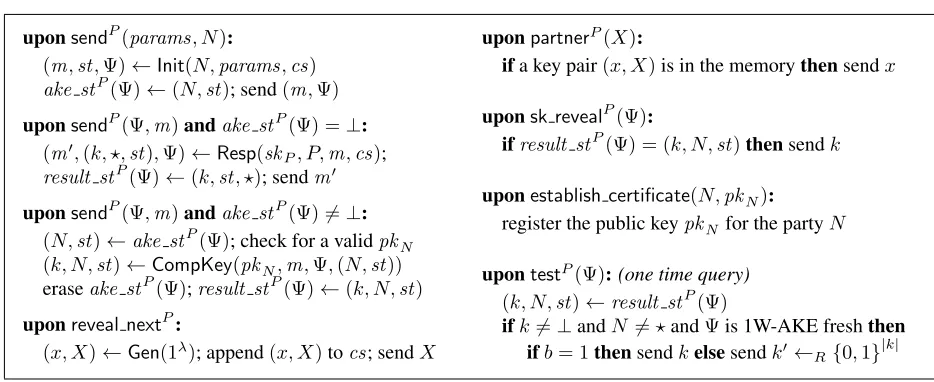
Figure 1: 1W-AKE Security Challenger: ChKE
b (1λ), whereλis the security parameter. If any invocation
outputs⊥, the challenger erases all session-specific information for that session and aborts that session. [3]
3.1 Correctness
In a 1W-AKE protocol an anonymous client (denoted by ~) tries to establish a shared secret key with a nodeN. The client callsInit(N, pkN, cs), which returns an output messagem, session idΨand session
statest. The client sends mtoN. Inittakes a queuecsas input, wherecsstores already chosen keys. If csis empty then Initgenerates a fresh output messagem. In response,N runs Resp(skN, N, m, cs)and
outputs(m0,(k,~,−→v),ΨN), wherem0is the response message to the client,kis the session key computed
by N, and −→v contains ephemeral public keys for the session ΨN. On receiving m0, the client computes
(k0, N,−→v0)by callingCompKey(pkN, m0,Ψ, st), wherek0 is the session key computed by the client and
−
→v0 is the list of ephemeral public keys. An 1W-AKE protocol is correct if for every partyN:
Pr[(m, st,Ψ)←Init(N, pkN, cs),(m0,(k,~,−→v),ΨN)←Resp(skN, N, m, cs),
(k0, N,−→v0)←CompKey(pkN, m0,Ψ, st) :k=k0∧ −→v =−→v0)] = 1.
3.2 1W-AKE Security
The goal of the adversary in the 1W-AKE security experiment is to distinguish the session key of an uncom-promised session from a random key. It requires an active attacker to not learn anything about the key or be able to impersonate an honest node.
In the security game, a challengerChKE represents honest parties(P
1,· · · , Pm)and allows the attacker
a fixed set of queries described in Figure 1. The challenger internally runs the 1W-AKE algorithm, and simulates each party. For the challenge, the adversary asksChKE for the session key of an uncompromised session Ψfor a party P by querying testP(Ψ) (one time query). ChKE sends the correct session key or a randomly chosen session key to the attacker with equal probability. The attacker’s task is to determine whether the given key corresponds to the real sessionΨor is random.
For triggering the initiation session, triggering the response to a key exchange, and for completing a key exchange, the challenger allows the adversary to querysendP(·, m). For the compromising parties, the attacker can ask the following queries:
– sk revealP(Ψ): ask for the session key of a sessionΨ.
– establish certificate(N, pkN): register new long-term public keyspkN for an unused identityN.
The challenger maintains several variables for each partyP:
– params stores public parameters for the AKE protocol.
– ake stP(Ψ)stores the key exchange state for the partyPin the sessionΨ. It contains ephemeral keys that will be deleted after the completion of the key exchange.
– result stP(Ψ) stores the resulting state for the partyP for a completed session Ψ. This result state contains the established session keyk, the identity of the peer party, which is~if the peer is anony-mous, otherwise the identity of the peer. A statest that typically contains two vectors −→v0,−→v1 that contain the ephemeral and the long-term public keys used for establishing the session key ofΨ.
The attacker is apartnerof a public keyXif one of the following conditions hold:
– Xhas not been used yet.
– Xis the public key that the attacker registered using aestablish certificate(N, X)query.
– Xwas the response of asendP orreveal nextP query and there is a successive querypartnerP(X).
In order to prevent the attacker from trivially winning the game, Goldberg et al. [24] propose thefreshness
notion for the challenge session. A challenge session is1W-AKE freshif the following conditions hold:
1. Let(k, N, st) =result stP(Ψ). For every vector−→vi instthere is at least one elementXin−→vi such
that the attacker is not apartnerofX.
2. Ifake stP(Ψ) = (−→v , N)for the challenge sessionΨ, the adversary did not issuesk revealN(Ψ0), for anyΨ0such thatake stN(Ψ0) = (−→v ,~).
After a successful key exchange with a partyN, an anonymous client outputs a tuple(k, N,−→v0,−→v1), where kis the session key.−→v0,−→v1is the transcript of the protocol. The nodeN outputs(k,~,−→v0,−→v1)to denote that the peer party is anonymous.
Definition 4(1W-AKE security). Letλbe a security parameter and let the number of partiesm ≥ 1. A protocolπ is said to be1W-AKE secureif, for all probabilistic polynomial time (ppt) adversariesA, the advantageAdvA1w-ake(π, λ, m)thatAdistinguishes a session of a1W-AKE freshsession from a randomly chosen session key is negligible inλ, whereAdv1w-ake
A (π, λ, m)is defined as:
AdvA1w-ake(π, λ, m) =|P r(A(trans(π), k) = 1)−P r(A(trans(π), k0) = 1|,
wheretrans(π)is the transcript of the protocol,kis the real session key andk0is the random session key.
Forward Secrecy. In key exchange forward secrecy ensures that a session key derived from long-term keys remains secret even if the long-term keys are compromised in the future. A 1W-AKE secure protocol provides forward secrecy if the long-term public keys of the participating parties appear in the output vector of the protocol [24]. In that case the adversary can bepartnerwith a long-term public key, ensuring forward secrecy in the security game.
3.3 One-way Anonymity
the server, but from the server’s point of view (or from the view of any other user), the participating client must be anonymous.
In Figure 2 the 1W-Anonymity game is explained in detail. In the security experiment the adversary can communicate with all the parties directly through aChKE challenger. The adversary chooses two distinct party indices iandj for the key exchange challenge session Ψ∗ and gives that toChAN. ChAN chooses a candidate party by picking one index b∗ ← {i, j} randomly, and starts a key-exchange sessionΨ∗ with Pb∗. Finally the adversary has to guessb∗. To prevent trivial winning the adversary can not execute certain queries [3, 24] that leak the state of the candidate parties. Formally, to satisfy this condition we require that ChAN internally runs a copy of 1W-AKE challengerChKE. We denote the internal copy asIChKE.
Definition 5(1W-anonymity). Letλbe the security parameter. LetP, N be ppt interactive turing machines, andvdenote the view of the adversary while interacting withP andN, i. e. v =hA(1λ), P(1λ), N(1λ)i.
Letbbe the output of the adversary after a 1W-anonymity game. A protocolπis said to be 1W-anonymous if, for all ppt adversariesA, the advantageAdv1w-anon
A (π, λ, m)is negligible inλ, where:
Adv1w-anonA (π, λ, m) =|P r[b← hA(1λ),ChAN
b∗(1λ),ChKE(1λ)i|b=b∗]− P r[b← hA(1λ),ChAN
b∗(1λ),ChKE(1λ)i|b6=b∗]|.
uponstart(i, j, params, N):(one time query)
ifi6=jthen
ifb= 1 then i∗←i else i∗←j
sendsendPi∗(params, N)toIChKE
1 (1λ)
wait for the response(Ψ∗,m0); sendm0 to
M
uponsend(m): forwardsendPi∗
toIChKE
1 (1 λ)
uponreveal next:
forwardreveal nextPi∗toIChKE
1 (1λ)
uponsk reveal:
forwardsk revealPi∗(Ψ∗)toIChKE
1 (1λ)
uponpartner(X):
forwardpartnerPi∗(X)toIChKE
1 (1 λ)
Figure 2: The anonymizing machineChAN
b (1λ):ICh
KE
1 (1λ)is an internally emulated copy ofCh1KE(1λ)[3]
4
Our Protocol
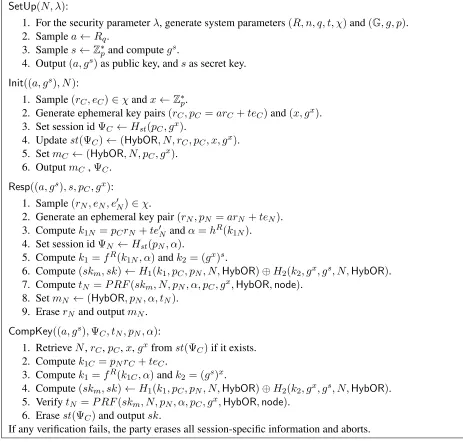
In this section we describe theHybridORprotocol, a hybrid lattice-based onion routing protocol. We call this protocol hybrid as the long-term part of the key comes from a DH key exchange, whereas the ephemeral part of the key comes from a lattice based key exchange. Hence the security of the protocol essentially depends on the hard problems in either setting, namely the hardness of the GDH problem from the DLog setting or the hardness of the ring-LWE problem from the lattice-based setting.
In ourHybridORprotocol, The client generates fresh ephemeral keyspC ∈Rqandgx ∈ Gand sends
them to the node. The node generates a fresh ephemeral key pN ∈ Rq and computes k1N = pCrN +
te0N ≈arCrN, a signal valueα = hR(k1N). The node sendspN andαto the client. The client computes
k1C =pNrC +trC0 ≈ arCrN. Recall thatt = 2. The client and nodeapproximately agreeon the shared
secret value k1C andk1N. To achieveexact agreementon the shared secret from the approximate shared
secret, the robust extractorfR(·)is used. The client and node compute the shared secretk1,k2, andskas follows:
k1 =fR(k1N, α), k2 = (gx)s, sk=H1(k1)⊕H2(k2)(node-side)
SetUp(N, λ):
1. For the security parameterλ, generate system parameters(R, n, q, t, χ)and(G, g, p).
2. Samplea←Rq.
3. Samples←Z∗pand computegs.
4. Output(a, gs)as public key, andsas secret key.
Init((a, gs), N):
1. Sample(rC, eC)∈χandx←Z∗p.
2. Generate ephemeral key pairs(rC, pC =arC+teC)and(x, gx).
3. Set session idΨC ←Hst(pC, gx).
4. Updatest(ΨC)←(HybOR, N, rC, pC, x, gx).
5. SetmC ←(HybOR, N, pC, gx).
6. OutputmC ,ΨC.
Resp((a, gs), s, pC, gx):
1. Sample(rN, eN, e0N)∈χ.
2. Generate an ephemeral key pair(rN, pN =arN +teN).
3. Computek1N =pCrN +te0N andα=hR(k1N).
4. Set session idΨN ←Hst(pN, α).
5. Computek1=fR(k1N, α)andk2 = (gx)s.
6. Compute(skm, sk)←H1(k1, pC, pN, N,HybOR)⊕H2(k2, gx, gs, N,HybOR). 7. ComputetN =P RF(skm, N, pN, α, pC, gx,HybOR,node).
8. SetmN ←(HybOR, pN, α, tN).
9. EraserN and outputmN.
CompKey((a, gs),Ψ
C, tN, pN, α):
1. RetrieveN,rC,pC,x,gxfromst(ΨC)if it exists.
2. Computek1C =pNrC+teC.
3. Computek1=fR(k1C, α)andk2 = (gs)x.
4. Compute(skm, sk)←H1(k1, pC, pN, N,HybOR)⊕H2(k2, gx, gs, N,HybOR). 5. VerifytN =P RF(skm, N, pN, α, pC, gx,HybOR,node).
6. Erasest(ΨC)and outputsk.
If any verification fails, the party erases all session-specific information and aborts.
Figure 3: A detailed description of theHybridORprotocol
4.1 Construction
Figure 3 provides a detailed description of theHybridORprotocol. The node N runs theSetUpalgorithm to generate the system parameters. InHybridORtheSetUpalgorithm can be seen as a combination of two separateSetUp algorithms. One part generates the system parameters for the DH-like key exchange (as in [3, 24]) and the other part generates the parameters for the lattice based settings (as in [13]).
The SetUpalgorithm generates a group Gwith large prime orderp, where the GDH [37] problem is
hard. Letg∈Gbe the generator of the group. TheSetupalgorithm further generates the public parameters
for the lattice based settings as described in Section 2.3. It publishes the dimensionn, the prime modulusq, the description of the ringRand the error distributionχin the public parameter.
The node samples a ← Rq ands ← Z∗p, computes gs, and publishes(R, n, q, t, χ, a, G, g, gs)as the
key. The node also publishesHst(·), H1(·), H2(·) and aP RF(·) in the public parameter, where Hst(·)
is a collision-resistant hash function, H1(·) is a randomness extractor andH2(·)is a random oracle. The P RF(·) is a pseudorandom function that is used to generate the key confirmation message. Note that according to [18], we instantiate a randomness extractor with HMAC. However, we can also use the key derivation function HKDF [31] to instantiateH1.
To initiate a new key exchange session the anonymous client Ccalls theInitalgorithm. Initrandomly samplesrC andeC from the error distributionχ andx from Z∗p. It computes the ephemeral key pair as
pkC = (pC, gx)andskC = (rC, x), wherepC =arC +teC mod q.Initsets the local session identifier as
ψC =Hst(pC, gx), whereHstis a collision-resistant hash function. The session information of the client is stored in the variablest(ψ)asst(ψC) = (HybOR, N, rC, pC, x, gx). Initgenerates the outgoing message
mC = (HybOR, N, pC, gx), and sends(ψC, mC)to the nodeN over the network.
In response to the message the node runs Resp, which verifies whetherpC ∈ Rq andgx ∈ G. On
successful verification it randomly samplesrN andeN from the error distributionχ and computespN =
arN +teN modq. Respoutputs the ephemeral key pair(pN, rN), wherepN is the public part and rN
remains secret to the node. Respfurther samples e0N ← χ and computes k1N = pCrN+te0N mod q
andα = hR(k1N). hR(·)is a randomized algorithm used to generate the signal value α, as described in
section 2.3. To ensure the correctness of the shared secret computation,N sendsαto the client [13]. The node computes the short-term shared secret (k1) and the long-term shared secret (k2) as:
k1 =fR(k1N, α), k2 = (gx)s=gxs,
wherefR(·)is the robust extractor as defined in Section 2.3. By short-term shared secret we mean the shared
secret computed using the client’s ephemeral key and node’s ephemeral key. By long-term shared secret we mean the shared secret computed by using the client’s ephemeral key and node’s long-term or static key.
The node computes the session keysk, the PRF keyskmand the key confirmation messagetN as:
(skm, sk) =H1(k1, pC, pN, N,HybOR)⊕H2(k2, gx, gs, N,HybOR) tN =P RF(skm, N, pN, α, pC, gx,HybOR,node).
The tag tN provides only a means for the key confirmation. Resp returns the session identifier ψN =
Hst(pN, α)and a messagemN = (HybOR, pN, α, tN). The node sends(ψN, mN)to the client. The node
completes the session by deleting(rN, eN, e0N)and outputting(sk,~,(−→v0,−→v1)), where−→v0 ={pC, gx}and
− →v1 ={p
N, gs}.~denotes that the identity of the client is not known to the node.
On receiving the message (ψN, mN)for the sessionψC, the clientC calls the algorithmCompKeyto
compute the session key. CompKey first checks whether the sessionψC is active; if so, it retrieves the
required session information, namelyrC,pC,x,gxfromst(ψC). Then it checks whetherpN ∈ Rq. After
successful verificationCompKeycomputes the shared secretsk1,k2as follows:
k1C =pNrC+teC mod q,
k1 =fR(k1C, α), k2 = (gs)x=gxs.
The client computes(skm, sk) = H1(k1, pC, pN, N,HybOR)⊕H2(k2, gx, gs, N,HybOR), wheresk is the session key andskm is the PRF key. It verifies the key-confirmation messagetN using the key skm.
After that the client completes the sessionψC by deletingst(ψC)and outputting(sk, N,(−→v0,−→v1)), where
− →v
0 ={pC, gx}andv→−1 ={pN, gs}. If any verification fails during the session execution, the party erases all
session-specific information and aborts the session.
In Figure 4 in Appendix A, we compareHybridORwith thentorand Ace protocols in the literature.
by Ding et. al [13]. Hence the correctness of HybridORdirectly follows from the correctness of DH key exchange and the correctness of the lattice-based protocol [13].
For the DH part, the node computes (gx)s =gxs and the client computes(gs)x = gxs. Further, both client and node computesH2(gxs, gx, gs, N,HybOR). For the lattice part the node computesk1N =pCrN+
te0N ≈arCrNand the client computesk1C =pNrC+teC ≈arCrN. The node also computesα=hR(k1N)
and sends it to the client. The client and node useαto make sure that the shared secretk1 computed from k1N (for the node) andk1C (for the client) do not produce different results in modulo operation. They use
the robust extractorfR(·) (see Section 2.3) and computek1 = fR(k1N, α) = fR(k1C, α). More details
of the robust extractor can be found in [13]. After computing the shared secretk1 the client and node both computesH1(k1, pC, pN, N,HybOR). Further, from both parts of the shared secret they compute the session
key and PRF key for the protocol as(skm, sk) =H1(k1, pC, pN, N,HybOR)⊕H2(gxs, gx, gs, N,HybOR).
5
Security Analysis
5.1 Type of Adversary
To analyze the 1W-AKE security of our protocol, we consider three types of 1W-AKE adversaries. We classify the type of adversary depending on the power of the adversary in the test session. For all other sessions the adversary can be partner to any public values, after respecting the freshness condition of the 1W-AKE security game.
Type-I adversary. The first type of adversary cannot be partner to any of the public values in the test session. By proving security against this kind of adversary we show that an active adversary without the knowledge of any secret values used in the test session cannot learn anything about the session key.
Type-II adversary. The second type of adversary can be the partner with only the ephemeral public key from a nodeN in the test session. By proving the security against this kind of adversary we give the security guarantee of the protocol against a man-in-the-middle adversary trying to impersonate the nodeN to the client.
Type-III adversary. The third type of adversary can be partner with only the long term public key in the test session. This gives the guarantee of forward security of the protocol; i.e., even if some information about the long-term private key is known to the adversary, the adversary cannot learn any information about the already created session key.
5.2 Security against Type-I Adversary
We show thatHybridORis secure against Type-I adversary under either the GDH or the ring-LWE assump-tion. The motivation of this security theorem is to show that even if the ring-LWE assumption or the GDH assumption (but not both) is broken,HybridORremains secure against Type-I adversary.
Theorem 6. The protocolHybridORis 1W-AKE secure against a PPT Type-I adversary under the GDH or the ring-LWE assumption, consideringH1 as randomness extractor andH2 as random oracle. More
precisely, for any PPT Type-I adversaryA,
Adv1w-akeA ≤min(AdvdrlweA◦B0,1 +AdvdrlweA◦B1,2, AdvAGDH◦B0),
whereB0,1,B1,2 andB0 are the reduction algorithms as described in the proof.
G0: This is the original 1W-AKE security game, where the reduction algorithm B generates all the public values honestly in all the sessions.
G1: This game is identical toG0, except herepC is generated uniformly at random in thetestsession.
G2: This game is similar toG1, except here pN is generated uniformly at random in thetest session
and also thetestsession secretk1is generated uniformly at random. AsG0is the real 1W-AKE game, we can boundPr(E0)as
AdvA1w-ake =|Pr(E0)−1/2|. (1)
Lemma 7. No PPT Type-I adversary can distinguish between G0 andG1 under the decision ring-LWE
assumption, ifH1is a randomness extractor andH2is a random oracle.
Proof. If there exists a PPT Type-I adversary A that can distinguish between G0 and G1, then we can construct a PPT reduction algorithmB0,1 that can efficiently distinguish between tuples from a ring-LWE distribution and a uniform distribution.
InG0,(a, pC)are samples from a ring-LWE distribution, such thatpC =arC+teC. InG1,(a, pC)are
samples from a uniform distribution overRq×Rq. Under the decisional ring-LWE assumption these two
distributions are indistinguishable.
Solving decision ring-LWE. To simulate the 1W-AKE challenger for A the reduction algorithm B0,1 guessesψi to be thetestsession. In thetestsession it honestly generates(G, g, gx, gs). B0,1 also takes a pair(a0, u0)from the ring-LWE challenger and setsa= a0 andpC =u0. Now if(a0, u0)is a ring-LWE
sample, then there exists anrC, eC ∈χsuch thatpC =arC+teCand in that case the output ofB0,1is dis-tributed exactly as inG0. Whereas if(a0, u0)is sample from a uniform distribution overR2q,B0,1simulates G1 forA. Thus, ifAcan distinguish G0fromG1, thenA◦B0,1 can distinguish ring-LWE samples from samples from a uniform distribution overR2q. Thus ifAcan distinguishG0fromG1,A◦B0,1can solve the decision ring-LWE problem. Hence,
|Pr(E0)−Pr(E1)| ≤AdvdrlweA◦B0,1. (2)
Lemma 8. No PPT Type-I adversary can distinguish between G1 andG2 under the decision ring-LWE assumption, ifH1is a randomness extractor andH2is a random oracle.
Proof. If there exists a PPT Type-I adversary A that can distinguish between G1 and G2, then we can construct an PPT reduction algorithmB1,2that can efficiently distinguish between tuples from a ring-LWE distribution and a uniform distribution.
InG1,(a, pN)are samples from a ring-LWE distribution, such thatpN =arN +teN. InG2,(a, pN)
are samples from a uniform distribution overRq×Rq. Under the decisional ring-LWE assumption these
two distributions are indistinguishable. InG2,k1is also distributed as a random element fromRq. In both
the casespC is uniformly distributed overRq.
Solving decision ring-LWE. To simulate the 1W-AKE challenger for A the reduction algorithm B1,2 guessesψi to be thetestsession. In the testsession it honestly generates(G, g, gu, gv). B1,2 also takes {(a0, u0),(a1, u1)}from the ring-LWE challenger and setsa=a0,pC =a1,pN =u0 andk1 =u1. Now
if{(a0, u0),(a1, u1)}are ring-LWE samples, then there existrN, eN, e0N ∈ χsuch thatpN =arN +teN
Acan distinguishG1fromG2, thenA◦B1,2can distinguish ring-LWE samples from samples from uniform distribution overR2
q.
Thus if a PPT Type-I adversaryAcan distinguish betweenG1andG2, then we can construct a reduction B1,2which can efficiently solve the ring-LWE problem. As a result we can write,
|Pr(E1)−Pr(E2)| ≤AdvdrlweA◦B1,2. (3)
Analysis ofG2.InG2the adversary has to guess ab∗in the 1W-AKE game to distinguish between the real session keyskand randomly chosen session key sk0. AspC,pN andk1 are chosen uniformly at random fromRq, andH1(·)is a randomness extractor, the resulting session keyskis uniformly distributed over the key space. On the other hand,sk0 is also chosen uniformly from the key space. As a result, the adversary has no information aboutb∗, and hence
Pr(E2) = 1/2. (4)
By combining equation(1)−(4), we can write:
AdvA1w-ake ≤AdvdrlweA◦B0,1 +AdvdrlweA◦B1,2. (5) Lemma 9. The protocol HybridOR is 1W-AKE secure against a PPT Type-I adversary under the GDH assumption in the random oracle model.
Proof. If there exists a PPT Type-I adversaryAthat can break the 1W-AKE security of the protocol, then we can construct a PPT reduction algorithmB0against the GDH challenger.Ais allowed to make a polynomial number (poly(λ)) of session queries. B0 also simulates the random oracleH2. Let{G, g, gu, gv}be the GDH challenge.B0has to computeguvin order to win the game.
The algorithmB0 guessesψi to be atestsession. To simulate theψi,C runs theSetUpand generates
(R, n, q, t, χ). It uses the groupGand generatorgfrom the GDH challenger in the public parameters. B0 samplesa←Rsets(a, gu)as the static key pair of the server and simulatesψisession by setting:
gx =gv, (pC)i=arC+teC, (pN)i =arN +teN,
(K1)i= (pC)irN+te0N,(α)i=Signal((k1)i),
where,rC, rN, eC, eN, e0N ∈r χ. B0 tosses a coin and choosesb∈r {0,1}. Ifb = 0thenB0 computes the
session key by computingH1((k1)i,(pC)i,(pN)i, N,HybOR)⊕H2(·, gx, gu, N,HybOR), whereH1(·)is
a randomness extractor andB programsH2(·)as a random oracle. B sends the session key toA. Ifb= 1 thenB sends a random session key toA.
But in order to compute the correct test session key and to win the game, A has to query the random oracleH2(·)with the same input. OtherwiseA cannot distinguish a real session key from a random one, asH2(·)is modeled as a random oracle. WheneverAmakes a queryH2(Z, gx, gu, N,HybOR)for some Z ∈G,B0asks the DDH oracle whether(gx, gv, Z)is a validDDHtuple. If that is the case, thenZ =guv andB0sends the answer to the GDH challenger. Clearly the reductionB0is efficient.B0has to guess the test session with probability1/poly(λ), so ifAbreaks the 1W-AKE protocol with non-negligible probability thenB0will be able to solve the GDH problem with significant probability. Hence we can write,
Adv1w-akeA ≤AdvGDHA◦B0. (6)
Conclusion.By combining equation(5)and(6), we prove the result.
Note that the Type-I adversaryAcannot be partner to any of the public values in the test session only. For all other sessions it can be a partner to almost all values after respecting the freshness criterion. So in order to simulate a 1W-AKE challenger for the adversaryA, the reduction perfectly simulates all other sessions. As a result the challenger can satisfy any kind of queries (see Section 3.2) from the adversaryA during the simulation.
5.3 Security against Type-II Adversary
In this section we show that in the pre-quantum computing era (today)HybridORis secure against PPT Type-II adversary. Here we consider an active adversary which can actually become a partner with the ephemeral key of the server. We show that even in that case the adversary will not be able to win the 1W-AKE game.
Theorem 10. The protocolHybridORis 1W-AKE secure against a PPT Type-II adversary under the GDH assumption in the random oracle model.
Proof. If there exists a PPT Type-II adversaryAthat can break the 1W-AKE security of the protocol, then we can construct a PPT reduction algorithmBagainst the GDH challenger.Ais allowed to make a polynomial number (poly(λ)) of session queries. B also simulates the random oracleH2. LetP ={P1,· · · , Pm}be
the set of parties. Let{G, g, gu, gv}be the GDH challenge.Bhas to computeguvin order to win the GDH
game.
The algorithmB guessesψito be atestsession. To simulate theψi,B runs theSetUpand generates
(R, n, q, t, χ). It uses the groupGand generatorgfrom the GDH challenger in the public parameters. B samplesa←Rsets(a, gu)as the static key pair of the server and simulatesψisession by setting:
gx=gv,
(pC)i =arC+teC, (pN)i =arN +teN,
(K1)i = (pC)irN +te0N,(α)i =Signal((k1)i),
where,rC, rN, eC, eN, e0N ∈r χ. B tosses a coin and choosesb ∈r {0,1}. Ifb = 0thenB computes the
session key by computingH1((k1)i,(pC)i,(pN)i, N,HybOR)⊕H2(·, gx, gu, N,HybOR), whereH1(·)is
a randomness extractor andB programsH2(·)as a random oracle. B sends the session key toA. Ifb= 1 thenB sends a random session key toA.
The adversaryAcan be partner with ephemeral key(pN)iof the server in thetestsession. In that case
the reductionB can answerA with the correct value of rN. A can computeH1((k1)i,(pC)i,(pN)i, N,
HybOR)using that information. But in order to compute the correct test session key and to win the game,A has to query the random oracleH2(·)with the same input. OtherwiseAcannot distinguish a real session key from a random one, asH2(·)is modeled as a random oracle. WheneverAmakes a queryH2(Z, gx, gu, N, HybOR) for someZ ∈ G, B asks the DDH oracle whether(gx, gv, Z) is a valid DDH tuple. If that
is the case, then Z = guv and B sends the answer to the GDH challenger. Clearly the reduction B is efficient. B has to guess the test session with probability1/poly(λ), so ifAbreaks the 1W-AKE protocol with non-negligible probability thenBwill solve the GDH problem with significant probability.
Notice that this theorem directly imply that a Type-II adversary can break the 1W-AKE security of HybridORin a quantum world. As in the quantum world the Type-II adversary can compute the discrete log of the long term secretgsand it is already partner to the ephemeral secretpN in thetestsession. Hence the
adversary can compute the session key and wins the 1W-AKE game.
In order to make this protocol secure against Type-II adversary in a quantum world we need replace the long term key with a quantum secure component. But in that case we cannot use our current DH public keys and subsequently requires modification to the current Tor public key infrastructure. So, in today’s scenario it is sufficient to follow theHybridORdesign in the current form. As we can deploy this easily in the current Tor network.
5.4 Security against Type-III Adversary
A more important question to ask now is whetherHybridORprovides forward security in the post-quantum world. If not, then the privacy of today’s anonymous communication cannot be ensured once quantum computers arrive. We prove thatHybridORis forward secure if the ring-LWE problem is hard. The motive of this theorem is to show that by usingHybridORin Tor we can aim at the privacy of today’s anonymous communication even after quantum computers arrive.
Theorem 11. HybridORis 1W-AKE secure against a PPT Type-III adversary under the ring-LWE assump-tion. More precisely, for any PPT Type-III adversaryA,
AdvA1w-ake ≤AdvdrlweA◦B0,1 +Adv
drlwe
A◦B1,2,
whereB0,1andB1,2are the reduction algorithms as described in the proof.
Proof. To prove the security against a Type-III adversary, first we define a sequence of three gamesG0 to G2.
G0: This is the original 1W-AKE security game, where the reduction algorithm B generates all the values honestly in all the sessions.
G1: This game is identical toG0, except herepC is generated uniformly at random in thetestsession.
G2: This game is similar to G1, except herepN is generated uniformly at random in thetestand also
thetestsession secretk1 is generated uniformly at random.
Lemma 12. No PPT Type-III adversary can distinguish betweenG0 andG1 under the decision ring-LWE
assumption, ifH1is a randomness extractor.
Lemma 13. No PPT Type-III adversary can distinguish betweenG1 andG2 under the decision ring-LWE assumption, ifH1is a randomness extractor.
To prove Lemma 12 we consider that if there exists a PPT Type-III adversary A that can distinguish betweenG0andG1, then we can construct a PPT reduction algorithmB0,1that can solve the decision ring-LWE problem. Similarly for Lemma 13, if there exists a PPT Type-III adversary A that can distinguish betweenG1andG2, then we can construct a PPT reduction algorithmB1,2to solve the decision ring-LWE problem.
The proof of Theorem 11 is same as the proof of Theorem 6 (see Lemma 7, Lemma 8).
6
Performance Analysis
We analyze the performance ofHybridOR, and compare it with thentorprotocol.
Parameters. To achieve computational efficiency and to reduce the size of the public parameters, in HybridORwe use an algebraic variant of LWE called ring-LWE [34]. Similar to other ring-LWE based protocols [6, 40, 48], the security and performance ofHybridORessentially depend on the three factors: n, q, andβ. Here,nis the degree of the irreducible polynomialf(x),qis the prime modulus andβ =√2πσ for the standard deviationσof the error distributionχ.
Lindner and Peikert [32] show how the parameters(n, q, β)affect the security and performance of lattice based systems. They choose parameter set(256,4093,8.35)formedium securitylevel and claimed that to be comparable with128-bit AES security. Nevertheless, several implementations of lattice-based cryptographic primitives [20, 45] usen = 512 to achievehigh security. To be on the safer side, we also choose a high securitylevel, and use parameter set(512,1051649,8.00)(as used in [45]) in our implementation forRq.
For the DLog groupG, we use the elliptic curve cryptographic (ECC) setting with points (compressed
form) of sizep= 256bits, such as provided by Curve25519[5].
Computation Cost. We assume that the elementsrC, eC,pC andgx are precomputed on the client side,
and the elementsrN,eN,e0N, andpN are precomputed on the node side, e.g. in idle cycles. In our analysis,
they are received by the code as an input. In that case, to compute the session secret{k1, k2}, the client and the node each have to perform1multiplication and1addition inRqand1exponentiation inG.
Multiplications overRq can be performed efficiently using an FFT-based algorithm [34], which takes
O(nlogn)for a serial implementation andO(logn)time for a parallel implementation [25]. It is important to observe that these multiplications are more efficient than exponentiation inG(even in ECC settings). As
a result the total computation cost of the node (with precomputation) is mainly dominated by exponentiation inG.
As a proof of concept, we implement our protocol in a machine with a 6-core Intel Xeon (W3690) processor, each core running at3.47GHz. We use the GMP [26] library and the Tor library to implement the protocol. The code is compiled with -O3 optimizations using gcc4.6.3.
For our choice of parameter set (512,1051649,8.00) and ECC Curve25519, both the client and the node require≈150µsto compute the shared secret. The multiplication along with one addition inRqonly
requires≈50µs, and the exponentiation inGrequires≈100µs.
Thentorprotocol in Tor requires two exponentiations inGon both sides, and correspondingly requires
≈ 200µsto compute the shared secret. As a result, our unoptimized proof-of-concept HybridOR imple-mentation is nearly 1.5 times faster than thentor protocol used in Tor. Note that, for ntor, using some parallelization technique both the node and the client can reduce the computation cost to1.33 exponentia-tions (forλ= 128) [3]; however, the current Tor implementation does not employ these.
Communication Cost.In theHybridORprotocol the client has to send an elementgx ∈
Gand an element
pC ∈Rqto the node. We require32bytes to represent an element on Curve25519. On the other hand, for an
element inRq, we require at most1/8(nlgq)bytes, which is around1280bytes for the chosen parameter
set(512,1051649,8.0). Therefore, the client communicates1312bytes to the server.
On the other hand, the node has to send an elementpN ∈Rq, ann-bit signalα, and the key confirmation
message of32bytes to the client. That requires a total of1/8(nlgq+n)+32bytes. For the chosen parameter set(512,1051649,8.0), the node has to send about1376bytes to the client.
7
Conclusion
Lattice-based cryptographic protocols are supposed to offer resilience against attacks by quantum comput-ers, and the recent efficient ring-based constructions also put them in the realm of the practical use. In this paper, we demonstrated their utility to onion routing. In particular, we have presented a novel lattice-based 1W-AKE protocol HybridOR, which extracts its security from both the classically secure GDH assump-tion and the quantum-secure ring-LWE assumpassump-tion. On one hand, we based its security against man-in-the-middle impersonation attacks only on the GDH assumption as we do not expect an adversary to have quantum capabilities today, and it allows us to leverage the current Tor PKI in its current form. On the other hand, we base its forward secrecy on the arguably quantum-secure ring-LWE assumption, which allows us to makeHybridORmore efficient compared to the currently employedntorprotocol.
We also analyzed performance of our protocol in terms of its computation and communication cost for the128-bit security setting. Our performance analysis demonstrates that post-quantum 1W-AKE can already be considered practical for use today.
Finally, we view our efficientHybridORconstruction to be of independent interest to other authenticated key exchange protocols as well as anonymous communication scenarios over the Internet, and we plan to explore some those scenarios in the future.
Acknowledgements. We would like to thank Sujoy Sinha Roy for his suggestions regarding the ring-LWE implementation. This work was supported by the German Universities Excellence Initiative, and was partially supported by CoEC and R.C. Bose Centre for Cryptology and Security, ISI Kolkata.
References
[1] B. Applebaum, D. Cash, C. Peikert, and A. Sahai. Fast Cryptographic Primitives and Circular-Secure Encryption Based on Hard Learning Problems. InAdvances in Cryptology—CRYPTO ’09, pages 595–618. 2009.
[2] M. Backes, I. Goldberg, A. Kate, and E. Mohammadi. Provably Secure and Practical Onion Routing. InProc. 25th IEEE Computer Security Foundations Symposium (CSF), 2012.
[3] M. Backes, A. Kate, and E. Mohammadi. Ace: An Efficient Key-Exchange Protocol for Onion Routing. In
WPES, pages 55–64. ACM, 2013.
[4] M. Bellare and P. Rogaway. Entity Authentication and Key Distribution. InAdvances in Cryptology—CRYPTO ’93, pages 232–249. 1994.
[5] D. J. Bernstein. Curve25519: New Diffie-Hellman Speed Records. InPKC ’06, pages 207–228, 2006.
[6] J. W. Bos, C. Costello, M. Naehrig, and D. Stebila. Post-Quantum Key Exchange for the TLS Protocol from the Ring Learning with Errors Problem. IACR Cryptology ePrint Archive, 2014, 2014. To appear at IEEE Security and Privacy Symposium ’15.
[7] Z. Brakerski, A. Langlois, C. Peikert, O. Regev, and D. Stehl´e. Classical Hardness of Learning with Errors. In
STOC ’13, pages 575–584, 2013.
[8] R. Canetti. Universally Composable Security: A New Paradigm for Cryptographic Protocols. In FOCS ’01, pages 136–145, 2001.
[9] R. Canetti and H. Krawczyk. Analysis of key-exchange protocols and their use for building secure channels. In
Advances in Cryptology—EUROCRYPT 2001, pages 453–474. 2001.
[10] D. Catalano, D. Fiore, and R. Gennaro. Certificateless Onion Routing. InProc. 16th ACM Conference on Computer and Communication Security (CCS), pages 151–160, 2009.
[12] G. Danezis, R. Dingledine, and N. Mathewson. Mixminion: Design of a Type III Anonymous Remailer Protocol. InProc. 24th IEEE Symposium on Security & Privacy, pages 2–15, 2003.
[13] J. Ding, X. Xie, and X. Lin. A Simple Provably Secure Key Exchange Scheme Based on the Learning with Errors Problem. Cryptology ePrint Archive, Report 2012/688, 2012. http://eprint.iacr.org/.
[14] R. Dingledine and N. Mathewson. Design of a Blocking-Resistant Anonymity System. Technical report.
https://svn.torproject.org/svn/projects/design-paper/blocking.pdf.
[15] R. Dingledine and N. Mathewson. Tor Protocol Specification. https://gitweb.torproject.org/ torspec.git?a=blob_plain;f=tor-spec.txt.
[16] R. Dingledine, N. Mathewson, and P. Syverson. Tor: The Second-Generation Onion Router. In13th USENIX Security Symposium (USENIX), pages 303–320, 2004.
[17] L. Ducas and A. Durmus. Ring-LWE in Polynomial Rings. InPKC ’12, pages 34–51, 2012.
[18] P.-A. Fouque, D. Pointcheval, and S. Zimmer. HMAC is a Randomness Extractor and Applications to TLS. In
ACM ASIACCS ’08, pages 21–32, 2008.
[19] A. Fujioka, K. Suzuki, K. Xagawa, and K. Yoneyama. Strongly Secure Authenticated Key Exchange from Factoring, Codes, and Lattices. InPKC ’12, pages 467–484, 2012.
[20] A. Fujioka, K. Suzuki, K. Xagawa, and K. Yoneyama. Practical and Post-Quantum Authenticated Key Exchange from One-Way Secure Key Encapsulation Mechanism. InACM ASIACCS ’13, pages 83–94, 2013.
[21] C. Gentry. Fully homomorphic encryption using ideal lattices. InSTOC ’09, pages 169–178, 2009.
[22] I. Goldberg. On the Security of the Tor Authentication Protocol. InProc. 6th Workshop on Privacy Enhancing Technologies, pages 316–331, 2006.
[23] I. Goldberg. Privacy Enhancing Technologies for the Internet III: Ten Years Later. InDigital Privacy: Theory, Technologies and Practices, pages 3–18, 2007.
[24] I. Goldberg, D. Stebila, and B. Ustaoglu. Anonymity and One-Way Authentication in Key Exchange Protocols.
Designs, Codes and Cryptography, 67(2):245–269, 2013.
[25] N. G¨ottert, T. Feller, M. Schneider, J. Buchmann, and S. Huss. On the Design of Hardware Building Blocks for Modern Lattice-Based Encryption Schemes. InCHES 2012, pages 512–529. 2012.
[26] T. Granlund and the GMP development team.GMP: The GNU Multiple Precision Arithmetic Library, 6.0 edition, 2014.http://gmplib.org/.
[27] A. Kate and I. Goldberg. Using Sphinx to Improve Onion Routing Circuit Construction. In FC ’10, pages 359–366, 2010.
[28] A. Kate, G. M. Zaverucha, and I. Goldberg. Pairing-Based Onion Routing. InIn PETS ’07, pages 95–112, 2007.
[29] A. Kate, G. M. Zaverucha, and I. Goldberg. Pairing-Based Onion Routing with Improved Forward Secrecy.
ACM Trans. Inf. Syst. Secur., 13(4):29, 2010.
[30] H. Krawczyk. Hmqv: A high-performance secure diffie-hellman protocol. InAdvances in Cryptology—CRYPTO 2005, pages 546–566. 2005.
[31] H. Krawczyk. Cryptographic Extraction and Key Derivation: The HKDF scheme. InAdvances in Cryptology— CRYPTO ’10, volume 6223, pages 631–648. 2010.
[32] R. Lindner and C. Peikert. Better Key Sizes (and Attacks) for LWE-Based Encryption. InCT-RSA 2011, pages 319–339. 2011.
[33] V. Lyubashevsky and D. Micciancio. Asymptotically Efficient Lattice-Based Digital Signatures. InTheory of Cryptography Conference (TCC) ’08, pages 37–54. 2008.
[35] D. Micciancio. Improving Lattice Based Cryptosystems Using the Hermite Normal Form. InCryptography and Lattices, volume 2146 ofLNCS, pages 126–145. 2001.
[36] D. Micciancio and O. Regev. Lattice-based Cryptography. In Post-Quantum Cryptography, pages 147–191. 2009.
[37] T. Okamoto and D. Pointcheval. The Gap-Problems: A New Class of Problems for the Security of Cryptographic Schemes. InPKC ’01, pages 104–118, 2001.
[38] L. Øverlier and P. Syverson. Improving Efficiency and Simplicity of Tor Circuit Establishment and Hidden Services. InIn PETS ’07, pages 134–152, 2007.
[39] C. Peikert. Public-Key Cryptosystems from the Worst-Case Shortest Vector Problem: Extended Abstract. In
STOC ’09, pages 333–342, 2009.
[40] C. Peikert. Lattice Cryptography for the Internet. Cryptology ePrint Archive, Report 2014/070, 2014. http: //eprint.iacr.org/.
[41] M. Reed, P. Syverson, and D. Goldschlag. Anonymous Connections and Onion Routing.IEEE J-SAC, 16(4):482– 494, 1998.
[42] O. Regev. New Lattice-Based Cryptographic Constructions. J. ACM, 51(6):899–942, Nov. 2004.
[43] O. Regev. On Lattices, Learning with Errors, Random Linear Codes, and Cryptography. InSTOC ’05, pages 84–93, 2005.
[44] M. Rennhard and B. Plattner. Introducing MorphMix: Peer-to-Peer based Anonymous Internet Usage with Collusion Detection. InACM WPES ’02, pages 91–102, 2002.
[45] S. S. Roy, F. Vercauteren, N. Mentens, D. D. Chen, and I. Verbauwhede. Compact Ring-LWE based Cryptopro-cessor. Cryptology ePrint Archive, Report 2013/866, 2013.http://eprint.iacr.org/.
[46] F. Song. A note on quantum security for post-quantum cryptography. InPost-Quantum Cryptography, pages 246–265. 2014.
[47] The Tor Project. https://www.torproject.org/, 2003. Accessed November 2014.
A
Comparison Between the
ntor
, Ace, and
HybridOR
Protocols
ThentorProtocol
Client Node
(no long-term key) (long-term keys(s, gs))
x←RZ∗p
gx
−−−−−−−−−−→ y←RZ∗p gy
←−−−−−−−−−−
H((gy)x,(gs)x) =H(gyx, gsx) H((gx)y,(gx)s) =H(gxy, gxs)
(established session keyH(gxy, gxs))
TheAceProtocol
Client Node
(no long-term key) (long-term keys(s, gs))
x1, x2←RZ∗p
gx1,gx2
−−−−−−−−−−→ y←RZ∗p gy
←−−−−−−−−−−
(gs)x1(gy)x2=gx1s+x2y (gx1)s(gx2)y=gx1s+x2y
(established session keyH(gx1s+x2y))
TheHybridORProtocol
Client Node
(no long-term key) (long-term keys(s, gs)) rC, eC, e0C←Rχ, x←RG
pC=arC+teC
pC,gx
−−−−−−−−−−→ rN, eN, e0N ←Rχ pN =arN+teN k1N =pCrN+te0N α=hR(k
1N) pN,α
←−−−−−−−−−− k1C=pNrC+te0C
k1=fR(k1n, α), k2=gsx k1=fR(k1n, α), k2=gxs
(established session keysk=H1(k1)⊕H2(k2))
![Figure 2: The anonymizing machine ChANb (1λ): IChKE1 (1λ) is an internally emulated copy of ChKE1 (1λ) [3]](https://thumb-us.123doks.com/thumbv2/123dok_us/7949564.1319316/9.612.83.493.321.436/figure-anonymizing-machine-chanb-ichke-internally-emulated-chke.webp)