Min Liang1 and Li Yang2,3
1 Data Communication Science and Technology Research Institute, Beijing 100191,
China
2 State Key Laboratory of Information Security, Institute of Information
Engineering, Chinese Academy of Sciences, Beijing 100093, China
3 University of Chinese Academy of Sciences, Beijing 100049, China
Abstract. In modern cryptography, block encryption is a fundamental cryptographic primitive. However, it is impossible for block encryption to achieve the same security as one-time pad. Quantum mechanics has changed the modern cryptography, and lots of researches have shown that quantum cryptography can outperform the limitation of traditional cryptography.
This article proposes a new constructive mode for private quantum en-cryption, namedEHE, which is a very simple method to construct quan-tum encryption from classical primitive. Based onEHE mode, we con-struct a quantum block encryption (QBE) scheme from pseudorandom functions. If the pseudorandom functions are standard secure, our scheme is indistinguishable encryption under chosen plaintext attack. If the pseu-dorandom functions are permutation on the key space, our scheme can achieve perfect security. In our scheme, the key can be reused and the randomness cannot, so a 2n-bit key can be used in exponential times of encryption, where the randomness will be refreshed in each time of encryption. Thus 2n-bit key can perfectly encryptO(n2n) qubits, and
the perfect secrecy would not be broken if the 2n-bit key is reused only exponential times.
Comparing with quantum one-time pad (QOTP), our scheme can be the same secure as QOTP, and the secret key can be reused (no matter whether the eavesdropping exists or not). Thus, the limitation of per-fectly secure encryption (Shannon’s theory) is broken in the quantum setting. Moreover, our scheme can be viewed as a positive answer to an open problem in quantum cryptography “how to unconditionally reuse or recycle the whole key of private-key quantum encryption”. In order to physically implement the QBE scheme, we only need to implement two kinds of single-qubit gates (PauliX gate and Hadamard gate), so it is within reach of current quantum technology.
Keywords: Quantum cryptography, quantum encryption, block encryp-tion, quantum pseudorandom functions, perfect security
1
Introduction
quantum information. The requirement of processing quantum information oc-curs, and we have to develop quantum cryptographic technology for quantum information, e.g. encryption of quantum information. Since the quantum infor-mation can be seen as an extension of classical inforinfor-mation in complex Hilbert space, the cryptographic schemes for quantum information are suitable for clas-sical information, but not vice versa.
Quantum information encryption is a kind of basic quantum cryptographic primitive, especially the quantum one-time pad (QOTP), which has been applied in various quantum cryptographic schemes. For example, the quantum message authentication (QMA) is applied in the constructions of secure multiparty quan-tum computation [1] and quanquan-tum interactive proof [2], and the authenticity of QMA can be guaranteed by quantum encryption [3].
QOTP (or private quantum channel) [4–7] is the first kind of quantum in-formation encryption scheme, which uses preshared classical symmetric key and has perfect security. However, the secret key cannot be reused. The recycling is-sues of QOTP-key have been studied in some literatures [8]. Zhou et al. propose another symmetric-key encryption algorithm [9], which uses quantum-classical hybrid keys.
Public-key encryption of quantum messages is firstly studied by Yang [10], in which both the public key and private key are classical. Because the scheme is constructed based on NP-complete problem, it has computational security at the most. Later, public-key encryption schemes with computational security are studied in more literatures [11–13]. In addition, public-key encryption with information-theoretic security is also studied [14, 15].
Alagic et al.[16] propose a private-key scheme and a public-key encryption scheme for quantum data, both of which have computational security. The private-key scheme is constructed based on quantum pseudorandom function (PRF) and QOTP, but it is not indistinguishable against chosen ciphertext at-tack. The public-key scheme is constructed based on quantum trapdoor one-way permutation and QOTP.
There are some literatures about QMA [3, 17, 18] or non-malleable quantum encryption [19, 20]. Because authenticity of QMA implies encryption [3], those secure quantum authentication schemes can also be used as quantum message encryption scheme; However, the secret key cannot be reused or can be recycled partially.
1.1 Our Results
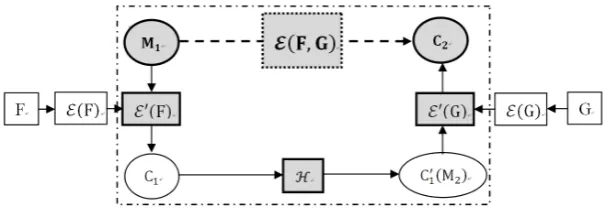
We present a detail description of EHE encryption. In the notation “EHE”, each E represents a different quantum encryption operation, and Hrepresents a transversal Hadamard transformation. Actually, QOTP can be viewed as a special case of EHE encryption, where each E is implemented by encrypting quantum superpositions using classical one-time pad.
based on two PRFsFandG.E0(F) andE0(G) are insecure QBE schemes that are constructed usingE(F) andE(G). The whole procedure of quantum encryption E(F, G) :σ∈M1→ρ∈C2 can be finished in the three steps: (1) the quantum messageσ∈M1is encrypted using the first QBE schemeE0(F), and the obtained ciphertext is ρ1 ∈ C1; (2) perform transversal Hadamard transformation on
ρ1 ∈C1, and obtainρ2 ∈C10; (3) If C10 ⊆M2, thenρ2 ∈M2 can be encrypted using the second QBE schemeE0(G), and the obtained ciphertext isρ∈C
2.
Fig. 1. Construction of quantum block encryption scheme E(F, G). The rectangles represent cryptographic primitives or related computational steps. The elliptic frames represent plaintext space or ciphertext space. The gray frames represent the detailed procedure of the schemeE(F, G): the quantum message in spaceM1 is encrypted using
the first scheme E0
(F), and then be transformed using H, and finally be encrypted using the second schemeE0
(G).
We study the security of QBE schemeE(F, G), and obtain the main results as follows.
Theorem 1 (informal).If PRFsF, Gare chosen independently and have stan-dard security in the quantum computation setting, thenE(F, G)is an IND-CPA-secure QBE scheme.
Theorem 2 (informal). F, G are independent PRFs with standard security. If both F andG are permutations on the key space, thenE(F, G)is a perfectly secure QBE scheme.
QOTP has been widely applied in the theoretical design of various quantum encryption and authentication schemes [1–3, 14, 18]. Based on our results, we can consider modifying those QOTP-based schemes by replacing QOTP with perfectly secure QBE, and expect an obvious optimization, for example, recycling all the keys of the scheme in Ref.[18] or lifting weak authentication to total authentication [17].
1.2 Related works
How to construct quantum cryptographic primitives from classical ones. Based on quantum mechanics, the information extends to quantum in-formation, and the computation extends to quantum computation. A natural question is whether or not the modern cryptography based on the information and computation could extend to quantum cryptography. Concretely, how to extend classical cryptographic primitive to quantum one? Our results give an answer from the aspect of BE (or pseudorandom functions). In addition, there are also some other related works.
In Ref.[10], a quantum public-key encryption scheme is proposed based on classical McEliece public-key cryptosystem. Later, more constructions are pro-posed [11]. In order to improve the security, Yang and Liang [13] propose double-encryption technique, which is the origin ofEHE encryption.
Garg et al. [17] propose the “Auth-QFT-Auth” pattern used to construct QMA scheme (denoted as Auth2(H(Auth1(ρ)))), where Auth1, Auth2 are the classical Wegman-Carter MAC schemes andHis the quantum Hadamard trans-form. Obviously, this pattern is very similar toEHE encryption.
In fact, QOTP can be viewed as anEHE-like construction based on classical OTP: quantum states are encrypted using the classical one-time pad in the basis {|0i,|1i}, and then using the classical one-time pad in the basis{|+i,|−i}.
The most related work is Ref.[16], which propose a computationally secure framework for quantum encryption. However, their construction uses “PRF+QOTP” mode, and our construction uses EHE mode. In the spirit,EHE mode is a spe-cial combination of two insecure encryption. This mode of combination can be extended to construct more quantum cryptographic schemes.
Quantum encryption with key recycling. OTP is a perfectly secure en-cryption scheme, but the key cannot be reused; In BE scheme, the key can be reused, but the security is weaker than OTP. In quantum cryptography, there exists the same problem: QOTP has the same security as OTP, but the key cannot be reused (Though we can use a QOTP with quantum key distribution, this would need more rounds of interaction and more communication.). In order to settle this problem, the researchers begin to consider how to recycle part of the keys or conditionally reuse the keys.
reused. Fehr and Salvail [23] propose a classical-message-oriented quantum au-thentication scheme with key recycling, in which the partial randomness can be extracted and be used as the OTP-key or QOTP-key. Then the combination of the authentication scheme and OTP (or QOTP) becomes a quantum encryption scheme with key recycling, and can be used to encrypt the classical or quantum information.
There are also some researches about QMA with key recycling [17, 18]. The “Auth-QFT-Auth” authentication scheme [17] allows conditionally recycling part of the keys: the inner key can be recycled upon successful verification, and the outer key unfortunately cannot be. Because any scheme to authenticate quan-tum messages must also encrypt them [3], these authentication schemes can also be used as encryption schemes with key recycling.
In all these schemes, the keys cannot be totally reused, and we will solve this problem through QBE scheme.
1.3 Organization
In Section 2, we introduce some basic notations, and review three kinds of PRFs. In Section 2.3, we describe theEHE encryption technique. In Section 3, we show how to construct IND-CPA-secure or IND-CCA-secure QBE schemes, and prove the perfectly secure scheme is achievable. Finally, we conclude and discuss these results.
2
Preliminaries
2.1 Notations and definitions
F uncn = {f|f : {0,1}n → {0,1}n} denotes the set of all the functions that map n bits to nbits. Define YX as the set of functions {f|f : X → Y}, then
F uncn=NN, where N ={0,1}n.
Any classical computable functionf ∈ YX can be implemented by a quan-tum computer, or be implemented as an oracle which is queried on quanquan-tum superpositions.
Uf : X
x∈X,y∈Y
αx,y|xi|yi −→ X
x∈X,y∈Y
αx,y|xi|y⊕f(x)i, (1)
whereX andY are the domain and range, respectively.P
x∈X,y∈Y can be briefly written as P
x,y without leading to any misunderstanding. A
|fi represents the quantum adversary Acan access to f with quantum superposition queries.Af represents the (classical or quantum) adversary Acan access tof classically
the domain and range, respectively. Denote K × X ={(k, x) :k ∈ K, x ∈ X }. K,X,Y are implicit functions of the security parametern. We writey =Fk(x) ory=F(k, x).
Definition 1 (PRF).A functionF :K×X → Yis PRF, if for any probabilistic polynomial-time (PPT) adversary A, the advantage of A while distinguishing
Fk,∀k from a truly random functionf
AdvP RFF (A) =
P rk←R−K[A
Fk() = 1]−P r
f←R−F uncn
[Af() = 1]
is negligible. We writek←R− Kto represent the keykis drawn fromKuniformly and randomly. f ←R−F uncn represents the function f is randomly drawn from
F uncn. The notations can be briefly written ask← K andf ←F uncn. “(n) is negligible” means that, for any polynomialp(n), there existsn0such that (n)< p(n)1 ,∀n > n0.
PauliX gate andZ gate can be represented as:X=
0 1 1 0
,Z=
1 0 0−1
,
and Hadamard gate is H = √1 2
1 1 1−1
. Given any unitary matrix U and a
n-bit string b = b1b2· · ·bn (bi is the i-th bit of the string b), we write Ub to denoteNni=1Ubi. Particularly,U⊗n=Nn
i=1U =U 11···1. For twon-bit stringsa, b∈ {0,1}n, defineab=Pn
i=1aibi(mod2).
We write [[pk, Uk, k∈ K]] to represent a quantum message encryption scheme that performs encryption operator Uk and decryption operator Uk† using the symmetric key k ∈ K, where k is chosen with probability pk and cannot be reused. Then QOTP can be described by the notation [[pab= 212n, XaZb, a, b∈
{0,1}n]].
2.2 Quantum pseudorandom functions
Following the definitions in Ref.[24], there are two security notions of PRF under quantum computation model. The first notion is standard security, where the quantum adversary can only access to the function classically; We denote this kind of PRF as “sPRF”. The second one is quantum security, where the quantum adversary can access to the function with quantum superposition queries; We denote this kind of PRF as “qPRF”.
Definition 2 (sPRF).A PRF F :K × X → Y is standard secure, if no quan-tum polynomial-time (QPT) adversary A making classical queries can distin-guish between a truly random function and the function Fk,∀k. That is, for every such A, there exists a negligible function=(n) such that
P rk←K[AFk() = 1]−P rf←F uncn[A
Definition 3 (qPRF). A PRFF :K × X → Y is quantum secure, if no QPT adversary A making quantum queries can distinguish between a truly random function and the function Fk,∀k. That is, for every suchA, there exists a neg-ligible function =(n)such that
P rk←K[A
|Fki() = 1]−P r
f←F uncn[A
|fi() = 1] < .
For sPRFF, defineAdvsP RF
F (A) =
P rk←K[AFk() = 1]−P rf←F uncn[A
f() = 1] . For qPRFF, defineAdvFqP RF(A) =
P rk←K[A|Fki() = 1]−P rf←F uncn[A
|fi() = 1] , whereAis QPT adversary.
When quantum queries are allowed, QPT adversary has more advantage while distinguishing PRF and truly random function. That is AdvsP RF
F (A) <
AdvFqP RF(A). IfAdvFqP RF(A)< (n), then AdvFsP RF(A) < (n), where(n) is negligible. Thus, if a PRFF is a qPRF, then it is also a sPRF.
How to directly construct a sPRF that is not a qPRF? In fact, Even-Mansour block cipher is a sPRF [25], but it is not a qPRF [26]. In addition, CBC-MAC is also not quantum-secure as a PRF [27].
Lemma 1. Given a functionG, if Gis independent of PRF{Fk}k∈K, then
P rk←K[AFk,G() = 1]−P rf←F uncn[A
f,G() = 1]
< (n), whereA is any PPT adversary and(n) is negligible.
Proof. Define a new quantum adversaryAG, where the adversaryAis allowed to access to the functionGclassically. BecauseGis independent of{Fk}k∈K, we have
P rk←K[AFk,G() = 1]−P rf←F uncn[A
f,G() = 1]
=
P rk←K[A Fk
G () = 1]−P rf←F uncn[A
f G() = 1]
=AdvP RFF (AG).
Fk is a PRF, soAdvFP RF(AG) is negligible. Thus complete the proof. 2 The are two similar results for sPRF and qPRF, respectively.
Lemma 2. Given a functionG, if Gis independent of sPRF{Fk}k∈K, then
P rk←K[AFk,G() = 1]−P rf←F uncn[A
f,G
() = 1]< (n),
whereA is any QPT adversary and(n)is negligible.
Lemma 3. Given a functionG, if Gis independent of qPRF{Fk}k∈K, then
P rk←K[A
|Fki,|Gi() = 1]−P r
f←F uncn[A
|fi,|Gi() = 1]
Remark 1. If G is a PRF {Gk}k∈K and is independent of {Fk}k∈K, then the results in Lemmas 1,2 and 3 hold as well.
Theorem 3 (Parallel Composition). If {Fk}k∈K and{Gk}k∈K are two in-dependent sPRFs, then Hk = (Fk1, Gk2),∀k=k1kk2 is also a sPRF. That is, for any QPT adversaryA, there exists a negligible function(n)such that
P rk←K×K[AHk() = 1]−P rf←F unc2n[A
f() = 1]
< (n).
Proof. According to Definition 2, if F is a sPRF, then for any QPT adversary A1 there exists a negligible function1(n) such that
P rk←K[A Fk
1 () = 1]−P rf1←F uncn[A
f1 1 () = 1]
< 1(n).
IfGis a sPRF, then for any QPT adversaryA2there exists a negligible function
2(n) such that
P rk←K[A Gk
2 () = 1]−P rf2←F uncn[A
f2 2 () = 1]
< 2(n).
Thus for any QPT adversary A, we have the following deduction according to Lemma 2 and Remark 1.
P rk1←K,k2←K[A
Fk1,Gk2() = 1]−P rf
1←F uncn,f2←F uncn[A
f1,f2() = 1]
≤
P rk1←K,k2←K[A
Fk1,Gk2() = 1]−P r
f1←F uncn,k2←K[A
f1,Gk2() = 1]
+P rf1←F uncn,k2←K[A
f1,Gk2() = 1]−P rf1←F unc
n,f2←F uncn[A
f1,f2() = 1]
< 1(n) +2(n).
Let (n) = 1(n) +2(n), then (n) is negligible. Let Hk = (Fk1, Gk2) and
f = (f1, f2). Thus complete the proof. 2
2.3 EHE encryption
In Ref.[13], Yang and Liang have improved the security of quantum McEliece PKE using double-encryption technology. Here, the “double-encryption” is named as “EHE encryption”. The new name “EHE encryption” can accurately reflect its structural characteristic.
Based on EHE encryption, secure quantum encryption scheme can be con-structed by combining two insecure ones. EHE is a universal technology for the construction of quantum cryptographic schemes. The basic framework can be summarized in the following three steps: (1) Encrypt using the first insecure quantum encryption scheme; (2) Perform transversal Hadamard transformation; (3) Encrypt again using the second insecure quantum encryption scheme.
KeyGen: k1←G1(1n), k2←G2(1n), outputk1, k2;
Enc(k1, k2, σ): σ1←E1(k1, σ), σ2← H(σ1), ρ←E2(k2, σ2), outputρ;
Dec(k1, k2, ρ): ρ1←D2(k2, ρ), ρ2← H(ρ1), σ←D1(k1, ρ2), outputσ.
The two encryption schemes (Gi, Ei, Di), i = 1,2 should satisfy the condi-tionsDi(ki, Ei(ki, σ)) =σ,∀σ, i= 1,2. It is straightforward that
Dec(k1, k2, Enc(k1, k2, σ)) =σ,∀σ,
so the combined construction can decrypt the ciphertext correctly.
3
Quantum block encryption
3.1 Some definitions
[[pk, Uk, k∈ K]] is a kind of symmetric-key quantum encryption scheme, where each key kis chosen with probabilitypk and cannot be reused. In this section, we propose the QBE scheme, which is another kind of symmetric-key scheme, and its secret key can be reused many times.
Definition 4 (QBE).QBE scheme is defined by a triplet(KeyGen, Enc, Dec), where KeyGen, Enc, Dec are key generation, encryption and decryption algo-rithms, respectively.Kis the key space, andHM andHC are the quantum plain-text/ciphertext spaces. The randomness Ris optional.
KeyGen: given a security parameter n, it generates a secret key k∈ K; Enc: choose a random numberr∈Rand perform the encryption transformation
Enc:K × HM →R× HC with the key k∈ K;
Dec: perform the decryption transformationDec:K ×R× HC→ HM with the keyk∈ K.
These algorithms satisfy the condition Dec(k, Enc(k, σ)) =σ,∀k∈ K, σ∈ HM. Similar to the security notions of classical encryption, we can define the quantum versions of indistinguishability (IND), indistinguishability against cho-sen plaintext attack (IND-CPA), indistinguishability against chocho-sen ciphertext attack (IND-CCA). These definitions can also be referred to Refs.[14][16][28]. Notice that, indistinguishability for quantum encryption is originally defined in Ref.[28]. Later, Broadbent and Jeffery [33] presents a definition of quantum IND-CPA with an interactive game, and gives no explicit definition of IND. Following the definition in Ref.[33], Ref.[16] defines IND, IND-CPA and IND-CCA with an incremental way instead of interactive game. The incremental definition is very brief and is adopted in our manuscript.
Definition 5 (IND). A QBE scheme (KeyGen, Enc, Dec) is IND-secure, if for any QPT adversaryA,
P r[A(X k∈K
pkEnc(k, σ1)) = 1]−P r[A( X
k∈K
pkEnc(k, σ2)) = 1]
where (n) is negligible, σ1, σ2 R
←− HM, pk = P r[k ← KeyGen(1n)], and the probability in these terms is taken over the internal randomness of the algorithms
KeyGen,Enc andA.
Next, we introduce another definition of IND. Obviously, the two definitions are equivalent.
Definition 6 (IND). A QBE scheme (KeyGen, Enc, Dec) is IND-secure, if for any QPT adversaryA,
P r[A(X k∈K
pkEnc(k, σ)) = 1]−P r[A( X
k∈K
pkEnc(k,
I
2n)) = 1]
< (n),
where (n) is negligible, σ ←R− HM,pk =P r[k ←KeyGen(1n)], and the prob-ability in these terms is taken over the internal randomness of the algorithms
KeyGen,Enc andA.
Definition 7 (IND-CPA).A QBE scheme(KeyGen, Enc, Dec)is IND-CPA-secure, if it is IND-secure when the QPT adversaryAis allowed to access to the encryption oracleEnc(k,∗), where kis the secret key.
Ref.[16] gives a definition of non-adaptive CCA, which is named IND-CCA1. We give a definition for adaptive attack, which is stronger. Recently, Ref.[34] also gives a definition of adaptive IND-CCA, which is named IND-CCA2. We would compare their differences in the future.
Definition 8 (IND-CCA).A QBE scheme(KeyGen, Enc, Dec)is IND-CCA-secure, if it is IND-CPA-secure when the QPT adversary Ais allowed to access to the decryption oracle Dec(k, ρ),∀ρ ∈ HC and ρ is computationally distin-guishable from the queried ciphertext of the indistinguishability challenge, where
k is the secret key.
All the notions of IND, IND-CPA and IND-CCA define the computational security. In addition, we can define information-theoretic security, e.g. perfect security. Actually, QOTP is a kind of perfectly secure quantum encryption. In quantum cryptography, there exist some other cryptographic schemes that can achieve perfect security.
Definition 9 (Perfect Security).A QBE scheme(KeyGen, Enc, Dec)is per-fectly secure, if Definition 5 (or Definition 6) holds for (n) ≡ 0 when A is computationally unbounded quantum adversary.
In QOTP [[pab = 212n, X
aZb, a, b∈ {0,1}n]], a secret key of 2nbits is nec-essary for perfectly encrypting nqubits. Suppose we set a restriction ona and
b such that a≡ b, then we get a new encryption scheme [[pc = 21n, X
Proposition 1. The quantum encryption scheme[[pc= 21n, XcZc, c∈ {0,1}n]]
is not IND-secure.
Proof. Supposen= 1. Two quantum states √1
2(|0i+i|1i) and|0iare chosen as the challenge messages. Consider the two messages are encrypted. The density matrixes of the two messages are written asσ1and σ2, respectively.
The keyc∈ {0,1} is chosen with probability 12. Because the adversary does not know the value of c, the ciphertexts corresponding to σ1 and σ2 should be represented as two mixed statesρ1,ρ2.
ρ1= X
c∈{0,1}
pcEnc(c, σ1) = 1
2Enc(0, σ1) + 1
2Enc(1, σ1) =
1/2−i/2
i/2 1/2
,
ρ2= X
c∈{0,1}
pcEnc(c, σ2) = 1
2Enc(0, σ2) + 1
2Enc(1, σ2) =
1/2 0 0 1/2
.
The trace distance of the two ciphertexts is D(ρ1, ρ2) = 12, and the adversary can efficiently distinguish the ciphertexts of σ1 and σ2. In fact, the adversary chooses{√1
2(|0i+i|1i), 1 √
2(|0i−i|1i)}as the measurement basis. If the adversary measuresρ1 in the basis, he can obtain √12(|0i+i|1i) with probability 1; If the adversary measuresρ2in the basis, he can obtain √12(|0i+i|1i) with probability
1
2, and obtain 1 √
2(|0i−i|1i) with probability 1
2. Thus, the adversary can efficiently distinguishρ1andρ2 with successful probability 34.
For any value of n, we choose the two states √1
2n(|0i+i|1i)
⊗n and |0i⊗n as the challenge messages, and analyze the security in the same way. Then the adversary can efficiently distinguish their ciphertexts with successful probability 1− 1
4n. Thus complete the proof. 2
3.2 An insecure construction from classical block encryption
Next, we introduce the PRF-based classical BE scheme E(F), and construct a QBE schemeE0(F) which is insecure.
Construction 1(Construction 5.3.9 in Ref.[29]): LetF :K × {0,1}n→ {0,1}n be a PRF. Define classical BE schemeE(F) = (G
F, EF, DF) as follows.
GF(1n): k R
←− K, outputk;
EF(k, m): r R
←− {0,1}n, c←m⊕F(k, r), output (r, c);
DF(k,(r, c)): m←c⊕F(k, r), outputm.
Based on the classical schemeE(F), we can construct a QBE schemeE0(F) = (G0F, EF0 , DF0 ) for encrypting any quantum message σ ∈ HM. Assume without loss of generality that the quantum message is a pure state σ = P
mαm|mi, whereP
m|αm|2= 1. According to the encryption operatorEF0 defined in Con-struction 2, the obtained ciphertext is also pure state, which can be written as
ρ=P cαc|ci.
Construction 2: LetE(F) = (GF, EF, DF) be a classical BE scheme defined in Construction 1, define the QBE schemeE0(F) = (G0
G0F(1n): k←G
F(1n), outputk;
EF0 (k, σ): r←R− {0,1}n, ρ←P
mαm|m⊕F(k, r)i, output (r, ρ);
D0F(k,(r, ρ)): σ←P
cαc|c⊕F(k, r)i, outputσ.
If the quantum message is a mixed state, then the encryption and decryption algorithms defined in Construction 2 can be described in the form of unitary operators.
E0F(k, σ) =
r, XF(k,r)σXF(k,r), DF0 (k,(r, ρ)) =X F(k,r)
ρXF(k,r). (3) Next we show that the QBE schemeE0(F) in Construction 2 is insecure. Theorem 4. The QBE schemeE0(F) = (G0
F, EF0 , D0F)in Construction 2 is not IND-secure.
Proof. Choose two quantum plaintexts |ϕ1i = √12n
P
m∈{0,1}n|mi and |ϕ2i = |0i⊗n. Suppose the secret key isk, the ciphertexts of|ϕ
1iand |ϕ2iare
EF0 (k,|ϕ1i) = (r, 1 √
2n X
m∈{0,1}n
|m⊕F(k, r)i) = (r,√1 2n
X
m∈{0,1}n
|mi) = (r,|ϕ1i),
EF0 (k,|ϕ2i) = (r,|F(k, r)i).
With respect to the adversary (who does not know the key k), the ciphertexts of|ϕ1iand|ϕ2ishould be written in the mixed states as follows.
X
k∈K
pkEF0 (k,|ϕ1i) = (r,|ϕ1ihϕ1|),
X
k∈K
pkEF0 (k,|ϕ2i) = (r, 1 |K|
X
k∈K
|F(k, r)ihF(k, r)|).
The adversary performs quantum measurement on the ciphertexts in the basis {|+i,|−i}. Because|ϕ1i=|+i⊗n, while measuring its ciphertext, the outcome would be 00· · ·0 with probability 1; While measuring the ciphertext of|ϕ2i, the outcome would be 00· · ·0 with probability at most |K|1 P
k∈K 1 2n =
1
2n. Thus,
the adversary can successfully distinguish the two ciphertexts with probability at least 1− 1
2n. Thus complete the proof. 2
Theorem 4 can be extended to the case that replacingE(F) = (GF, EF, DF) with any quasi-length-preserving encryption scheme. See the eprint version of Ref.[30] for the definition of quasi-length-preserving encryption.
Theorem 5. Given any quasi-length-preserving classical BE scheme, the QBE scheme constructed according to Construction 2 is not IND-secure.
Proof. The proof is similar to Theorem 4. 2
3.3 IND-CPA quantum block encryption
If F andG are PRFs, two insecure QBE schemes can be defined following the constructions in Section 3.2. Denote the two schemes as E0(F) = (G0
F, EF0 , DF0 ) andE0(G) = (G0
G, EG0 , DG0 ), respectively. Next, we propose a secure QBE scheme E(F, G) = (KeyGen, Enc, Dec) following the framework ofEHE encryption.
Construction 3: Given two schemes E0(F) = (G0
F, E0F, D0F) and E0(G) = (G0G, EG0 , DG0 ), define a new QBE scheme E(F, G) = (KeyGen, Enc, Dec) as follows.
KeyGen(1n): k
1←G0F(1n),k2←G0G(1n), output (k1, k2);
Enc(k1, k2, σ): (r1, σ1)←EF0 (k1, σ),σ2 ← H(σ1), (r2, ρ)←EG0 (k2, σ2), output (r1, r2, ρ);
Dec(k1, k2,(r1, r2, ρ)): σ2←D0G(k2,(r2, ρ)),σ1← H(σ2),σ←DF0 (k1,(r1, σ1)), outputσ.
According to the QBE schemeE(F, G) defined in Construction 3, we encrypt
nqubitsσwith the keysk1, k2, and obtain
Enc(k1, k2, σ) = (r1, r2, XG(k2,r2)H⊗nXF(k1,r1)σXF(k1,r1)H⊗nXG(k2,r2)) 4
= (r1, r2, ρ). (4)
We decrypt the ciphertext (r1, r2, ρ) with the keysk1, k2, and obtain
Dec(k1, k2,(r1, r2, ρ)) =XF(k1,r1)H⊗nXG(k2,r2)ρXG(k2,r2)H⊗nXF(k1,r1). (5) Notice that
XG(k2,r2)H⊗nXF(k1,r1)σXF(k1,r1)H⊗nXG(k2,r2)
=H⊗nZG(k2,r2)XF(k1,r1)σXF(k1,r1)ZG(k2,r2)H⊗n. (6) Then we can make a slight modification to the encryption/decryption operators (in Equations (4) and (5)) as follows.
Enc(k1, k2, σ) = (r1, r2, ZG(k2,r2)XF(k1,r1)σXF(k1,r1)ZG(k2,r2)), (7)
Dec(k1, k2,(r1, r2, ρ)) =XF(k1,r1)ZG(k2,r2)ρZG(k2,r2)XF(k1,r1). (8) It can be seen that, the only modification is that the quantum operator H⊗n is discarded. Because the operator H⊗n does not contain variable parameters, the modification would not affect its security essentially. However, there exists a slight disadvantage that is analyzed as follows.
For this tiny difference, we decide to choose the original scheme in Construction 3. That is, the Hadamard transformationH⊗n is kept in the scheme.
It can be seen that the QBE schemeE(F, G) = (KeyGen, Enc, Dec) is very similar to QOTP. The difference is that, the QOTP-key is replaced with the pseudorandom numbers generated from the PRFsF, Gwith the keysk1, k2 and randomnessr1, r2. According to Construction 3, the keys of the PRFs (or clas-sical BE schemes) are used as the key of QBE schemeE(F, G). Because the keys of the PRFs (or classical BE schemes) can be reused, the key ofE(F, G) can also be reused. However, the randomnessr1, r2 cannot be reused, or else the security would decrease. The proof is as follows.
Proposition 2. For the QBE scheme E(F, G) = (KeyGen, Enc, Dec) defined in Construction 3, if it is allowed to reuse the randomness (r1, r2), then the scheme is not IND-CPA-secure.
Proof. Letk1, k2be the secret key of QBE scheme, and choose the randomness (r1, r2). For the first time, the sender encrypts the quantum message σ, and obtains the ciphertext
Enc(k1, k2, σ) = (r1, r2, XG(k2,r2)H⊗nXF(k1,r1)σXF(k1,r1)H⊗nXG(k2,r2)) 4
= (r1, r2, ρ).
In the CPA model, the adversary is allowed to access to the quantum encryption oracle. Given the input ρ, the adversary can query the quantum encryption oracle OEnc(k1,k2,∗). If the randomness (r1, r2) are reused, then the adversary would obtain the new ciphertext
OEnc(k1,k2,∗)(ρ) = (r1, r2, X
G(k2,r2)H⊗nXF(k1,r1)ρXF(k1,r1)H⊗nXG(k2,r2)) = (r1, r2, XF(k1,r1)⊕G(k2,r2)ZF(k1,r1)⊕G(k2,r2)σZF(k1,r1)⊕G(k2,r2)XF(k1,r1)⊕G(k2,r2)) = (r1, r2, XcZcσZcXc),
wherec=4F(k1, r1)⊕G(k2, r2). The ciphertextXcZcσZcXccan be viewed as the outcome of performing quantum encryption scheme [[pc= 21n, X
cZc, c∈ {0,1}n]] on the quantum message σ. From Proposition 1, we conclude the QBE scheme in Construction 3 is not IND-CPA-secure if the randomness is reused. 2
According to Proposition 2, while applying the QBE scheme E(F, G), the randomness r1, r2 cannot be reused, and should be chosen randomly in every execution of encryption.
Next we prove the security of QBE schemeE(F, G) in Construction 3. Theorem 6. If F, G:K × {0,1}n → {0,1}n are two independent sPRFs, then E(F, G) = (KeyGen, Enc, Dec)in Construction 3 is an IND-CPA-secure QBE scheme.
Proof. If the scheme in Construction 3 adapts the truly random functionsf1, f2∈
Next we show the QBE scheme is IND-secure while using the two sPRFsF
andG.
According to the QBE scheme, if totally mixed state 2In is encrypted, the
outcome is (r1, r2,2In), wherer1, r2are chosen randomly. Given any QPT adver-sary A, assume Acan distinguish the two ciphertexts of arbitrary state σ and
I
2n with advantage
P r
A(r1, r2, 1 |K|2
X
k1,k2
XG(k2,r2)H⊗nXF(k1,r1)σXF(k1,r1)H⊗nXG(k2,r2)) = 1
−P r
A(r1, r2,
I
2n) = 1
=(n). (9)
Then we prove (n) is negligible as follows. For the pair of sPRFs (F, G), we construct a distinguisher D invoking the QPT adversary A. The distinguisher Dcan classically query a pair of functions, and should make a judgement about the queried functions, e.g. the queried functions are a pair of PRFs (F, G) or truly random functions (f1, f2).
Construction of distinguisher D. D is given an input 1n and a pair of accessible classical random oracle (O1, O2), whereOi :{0,1}n → {0,1}n, i= 1,2.
1. Choose a pair of random valuesr1, r2∈ {0,1}n;
2. Access to the pair of classical random oracles (O1, O2) with inputr1, r2, and obtain the outcome (s1, s2) = (O1(r1), O2(r2));
3. Randomly choose a plaintextσ(σ6= I
2n). The output (s1, s2) is used as the key to encryptσas follow:σ→(r1, r2, Xs2H⊗nXs1σXs1H⊗nXs2); Denote the ciphertext as (r1, r2, ρ);
4. Invoke the QPT adversary A on input (r1, r2, ρ), and output whatever A does.
In the above distinguisher, Dmay access two kinds of classical random oracles. The first one is for truly random functions (f1, f2), and the second one is for PRFs (F, G). We discuss the two cases as follows.
(a) IfDaccess to the truly random functions (f1, f2), then (s1, s2) is a random element in {0,1}2n. In addition, the value of (s
1, s2) is not accessible to Ain the distinguisher. From the aspect ofA, the ciphertext (r1, r2, ρ) can be written as a mixed state (r1, r2,221n
P s1,s2X
s2H⊗nXs1σXs1H⊗nXs2) (That is (r1, r2,2In)). Thus,
P r[Df1,f2() = 1] =P r[A(r 1, r2,
I
2n) = 1], (10)
wheref1, f2are chosen randomly and independently from the setF uncn. (b) IfDaccess to PRFs (F, G), then (s1, s2) = (F(k1, r1), G(k2, r2)). From the
aspect ofA(who does not knowk1, k2), the ciphertext (r1, r2, ρ) can be writ-ten as (r1, r2,|K|12
P k1,k2X
can be concluded that
P r[DFk1,Gk2() = 1] = (11)
P r[A(r1, r2, 1 |K|2
X
k1,k2
XG(k2,r2)H⊗nXF(k1,r1)σXF(k1,r1)H⊗nXG(k2,r2)) = 1],
wherek1, k2∈ Kare chosen randomly and independently. From the equations (9)(10)(11), it can be deduced that
|P r[DFk1,Gk2() = 1]−P r[Df1,f2() = 1]|=(n). (12) A is a QPT algorithm, then the distinguisher D invoking A is also a QPT algorithm. Using Theorem 3, if F, G are sPRFs, then (n) in Equation (12) is negligible. From Equation (9) and Definition 6, the QBE scheme E(F, G) is IND-secure.
Consider the case that the adversary A is allowed to access to quantum encryption oracle
OEnc(k1,k2,∗):σ→(r1, r2, XG(k2,r2)H⊗nXF(k1,r1)σXF(k1,r1)H⊗nXG(k2,r2)). If the randomness used byOEnc(k1,k2,∗) have also been used in challenge query, then it would be insecure (According to Proposition 2, the advantage ofAwhile distinguishing the challenge ciphertexts would be non-negligible). However, the encryption oracle will use a fresh randomness that is chosen uniformly and in-dependently, so the probability that OEnc(k1,k2,∗) uses the same randomness as the challenge query is negligible. Then allowingAto access to encryption oracle
OEnc(k1,k2,∗) has negligible effect on all the above proof of IND security. Thus
the QBE schemeE(F, G) is IND-CPA-secure. 2
Remark 2. From the proof of Theorem 6, the distinguisher can classically access to the oracles of PRFs (or truly random functions). The PRFs are not required to have quantum security. The PRFs with standard security are sufficient to assure the IND security of the QBE scheme.
Corollary 3.6.7 in Ref.[29] has shown that the existence of one-way function implies the existence of PRF. Zhandry [24] has proved that, if PRF exists then there exists sPRF that is not qPRF. Thus, from Theorem 6, we reduce IND-CPA-secure QBE scheme to the existence of one-way function. That is, if there exist one-way functions, then IND-CPA-secure QBE schemes exist as well.
Definition 10. A function F :K × {0,1}n → {0,1}n is pairwise independent sPRF, if the two probability distributions (Fk1(Un), Fk2(Un)),k1, k2 ∈ K and
f(U2n)are QPT-indistinguishable, whereUnis uniformly distributed over{0,1}n andf is a truly random function in F unc2n. That is
P r(k1,k2)←K×K[A
Fk1,Fk2() = 1]−P rf←F unc2
n[A
f() = 1]
IfFis a pairwise independent PRF, letG=F, then a QBE schemeE(F, F) = (KeyGen, Enc, Dec) can be constructed fromEHE encryption technology.
Construction 4: Given a pairwise independent PRF F : K × {0,1}n → {0,1}n, an insecure QBE schemeE0(F) = (G0
F, EF0 , D0F) can be constructed
fol-lowing Constructions 1 and 2. Then a secure QBE schemeE(F, F) = (KeyGen, Enc, Dec) can be constructed as follows.
KeyGen(1n): k
1←G0F(1n),k2←G0F(1n), output (k1, k2);
Enc(k1, k2, σ): (r1, σ1)←EF0 (k1, σ),σ2← H(σ1), (r2, ρ)←EF0 (k2, σ2), output (r1, r2, ρ);
Dec(k1, k2,(r1, r2, ρ)): σ2←D0F(k2,(r2, ρ)),σ1← H(σ2),σ←DF0 (k1,(r1, σ1)), outputσ.
According to the QBE schemeE(F, F) in Construction 4, we encryptnqubits
σwith the keysk1, k2, and obtain
Enc(k1, k2, σ) = (r1, r2, XF(k2,r2)H⊗nXF(k1,r1)σXF(k1,r1)H⊗nXF(k2,r2)) 4
= (r1, r2, ρ). (14)
We decrypt the ciphertext (r1, r2, ρ) with the keysk1, k2, and obtain
Dec(k1, k2,(r1, r2, ρ)) =XF(k1,r1)H⊗nXF(k2,r2)ρXF(k2,r2)H⊗nXF(k1,r1). (15) Theorem 7. If F is a pairwise independent PRF and has standard security, thenE(F, F)in Construction 4 is an IND-CPA-secure QBE scheme.
Proof. The proof is similar to Theorem 6. Definition 10 is used in the proof. The
details are omitted. 2
3.4 CCA-secure construction
Firstly, we prove the QBE schemes in Constructions 3 and 4 are not IND-CCA-secure.
Theorem 8. The QBE schemes E(F, G)and E(F, F) (in Constructions 3 and 4) are not IND-CCA-secure.
Proof. We give a proof only to the QBE schemeE(F, G). The other one is similar. According to the construction ofE(F, G), the sender encryptsn-qubit challenge plaintextσ=|mihm|with the keysk1, k2, and obtains challenge ciphertext
Enc(k1, k2, σ) = (r1, r2, XG(k2,r2)H⊗nXF(k1,r1)σXF(k1,r1)H⊗nXG(k2,r2)) 4
= (r1, r2, ρ).
When Aobtains the challenge ciphertext ρ, he can perform a Pauli operation
Zw (∀w∈ {0,1}n andw6= 0) on it and get a new ciphertext
ρ0=ZwρZw=XG(k2,r2)H⊗nXF(k1,r1)(XwσXw)XF(k1,r1)H⊗nXG(k2,r2) =XG(k2,r2)H⊗nXF(k1,r1)(|m⊕wihm⊕w|)XF(k1,r1)H⊗nXG(k2,r2). Then the trace distance of ρ0 and challenge ciphertext is D(ρ0, ρ) = D(|m⊕
wi,|mi) = 1 and the two ciphertexts can be distinguished completely. Thus he can access to the quantum decryption oracle with the input ρ0, and get the corresponding plaintext|m⊕wihm⊕w|. Finally, using the valuew, the adversary can restore the challenge plaintext |mihm|. Thus, the QBE scheme E(F, G) is
not IND-CCA-secure. 2
Similar to the above proof, we can also prove the scheme 1 in Ref.[16] is not IND-CCA-secure.
QBE schemes in Constructions 3 and 4 are IND-CPA-secure. If it is required to be secure against chosen ciphertext attack, we can try to compose it with QMA schemes [3][17][18]. A QMA scheme consists of three algorithms
QM A= (QmaKey, Auth, V erif y),
where QmaKey(1n) generates an authentication key, Auth(authkey, σ) gener-ates an authentication tagqT agfor a messageσ, andV erif y(authkey, σ, qT ag) checks if qT ag is a valid authentication tag for quantum message σ. By com-posing the QBE and QMA schemes, we can construct a new QBE scheme as follows.
Construction 5:Given a QBE schemeE(F, G) = (KeyGen, Enc, Dec) and a QMA scheme QM A = (QmaKey, Auth, V erif y), define a new QBE scheme E0(F, G) = (KeyGen0, Enc0, Dec0) as follows.
KeyGen0(1n): (k
1, k2)←KeyGen(1n),authkey←QmaKey(1n), output (k1, k2,
authkey);
Enc0(k1, k2, authkey, σ): (r1, r2, ρ)←Enc(k1, k2, σ),qT ag←Auth(authkey, ρ), output (r1, r2, ρ, qT ag);
Dec0(k1, k2, authkey,(r1, r2, ρ, qT ag)): CheckV erif y(authkey, ρ, qT ag) ?
= 1; Out-putDec(k1, k2,(r1, r2, ρ)) if it holds, and output otherwise.
In our QBE scheme, the ciphertext contains two parts (classical part and quantum part). The randomnessr1, r2 is the classical part, and the cipherstate is the quantum part. Though the randomnessr1, r2is a part of ciphertext, it will not be encrypted or decrypted. It is an ancillary information for the decryption. We do not authenticate the randomnessr1, r2since the tamper on the classical part equals to the tamper on the quantum part.
Proof (Proof sketch). Comparing the new scheme E0(F, G) in Construction 5 with E(F, G) in Construction 3, the new scheme only appends an authentica-tion tagqT agto the ciphertextρ, which is generated byE(F, G). Then the new scheme is also IND-CPA-secure. While analyzing the CCA security ofE0(F, G), the adversary can access to the decryption oracle ofE0(F, G). However, he can-not access to the decryption oracle with the challenge ciphertextρ. So he should modify the ciphertext ρ, and then access to the oracle with the modified ci-phertext. Because an authentication tag is appended to the challenge ciphertext
ρ, if he modifies the ciphertext ρ and accesses to the decryption oracle, then the modified ciphertext passes through the V erif y’s checking with a negligible probability . That is, the decryption oracle would output with probability at least 1−. Though the adversary is allowed to access to the decryption oracle of E0(F, G), it is still useless to him. Thus,E0(F, G) is still IND-CPA-secure while the decryption oracle is accessible. Thus complete the proof. 2
Alagic and Majenz [20] propose non-malleable quantum encryption. In the future, we will consider whether the QBE scheme defined in Construction 5 satisfies the non-malleability or not.
3.5 Perfectly secure case
In Section 3.3, the QBE scheme in Construction 3 has been proved to be IND-CPA-secure. Next we show the QBE scheme can achieve higher security in a particular case.
It is well known that, BE cannot achieve the same security as OTP in clas-sical cryptography. However, based on quantum mechanics, there may be an important breakthrough – QBE can achieve the same security as QOTP. Next we show the QBE scheme E(F, G) = (KeyGen, Enc, Dec) can achieve perfect security in certain special case.
Theorem 10. Given two independent sPRFs F, G : K × X → Y, where K = X =Y={0,1}n, if for any fixedx, both F(∗, x) :K → Y andG(∗, x) :K → Y are permutations, then E(F, G) in Construction 3 is a perfectly secure QBE scheme.
Notice that, Theorem 10 proves a special case of the scheme in Theorem 6 with only one additional limitation on the functions F, G. So the reusability of the key would not be affected. We have presented a strict proof that, the security is enhanced with this additional limitation, and achieve the same level as QOTP.
Proof. From Theorem 6,E(F, G) in Construction 3 is an IND-CPA-secure QBE scheme. Next we prove it can achieve perfect security ifF(∗, x) andG(∗, x) are permutations.
Suppose a block of quantum plaintext hasnqubits, and its density operator
σ can be written as a 2n×2n matrix with trace tr(σ) = 1. Given a set of all 2n×2n matrixes, it is an inner space if we define inner product as (M
1, M2) =
{0,1}n}is a group of complete orthogonal bases. Thus the density operatorσcan be expressed as σ= P
α,βaα,βXαZβ, where aα,β = 21ntr(σZ
βXα). According to the QBE scheme E(F, G), quantum plaintext σ is encrypted with the keys
k1, k2∈ {0,1}n as follows.
Enc(k1, k2, σ) = (r1, r2,
X
α,β
aα,βXG(k2,r2)H⊗nXF(k1,r1)XαZβXF(k1,r1)H⊗nXG(k2,r2)).
The keys k1, k2 are unknown to the adversary and every k1, k2 are used with identical probability. Thus, from the aspect of the adversary, the quantum ciphertext should be represented as an equal mixture of a quantum plaintextσ
encrypted under all possible keys with uniform probability
1 22n
X
k1,k2
Enc(k1, k2, σ)
= (r1, r2, 1 22n X α,β aα,β X k1,k2
XG(k2,r2)H⊗nXF(k1,r1)XαZβXF(k1,r1)H⊗nXG(k2,r2)).
Using the following three equations
ZβXF(k1,r1)= (−1)βF(k1,r1)XF(k1,r1)Zβ, (16)
H⊗nXαZβH⊗n =ZαXβ, (17)
XG(k2,r2)Zα= (−1)αG(k2,r2)ZαXG(k2,r2), (18) one can conclude that
1 22n
X
k1,k2
Enc(k1, k2, σ)
= (r1, r2, 1 22n X α,β aα,β X k1,k2
(−1)βF(k1,r1)(−1)αG(k2,r2)ZαXβ). (19)
IfF(∗, r1) :K → Y and G(∗, r2) :K → Y are permutations, then 1
2n X
k1
(−1)βF(k1,r1)=δ
β,0,∀β ∈ {0,1}n, (20) 1
2n X
k2
(−1)αG(k2,r2)=δ
α,0,∀α∈ {0,1}n, (21)
where the function δx,y =
1,x=y;
0,otherwise. Using Equations (20)(21), it can be deduced that
1 22n
X
k1,k2
Enc(k1, k2, σ) = (r1, r2, X
α,β
aα,βδα,0δβ,0ZαXβ)
= (r1, r2, a0,0I) = (r1, r2,
tr(σ)
2n I) = (r1, r2,
I
The factsaα,β =tr(σZβXα)/2n andtr(σ) = 1 are used in the above deduction.
r1, r2 are randomly chosen and are independent of the plaintext. Then the ad-versary can obtain nothing from the quantum ciphertext (r1, r2,2In). Thus the
QBE schemeE(F, G) has perfect security. 2
Because the perfectly secure QBE scheme is just a special case of the con-structions in previous sections, the related results and discussions in Sections 3.3 and 3.4 are also suitable for the perfectly secure QBE scheme. So the keysk1, k2 are reusable and would not decrease the security. If the randomness (r1, r2) are reused, the security would decrease.
Notice that the key can be reused and the randomness cannot. The ran-domness r1, r2 has exponential different choices, so a 2n-bit key can be used in exponential times of encryption, where the randomness will be refreshed in each time of encryption. Thus 2n-bit key can perfectly encryptO(n2n) qubits, and the perfect secrecy would not be broken if the 2n-bit key is reused only exponential times.
Remark 3. In Theorem 10, the functionsF, Gshould satisfy two conditions: (1) they are independent sPRFs; (2) for any fixed x, both F(∗, x) andG(∗, x) are permutations. We argue that E(F, G) cannot be a perfectly secure QBE if the condition (1) does not hold. For example, letF(k1, r1) =k1⊕r1andG(k2, r2) =
k2⊕r2, then both F(∗, r1) and G(∗, r2) are permutations. SoEnc(k1, k2, σ) = (r1, r2, H⊗nZk2⊕r2Xk1⊕r1σXk1⊕r1Zk2⊕r2H⊗n). Because r1, r2 are public, the encryption is equivalent toQOT P(k1, k2, σ) =Zk2Xk1σXk1Zk2. Thus the keys
k1, k2 cannot be reused, andE(F, G) is not a QBE.
Next, we give a detail comparison between our scheme and QOTP, especially their relations and differences. (1) For QOTP (see Ref.[4]), while considering the encryption ofnqubits, we should use an unused 2n-bit key in each encryption, and an used key may be chosen again with probability 212n if the key is randomly
chosen. For our scheme, the key can be reused, but a 2n-bit randomness should be sampled and an used randomness may be chosen again with probability 212n. (2)
In QOTP, the key can be used only one time and no randomness is used. In our scheme, the key can be reused, and we only need to choose a 2n-bit randomness in each encryption. Because the randomness can be chosen from exponential candidates, our scheme can be viewed as exponential times of n-qubit QOTP encryption with the same key. (3) In the n-qubit QOTP, the key has 2n bits, where n can be arbitrary value. That means the length of the key is variable. In our scheme, the randomness has 2nbits, where the value ndepends on the length of the key. (4) In QOTP, 2n-bit key can perfectly encryptnqubits. In our scheme, 2n-bit key can perfectly encryptO(n2n) qubits, since the scheme would not be perfectly secure when the randomness is reused. (5) Our scheme can be implemented using PauliX andH gates, and the number is at most 3n(nis the length of one block); the QOTP can be implemented using PauliX gate and Z
been used as a basic quantum primitive in various cryptographic protocols and algorithms [1–3, 14, 18]. If the QOTP in these protocols or algorithms is replaced with perfectly secure QBE scheme, then optimized schemes could be obtained.
As is well known that, “QKD+OTP” can perfectly encrypt classical mes-sages in theory, and there are many applications in practice. However, lots of interaction and communication are necessary, and the efficiency would decrease. Actually, the QBE scheme can also be used to encrypt classical messages. For ex-ample, the classical messagemcan be viewed as a quantum state|mi, and each bit mi is encrypted to a qubitXG(k2,r2)iHXF(k1,r1)i|mii, which belongs to the set {|0i,|1i,|+i,|−i}. Then, while encrypting classical messages, we can use a perfectly secure QBE scheme. Because no interaction is needed in QBE scheme, it would be more efficient than “QKD+OTP”, and is a potential replacement of “QKD+OTP” in the future. Theoretically, 2n-bit key can perfectly encrypt
O(n2n) classical bits.
4
Conclusions and discussions
TheEHEencryption has been described and be used in the construction of QBE scheme. Firstly, we show how to construct an insecure QBE scheme based on PRF. Then, we propose a secure construction from two insecure QBE schemes according to EHE encryption. It is shown that the QBE scheme is IND-CPA-secure if there exist PRFs with standard security. Moreover, the QBE scheme combined with QMA scheme can achieve IND-CCA security. Finally, we show the QBE scheme can have the same security as QOTP when the PRFs satisfy an additional condition.
For perfect secrecy, Ref.[31] proposed a strict mathematical proof that the key must have at least the same length as the plaintext. In Section 3.5, we have shown the BE scheme based on quantum mechanics can break the limitation of perfectly secure encryption. In QOTP, 2n-bit key is necessary to perfectly encrypt n qubits. However, in the QBE scheme, 2n-bit key can be reused and the fresh randomness (r1, r2) are used to encrypt anothernqubits, thus 2n-bit key can be used to perfectly encrypt O(n2n) qubits.
EHEencryption is a kind of generic transformation used for the construction of quantum encryption scheme. It can convert classical encryption or insecure quantum encryption scheme into secure quantum encryption scheme. The QBE scheme constructed based on EHE encryption can be seen as an extension of classical BE scheme, and it is also suitable for encryption of the classical mes-sages. Thus, EHE encryption has established the direct connection between the quantum and classical BE schemes.
Finally, two problems are left for the future research.
Is there any other quantum cryptographic scheme that can be constructed in theEHE-like way?
– Replace the QOTP with the QBE in those QOTP-based (encryption, authen-tication or others) schemes. QOTP has been used as an important building block in many quantum schemes. Because the perfectly secure QBE scheme in Section 3.5 has many advantages, we could replace the QOTP with the QBE and expect an obvious optimization, for example, recycling all the keys of the scheme in Ref.[18] or lifting weak authentication to total authentica-tion [17].
Acknowledgements This work was supported by the National Natural Sci-ence Foundation of China (Grant No. 61672517), and National Cryptography Development Fund (Grant No. MMJJ20170108).
References
1. Dupuis, F., Nielsen, J.B., Salvail, L.: Actively secure two-party evaluation of any quantum operation. In: Safavi-Naini, R., Canetti, R. (eds.) CRYPTO 2012. LNCS, vol. 7417, pp. 794C811. Springer, Heidelberg (2012)
2. Aharonov, D., Ben-Or, M., Eban, E.: Interactive proofs for quantum computations. In: Proceedings of Innovations in Computer Science, ICS 2010, pp. 453C469. Tsinghua University Press (2010)
3. Barnum, H., Crepeau, C., Gottesman, D., Smith, A., Tapp, A.: Authentication of quantum messages. In: Proceedings of the 43rd Symposium on Foundations of Computer Science, FOCS 2002, pp. 449C458. IEEE (2002)
4. Boykin, P., Roychowdhury, V.: Optimal Encryption of Quantum Bits. Phys. Rev. A 67(4), 42317 (2003)
5. Boykin, P.: Information security and quantum mechanics: security of quantum pro-tocols. Dissertation for the Doctoral Degree. University of California, Los Angeles (2002)
6. Ambainis, A., Mosca, M., Tapp, A., De Wolf, R.: Private quantum channels. In: 41st IEEE FOCS, pp. 547-553 (2000)
7. Leung, D.: Quantum Vernam cipher. Quantum Inf. Comput. 2(1), 14C34 (2002) 8. Oppenheim, J., Horodecki, M.: How to reuse a one-time pad and other notes on
authentication, encryption, and protection of quantum information. Phys. Rev. A 72, 042309 (2005)
9. Zhou, N. R., Liu, Y., Zeng, G. H., Xiong, J., Zhu, F. C.: Novel qubit block encryption algorithm with hybrid keys. Physica A 375(2), 693 - 698 (2006)
10. Yang, L.: Quantum public-key cryptosystem based on classical NP-complete prob-lem. Manuscript (2003). arXiv: quant-ph/0310076
11. Yang, L., Liang, M., Li, B., Hu, L., Feng, D. G.: Quantum public-key cryp-tosystems based on induced trapdoor one-way transformations. Manuscript (2010). arXiv:1012.5249v2
12. Fujita, H.: Quantum McEliece public-key cryptosystem. Quantum Inf. Comput. 12(3&4), 181-202 (2012)
14. Liang, M., Yang, L.: Public-key encryption and authentication of quantum infor-mation. Sci. China-Phys. Mech. Astron. 55, 1618-1629 (2012)
15. Kawachi, A., Portmann, C.: On the power of quantum encryption keys. In: J. Buchmann and J. Ding (Eds.) PQCrypto 2008. LNCS, vol. 5299, pp. 165C180 (2008) 16. Alagic, G., Broadbent, A., Fefferman, B., Gagliardoni, T., Schaffner, C., Jules, M. St.: Computational Security of Quantum Encryption. In: A.C.A. Nascimento and P. Barreto (Eds.) ICITS 2016. LNCS, vol. 10015, pp. 47-71 (2016)
17. Garg, S., Yuen, H., Zhandry, M.: New security notions and feasibility results for authentication of quantum data. In: J. Katz and H. Shacham (Eds.) CRYPTO 2017 Part II. LNCS, vol. 10402, pp. 342C371 (2017)
18. Portmann, C.: Quantum authentication with key recycling. In: J.-S. Coron and J.B. Nielsen (Eds.) EUROCRYPT 2017 Part III. LNCS, vol. 10212, pp. 339C368 (2017)
19. Ambainis, A., Bouda, J., Winter, A.: Nonmalleable encryption of quantum infor-mation. J. Math. Phys. 50(4), 042106 (2009)
20. Alagic, G., Majenz, C.: Quantum non-malleability and authentication. In: J. Katz and H. Shacham (Eds.) CRYPTO 2017 Part II. LNCS, vol. 10402, pp. 310C341 (2017) 21. Damgard, I., Pedersen, T.B., Salvail, L.: A quantum cipher with near optimal key-recycling. In: Shoup, V. (ed.) CRYPTO 2005. LNCS, vol. 3621, pp. 494-510. Springer, Heidelberg (2005)
22. Damgard, I., Brochmann Pedersen, T., Salvail, L.: How to re-use a one-time pad safely and almost optimally even if P=NP. Nat. Comput. 13(4), 469-486 (2014) 23. Fehr, S., Salvail, L.: Quantum authentication and encryption with key recycling.
In: J.-S. Coron and J.B. Nielsen (Eds.) EUROCRYPT 2017 Part III. LNCS, vol. 10212, pp. 311-338 (2017)
24. Zhandry, M.: How to Construct Quantum Random Functions. In: 53rd IEEE FOCS, pp. 679-687 (2012)
25. Even, S., Mansour, Y.: A construction of a cipher from a single pseudorandom permutation. J. Cryptology 10(3), 151-162 (1997)
26. Kuwakado, H., Morii, M.: Security on the quantum-type Even-Mansour cipher. In: Proceedings of the International Symposium on Information Theory and Its Appli-cations (ISITA), pp. 312C316. IEEE Computer Society (2012)
27. Kaplan, M., Leurent, G., Leverrier, A., Naya-Plasencia, M.: Breaking symmet-ric cryptosystems using quantum period finding. In: Robshaw, M., Katz, J. (eds.) CRYPTO 2016. LNCS, vol. 9815, pp. 207-237. Springer, Heidelberg (2016).
28. Xiang, C., Yang, L.: Indistinguishability, semantic security for quantum encryption scheme. In: Proceedings of SPIE, vol. 8554, p.85540G-8 (2012)
29. Goldreich, O.: Foundations of Cryptography: Basic Tools. Cambridge University Press, Cambridge (2001)
30. Gagliardoni, T., Hlsing, A., Schaffner, C.: Semantic security and indistinguishabil-ity in the quantum world. In: M. Robshaw and J. Katz (Eds.) CRYPTO 2016 Part III. LNCS, vol. 9816, pp. 60-89 (2016)
31. Shannon, C.: Communication theory of secrecy systems. Bell Syst. Tech. J. 28(4), 656-715 (1949)
32. Boneh, D., Zhandry, M.: Quantum-secure message authentication codes. In: Jo-hansson, T., Nguyen, P. (eds.) EUROCRYPT 2013. LNCS, vol. 7881, pp. 593-609. Springer, Heidelberg (2013)
33. Broadbent, A., Jeffery, S.: Quantum homomorphic encryption for circuits of low T-gate complexity. CRYPTO 2015.