Bilinear Maps
?¨
Oznur Arabacı, Mehmet Sabir Kiraz, ˙Isa Sertkaya, and Osmanbey Uzunkol Mathematical and Computational Sciences
T ¨UB˙ITAK B˙ILGEM, Turkey
{oznur.arabaci, mehmet.kiraz, isa.sertkaya, osmanbey.uzunkol}@tubitak.gov.tr
Abstract. Bilinear maps are popular cryptographic primitives which have been commonly used in various modern cryptographic protocols. However, the cost of computation for bilinear maps is expensive because of their realization using variants of Weil and Tate pairings of ellip-tic curves. Due to increasing availability of cloud computing services, devices with limited computational resources can outsource this heavy computation to more powerful external servers. Currently, the checka-bility probachecka-bility of the most efficient outsourcing algorithm is 1/2 and the overall computation requires 4 point addition in the preimage and 3 multiplications in the image of the bilinear map under the one-malicious version of a two-untrusted-program model. In this paper, we propose two efficient new algorithms which decrease not only the memory requirement but also the overall communication overhead.
Keywords: Outsourcing computation, Bilinear maps, Secure delega-tion, Secure Cloud Computing.
1
Introduction
The improvements in the cloud computing services result in variety of new se-curity and privacy challenges. Many cryptographic mechanisms involving com-plex computations such as bilinear maps are proposed to overcome these chal-lenges [5, 6, 14]. Since speeding up the computation of bilinear maps is crucial in real-life applications, many schemes are suggested to reduce the computa-tional cost of pairing computation [2, 3, 6, 11, 16, 19]. Especially, Hess introduced a general framework encompassing different types of pairing functions giving optimum numbers of computation steps [12]. However, these computations are still infeasible or unaffordable for resource constrained devices including mobile phones, tablets, smart or RFID cards.
Since Hohenberger and Lysyanskaya stated the question of how a computa-tionally limited device may outsource its computation to another, potentially malicious, but much more computationally powerful device [13], it has been ?This paper is going to appear in the 8th International Conference Information
Pairing Challenges
U1(X, Y)
Pairing Challenges
Pairing Responses
Pairing Responses
Server I
Server II
Server I?
= Server II Checkability
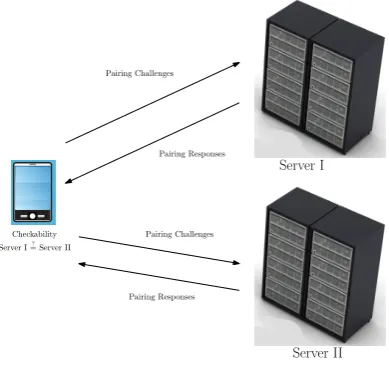
Fig. 1.Outsourcing Bilinear Maps with Two Untrusted Cloud Servers
studied extensively. Outsourcing the complex computations to external power-ful devices dates back to Matsumoto, in which the RSA signature generation problem is considered [17]. More specifically, Chevallier-Mames et al.proposed a protocol enabling a computationally limited device to outsource the computa-tion of bilinear maps into a more resourceful device [8]. However, this delegacomputa-tion process brought new concerns. Firstly, the external device should learn noth-ing about the secrets. Also, the computationally-limited device should be able to check whether the external device computed correctly, at least with certain probability. These two concerns can be eliminated by masking the secret values with the cost of some extra computations before sending to the external server, and then removing the masking values together with a way of validating the outsourced computation.
Besides the efficiency constraints, secrecy is the main objective of the secu-rity model, since the input and output pair of a client is used for cryptographic purposes. Henceforth, outsource mechanisms surely follow a security model in which the client (the energy limited trusted device that needs to delegate the computation) does not trust the servers (which perform the needed computa-tions). Thus, in the security model, it is assumed that the client is honest but the servers are untrusted. Furthermore, checkability, validation of the computation processes, should be also addressed.
– One-Untrusted Program (OUP): One malicious server performs the compu-tation.
– One-Malicious version of a Two-Untrusted Program (OMTUP): Two un-trusted servers perform the computation but only one of them may behave maliciously.
– Two-Untrusted Program (TUP): Two untrusted servers perform the compu-tation and both of them may behave maliciously, but they do not maliciously collude.
Following the work of Chenet al., [1], Tianet al.proposed two algorithms [20] in the OMTUP setting. First algorithm achieves less computational complexity and the second one improves the checkability at the cost of some additional computations. These outsource protocols are composed of both offline and on-line computation steps. In the offon-line phase, the client prepares the necessary values. During the online phase, the client creates masked values based on the precomputed offline values and requests the bilinear map computation.
In this paper, we propose two new algorithms following the steps of Chenet al.and Tianet al.’s work. We further analyze the protocols under the OMTUP assumption and reduce not only the computational complexity of the offline computations, but also the memory needed to store the values resulting from the offline computations together with the communication overhead. While doing so, we do not increase the computation costs that need to be handled by the client.
1.1 Related work
Weil and Tate pairings are firstly used as cryptanalytic tools for reducing the discrete logarithm problem (DLP) on some elliptic curves to DLP on finite fields [4]. Later, Bonehet al.and Joux constructed new cryptographic protocols based on bilinear maps [5, 6, 14]. Reducing the computational cost of bilinear maps are suggested in [2, 3, 6, 10–12, 16, 19].
First protocol for secure outsourcing of elliptic curve pairings were proposed by Chevallier-Mameset al.[8]. The algorithm assumes the OUP setting and it is 1-checkable. However, the algorithm requires expensive computations, namely multiple membership test operation which is equivalent to an exponentiation over the finite field and inversion on the exponents. Later on, under the same OUP assumption, Kang et al.[15] and Canard et al. [7] improved the computational complexity results. However, the solutions were not feasible since exponentiation, membership test, and inversion were still required. Tsang et al.made a taxon-omy for pairing based computations and constructed a batch pairing delegation mechanism [21]. Chowet al. studied server aided signature verification [9].
additions in G1 and G2, and 4 multiplications in G3, where e : G1×G2 →
G3 is the underlying bilinear map. Later, Tianet al. proposed a more efficient algorithm [20] and reduced the online computation phase to 4 point additions in G1 andG2, and 3 multiplications inG3.
1.2 Our contributions
In this paper, we propose two efficient new algorithms for secure outsourcing of bilinear maps. Compared to the state of the art algorithms (especially Tian et al.’s [20]), our algorithms need less offline computations, less memory, and less queries to the servers. In order to manage that, different from the previous studies, we use negation of an input value (it is almost for free since it is located over the elliptic curve), and we also send the same checking computation to both servers. Since it is assumed that the two servers do not collude, we reduce the computation costs without affecting the checkability of the system. The second algorithm may for instance be utilized in signature verification applications, in which we evade from at least one multiplication. For both propositions, we also provide the security model following exactly the lines of the security model of Hohenberger and Lysyanskaya [13]. We conclude the paper by comparing the efficiency of the system with the very recent work of Tianet al.[20].
1.3 Roadmap
In Section 2, we give the security definitions for the outsourcing algorithm. Then, we present some background and preliminaries that will be needed throughout the manuscript, and we propose our two main algorithms together with their security analysis in Section 3. Next, in Section 4, we analyze complexity of our new algorithms and compare it to the complexity of the best known algorithm [20]. Finally, we conclude the paper in Section 5.
2
Security Model
Chenet al.. [1] and Tianet al.[20] follow the security model proposed by Hohen-berger and Lysyanskaya [13]. We remark especially that we also follow exactly their security model [13].
Definition 1. An algorithm is said to obey the outsource input/output specifi-cation if it takes five inputs, and produces three outputs. The first three inputs are generated by an honest party, and are classified by how much the adversary A= (E, U0)knows about them. The first input is called the honest, secret input,
Definition 2. LetAlg(., ., ., ., .)be an algorithm with outsource-IO. A pair of al-gorithms(T, U)is said to be an outsource-secure implementation of an algorithm
Algif: Correctness.TU is a correct implementation of Alg.
Security. For all probabilistic polynomial-time adversaries A = (E, U0), there
exist probabilistic expected polynomial-time simulators(S1, S2)such that the fol-lowing pairs of random variables are computationally indistinguishable. Let us say that the honestly-generated inputs are chosen by a process I.
– Pair One: EV IEWi
real∼EV IEWideal (The external adversary, E, learns nothing.):
• The view that the adversarial environmentE obtains by participating in the following REAL process:
EV IEWi
real={(istatei, xihs, xihp, xihu)←I(1k, istatei−1); (estatei, ji, xi
ap, xiau, stopi)←E(1k, EV IEW i−1 real, x
i,
hp, xihu); (tstatei, ustatei, yi
s, y i p, y
i u)← TU0(ustatei−1)
(tstatei−1, xji hs, x
ji hp, x
ji hu, x
i
ap, xiau) : (estatei, yi
p, yiu)} EV IEWreal=EV IEWreali ifstopi =T RU E.
The real process proceeds in rounds. In round i, the honest (secret, pro-tected, and unprotected) inputs(xi
hs, x i hp, x
i
hu)are picked using an honest, stateful process I to which the environment does not have access. Then the environment, based on its view from the last round, chooses (0)the value of itsestateivariable as a way of remembering what it did next time it is invoked;(1)which previously generated honest inputs(xjhsi, x
ji hp, x
ji hu) to give toTU0
(note that the environment can specify the indexjiof these inputs, but not their values);(2)the adversarial, protected input xi
ap;(3) the adversarial, unprotected input xi
au; (4) the Boolean variable stopi that determines whether roundi is the last round in this process. Next, the algorithmTU0 is run on the inputs(tstatei−1, xji
hs, x ji hp, x
ji hu, x
i ap, xiau), where tstatei−1 is Ts previously saved state, and produces a new state tstatei for T, as well as the secret yi
s, protected yip and unprotected yui outputs. The oracle U0 is given its previously saved state, ustatei−1, as input, and the current state ofU0 is saved in the variable ustatei. The view of the real process inroundi consists ofestatei, and the values yi p and yi
u. The overall view of the environment in the real process is just its view in the last round (i.e.,ifor whichstopi =T RU E).
• The IDEAL process: EV IEWi
ideal={(istatei, xihs, xihp, xihu)←I(1k, istatei−1); (estatei, ji, xi
ap, xiau, stopi)←E(1k, EV IEW i−1 ideal, x
i,
hp, xihu); (astatei, yi
s, yip, yiu)←Alg(astatei−1, x ji hs, x
ji hp, x
ji hu, x
i ap, xiau); (sstatei, ustatei, Yi
p, Yui, replacei)← SU0(ustatei−1 )
1 (sstatei−1, x ji hp, x
ji hu, x
i
(zi
p, zui) =replacei(Ypi, Yui) + (1−replacei)(ypi, yiu) : (estatei, zi
p, ziu)} EV IEWideal=EV IEWideali ifstopi=T RU E.
The ideal process also proceeds in rounds. In the ideal process, we have a stateful simulator S1 who, shielded from the secret input xhs, but given the non-secret outputs thatAlgproduces when run all the inputs for round i, decides to either output the values(yi
p, yiu)generated byAlg, or replace them with some other values (Yi
p, Yui) (Notationally, this is captured by having the indicator variable replacei be a bit that determines whether yi
p will be replaced withYpi.) In doing so, it is allowed to query the oracle U0; moreover,U0 saves its state as in the real experiment.
– Pair Two: U V IEWreal∼U V IEWideal (The untrusted software, (U1, U2),
learns nothing.):
• The view that the untrusted software U0 obtains by participating in the
REAL process described in Pair One. U V IEWreal =ustateiif stopi = T RU E.
• The IDEALprocess: U V IEWi
ideal={(istate i, xi
hs, x i hp, x
i
hu)←I(1
k, istatei−1); (estatei, ji, xi
ap, xiau, stopi)←E(1k, estatei−1, xi,hp, xihu, yip−1, yi−1u); (astatei, yi
s, yip, yiu)←Alg(astatei−1, x ji hs, x
ji hp, x
ji
hu, xiap, xiau); (sstatei, ustatei)←SU0(ustatei−1 )
2 (sstatei−1, x ji hu, xiau) : (ustatei)} U V IEWideal=U V IEWideali ifstopi=T RU E.
In the ideal process, we have a stateful simulator S2 who, equipped with only the unprotected inputs (xi
hu, x i
au), queries U0. As before, U0 may maintain state.
In our security model we assume one-malicious version of a two-untrusted program (OMTUP) model. More concretely, there are two untrusted cloud servers in this model performing the outsourced computation, where only one of them is assumed to be malicious.
Definition 3. A pair of algorithms (T, U1, U2) are an α-efficient implementa-tion of an algorithm Alg if (1) they are an outsource-secure implementation of
Alg, and (2) ∀ inputsx, the running time ofT is ≤an α-multiplicative factor of the running time ofAlg(x).
Definition 4. A pair of algorithms (T, U1, U2)are an β-checkable implementa-tion of an algorithm Alg if (1) they are an outsource-secure implementation of
Alg, and(2) ∀ inputsx, if U0
i, i= 1,2 deviates from its advertised functionality during the execution ofT(U10,U20)(x), T will detect the error with probability≥β.
3
Algorithms for outsourcing of bilinear maps
3.1 Preliminaries: Bilinear Maps
Let (G1,+) and (G2,+) be two additive cyclic groups of orderqwithG1=< Q > andG2=< P >, (G3,·) be a multiplicative cyclic group of orderq, whereqis a
prime number and 0G1,0G2 and 1G3 are the identity elements of the groupsG1,
G2andG3, respectively. Assume that Discrete Logarithm Problem (DLP) is hard
in bothG1 andG2(i.e., given a randomy∈G1(or∈G2), it is computationally
infeasible to find an integer x ∈ Z such that y = gx). If it is clear from the
context we write 0 for the identity elements ofG1, G2 and 1 forG3. Abilinear
map is a mape: G1×G2→G3 satisfying the following properties [4]:
– Bilinearity: For allP1, Q1∈G1, P10, Q01∈G2,eis a group homomorphism in each component, i.e.
1. e(P1+Q1, P0
1) =e(P1, P10)·e(Q1, P10), 2. e(P1, P0
1+Q01) =e(P1, P10)·e(P1, Q01).
– Non-degeneracy:eis non-degenerate in each component, i.e.,
1. For allP ∈G1,P6= 0, there is an elementQ∈G2such thate(P, Q)6= 1, 2. For allQ∈G2,Q6= 0, there is an elementP ∈G1such thate(P, Q)6= 1.
– Computability: There exists an algorithm which computes the bilinear mapeefficiently.
3.2 Algorithm 1
Precomputations Like all existing outsourcing algorithms, some precomputa-tions are performed to speed up the proposed algorithms following the method of [20]. It includes a static table ST and a dynamic table DT. The values stored in the dynamic table are replaced while they are used, and then the table is reconstructed in an idle time of the device. We next describe the steps of the
Rand1algorithm to generate random group elements.
Rand1
– Preprocessing Step: Let P1 and P2 be generators ofG1 and G2,
respec-tively. Generate n random elements α1,· · ·, αn ∈ Z/qZ. For j = 1,· · ·, n
computeβj1=αj·P1 andβj2 =αj·P2, and store the values ofαj, βj1 and
βj2 in ST. Computee(P1, P2)∈G3and store it in ST.
– Generation of Precomputed Values: A new entry in DT is computed
as follows: Generate randomlyS ∈ {1,· · · , n} such that |S| =k. For each j∈S, select randomly Kj ∈ {1,· · ·, h−1}, whereh >1 is a small integer. Compute
x1≡X
j∈S
αjKjmodq.
Ifx1≡0 modq, start again. Otherwise, compute x1·P1≡X
j∈S
Following the above procedure, compute similarly the elements (x2, x2 ·
P2),(x3, x3·P1), and (x4, x4·P2). Then compute 1. 2x1·P1,
2. −2x2·P2, 3. e(P1, P2)2x1x2,
4. e(P1, P2)x3x4.
The entry
(x1·P1,2x1·P1, x3·P1, x2·P2,−2x2·P2, x4·P2, e(P1, P2)2x1x2, e(P1, P2)x3x4)
is stored in DT. On each invocation of Rand1, an entry is returned and removed from DT. Further, a new set of values is used as fresh random values.
Proposed Algorithm 1 Our algorithm takesA∈G1,B ∈G2 as inputs and produces e(A, B) as output. In what follows, T denotes a trusted device with limited computation resources, andUi(A, B)→e(A, B), i∈ {1,2}denotes party Ui taking (A, B) as inputs and returninge(A, B) as output.
– Initialization:T callsRand1to get random values (x1·P1,2x1·P1, x3·P1, x2·P2,−2x2·P2,
x4·P2, λ=e(P1, P2)2x1x2, e(P1, P2)x3x4).
– Computation:In random orders,T sends the following values toU1 1. U1(A+ 2x1·P1,−B−2x2·P2)→α1,
2. U1(x3·P1, x4·P2)→α0
1.
Similarly, in random orders,T sends the following values toU2 1. U2(A+x1·P1, B+x2·P2)→α2,
2. U2(x3·P1, x4·P2)→α0
2.
– Recover:T checks whetherα0
1 ? =α0
2 ?
=e(P1, P2)x3x4. If the verifications are
successful then it computes
β=α1α2 2λ
and producesβ as output. Otherwise, it rejects and gives an “Error”.
Security Analysis
Proof. The correctness follows easily by bilinear property ofe:
β =α1·α22·λ
=e(A+ 2x1·P1,−B−2x2·P2)·
e(A+x1·P1, B+x2·P2)2·e(P1, P2)2x1x2
=e(A, B)−1·e(P1, P2)−4x1x2·e(A, B)2·
e(P1, P2)2x1x2·e(P1, P2)2x1x2
=e(A, B).
We next prove the security of the algorithm. Let (E, U0
1, U20) be a PPT ad-versary that interacts with a PPT algorithmT in the OMTUP model.
Pair One:EV IEWi
real∼EV IEWideal (The external adversary,E, learns noth-ing.):
For a roundi, if the input (A, B) is other than secret, honest, (i.e., honest, pro-tected or adversarial, propro-tected) the simulatorS1 behaves as in the real round. S1 never requires to access the secret input, since there is none. So suppose that the input (A, B) is honest, secret. In that case, the simulator S1 behaves as follows: On receiving input in theith round,S1ignores it and instead make random queries to the servers U0
1, U20:
– U0
1(x1·P1, x2·P2)→α1,
– U0
1(x3·P1, x4·P2)→α01,
– U0
2(x5·P1, x6·P2)→α2,
– U0
2(x3·P1, x4·P2)→α02.
After getting responses fromU10 andU20,S1checks:
– Ifα0
16=α02ore(x3·P1, X4·P2)6=α01, S1producesYpi =“Error”,Yui=∅and repi= 1.
– If all responses are correct,S1sets Yi
p =∅, Yui=∅, andrepi= 0.
– Otherwise,S1selects a random valuesr∈G3 and setsYpi=sr, Yui=∅ and repi= 1.
For all cases,S1saves the appropriate states.
The input distributions in the real and ideal experiments are computationally indistinguishable forU0
1 andU20. The inputs toU10 andU20 are chosen uniformly at random in the ideal experiment. In a real experiment, each part of all queries that T makes to any one program in the computation step is independently re-randomized, and the re-randomization factors(i.e., outputs ofRand1) are either truly randomly generated by naive table-lookup approach or computationally indistinguishable from random by the assumption of the EBPV generator [18]. Now, there are three possibilities to consider.
– If U0
– If one of (U0
1, U20) give an incorrect output in theith round and it has been detected by both T and S1 with probability 1/2, then it will result in an “Error”.
– Finally, we consider the case, where one of (U0
1, U20) give an incorrect output in theith round and it is not caught with probability 1/2. In the real exper-iment,the two outputs generated by (U0
1, U20) are multiplied together along with a random valueλ.
Thus, a corrupted output looks random to the environmentE, in the real experiment, S1 also simulates with a random value in G3 as the output. So, EV IEWi
real∼EV IEW i
ideal even when one of (U10, U20) is dishonest. Now, by the hybrid argument, we conclude thatEV IEWreal∼EV IEWideal.
Pair Two: U V IEWreal∼U V IEWideal (The untrusted software, (U1, U2), learns nothing.):
Here, regardless of the input type, the simulatorS2always behaves the same way. Upon receiving an input on roundi,S2ignores it and instead makes four random queries toU0
1 andU20. Then S2saves its own state and the states of (U10, U20).E can easily distinguish between these real and ideal experiments (output of the ideal experiment is never corrupted), but we want to show thatE cannot share this information with (U0
1, U20). This happens because in the ith round of the real experiment,T always re-randomizes the inputs to (U0
1, U20), and in the ideal experiment S2 creates random, independent queries for (U0
1, U20). So, for each roundi, we haveU V IEWi
real∼U V IEWideali . Then, by the hybrid argument, we get the desired resultU V IEWreal∼U V IEWideal.
Theorem 2. The algorithms(T,(U1, U2))of “Algorithm 1” are a(O(log1q),1/2) -outsource secure implementation of a pairing evaluation under the OMTUP as-sumption.
Proof. By the above theorem,U1 andU2 cannot distinguish a test query from a real query. Without loss of generality, assume that U1 is honest while U2 is dishonest (since we are under the OMTUP assumption). Thus,U2 fails with a probability 1/2.
3.3 Algorithm 2
Precomputations Rand2
– Preprocessing Step: Generate n random elements α1,· · ·, αn ∈Zq. For j= 1,· · ·, ncomputeβj1=αj·P1 andj2 =αj·P2, and store the values of
αj, βj1 and βj2 in a static table ST. Computee(P1, P2) and store the value
in ST.
– Generation of Precomputed Values: When a table DT needs a new
that |S| =k. For each j ∈ S, randomly select Kj ∈ {1,· · ·, h−1}, where h >1 is a small integer. Compute
x1≡X
j∈S
αjKjmodq.
Ifx1≡0 modq, start again. Otherwise, compute x1P1≡X
j∈S
Kj·βj1 modq.
Following the above procedure, compute similarly the elements (x2, x2 ·
P2),(x3, x3·P1),(x4, x4·P1), and (x5, x5·P2). Then compute 1. (x2−x−11x2x3)·P2,
2. e(P1, P2)x4x5.
The entry
(x1·P1, x3·P1, x4·P1, x2·P2, x5·P2, (x2−x−11x2x3)·P2, e(P1, P2)x4x5)
is stored in DT. On each invocation of Rand2, an entry is returned and removed from DT. Further, a new set of values is used as fresh random values.
Proposed Scheme 2 Algorithm 2 takesA∈ G1, B ∈G2 as inputs and pro-ducese(A, B) as output. In what follows,T denotes a trusted device with limited computation resources, andUi(A, B)→e(A, B), i∈ {1,2}denotes partyUi tak-ing (A, B) as inputs and givtak-inge(A, B) as output.
– Init: T callsRand2to get random values
(x1·P1, x3·P1, x4·P1, x2·P2, x5·P2, (x2−x−11x2x3)·P2, e(P1, P2)x4x5).
– Computation:In random orders,T sends the following toU1 1. U1(A+x1·P1, B+x2·P2)→α1,
2. U1(x4·P1, x5·P2)→α0
1.
Similarly, in random orders,T sends the following toU2 1. U2(A+x3·P1,−x2·P2)→α2,
2. U2(−x1·P1, B+ (x2−x−11x2x3)·P2)→α3 3. U2(x4·P1, x5·P2)→α0
2.
– Recover:T checks whetherα0
1 ? =α0
2 ?
=e(P1, P2)x4x5. If the verifications are
successful then it computes
β =α1α2α3
Security Analysis
Theorem 3. Under the OMTUP assumption, the algorithms (T,(U1, U2)) of “Algorithm 1” are an outsource-secure implementation of a pairing evaluation, where the input (A, B)may be honest, secret, honest, protected, or adversarial, protected.
Proof. The correctness is straight forward: β =α1·α2·α3
=e(A+x1·P1, B+x2·P2)·e(A+x3·P1,−x2·P2)·
e(−x1·P1, B+ (x2−x−11x2x3)·P2) =e(A, B)e(P1, P2)x1x2·e(P1, P2)−x2x3·
e(P1, P2)−x1(x2−x−11x2x3)
=e(A, B).
The proof of the security part follows analogously to the proof of Theorem 1.
4
Complexity Analysis
4.1 Comparisons
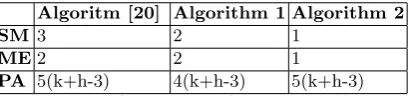
We compare the precomputation algorithms of our proposed schemes with Tian et al.’s algorithm [20]. In the following tables, SM denotes scalar multiplication in
G1,G2, ME modular exponentiation, PC pairing computation on the server side,
FM field multiplication, and PA point addition inG1,G2. Furthermore,kdenotes
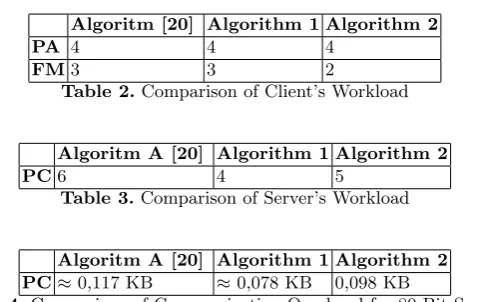
the size of the setS in the algorithmsRand1and Rand2. Table I compares the precomputation, Table II compares the client’s workload, and Table III compares the server’s workload. Table IV compares the communication overhead between the client and the servers, and finally Table V gives the memory requirements for ST and DT by means of counting the number of group elements.
Algoritm [20] Algorithm 1 Algorithm 2
SM3 2 1
ME2 2 1
Algoritm [20] Algorithm 1 Algorithm 2
PA 4 4 4
FM3 3 2
Table 2.Comparison of Client’s Workload
Algoritm A [20] Algorithm 1 Algorithm 2
PC6 4 5
Table 3.Comparison of Server’s Workload
Algoritm A [20] Algorithm 1 Algorithm 2 PC≈0,117 KB ≈0,078 KB 0,098 KB
Table 4.Comparison of Communication Overhead for 80-Bit Security
ST DT Algorithm 1 3 8 Algorithm 2 3 7
Table 5.Memory Requirements forRandalgorithms.
5
Conclusion
In this paper, we studied outsourcing the computation of bilinear maps and pro-posed two new efficient algorithms decreasing both the memory requirement and the overall communication overhead. We defined the necessary security model, and proved the correctness and the security of the proposed secure outsourcing algorithms. We further gave the comparisons of our algorithms with a very re-cent outsourcing mechanism of Tian et al. [20] with respect to the offline and online computations, and the memory to be used. In this way, we show that our algorithms are more efficient than all previously proposed solutions.
Acknowledgment
Kiraz’s and Arabaci’s works are supported by a grant from Ministry of Develop-ment of Turkey provided to the Cloud Computing and Big Data Research Lab Project. Uzunkol’s work is supported by the project (114C027) funded by EU FP7-The Marie Curie Action and T ¨UB˙ITAK (2236-CO-FUNDED Brain Circu-lation Scheme).
References
2. Barreto, P., Galbraith, S., higeartaigh, C., Scott, M.: Efficient pairing computation on supersingular abelian varieties. Designs, Codes and Cryptography 42(3), 239– 271 (2007),http://dx.doi.org/10.1007/s10623-006-9033-6
3. Beuchat, J.L., Gonzlez-Daz, J., Mitsunari, S., Okamoto, E., Rodrguez-Henrquez, F., Teruya, T.: High-speed software implementation of the optimal ate pairing over barretonaehrig curves. In: Joye, M., Miyaji, A., Otsuka, A. (eds.) Pairing-Based Cryptography - Pairing 2010, Lecture Notes in Computer Science, vol. 6487, pp. 21–39. Springer Berlin Heidelberg (2010), http://dx.doi.org/10.1007/978-3-642-17455-1_2
4. Blake, I., Seroussi, G., Smart, N., Cassels, J.W.S.: Advances in Elliptic Curve Cryptography (London Mathematical Society Lecture Note Series). Cambridge University Press, New York, NY, USA (2005)
5. Boneh, D., Franklin, M.: Identity-based encryption from the weil pairing. In: Kilian, J. (ed.) Advances in Cryptology CRYPTO 2001, Lecture Notes in Computer Science, vol. 2139, pp. 213–229. Springer Berlin Heidelberg (2001), http://dx. doi.org/10.1007/3-540-44647-8_13
6. Boneh, D., Lynn, B., Shacham, H.: Short signatures from the weil pairing. Journal of Cryptology 17(4), 297–319 (2004), http://dx.doi.org/10.1007/s00145-004-0314-9
7. Canard, S., Devigne, J., Sanders, O.: Delegating a pairing can be both secure and efficient. In: Boureanu, I., Owesarski, P., Vaudenay, S. (eds.) Applied Cryptography and Network Security, Lecture Notes in Computer Science, vol. 8479, pp. 549– 565. Springer International Publishing (2014), http://dx.doi.org/10.1007/978-3-319-07536-5_32
8. Chevallier-Mames, B., Coron, J.S., McCullagh, N., Naccache, D., Scott, M.: Secure delegation of elliptic-curve pairing. Cryptology ePrint Archive, Report 2005/150 (2005)
9. Chow, S.S., Au, M.H., Susilo, W.: Server-aided signatures verification secure against collusion attack. Information Security Technical Report 17(3), 46 – 57 (2013), http://www.sciencedirect.com/science/article/pii/ S1363412712000489, security and Privacy for Digital Ecosystems
10. Galbraith, S.D., Paterson, K.G., Smart, N.P.: Pairings for cryptographers. Discrete Applied Mathematics 156(16), 3113 – 3121 (2008),http://www.sciencedirect. com/science/article/pii/S0166218X08000449, applications of Algebra to Cryp-tography
11. Hess, F., Smart, N., Vercauteren, F.: The eta pairing revisited. Information Theory, IEEE Transactions on 52(10), 4595–4602 (Oct 2006)
12. Hess, F.: Pairing lattices. In: Galbraith, S., Paterson, K. (eds.) Pairing-Based Cryp-tography Pairing 2008, Lecture Notes in Computer Science, vol. 5209, pp. 18– 38. Springer Berlin Heidelberg (2008), http://dx.doi.org/10.1007/978-3-540-85538-5_2
13. Hohenberger, S., Lysyanskaya, A.: How to securely outsource cryptographic com-putations. In: Theory of Cryptography, Second Theory of Cryptography Con-ference, TCC 2005, Cambridge, MA, USA, February 10-12, 2005, Proceedings. Lecture Notes in Computer Science, vol. 3378, pp. 264–282. Springer (2005), http://www.iacr.org/cryptodb/archive/2005/TCC/3678/3678.pdf
14. Joux, A.: A one round protocol for tripartite diffiehellman. Journal of Cryptology 17(4), 263–276 (2004),http://dx.doi.org/10.1007/s00145-004-0312-y 15. Kang, B.G., Lee, M.S., Park, J.H.: Efficient delegation of pairing computation
16. Koblitz, N., Menezes, A.: Pairing-based cryptography at high security levels. In: Smart, N. (ed.) Cryptography and Coding, Lecture Notes in Computer Science, vol. 3796, pp. 13–36. Springer Berlin Heidelberg (2005), http://dx.doi.org/10. 1007/11586821_2
17. Matsumoto, T., Kato, K., Imai, H.: Speeding up secret computations with insecure auxiliary devices. In: Goldwasser, S. (ed.) Advances in Cryptology CRYPTO 88, Lecture Notes in Computer Science, vol. 403, pp. 497–506. Springer New York (1990),http://dx.doi.org/10.1007/0-387-34799-2_35
18. Nguyen, P., Shparlinski, I., Stern, J.: Distribution of modular sums and the security of the server aided exponentiation. In: Cryptography and Computational Number Theory, Progress in Computer Science and Applied Logic, vol. 20, pp. 331–342. Birkhuser Basel (2001)
19. Scott, M., Costigan, N., Abdulwahab, W.: Implementing cryptographic pairings on smartcards. In: Goubin, L., Matsui, M. (eds.) Cryptographic Hardware and Embed-ded Systems - CHES 2006, Lecture Notes in Computer Science, vol. 4249, pp. 134– 147. Springer Berlin Heidelberg (2006), http://dx.doi.org/10.1007/11894063_ 11
20. Tian, H., Zhang, F., Ren, K.: Secure bilinear pairing outsourcing made more ef-ficient and flexible. In: Bao, F., Miller, S., Zhou, J., Ahn, G. (eds.) Proceedings of the 10th ACM Symposium on Information, Computer and Communications Se-curity, ASIA CCS ’15, Singapore, April 14-17, 2015. pp. 417–426. ACM (2015), http://doi.acm.org/10.1145/2714576.2714615