Clinical Interventions in Aging
Dove
press
O R I G I N A L R E S E A R C H
open access to scientific and medical research
Open Access Full Text Article
Impact of beta2-agonists, beta-blockers,
and their combination on cardiac function
in elderly male patients with chronic
obstructive pulmonary disease
Long-Huan Zeng1,*
Yi-Xin Hu2,* Lin Liu2
Meng Zhang1
Hua Cui1
1Second Geriatric Cardiology
Division, 2Clinical Department of
Geriatrics, Chinese PLA General Hospital, Beijing, People’s Republic of China
*These authors contributed equally to this work
Correspondence: Hua Cui
Second Geriatric Cardiology Division, Chinese PLA General Hospital, 28 Fuxing Road, Beijing 100853, People’s Republic of China Tel/fax +86 10 6687 6349 Email [email protected]
Purpose: This study was undertaken to determine the association between cardiac function and therapy with beta2-adrenoceptor agonists (β2-agonists), β-blockers, or β-blocker–β2-agonist
combination therapy in elderly male patients with chronic obstructive pulmonary disease (COPD).
Patients and methods: This was a retrospective cohort study of 220 elderly male COPD patients (mean age 84.1 ± 6.9 years). The patients were divided into four groups on the basis of the use of β-blockers and β2-agonists. N-terminal fragment pro-B-type natriuretic peptide (NT pro-BNP), left ventricular ejection fraction (LVEF), and other relevant parameters were measured and recorded. At follow-up, the primary end point was all-cause mortality.
Results: Multiple linear regression analysis revealed no significant associations between NT pro-BNP and the use of β2-agonists (β = 35.502, P= 0.905), β-blockers (β = 3.533, P= 0.989), or combination therapy (β = 298.635, P = 0.325). LVEF was not significantly associated with the use of β2-agonists (β = −0.360, P= 0.475), β-blockers (β = −0.411, P= 0.284), or combi-nation therapy (β = −0.397, P = 0.435). Over the follow-up period, 52 patients died, but there was no significant difference in mortality among the four groups (P= 0.357). Kaplan–Meier analysis showed no significant difference among the study groups (log-rank test, P= 0.362). After further multivariate adjustment, use of β2-agonists (hazard ratio [HR] 0.711, 95% con-fidence interval [CI] 0.287–1.759; P= 0.460), β-blockers (HR 0.962, 95% CI 0.405–2.285; P= 0.930), or combination therapy (HR 0.638, 95% CI 0.241–1.689; P 0.366) were likewise not correlated with mortality.
Conclusion: There was no association between the use of β2-agonists, β-blockers, or β-blocker–
β2-agonist combination therapy with cardiac function and all-cause mortality in elderly male
COPD patients, which indicated that they may be used safely in this population.
Keywords:β2-agonists, β-blockers, β-blocker–β2-agonist combination, elderly COPD patients,
cardiac function, mortality
Introduction
Chronic obstructive pulmonary disease (COPD) is a global epidemic and is predicted to be the fifth most widespread disease and the third-leading cause of death worldwide by 2020.1–3 The incidence of COPD increases sharply with age, and is more common in
males.2,3 Most COPD patients often have complications of multiple-organ insufficiency,
such as cardiac insufficiency,4–7 which increases mortality risk and worsens survival,
thereby presenting many therapeutic challenges to health-care providers.6,8,9
Clinical Interventions in Aging downloaded from https://www.dovepress.com/ by 118.70.13.36 on 20-Aug-2020
For personal use only.
Number of times this article has been viewed
This article was published in the following Dove Press journal: Clinical Interventions in Aging
Dovepress
Zeng et al
Beta2-adrenoceptor agonists (β2-agonists) are typically used for COPD treatment to relieve airflow limitation and improve respiratory disorders. A recent study observed no association between β2-agonist therapy and mortality in patients with heart failure (HF) after adjusting for B-type natriuretic peptide (BNP).10 However, for COPD patients
with coexisting HF, there is some concern regarding the rela-tionship between β2-agonist use and mortality in patients with cardiovascular disease. Several studies reported that regular use of β2-agonists can cause downregulation of myocardial
β2-adrenoceptors, which may play an important role in onset or worsening HF.11,12 Au et al13 showed that β
2-agonist use
was associated with an increased risk of all-cause mortality in patients with left ventricular systolic dysfunction (LVSD). Thus, the concerns and controversies make physicians reluc-tant to prescribe β2-agonists in COPD patients.
It is generally accepted that β-blockers can be used safely in patients with HF to improve LVSD14 and reduce
mortality.15 Although a few clinical trials had suggested
the safety and efficacy of β-blocker therapy in COPD patients,16,17 the actual use of β-blockers has remained lower
than expected.18,19 In addition, clinicians are cautious of β-blocker use for fear of provoking bronchospasm,20,21 which
may worsen cardiopulmonary function.
To date, there have been a considerable number of clinical trials to assess the use of β2-agonists and β-blockers, yet most of them have been limited by the absence of detailed data on COPD status and high-risk patients, such as the elderly. In such cases, physicians would be extremely prudent to prescribe β2-agonists for bronchospasm and β-blockers for tachycardia caused by cardiac insufficiency. To the best of our knowledge, COPD is an age-related disease; however, few studies have reported the effectiveness of β-blockers and β2-agonists in a population with COPD, particularly the elderly. Therefore, we designed the current study to assess the association between the use of β-blockers, β2-agonists, or a combination therapy and cardiac function, as well as all-cause mortality in elderly male COPD patients.
Methods
Ethical approval of the study protocol
This study complied with the Declaration of Helsinki22 and
was approved by the Scientific and Ethics Review Board of the Department of Geriatrics, Chinese PLA General Hospital, Beijing, People’s Republic of China. All patients enrolled in the study submitted written informed consent.
Patient enrollment
A total of 220 male COPD patients (mean age 84.1 ±
6.9 years) were retrospectively enrolled in the present trial between January 2008 and May 2011. All participants were hospitalized in the Department of Geriatrics of the Chinese PLA General Hospital during the aforementioned recruitment period. Patient information was collected and registered with the electronic database of the cardiovas-cular center in the same hospital. Patient recruitment was carried out by physicians from the Department of Geriatric Cardiology, PLA General Hospital, who received proper instructions from the research team on the study aims and design.
Overall, 63 patients received β2-agonists (salbutamol, salmeterol, or procaterol) and 112 were administered
β-blockers (metoprolol, bisoprolol, or carvedilol). To evaluate the association between the use of β-blockers,
β2-agonists, or a combination of both with cardiac function, the patients were divided into four groups on the basis of the use of β2-agonists and β-blockers: β2-agonists, β-blockers,
β2-agonists and β-blockers, or neither (the control group). Data on demographic variables, medication use, medi-cal history, and current smoking status were collected. The patients’ cardiovascular histories and cardiac risk factors were obtained from medical records of current or previ-ous diagnoses and/or therapies, and included incidences of coronary heart disease, previous myocardial infarction, HF, hypertension, dyslipidemia, diabetes mellitus, renal dysfunc-tion, and peripheral arterial occlusive disease.
Laboratory indicators, such as N-terminal fragment (NT) pro-BNP, total cholesterol, high-density-lipoprotein cholesterol, low-density-lipoprotein cholesterol (LDL-c), tri-glycerides, serum creatinine, and high-sensitivity C-reactive protein (HS-CRP) levels, were measured and recorded at the same time. Left ventricular ejection fraction (LVEF), left ventricular end-systolic volume, left ventricular end-diastolic volume, and shortening fraction were calculated via standard transthoracic echocardiography performed by trained doctors blinded to group allocation.
Outcomes
The primary end point of the study was all-cause mortality, and eligible patients were followed up until they died (study end point) or the end of the trial duration (December 31, 2012), with a median follow-up of 22.2 months. Survival status was obtained from patient medical records.
Clinical Interventions in Aging downloaded from https://www.dovepress.com/ by 118.70.13.36 on 20-Aug-2020
Dovepress β2-agonists, β-blockers, and cardiac function in COPD
Pulmonary function tests
All patients underwent pulmonary function tests. Spirometric evaluations were conducted in accordance with current guidelines using established reference values. A diagnosis of COPD was based on postbronchodilator spirometric data in conjunction with a history of cough, sputum production, and/or dyspnea. COPD, as defined by the Global initiative for chronic Obstructive Lung Disease criteria,1 was classified
into three stages: I = mild COPD (forced expiratory volume in 1 second/forced vital capacity [FEV1/FVC] 0.70 and FEV1 80% of the predicted FEV1), II = moderate COPD (FEV1/FVC 0.70 and FEV1 50% FEV1 80% of the predicted FEV1), and III = severe COPD (FEV1/FVC 0.70 and FEV1 30% FEV1 50% of the predicted FEV1).
Statistical analysis
Baseline characteristics among the patient groups were evaluated. Continuous data are presented as means ± standard deviation or median and 25th to 75th percentiles as appropri-ate, and compared using one-way analysis of variance or the Wilcoxon rank-sum test, depending on the distribution of variables. Categorical variables are expressed as percentages and evaluated using the chi-squared test. Multiple linear regres-sion analysis was used to determine the relationship between the use of β2-agonists, β-blockers, or a combination of both, and indices of cardiac function (NT pro-BNP and LVEF). In the model, we entered “P-in was 0.1 and P-out was 0.05”.We entered β-blocker and β2-agonist use and factors associated with NT pro-BNP at a P-value 0.05, using the Enter and Stepwise fashion, included those variables with a P-value 0.05. The same method was deemed suitable for LVEF. Patient survival was analyzed using the Kaplan–Meier method. The Cox pro-portional hazard model was used to adjust the variables. Age, body mass index (BMI), blood pressure, heart rate, biochemical markers, echocardiographic parameters, COPD severity, New York Heart Association (NYHA) classification, current smok-ing status, comorbidities, and prescribed drug use were included in the final model. For all tests, a two-tailed P-value 0.05 was considered statistically significant. All calculations were performed using SPSS version 16.0 statistical software for Windows (IBM, Armonk, NY, USA).
Results
Baseline characteristics
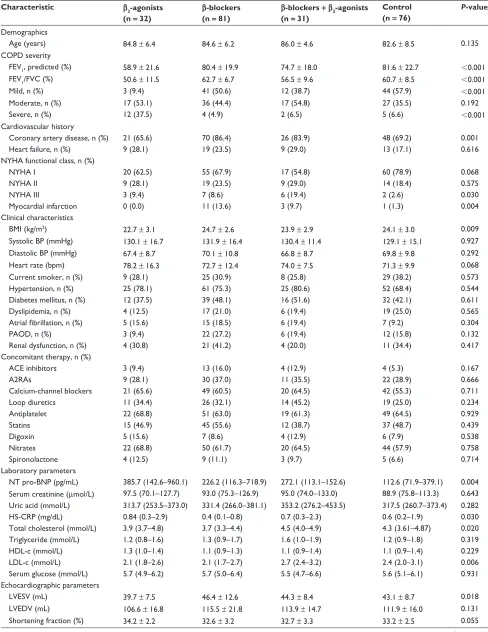
Patient demographics are provided in Table 1. Data from the 220 enrolled male patients (mean age 84.1 ± 6.9 years) were
subjected to statistical analysis. In all, β2-agonists were prescribed for 32 patients, β-blockers for 81, both β-blockers and β2-agonists for 31, and neither (the control group) for 76.
The patients administered β2-agonists had significantly higher predicted FEV1% values (P 0.001) and had a greater tendency for severe COPD (P 0.001). Patients treated with β-blockers were more likely to have underlying his-tories of coronary artery disease and myocardial infarction, whereas those receiving combination therapy had poorer cardiac function status, as indicated by a greater incidence of NYHA classification III (P = 0.030). Medication use, age, and current smoking status were similar among the four groups (all P 0.05). Univariate analysis showed significant differences in both HS-CRP (P= 0.030) and LDL-c levels among all four groups. Patients using a combination therapy had significantly higher LDL-c and total cholesterol levels (P = 0.006 and 0.020, respectively) compared with other patients. Patients using β2-agonists had slightly higher HS-CRP levels (P= 0.030) than others (Table 1).
There was a significant difference in NT pro-BNP values among the four groups, with the highest levels detected in
β2-agonist users (385.7 pg/mL, range 142.6–960.1; P= 0.004). However, differences in LVEF were not statistically signifi-cant among the four groups (P= 0.108, Table 1).
Correlation analysis
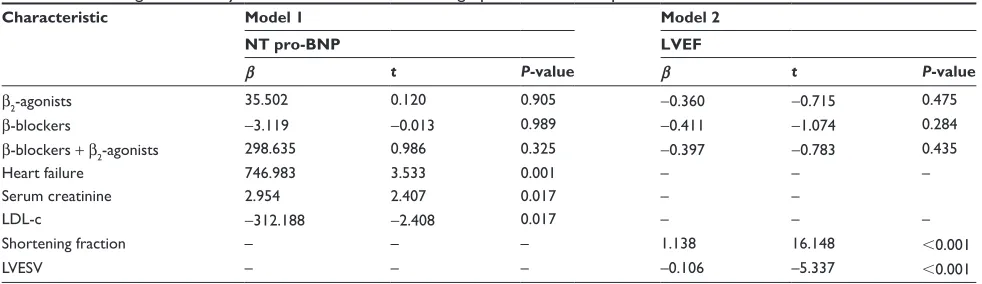
Multivariate linear regression analysis with NT pro-BNP as the dependent variable showed that use of β2-agonists (β= 35.502, P= 0.905), β-blockers (β= −3.119, P= 0.989), and β-blocker–β2-agonist combination therapy (β= 298.635, P = 0.325) were not significantly associated with NT pro-BNP compared to the control group. Serum creatinine (β= 2.954, P= 0.017) and the presence of HF (β= 746.983, P= 0.001) were positively correlated with NT pro-BNP, whereas LDL-c (β= −312.188, P= 0.017) was negatively correlated with NT pro-BNP. In addition, with LVEF as the dependent variable, there were no significant associations between LVEF and the use of β2-agonists (β= −0.360, P= 0.475), β-blockers (β=−0.411, P= 0.284), or β-blocker–β2-agonist combina-tion therapy (β= −0.397, P= 0.435). Meanwhile, LVEF was positively associated with shortening fraction (β = 1.138, P 0.001) and negatively associated with left ventricular end-systolic volume (β= −0.106, P 0.001; Table 2).
Clinical events
Although a total of 52 patients died over the follow-up period, there were no statistical differences in mortality
Clinical Interventions in Aging downloaded from https://www.dovepress.com/ by 118.70.13.36 on 20-Aug-2020
Dovepress
Zeng et al
Table 1 Baseline characteristics
Characteristic β2-agonists (n = 32)
β-blockers (n = 81)
β-blockers + β2-agonists (n = 31)
Control (n = 76)
P-value
Demographics
Age (years) 84.8 ± 6.4 84.6 ± 6.2 86.0 ± 4.6 82.6 ± 8.5 0.135
COPD severity
FEV1, predicted (%) 58.9 ± 21.6 80.4 ± 19.9 74.7 ± 18.0 81.6 ± 22.7 0.001
FEV1/FVC (%) 50.6 ± 11.5 62.7 ± 6.7 56.5 ± 9.6 60.7 ± 8.5 0.001
Mild, n (%) 3 (9.4) 41 (50.6) 12 (38.7) 44 (57.9) 0.001
Moderate, n (%) 17 (53.1) 36 (44.4) 17 (54.8) 27 (35.5) 0.192
Severe, n (%) 12 (37.5) 4 (4.9) 2 (6.5) 5 (6.6) 0.001
Cardiovascular history
Coronary artery disease, n (%) 21 (65.6) 70 (86.4) 26 (83.9) 48 (69.2) 0.001
Heart failure, n (%) 9 (28.1) 19 (23.5) 9 (29.0) 13 (17.1) 0.616
NYHA functional class, n (%)
NYHA I 20 (62.5) 55 (67.9) 17 (54.8) 60 (78.9) 0.068
NYHA II 9 (28.1) 19 (23.5) 9 (29.0) 14 (18.4) 0.575
NYHA III 3 (9.4) 7 (8.6) 6 (19.4) 2 (2.6) 0.030
Myocardial infarction 0 (0.0) 11 (13.6) 3 (9.7) 1 (1.3) 0.004
Clinical characteristics
BMI (kg/m2) 22.7 ± 3.1 24.7 ± 2.6 23.9 ± 2.9 24.1 ± 3.0 0.009
Systolic BP (mmHg) 130.1 ± 16.7 131.9 ± 16.4 130.4 ± 11.4 129.1 ± 15.1 0.927
Diastolic BP (mmHg) 67.4 ± 8.7 70.1 ± 10.8 66.8 ± 8.7 69.8 ± 9.8 0.292
Heart rate (bpm) 78.2 ± 16.3 72.7 ± 12.4 74.0 ± 7.5 71.3 ± 9.9 0.068
Current smoker, n (%) 9 (28.1) 25 (30.9) 8 (25.8) 29 (38.2) 0.573
Hypertension, n (%) 25 (78.1) 61 (75.3) 25 (80.6) 52 (68.4) 0.544
Diabetes mellitus, n (%) 12 (37.5) 39 (48.1) 16 (51.6) 32 (42.1) 0.611
Dyslipidemia, n (%) 4 (12.5) 17 (21.0) 6 (19.4) 19 (25.0) 0.565
Atrial fibrillation, n (%) 5 (15.6) 15 (18.5) 6 (19.4) 7 (9.2) 0.304
PAOD, n (%) 3 (9.4) 22 (27.2) 6 (19.4) 12 (15.8) 0.132
Renal dysfunction, n (%) 4 (30.8) 21 (41.2) 4 (20.0) 11 (34.4) 0.417
Concomitant therapy, n (%)
ACE inhibitors 3 (9.4) 13 (16.0) 4 (12.9) 4 (5.3) 0.167
A2RAs 9 (28.1) 30 (37.0) 11 (35.5) 22 (28.9) 0.666
Calcium-channel blockers 21 (65.6) 49 (60.5) 20 (64.5) 42 (55.3) 0.711
Loop diuretics 11 (34.4) 26 (32.1) 14 (45.2) 19 (25.0) 0.234
Antiplatelet 22 (68.8) 51 (63.0) 19 (61.3) 49 (64.5) 0.929
Statins 15 (46.9) 45 (55.6) 12 (38.7) 37 (48.7) 0.439
Digoxin 5 (15.6) 7 (8.6) 4 (12.9) 6 (7.9) 0.538
Nitrates 22 (68.8) 50 (61.7) 20 (64.5) 44 (57.9) 0.758
Spironolactone 4 (12.5) 9 (11.1) 3 (9.7) 5 (6.6) 0.714
Laboratory parameters
NT pro-BNP (pg/mL) 385.7 (142.6–960.1) 226.2 (116.3–718.9) 272.1 (113.1–152.6) 112.6 (71.9–379.1) 0.004 Serum creatinine (μmol/L) 97.5 (70.1–127.7) 93.0 (75.3–126.9) 95.0 (74.0–133.0) 88.9 (75.8–113.3) 0.643 Uric acid (mmol/L) 313.7 (253.5–373.0) 331.4 (266.0–381.1) 353.2 (276.2–453.5) 317.5 (260.7–373.4) 0.282
HS-CRP (mg/dL) 0.84 (0.3–2.9) 0.4 (0.1–0.8) 0.7 (0.3–2.3) 0.6 (0.2–1.9) 0.030
Total cholesterol (mmol/L) 3.9 (3.7–4.8) 3.7 (3.3–4.4) 4.5 (4.0–4.9) 4.3 (3.61–4.87) 0.020
Triglyceride (mmol/L) 1.2 (0.8–1.6) 1.3 (0.9–1.7) 1.6 (1.0–1.9) 1.2 (0.9–1.8) 0.319
HDL-c (mmol/L) 1.3 (1.0–1.4) 1.1 (0.9–1.3) 1.1 (0.9–1.4) 1.1 (0.9–1.4) 0.229
LDL-c (mmol/L) 2.1 (1.8–2.6) 2.1 (1.7–2.7) 2.7 (2.4–3.2) 2.4 (2.0–3.1) 0.006
Serum glucose (mmol/L) 5.7 (4.9–6.2) 5.7 (5.0–6.4) 5.5 (4.7–6.6) 5.6 (5.1–6.1) 0.931
Echocardiographic parameters
LVESV (mL) 39.7 ± 7.5 46.4 ± 12.6 44.3 ± 8.4 43.1 ± 8.7 0.018
LVEDV (mL) 106.6 ± 16.8 115.5 ± 21.8 113.9 ± 14.7 111.9 ± 16.0 0.131
Shortening fraction (%) 34.2 ± 2.2 32.6 ± 3.2 32.7 ± 3.3 33.2 ± 2.5 0.055
(Continued)
Clinical Interventions in Aging downloaded from https://www.dovepress.com/ by 118.70.13.36 on 20-Aug-2020
Dovepress β2-agonists, β-blockers, and cardiac function in COPD Table 1 (Continued)
Characteristic β2-agonists (n = 32)
β-blockers (n = 81)
β-blockers + β2-agonists (n = 31)
Control (n = 76)
P-value
LVEF (%) 62.6 ± 3.1 60.1 ± 5.9 60.5 ± 4.6 61.6 ± 3.4 0.108
50%, n (%) 0 (0.0) 4 (4.9) 1 (3.2) 0 (0.0)
50%, n (%) 32 (100) 77 (95.1) 30 (96.8) 76 (100.0)
Abbreviations: COPD, chronic obstructive pulmonary disease; FEV1, forced expiratory volume in 1 second; FVC, forced vital capacity; NYHA, New York Heart Association;
BMI, body mass index; BP, blood pressure; bpm, beats per minute; PAOD, peripheral arterial occlusive disease; ACE, angiotensin-converting enzyme; A2RA, angiotensin-II receptor antagonist; HS-CRP, high-sensitivity C-reactive protein; LDL-c, low-density-lipoprotein cholesterol; HDL-c, high-density-lipoprotein cholesterol; NT pro BNP, N-terminal pro-hormone brain natriuretic parameters; LVESV, left ventricular end-systolic volume; LVEDV, left ventricular end-diastolic volume; LVEF, left ventricular ejection fraction.
Table 2 Linear regression analyses of clinical data, echocardiographic data and NT pro-BNP/LVEF
Characteristic Model 1 Model 2
NT pro-BNP LVEF
β t P-value β t P-value
β2-agonists 35.502 0.120 0.905 −0.360 −0.715 0.475
β-blockers −3.119 −0.013 0.989 −0.411 −1.074 0.284
β-blockers +β2-agonists 298.635 0.986 0.325 −0.397 −0.783 0.435
Heart failure 746.983 3.533 0.001 – – –
Serum creatinine 2.954 2.407 0.017 – –
LDL-c −312.188 −2.408 0.017 – – –
Shortening fraction – – – 1.138 16.148 0.001
LVESV – – – –0.106 –5.337 0.001
Abbreviations: NT pro-BNP, N-terminal pro-hormone brain natriuretic parameters; LVEF, left ventricular ejection fraction; LDL-c, low-density-lipoprotein cholesterol; LVESV, left ventricular end-systolic volume.
rates among the study groups (P = 0.357). NT pro-BNP levels were significantly higher in those patients who died than those who survived (195.7 pg/mL [range 70.5–449.3] versus 707.1 pg/mL [range 194.9–2,393.1], P 0.001), but in contrast, LVEF was statistically lower in those patients who died (59.9% ± 6.2% versus 61.4% ± 4.1%, P= 0.014). Kaplan–Meier analysis of all-cause mortality revealed no significant difference among the study groups (log-rank test, P= 0.362). When adjusted for age, BMI, blood pressure, heart rate, serum creatinine, LDL-c, NT pro-BNP, HS-CRP, echocardiographic parameters, COPD severity, NYHA class, current smoking status, prescribed drugs, and comorbidities, there was still no significant association observed between the use of β2-agonists
(haz-ard ratio [HR] 0.711, 95% CI 0.287–1.759; P= 0.460),
β-blockers (HR 0.962, 95% CI 0.405–2.285; P= 0.930), or β-blocker–β2-agonist combination therapy (HR 0.638,
95% CI 0.241–1.689; P= 0.366) and all-cause mortality. In addition, HS-CRP was not associated with mortality (P= 0.609) either, whereas NT pro-BNP had a significant effect on mortality (HR 1.612, 95% CI 1.265–2.055; P
0.001). No statistical interaction was observed between
β-blockers and β2-agonists regarding all-cause mortality
(P = 0.428). Multivariable associations of mortality are presented in Table 3. In addition, among patients receiving beta-blockers, β2-agonist use (compared with no β2-agonist
use) was associated with lower all-cause mortality [HR 1.134 (0.378–3.403) versus 1.377 (0.485–3.910) in those not receiving a beta-blocker]. No statistical interaction was observed between β2-agonists and β-blockers regarding
all-cause mortality (Table 4).
Discussion
The primary objective of this study was to examine the association between cardiac function, all-cause mortality, and the use of β2-agonists, β-blockers, or both in elderly male
COPD patients. The main findings of the current study indi-cated that β2-agonist use may not be associated with either
NT pro-BNP or LVEF in elderly male COPD patients, and that β2-agonist use was not associated either with all-cause
mortality in these patients when adjusted for NT pro-BNP, LVEF, and relevant clinical, demographic, and medication variables. Similar results were also found for patients using
β-blockers or combination therapy.
Clinical Interventions in Aging downloaded from https://www.dovepress.com/ by 118.70.13.36 on 20-Aug-2020
Dovepress
Zeng et al
Table 3 Associates of all-cause mortality in the total population
Variable HR (95% CI, P-value)
NT pro-BNP 1.612 (1.265–2.055, 0.001)
Myocardial infarction 4.026 (1.229–13.187, 0.021)
Renal dysfunction 2.363 (1.229–4.544, 0.010)
ACE inhibitors 0.155 (0.035–0.689, 0.014)
A2RAs 0.387 (0.181–0.828, 0.014)
Loop diuretic 3.973 (2.004–7.877, 0.001)
β2-agonists 0.711 (0.287–1.759, 0.460)
β-blockers 0.962 (0.405–2.285, 0.930)
β-blockers +β2-agonists 0.638 (0.241–1.689, 0.366)
Abbreviations: HR, hazard ratio; CI, confidence interval; NT-proBNP, N-terminal pro-hormone brain natriuretic parameters; ACE, angiotensin-converting enzyme; A2RA, angiotensin-II receptor antagonist.
Table 4 Association between β2-agonist use and all-cause mortality according to β-blocker therapy
Outcome, β-blockers β2-agonists No β2-agonists HR (95% CI) P-value P-value interactiona
β-blockers 31 81 1.134 (0.378–3.403) 0.823 0.428
No β-blockers 32 76 1.377 (0.485–3.910) 0.548
Note:aInteraction between β
2-agonists and β-blockers.
Correlation of β
2-agonist use
with cardiac function and mortality
Unlike some studies that demonstrated that β2-agonist use was associated with increased risk of all-cause mortality,13,23
the present study found that β2-agonist use did not influence all-cause mortality in elderly male COPD patients over the follow-up period. Au et al13 showed a dose–response
increase in mortality in patients with LVSD who used
β2-agonists. However, they focused on a population with LVSD and did not include patients with HF and preserved systolic function (HFPSF). Another retrospective analy-sis of the Candesartan in Heart Failure – Assessment of Reduction in Mortality and Morbidity (CHARM) study examined the effect of bronchodilator use in trial partici-pants. The analysis indicated an increased risk of mortality, cardiovascular death, and major adverse cardiovascular events in bronchodilator users compared to patients not using bronchodilators.23 Although previous studies focused
on patients with LVSD and/or HFPSF, only a portion of the subjects had coexisting COPD. However, our study included only COPD patients with predominantly normal cardiac function or mild-to-moderate cardiac insufficiency. Furthermore, the incidence of COPD sharply increased with age.1 The mean patient age in the two previous
studies was less than 70 years, but average patient age in the current study was 84.8 years, which gives more evidence for β2-agonist therapy in elderly male COPD patients.
The present study showed that β2-agonist use was not associated with either NT pro-BNP or LVEF, which was partially consistent with the finding that chronic β2-agonist treatment did not affect LVEF in mice.24 In addition, some
authors suggested that β2-agonists may improve pulmo-nary function in patients with HF.25 Perhaps a plausible
hemodynamic explanation is that COPD patients gradually achieved improved right ventricular function and may have achieved improved left ventricular function as well as NT pro-BNP levels to some degree, with ameliorating pulmonary function mediated by β2-agonists. Further survival analysis indicated that NT pro-BNP level was an independent risk factor for all-cause mortality. Thus, these data may partly explain why there was no influ-ence of β2-agonist use on outcome in our study patients. Bermingham et al10 reported that β
2-agonist therapy in
patients with HF showed no relationship with long-time mortality when adjusted for population differences, includ-ing BNP levels, which was in accordance with our results. These findings suggested that β2-agonists may be used safely in elderly male COPD patients.
Correlation of β-blocker use
with cardiac function and mortality
The benefit of β-blocker use in cardiovascular disease with heart dysfunction has been widely accepted in recent years.14 Two randomized clinical trials showed a
relation-ship between β-blocker use and cardiac function.26,27 One
showed that carvedilol administration had no influence on plasma NT pro-BNP levels in patients with HF.26 In the other
study, β-blocker use was associated with increasing LVEF in patients undergoing coronary artery bypass grafting.27
However, neither reported an association in COPD patients, especially in high-risk patients, such as the elderly or those with multiple comorbidities for whom physicians may be hesitant to prescribe β-blockers. Our analysis examined this particular patient group, and found that β-blocker use had no association with NT pro-BNP, or LVEF. To elucidate this problem, we next assessed the association between β-blocker use and death from any cause among confirmed COPD patients. The adjusted data confirmed that β-blocker use was
Clinical Interventions in Aging downloaded from https://www.dovepress.com/ by 118.70.13.36 on 20-Aug-2020
Dovepress β2-agonists, β-blockers, and cardiac function in COPD not associated with all-cause mortality in elderly male COPD
patients, which was consistent with the results of studies that described the beneficial effects of β-blocker use in COPD patients.26,27 An observational study suggested that β-blocker
use had a tendency to lower mortality risk in patients with combined COPD and hypertension.28 Also, a recent study
produced evidence of the survival benefits of β-blocker use in COPD patients.29 Despite the shared viewpoint that caution
should be exercised when prescribing β-blockers to COPD patients, the present study demonstrated that even in elderly male COPD patients, β-blocker use may not have an impact on all-cause mortality and may not be contraindicated in older male COPD patients. Thus, we should pay more attention to additional tests.
Correlation of combination therapy
with cardiac function and mortality
The present study is the first to demonstrate that combined use of β-blockers and β2-agonists is not associated with NT pro-BNP levels or LVEF in elderly COPD male patients compared to a control group.
Perhaps the most reasonable explanation for this observa-tion is that there was a potential reciprocity between β-blocker and β2-agonist use. Some authors have found that β2-agonist use may increase cardiac sympathetic outflow and augment ventricular contractility.30–32 Beta-blocker use, however, may
have a partial antagonistic effect on the inotropic and cardiac sympathetic results of β2-agonist use and increased suscep-tibility to the effects of β2-inotropic properties.33–35 Newton
et al11 also observed a significantly less inotropic response to
salbutamol in patients treated with β-blockers compared to those not using β-blockers. Together, these studies suggested a pathophysiological and pharmacological plausibility that there may be no influence on cardiac function in elderly COPD patients administered β-blocker and β2-agonist combination therapy. Further analysis showed that combination therapy had no influence on all-cause mortality in the fully adjusted model. The results presented here are in line with a large-scale study, which also reported no increased risk of mortality in patients with HF taking both β-blockers and β2-agonists.10 Two
stud-ies that demonstrated that NT pro-BNP was associated with mortality36,37 were also consistent with our results. However,
unlike the previous large-scale study study, we focused on COPD patients who were almost 10 years older. This new information may provide important evidence and background information for further prospective studies.
Our results showed that β2-agonist users had a higher incidence of severe COPD and higher HS-CRP levels, which
was consistent with an observation that COPD severity was correlated with CRP.38 However, after full adjustment, there
was no significant association between HS-CRP and mortality. Therefore, this finding suggested that β2-agonist use may have no influence on mortality in elderly male COPD patients.
To our knowledge, different drugs have different chemi-cal formulas, which could cause a potential discrepancy in the mode of action. In the current study, no significant difference was observed in medication use at baseline, such as loop diuretics and calcium-channel blockers. However, our results may not reflect the discrepancy on different kinds of
β-blockers/β2-agonists. Thus, further prospective studies on the issue are needed to validate these early findings.
There were some limitations to the present study. First, all patients were male and the study population was rela-tively small. Further large-scale studies (including female patients) are required to verify the findings of the present study. Second, the specific type, administration route, dose, frequency, and duration of therapy were not recorded. It was also difficult to adjust adequately for measurement of patient adherence. Third, this was an observational, retrospective, cohort study and not a large-scale, prospec-tive, randomized trial; therefore, the lack of association we observed cannot be assessed definitively. However, the information regarding β-blocker use was based on prescription records and clinic data, all of the included patients were carefully examined, data were obtained on lung-function measurements and demographic informa-tion, and sophisticated statistical modeling was performed. Given that the prevalence of COPD increases with age and most of the patients were male,2,3 the present study may at
least give some implications for COPD management and timely initiation of disease-modifying therapy in elderly male patients.
Conclusion
In summary, the present study showed no significant associa-tion between the administraassocia-tion of β2-agonists, β-blockers, or a β-blocker–β2-agonist combination therapy and cardiac function as well as all-cause mortality in elderly male COPD patients, thus these medications may be used safely in elderly male COPD patients. Our results may be helpful to assess the clinical effectiveness of β2-agonist and β-blocker use in such patients; however, additional prospective studies are required to validate our findings.
Disclosure
The authors report no conflicts of interest in this work.
Clinical Interventions in Aging downloaded from https://www.dovepress.com/ by 118.70.13.36 on 20-Aug-2020
Dovepress
Zeng et al
References
1. Rabe KF, Hurd S, Anzueto A, et al. Global strategy for the diagnosis, management, and prevention of chronic obstructive pulmonary disease: GOLD executive summary. Am J Respir Crit Care Med. 2007;176: 532–555.
2. Hardie JA, Vollmer WM, Buist AS, Bakke P, Mørkve O. Respiratory symptoms and obstructive pulmonary disease in a population aged over 70 years. Respir Med. 2005;99:186–195.
3. Halbert RJ, Natoli JL, Gano A, Badamgarav E, Buist AS, Mannino DM. Global burden of COPD: systematic review and meta-analysis. Eur Respir J. 2006;28:523–532.
4. Kitzman DW, Gardin JM, Gottdiener JS, et al. Importance of heart failure with preserved systolic function in patients 65 years of age. CHS Research Group. Cardiovascular Health Study. Am J Cardiol. 2001;87:413–419.
5. Iversen KK, Kjaergaard J, Akkan D, et al. Chronic obstructive pul-monary disease in patients admitted with heart failure. J Intern Med. 2008;264:361–369.
6. Le Jemtel TH, Padeletti M, Jelic S. Diagnostic and therapeutic chal-lenges in patients with coexistent chronic obstructive pulmonary disease and chronic heart failure. J Am Coll Cardiol. 2007;49:171–180. 7. Braunstein JB, Anderson GF, Gerstenblith G, et al. Noncardiac
comor-bidity increases preventable hospitalizations and mortality among Medicare beneficiaries with chronic heart failure. J Am Coll Cardiol. 2003;42:1226–3123.
8. Hawkins NM, Huang Z, Pieper KS, et al. Chronic obstructive pulmonary disease is an independent predictor of death but not atherosclerotic events in patients with myocardial infarction: analysis of the Valsartan in Acute Myocardial Infarction Trial (VALIANT). Eur J Heart Fail. 2009;11:292–298.
9. Hawkins NM, Petrie MC, Jhund PS, Chalmers GW, Dunn FG, McMurray JJ. Heart failure and chronic obstructive pulmonary disease: diagnostic pitfalls and epidemiology. Eur J Heart Fail. 2009;11: 130–139.
10. Bermingham M, O’Callaghan E, Dawkins I, et al. Are beta2-agonists responsible for increased mortality in heart failure? Eur J Heart Fail. 2011;13:885–891.
11. Newton GE, Azevedo ER, Parker JD. Inotropic and sympathetic responses to the intracoronary infusion of a beta2-receptor agonist: a human in vivo study. Circulation. 1999;99:2402–2407.
12. Wood-Baker R, Cochrane B, Naughton MT. Cardiovascular mortality and morbidity in chronic obstructive pulmonary disease: the impact of bronchodilator treatment. Intern Med J. 2010;40:94–101.
13. Au DH, Udris EM, Fan VS, Curtis JR, McDonell MB, Fihn SD. Risk of mortality and heart failure exacerbations associated with inhaled
β-adrenoceptor agonists among patients with known left ventricular systolic dysfunction. Chest. 2003;123:1964–1969.
14. Bristow MR, Gilbert EM, Abraham WT, et al. Carvedilol produces dose-related improvements in left ventricular function and survival in subjects with chronic heart failure: MOCHA investigators. Circulation. 1996;94:2807–2816.
15. Dickstein K, Cohen-Solal A, Filippatos G, et al. ESC guidelines for the diagnosis and treatment of acute and chronic heart failure 2008: the Task Force for the Diagnosis and Failure 2008 of the European Society of Cardiology. Developed in collaboration with the Heart Failure Associa-tion of the ESC (HFA) and endorsed by the European Society of Inten-sive Care Medicine (ESICM). Eur Heart J. 2008;29:2388–2442. 16. Salpeter S, Ormiston T, Salpeter E. Cardioselective beta-blockers for
chronic obstructive pulmonary disease. Cochrane Database Syst Rev. 2005;4:CD003566.
17. Jabbour A, Macdonald PS, Keogh AM, et al. Differences between beta-blockers in patients with chronic heart failure and chronic obstructive pulmonary disease: a randomized crossover trial. J Am Coll Cardiol. 2010;55:1780–1787.
18. Hawkins NM, Jhund PS, Simpson CR, et al. Primary care burden and treatment of patients with heart failure and chronic obstructive
19. Salisbury AC, Reid KJ, Spertus JA. Impact of chronic obstructive pul-monary disease on post-myocardial infarction outcomes. Am J Cardiol. 2007;99:636–641.
20. van der Woude HJ, Zaagsma J, Postma DS, Winter TH, van Hulst M, Aalbers R. Detrimental effects of beta-blockers in COPD: a concern for nonselective beta-blockers. Chest. 2005;127:818–824.
21. Egred M, Shaw S, Mohammad B, Waitt P, Rodrigues E. Under-use of beta-blockers in patients with ischaemic heart disease and concomitant chronic obstructive pulmonary disease. QJM. 2005;98:493–497. 22. World Medical Association. World Medical Association Declaration of
Helsinki: ethical principles for medical research involving human subjects. Available from: http://www.wma.net/en/30publications/10policies/b3/ index.html. Accessed October 29, 2012.
23. Hawkins NM, Wang D, Petrie MC, et al. Baseline characteristics and outcomes of patients with heart failure receiving bronchodilators in the CHARM programme. Eur J Heart Fail. 2010;12:557–565.
24. Choucair-Jaafar N, Beetz N, Gilsbach R, et al. Cardiovascular effects of chronic treatment with a beta2-adrenoceptor agonist relieving neu-ropathic pain in mice. Neuropharmacology. 2011;61:51–60. 25. Ng TM, Munger MA, Lombardi WL, et al. Chronically inhaled
sal-meterol improves pulmonary function in heart failure. J Cardiovasc Pharmacol. 2002;40:140–145.
26. Rosenberg J, Gustafsson F, Remme WJ, Riegger GA, Hildebrandt PR. Effect of beta-blockade and ACE inhibition on B-type natriuretic pep-tides in stable patients with systolic heart failure. Cardiovasc Drugs Ther. 2008;22:305–311.
27. Shahzamani M, Ghanavati A, Froutagheh AN, et al. Carvedilol com-pared with metoprolol on left ventricular ejection fraction after coronary artery bypass graft. J Perianesth Nurs. 2011;26:384–387.
28. Au DH, Bryson CL, Fan VS, et al. Beta-blockers as single-agent therapy for hypertension and the risk of mortality among patients with chronic obstructive pulmonary disease. Am J Med. 2004;117:925–931. 29. Rutten FH, Zuithoff NP, Hak E, Grobbee DE, Hoes AW. Beta-blockers
may reduce mortality and risk of exacerbations in patients with chronic obstructive pulmonary disease. Arch Intern Med. 2010;170:880–887. 30. Bristow MR, Ginsburg R, Umans V, et al. Beta 1- and beta
2-adrenergic-receptor subpopulations in nonfailing and failing human ventricular myocardium: coupling of both receptor subtypes to muscle contraction and selective beta 1-receptor down-regulation in heart failure. Circ Res. 1986;59:297–309.
31. Persson B, Andersson OK, Hjemdahl P, Wysocki M, Agerwall S, Wallin G. Adrenaline infusion in man increases muscle sympathetic nerve activity and noradrenaline overflow to plasma. J Hypertens. 1989;7:747–756.
32. Arnold JM, McDevitt DG. Heart rate and blood pressure responses to intravenous boluses of isoprenaline in the presence of propranolol, practolol and atropine. Br J Clin Pharmacol. 1983;16:175–184. 33. Strauss MH, Reeves RA, Smith DL, Leenan FHH. The role of cardiac
β1-receptors in the hemodynamic response to a β2-agonist. Clin Pharmacol Ther. 1986;40:108–115.
34. Levine MA, Leenen FH. Role of beta 1-receptors and vagal tone in cardiac inotropic and chronotropic responses to a beta 2-agonist in humans. Circulation. 1989;79:107–115.
35. Schäfers RF, Adler S, Daul A, et al. Positive inotropic effects of the
β2-adrenoceptor agonist terbutaline in the failing human heart: effects of long-term β1-adrenoceptor antagonist treatment. J Am Coll Cardiol. 1994;23:1224–1233.
36. Bettencourt P, Azevedo A, Pimenta J, Friões F, Ferreira S, Ferreira A. N-terminal-pro-brain natriuretic peptide predicts outcome after hospital discharge in heart failure patients. Circulation. 2004;110:2168–2174. 37. Kragelund C, Grønning B, Køber L, Hildebrandt P, Steffensen R.
N-terminal pro-B-type natriuretic peptide and long-term mortality in stable coronary heart disease. N Engl J Med. 2005;352:666–675. 38. Zhang Y, Bunjhoo H, Xiong W, Xu Y, Yang D. Association between
C-reactive protein concentration and chronic obstructive pulmonary disease: a systematic review and meta-analysis. J Int Med Res. 2012;40:
Clinical Interventions in Aging downloaded from https://www.dovepress.com/ by 118.70.13.36 on 20-Aug-2020
Clinical Interventions in Aging
Publish your work in this journal
Clinical Interventions in Aging is an international, peer-reviewed journal focusing on evidence-based reports on the value or lack thereof of treat-ments intended to prevent or delay the onset of maladaptive correlates of aging in human beings. This journal is indexed on PubMed Central, MedLine, the American Chemical Society’s ‘Chemical Abstracts
Service’ (CAS), Scopus and the Elsevier Bibliographic databases. The manuscript management system is completely online and includes a very quick and fair peer-review system, which is all easy to use. Visit http://www.dovepress.com/testimonials.php to read real quotes from published authors.
Dovepress
Dove
press
β2-agonists, β-blockers, and cardiac function in COPD
Clinical Interventions in Aging downloaded from https://www.dovepress.com/ by 118.70.13.36 on 20-Aug-2020