A n Efficient Parallel S u b s t r a t e for T y p e d Feature S t r u c t u r e s on
Shared M e m o r y Parallel M a c h i n e s
N I N O M I Y A T a k a s h i t, T O R I S A W A K e n t a r o t and T S U J I I J u n ' i c h i t$ t D e p a r t m e n t of I n f o r m a t i o n Science
G r a d u a t e School of Science, University of Tokyo* $CCL, U M I S T , U.K.
A b s t r a c t
This paper describes an efficient parallel system for processing Typed Feature Structures (TFSs) on shared-memory parallel machines. We call the system Parallel Substrate for TFS (PSTFS}. PSTFS is designed for parallel computing envi- ronments where a large number of agents are working and communicating with each other. Such agents use PSTFS as their low-level mod- ule for solving constraints on TFSs and send- ing/receiving TFSs to/from other agents in an efficient manner. From a programmers' point of view, PSTFS provides a simple and unified mechanism for building high-level parallel NLP systems. The performance and the flexibility of our PSTFS are shown through the experiments on two different types of parallel HPSG parsers. The speed-up was more than 10 times on both parsers.
1 I n t r o d u c t i o n
The need for real-time NLP systems has been discussed for the last decade. The difficulty in implementing such a system is that people can not use sophisticated but computationally ex- pensive methodologies. However, if we could provide an efficient tool/environment for de- veloping parallel NLP systems, programmers would have to be less concerned about the issues related to efficiency of the system. This became possible due to recent developments of parallel machines with shared-memory architecture.
We propose an efficient programming envi- ronment for developing parallel NLP systems on shared-memory parallel machines, called the Parallel Substrate for Typed Feature Structures (PSTFS). The environment is based on agent- based/object-oriented architecture. In other words, a system based on PSTFS has many computational agents running on different pro- cessors in parallel; those agents communicate with each other by using messages including TFSs. Tasks of the whole system, such as pars-
* This research is partially founded by the project of JSPS(JSPS-RFTF96P00502).
Order~
!
Rep~
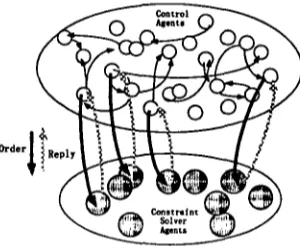
Figure 1: Agent-based System with the PSTFS
ing or semantic processing, are divided into sev- eral pieces which can be simultaneously com- puted by several agents.
Several parallel NLP systems have been de- veloped previously. But most of them have been neither efficient nor practical enough (Adriaens and Hahn, 1994). On the other hand, our PSTFS provides the following features.
• An efficient communication scheme for messages including Typed Feature Struc- tures (TFSs) (Carpenter, 1992).
• Efficient treatment of TFSs by an abstract machine (Makino et al., 1998).
Another possible way to develop parallel NLP systems with TFSs is to use a full concurrent logic programming language (Clark and Gre- gory, 1986; Ueda, 1985). However, we have ob- served that it is necessary to control parallelism in a flexible way to achieve high-performance. (Fixed concurrency in a logic programming lan- guage does not provide sufficient flexibility.) Our agent-based architecture is suitable for ac- complishing such flexibility in parallelism.
[image:1.612.355.505.222.345.2]C o n s t r a i n t S o l v e r Agent b e g i n - d e f i n i t i o n s
me" [FIRST F~a#~ ]
n a ( [.LAST Schlbevt J )"
, [FIRST J o h a ~ . ] ,
namer [LAST Bach J ]"
c o n c a t e n a t e . n a m e ( X , x = [FULL[LAST~IRST ~12[
[] j'
] ['5])
Y) iY = [FIRST 1 ~
[LAST 212.J
e n d - d e f i n l t l o n s
(A) Description of CSAs
A S T Sch*beTt J '
IRST J o h a . . ]
A S T Bach J '
~'ULL ]
g %T
]FULL (Joha*#, Bach) ]
~FIRST J o h a . . J
[LAST Bach
(C) Values of F and R d e H n e ¢Gontrol A g e n t # a m e - c o n c a f e ~ a l o r - s s b
When a message s.1¥e(z) arrives, d o the f o l l o w i n g s , S := C S A ~ s e l v o - c s n J t t a i n t ( c o n c a t e n a t e _ n a ~ e ( ~ , ?));
return S;
define #Gontrol A g e n t %ome.comcafe~ator
When a message selw arrives, d o the followings, R := O;
F := ( C S A ~= selve-©oastr,int(name(?)));
i := O; forall z E F d o
c r e a t e uarae-concat¢~atoT'-Rmb age~| J~f i;
N , ~= s*lve(x); i := i + 1;
forellend
for j := 0 to i d o
R := R U ( W a i t - l o r - r e s u l t ( J ~ f j ) ) ;
f o r e n d return 77.;
(B) Description of GAs
Figure 2: Example concatenate_name
2 P r o g r a m m e r s ' V i e w
From a programmers" point of view, the P S T F S mechanism is quite simple and natural, which is due to careful design for accomplishing high- performance and ease of progranmfing.
Systems to be constructed on our P S T F S will include two different types of agents:
• Control Agents (CAs)
• Constraint Solver Agents (CSAs)
As illustrated in Figure 1, CAs have overall control of a system, including control of par- allelism, and they behave as masters of CSAs. CSAs modify TFSs according to the orders from CAs. Note that CAs can neither modify nor generate TFSs by themselves.
P S T F S has been implemented by combin- ing two existing programming languages: the concurrent object-oriented programm, ng lan- guage A B C L / f (Taura, 1997) and the sequential p r o g r a m m i n g language LiLFeS (Makino et as., 1998). CAs can be written in A B C L / f , while description of CSAs can be mainly written in LiLFeS.
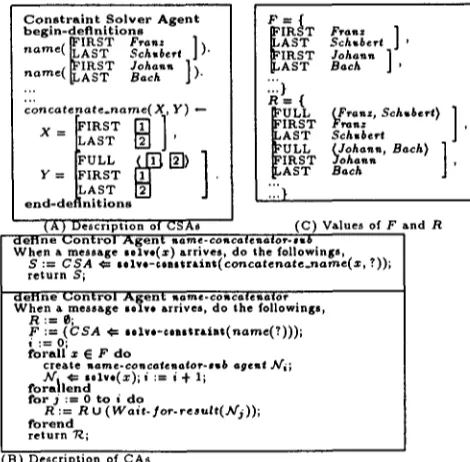
Figure 2 shows an example of a part of the P S T F S code. The task of this code is to con- catenate the first and the second name in a given list. One of t h e CAs is called name-
concatenator. This specific CA gathers pairs of
the first and last name by asking a CSA with the message s o l v e - c o n s t r a i n t ( ' n a m e ( ? ) ' ) . When the CSA receives this message, the argument
'name(?)' is treated as a Prolog query in
LiLFeS 1, according to the program of a CSA ((A) of Figure 2). There are several facts with the predicate 'name'. W h e n the goal 'name(?)'
is processed by a CSA, all the possible answers defined by these facts are returned. The ob- tained pairs are stored in the variable F in the
name-coneatenator ( ( C ) i n Figure 2).
The next behavior of the name-eoncatenator
agent is to create CAs (name-concatenator-
?F~) and to send t h e message s o l v e with a to each created CA running in parallel. The message contains one of the TFSs in F . Each name-concatenator-sub asks a CSA to con- catenate F I R S T and LAST in a TFS. T h e n each CSA concatenates t h e m using the defi- nite clause concatenate_name given in (A) of Figure 2. T h e result is returned to the name-
concatenator-sub which had asked to do the job.
Note that the name-concatenator-sub can ask any of the existing CSAs. All CSAs can basi- cally perform concatenation in parallel and in- dependent way. Then, the name-concatenator
waits for the name-concatenator-sub to return concatenated names, and puts t h e return val- ues into the variable R.
The CA name-concatenator controls the over- all process. It controls parallelism by creating CAs and sending messages to them. On tile other hand, all the operations on TFSs are per- formed by CSAs when they are asked by CAs.
Suppose that one is trying to implement a parsing system based oil PSTFS. The distinc- tion between CAs and CSAs roughly corre- sponds to the distinction between an abstract parsing schema and application of phrase struc- ture rules. Here, a parsing schema means a high-level description of a parsing algorithm in which the application of phrase structure rules is regarded as an atomic operation or a sub- routine. This distinction is a minor factor in writing a sequential parser, but it has a major impact on a parallel environment.
For instance, suppose that several distinct agents evoke applications of phrase structure rules against the same d a t a simultaneously, and the applications are accompanied with destruc- tive operations on the data. This can cause an anomaly, since the agents will modify the orig.- inal data in unpredictable order and there is no way to keep consistency. In order to avoid this anomaly, one has to determine what is an atomic operation and provide a m e t h o d to pre- vent the anomaly when atomic operations are evoked by several agents. In our framework, any action taken by CSAs is viewed as such an atomic operation and it is guaranteed that no anomaly occurs even if CSAs concurrently
[image:2.612.66.301.71.302.2]Local
Heapi~ii iiii ~!~iiiiiiiiii: ~ ...
S h a r e d H e a p A r e a
PSTFS
Figure 3: Inside of the P S T F S
perform operations on t h e same data. This can be done by introducing copying of TFSs, which does not require a n y destructive opera- tions. The details axe described in t h e next sec- tion.
T h e other implication of t h e distinction be- tween CAs and CSAs is t h a t this enables effi- cient communication between agents in a natu- ral way. During parsing in H P S G , it is possible t h a t TFSs with h u n d r e d s of nodes can be gen- erated. Encoding such TFSs in a message and sending them in an efficient way are not triv- ial. P S T F S provides a c o m m u n i c a t i o n scheme that enables efficient sending/receiving of such TFSs. This becomes possible because of the distinction of agents. In other words, since CAs cannot nmdify a TFS, CAs do not have to have a real image of TFSs. W h e n CSAs r e t u r n the results of computations to CAs, t h e CSAs send only an ID of a TFS. Only when t h e ID is passed to other CSAs and t h e y try to modify a T F S with the ID, t h e actual transfer of the T F S ' s real image occurs. Since the transfer is car- ried out only between CSAs, it can be directly performed using a low level representation of TFSs used in CSAs in an efficient m a n n e r . Note t h a t if CAs were to m o d i f y T F S s directly, this scheme could not have been used.
3 A r c h i t e c t u r e
This section explains t h e inner s t r u c t u r e of P S T F S focusing on the execution m e c h a n i s m of CSAs (See (Taura, 1997) for f u r t h e r detail on CAs). A CSA is i m p l e m e n t e d by modifying t h e a b s t r a c t machine for T F S s (i.e., LiAM), origi- nally designed for executing LiLFeS (Makino et al., 1998).
T h e i m p o r t a n t constraint in designing t h e ex- ecution mechanism for CSAs is t h a t TFSs gen- e r a t e d by CSAs must be kept unmodified. This is because t h e TFSs m u s t be used with several agents in parallel. If t h e TFS h a d been modi- fied by a CSA and if o t h e r agents did not know the fact, the expected results could not have been obtained. Note t h a t unification, which is
(i) Copying from shared heap
o" :ii ::i:. iiiii:.i ~i:.iii~ i ::!~4~ii' .::iii: ~:~ ~ ~ i i ~iii~ ~ ~!i i~l ~ i!~:~ :.:
Local Heap
Shared
Heap
:: :: ::.~ ~:i~iiii ii~?~ ii~ ii ! ~ ::if i::i;ii~i ~/~::.:::.!! ii i~iiii~i~ ~: ~ o .~.~ i~ii ii~i!! i~ ...
(ii) Computation on local heap
R
~
~
LocalHeapShared Heap
(iii) Write resulting TFSs to shared heap
Local Heap
Figure 4: O p e r a t i o n steps on P S T F S
a m a j o r operation on T F S s , is a destructive op- eration, and modifications are likely to occur while executing CSAs. Our execution mecha- nism handles this problem by letting CSAs copy T F S s g e n e r a t e d by o t h e r CSAs at each time. T h o u g h this m a y not look like an efficient w a y at first glance, it has been performed efficiently by shared m e m o r y mechanisms and our copying m e t h o d s .
A CSA uses two different types of m e m o r y areas as its heap:
• shared heap • local heap
A local heap is used for t e m p o r a r y operations during the c o m p u t a t i o n inside a CSA. A CSA cannot r e a d / w r i t e local heap of o t h e r CSAs. A shared heap is used as a m e d i u m of commu- nication b e t w e e n CSAs, and it is realized on a shared m e m o r y . W h e n a CSA completes a c o m p u t a t i o n on TFSs, it writes t h e result on a shared heap. Since t h e shared heap can be read by any CSAs, each CSA can read the re- sult performed by a n y o t h e r CSAs. However, t h e portion of a shared heap t h a t t h e CSA can write to is limited. A n y o t h e r CSA cannot write on t h a t portion.
[image:3.612.77.301.74.184.2] [image:3.612.326.538.75.357.2]Note t h a t the message only contains the IDs of the TFSs as described in the previous section. The IDs are realized as pointers on the shared heap.
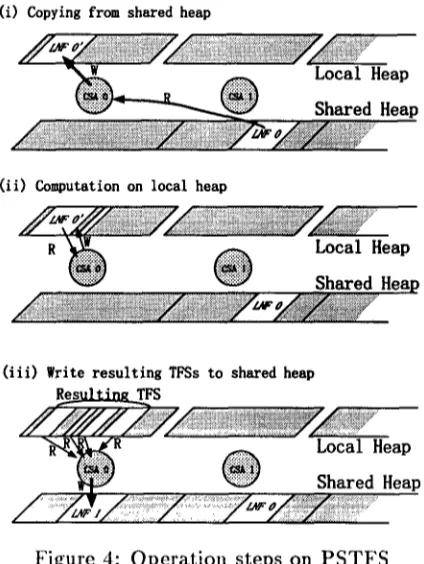
1. Copy TFSs pointed at by the IDs in the message from the shared heap to the local heap of the CSA. ((i) in Figure 4.)
2. Process a query using LiAM and the local heap. ((ii) in Figure 4.)
3. If a query has an answer, the result is copied to the portion of the shared heap writable by the CSA. Keep IDs on the copied TFSs. If there is no answer for the query, go to Step 5. ((iii) in Figure 4.)
4. Evoke backtracking in LiAM and go to Step 2.
5. Send the message, including the kept IDs, back to the CA that had asked the task.
Note that, in step 3, the results of the compu- tation becomes readable by other CSAs. This procedure has the following desirable features.
S i m u l t a n e o u s C o p y i n g An identical TFS on a shared heap can be copied by several CSAs simultaneouslv. This is due to our shared memory mecilanism and the prop- erty of LiAM that copying does not have any side-effect on TFSs 2.
S i m u l t a n e o u s / S a f e W r i t i n g CSAs can write on their own shared heap without the danger of accidental modification by other CSAs.
D e m a n d D r i v e n C o p y i n g As described in t h e previous section, the transfer of real images of TFSs is performed only after the IDs of the TFSs reach to the CSAs requir- ing the TFSs. Redundant copying/sending of the TFSs' real image is reduced, and the transfer is performed efficiently by mecha- nisms originally provided by LiAM.
W i t h efficient data transfer in shared-memory machines, these features reduce the overhead of parallelization.
Note that copying in the procedures makes it possible to support non-determinism in NLP systems. For instance, during parsing, interme- diate parse trees must be kept. In a chart pars- ing for a unification-based grammar, generated
2 A c t u a l l y , t h i s is n o t trivial. C o p y i n g in S t e p 3 n o r - m a l i z e s T F S s a n d s t o r e s t h e T F S s i n t o a c o n t i n u o u s re- gion o n a s h a r e d h e a p . T F S s s t o r e d in s u c h a way c a n be c o p i e d w i t h o u t a n y side-effect.
edges are kept untouched, and destructive oper- ations on the results must be done after copying them. The copying of TFSs in the above steps realizes such mechanisms in a natural way, as it is designed for efficient s u p p o r t for d a t a sharing and destructive operations on shared heaps by parallel agents.
4 A p p l i c a t i o n a n d P e r f o r m a n c e E v a l u a t i o n
This section describes two different types of HPSG parsers implemented on P S T F S . One is designed for our Japanese g r a m m a r and the al- gorithm is a parallel version of the CKY algo- rithm (Kasami, 1965). T h e other is a parser for an ALE-style G r a m m a r (Carpenter and Penn, 1994). The algorithms of b o t h parsers are based on parallel parsing algorithms for CFG (Ni- nomiya et al., 1997; Nijholt, 1994; Grishman and Chitrao, 1988; T h o m p s o n , 1994). Descrip- tions of both parsers are concise. Both of them are written in less than 1,000 lines. This shows that our PSTFS can be easily used. With the high performance of the parsers, this shows the feasibility and flexibility of our P S T F S .
For simplicity of discussion, we assume that HPSG consists of lexical entries and rule schemata. Lexical entries can be regarded as TFSs assigned to each word. A rule schema is a rule in the form of z --- a b e . . , where z. a. b. c are TFSs.
4.1 P a r a l l e l C K Y - s t y l e H P S G P a r s i n g A l g o r i t h m
A sequential CKY parser for CFG uses a data structure called a triangular table. Let Fi ~ de- note a cell in the triangular table. Each cell Fi,~
has a set of the non-terminal symbols in C F ~ that can generate the word sequence from the i + 1-th word to the j - t h word in an input sen- tence. The sequential CKY algorithm computes each Fi,j according to a certain order.
Our algorithm for a parallel CKY-style parser for HPSG computes each Fi,j in parallel. Note that Fi,j contains TFSs covering the word se- quence from the i + 1-th word to the j - t h word, not non-terminals. We consider only the rule schemata with a form of z ---* ab where
z , a , b are TFSs. Parsing is started by a CA
called PATCSCT¢. 7)ATiSCT¢ creates cell-agents
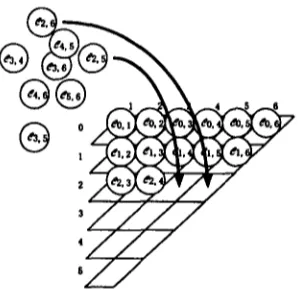
Ci,j(O <_ i < j <_ n) and distributes t h e m to pro-
cessors on a parallel machine (Figure 5). Each
Ci,j computes Fi,j in parallel. More precisely,
Ci,j(j - i = 1) looks up a dictionary and obtains
lexical entries. Ci,j(j - i > 1) waits for the mes- sages including Fi,k and Fk,j for all k(i < k < j )
from other cell-agents. W h e n Ci,j receives Fi,k
and Fk,jfor an arbitrary k, Ci,j computes TFSs
Figure 5: Correspondence between CKY matrix and agents:
Ci,j
correspond to the element of a CKY triangular matrixFi,k
andFkj.
T h e c o m p u t e d TFSs are consid- ered to be naothers of members ofFi,k
andFkj
and they are added to
Fi,j.
Note that these ap- plications of rule schemata are done in parallel in several CSAs 3. Finally. when computation ofFi
(usingFi k
and Fk j for allk(i
< k < j ) ) is completed, Ci, d]strlbutes • J . .Fi,
3 to other agents waiting forFij.
Parsing ]s completed when the computation of F0 n is completed.We have done a series of experiments on a shared-memory parallel machine, SUN Ultra Enterprise 10000 consisting of 64 nodes (each node is a 250 MHz UltraSparc) and 6 GByte shared memory. The corpus consists of 879 r a n d o m sentences from the E D R Japanese cor- pus written in Japanese (average length of sen- tences is 20.8) 4 . The g r a m m a r we used is an underspecified Japanese HPSG g r a m m a r (Mit- suishi et al., 1998) consisting of 6 ID-schemata and 39 lexical entries (assigned to functional words) and 41 lexical-entry-templates (assigned to parts of speech)• This g r a m m a r has wide cov- erage and high accuracy for real-world texts s.
Table 1 shows the result and comparison with a parser written in LiLFeS. Figure 6 shows its speed-up. From the Figure 6, we observe that the m a x i m u m speedup reaches up to 12.4 times. The average parsing time is 85 msec per
3CSAs cannot be added dynamically in our imple- mentation. So, to gain the m a x i m u m parallelism, we assigned a CSA to each processor. Each
Cij
asks the CSA on the same processor to apply rule schemata.4We chose 1000 random sentences from the E D R Japanese corpus, and the used 897 sentences are all the parsable sentences by the grammar.
5This grammar can generate parse trees for 82% of 10000 sentences from the E D R Japanese corpus and the dependency accuracy is 78%.
N u m b e r o I I A v ~ of P a r s i n g T i m e ( m s e c ) P r o c e s s o r s I P S T F S I L i L F e S
2 4 8 2 0 1 3 8 3 0 1 0 6 4 0 9 3 5 0 8 5
6 0 135
Table 1: Average parsing time per sentence
Speed-up
14
12
I 0
8
6
4
2
0
,,I
/
. /
i i i i i
10 20 30 40 50
# o f W o c e s s o r l
Figure 6: Speed-up of parsing time on parallel CKY-style HPSG parser
s e n t e n c e 6 •
4.2 C h a r t - b a s e d P a r a l l e l H P S G P a r s i n g A l g o r i t h m for A L E
G r a m m a r
Next, we developed a parallel chart-based HPSG parser for an ALE-style grammar. T h e algorithm is based on a chart schema on which each agent throws active edges and inactive edges containing a TFS. When we regard the rule schemata as a set of rewriting rules in CFG, this algorithm is exactly t h e same as the T h o m p s o n ' s algorithm (Thompson, 1994) and similar to PAX (Matsumoto, 1987). T h e main difference between the chart-based parser and our CKY-style parser is that t h e ALE-style parser supports a n-branching tree.
A parsing process is started by a CA called
P.AT~S£T~.
It .createsword-position agents
:Pk(0 < k < n), distributes t h e m to parallel processors and waits for t h e m to complete their tasks. The role of the
word-position agent Pk
[image:5.612.112.261.76.221.2] [image:5.612.351.541.76.133.2] [image:5.612.333.523.187.334.2]~ h o r t L e n g t h ~ e n t e n c e s / i / k i m beli . . . a n d y to w a l k
a p e r s o n w h o m h e s e e s w a l k s h e is s e e n
he p e r s u a d e s h e r to walk D o n n L e n g t h ~ e n t e n c e s
( I ) e. p e r s o n w h o s e e s k l m w h o sees s a n d y w h o m h e t r i e s to s e e walks
( 2 ) a p e r s o n w h o s e e s k i m w h o s e e s s a n d y w h o s e e s k i m w h o m h e tries t o s e e walks
(3) a p e r s o n w h o sees k i m w h o s e e s s a n d y w h o sees k i m w h o b e l i e v e s h e r t o t e n d to w a l k walks
Table 2: Test corpus for parallel ALE-style HPSG parser
~ h o r t L e n g t h ~ e n t e n c e s " ~ u m b e r of A v g . of P a r s i n g T l m e ( m s e c )
P r o c e s s o r s P S T F S ] LiLFeS ] A L E
10 160
20 156
30 127
40 205
50 142
60 170
~ o n ~ L e n g t h S e n t e n c e s N u m b e r o[ A v g . of ParsinK T l m e ~ m s e c ) P r o c e s s o r s P S T F S I LiLFeS l A L E
110 1~013208 308~7 ~ 3 7 U
20 2139
30 1776
40 1841
50 1902
6 0 2052
is to collect edges adjacent to the position k.
A word-position agent has its own active edges
and inactive edges. An active edge is in the form
( i , z --. A o x B ) , where A is a set of TFSs which
have already been unified with an existing con- stituents, B is a set of TFSs which have not been unified yet, and x is the TFS which can be unified with t h e constituent in an inactive edge whose left-side is in position k. Inactive edges are in the form ( k , x , j ) , where k i s the left-side position of the constituent x and j is the right- side position of the constituent x. T h a t is, the set of all inactive edges whose left-side position is k are collected by T'k.
In our algorithm, ~k is always waiting for ei- ther an active edge or an inactive edge, and per- forms the following procedure when receiving an edge.
• When Pk receives an active edge (i,z - -
A o x B ) , 7-)k preserve the edge and tries to
find the unifiable constituent with x from the set of inactive edges that :Pk has already received. If the unification succeeds, a new active edge (i,z ~ A x o B) is created. If the dot in the new active edge reaches to the end of RHS (i.e. B = 0), a new inactive edge is created and is sent to :Pi. Otherwise the new active edge is sent to :Pj.
• When Pk receives an inactive edge (k, x , j ) ,
:Pk preserves the edge and tries to find the unifiable constituent on the right side of the dot from the set of active edges that :Pk has already received. If the unification succeeds, a new active edge (i, z ---, A x o B)
is created. If the dot in the new active edge reaches to the end of RHS (i.e. B = 0), a new inactive edge is created and is sent to
7:)i. Otherwise the new active edge is sent
t o ~Oj.
As long as word-position-agents follow these behavior, they can run in parallel without any other restriction.
We have done a series of experiments in the same machine settings as the experiments with
Table 3: Average parsing time per sentence
Speed-up
12
10
!
0 ~
0 ,0 2 0 of P ~ . . . . 2 0 50 80
Figure 7: Speed-up of parsing time on chart- based parallel HPSG parser
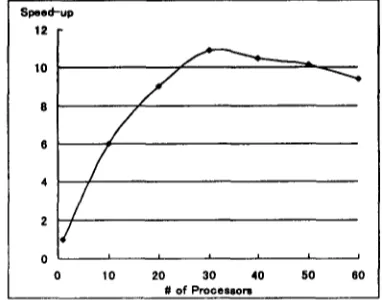
the CKY-style HPSG parser. We measured both its speed up and real parsing time, and we compared our parallel parser with the ALE system and a sequential parser on LiLFeS. T h e g r a m m a r we used is a sample HPSG g r a m m a r attached to A L E system 7, which has 7 schemata and 62 lexical entries. The test corpus we used in this experiment is shown in the Table 2. Results and comparison with other sequen- tial parsing systems are given in Table 3. Its speedup is shown in Figure 7. From the figure, we observe t h a t the m a x i m u m speedup reaches up to 10.9 times and its parsing time is 1776 msec per sentence.
4.3 D i s c u s s i o n
In both parsers, parsing time reaches a level required by real-time applications, though we used computationally expensive g r a m m a r for- malisms, i.e. HPSG with reasonable coverage and accuracy. This shows the feasibility of our
[image:6.612.345.499.77.198.2] [image:6.612.67.293.81.159.2] [image:6.612.325.516.253.403.2]P ~ I D 4 0 - - 3 0
2 0
1 0 0
P r o c e s s o r Status
_ = - - -
.=_....-_
. .
- . -=-- : _ _ - - - - . _ _ _ - - . ~ -
. : _ . . - - . . - - Swizch
. ~ : - _ _---.--.
: . . . ~ . . . . - . . o
- - - - : - - ~ : . - - - _:_. |
~ . . m -
I r I I
616,12 616.14 616.16 616.18 ( 8 4 C )
Figure 8: Processors status
framework for the goal to provide a parallel pro- gramming environment for real-time NLP. In addition, our parallel HPSG parsers are con- siderably more efficient than other sequential HPSG parsers.
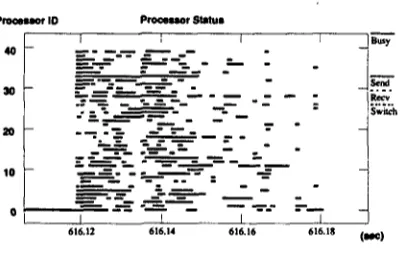
However, the speed-up is not proportional to the number of processors. We think that this is because the parallelism extracted in our parsing algorithm is not enough. Figure 8 shows the log of parsing Japanese sentences by the CKY-style parser. The black lines indicate when a proces- sor is busy. One can see that many processors are frequently idle.
We think that this idle time does not sug- gest that parallel NLP systems are useless. On the contrary, this suggest that parallel NLP sys- tems have many possibilities. If we introduce semantic processing for instance, overall pro- cessing time may not change because the idle time is used for semantic processing. Another possibility is the use of parallel NLP systems as a server. Even if we feed several sentences at a time, throughput will not change, because the idle time is used for parsing different sentences. 5 C o n c l u s i o n a n d F u t u r e W o r k
We described PSTFS, a substrate for parallel processing of typed feature structures. PSTFS serves as an efficient programming environment for implementing parallel NLP systems. We have shown the feasibility and flexibility of our PSTFS through the implementation of two HPSG parsers.
For the future, we are considering the use of our HPSG parser on PSTFS for a speech recog- nition system, a Natural Language Interface or Speech Machine Translation applications.
R e f e r e n c e s
Adriaens and Hahn, editors. 1994.
Parallel
Natural Language Processing.
Ablex Publish-ing Corporation, New Jersey.
Bob Carpenter and Gerald Penn. 1994. ALE 2.0 user's guide. Technical report, Carnegie Mellon University Laboratory for Computa- tional Linguistics, Pittsburgh, PA.
Bob Carpenter. 1992.
The Logic of Typed Fea-
ture Structures.
Cambridge University Press,Cambridge, England.
K. Clark and S. Gregory. 1986. Parlog: Parallel programming in logic.
Journal of the A CM
Transaction on Programming Languages and
Syste ms,
8 ( 1):1-49.Ralph Grishman and Mehesh Chitrao. 1988. Evaluation of a parallel chart parser. In
Pro-
ceedings of the second Conference on Applied
Natural Language Processing,
pages 71-76.Association for Computational Linguistics. T. Kasami. 1965. An efficient recognition and
syntax algorithm for context-free languages. Technical Report AFCRL-65-758, Air Force Cambrige Research Lab., Bedford, Mass. Takaki Makino, Minoru Yoshida, Kentaro Tori-
sawn, and Jun'ichi Tsujii. 1998. LiLFeS - - towards a practical HPSG parser. In
COLING-A CL '98 Proceedings,
August.Yuji Matsumoto. 1987. A parallel parsing sys- tem for natural language analysis. In
Proceed-
ings of 3rd International Conference on Logic
Programming,
pages 396-409.Yutaka Mitsuishi, Kentaro Torisawa, and Jun'ichi Tsujii. 1998. HPSG-style underspec- ified Japanese grammar with wide coverage.
In
COLING-A CL'98 Proceedings,
August.Anton Nijholt, 1994.
Parallel Natural Language
Processing,
chapter Parallel Approaches toContext-Free Language Parsing, pages 135- 167. Ablex Publishing Corporation.
Takashi Ninomiya, Kentaro Torisawa, Kenjiro Taura, and Jun'ichi Tsujii. 1997. A par- allel cky parsing algorithm on large-scale distributed-memory parallel machines. In
PACLING '97,
pages 223-231, September.Kenjiro Taura. 1997.
Efficient and Reusable
Implementation of Fine-Grain Multithread-
ing and Garbage Collection on Distributed-
Memory Parallel Computers.
Ph.D. thesis,Department of Information Sciencethe, Uni- versity of Tokyo.
Henry S. Thompson, 1994.
Parallel Natural
Language Processing,
chapter Parallel Parsersfor Context-Free Grammars-Two Actual Im- plementations Comparesd, pages 168-187. Ablex Publishing Corporation.
[image:7.612.85.288.75.208.2]