Benchmark Databases for Video-Based Automatic Sign Language Recognition
Philippe Dreuw
1, Carol Neidle
2, Vassilis Athitsos
3, Stan Sclaroff
2, and Hermann Ney
11RWTH Aachen University, Aachen, Germany
2Boston University, Boston, MA, USA
3University of Texas, Arlington, TX, USA
Abstract
A new, linguistically annotated, video database for automatic sign language recognition is presented. The new RWTH-BOSTON-400 corpus, which consists of 843 sentences, several speakers and separate subsets for training, development, and testing is described in detail. For evaluation and benchmarking of automatic sign language recognition, large corpora are needed. Recent research has focused mainly on isolated sign language recognition methods using video sequences that have been recorded under lab conditions using special hardware like data gloves. Such databases have often consisted generally of only one speaker and thus have been speaker-dependent, and have had only small vocabularies. A new database access interface, which was designed and created to provide fast access to the database statistics and content, makes it possible to easily browse and retrieve particular subsets of the video database. Preliminary baseline results on the new corpora are presented. In contradistinction to other research in this area, all databases presented in this paper will be publicly available.
1.
Introduction
Currently available sign language video databases were cre-ated for linguistic purposes or gesture recognition using small vocabularies. Most databases used in sign language processing so far do not provide or include what is impor-tant for the evaluation of sign language processing algo-rithms (Bowden et al., 2004; Martinez et al., 2002). An overview of available language resources for sign language processing and especially recognition is presented in (Za-hedi et al., 2006). Recently an Irish sign language database has been released (Stein et al., 2007). Here we focus on benchmark databases that can be used for investigating lin-guistic problems, and evaluating automatic sign language recognition systems or statistical machine translation sys-tems.
The National Center for Sign Language and Gesture Re-sources at Boston University has published an expanding database of American Sign Language (ASL). Dreuw and colleagues from the RWTH Aachen University created sev-eral subsets for the evaluation of isolated and continuous sign language recognition: BOSTON-50, RWTH-BOSTON-104, and the new RWTH-BOSTON-400 (see Section 4.). The new RWTH-BOSTON-400 is the largest publicly available benchmark corpus for video-based con-tinuous sign language recognition. It contains 843 sen-tences, several speakers, and separate splits for training, development, and testing of automatic sign language recog-nition systems.
The RWTH-BOSTON-400 database is created from a subset of the larger data set available through Boston Uni-versity. The BU ASL corpus has been used previously in evaluation of computer vision and pattern recognition methods, including detection of head gestures (Erdem and Sclaroff, 2002), recognition of facial expressions (Vogler and Goldenstein, 2007), hand tracking and recognition of hand shapes and movements (Vogler and Metaxas, 2004; Yuan et al., 2005; Dreuw et al., 2006), as well as
catego-rization of signs (Zahedi et al., 2005; Tsechpenakis et al., 2006). Both data sets can be used for the training and eval-uation of sign language recognition algorithms, as well as development and testing of human-machine interface ap-proaches, data mining, etc. Since the data sets include an-notations of non-manual gestures and movements that are integral to sign language, these data sets could also be used as a resource for investigating correlations, temporal rela-tions, and alignments across manual and non-manual ges-tural channels.
2.
Multimodal Resources for ASL
The National Center for Sign Language and Gesture Re-sources (NCSLGR) at Boston University1 has been
en-gaged in the collection of ASL data (including sets of in-dividual utterances, narratives, and dialogues) from Deaf native signers. The NCSLGR makes available high-quality video files showing the signing from multiple angles, in-cluding a close-up of the face, in a variety of video formats, along with linguistic annotations that have been carried out in conjunction with the American Sign Language Linguis-tic Research Project (ASLLRP) at Boston University, us-ing SignStreamTM (Neidle et al., 2001; Neidle, 2002a)2.
The annotations, available as SignStreamTM files and in
XML format, include indication of the start and end points of linguistically significant behaviors, including individual signs, produced by the hands and arms, and facial gestures (e.g., eyebrow position, eye aperture) and head movements (including nods and shakes) that have grammatical signif-icance3. The annotation conventions are documented in
1
http://www.bu.edu/asllrp/cslgr/
2
A Macintosh Classic application designed by this group to facilitate linguistic analysis of visual language data. A Java reim-plementation currently underway will contain many new features, including tools for fine-grained phonological annotation.
3
Table 1: RWTH-BOSTON-104 corpus statistics
Training Evaluation
sentences 161 40
running words 710 178
vocabulary 103 65
singletons 27 9
OOV - 1
images 12422 3324
Table 2: RWTH-BOSTON-400 person statistics for train-ing set
speaker name segments time [sec]
Ben 90 283.3s
Norma 142 375.267s
Mike 364 1219.77s
Lana 37 162.367s
It consists of 50 isolated words (83 distinct words when pronunciation information is included), 483 word utter-ances, and 2 speakers (1 female, 1 male).
4.2. RWTH-BOSTON-104
Recently, this database has been extended by Dreuw and colleagues with pronunciation information (see Sec-tion 5.2.), and has been used successfully for continu-ous sign language recognition experiments (Dreuw et al., 2007a). The corpus statistics and language model perplex-ities are shown in Table 1 and Table 4.
4.3. RWTH-BOSTON-400
Many different information tiers that are of interest for lin-guistic research are available in the database XML annota-tions. From the recognition point of view, we have focused so far on only two field ids in order to build a subset which can be used for automatic recognition and statistical ma-chine translation, namely the main glossfield (id=10000) and the English translation field (id=20001) (see Listing 1). The complete corpus currently contains 843 sentences in total and is divided into 633 train sentences, 106 develop-ment sentences, 104 evaluation sentences. There are 7768 running words, where the main vocabulary has a size of 406 words without pronunciation information (i.e. the main evaluation tokens) (see Table 3).
There are four signers who occur in the video database: 2 male speakers account for 454 segments, and 2 female speakers account for 179 segments (see Table 2).
Table 3: RWTH-BOSTON-400 corpus statistics
Training Development Evaluation
sentences 633 106 104
running words 5733 678 589
vocabulary 483 74 36
singletons 217 10 2
OOV - 7 0
images 49486 10016 9053
τ= 15 τ= 20
Figure 1: Sample frames of the RWTH-BOSTON-Hands database with annotated hand positions. Left and right hand are marked with red and blue circles respectively. The last image shows different tolerance radiiτ= 15andτ= 20.
4.4. RWTH-BOSTON-Hands
For the evaluation of hand tracking methods in sign lan-guage recognition systems a database has been prepared. The RWTH-BOSTON-Hands database is of a subset of the RWTH-BOSTON-104 videos with additional annotation of the signer’s hand positions. The positions of both hands have been annotated manually in 15 videos. 1119 frames in total are annotated.
5.
System Overview & Features
We give a short overview of the recognition framework and the used features presented in (Dreuw et al., 2007a).5.1. Visual Modeling
Phonological analysis going back to (Stokoe et al., 1965) has revealed that signs are made up out of basic articula-tory units, initially referred to as cheremes by Stokoe, now commonly calledphonemesbecause of their similarity with the discriminatory units that compose words in spoken lan-guages.
Signs are generally decomposed analytically for pur-poses of linguistic analysis into hand shape, orientation, place of articulation, and movement (with important lin-guistic information also conveyed through non-manual ges-tures, i.e., facial expressions and head movements).
However, it is still unclear how best to approach recogni-tion of these articulatory parameters. Although phonemes in spoken language are sequential, notwithstanding co-articulation effects, in signed languages phonemes are re-alized simultaneously. The hand is simultaneously in a par-ticular configuration, orientation, and location as it under-goes movement. The recognition of (linguistic) phonemes could be possible in a multi-channel approach, where the correct and combined alignment of the independent sys-tems remains a challenge. Here we focus on the recognition of the main stream only. For this reason, we have relied on glossesin the annotations, i.e., whole-word transcriptions, and the system is based on whole-word models.
Each word model consists of a temporal division into one to threepseudo-phonemesmodeling the average word length seen in training. Each pseudo-phoneme is mod-eled by a 3-state left-to-right hidden Markov model (HMM) with three separate Gaussian mixtures (GMM) and a glob-ally pooled covariance matrix.
32×32 pixels serve as good basic features for many image recognition problems, and have already been successfully used for gesture recognition.
They give a global description of all (manual and non-manual) features that have been shown to be linguistically important. The baseline system is Viterbi trained and uses a trigram LM (c.f. Section 5.3.).
Manual Features. To extract manual features, the domi-nant hand (i.e., the hand that is mostly used for one-handed signs and as finger spelling) is tracked in each image se-quence. Given the hand position ut = (x, y)at time t
in signing space, features such as hand velocity mt = ut−ut−δ can easily be extracted. The hand trajectory
features (Dreuw et al., 2007a) are similar to the features presented in (Vogler and Metaxas, 2001).
5.2. Pronunciation Handling
Signed languages exhibit dialectal variation comparable to that found in spoken languages. Thus, one may find signs quite different from one another (in all aspects of their ar-ticulation, including potentially duration) used by different signers with comparable meanings. For example, there are 5 different dialectal variants for “bread” used in Switzer-land, and as many different ASL signs for “birthday” used in America.
It is also possible that a given sign may be produced with variations in articulation. For example,GIVE,(2h)GIVE,
(2h)alt.GIVE: Each of these signs differ in shape or articulation, and should have a unique gloss model. Due to the relatively large vocabulary with many singleton ob-servations, we put words with variations in articulation but with same meaning into the same evaluation class (i.e., they will have the same evaluation token). This helps us to es-timate better language models and reduces the perplexity (see Section 5.3.).
Other problematic sources of variation include the natu-ral variation that occurs for an individual speaker in mul-tiple productions of the same sign, resulting sometimes from differences in linguistic context (giving rise to differ-ent co-articulation effects), speed of speech, slight variants in handshape allowed for particular signs, etc.
Small differences between the appearance and the length of the utterances are compensated for by the HMMs, but different pronunciations of a sign must be modeled by sep-arate models, i.e. a different number of states and GMMs.
5.3. Language Models
A trigram LM was trained on the main gloss annotations of the training corpora using the SRILM toolkit (Stolcke, 2002) with modified Kneser-Ney discounting with interpo-lation.
As explained in Section 4.3. for the RWTH-BOSTON-400 database, we train 483 word classes but we have only 400 evaluation tokens due to different pronunciations. Therefore, we have only a perplexity (P P) of 400 for a zerogram LM in Table 5, as the pronunciations are not con-sidered in LM training (i.e. only the evaluation tokens, see Section 5.2.). A small perplexity corresponds to strong lan-guage model restrictions.
Table 4: RWTH-BOSTON-104 language model perplexi-ties
LM type TestP P
zerogram 106.0 unigram 36.8
bigram 6.7
trigram 4.7
Table 5: RWTH-BOSTON-104 language model perplexi-ties
LM type DevelopmentP P TestP P
zerogram 400 400
unigram 63.4 50.9
bigram 32.3 26.2
trigram 30.1 25.1
6.
Experimental Results
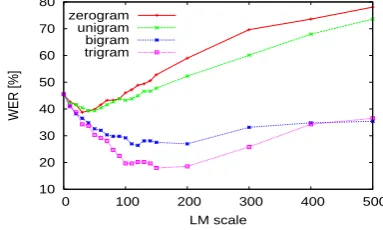
For the recognition of isolated signs we used the RWTH-BOSTON-50 database, where the currently best known word-error-rate of 17.2% WER has been reported in (Za-hedi et al., 2005). Figure 2 shows the effect of using dif-ferentn-gram language models and scales on the RWTH-BOSTON-104 database (Dreuw et al., 2007a). As in ASR, the language model adaptation by using sign language pronunciations achieves large improvements (the currently best known word-error-rate is 17.8% WER). Interestingly, the improvement factors achieved are similar to those from speech recognition (Klakow and Peters, 2002). Prelimi-nary results for statistical machine translation on the rec-ognizer output have been presented in (Stein et al., 2007). We achieve a 2.30% tracking error rate for a 20×20 search window on the RWTH-BOSTON-Hands database (Dreuw et al., 2006).
Movement epenthesis refers to movements that occur in natural sign languages when the location in the signing space changes between one sign and the next. In this work, Dreuw et al. added special labels in the RWTH-BOSTON-400 database for some of the movements that can occur in between signs (e.g.[UP],[DOWN],[SILENCE]) and also noted[HOLD]). Special care must be taken for LM handling of such movements, as they can be important in-dicators; for example, there is often a [HOLD] with the
10 20 30 40 50 60 70 80
0 100 200 300 400 500
WER [%]
LM scale zerogram
unigram bigram trigram
final sign in a question. Furthermore, sentence bound-aries and unknown words are also labeled and handled by (Kneser and Ney, 1995) discounting with interpolation in the LM. Preliminary results for movement epenthesis in an-other subset of the database have been presented in (Yang et al., 2007).
With pronunciation information, movement epenthesis information, and sentence boundary information, the vo-cabulary to be trained consists of 482 words.
In training, 475 words from the complete vocabulary are trained, which results in an out-of-vocabulary (OOV) rate of 7 words. These words cannot be recognized using a whole-word model approach. After pronunciation handling in the training and recognition lexicon, we have in total 23 OOVs in the development corpus and 0 OOV words in the evaluation corpus.
For training the models, it is important to have a one-to-one correspondence between sign production and gloss. Encoding of pronunciation information makes it possible to distinguish variants. For the earlier RWTH-BOSTON-104 corpus annotations, Dreuw and colleagues added pronunci-ation informpronunci-ation to the (preliminary version of the) Boston annotations and adapted the language models accordingly (Dreuw et al., 2007a). The new RWTH-BOSTON-400 cor-pus makes use of the newly released, fully verified, Boston NCSLGR annotations (Neidle, 2002b; Neidle, 2007). (The final verification of those annotations took some time, largely because of the importance of enforcing such one-to-one sign-gloss correspondences.)
Preliminary results on the large RWTH-BOSTON-400 database showed a couple of problems. One of the first steps in setting up an ASLR system from scratch is the start-stop silence detection and linear segmentation of the sentences in order to initialize the models to be trained. It turned out that opposed to ASR, where usually the en-ergy of the audio signal is used for silence detection in the sentences (i.e. the corresponding motion in a video signal), new features and models will have to be defined for silence detection in sign language recognition. Silence cannot be detected by simply analyzing motion in the video, because words can be signed by just holding a particular posture in the signing space. A thorough analysis and a reliable detection of silence in general and sentence boundaries in particular are important to reliably speed up and automate the training process in order to improve the recognition per-formance.
Furthermore, there is also the issue of canonically one-handed vs. two-one-handed signs sometimes being produced with a non-canonical number of hands. Due to the lack of data, not all pronunciation models can be robustly es-timated. In terms of recognition performance or word er-ror rates, the confusion between such a one-handed version and a two-handed version would cause a substitution error, which can be suppressed by the use of evaluation tokens (c.f. Section 5.2.): the confusion of signs of the same class (i.e. meaning) are not considered as an error.
For signs that are normally produced as one-handed but that may also have two-handed realizations (or vice versa: canonically two-handed signs that may sometimes be pro-duced with only 1 hand), the one-handed and two-handed
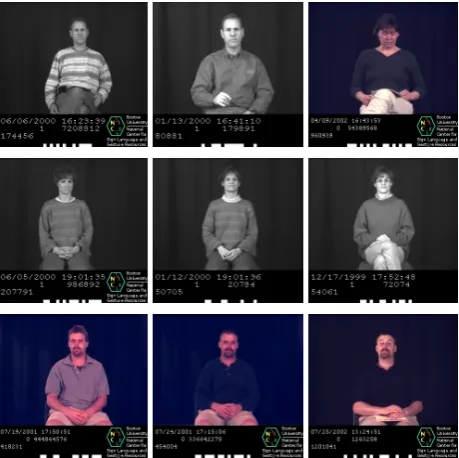
Figure 3: Example of the four speakers: due to the differ-ent clothing (short sleeves, long sleeves, glasses, etc.) and camera setups, nine speaker setups have to be handled in the RWTH-BOSTON-400 database.
versions can be trained independently, but use a common evaluation token.
Another problem arises from the increased number of speakers and different environment setups: the usage of appearance-based full-body features for a baseline system as proposed in (Dreuw et al., 2007a) is of course lim-ited to either many training examples or similar appearance of the speaker. Opposed to the simpler speaker setup of the RWTH-BOSTON-104 with only 3 speaker setups, we have to deal with at least 9 speaker setups in the RWTH-BOSTON-400 database (see Figure 3).
7.
Summary & Conclusion
The largest publicly available benchmark corpus for con-tinuous sign language recognition was presented. Promis-ing results on the publicly available benchmark database RWTH-BOSTON-104 have been achieved for automatic recognition (Dreuw et al., 2007a) and translation (Dreuw et al., 2007b; Stein et al., 2007) that can be used as baseline reference for other researchers. However, the preliminary results on the larger RWTH-BOSTON-400 database show the limitations of the proposed framework and the need for better visual features and models.
In the future, the new database access will be used to further enrich the RWTH-BOSTON-400 annotations, and will open up the path to multiple stream processing (i.e. the independent recognition of hands, faces, body, ...) with a late fusion of the independent systems.
With the new database access interface it will be easier in the future to provide further benchmark subsets focussing on different problems in automatic recognition (such as speaker independence or part of speech tagging).
and which additional features, pronunciations, speaker or language model adaptations can remedy certain problems.
There is also an ongoing effort at Boston University to create a video sign lexicon with over 3,000 signs (including most of those contained in (Valli, 2006)), as produced by multiple signers. These video examples will be added to the corpus publicly accessible through the DAI. Our goal for the longer term is to enhance the DAI interface to sup-port searches based on linguistic properties of signs, such as hand shape, once linguistic annotations including such information become available. Another potential enhance-ment to the DAI would be to support “query by example”, where a user-provided video clip of a sign can be used to retrieve similar items (or utterances that contain similar items). Thus, the research in computer vision sign language recognition could be used to enhance the DAI search capa-bilities.
8.
References
R. Bowden, D. Windridge, T. Kadir, A. Zisserman, and M. Brady. 2004. A linguistic feature vector for the vi-sual interpretation of sign language. InEuropean Conf. Computer Vision, volume 1, pages 390–401.
P. Dreuw, T. Deselaers, D. Rybach, D. Keysers, and H. Ney. 2006. Tracking using dynamic programming for appearance-based sign language recognition. In IEEE Intl. Conf. on Automatic Face and Gesture Recognition, pages 293–298, Southampton, April.
P. Dreuw, D. Rybach, T. Deselaers, M. Zahedi, and H. Ney. 2007a. Speech recognition techniques for a sign lan-guage recognition system. In Interspeech 2007, pages 2513–2516, Antwerp, Belgium, August. ISCA best stu-dent paper award of Interspeech 2007.
P. Dreuw, D. Stein, and H. Ney. 2007b. Enhancing a sign language translation system with vision-based fea-tures. InInternational Workshop on Gesture in Human-Computer Interaction and Simulation, pages 18–20, Lis-bon, Portugal, May.
U. M. Erdem and S. Sclaroff. 2002. Automatic detection of relevant head gestures in American Sign Language com-munication. InInternational Conf. on Pattern Recogni-tion (ICPR), volume 1, pages 460–463.
D. Klakow and J. Peters. 2002. Testing the correlation of word error rate and perplexity. Speech Communication, 38:19–28.
R. Kneser and H. Ney. 1995. Improved backing-off form -gram language modeling. In IEEE ICASSP, volume 1, pages 49–52, Detroit, MI.
A. M. Martinez, R. B. Wilbur, R. Shay, and A. C. Kak. 2002. Purdue RVL-SLLL ASL database for Automatic Recognition of American Sign Language. InIEEE Int. Conf. on Multimodal Interfaces, Pittsburg, PA, USA, Oc-tober.
C. Neidle, S Sclaroff, and V. Athitsos. 2001. SignstreamTM: A tool for linguistic and computer vision research on visual-gestural language data. Be-havior Research Methods, Instruments, and Computers, 3(33):311–320.
C. Neidle. 2002a. SignstreamTM: A database tool for
re-search on visual-gestural language. Journal of Sign Lan-guage and Linguistics, 1/2(4):203–214.
C. Neidle. 2002b. SignstreamTMannotation: Conventions
used for the American Sign Language Linguistic Re-search Project. Technical Report 11, Boston University. C. Neidle. 2007. SignstreamTMannotation: Addendum to
conventions used for the American Sign Language Lin-guistic Research Project. Technical Report 13, Boston University, August.
D. Stein, P. Dreuw, H. Ney, S. Morrissey, and A. Way. 2007. Hand in hand: Automatic sign language to speech translation. In 11th Conference on Theoretical and Methodological Issues in Machine Translation (TMI-07), pages 214–220, Sk¨ovde, Sweden, September.
W. Stokoe, D. Casterline, and C. Croneberg. 1965. A Dic-tionary of American Sign Language on Linguistic Prin-ciples. Gallaudet College Press, Washington D.C., USA. A. Stolcke. 2002. SRILM - an extensible language model-ing toolkit. InICSLP, volume 2, pages 901–904, Denver, CO, September.
G. Tsechpenakis, D. Metaxas, and C. Neidle. 2006. Learning-based dynamic coupling of discrete and contin-uous trackers. Computer Vision and Image Understand-ing, 104(2-3):140–156, December.
C. Valli, editor. 2006. The Gallaudet Dictionary of Amer-ican Sign Language. Gallaudet U. Press, Washington, DC, USA.
C. Vogler and S. Goldenstein. 2007. Facial movement analysis in ASL. Springer Journal on Universal Access in the Information Society, page to appear.
C. Vogler and D. Metaxas. 2001. A framework for rec-ognizing the simultaneous aspects of American Sign Language. Computer Vision & Image Understanding, 81(3):358–384, March.
C. Vogler and D. Metaxas. 2004. Handshapes and move-ments: Multiple-channel ASL recognition. Springer Lecture Notes in Artificial Intelligence, (2915):247–258. R. Yang, S. Sarkar, and B. Loeding. 2007. Enhanced level building algorithm for the movement epenthesis problem in sign language recognition. In Computer Vision and Pattern Recognition.
Q. Yuan, S. Sclaroff, and V. Athitsos. 2005. Automatic 2d hand tracking in video sequences. InIEEE Workshop on Applications of Computer Vision.