Computational Linguistics and Chinese Language Processing
Vol. 18, No. 4, December 2013, pp. 31-44 31 The Association for Computational Linguistics and Chinese Language Processing
Correcting Serial Grammatical Errors based on
N-grams and Syntax
Jian-cheng Wu
, Jim Chang
, and Jason S. Chang
Abstract
In this paper, we present a new method based on machine translation for correcting serial grammatical errors in a given sentence in learners’ writing. In our approach, translation models are generated to translate the input into a grammatical sentence. The method involves automatically learning two translation models that are based on Web-scale n-grams. The first model translates trigrams containing serial preposition-verb errors into correct ones. The second model is a back-off model, used in the case where the trigram is not found in the training data. At run-time, the phrases in the input are matched and translated, and ranking is performed on all possible translations to produce a corrected sentence as output. Evaluation on a set of sentences in a learner corpus shows that the method corrects serial errors reasonably well. Our methodology exploits the state-of-the art in machine translation, resulting in an effective system that can deal with many error types at the same time.
Keywords: Grammatical Error Correction, Serial Errors, Machine Translation, N-grams, Language Model
1.
Introduction
Many people are learning English as a second or foreign language: it is estimated there are 375 million English as a Second Language (ESL) and 750 million English as a Foreign Language (EFL) learners around the world, according to Graddol (2006). Three times as many people speak English as a second language as there are native speakers of English. Nevertheless, non-native speakers tend to make many kinds of errors in their writing, due to the influence of their native languages (e.g., Chinese or Japanese). Therefore, automatic grammar checkers are needed to help learners improve their writing. In the long run, automatic grammar checkers also can help non-native writers learn from the corrections and
Correcting Serial Grammatical Errors based on N-grams and Syntax 33
We present a new system that automatically generates a statistical machine translation model based on a trigram containing a word followed by preposition and verb or by an infinitive in web-scale n-gram data. At run-time, the system generates multiple possible trigrams by changing a word’s lexical form and preposition in the original trigram. Example trigrams generated for “difficulty to understand” are shown in Figure 1. The system then ranks all of these generated sentences and use the highest ranking sentence as suggestion.
The rest of the paper is organized as follows. We review the related work in the next section. Then, we describe our method for automatically learning to translate a sentence that may contain preposition-verb serial errors into a grammatical sentence (Section 3). In our evaluation, we describe how to measure the precision and recall of producing grammatical sentences (Section 4) in an automatic evaluation (Section 5) over a set of marked sentences in a learner corpus.
2.
Related Work
Grammatical Error Detection (GED) for language learners has been an area of active research. GED involves pinpointing some words in a given sentence as ungrammatical and offering correction if necessary. Common errors in learners’ writing include misuse of articles, prepositions, noun number, and verb form. Recently, the state-of-the-art research on GED has been surveyed by Leacock et al. (2010). In our work, we address serial errors in English learners’ writing which are simultaneously related to the preposition and verb form, an aspect that has not been dealt with in most GED research. We also consider the issues of broadening the training data for better coverage and coping with data sparseness when unseen events happen.
Although there are over a billion people estimated to be using or learning English as a second or foreign language, common English proofreading tools do not target specifically the most common errors made by second language learners. Many widely-used grammar checking tools are based on pattern matching and at least some linguistic analysis, based on hand-coded grammar rules (Leacock et al., 2010). In the 1990s, data-driven, statistical methods began to emerge. Statistical systems have the advantage of being more intolerant of ill-form, interlanguage, and unknown words produced by the learners than the rule-based systems.
34 Jian-cheng Wu et al.
More recently, researchers have looked at grammatical errors related to the most common prepositions (9 to 34 prepositions, depending on the percentage of coverage). Eeg-Olofsson and Knuttson (2003) described a rule-based system to detect preposition errors for learners of Swedish. Based on part-of-speech tags assigned by a statistical trigram tagger, 31 rules were written for very specific preposition errors. Tetreault and Chodorow (2008), Gamon et al. (2008), and Gamon (2010) developed statistical classifiers for preposition error detection. De Felice and Pulman (2007) trained a voted perceptron classifier on features of grammatical relations and WordNet categories in an automatic parse of a sentence. Han et al. (2010) found that a preposition error detection model trained on correct and incorrect usage in a learner corpus works better than using well-formed text in a reference corpus.
In the research area of detecting verb form errors, Heidorn (2000) and Bender et al. (2004) proposed methods based on parse tree and error templates. Lee and Seneff (2008) focused on three cases of verb form errors: subject-verb agreement, auxiliary agreement, and verb complement. The first two types are isolated verb form errors, while the third type may involve serial errors related to preposition and verb. Izumi et al. (2003) proposed a maximum entropy model, using lexical and POS features, to recognize a variety of errors, including verb form errors. Lee and Seneff (2008) used a database of irregular parsing caused by verb form misuse to detect and correct verb form errors. In addition, they also used the Google n-gram corpus to filter out improbable detections. Both Izumi et al. (2003) and Lee and Seneff (2008) obtained a high error correction rate, but they did not report serial errors separately, making comparison with our approach is impossible.
In a study more closely related to our work, Alla Rozovskaya and Dan Roth (2013) introduced a joint learning scheme to jointly resolve pairs of interacting errors related to subject-verb and article-noun agreements. They showed that the overall error correction rate is improved by learning a model that jointly learns each of these interacting errors.
3.
Method
Correcting Serial Grammatical Errors based on N-grams and Syntax 35
3.1 Problem Statement
We focus on correcting serial errors in learners’ writing using the context of trigrams in a sentence. We train a statistical machine translation model to correct learners’ errors of the types of a content word followed by a preposition and a verb using web-scale n-grams.
Problem Statement: We are given a sentence S = w1, w2, …, wn, and web-scale n-gram,
webgram. Our goal is to train two statistical machine translation model TM and back-off model TMbo to correct learners’ writing. At run-time, trigrams (wi , wi+1, wi+2) in S (i =1, n-2)
are matched and replaced using TM and the back-off model TMbo to translate S into a correct
sentence T.
In the rest of this section, we describe our solution to this problem. First, we describe the strategy to train TM (Section 3.2) and TMbo (Section 3.3) using webgrams. Finally, we show
how our system corrects a sentence at run-time using TM, TMbo, and a language model LM
(Section 3.4).
3.2 Generating TM
We attempt to identify trigrams that fit the pattern of serial errors and correction we are dealing with in webngram, and we group the selected trigrams by their content words and verb lemmas. Our learning process is shown in Figure 2. We assume that, within each group, the low frequency trigrams are probably errors that should be replaced by the most frequent trigram: a one construction per collocation constraint. For example, when expressing “difficulty” and “to understand,” any NPV constructs with low frequency (e.g., “difficulty for understanding” and “difficulty about understanding”) are erroneous forms of the most frequent trigram “difficulty in understanding”. Therefore, we generate TM with such phrase to phrase translations accordingly.
(1) Select trigrams related to serial errors and corrections from webngram (Section 3.2.1) (2) Group the selected trigrams by the first and last word in the trigrams (Section 3.2.2) (3) Generate a phrase table for the statistical machine translation models for each group
(Section 3.2.3)
Figure 2. Outline of the process used to generate TM.
3.2.1 Select and Annotate Trigrams
We select four types of trigrams (t1, t2, t3) from webngram, including noun-prep-verb (NPV),
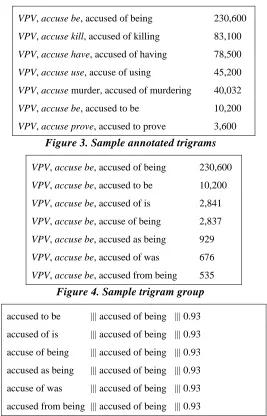
verb-prep-verb (VPV), adj-prep-verb (APV), and adverb-prep-verb (RPV). We then annotate the trigrams with types and lemmas of content words t1 and t3 (e.g., “accused of being 230633”
36 Jian-cheng Wu et al.
VPV, accuse be, accused of being 230,600 VPV, accuse kill, accused of killing 83,100 VPV, accuse have, accused of having 78,500 VPV, accuse use, accuse of using 45,200 VPV, accuse murder, accused of murdering 40,032 VPV, accuse be, accused to be 10,200 VPV, accuse prove, accused to prove 3,600
Figure 3. Sample annotated trigrams
VPV, accuse be, accused of being 230,600 VPV, accuse be, accused to be 10,200 VPV, accuse be, accused of is 2,841 VPV, accuse be, accuse of being 2,837 VPV, accuse be, accused as being 929 VPV, accuse be, accused of was 676 VPV, accuse be, accused from being 535
Figure 4. Sample trigram group
accused to be ||| accused of being ||| 0.93
accused of is ||| accused of being ||| 0.93
accuse of being ||| accused of being ||| 0.93
accused as being ||| accused of being ||| 0.93
accuse of was ||| accused of being ||| 0.93 accused from being ||| accused of being ||| 0.93
Figure 5. Sample phrase translations for a trigram group
3.2.2 Group Trigrams
We then group the trigrams by types, the first words, and the verb lemmas. See Figure 4 for a sample VPV group of trigrams. This step should bring together the trigrams containing serial errors and their correction. Note that we assume certain serial errors will have a correction of the same length here, which is true in most cases.
3.2.3 Generate Rules
Correcting Serial Grammatical Errors based on N-grams and Syntax 37
probability as follows. Recall that we assume that the higher the count of the trigram, the more likely the trigram is to be correct. So, we generate “l1, l2, l3 ||| h1, h2, h3 ||| p ,” where h1, h2, h3
is the trigram with the highest frequency count; l1, l2, l3 is one of the trigrams with lower
frequency count; and p denotes the probability of l1, l2, l3 translating into h1, h2, h3. We define
p=(highest frequency count)/(group frequency count).
3.3 Generating TM
boIn addition to the surface-level translation model TM, we also build a back-off model as a way of coping with cases where the trigram (t1, t2, t3) is unseen in TM. The idea is to assume the
complement (t2, t3) of t1 tends to be in a certain syntactic form regardless of the verb t3, as
dictionaries typically would describe the usage of “accuse” in terms of “accuse somebody of doing something.” Our learning process for TMbo is shown in Figure 9.
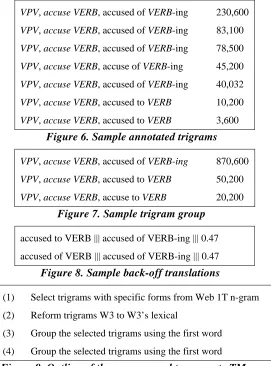
VPV, accuse VERB, accused of VERB-ing 230,600 VPV, accuse VERB, accused of VERB-ing 83,100 VPV, accuse VERB, accused of VERB-ing 78,500 VPV, accuse VERB, accuse of VERB-ing 45,200 VPV, accuse VERB, accused of VERB-ing 40,032 VPV, accuse VERB, accused to VERB 10,200 VPV, accuse VERB, accused to VERB 3,600
Figure 6. Sample annotated trigrams
VPV, accuse VERB, accused of VERB-ing 870,600 VPV, accuse VERB, accused to VERB 50,200 VPV, accuse VERB, accuse to VERB 20,200
Figure 7. Sample trigram group
accused to VERB ||| accused of VERB-ing ||| 0.47
accused of VERB ||| accused of VERB-ing ||| 0.47 Figure 8. Sample back-off translations
(1) Select trigrams with specific forms from Web 1T n-gram
(2) Reform trigrams W3 to W3’s lexical
(3) Group the selected trigrams using the first word
(4) Group the selected trigrams using the first word
38 Jian-cheng Wu et al.
3.3.1 Generalize Trigrams
First, we generalize the annotated trigrams (see Section 3.2.1) by replacing the verb form with its part of speech designator (i.e., replace “accuse” with VERB, and replace “accusing” with VERB-ing).
3.3.2 Sum Counts
In this step, we group the identically transformed trigrams and sum up the frequency counts. See Figure 6 for sample results.
3.3.3 Group Trigrams of the Same Context
We then group the trigrams by type and by the first word (context). See Figure 7 for a sample “accuse P V” group of trigrams.
3.3.4 Generate Rules
For each group of generalized trigrams, we then generate the phrase and translation pair with the probability as described in Section 3.2.3. See Figure 8 for a sample of back-off translations.
3.4 Run-time Correction
If one loads TM and TMbo into memory before the decoding process (generating, ranking, and
selecting translations), that would take up a lot of memory and slow the process of matching phrases to find translations. Therefore, we generate phrase translations on the fly for the given sentence before decoding. Our process of decoding to correct grammatical errors is shown in Figure 10.
(1) Tag the input sentence with part of speech information in order to find trigrams that fit the type of serial errors
(2) Search TM and generate translations for the input phrases (3) Search TMbo and generate translations for the input phrases
(4) Run statistical machine translation
Figure 10. Outline of the process used to correct the sentence at run-time
3.4.1 Tag the Input Ssentence
We use a POS tagger to tag the input sentence, and we identify trigrams (t1, t2, t3) consisting of
Correcting Serial Grammatical Errors based on N-grams and Syntax 39
3.4.2 Search TM and Generate Translation Rules
We then search for the group of trigrams (indexed by POS type and t1, t3) in TM containing the
trigrams (t1, t2, t3), found in Step 3.4.1. We find the trigram (h1, h2, h3) with the highest count
in that group. With that, we can dynamically add the translation, “t1, t2, t3 ||| h1, h2, h3 ||| 1.0” to
the cache of TM in memory (e.g., “difficulty to understand ||| difficulty in understanding ||| 1.0”) to speed up the subsequent decoding process.
3.4.3 Search TMbo and Generate Translation Rules
Just like in 3.4.2, we use t1 and its part of speech p1 to search TMbo for the generalized trigram
group that matches (t1, t2, t3). We then find the most frequent generalized trigram (h1, h2, h3) in
that group. After that, we need to specialize (h1, h2, h3) for t3 by replacing h3 with the verb
form of t3 for the designator h3, resulting in (h1, h2, h’3). Consider the generalized trigram
“accused of VERB-ing” and t3 = “murder,” the specialized trigram would be “accused of
murdering.” Finally, we add “t1, t2, t3 ||| h1, h2, h’3 ||| 1.0” (e.g., “accused to murder ||| accused
of murdering ||| 1.0”) to the cache of TM in memory for the same purpose of speeding up decoding.
3.4.4 Decode the Input Sentence without Reordering
Finally, we run a monotone decoder with the cache TM and a language model LM. By default, any word not in TM will be translated into itself.
4.
Experimental Setting
Our system DeeD (Don’ts-to-Do’s English-English Decoder) was designed to correct preposition-verb serial errors in a given sentence written by language learners. Nevertheless, since large-scale learner corpora annotated with errors are not widely available, we have resorted to Web scale n-grams to train our system, while using a small annotated learner corpus to evaluate its performance. In this section, we first present the details of training DeeD for the evaluation (Section 4.1). Then, Section 4.2 lists the grammar checking systems that we used in our evaluation and comparison. Section 4.3 introduces the evaluation metrics for the performance of the systems, and details of the sentences evaluated and performance judgments are reported in Section 4.4.
4.1 Training DeeD
40 Jian-cheng Wu et al.
million unigrams, 3 hundred million bigrams, and around 1 billion trigrams to fivegrams. We obtained 104,537,560 trigrams, containing only words in the General Service List (West, 1954) and Academic Word List (Coxhead, 1999). These trigrams were further reduced to 4,486,615 entries that fit the patterns of four types of serial errors and corrections: an adjective, noun, verb, or adverb followed by a preposition (or infinitive to) and a verb.
To determine the part of speech of words in the n-gram, we used the most frequent tag of a given word in BNC to tag words in the trigram.
4.2 Grammar Checking Systems Compared
Once we have trained DeeD as described in Section 3, we evaluated its performance using two datasets. The first dataset contained sentences written by an ESL or EFL learner with the serial errors with corrections. The second dataset contained mostly correct sentences in British National Corpus (BNC) with mostly published works written by native, expert speakers.
The first testset is a subset of the Cambridge Learner Corpus, the CLC First Certificate Exam Dataset (CLC/FCE). This dataset contains 1,244 exam essays written by students who took the Cambridge ESOL First Certificate in English (FCE) examination in 2000 and 2001. For each exam script, the CLC/FCE Dataset includes the original text annotated with error, type, and correction. From the 34,893 sentences in the 1,244 exam essays, we extracted 118 sentences that contained the serial errors in question. Other types of errors were replaced with corrections in these sentences.
The second testset is a random sample of 1000 sentences containing trigrams that fit the error patterns also used to evaluate our system. The four system and testset combinations evaluated are:
—Learner corpus without back-off model (LRN): The proposed system using only the surface-level translation model was tested on the first testset obtained from a learner corpus.
—Learner corpus with back-off model (LRN-BO): The proposed system with the additional back-off model was tested on the first testset obtained from a learner corpus.
—BNC without back-off model (BNC): The proposed system using only the surface-level translation model was tested on the first testset obtained from the British National Corpus.
—BNC with back-off model (BNC-BO): The proposed system without the back-off model was tested on the first testset obtained from the British National Corpus.
4.3 Evaluation Metrics
Correcting Serial Grammatical Errors based on N-grams and Syntax 41
testset, we measured the error rate (false alarms). We define precision and recall as:
Precision = C/S (1)
Recall = C/N (2)
where N is the number of serial errors, S is the number of corrections our system found, and C is the number of corrections where our system was correct. We also computed the corresponding F-score. Error rate was used in the second dataset described above, and we define the error rate as follows:
Error Rate = E/T (3)
where E is the number of corrections our system found (which are all wrong, since we were testing sentences with no errors) and T is the number of sentences tested.
5.
Evaluation Results
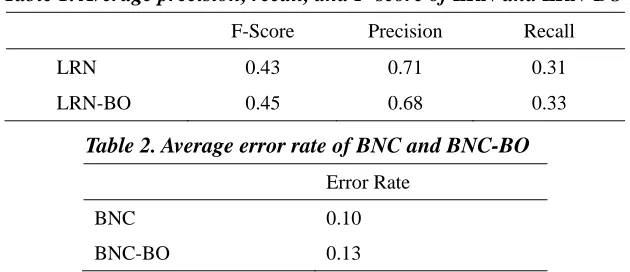
In this section, we report the results of the evaluation using the dataset and environment mentioned in the previous section. During this evaluation, 118 sentences with serial errors were used to evaluate the two systems: LRN and LRN-BO. Table 1 shows the average precision, recall, and F-score of LRN and LRN-BO. As we can see, LRN performs better in precision, which is reasonable since the back-off model corrects errors without the information of the verb involved. LRN-BO performs better in recall because the back-off model applies when the original model does not cover the case. Overall, LRN-BO performs better in F-score.
Table 1. Average precision, recall, and F-score of LRN and LRN-BO
F-Score Precision Recall
LRN 0.43 0.71 0.31
LRN-BO 0.45 0.68 0.33
Table 2. Average error rate of BNC and BNC-BO
Error Rate
BNC 0.10 BNC-BO 0.13
During this evaluation, 1000 sentences in BNC that fit the pattern of serial errors but in fact do not contain errors, were used to evaluate the same two systems: BNC and BNC-BO. Table 2 shows the average error rate of BNC and BNC-BO. It is not surprising that BNC
42 Jian-cheng Wu et al.
6.
Conclusions
Many avenues exist for future research and improvement of our system. For example, spell checking can be done before correcting grammatical errors. Context used to “translate” the serial errors can be enlarged from one word to two or more words (immediately or closely) preceding the errors. We can also add one more level of backing off for the context word preceding the serial errors: from surface word to lemma or from a proper name to named entity type (PERSON, PLACE, ORGANIZATION). We also can improve the accuracy of part of speech tagging used in applying the back-off model.
Additionally, an interesting direction to explore is extending this approach to handle other types of isolated and serial errors commonly found in learners’ writing. Yet another direction of research would be to consider corrections resulting in more or fewer words (e.g., one less word as in *spend time for work vs. spend time working). Or, we could also combine n-gram statistics from different types of corpora: a Web-scale corpus, a reference corpus, and a learner corpus. For example, the translation probability can be determined via statistical classifier training on the learner corpus with features extracted from n-grams of multiple corpora.
In summary, we have introduced a new method for correcting serial errors in a given sentence in learners’ writing. In our approach, a statistical machine translation model is generated to attempt to translate the given sentence into a grammatical sentence. The method involves automatically learning two translation models based on Web-scale n-grams. The first model translates trigrams containing serial preposition-verb errors into correct ones. The second model is a back-off model for the first model, used in the case where the trigram is not found in the training data. At run-time, the phrases in the input are matched using the translation model and are translated before ranking is performed on all possible translation sentences generated. Evaluation on a set of sentences in a learner corpus shows that the method corrects serial errors reasonably well. Our methodology exploits the state of the art in machine translation, resulting in an effective system that can deal with serial errors at the same time.
References
Atwell, E. S. (1987). How to detect grammatical errors in a text without parsing it. In Proceedings of the Third Conference of the European Association for Computational Linguistics (EACL), 38-45, Copenhagen.
44 Jian-cheng Wu et al.
Rozovskaya, A., & Roth, D. (2013). Joint Learning and Inference for Grammatical Error Correction, In Proceedings of the 2013 Conference on Empirical Methods in Natural Language Processing, 791-802.
West, M. (1953). A General Service List of English Words. London: Longman, 1953.