Copyright 0 1985 by the Genetics Society of America
A TWO-STAGE
MODEL FOR T H E C O N T R O L OF RDNA
MAGNIFICATION
R. SCOTT HAWLEY' AND KENNETH D. TARTOF'
The Institute for Cancer Research, Philadelphia, Pennsylvania I91 I 1 Manuscript received May 24, 1984
Revised copy accepted November 16, 1984
ABSTRACT
Males of the genotype bb/Ybb- have been shown to produce both magnified
(bb"+) and, less frequently, reduced (bb'') X chromosomes. An analysis of the progeny of single magnifying bb/Ybb- males reveals that bb"+ revertants may be recovered either as rare single events or, more frequently, in large clusters. To analyze the role of the bb phenotype in the induction of rDNA magnifi- cation we have constructed a series of bb and bb+ derivatives of Ybb-. Males carrying an X chromosomal bb allele and one of these derivatives (bb/bbYbb- or
bb/bb+Ybb-) produce small numbers (one to two) of bb"+ progeny at a frequency similar to that observed for bb/Ybb- males but do not produce large clusters of
bb"+ revertants. In addition, bb/bb+Ybb- males produce essentially equal num- bers of magnified (bb"+) and reduced (bb") X chromosomes. These data, to- gether with a consideration of the growth properties of the male germline in Drosophila, suggest that magnification/reduction may occur at two different times during development. Those events that give rise to large clusters, and, thus, necessarily arise early in germ cell development, appear to be dependent on the bb phenotype. However, those events that give rise to single bb"+
chromosomes arise late in spermatogenesis, probably at meiosis, and are inde- pendent of the bb phenotype.
N wild-type Drosophila melanogaster males there are two clusters of tandemly
I
repeated rRNA genes (rDNA), each with approximately 250 copies. One of these is located in the proximal heterochromatin of the X chromosome and the other on the short arm of the Y chromosome. Partial deficiencies, known as bobbed (bb) mutants, exist at either cluster. Alterations in X chromosomal rDNA redundancy occur at very high frequency only in males and only in those carrying the aberrant Y chromosome known as Ybb-. In such bb/Ybb-males, a phenomenon known as magnification occurs, whereby increases in rDNA redundancy are observed as reversions of bb to bbm+ (bobbed magnified
+;
RITOSSA 1968). A second mutational event, in which bb mutates to bb"(bobbed reduced lethal), is also produced by bb/Ybb- males and is referred to as reduction (TARTOF 1974). T h e occurrence of both bbm+ and bb" products in the same germline and the absence of magnification in males bearing a ring-
' Present address: Departments of Genetics and Molecular Biology, Albert Einstein College of Medicine, * To whom correspondence should be addressed.
Bronx, New York 10461.
X chromosome [R( 1)2,bb/Ybb-] led TARTOF (1974) to suggest that magnifica- tion and reduction are the reciprocal products of an unequal sister chromatid exchange.
In the experiments described here, we shall present evidence to indicate that magnification events may occur at two distinct times during male germline development. For purposes of simplicity, spermatogenesis may be conveniently divided into three stages (for a detailed review see LINDSLEY and TOKUYASU
1980). In the first stage (mitotic), male germ cells develop from three to seven
pole cells created by the migration of nuclei into the polar cytoplasm of the egg. These cells undergo three asynchronous mitoses to give rise to an average of 37 cells which then migrate in the developing embryo to form the pre- sumptive gonad. Approximately ten to 14 of these cells go on to form the adult stem cell population located in the apical region of the testis. In the second stage (syncytial) stem cells divide mitotically to produce a new stem cell and a primary spermatogonium. T h e primary spermatogonium then goes on to divide in a synchronous and syncytial fashion to produce a 16 cell cyst. T h e third and final stage (meiotic) is comprised of the two meiotic divisions that ultimately yield the bundle of 64 mature sperm. We will present data to indicate that there is an early (mitotic or syncytial) magnification event that is dependent on the bb phenotype. In addition, we propose that there is also a late (meiotic) event that does not require a bb phenotype but does require some aberrant aspect of the
Ybb-
chromosome, other than the deficiency for rDNA.MATERIALS AND METHODS
Stocks: The flies were raised at 24.5" on standard medium (TARTOF 1973). Descriptions of most of the mutants used in this study may be found in LINDSLEY and GRELL (1968). The pertinent chromosomes used here are as follows. I n ( Z ) s ~ ' ~ s c ~ ~ , y sc4 sc8 cu v B , referred to here as sc4sc8, is an inverted X chromosome deficient for rDNA; bb', bb6 and bb8 are X chromosomal bb mutations that arose spontaneously in this laboratory (TARTOF 1973); bb""-* refers to the bb+ allele from our Oregon-R wild-type stock; Ybb- is a Y chromosome deficient for 80% of its rDNA (TARTOF
1973); EYbb-, a derivative of Ybb- that carries E on p, was constructed by D. KOMMA and obtained from S. ENDOW; C(Z)DX, y f is an attached-X chromosome deficient for rDNA; C(I)DX, y f + is a derivative of C(I)DX, yfobtained from the Pasadena Drosophila Stock Center; In(I)sc', sc8 is an X chromosome inversion with a distal breakpoint near S E and a proximal X breakpoint that is proximal to bb+; In(I)dl-49, y Hw m2 g4, referred to here as dl-49, is a bb+ inverted X chromosome; B'v+Ybb+y+
is a bb+ multiply marked Y chromosome; the wild-type Y chromosome used here was obtained from our standard Oregion-R stock; B'Y is an otherwise normal bb+ Y chromosome whose long arm is marked with B'; YbbSuVas is a Y chromosome that suppresses the position effect variegation of
In(Z)wm4 and carries a lethal to severe bb allele (recovered by K.D.T.); and Ybbm carries a sponta- neous lethal to severe bb allele (recovered by K.D.T.).
Classijcation of bb and bb+: The bb2, bb8 and bb6 alleles used here are all strong bb alleles with high penetrance. They exhibit severe abdominal etching, very short thin bristles that show little or no tapering and lengthened development time. In all cases both experimental and control flies were derived from the same bb/B'Y fathers.
66' revertant females were selected on the basis of complete reversion of the bb phenotype. Moreover, each bb+/sc4sc8 female was testcrossed to sc4sc8/B'Y males, and their X/sc4sc8 daughters were examined with respect to bb to ensure stability and completeness of reversion. 111 110 case
RDNA MAGNIFICATION-REDUCTION
me/-41 r DNA
A
693
B
y + rDNA mei-4f
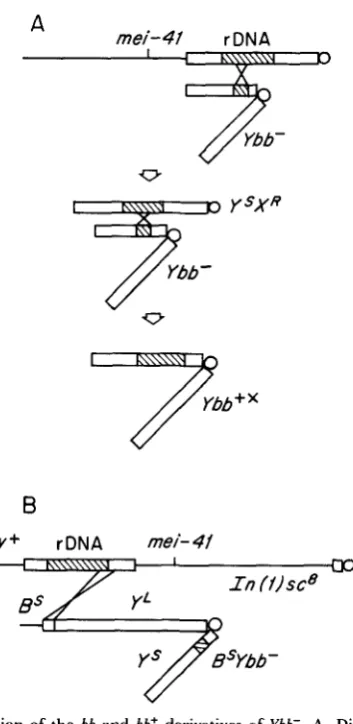
FIGURE 1.-Construction of the bb and bb+ derivatives of Ybb-. A, Diagram of the most likely origin of Ybb+x. mei-41-induced interchange resulted in the recovery of a female carrying both Ybb-
and a YsXR interchange product. In the process of recovering the interchange a bb+ Y chromosome was obtained. This Y is presumed to have arisen by exchange between the short arm of Ybb- and the YsXR fragment. B, Diagram of the origin of y+bbYbb- and y+bb+Ybb-. Interchanges were re- covered from h(1)sc8, bb+ mei-41/PYbb- males crossed to C(I)DX,y f / B s Y females. Thin lines indicate euchromatic regions of the X, blocks represent heterochromatin and diagonally filled blocks indi- cate rDNA.
Statistical analysis: All measurements of magnification frequency were obtained as averages over the progeny of a number of individual males. Statistical comparisons of frequencies of magnifica- tion were obtained by consulting the tables of KASTENBAUM and BOWMAN (1970).
RESULTS
Construction of bb+ and bb derivatives of Ybb-: We have previously isolated
sites on the Ybb- chromosome occurs at a frequency of about 2 X (HAW- LEY and TARTOF 1983). Such interchanges are detected as viable and fertile
C(I)DX, y f females that result from mating
y
mei-41 bb+"R"-R/Ybb- males toC(1)DX y f / F Y females. Cytogenetic analysis of the progeny of one such female
revealed that it carried Ybb- and a YsXR interchange. In the process of isolating
the YsXR fragment, a bb+Y chromosome was recovered that was cytologically
indistinguishable from Ybb- and fertile with a normal X . We infer that this chromosome arose by spontaneous exchange between Ybb- and the YsXR frag- ment. It is designated as Ybb+x (where
bb+x
denotes the recovery of the X bb+locus). Since mei-41 can induce partial deficiencies of X chromosomal rDNA
(HAWLEY and TARTOF 1983), it was possible to obtain a bb derivative of this chromosome by crossing y mei-41 bb/Ybb+x males to C(I)DX,
y
f + / E , females and screening for a y f' bb female. One such chromosome, Ybbx, that carries a severe allele of bobbed was obtained and utilized.Another type of bb+ derivative of Ybb- was constructed by crossing Zn(l)scs,
sc8 bb+ mei-41/BsYbb- males to C(I)DX, y f / B s Y females (Figure
1B).
Among therare y+ B+ f female progeny, both bb+ and bb flies, which also showed slight "hairy wing" effects, were recovered. Two of these exceptions, one of which was bb and the other bb+, were chosen for further study. In both cases the
Bs
marker on YL of Ybb- was replaced by y+ bb+ or y+ bb from the Zn(1)sc' chro- mosome. This indicates that the site of exchange on the X occurred within or proximal to the rDNA of Zn(1)sc'. Since both chromosomes are male fertile with a normal X , the exchange sites on the Y were distal to the distal-most fertility factor on the long arm of Ybb-. These chromosomes are designated
y+bbYbb- and y+bb+Ybb-. A bb'l derivative of y+bbYbb-, designated y+bb''Ybb-, was
also recovered during the course of single pair matings of bbs/y+bbYbb- males
to sc4sc8/dl-49 females.
bb+ and bb derivatives of Ybb- induce magnzjication: To examine the ability
of these chromosomes to induce rDNA magnification, males were constructed that carried a bb allele on the X and a bb+ or bb derivative of Ybb-. These males were then singly mated to sc4sc8/dl-49 females and the X/sc4sc8 progeny scored with respect to bb phenotype. All bb+ exceptions were crossed to sc4sc8/
B'Y males, both to ensure that the putative reversions were not a consequence of nondisjunction of the X and Y chromosomes and to test the stability of those reversions that had occurred. As shown in Table 1, magnification of bb2 does not occur in the presence of a wild-type Y or B"Y chromosome but does occur at high frequency (0.198 to 0.398) in males carrying Ybb-. bb+ derivatives of
Ybb-, Ybb+x and y+bb+Ybb- also induced magnification of bb2 but at a much
lower frequency (0.013 to O.C?C) than was observed for Ybb-. Magnification is also observed in bb2 males carrying bb derivatives of Ybb- (Ybbx, y+bbYbb- and
y+bb"Ybb-) but at frequencies (0.107 to 0.01 8) that are intermediate between
those observed for Ybb- and its bb+ derivatives. Similarly, these bb+ and bb
derivatives of Ybb- also induce magnification of two other bobbed alleles, bb6
and bb8, although again at frequencies much lower than were obtained with
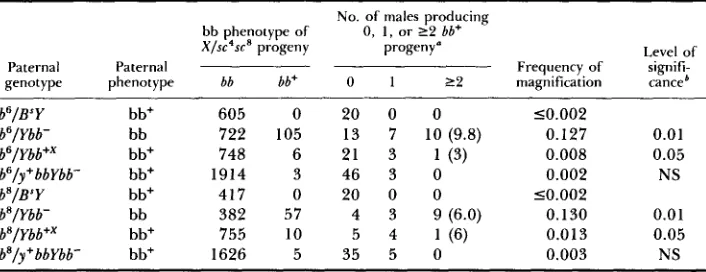
Ybb- (Table 2).
RDNA MAGNIFICATION-REDUCTION 695
TABLE 1
bb and bb+ derivatives of Ybb- induce magnijcation
bb phenotype of
X/sc'sc* progeny 0 , 1 , or >.2 bb+ progeny" Level of No. of males producing
Paternal Paternal Frequency of signifi-
genotype phenotype bb bb+ 0 1 2 2 magnification canceb
bb2/Y bb+ 2710 0
(mass mating)
10.001
bb2/B'Y bb+ 1010 0 45 0 0 co.001
y bb2/Ybb- bb 433 100 4 4 14 (6.8) 0.188 0.01
bb ' / B r Yb b- bb 171 113 2 3 8 (13.7) 0.398 0.01
bb2/Ybbx bb+ 318 8 16 3 2 (2.5) 0.024 0.01
bb2/Ybb+x bb+ 750 10 26 8 l ( 2 ) 0.013 0.0 1
bb2/y+bb"Ybb- bb 649 78 20 5 10 (7.3) 0.107 0.01
bb2/y+ bbYbb- bb+ 433 8 15 3 2 (2.5) 0.018 0.01
11. 1428 28 (mass-mating) 0.019 0.01
bb'/y+bb+Ybb- bb+ I. 499 3 18 1 l ( 2 ) 0.006 0.05
Males of the indicated genotype were mated singly to sc4scs/dl-49 females and the X/sc4scs
progeny scored with respect to bb.
* The numbers in parentheses indicate the mean numbers of bb+ progeny produced by males giving more than one revertant. In cases in which only one cluster of ?two revertants was ob- served, the numbers in parentheses indicate only the size of that cluster.
'
Statistical significance is computed using the tables of KASTENBAUM and BOWMAN (1970) by comparing the number of magnificants observed in the given experiment with that seen in thebb2/BsY control.
TABLE 2
bb and bb+ derivatives of Ybb- also induce magnijcation of bb6 and bb8
No. of males producing 0, 1 , or 2 2 bb+
bb phenotype of
X/sc'sca progeny progeny" Level of
Paternal Paternal Frequency of signifi-
genotype phenotype bb bb+ 0 1 2 2 magnification canceb
~~ ~ ~~
bb6/BsY bb+
bb6/Ybb- bb
bb'/Ybb+' bb+
bb6/y+bbYbb- bb+
bbs/B' Y bb+
b b'/Ybb- bb
bb8/Ybb+x bb+
bbs/y+bbYbb- bb'
605 722 748 1914 417 382 755 1626
0 2 0 0 0
105 13 7 10 (9.8)
6 21 3 1 (3)
3 4 6 3 0
0 2 0 0 0
57 4 3 9 (6.0)
10 5 4 1 (6)
5 3 5 5 0
~~~ 10.002
0.127 0.01
0.008 0.05
0.002 NS
0.130 0.01
0.013 0.05
0.003 NS
10.002
~~~~~ ~ ~ ~ ~ ~ ~ ~~~~~~~
The numbers in parentheses indicate the mean numbers of bb+ progeny produced by males giving more than one revertant. In cases in which only one cluster of ?two revertants was ob- served, the numbers in parentheses indicate only the size of that cluster.
'Statistical significance is computed using the tables of KASTENBAUM and BOWMAN (1970) by comparing the number of magnificants observed in the given experiment with that seen in the bb/ B"Y control. NS, not significant.
least an order of magnitude less than those observed with the rDNA-deficient
Ybb- chromosome. Moreover, it is important to note that, as shown in Tables
1 and 2, this is primarily the result of the failure of males carrying bb or bb+
TABLE 3
bb and bb+ derivatives of Ybb- induce magnijication and reduction at similar frequencies
Genotype of sons with
respect to bb Frequency of Level of significance No. of X I
Paternal B'Y sons Reduc-
genotype tested bb+" bb bb' Magnification Reduction Magnification tion bb2/B'Y 2450 0 2540 0
bb2/Ybb- 1027 360 653 14 0.350 0.014 0.01 0.01
bb2/Bs Ybb- 780 89 683' 8 0.114 0.010 0.01 0.01
bb2/y+bbYbb- 1313 9 (2) 1288 14 0.007 0.01 1 0.01 0.01
bb2/Ybb+x 1013 0 1003 10 0.0 10 0.01
bb'/y+bb+Ybb- 800 5 (1) 791 3 0.006 0.004 0.01 0.05
Males of the indicated genotype were crossed to C ( 1 ) D X , y f / B ' Y females, and the X/B'Y sons were individually tested for bb+, bb or bb' by crossing to four to five sc4sc8/dl-49 females. All putative bb+ or bb' mutations were retested for at least two generations. In addition cytological examinations were performed to confirm that these exceptions are not the consequence of X-Y interchange.
' Numbers in parentheses indicate other males scored that produced both bb+ and bb progeny. Testcrosses revealed that these males carried weak alleles of bb with low penetrance.
'
One X-Y(y+bb+.B") interchange was also recovered.are so common among the progeny of Ybb- bearing males. T h e frequencies with which males bearing Ybb- or one of its bb and bb+ derivatives produce single magnified bb"+ offspring are nearly the same.
Magnzfication and reduction events occur at similar frequencies in bb+/bb+Ybb-
males: As noted bb"+ progeny produced by bb/bbYbb- or bb/bb+Ybb- males are
not recovered in large clusters but rather as rare single events. This suggests that bbm+ loci recovered from bb/bb+Ybb- males may be arising very late in spermatogenesis, perhaps at meiosis. If this is the case then one might expect to recover the reciprocal event, namely, reduced (bb") X chromosomes, at a frequency similar to that observed for bb"+ chromosomes.
T o measure magnification and reduction simultaneously, males bearing a bb2
X chromosome and the indicated Y chromosome were crossed to C(I)DX,y
f/
B"Y females, and the bb'/BSY sons were then individually crossed to four or five
sc4sc8/dl-49 females. Those males that yielded only bb+/sc4sc8 daughters carry
bb"+ alleles, and those that produce no X/sc4sc8 daughters but substantial num-
bers of X/dZ-49 progeny carry bb" alleles. For each putative bb"+ or bb"' excep- tion a number of X/dZ-49 sisters were testcrossed to confirm the phenotype.
As shown in Table 3, y+bbYbb-, y+bb+Ybb- and Ybb+x derivatives of Ybb-
induce reduction at frequencies similar to those observed for Ybb-. T h e failure to Ybb+x to produce bbm+ loci in this particular experiment is not understood since this chromosome is capable of inducing magnification at a frequency similar to the frequency of reduction observed in this experiment (see Table 1). However, in the case of y+bbYbb- and y+bb+Ybb- in which magnification and reduction events are both observed, bbm+ and bb'l alleles are recovered at
RDNA MAGNIFICATION-REDUCTION 697 TABLE 4
Other Y chromosomes also induce magnijication
bb phenotype of bbPlsc4scs
progeny Level of
Frequency of signifi- Y chromosome bb/Y phenotype bb bb+ magnification cance' ybb+ORE.R Wild type 2151 0 10.001
Ybb- Severe bb 653 360 0.355 0.01
Ybb" Moderate-severe bb 2309 203 0.080 0.01
YbbSuVar Slight bb 533 7 0.01 1 0.01 Bsv+ Ybb+v + Wild tvDe 1287 4 0.003 0.05
~~~
Males bearin a bb2 X chromosome and the indicated Y were crossed to sc4sc8/dl-49 females
a Level of significance is computed using the tables of KASTENBAUM and BOWMAN (1970) by
comparing the number of magnificants observed in the given experiment with that seen in the control.
and the Xlsc'sc
B
female progeny were scored with respect to bb.consequence of a reciprocal meiotic event, presumably unequal sister chro- matid exchange.
Y chromosomal variants unrelated to Ybb- also induce rDNA magnification: In the preceding sections, it has been demonstrated that bb and bb+ derivatives of
Ybb- are capable of inducing magnification, albeit at a reduced frequency. This demonstrates that the ability of Ybb- to induce at least some magnification is not merely due to the deficiency for rDNA, or of the bb phenotype, but, rather, is a consequence of some other aberrant feature of this chromosome. Accordingly, one might predict that other Y chromosomes, whose origins are unrelated to Ybb-, should also be capable of inducing rDNA magnification.
Males carrying a bb2 X chromosome and either Ybb+oRE-R, YbbP2, YbbSuVar or
B'v+Ybb+y+ were crossed to sc4sc8/dl-49 females, and the results are presented in Table
4.
Although no magnificants were observed among the progeny of males bearing a wild-type Y chromosome, they are obtained at modest fre- quencies (0.003 to 0.080) among progeny of males bearing the variant Y chro- mosomes. It may also be noted that, although all three variant Ys produce some bbm+ progeny, a high frequency of magnification is only observed in the presence of YbbP2 which, like Ybb-, produces a strong bb phenotype in combi- nation with bb2. These experiments demonstrate both that Y chromosomes unrelated to Ybb- can in fact induce magnification and that the severity of the bb phenotype is correlated with frequency of magnification.Magnification of bb Ybb- chromosomes: In the crosses presented magnification was always assayed with respect to the X chromosomal bb locus. However, it is
also possible to demonstrate that X chromosomal rDNA is capable of being magnified when present on a Y chromosome. Table 5 presents the results of a series of crosses in which males bearing the sc4sc8 chromosome and either
y+bbYbb- or YbbX were crossed to C(l)DX,
y
f + / B 5 Y females and the C(l)DX, yf + / U daughters examined with respect to the bb phenotype. All bb+ exceptional
TABLE 5
Y chromosomal magnijcation as measured by matings of single
sc4scs/Ybb males to C(l)DX, y f+/B'Y females and scoring the
C(l)DX, y f+/Y female progeny with respect to bb
bb phenotype o f C ( I ) D X y
f / Y females
Frequency of Paternal genotype bb bb+ magnification sc4scs/Ybbx 819 37 0.043 sc4sc8/y+ bbYbb- 43 1 18 0.040
cannot be accurately assessed in sc4sc8/Y males due to the presence of scute.) In each case a modest frequency of magnification (about 0.040) was observed. This demonstrates that the ability of X chromosomal rDNA to undergo mag- nification is not solely a consequence of its location on the X chromosome.
DISCUSSION
T h e construction of bb and bb+ derivatives of Ybb- allows us to distinguish between events that produce large clusters of bb"+ revertants and those that produce rare single bbm+ and bb" chromosomes. T o explain our data we will argue that there are two times at which magnification events can occur: an early event induced by the bb phenotype that gives rise to the large clusters of magnified loci and a late (meiotic) event, induced by Ybb-, that is independ- ent of the bb phenotype and gives rise to small numbers (one or two per male)
of bb"+ and bb" loci.
First, we consider the class of rare magnification events that appear with similar frequencies in bb/bb+Ybb- and bb/Ybb- males. These events necessarily occur late in spermatogenesis, well after the mitotic and syncytial stages, since they arise at low frequency and show no evidence of clustering. Therefore, they probably take place sometime during the meiotic process. T h e occurrence
of bb"+ and bb'l products in a phenotypically bb+ germline demonstrates that
these late magnification events are neither a consequence of the bb phenotype nor of the deficiency for rDNA carried by Ybb-. Thus, the induction of meiotic magnification and reduction events is unrelated to rDNA dosage and appears
to be the consequence of some other property of this chromosome, perhaps a deficiency for some site at or near the ribosomal RNA gene cluster. That is, the late class of events seem to represent a form of X rDNA mutability induced by an aberrant homologue. Moreover, the occurrence of bbm+ and bb" products
RDNA MAGNIFICATION-REDUCTION 699
In contrast to the rare reciprocal events described before, individual bb/Ybb- males also frequently give rise to large clusters of bbm+ progeny that appear in vast excess to their bbrL sibs. Because of the size of these clusters and their distribution among bb/Ybb- individuals, they necessarily reflect an early mag- nification event that probably arises during the mitotic or syncytial stage of germline development. T o explain these observations it has been proposed (TARTOF 1974) that both magnification and reduction are reciprocal products of rare premeiotic unequal sister chromatid exchanges, and the excess of mag- nified loci compared to reductants is the result of a selective advantage that would accrue to a bb" revertant cell occurring in an otherwise bb germline. However, in bb/bb+Ybb- germlines the expected clusters of bbm+ are eliminated. Furthermore, we do not observe large clusters of bb" alleles that would be expected from phenotypically bb+ cells that are genotypically bb"/bb+Ybb-. T h e fact that these clusters are eliminated in phenotypically bb+ germlines and that the ability of various Y chromosomes to induce magnification is strictly corre- lated with the severity of the bobbed phenotype lead us to propose that the early magnification event is dependent on the bobbed phenotype. Although we propose that the bb phenotype is necessary for magnification, we do not know whether it is sufficient. It may be that the structural aberration associated with Ybb- is also required. In any case, according to this model, bb/Ybb- flies give rise to large clusters of bb"+ alleles as a consequence of early magnification events that are amplified by the further proliferation of the germline during the mitotic or syncytial stage. bb"/Ybb- cells arising from early events would presumably die or otherwise fail to proliferate at this time, so that those bb"
chromosomes that are obtained from bb/Ybb- flies probably arise from late events. Thus, large clusters of bbm+ and bb'l chromosomes would not be ob- served among the progeny of bb/bb+Ybb- males because the early germline events require a bb phenotype for induction.
This model also explains two observations regarding the behavior of bb+/ Ybb- males. First, the rDNA content of a bb+ X chromosome does not increase beyond the amount required for a bb+ phenotype even when that X is main- tained over Ybb- for as many as ten generations (TARTOF 1973). This is ex- plained by the hypothesis that the early high-frequency magnification event requires a bobbed phenotype and, therefore, does not occur in bb+/Ybb- germ- lines. Second, bb+/Ybb- flies will produce rare (presumably meiotic) bb progeny by reduction (TARTOF 1974). This is explained by the occurrence of late reciprocal events that require the Ybb- but are independent of the bb pheno- type. We would predict that reciprocal supermagnified bb+ offspring also occur at low frequency but are not phenotypically distinct from their bb+ sibs and so do not accumulate in the population.
control occurs late in spermatogenesis, probably about the time of meiosis, and is independent of the bobbed phenotype. In at least this case the Ybb- chro- mosome is required, and as we have suggested previously (HAWLEY and TAR- TOF 1983), the observed rDNA mutability may reflect aberrant homologue- homologue interactions, such as failed pairing. Although our hypothesis pro-
poses two distinct times for the induction of magnification events, we are not suggesting that the magnification events themselves arise by different chro- mosomal processes. T h e failure of R(l),bb/Ybb- males to produce any bb"'
progeny (TARTOF 1974) suggests that the stable genetic reversion of bb to bb+
is a consequence of unequal sister chromatid exchange whenever it occurs.
R. S C O ~ HAWLEY was a Helen Hay Whitney Postdoctoral Fellow. Support from the National Institutes of Health grants GM-19194, RR-05539 and CA-06927 and an appropriation from the Commonwealth of Pennsylvania is gratefully acknowledged. Support for the work performed at Albert Einstein College of Medicine was provided by National Institutes of Health grant HHSRR- 05397 to AECOM and is gratefully acknowledged. MARILYN JONES provided excellent technical assistance.
LITERATURE CITED
HAWLEY, R. S. and K. D. TARTOF, 1983 The effect of mei-41 on rDNA redundancy in Drosophila
KAPLAN, W. D., 1953 The influence of Minutes upon somatic crossing over in Drosophila melan-
KASTENBAUM, M. A. and K. 0. BOWMAN, 1970 Tables for determining the statistical significance
LINDSLEY, D. L. and E. H. GRELL, 1968 Genetic variations of Drosophila melanogaster. Carnegie
LINDSLEY, D. L. and K. T. TOKUYASU, 1980 Spermatogenesis. In: The Genetics and Biology of
RITOSSA, F. M., 1968 Unstable redundancy of genes for ribosomal RNA. Proc. Natl. Acad. Sci.
TARTOF, K. D., 1971 Increasing the multiplicity of ribosomal RNA genes in Drosophila melano- gaster. Science 171: 294-297.
TARTOF, K. D., 1973 Regulation of ribosomal gene multiplicity in Drosophila melanogaster. Ge- netics 73: 57-77.
TARTOF, K. D., 1974 Unequal mitotic sister chromatid exchange as the mechanism for ribosomal
melanogaster. Genetics 1 0 4 63-80.
ogaster. Genetics 38: 630-653.
of mutation frequencies. Mutat. Res. 9: 527-549.
Inst. Wash. Publ. 627.
Drosophila, Vol. 2d, pp. 226-293. Academic Press, New York.
USA 6 0 509-516.
gene magniGcaLion. Proc. Natl. Acad. Sci. USA 71: 1272-1276.