Journal of RANGE
MANAGEMENT
Vozume~~J
Gimber
4Range Research to Meet New Challenges and Goals ______.._____.__ James P. Blaisdell, Vinson L. Duvall, Robert W. Harris, R. Duane Lloyd, and Elbert H. Reid 227 Selenium Concentrations in Forage on Some High Northwestern
Ranges ____________________._____-___________ D. L. Carter, C. W. Robbins, and M. J. Brown Blood Components of Range Cattle: Phosphorus, Calcium, Hemoglobin, and
Hematocrit ____________________________---______---_____---______----__ W. G. Kirk and George K. Davis Nitrate Poisoning, Fire Retardants, and Fertilizers-Any
Connection? __._______ _____ _______________ .____ _____ __.._ ______ __._ ________ ____ _______ ____ _______..__ Marvin Dodge Barrier Effect of the Shrub Eheagnus commutata on Grazing Cattle and Forage
Production in Central Alberta ____________________ ____ _______ ___.. ____ ___._._ ___ Arthur W. Bailey Energy Balance Relative to Percent Plant Cover in a Native
Community __ ____ ______ _____ ______ ._.___ ______._______.__________ J. Kristian Aase and J. Ross Wight Hydrologic and Biotic Effects of Grazing vs. Non-grazing Near Grand Junction,
Colorado _________________________________________________________._____________________________---__-- Gregg C. Lusby 234
239
244
248
252
256 Biotic and Hydrologic Variables in Prairie Potholes in North
Dakota ________________________________________________-_.__._________._____--__._____---_._____-__-_._ Charles E. Sloan 260 Climate and the Rangelands of Canada ____________.________________________________._______- A. C. Carder 263 Complementary Grazing Systems for the Northern Great Plains __________ R. W. Lodge 268 The Role of Wet Meadows as Wildlife Habitat in the
Southwest _______________________________.____________________________ David R. Patton and B. Ira Judd 272 Responses to Chopping and Rock Phosphate
Ranges ______..___________________________._______ ___.. ________.
on South Florida
Clifford E. Lewis 276 Effects of Environment on the Metabolism and Germination of Crested Wheat-
grass Seeds ____________________________ A. M. Wilson, Jack R. Nelson, and Carl J. Goebel 283 Soil Physical Conditions after Plowing and Packing of
Ridges ___________________._____________._______________.______________________ D. N. Hyder and R. E. Bement 289
Technical Notes
Ground Dwelling Beetles in Burned and Unburned
Vegetation ___ _..__ ____________ ____ ________ _.___.._ _______ ____ __________________.______________ W. H. Rickard 293 Relationships Between Visual Obstruction Measurements and Weight of Grass-
land Vegetation R. J. Robel, J. N. Briggs, A. D. Dayton, and L. C. Hulbert Relationship of Utilization Intensity to Plant Vigor in a Crested Wheatgrass
Seeding __________________________________________._____ L. E. Horton and Richard H. Weissert Estimating Dryweights of Foodplants in Feces of
Herbivores ____ . . ..__.. James C. Free, Richard M. Value of Broom Snakeweed
Indicator ______ _._.___... _______
as a Range Condition
295
298
Hansen, and Phillip L. Sims 300
Donald A. Jameson 302
Book Reviews __________________________________.________________________________________.______ _______________ ___.______________________ 304
cover
Photo-Grazing
“Chopped” Pine-Wiregrass
Range,
Range Research to Meet New Challenges
and Goals
JAMES P. BLAISDELL, VINSON L. DUVALL, ROBERT W. HARRIS, R. DUANE LLOYD, AND ELBERT H. REID1
Assistant Directors, USDA Forest Service, Forest and Range Experiment Stations: Ogden, Utah; New Orleans, Louisiana; Portland, Oregon; and
Ft. Collins, Colorado, respectively.
Highlight
The state of range management knowledge in relation to goals of society was considered by a Forest Service committee, and an enlarged concept of “range” was developed to include both ecological characteristics and land use. Range can contribute to better living conditions by providing stability to rural communities and regional economies and a high-quality environment, with optimum fish, wild- life, and recreational opportunities. Important range research needs are to: analyze ecosystems, inventory range resources, coordinate management and use, improve resources, maintain and improve environmental quality, and analyze social and economic aspects of resource use.
It is worthwhile in most any endeavor to pause occasionally and examine the status quo-to consider carefully what has been accom- plished and what needs to be done. Accordingly, the state of range management knowledge in relation to the goals of society was con- sidered by a Forest Service com- mittee, and a position statement is being developed to guide future range research. Since many ques- tions have recently been raised about range, objectives of range management, and the role of the American Society of Range Man- agement itself, it was felt that philosophies and conclusions of this committee might be of interest to others. The authors wish to ac- knowledge the assistance of many colleagues who contributed to the development of ideas presented herein, particularly Richard J. Mc-
lRetired. Present address: Fort Col- lins, Colorado. Formerly Assistant Director, Rocky Mountain Forest and Range Experiment Station, Fort Col- lins.
Connen, Kenneth W. Parker, and Robert S. Rummell.
What is Range?
The term “range,” as originated in the United States, traditionally carries a strong connotation of land used primarily for livestock grazing. Range is extensive and extremely diverse with wide variations in elevation, topography, soil, climate, and vegetation. It is viewed by some as a residual that was left after more productive and valuable areas were converted to higher eco- nomic uses (Upchurch, 1963). Con- sequently, range cannot be easily defined so an enlarged concept seems necessary to properly include both ecological characteristics and use:
Ranges are uncultivated areas that support herbaceous or shrubby vegetation. The range complex (ecosystem) includes not only the soil and vegetation but also the associated atmosphere, water, and animal life. Some areas are both range and forest: the tree overstory may be sparse or the trees may have been har- vested or burned, allowing growth
of herbs or shrubs. Most ranges are covered with native plants, but extensive areas have been seeded to exotics. Al though ranges are usually used by live- stock and wildlife, some may not be ecologically or economically suitable and may not actually be grazed.
Often, an area is range because its ecological nature, economic con- ditions, or lack of irrigation makes it unsuitable for cultivation. Most
227
native rangelands that are suitable for cultivation were converted to crop production or permanent pas- ture; some have reverted to non- cultivated status because of errors in selection, diminishing produc- tivity, or economic changes.
Land use is constantly changing among ranges, forests, and crop- lands (Fig. 1). Some lands are con- currently used as range and forest. Croplands, rangelands, and forest lands have been and will continue to be transferred to urban and industrial uses as population in- creases.
Reliable information on the cur- rent extent of the Nation’s range- lands is unavailable, but estimates based on land-use concepts rather than resource characteristics indi- cate that livestock graze 865 million acres (38 percent of the Nation’s land area) in addition to cropland pastures. Not all rangeland is grazed, however, and it is estimated that half of the contiguous 48 States is rangeland. Of the total 908 million acres, grasses and shrubs characterize 653 million acres and 255 million acres are forested ranges.
Most rangelands are in the West, and most western ranges are pub- licly owned; but substantial acreage, especially in the plains and the South, is privately owned. Grazing by wildlife and livestock has been the most commonly recognized use of range resources; however, society is becoming more concerned about its total environment, and is look- ing at rangelands from new points of view.
228
BLAISDELL ET AL.FIG. 1. Uses of ranges, forests, and crop-
lands are constantly changing. The arrows indicate some of the shifts in use that occur.
The Range Ecosystem
Range is composed of com- munities of plants and animals in their natural environment. Vari- able and complex, it has innumer- able combinations of organisms, soils, climate, and topography. These components function as an “ecosystem,” which includes flow of energy and transformation, cir- culation, and accumulation of mat- ter by living organisms.
Ecosystem is a term proposed by Tansley (1935) to include both the living organisms of a community and the associated nonliving en- vironment. Past attention has been focused on vegetation, but plants are merely part of the larger system, and vegetal response must be in- terpreted in terms of other com- ponents of the system and their interrelations (Fig. 2). These com- ponents are closely interrelated; any influence on one affects all others (Ellison et al., 1951).
Components
Although the range ecosystem has an endless number of components, they may be conveniently grouped into a few major categories.
Vegetation is the aggregate of plants, including fungi, algae, mosses, forbs, grasses, shrubs, and trees. Range vegetation is char- acteristically variable and a small plot may contain numerous species. Hence, many different degrees of tolerance to other factors of the
FIG. 2. The range ecosystem (adapted from Billings, 19.52) and its many products and uses.
environment are represented as well as many different patterns of growth form and reproductive de- velopment.
Animals include not only man, domestic livestock, and wildlife but the entire fauna above and below ground. Undoubtedly, domestic livestock have had the greatest effect on rangelands in recent times, but pressures of native wild animals have also been severe in many situations. Influences of graz- ing animals are mainly exerted through herbage removal, tram- pling, and dissemination of seed. Also, insect and rodent pests may have tremendous effects on range vegetation. Man is both a part and a manipulator of range ecosys- tems (Van Dyne, 1966), but in reaching production goals he has often upset the ecological balance with disastrous results.
Soil is the natural body of or- ganic and mineral material sup- porting plant life. It varies with parent material from which it de- veloped and with the associated
climatic, topographic, and biotic factors. It is the source of water and nutrients that support vegeta- tion and, therefore, is the basic range resource that must be main- tained in a productive condition.
Topography includes variations in elevation as well as degree and direction of slope of the land sur- face. It modifies the local climate and, consequently, the character of the vegetation. It has a very im- portant influence on the distribu- tion of animals.
Climate is a combination of atmospheric factors: radiation, pre- cipitation, temperature, air, wind, and humidity. It dictates, to a large extent, the type of vegetation and soil on a particular area. Varia- tions in climatic factors make dif- ferent kinds of weather, which greatly influences annual produc- tion of herbage.
RANGE
RESEARCH
229
part in shaping major biotic com- munities, particularly through the destruction of woody plants, thus allowing development of predomi- nantly herbaceous vegetation. Fire can be an important tool in vegeta- tion management.
Despite recognition that the sys- tem functions as a whole, the maze of interrelations between the vari- ous biotic and abiotic factors has long discouraged attempts at com- plete ecosystem studies. Neverthe- less, studies dealing with a few factors have made real contribu- tions to our understanding of cer- tain ecosystems. Recent develop- ments in modeling concepts, mathe- matics, and computer technology have opened the way to more com- plete analyses.
Products and Uses
In the minds of many, range has been associated merely with live- stock production and in recent years it has become increasingly evident that the range has a rather low capability to profitably absorb in- puts for livestock production alone. However, it is becoming recognized more and more that livestock is but one of many outputs from the range, and that all outputs-present and potential-and their interrela- tions must be studied and evaluated.
Water
Water is probably the most im- portant single product. Not only is it directly essential to human life, but it is vital to the life and production of vegetation that may be harvested for man’s use. Agricul- ture, transportation, power genera- tion, manufacturing, and waste dis- posal need water produced by the range ecosystem.
In terms of supply it is estimated that total water withdrawals in the contiguous 48 states in 1980 will amount to 50 percent of renewable surface ground water supplies, as contrasted to 21 percent in 1960. It should be recognized, however, that present uses already approach or exceed the limit of available
supplies in many localities of the East (U.S. Dep. Agr., 1962). Since range comprises roughly one-half the land surface of the United States, it provides a substantial part of the total water supply. It is extremely important, therefore, that the range be properly managed for optimum production of quality water.
Air
Air-the mixture of gas, liquid, and solid particles that envelops our earth-is vital to man directly, essential for plants and animals, and necessary for man’s domestic, community, industrial, and agricul- tural activities. Physical properties of air-temperature, water den- sity, and air movement-affect the growth and development of plant and animal life, and limit man’s use of the land. Chemical proper- ties-oxygen, carbon dioxide, water vapor, and, increasingly, pollutants -directly affect man and his well- being (Middleton, 1966).
Rangelands provide a source of unpolluted air as well as an im- mense capacity to receive, trans- port, and discard pollutants from urban and industrial areas. Air quality is directly influenced by wind erosion resulting from de- pleted vegetal cover, smoke from burning organic matter and, of course, by carbon dioxide-oxygen exchange processes of the vegeta- tion. With continually increasing problems of air pollution, knowl- edge of the air environment be- comes more and more important as a basis for regional “airshed” management.
Fish and Wildlife
The Nation’s rangelands and as- sociated waters are the habitat for millions of big game and countless numbers of other wildlife includ- ing songbirds, upland game birds, waterfowl, and fish. These wildlife resources provide recreation and income for a broad spectrum of our population. For example, some 40 million of us-about one in four-
spend about $5 billion annually to go hunting and fishing. In addi- tion, great numbers of people simply like to observe, photograph, or study wildlife, and thereby enjoy the legacy of our lands and waters. Fish and wildlife, then, contribute substantially to our national econ- omy, and are particularly impor- tant to many farm and rural com- munity residents.
Vegetation manipulation through such practices as livestock grazing, timber harvesting, complete type conversion, selective plant control, and introduction of new species through seeding and planting can greatly influence habitat quality and, consequently, wildlife popula- tions. Full consideration must be given to interrelations between ter- restrial range uses and associated fish habitats. Improper land use in some areas has resulted in exces- sive stream siltation, unstable chan- nels, and exposed banks. Improved fish and wildlife outputs will come about only through an understand- ing of the ecosystem and fully co- ordinated land management prac- tices.
Forage for Livestock
Although some rangelands are not high producers, essentially all are integral parts of the operations of thousands of ranch families whose livelihood depends upon sustained yield of forage and live- stock products. Range forage is used in combination with hay and grain produced on local agricul- tural lands and allows profitable utilization of such feeds that might otherwise be difficult or uneco- nomical to market. This is particu- larly true of some of the sparsely populated areas of the West. At the same time, these rangelands are a source of beef cattle and lambs that are finished in the large com- mercial feedlots prior to slaughter.
230
BLAISDELL
ET AL.
Therefore, it is important that they be managed in such a way as to maintain or improve the basic re- source while providing maximum returns to the ranch families as well as to the communities and states of which they are a part.
Open Space and Recreation Rangelands provide innumerable recreation opportunities in addition to those directly associated with fish and wildlife. Abundance of surface water, wide open spaces, and interesting and beautiful land- scapes are attracting more and more people into range areas for camping, picnicking, rock hunting, and other kinds of outdoor recrea- tion activities.
Colorful rocks, unique geological formations, and a wide variety of plant communities make an end- less array of interesting and beauti- ful scenery for the viewer. Wildlife is also a source of interest and beauty. To some people the ulti- mate in enjoyment of the outdoors is seeing deer or elk in their native habitat or hearing the song of an unseen bird. Pastoral scenes can also add much to the landscape. Cattle and sheep, cowboys and sheepherders, rustic cabins, corrals, or even sheep-camp wagons con- tribute to enjoyment of the range landscape-especially if a good job of land and livestock husbandry is evident. Not the least of rangeland attributes is simply the broad ex- panse of open space where one’s eyes and thoughts can roam to distant horizons.
With increasing recreational use, knowledge of range ecosystems is essential to maintenance of quality opportunities and wise integration of recreation with other uses and values of this extensive resource.
Miscellaneous Products
Products from the range vary as much as its sites, climate, and vege- tation. Ranges produce edible nuts and berries, chemical compounds
products. New uses constantly stream from our Nation’s labora- tories. Since livestock grazing and other land management practices affect the vegetation and its various uses, management plans should ac- count for all product possibilities from the range. Knowledge of the operation of various biotic com- punities is essential to proper evaluation of the many resource values and to wise management decisions.
Resource Reserve
As an output of the range ecosys- tem, the resource reserve is an im- portant national asset maintained in a readiness condition available to support our economic and social culture (U.S. Dept. Agr., 1968). It is much more than a source of agricultural production and must be preserved as a viable, flexible system that can respond to future needs. This range resource reserve has particular significance in view of today’s rapidly changing society generated by a highly developed, progressive technology. As our growing population places more and more demands on our total environment, this resource reserve will be available to satisfy presently unforeseeable needs. We need to learn how to manage the range ecosystem for efficient production at the present time without caus- ing serious damage or irreversible changes in the basic resource.
Range in Relation to Goals of Society
The vast rangeland areas of the Nation are becoming increasingly valuable to society. Economic prog- ress, changes in society’s needs, and varying roles among regions are in- fluencing the relative importance of the Nation’s rangeland uses and products.
Important goals for natural re- source management in the United States during the 1970’s are to:
and (3) provide fish, wildlife, and recreational opportunities.
Range can contribute to better living for present and future gen- erations by providing security and stability to regional economies and rural communities. It also can pro- vide a high-quality environment, recreational opportunities, fish, wildlife, water, forage, etc. These uses must be balanced within the constraints of the stewardship re- sponsibility.
Strengthen Rural Communities Livestock products are valuable income sources for rural popula- tions and regional economies. The social and economic viability of rural communities can be strength- ened if farm and ranch incomes can be increased to provide ade- quate returns to the operators, and rural slum situations can be re- lieved. Correcting these factors will help reduce the flow of rural people to urban areas in search of employ- ment.
Rangeland is a major compo- nent of the income base for many farms and ranches, large and small, throughout the West, South, and the Ozarks. Rangeland use and management in these regions should be directed to provide adequate incomes and to maintain and strengthen the competitive position of families whose incomes and living standards are based on range livestock production. Opportunities exist for more efficient land use, better balance of resource combina- tions, improved efficiency of live- stock production, increased volume of business, and lower costs of pro- duction for many range livestock producers.
RANGE
RESEARCH
231
ecosystem and coordinated man- agement.
In much of the West, local and regional economies are highly de- pendent on the range livestock in- dustry, and many year-round ranch operations are based wholly on use of range forage. In the Ozarks and in the South, most small-acreage farmers depend upon grazing their livestock on forest ranges to aug- ment their incomes. The amount and quality of forage, the balance of seasonal ranges, and the manage- ment efficiency of the ranch opera- tion govern the incomes of ranchers and of their communities.
A hypothetical case demonstrates the importance of rangeland to a western rural economy. If grazing were reduced 20 percent (222,876 animal-unit-months) on Federal lands in Grant County, eastern Or- egon, annual ranch income would decrease 11 percent ($405,000), and total county income would drop $624,000 per year (Bromley et al., 1968). Comparable increases might be realized if range productivity were improved.
Situations exist where effective management and use of the range resources would permit rural fam- ilies to remain self-employed and independent in their home com- muni ties, earn adequate incomes, and contribute to their local econ- omy rather than move to a city where their presence might add to an urban crisis. Improved man- agement and use of the 163 million acres of forested range in the South can strengthen and maintain rural families and communities.
Maintain Environmental Quality The concern of society for en- vironmental quality has prompted an examination of past uses and abuses of rangelands. Certainly, lack of harmony between man and his environment has been demon- strated, but dearth of knowledge about operation of the ecosystem prevented him from taking the ac- tion necessary to avoid serious problems. For example:
-When livestock grazed the west- ern ranges during the late 1890’s, the early settlers did not realize that too many cattle could severely damage the rangeland vegetation and create soil erosion.
-When 18 million acres of mixed prairie in the Great Plains were plowed within a
lo-year period, no one visual- ized the duststorms that were to follow.
-When chemicals were sprayed on millions of acres to control insects and noxious plants, the possible effects on wildlife, birds, fish, or man were not anticipated.
-When water- tables under some rangelands were lowered through gully erosion, no one could predict the seriousness of vegetation changes that would follow.
The science of range manage- ment was developed under a phi- losophy of stewardship, on the pre- mise that vegetation can be used perpetually for grazing while simul- taneously providing society with high-quality air and water, open space, and recreation. Proper exer- cise of stewardship responsibilities will protect the ecosystem and its basic components from irrevocable damage. The total environment must be preserved, restored, or im- proved, as an obligation to future generations.
Plant cover greatly affects amount, timing, and quality of water pro- duced. Insect and disease infesta- tions, wildfire, livestock and wild- life overuse, and severe droughts can seriously damage vegetation, reduce soil stability, and adversely affect water quantity and quality. On the other hand, man can man- age the system to produce desired changes in vegetation with cor- responding improvement in water quality and/or yield.
Some 4 b,illion tons of sediment are washed into tributary streams in the United States each’year, and
a substantial part of this comes from rangelands. Vegetation is the major deterrent to erosion. For ex- ample, amount of live plant and litter cover has been shown to be the most important site factor af- fecting erosion on rangelands in Utah, Idaho, and Montana (Cope- land, 1965).
Water supply can be seriously impaired by livestock wastes. Do- mestic animals produce more than
1 billion tons of fecal wastes a year and over 400 million tons of liquid wastes. Waste production by ani- mals in the United States is equiva- lent to that of a population of 1.9 billion people (Wadleigh, 1968). Manure disposal is difficult, partly because commercial fertilizer is less costly and easier to apply. Keeping livestock dispersed on pastures and ranges is one alternative that may help abate this type of pollution.
Rangelands provide one of the Nation’s largest reservoirs of clean air. Vegetation on these vast areas is a vital source of photosynthetic activity. As plants extract carbon dioxide from the atmosphere, they release oxygen as a by-product. This contribution to the oxygen-carbon dioxide balance is basic to life, and may be one of the range’s most importan t-yet most overlooked- effects on man’s environment.
An estimated 30 million tons of dust enter earth’s atmosphere each year (Wadleigh, 1968). Windblown soil not only pollutes the air, but also lowers the quality of the land and its capacity to produce. Proper management of range ecosystems and repair and improvement of pre- viously damaged rangelands can help alleviate this problem.
232 BLAISDELL ET AL. Understanding ecological rela-
tionships among living things makes it possible for the land manager to conserve plant-animal communities and restore or maintain desirable landscapes. In Nicasio Valley, Cali- fornia, for example, environmental designers found that the open grass- land character of the landscape could be maintained only when cattle grazed the area (Twiss et al., n.d. [ 1969]).
Provide Fish, Wildlife, and
Recreational Opportunities
Modern society values fish and wildlife even more than the pioneers who used them fo,r food. Today, esthetic qualities for personal ob- servation and photography outrank values for hunting and fishing.
Managers of the range ecosystem must recognize the importance of the habitats for both fish and wild- life. Each species has peculiar food and cover requirements. Interac- tions among wildlife species as well as interrelations of livestock and wildlife must be considered. Often, livestock grazing is necessary to maintain suitable wildlife habitats.
Streambank vegetation regulates the amount of solar energy received at the stream surface. Water tem- peratures are critical for many species of fish. If vegetation is damaged, water temperatures may change, and undesirable species of fish may become dominant. Stream- side vegetation also influences food production in streams and the chemical content of the water. Con- dition of nearby watershed areas also influences fish and their habi- tat. Sediment from roads, im- properly used ranges, and barren streambanks can destroy habitats and fish populations.
Recreation on rangeland has ex- panded from token activities in pioneer times to present-day major use. Clawson (1959) estimated that city and country park-type recrea- tion would quadruple by the year 2000, but resource-based recreation -visits to forests and rangelands- would increase 40 times.
Man, as a recreationist, exerts pressures on rangelands similar to those of grazing animals. Solutions to many recreation problems may be found in principles used for years in range management. Rota- tion of campground locations is a short step from rotation of grazing use by animals. Damage due to concentrations of people and pack stock on fragile vegetation and soils also is an ecological problem.
Recreational values already are high for some rangelands, especially in the mountains. Those for other areas, such as deserts, are increasing. Generally, there need be no conflict between recreation and grazing if the two uses are properly managed.
Range Ecosystem Research Public concern over rangeland stewardship and conservation prob- lems fostered the growth of the art and science of range management (Roberts, 1963; Stoddart and Smith, 1955), and a program of research was developed to provide a scien- tific basis for range management (USDA, Forest Service, Division of Range Research, 1944).
Although range management has usually emphasized “planning and directing range use to obtain sus- tained maximum animal produc- tion” (American Society of Range Management, 1964), range scientists have recognized the multiple values of the range and the complexity of interacting factors within the eco- system. Consequently, their efforts have been directed at range ecology as well as grazing management and direct range improvement. Be- cause of public alarm over mud- flows and flash floods, early range scientists often focused attention on watersheds damaged by unregulated and excessive grazing, as well as on fundamental ecosystem character- istics and biological production.
Today’s research problems can be grouped into the following cate- gories: (1) analyze ecosystems, (2) inventory range resources, (3) co- ordinate management and use, (4) improve resources, (5) maintain and impro’ve environmental quality,
and (6) analyze social and economic aspects of resource use. Several agencies and institutions are con- ducting research on these problems: the U.S. Departments of Agricul- ture and Interior, State Agricultural Experiment Stations, and many uni- versities, particularly those affili- ated with the International Biologi- cal Program.
Although substantial progress has been made, the total research effort is far from adequate. Funds suf- ficient for a realistic research pro- gram, even as contemplated over 30 years ago (USDA Forest Service, 1936), have not been available. Some problems described in 1936 still persist, while new problems emerge. The gap widens between knowledge available and that needed to exercise responsible management and stewardship of the range ecosystem. Basically, the total range research program needs to be expanded and its scope broad- ened to emphasize society’s growing concern for environmental quality and improvement of rural com- munities.
The most pressing needs are for new information to: (a) help re- solve serious problems confronting people and communities that are economically dependent on range resources, (b) facilitate more effec- tive management of rangelands as a major portion of our total en- vironment, and (c) enable us to meet stewardship responsibilities. Range ecosystems should be inten- sively and comprehensively ana- lyzed, and rangeland resources sci- entifically inventoried.
Recent range research empha- sizing resource improvement, man- agement and use coordination, and ecology of plant communities has provided much usable information and should be continued and ex- panded. Research in the other categories listed, however, has been severely limited by shortage of funds and societal preferences. An expanded and intensified research program in these areas is impera- tive.
RANGE
RESEARCH
233
require dedicated scientists with thorough and modern training in various disciplines-soil physicists, microbiologists, ecologists, range sci- entists, zoologists, mathematicians, economists, sociologists, etc.-orga- nized into teams. The traditional single-function research organiza- tion cannot cope with today’s com- plex problems.
The needs and opportunities for range research are considered within this general framework.
Analyze Ecosystems
Existing information on range ecosystems is substantial but it is fragmentary. The scientific founda- tion for management of the huge resource in the
1970’s
and beyond is inadequate because the ecosystem components vary widely and their interrelations are extremely com- plex. The first step toward meeting society’s goals, especially those for environmental quality and steward- ship, is to consolidate our present knowledge and initiate new re- search to fill gaps in our under- standing of ecosystem components and their interactions.Inventory Resources The Nation’s range resources should be continually inventoried and evaluated as a basis for develop- ing national policies and programs. Such an inventory would provide periodic data on quantity, quality, and productivity of rangeland eco- systems.
Coordinate Management and Use Satisfactory management, often complicated, is essential to con- trolling environmental quality and strengthening rural communities. Systems are needed that minimize conflicts between grazing by live- stock and wildlife and other uses; complementary uses should be en- couraged. Managers responsible for multiple use planning need to know the probable impacts of ecosystem manipulation alternatives on so- ciety’s goals.
Improve Resources
Many ranges have been depleted because of unwise attempts to cul-
tivate, past mismanagement of live- stock, encroachment of undesirable shrubs and trees, and destruction by pests. Low-value plants have invaded more than 300 million acres in the West; intensive treat- ment is needed on 40 to 80 million acres to protect watersheds, to im- prove landscape values, and to re- store forage productivity.
Maintain and Improve Environmental Quality
Man’s use has often impaired the environmental quality of our range- lands. As population and use pres- sures grow, the threat of further loss of environmental quality in- creases. Research is needed to monitor undesirable changes im- posed by management practices and uses; to determine impacts on soil, water, air, fish, wildlife, recreation, and landscape values; and to find ways to overcome past damage and prevent future losses in environ- mental quality.
Analyze Social and Economic
of Resource Use Aspects Viable resource use systems de- velop and operate within constraints
imposed by social and economic criteria as well as by ecological criteria (Firey, 1960). A compre- hensive range ecosystem research program should include work in the social and economic sciences. Too often, the lack of kno,wledge and understanding of the social, po- litical, or economic aspects of range- land use has hampered-or even blocked-full use of sound biologi- cal research.
Research is needed to provide a sound basis for directing ecological studies, and for getting their find- ings into practice. Social and eco- nomic research also is essential to maintain and strengthen rural econ- omies.
Literature Cited
AMERICAN SOCIETY OF RANGE MANAGE-
MENT, RANGE TERM GLOSSARY COM- MITTEE. 1964. A glossary of terms used in range management. Amer. Sot. Range Manage. Portland, Oreg. 32 p.
BILLINGS, W. D. 1952. The environ-
mental complex in relation to plant growth and distribution. Quart. Rev. Biol. 27:251-265.
BROMLEY, D. W., G. E. BLANCH, AND H. H. STOEVENER. 1968. Effects of selected changes in federal land use on a rural economy. Oreg. Agr. Exp. Sta. Bull. 604, 27 p.
CLAWSON, MARION. 1959. Methods of measuring the demand for and value of outdoor recreation. Resources for the Future, Wash., D.C. RFF Re- print 10, 36 p.
COPELAND, OTIS L. 1965. Land use and ecological factors and relation to sediment yields. In Fed. Inter- agency Sedimentation Conf. Proc., Pap. 11. U.S. Dep. Agr. Misc. Pub. 970, p. 72-84.
ELLISON, LINCOLN, A. R. CROFT, AND REED W. BAILEY. 1951. Indicators of condition and trend on high range-watersheds of the Intermoun- tain region. U.S. Dep. Agr., Agr. Handb. 19, 66 p.
FIREY, WALTER. 1960. Man, mind and land-a theory of resource use. Free Press, Glencoe, Ill. 256 p. MIDDLETON, JOHN T. 1966. Control
of environment. In Environmental Improvement (Air, Water, and Soil). p. 53-71, U.S. Dep. Agr. Grad. Sch., Wash., D.C.
ROBERTS, PAUL H. 1963. Hoof prints on forest ranges-the early years of national forest range administration. Naylor Co., San Antonio, Tex. 151 p. STODDART, L. A., AND ARTHUR D. SMITH.
1955. Range management. Ed. 2, McGraw-Hill Book Co., New York. 433 p.
TANSLEY, A. G. 1935. The use and abuse of vegetational concepts and terms. Ecology 16: 284-307.
TWISS, ROBERT, DAVID STREATFIELD, EUGENE KO JAN, AND ARTHUR W. MAGILL. n.d. [ 1969.1 Nicasio-hid- den valley in transition. Marin County Planning Dep., and others, San Rafael, Calif. 50 p.
U.S. DEP. OF AGR. 1962. Land and water resources-a policy guide. Govt. Print. Off., Wash., D.C. 73 p. U.S. DEP. OF AGR. 1968. USDA re- source conservation mission-a re- sponse to the Bureau of the Budget issue on agricultural production capacity, Sept. 27, 1968. Resources in Action. Agr./2000, 25 p. Wash., D.C.
U.S. DEP. OF AGR. FOREST SERVICE.
234 CARTER, ROBBINS, AND BROWN
U.S. DEP. OF AGR. FOREST SERVICE, West. In AAAS Symp., Denver, Colo., Oak Ridge Nat. Lab., Oak Ridge, DIVISION OF RANGE RESEARCH. 1944. Dec. 27-29, 196.1. - Amer. Advance Tenn. 46 p.
The history of western research. Agr. Sci. Pub. 73:83-g& WADLEIGH, CECIL H. 1968. Wastes in Hist. 18: 127-143. VAN DYNE, GEORGE M. 1966. Eco- relation to agriculture and forestry. UPCHURCH, M. L. 1963. Public graz- systems, systems ecology, and systems U.S. Dep. Agr. Misc. Pub. 1065,
ing lands in the economy of the ecologists. ORNL-3957, UC-48, illus. 112 p.
Selenium Concentrations in Forage
on Some High Northwestern
Ranges
1D. L. CARTER, C. W. ROBBINS, AND M. J. BROWN Research Soil Scientist and Soil Scientists, Snake River Conservation Research Center, Northwest Branch, Soil
and Water Conservation Research Division, Agricultural Research Service, U.S.
Department of Agriculture, Kimberly, Idaho.
Highlight
Forages produced on some high northwestern ranges were analyzed for selenium concentration to determine the hazard of white muscle disease (WMD) in calves and lambs. The selenium concentration in 94 forage samples ranged from 0.01 to 0.78 ppm, of which 20 samples con- tained more than 0.10 ppm. The remaining 74 samples contained less than 0.10 ppm and 59 of those contained less than 0.05 ppm. Approximately 90% of the summer ranges studied produce forage containing less than 0.10 ppm selenium. Thus, the hazard of WMD on these north- western ranges may be high. Ranchers should work in- dividually and in groups to ascertain losses from the disease and minimize them by injecting the animals with selenium.
Livestock losses from selenium responsive diseases are common in the northwestern United States. White muscle disease (WMD), the most common of these diseases, afflicts calves and lambs, causing serious economic losses. WMD occurs when animal feeds contain insufficient selenium for normal ani- mal nutrition (Muth, 1963). The minimal diet level of selenium required to prevent WMD is from 0.03 to 0.10 parts per million (ppm), depend- ing upon the level of vitamin E and possibly other substances (Allaway et al., 1967; and Underwood,
1966). While range forage is still green, it contains a good supply of vitamin E and the required selenium content to prevent WMD is below 0.10 ppm and may be as low as 0.03 ppm. As the range forage dries, the selenium content required to pre- vent WMD increases to about 0.10 ppm. WMD is
l Received July 16, 1969; accepted for publication September 15, 1969.
common in animals being fed hay that contains less than this amount.
Animals on high selenium diets for a few months build up selenium reserves that may protect them and their offspring from WMD for a full year. Thus, the selenium content of feed being consumed by livestock during all seasons should be known. Low selenium diets at a certain time may not repre- sent a WMD hazard if animals have built-up pro- tective reserves from a previous diet. The duration of these selenium reserves depends on the concen- tration in the diet and how long the animals are on that diet.
Generally, only animals less than six months old are afflicted by WMD. The disease is characterized by muscle tissue degeneration, and the animal may or may not exhibit visible symptoms, depending on the muscles that are affected. Heart muscles are most commonly affected, and animals may exhibit no symptoms until death. Other muscles com- monly affected are hindquarter, forequarter, and throat muscles. When these muscles degenerate, the animals have difficulty walking, standing, or swallowing. Often the degenerating muscle tissue contains white deposits of calcium compounds. Hence the name-white muscle disease.
Plants may contain from none to several thou- sand parts per million of selenium, depending upon the plant species and the soil. On alkaline soils, certain plants may accumulate concentrations toxic to livestock. Toxicity usually results from eating plants containing from four to several thou- sand parts per million selenium (Rosenfeld and Beath, 1964). Extensive information is available about selenium toxicity to animals and the geo- graphic regions where selenium toxicity is likely are also well characterized.
234 CARTER, ROBBINS, AND BROWN
U.S. DEP. OF AGR. FOREST SERVICE, West. In AAAS Symp., Denver, Colo., Oak Ridge Nat. Lab., Oak Ridge, DIVISION OF RANGE RESEARCH. 1944. Dec. 27-29, 196.1. - Amer. Advance Tenn. 46 p.
The history of western research. Agr. Sci. Pub. 73:83-g& WADLEIGH, CECIL H. 1968. Wastes in Hist. 18: 127-143. VAN DYNE, GEORGE M. 1966. Eco- relation to agriculture and forestry. UPCHURCH, M. L. 1963. Public graz- systems, systems ecology, and systems U.S. Dep. Agr. Misc. Pub. 1065,
ing lands in the economy of the ecologists. ORNL-3957, UC-48, illus. 112 p.
Selenium Concentrations in Forage
on Some High Northwestern
Ranges
1D. L. CARTER, C. W. ROBBINS, AND M. J. BROWN Research Soil Scientist and Soil Scientists, Snake River Conservation Research Center, Northwest Branch, Soil
and Water Conservation Research Division, Agricultural Research Service, U.S.
Department of Agriculture, Kimberly, Idaho.
Highlight
Forages produced on some high northwestern ranges were analyzed for selenium concentration to determine the hazard of white muscle disease (WMD) in calves and lambs. The selenium concentration in 94 forage samples ranged from 0.01 to 0.78 ppm, of which 20 samples con- tained more than 0.10 ppm. The remaining 74 samples contained less than 0.10 ppm and 59 of those contained less than 0.05 ppm. Approximately 90% of the summer ranges studied produce forage containing less than 0.10 ppm selenium. Thus, the hazard of WMD on these north- western ranges may be high. Ranchers should work in- dividually and in groups to ascertain losses from the disease and minimize them by injecting the animals with selenium.
Livestock losses from selenium responsive diseases are common in the northwestern United States. White muscle disease (WMD), the most common of these diseases, afflicts calves and lambs, causing serious economic losses. WMD occurs when animal feeds contain insufficient selenium for normal ani- mal nutrition (Muth, 1963). The minimal diet level of selenium required to prevent WMD is from 0.03 to 0.10 parts per million (ppm), depend- ing upon the level of vitamin E and possibly other substances (Allaway et al., 1967; and Underwood,
1966). While range forage is still green, it contains a good supply of vitamin E and the required selenium content to prevent WMD is below 0.10 ppm and may be as low as 0.03 ppm. As the range forage dries, the selenium content required to pre- vent WMD increases to about 0.10 ppm. WMD is
l Received July 16, 1969; accepted for publication September 15, 1969.
common in animals being fed hay that contains less than this amount.
Animals on high selenium diets for a few months build up selenium reserves that may protect them and their offspring from WMD for a full year. Thus, the selenium content of feed being consumed by livestock during all seasons should be known. Low selenium diets at a certain time may not repre- sent a WMD hazard if animals have built-up pro- tective reserves from a previous diet. The duration of these selenium reserves depends on the concen- tration in the diet and how long the animals are on that diet.
Generally, only animals less than six months old are afflicted by WMD. The disease is characterized by muscle tissue degeneration, and the animal may or may not exhibit visible symptoms, depending on the muscles that are affected. Heart muscles are most commonly affected, and animals may exhibit no symptoms until death. Other muscles com- monly affected are hindquarter, forequarter, and throat muscles. When these muscles degenerate, the animals have difficulty walking, standing, or swallowing. Often the degenerating muscle tissue contains white deposits of calcium compounds. Hence the name-white muscle disease.
Plants may contain from none to several thou- sand parts per million of selenium, depending upon the plant species and the soil. On alkaline soils, certain plants may accumulate concentrations toxic to livestock. Toxicity usually results from eating plants containing from four to several thou- sand parts per million selenium (Rosenfeld and Beath, 1964). Extensive information is available about selenium toxicity to animals and the geo- graphic regions where selenium toxicity is likely are also well characterized.
SELENIUM IN FORAGE
235
that forage on some high northwestern ranges may be low in selenium content.
Methods
Sampling locations were selected on high northwestern rangelands used for summer and early fall grazing. The locations selected represent large areas typical of the particu- lar high range. These ranges are generally conifer-aspen- grass or conifer-grass complexes. Mixed forage being con- sumed by livestock was sampled at each location. At most sites the samples were composed of 4 to 8 different plant species. The relative proportions of the various species were not determined because the primary objective was to sample the forage being consumed by the livestock. Each sample was composed of clippings of mixed forage from at least 20 different plants or plant clusters. Generally, the samples were composited from plants sampled over more than one acre. Care was taken to avoid sampling plants and areas that might have been contaminated by construction ac- tivities or excessive animal activity.
The samples were placed in cloth bags, taken to the lab- oratory, dried at 50 C for at least 48 to 72 hours, and ground to pass through a l-mm sieve. The selenium content was determined fluorometrically by the method of Allaway and Cary (1964).
No selenium accumulator plants grow in any of the high elevation areas sampled. However, to assure that mixed species samples represented the true selenium content of all forage in the area, samples of several individual species were collected at some sampling sites. The selenium con- tents of different species at the same site were very nearly the same. Differences were generally within the margin of experimental error of the analysis procedure. These results agree with a report that the selenium concentration of non- accumulator species will be nearly the same on low selenium soils (Ehlig et al., 1968). Thus, even if animals selectively grazed, they would obtain about the same quantity of selenium as they would from random grazing.
Results and Discussion
The selenium content of 94 forage samples from high northwestern ranges varied from 0.01 to 0.78 ppm, but only 20 samples contained more than 0.10 ppm. The remaining 74 samples contained less than 0.10 ppm selenium. Of these 74 samples, 59 contained less than 0.05 ppm. Thus, forage produced on many high summer ranges in the northwestern U.S. is low in selenium concentra- tion, and livestock losses from WMD and other selenium-responsive diseases may occur on these rangelands.
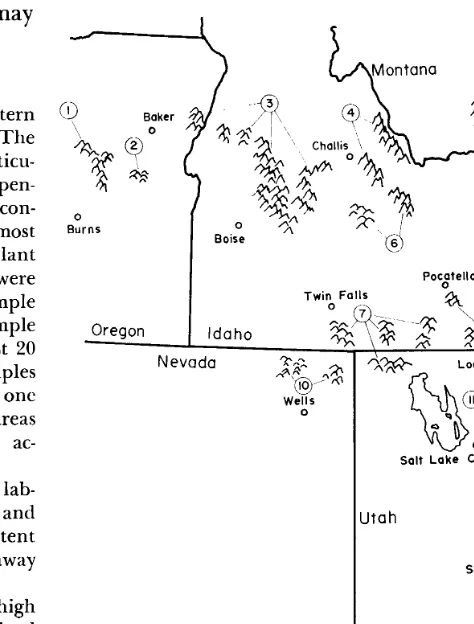
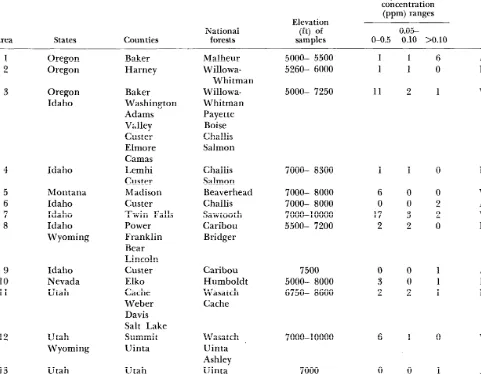
The high rangelands sampled were grouped into 14 areas according to geographic location (Fig. 1). Each range area was then classified according to the selenium level found in the forage sample (Table 1). Where
75%
or more of the samples con- tained more than 0.10 ppm selenium, the area was classified as adequate in selenium, even though it is realized that some ranges in this group may have localized areas of inadequate selenium in the for- age. Where 75% or more of the samnles containedCl
0 Burns
Baker
Q0
Wyomng
Jtah
Salina 0
34 14
FIG. 1. Geographic location of high northwestern ranges forage was sampled for determining selenium content.
where
less than 0.10 ppm selenium, the area was classified low or very low in selenium level depending upon the proportion containing less than 0.05 ppm selenium. Areas not falling in the described group- ings were classified as variable in selenium level. Some information on the geologic materials and the soil associations present in each area is also given in Table 1 (Ross and Forester, 1947, and Western Land Grant Universities and Colleges and the Soil Conservation Service, 1964).
236 CARTER, ROBBINS, AND BROWN
Table 1. Selenium concentration in forage from high summer ranges. Area locations are shown in Fig. 1.
Elevation (ft) of samples
Number of samples by selenium concentration
(PPm> ranges
0.05-
o-o.5 0.10 >O.lO Selenium level Area States Counties National forests
Oregon
Oregon Oregon Idaho
Baker Harney
Idaho Montana Idaho Idaho Idaho Wyoming
9 Idaho 10 Nevada 11 Utah
12 Utah Wyoming
Baker Washington Adams V;lley Custer Elmore Camas Lemhi Custer Madison Custer Twin Falls Power Franklin Bear Lincoln Custer Elko Cache Weber Davis Salt Lake Summit Uinta
13 Utah Utah 14 Utah Sevier
Malheur Willowa-
Whitman Willowa- Whitman Payette
Boise Challis Salmon
Challis Salmon Beaverhead Challis Sawtooth Caribou Bridger
Caribou Humboldt Wasatch Cache
Wasatch Uinta Ashley Uinta Fishlake
5000- 5500 5260- 6000
1 1
1
2
1 0 0 3 2
0 0 2
1
0 2
6 Adequate 0 Low
5000- 7250 11 Very low
7000- 8300 1 Low
7000- 8000 6
7000- 8000 0
7000-10000 17 5500- 7200 2
Very low Adequate Very low Low
7500 0
5000- 8000 3 6750- 8600 2
Adequate Low Low
7000-10000 6 0 Very low
7000 8000-10000
0
9
Adequate Variable 5
TOTAL 59 15 20
thors). The sample from area 9 contained 0.78 ppm selenium, the highest found in the study. Area 13 is part of the Uinta National Forest south of Payson, Utah. Areas 9 and 13 lie within areas mapped variable by Carter et al. (1968). Thus live- stock grazing summer ranges may or may not obtain adequate diet selenium for part of the year on these areas, depending upon the selenium content of winter feed.
Area 14 was the only range classified as variable. On this range, 69% of the samples contained less than 0.10 ppm selenium. Livestock losses from WMD in that area depend upon where the stock graze, supplement feeding programs and the sele- nium content of hay feed on home ranches. The WMD hazard is fairly high in area 14.
Five range areas produce forage classified as low in selenium level. These are areas 2, 4, 8, 10, and 11. Area 2 is south of Baker, Oregon in the Wil- lowa-Whitman National Forest. Area 4 represents
two ranges east of Challis, Idaho. Area 8 includes most of the high range in the southeastern corner of Idaho. Area 10 is the high range in northeastern Nevada, and area 11 is the Wasatch Mountain range in Utah. Livestock grazing forage on these ranges may not obtain adequate selenium to pro- tect young animals from WMD.
The remaining four range areas produce forage very low in selenium content. Area 3 includes a vast area north of Boise, Idaho which extends into Oregon. Area 5 is in southern Montana, and it lies within a region where alfalfa grown at lower elevations is also low in selenium (Carter et al., 1968). Area 7 includes portions of the Sawtooth National Forest in southern Idaho and Northern Utah. Area 12 is the Uinta Mountains in Utah with one sample from Wyoming.
SELENIUM IN FORAGE 237
Table 2. Geologic materials and soil associations for the sampling areas.
Area Geological materials present Soil associations present
1 Jurassic and Triassic rocks. Columbia River basalt.
2 Columbia River basalt Jurassic and Triassic rocks. Carboniferous rocks.
3
4
5
Columbia River basalt
Belt age argillites and quartzites. Paleozoic sedi- mentary rocks.
Jurassic and Triassic rocks.
Permian, undifferentiated, chert sandstone, lime- Granitic rock of the
stone, quartzite and shale. Pre-Belt gneiss, schist and related rock.
Idaho Batholith. Permian sedimentary rocks.
6
7
Paleozoic sedimentary rocks, undifferentiated. Chal- lis volcanics.
Snake River basalt, Idavada volcanics. Belt series argillites and quartzites. Some granitic rocks.
8
9
10
11
12
13
14
Mesozoic sedimentary rocks. Paleozoic sedimentary rocks. Alluvial and glacial deposits.
Mesozoic sedimentary rocks.
Idavada volcanics and silicic rocks of volcanic origin.
Knight Conglomerate, chiefly fluvial Ordovician rock. Nounan formation limestone and dolomite. Brigham Quartzite formation.
Mississippian rocks, undivided Early Tertiary, ande- sitic and pyroclastic rocks. Alluvial deposits. Mutual Formation, chiefly quartzite.
Early tertiary andesitic and pyroclastic rocks.
Late Tertiary basalt and basaltic andesite flows, Tertiary volcanic rocks, undifferentiated. Glacial outwash.
produces forage with adequate selenium to assure protecting livestock from WMD. Therefore, the hazard for livestock losses from WMD on these western ranges may be high. However, actual losses may not be great on all these ranges because of high vitamin E content of green forage, and other factors.
Incidence of WMD in calves and lambs is re- lated to the supply of selenium to the mother before the calves and lambs are born. There is some lasting protection against WMD when mother ani- mals have been supplied adequate selenium. How long the protection lasts depends upon many fac- tors such as the length of the adequate supply period and the selenium concentration in the sup- plying source relative to the critical protective level. Thus calves and lambs born on high summer ranges may not suffer WMD even though the
Soils of the cool to cold subhumid and humid forested regions (F). Western Brown Forest, Regosol and Lithosol
(F 14).
Soils of the cool to cold, subhumid and humid forested regions (F). Western Brown Forest, Regosol and Lithosol (F 14).
Soils of the cool to cold, subhumid and humid forested regions (F). Brown Podzolic, Lithosol and Regosol (F 2) and Western Brown Forest.
Dark colored soils of the subhumid regions (D). Prairie, Gray Brown Podzolic and Western Brown Forest (D 8). Dark colored soils of the subhumid regions (D). Cherno- zem, Prairie and Lithosol (D 4).
Dark colored soils of the subhumid regions (D). Prairie, Gray Brown Podzolic and Western Brown Forest (D 8). Dark colored soils of the subhumid regions (D). Prairie, Gray Brown Podzolic and Western Brown Forest (D 8). Prairie, Gray Wooded, Chestnut and Lithosol (D 10). Dark colored soils of the subhumid regions (D). Cheno- zem, Chestnut and Prairie (D 2). Prairie, Gray Brown Podzolic and Western Brown Forest (D 8).
Soils of the cool to cold, subhumid and humid forested regions (F). Gray Wooded, Gray Brown Podzolic, and Western Brown Forest (D 9).
Dark colored soils of the subhumid regions (D). Prairie and Lithosols (D 11).
Dark colored soils of the subhumid regions (D). Prairie, Gray Wooded, Chestnut and Lithosol (D 10).
Soils of the cool to cold, subhumid and humid forested regions (F). Gray Wooded, Podzol, and Lithosol (F 10). Dark colored soils of the subhumid regions (D). Prairie, Gray Wooded, Chestnut and Lithosol (D 10).
Dark colored soils of the subhumid regions (D). Prairie, Gray Wooded, Chestnut and Lithosols (D 10).
forage contains insufficient selenium. Protection of young animals can also be assured by injecting the mothers with selenium during gestation (Hidiroglou et al., 1965; and Mace et al., 1962). Another way to provide protective selenium on high ranges would be by supplying selenium-forti- fied salt, if it were approved for use (Paulson et al.,
1968).