Efficient Adaptively Secure IBBE from Standard Assumptions
Somindu C. Ramanna and Palash Sarkar Applied Statistics Unit
Indian Statistical Institute Kolkata, India.
E-mail: {somindu r,palash}@isical.ac.in
May 28, 2014
Abstract
This paper describes the first construction of efficient identity-based broadcast encryption (IBBE) schemes which can be proved secure against adaptive-identity attacks based on standard assumptions. The constructions are obtained by extending the currently known most efficient identity-based encryp-tion scheme proposed by Jutla and Roy in 2013. Ciphertext size and user storage compare favourably to previously known constructions. The new constructions fill both a practical and a theoretical gap in the literature on efficient IBBE schemes.
Keywords: identity-based encryption, broadcast encryption, identity-based broadcast en-cryption, Type-3 pairings, dual-system technique.
1
Introduction
Broadcast encryption (BE) enables broadcasting encrypted data to a set of users so that only a subset of these users, calledprivileged users, are able to decrypt. Users who are unable to decrypt the broadcasted information are calledrevoked users. The sets of privileged and revoked users form a partition of the set of all users and these sets can vary with each broadcast. A BE system is said to be collusion resistant if no information of the encrypted data is leaked even if all revoked users collude. BE has a wide range of applications including pay-TV, copyright protection of digital content and encrypted file systems.
At a broad level, there are two settings for BE. In symmetric key BE, there is a centre which pre-distributes key material to the users. During a broadcast, the actual message is encrypted with a session key and the session key undergoes several encryptions using a subset of keys corresponding to the privileged users. In such a scenario, it is not possible for an entity other than the centre to broadcast an encrypted message. BE in the public key setting (PKBE) addresses this problem. Users have public and private keys and anybody can broadcast an encrypted a message which can be decrypted by the intended set of privileged users.
1.1 Issues Regarding the Construction of IBBE Schemes
There are several important issues to be considered for IBBE schemes. Below we briefly discuss some of these issues.
Security model: The security model for IBBE allows an adversary to specify a target set of identities such that the adversary can compromise the security of an encryption to this target set. The model also allows the adversary to corrupt entities and obtain the decryption keys corresponding to their identities with the restriction that the corrupted set of identities is disjoint from the target set of identities. Depending on when the adversary specifies the target set leads to two different security notions. The weaker notion, called selective-identity security (summarised sID), requires the adversary to specify the target set before it can corrupt any entity. The stronger notion, called adaptive-identity security (summarised aID), allows the adversary to specify the target set after it has corrupted a set of identities (and also allows it to corrupt identities after specifying the target set). It is desirable to obtain schemes which are secure against adaptive-identity attacks.
Hardness assumption: As in most public-key schemes, the proof of security of the primitive is based on the assumption that some well formulated problem is computationally hard. There is a small subset of such problems which are considered to be standard. Apart from standard hardness assumptions, designers sometimes have to create new hard problems to effect a reduction. Since such non-standard problems are less studied, a basic theme of research is to try and obtain schemes which can be proved secure under standard assumptions.
Header size: In all BE schemes, the actual message undergoes a single encryption with a session key. In addition to this, the ciphertext contains some additional information which allows a privileged user to obtain the session key and recover the message. This additional information constitutes the header of the ciphertext. To reduce the communication overhead it is desirable to reduce the size of the header as much as possible. So, BE schemes with lower header sizes are preferrable.
User key size: The amount of key material that a user has to store is an important parameter. Practical deployment may require storing such material in smart cards. Consequently, it is of interest to try and reduce the size of user keys as much as possible.
Type of pairing: Constructions of IBBE falls in the general category of pairing-based cryptogra-phy. Such constructions require a bilinear pairing e : G1 × G2 → GT where G1,G2 and GT are
groups of some prime order Zp. Three kinds of pairings are identified in the literature: Type-1, where
1.2 Our Contributions
We present the first efficient IBBE constructions that achieve security against adaptive-identity attacks under standard hardness assumptions. All previously known schemes either achieved security against selective-identity attacks, or used non-standard assumptions, or could be obtained by specialising inner product encryption making them quite inefficient. Further, our constructions are based on Type-3 pairings, whereas previous works on IBBE used Type-1 pairings.
A simple way to encrypt a single message to a set of identities is to use an IBE scheme to encrypt it separately to each of the identities. Such a strategy, however, does not allow any savings in the header size. An IBE encryption results in a ciphertext which consist of several elements ofG1. To obtain a non-trivial IBBE scheme, it is of interest to try and share some of the group elements in the ciphertext across all the encryptions. This will lead to a reduction in the size of the ciphertext over the trivial scheme of separate encryption to each identity.
Currently, the most efficient IBE scheme that is known is due to Jutla and Roy [JR13] (actually a simple variant of their original proposal is the IBE of choice). In this work, we investigate the possibility of converting this IBE scheme into an IBBE scheme. The intuitive idea is to use share the randomiser across all the identities. Doing this directly, however, does not admit a security proof. To get around the problem, we need to put a bound on the size of the set of identities to which a single message can be simultaneously encrypted and then let the size of the public parameters be determined by this bound. The group elements in the public parameters allow the computation of polynomial hash of each of the identities. These hashes vary with the identities whereas the group elements which do not depend on the identity remain the same for all the identities. It is due to this feature that we are able to get a substantial practical reduction in the size of the ciphertext. The resulting scheme, denotedIBBE1, can be proved to be secure against adaptive-identity attacks using the dual-system proof technique introduced by Waters [Wat09]. The underlying hardness assumptions consists of the standard DDH assumption in the groupsG1 and G2 (DDH1 and DDH2 respectively).
Ciphertexts in IBBE1 contains`Zp elements (called tags) where `is the number of identities to which
encryption is to be done. Our second scheme,IBBE2, is a modification ofIBBE1 which provides a method whereby the number of tags in the ciphertext goes down and hence results in shorter ciphertexts. The proof of security of this scheme can be reduced from the proof of security ofIBBE1 using a hybrid argument. We describe a method whereby the tags can be generated using a hash function resulting in an even further reduction in the size of the ciphertext. The reduction is more significant in the case ofIBBE1 than in the case of IBBE2. The trade-off for doing this is that the hash function needs to be modelled as a random oracle for the security proof. User storage in bothIBBE1 andIBBE2 consists of a constant number of group elements ofG2.
1.3 Previous and Related Works
The notion of broadcast encryption was introduced by Fiat and Naor in [FN93]. They describe a symmetric key scheme that achieves bounded collusion resistance. The first fully collusion secure BE (for stateless receivers) was proposed by Naor, Naor and Lotspiech [NNL01]. They describe two symmetric key based BE constructions. Dodis and Fazio [DF02] used techniques from (hierarchical) identity-based encryption to instantiate the subset cover framework thereby leading to the first fully collusion resistant public key broadcast encryption (PKBE) schemes. The ciphertext size in their constructions is linear in the number of privileged users.
Boneh, Gentry and Waters [BGW05] proposed the first PKBE system achieving constant size cipher-texts. The scheme can be proved secure without random oracles but in the weaker selective model. Delerablee, Paillier and Pointcheval introduced dynamic broadcast encryption in [DPP07] and proposed two (partially) adaptively secure constructions.
The first adaptively secure schemes were proposed by Gentry and Waters [GW09] in both the public key and identity based settings. They describe two kinds of schemes – one achieving security without random oracles with ciphertext size linear in the number of privileged users and the other consisting of constant size ciphertexts with security relying on the use of random oracles. More recently, the case of adaptive CCA-security was considered in [PPS11, PPSS12]. The construction proposed in the later work consists of constant-size ciphertexts while the former does not.
All the schemes mentioned so far are secure under some non-standard and parametrised assumptions. The first BE scheme secure proved secure under static assumptions was proposed by Waters [Wat09] using the dual system encyrption method. The scheme has constant size ciphertexts but the user key size is linear in the total number of users. A revocation system with constant sized keys was proposed in [LSW10] with ciphertext size growing linearly in the number of revoked users and security from static assumptions.
The concept of identity-based broadcast encryption (IBBE) was formalised by Barbosa, Farshim [BF05] and independently by Baek, Safavi-Naini, Susilo [BSNS05]. They called it multi-receiver identity-based encryption (MR-IBE). The work [BSNS05] described a pairing based construction based on the Boneh-Franklin IBE [BF03] that could be proved selectively secure in the random oracle model. A key encap-sulation scheme for multiple parties obtained by extending the OR-construction of Smart [Sma04] to the identity-based setting was presented in [BF05]. Security relies on the use of random oracles.
The construction in [PKL08] (a corrected and improved version of [CS06b]) achieves a trade-off between the ciphertext size and the user key size. Ciphertexts are of size|S|/N, and user secret keys are of size N whereN is a parameter of the protocol (representing the maximum number of identities that the adversary is allowed to corrupt during simulation). This was the first scheme with sub-linear sized ciphertexts.
Abdallaet al.[AKN07] provided a generic construction from “wicked IBE” with constant-sized cipher-texts but user storage quadratic ism, the maximum number of recipients of a ciphertext. Both schemes ([PKL08] and [AKN07]) are selectively secure without random oracles. In 2007, Delerablee [Del07], pro-posed an IBBE construction with constant size ciphertexts and secret keys. The public parameters have sizeO(m). Security was proved in the selective identity model.
IBBE can be viewed as a special case of inner product encryption [LOS+10, OT11, OT12]. Most adaptively secure inner product encryption schemes are constructed using dual pairing vector spaces and hence lead to very inefficient schemes. This is because ciphertexts and keys usually consists vectors of dimension at least 4 (over G1 orG2) resulting in too much ciphertext overhead in the broadcast setting. It is due to this reason, we do not compare with IBBE schemes that can be obtained by specialising inner product encryption.
1.4 Comparison to Existing Schemes
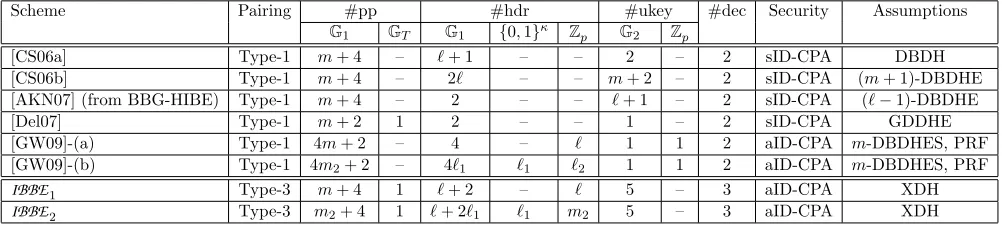
Tables 1 and 2 provide comparison of IBBE1, IBBE2, IBBE RO
1 and IBBE RO
2 with previously known IBBE systems secure with and without random oracles repectively. The ones derived as special cases of inner-product encryption have been omitted due to reasons explained earlier. Apart from these, we have tried to include all previously known IBBE schemes appearing in the literature.
We consider the following schemes for comparison: the early selectively secure constructions [BSNS05, BF05] based on random oracles (ROs); constructions in [CS06a, CS06b] with selective security and with-out ROs; constant-size ciphertext IBBE schemes selectively secure (with and withwith-out ROs) proposed by Delerablee [Del07]; generic constructions of IBBE schemes from “wicked” IBE schemes by Abdalla-Kiltz-Neven [AKN07] instantiated with BBG-HIBE (without ROs) and GS-HIBE (with ROs); two adaptively secure IBBE constructions proposed by Gentry and Waters [GW09] – one with linear size (in number of privileged users) ciphertexts and the other with sub-linear size ciphertexts refered to as (a) and (b) respectively and a variant of scheme (a) based on ROs.
The basis for comparison are the following parameters – type of pairing, number of group elements in PP (denoted #pp) from G1 and GT, number elements in Hdr (#hdr) from G1 and {0,1}n (in case a KDF is used), number of elements in a user key (#ukey) fromG2 and Zp, number of pairings required for
decryption, security model and computational assumptions. mdenotes the maximum size of the privileged users’ set. ` (≤ m) is the size of the intended recipient set chosen during encryption. In construction [GW09]-(b) as well as scheme IBBE2, the maximum number of privileged users is given by m = m1m2. The size of the set of users chosen during encryption is given by ` = `1`2 where `1 ≤ m1 and `2 ≤ m2. In the comparison, we ignore descriptions of hash functions, pseudorandom functions (PRFs) and other parameters that do not have any significant effect on the space-efficiency.
In the paper by Gentry and Waters [GW09], construction (b) consists of`1 separate symmetric encryp-tions of the message under the `1 keys generated by calls to the encapsulation algorithm of construction (a). In practice, the `1 keys would be used to mask a single session key via a KDF and there would be single encryption of the message under the session key. We take this into account in the comparison tables.
The short-hand ‘sID’ is used to indicate selective identity security and ‘aID’ is used to indicate security against adaptive-identity attacks. ‘CCA’ stands for chosen ciphertext attack whereas ‘CPA’ stands for chosen plaintext attacks. Apart from [BF05] all other schemes, including ours, have been proved secure against CPA. While CCA-security is the final desired goal, the first challenge in the design of IBBE schemes is to be able to handle adaptive-identity attacks. Most of the research on this topic have focussed on this goal. Given that our constructions provide satisfactory solutions to the first problem, adapting known techniques to efficiently achieve CCA-security should form the focus of future work.
The XDH assumption is a single name for the two decisional Diffie-Hellman (DDH) assumptions in the groups G1 and G2.
Scheme Pairing #pp #hdr #ukey #dec Security Assumptions
G1 GT G1 {0,1}κ G2 Zp
[BSNS05] Type-1 3 – `+ 1 – 1 – 2 sID-CPA DBDH
[BF05] Type-1 3 – 3` – 1 – 2 sID-CCA Gap-BDH
[AKN07] (from GS-HIBE) Type-1 m+ 2 1 `+ 1 – O(m) – `+ 1 sID-CPA DBDH
[Del07]-ROM Type-1 m+ 2 1 2 – 1 1 2 sID-CPA GDDHE
[GW09]-(a)-ROM Type-1 4m+ 2 – 4 – 1 1 2 aID-CPA m-DBDHES
IBBERO
1 Type-3 m+ 4 1 `+ 2 1 5 – 3 aID-CPA XDH
IBBERO
2 Type-3 m2+ 4 1 `+ 2`1 `1+ 1 5 – 3 aID-CPA XDH
Table 1: Comparison of IBBERO
1 and IBBE RO
2 with previously known IBBE systems in the random oracle model. In the case of Type-1 pairings,G2 is the same as G1.
Scheme Pairing #pp #hdr #ukey #dec Security Assumptions
G1 GT G1 {0,1}κ Zp G2 Zp
[CS06a] Type-1 m+ 4 – `+ 1 – – 2 – 2 sID-CPA DBDH
[CS06b] Type-1 m+ 4 – 2` – – m+ 2 – 2 sID-CPA (m+ 1)-DBDHE [AKN07] (from BBG-HIBE) Type-1 m+ 4 – 2 – – `+ 1 – 2 sID-CPA (`−1)-DBDHE
[Del07] Type-1 m+ 2 1 2 – – 1 – 2 sID-CPA GDDHE
[GW09]-(a) Type-1 4m+ 2 – 4 – ` 1 1 2 aID-CPA m-DBDHES, PRF [GW09]-(b) Type-1 4m2+ 2 – 4`1 `1 `2 1 1 2 aID-CPA m-DBDHES, PRF
IBBE1 Type-3 m+ 4 1 `+ 2 – ` 5 – 3 aID-CPA XDH
IBBE2 Type-3 m2+ 4 1 `+ 2`1 `1 m2 5 – 3 aID-CPA XDH
Table 2: Comparison of IBBE1 and IBBE2 with existing IBBE systems without random oracles. In the case of Type-1 pairings,G2 is the same asG1.
Based on Tables 1 and 2, we have the following observations.
1. Apart from IBBE1, IBBERO1 , IBBE2, IBBERO2 and the constructions of Gentry and Waters [GW09] (denoted (a), (b), (a)-ROM), all other schemes listed in the tables are secure only in the weaker selective identity model.
2. IBBE1,IBBE2 are the only known constructions to achieve adaptive security from the standard and static DDH assumptions. The GW constructions are based on non-standard assumptions.
3. The GW constructions have better ciphertext sizes whereas our constructions have better public parameter sizes. The trade-off is the use of a non-static assumption, i.e., the hardness assumption is parameterised bym.
4. Even though the new constructions achieve stronger security from the standard XDH assumption, this is not done at a loss in efficiency. The ciphertext size, user storage and also the encryption and decryption times are comparable to previous constructions. Apart from the comparison of the number of group elements, it is also to be noted that the new constructions use Type-3 pairings whereas the previous constructions used Type-1 pairings. This leads to significantly smaller sizes for
2
Preliminaries
In this section, we define some notation and then review pairings, complexity assumptions required for the proofs, and formal definitions related to identity-based broadcast encrytion.
2.1 Notation
The notationx1, . . . , xk
R
←− X indicates that elements x1, . . . , xk are sampled independently from the set
X according to some distribution R. We use U to denote the uniform distribution. For a (probabilistic) algorithm A, y ←− A(x) means thatR y is chosen according to the output distribution of A on input x. A(x;r) denotes thatA is run on inputx with its internal random coins set to r. For two integers a < b, the notation [a, b] represents the set{x∈Z:a≤x≤b}. IfGis a finite cyclic group, thenG×denotes the
set of generators ofG.
2.2 Asymmetric Pairings and Hardness Assumptions
A bilinear pairing is a 7-tuple G = (p,G1,G2,GT, e, P1, P2) where G1 = hP1i, G2 = hP2i are written additively and GT is a multiplicatively written group, all having the same order p ande:G1×G2 →GT
is a map with the following properties.
1. Bilinear: For P1, Q1 ∈G1 and P2, Q2 ∈G2, the following holds:
e(P1, P2+Q2) =e(P1, P2)e(P1, Q2) and e(P1+Q1, P2) =e(P1, P2)e(Q1, P2).
2. Non-degenerate: If e(P1, P2) = 1T, the identity element of GT, then eitherP1 is the identity of G1 orP2 is the identity ofG2.
3. Efficiently computable: The function eshould be efficiently computable. Three main types of pairings have been identified in the literature [SV07, GPS08].
Type-1 In this type, the groupsG1 and G2 are the same.
Type-2 G1 6=G2 and an efficiently computable isomorphismψ:G2 →G1 is known.
Type-3 Here,G16=G2 and no efficiently computable isomorphisms betweenG1 and G2 are known.
The constructions we provide are based on Type-3 pairings. The assumptions based on which the security of our constructions is proven are the decision Diffie-Hellman (DDH) assumptions in groups G1 and G2, called DDH1 and DDH2 respectively. Below, we describe these two assumptions. Let G = (p,G1,G2,GT, e, P1, P2) be an asymmetric pairing andA, a probabilistic polynomial time (PPT) algorithm
A that outputs 0 or 1.
Assumption DDH1. Define a distribution Das follows: P1 U
←−G×1;P2 U
←−G×2,a, s←−U Zp,µ←−U Zp; D= (G, P1, aP1, asP1).The advantage ofA in solving the DDH1 problem is given by
AdvDDH1G (A) =|Pr[A(D, sP1) = 1]−Pr[A(D,(s+µ)P1) = 1]|.
Assumption DDH2. Let a distribution D be defined as follows: P1 U
←− G×1; P2 U
←− G×2, r, c U ←− Zp,
γ ←−U Zp;
D= (G, P1, P2, rP2, cP2).
A’s advantage in solving the DDH2 problem is given by
AdvDDH2G (A) =|Pr[A(D, rcP2) = 1]−Pr[A(D,(rc+γ)P2) = 1]|.
The (ε, t)-DDH2 assumption is that, for anyt-time algorithmA,AdvDDH2G (A)≤ε.
2.3 Identity-Based Broadcast Encryption (IBBE)
Identity-based broadcast encryption (IBBE) is usually defined following the hybrid encryption (KEM-DEM) paradigm. The IBBE key encapsulation mechanism (KEM) produces a session key along with a header. This session key is uses to encrypt the message via the data encapsulation mechanism (DEM). The DEM can be instantiated to any secure symmetric key encryption scheme. The security of the IBBE would then rely on the security of the KEM. Our main interest is designing secure IBBE-KEMs. The details of the symmetric encryption portion (DEM) is omitted and also not considered in the security proof. Furthermore, for the sake of simplicity, we use the term IBBE in place of IBBE-KEM.
Definition 2.1 (IBBE). An IBBE scheme is defined by four probabilistic algorithms – Setup, Encap,
KeyGen and Decap. The identity space is denoted I and the key space for the symmetric encryption scheme is denoted byK.
Setup(κ, m) Takes as input a security parameterκand the maximum numbermof identities in a privileged recipient group. It outputs the public parametersPP and the master secretMSK.
KeyGen(MSK,id) Input is an identity id and master secretMSK; output is a secret key SKid forid.
Encap(PP, S ⊆I) Takes as input a set of identities S that are the intended recipients of the message. If |S| ≤m, the algorithm outputs a pair (Hdr, K) where Hdr is the header and K ∈ K is the session key.
Decap(PP, S,id,SKid,Hdr) Inputs the public parameters, a setS ={id1, . . . ,id`}, an identity id, a secret
keySKid corresponding toidi, a header Hdrand outputs the session keyK ifid∈S.
The message to be broadcast is encrypted using a symmetric encryption scheme Sym = (Sym.Encrypt,Sym.Decrypt) with key space K. Let C ←−R Sym.Encrypt(K, M) where M is the message to be broadcast and K is the session key returned by Encap algorithm. The broadcast consists of the triple (S,Hdr,C). The full header is given by (S,Hdr). During decryption, the keyK output by theDecap
algorithm is used to decryptC to obtain the messageM asM =Sym.Decrypt(K,C).
Correctness. The IBBE scheme satisfies the correctness condition if for all setsS ⊆I with|S| ≤m, for all idi ∈S, if (PP,MSK)
R
←−Setup(κ,I, m), SKidi ←−R KeyGen(MSK,idi), (Hdr, K)
R
←−Encap(PP, S), the Pr[K =Decap(PP, S,idi,SKidi,Hdr)] = 1.
Setup: The challenger runs theSetupalgorithm of the IBBE and gives the public parameters toA.
Key Extraction Phase 1: A makes a number of key extraction queries adaptively. For a query on an identity vectorid, the challenger responds with a keySKid.
Challenge: A provides a challenge set Sb with the restriction that ifid is queried in the key extraction
phase 1, then id ∈/ S. The challenger computes (b Hdrd, K0)
R
←− Encap(PP,S) and choosesb K1
U
←− K. It then chooses a bitβ uniformly at random from{0,1} and returns (Hdrd, Kβ) to A.
Key Extraction Phase 2: A makes more key extraction queries with the restriction that it cannot query a key for any identity inS.b
Guess: A outputs a bit β0.
If β =β0, then A wins the game. The advantage of A of the IBBE scheme in winning the ind-cpa is given by
AdvindIBBE-cpa(A) =
Pr[β=β0]−1 2
.
The IBBE scheme is said to be (ε, t, q)-IND-ID-CPAsecure if everyt-time adversary making at mostq key extraction queries hasAdvindIBBE-cpa(A)≤ε.
3
IBBE – A First Construction
Our IBBE constructions are based on a vairiant of the Jutla-Roy IBE [JR13] defined in [RS13] refered to as JR-IBE-D. The following section describes the IBE scheme.
3.1 Variant of Jutla-Roy IBE
We use a compact notation to denote normal and semi-functional ciphertexts and keys. The group elements shown in curly brackets{ }are the semi-functional components. To get the scheme itself, these components should be ignored.
Parameters: Choose P1 U
←− G×1, P2 U
←− G×2, α1, α2,∆1,∆2,∆3, c, d, e U
←− Zp, b ←−U Z×p,and set U1 = (−∆1b+d)P1, V1 = (−∆2b+e)P1, W1 = (−∆3b+c)P1,gT =e(P1, P2)α1+bα2. The parameters are given by
PP : (P1, bP1, U1, V1, W1, gT)
MSK: (P2, cP2, α1, α2,∆1,∆2,∆3, d, e) Ciphertext:
tag, s←−U Zp,{µ←−U Zp} C0 =m·(gT)s{×e(P1, P2)uµ},
C1 =sP1{+µP1}, C2=sbP1, C3 =s(U1+idV1+tagW1){+µ(d+id·e+tag·c)P1}. Key:
r←−U Zp,{γ, π
U ←−Zp}
3.2 Overview of the IBBE Construction
We start by providing a brief overview of our first IBBE construction –IBBE1. The starting point is JR-IBE-D that achieves adaptive-identity security from the DDH assumptions inG1 and G2. LetN1, N2, NT
and Np denote the sizes of representation of elements in G1,G2,GT and Zp respectively. A ciphertext in
JR-IBE-D consists of the three elementsC1, C2 andC3 fromG1; the elementC0 fromGT; and the element
tagfrom Zp. The size of one ciphertext isNT + 3N1+Np.
Now consider the setting of identity-based broadcast encryption. Suppose thatS ={id1, . . . ,id`} ⊆I
is a set of identities corresponding to the intended recipients of a message. A natural way to extend the IBE scheme to the broadcast setting is as follows. The user keys will be the usual IBE decryption keys and the public parameters will also remain the same. Components C1, C2 would still remain the same since they are independent of the identity. The mask (gT)s used to encrypt the message inC0 will now play the role of the session key i.e.,K= (gT)s. Introduce separate identity-hashes for each identity but randomised with the same scalar. In particular, C3 is replaced by C3,i=s(U1+idiV1+tagiW1), i∈[1, `].
We would like to emphasise that having separate hashes for each identity requires the use of separate tags for the different hashes. Otherwise, one can get hold ofsV1 by just taking the difference betweenC3,i
and C3,j for some i6=j. With sV1, an attacker can construct a header for S0 =S∪ {id} for any id of its choice. This header when decapsulated using a secret key for id, results in the same session key that the header for S encapsulates. So, not having separate tags makes the scheme insecure.
For the scheme with separate tags as described above the header size will be (2 +`)N1+`Np. This is
better than performing separate IBE encryptions for each identity resulting in header size of`(NT+ 3N1+ Np). However, the scheme as described does not seem to admit a security proof. Defining C3,i as above
leads to problems during simulation within the dual system framework. To see why the above method fails, we take a look at the dual system proof of JR-IBE-D.
The structure of dual-system proof: In a dual system proof for IBE, two types of ciphertexts and keys are defined – one is normal (as generated in the scheme) and the other is semi-functional (defined using some secret information possibly available only in the master secret). The proof is organised as a hybrid over a sequence of games where the challenge ciphertext and the secret keys returned as responses to key extraction queries are changed to semi-functional form. Once this is done, a final game is defined where the message encrypted by the challenge ciphertext is switched to random. This is mainly to argue about indistinguishability of ciphertexts. The security guarantee is obtained by showing that any two successive games are indistinguishable based on the hardness of some problems (DDH1, DDH2 in case of JR-IBE-D).
To this end, an important step is to show that a normal key is computationally indistinguishable from a semi-functional key. When the attacker requests a key for an identity id, a DDH2 instance is embedded in the key SKid in such a way that the power of the attacker in determining whether SKid is normal or semi-functional can be used to sovle the particular instance. At the same time the simulator needs to create a valid semi-functional ciphertext for the challenge identityidb. One must also ensure any semi-functional
ciphertext that the simulator creates for id cannot provide any extra advantage in solving the problem instance. All this is achieved by embedding a degree one polynomial f(x) = Ax+B in both the tagc in
the ciphertext foridb and the scalar π in the semi-functional components of SKid. Moreover, A and B are
First of all, a degree one polynomial in random variables A, B provides pairwise independence when evaluated at two different points (A, B are uniformly and independently distributed). This ensures correct distribution ofπ =f(id) andtag=f(idb). Secondly, the only way of creating a semi-functional ciphertext
for an identityid0 is by settingtag0 =f(id0) implying that any attempt by the simulator to create a semi-functional ciphertext forid will set tag=π. As a result, decryption is successful and the simulator gains no information about the semi-functionality ofSKid.
Independence issue for IBBE scheme: In the extension to the broadcast setting discussed above, we need to argue about the independence of`btagstag1, . . . ,tag
b
` in the challenge header forSb={idb1, . . . ,idb`b},
plus the scalarπ in the secret key for someid ∈/ S. Also we need to argue about the joint distribution ofb
all the tags in a single step since they all share the same randomiser. A degree one polynomial does not provide sufficient amount of randomness to do so. This is exactly where the dual system argument fails.
To overcome this problem, we introduce the restriction that the maximum size of a privileged users’ should be at most m. Then we replace the JR-IBE-D identity hash by a degree-m polynomial hash in the identity. Such a polynomial provides (m+ 1)-wise independence. Since one needs to argue about the independence of at mostm tags and oneπ, this hash will suffice for a dual system proof.
The coefficients of the polynomial are determined by the public parameters. So instead of U1, V1,PP will now contain elementsU1,jforj = 0, . . . , m. Define componentC3,iasC3,i=s(Pmj=0(idi)jU1,j+tagiW1) foridi ∈S. Also, as in JR-IBE-D, U1,j’s and W1 are created using linear combinations of certain scalars in the master secret i.e.,U1,j= (ej +b∆j)P1 forj= 0, . . . , mand W1= (c+b∆)P1. So the secret key for an identityid will now consist of the two subhashes Pm
j=0(id)jej and
Pm
j=0(id)j∆j. These sub-hashes are combined usingbinC2 during decryption to cancel out the hash inC3,i ifid=idi.
The technique of using polynomials to hash identities has been used earlier by Chatterjee and Sarkar in [CS06a] in the context of IBBE. However, they only obtain weaker security against selective-identity attacks.
3.3 Construction of IBBE1
We define our first IBBE construction
IBBE1 = (IBBE1.Setup,IBBE1.Encrypt,IBBE1.KeyGen,IBBE1.Decrypt)
as follows.
IBBE1.Setup(κ, m): Generate a Type-3 pairing (p,G1,G2,GT, e, F1, F2) based on the security parameter κ. Here, I =Zp and K = GT. In practice, a hash function can be used to map GT to the actual key
space of the symmetric encryption scheme. Compute parameters as follows.
P1 U
←−G×1, P2 U ←−G×2 α1, α2, c,∆,(ej,∆j)mj=0
U
←−Zp, b←−U Z×
p,
U1,j = (∆jb+ej)P1 forj= 0, . . . , m, W1 = (∆b+c)P1, gT =e(P1, P2)α1b+α2,
IBBE1.KeyGen(MSK,id): Choose r U
←− Zp and compute the secret key SKid = (D1, D2, D3, D4, D5) as follows.
D1 =rP2, D2 =rcP2, D3=
α1+r(Pmj=0(id)jej)
P2, D4 =r∆P2, D5=
α2+r(Pmj=0(id)j∆j)
P2,
IBBE1.Encap(PP, S = {id1, . . . ,id`}): If ` ≤ m, pick s,(tagi)`i=1 U
←− Zp. Compute the session key as K=gTs. The header is given byHdr= (C1, C2,(C3,i,tagi)`i=1) where
C1 =sP1, C2 =sbP1,
C3,i=s(Pmj=0(idi)jU1,j+tagiW1) for i= 1, . . . , `.
IBBE1.Decap(PP, S,id,SKid,Hdr): Suppose thatS={id1, . . . ,id`}. Ifid∈S, there is some index i∈[1, `]
such thatid=idi. The session key is derived as follows.
K = e(C1,tagiD2+D3)e(C2,tagiD4+D5) e(C3,i, D1)
.
Correctness: Let S ={id1, . . . ,id`} ⊆ I with `≤ m. Let (Hdr, K) ←− IBBE1.Encap(PP, S;s) where
Hdr= (C1, C2,(C3,i,tagi)`i=1) and letSKidi R
←−IBBE1.KeyGen(MSK,idi;r) for some idi ∈S.
e(C1,tagiD2+D3)e(C2,tagiD4+D5) e(C3,i, D1)
= e(sP1,tagi·rcP2+ (α1+r(
Pm
j=0(idi)jej))P2)·e(sbP1,tagir∆P2+ (α2+r(
Pm
j=0(idi)j∆j))P2) e(s(Pm
j=0(idi)jU1,j+tagiW1), rP2)
= e(sP1, α1P2)·e(sP1, P2)
tagirc+r(
Pm
j=0(idi)jej)·e(sP
1, bα2P2)e(sP1, P2)tagi·r∆b+r(
Pm
j=0(idi)j∆jb) e((Pm
j=0(idi)j∆jb+tagi∆b+ Pm
j=0(idi)jej+tagic)P1, P2)rs
= e(P1,(α1+bα2)P2)
s·e((Pm
j=0(idi)j∆jb+tagi∆b+ Pm
j=0(idi)jej +tagic)P1, P2)rs e((Pm
j=0(idi)j∆jb+tagi∆b+ Pm
j=0(idi)jej +tagic)P1, P2)rs =gsT.
Header size and user storage: The header consists of (2 +`) elements ofG1,`elements ofZp and one
element ofGT. Using the previous notation, the size of the header is (2 +`)N1+`Np+NT. The number
of keys to be stored by each user consists of 5 elements ofG2.
Use of random oracles. Let H :{0,1}κ×[1, m]→
Zp be a hash function that takes a seed (sayz) of
lengthκ, an index i∈[1, m] as input and produces a value inZp as output. IfH is modeled as a random
oracle, then for distinct inputs, the outputs will be independent and uniformly distributed inZp. Such an
IBBERO
1 makes. Note that the use of random oracles is “minimal”. It may be possible to use ROs more effectively to further reduce the header size.
Getting rid of tags? It would be nice to be able to completely get rid of the tags. These tags play a crucial role in the dual system proof. Lewko and Waters [LW10] proposed a different type of dual system encryption where the role of the tags is shifted to some scalars in the semi-functional components (similar to the scalarπin aIBBE1 secret key). However, one must also ensure that a semi-functional component can be decrypted by a normal key which in turn requires that these scalars in the semi-functional components cancel out during decryption. This can be done with multiple copies of the identity hash (as in [LW10]) in the ciphertext. In the context of broadcast encryption, having multiple copies of the identity hash in the ciphertext increases the header size. So, it does not seem likely that the technique of [LW10] will help reduce the header size any further.
Restriction on the size of the identity set: In the encapsulation algorithm we have assumed that the number of identities ` to which the message is to be encrypted is at most m, the parameter of the IBBE scheme. If it turns out that ` > m, then the set of identities will be divided intod`/megroups and the encapsulation algorithm will be applied separately to each group. The resulting header size will be d`/me((m+ 2)N1+mNp+NT). Since this is quite routine, we will simply analyse the scheme under the
assumption that`≤m.
3.4 Security of IBBE1
The schemeIBBE1 is proved secure in the sense ofIND-ID-CPA (Section 2.3, Definition 2.2) via the dual system technique. The following theorem formally states the security guarantee we prove for the scheme
IBBE1.
Theorem 3.1. If (εDDH1, t1)-DDH1 and (εDDH2, t2)-DDH2 assumptions hold in G1 and G2 respectively, then IBBE1 is (ε, t, q)-IND-ID-CPA-secure where ε ≤ εDDH1+ 2q ·εDDH2 + (q/p), t1 = t+O(m2ρ) and t2=t+O(m2ρ). ρ is the maximum time required for one scalar multiplication in G1 and G2.
Proof. We start by appropriately defining semi-functional headers and user keys for IBBE1. Let
IBBE1.SFEncap and IBBE1.SFKeyGen be algorithms that generate semi-functional headers and user keys (respectively) described as follows.
IBBE1.SFEncap(PP,MSK, S,(Hdr, K)): Takes as input a header-key pair created by IBBE1.Encap algo-rithm on a set S and modifies it to obtain semi-functional header and session key. Let S ={id1, . . . ,id`}
and Hdr= (C1, C2,(C3,i,tagi)`i=1). Pickµ U
←−Zp and modify K and the components ofHdras follows.
K←K·e(P1, P2)α1µ, C1←C1+µP1, C2 ←C2,
C3,i←C3,i+µ( m X
j=0
(idi)jej+tagi·c)P1 fori= 1, . . . , `.
Return the modified session keyK along with the header Hdr= (C1, C2,(C3,i,tagi)`i=1).
γ, π←−U Zp,
D1 ←D1, D2 ←D2+γP2, D3←D3+γπP2, D4 ←D4−
γ
b
P2, D5 ←D5−
γπ
b
P2.
The resulting keySKid= (D1, . . . , D5) is returned.
We need to show that all the semi-functionality properties are satisfied. Let (Hdr = (C1, C2,(C3,i,tagi)`i=1), K) be a header-key pair for the set S = {id1, . . . ,id`} and let SKidi be a user key for an identityidi∈S. Consider the following cases.
SKidi is semi-functional and (Hdr, K) is normal: Let SKidi ←− IBBE1.SFKeyGen(MSK,SK0id i;γ, π) whereSK0id
i is a normally generated key for idi. The requirement is that when Hdris decapsulated withSKid, the result isK. The following calculation shows that this requirement is satisfied.
e(C1,tagiD2+D3)e(C2,tagiD4+D5) e(C3,i, D1)
=K·e(sP1,tagiγP2+γπP2)e(sbP1,−tagi(γ/b)P2−(γπ/b)P2) =K·e(sP1,tagiγP2+γπP2)e(sP1,−tagiγP2−γπP2)
=K.
The second step follows from the correctness condition i.e., a normal header when decapsulated with a normal user key gives the corresponding normal session key.
SKidi is normal and (Hdr, K) is semi-functional: Let (Hdr0, K0) be a normally generated header-key pair and let (Hdr, K)←−IBBE1.SFEncap(PP,MSK, S,(Hdr0, K0);µ). We have
e(C1,tagiD2+D3)e(C2,tagiD4+D5) e(C3,i, D1)
=K· e(µP1,tagiD2+D3) e(µ(Pm
j=0(idi)jej+tagi·c)P1, D1)
=K·e(µP1, r(
Pm
j=0(idi)jej+tagi·c)P2) e(µ(Pm
j=0(idi)jej+tagi·c)P1, rP2) =K,
as required.
Both SKidi and (Hdr, K) are semi-functional: Let (Hdr0, K0) be a normally generated header-key pair and SKidi a normal key for idi. Also let (Hdr, K) ←− IBBE1.SFEncap(PP,MSK, S,(Hdr
0, K0);µ) and SKidi ←− IBBE1.SFKeyGen(MSK,SK0idi;γ, π). In this case, the key obtained by running the
IBBE1.Decapalgorithm is masked by a factor ofe(P1, P2)µγ(tagi+π) as shown below.
e(C1,tagiD2+D3)e(C2,tagiD4+D5) e(C3,i, D1)
In the second step we retain only pairings between semi-functional components since all other pairings involving semi-functional components get cancelled.
Note that the masking factor vanishes when tagi =−π. Then SKidi and thei-th component of Hdr
are callednominally semi-functional.
Now, given that semi-functional algorithms are defined, consider a sequence of gamesGreal,G0, (Gk)qk=1,
Gf inal between an adversaryA and a challenger with the games defined as follows.
• Greal: the actual IBBE security gameind-cpa(described in Section 2.3).
• Gk, 0 ≤ k ≤ q: challenge header is semi-functional; K0 is semi-functional; first k user keys are semi-functional.
• Gf inal: challenge header is semi-functional; K0 is random.
LetX denote the event that A wins inG. In Lemmas 3.1, 3.2 and 3.3, we show that
• |Pr[Xreal]−Pr[X0]| ≤εDDH1,
• |Pr[Xk−1]−Pr[Xk]| ≤εDDH2,
• |Pr[Xq]−Pr[Xf inal]| ≤q/p.
Clearly, the bit β is statistically hidden from the attacker in Gf inal, which means that Pr[Xf inal] = 1/2.
Hence, the advantage ofA in breaking the security of IBBE1 is thus given by
AdvindIBBE-cpa
1 (A) =|Pr[Xreal]− 1 2|
=|Pr[Xreal]−Pr[Xf inal]|
≤ |Pr[Xreal]−Pr[X0]|+
q X
k=1
(|Pr[Xk−1]−Pr[Xk]|)
+|Pr[Xq]−Pr[Xf inal]|
≤εDDH1+ 2qεDDH2+q p.
In the sequel, B1 (resp. B2) is a DDH1-solver (resp. DDH2-solver). We argue that B1, using the adversary’s ability to distinguish betweenGrealandG0, can solve DDH1. Similarly,A’s power to distinguish betweenGk−1 and Gk fork∈[1, q], can be leveraged to build a DDH2-solver B2.
Lemma 3.1. |Pr[Xreal]−Pr[X0]| ≤εDDH1.
Proof. Let (G, P1, bP1, sbP1, P2,(s+µ)P1) be the instance of DDH1 thatB1 has to solve i.e., decide whether µ= 0 or µ∈U Zp. The phases of the game are simulated byB1 as described below.
Setup: Chooseα1, α2, c,∆,(ej,∆j)mj=0 U
U1,j = ∆j(bP1) +ejP1 forj= 0, . . . , m, W1= ∆(bP1) +cP1, gT =e(P1, P2)α1e(bP1, P2)α2
PP : (P1, bP1,(U1,j)mj=0, W1, gT)
All the secret scalars present in the MSK are known. B1 can thus create normal keys. However, B1’s lack of knowledge of the scalarb or its encoding inG2 does not allow it to create semi-functional keys. Key Extraction Phases 1 & 2: B1 answers all of A’s queries with normal keys generated by the
IBBE1.KeyGenalgorithm.
Challenge: A sends a challenge set Sb={idb1, . . . ,idb b
`}. B sets (Hdrd, K0) as follows.
Fori= 1, . . . ,`, chooseb tagci
U ←−Zp,
K0 =e(sbP1, P2)α2e((s+µ)P1, P2)α1 =gsTe(P1, P2)
α1µ,
b
C1 = (s+µ)P1 =sP1+µP1,
b
C2 =sbP1,
Fori= 1, . . . ,`,b b
C3,i= (Pmj=0∆j(idbi)j+tagci·∆)(sbP1) + (Pmj=0ej(idbi)j+tagci·c)(s+µ)P1 = (Pm
j=0(idbi)j(∆jb+ej) +tagci(∆b+c))(sP1) + ( Pm
j=0ej(idbi)j +tagci·c)(µP1)
=s(Pm
j=0(idbi)jU1,j+tagciW1) +µ(
Pm
j=0ej(idbi)j +tagci·c)P1.
B1 sets Hdrd = (Cb1,Cb2,(Cb3,i,tagci)`ib=1). It then samples K1 U
←− GT, β ←− {0,U 1} and returns the pair (Hdrd, Kβ) to A. Observe that (Hdrd, K0) is normal if µ= 0 and semi-functional whenµ∈UZp.
Guess: A outputs its guess β0 and halts.
Breturns 1 ifA’s guess is correct i.e.,β =β0; otherwiseB1 returns 0. The advantage ofB1 in solving the DDH1 instance is given by
AdvDDH1G (B1) =|Pr[B1 returns 1|µ= 0]−Pr[B1 returns 1|µ∈UZp]|
=|Pr[β =β0|µ= 0]−Pr[β=β0|µ∈UZp]|
=|Pr[A wins inGreal]−Pr[A wins in G0]| =|Pr[Xreal]−Pr[X0]|.
SinceAdvDDH1G (B1)≤εDDH1, we have |Pr[Xreal]−Pr[X0]| ≤εDDH1. Lemma 3.2. |Pr[Xk−1]−Pr[Xk]| ≤εDDH2.
Proof. B2 is given an instance (G, P1, P2, rP2, cP2,(rc+γ)P2) of DDH2 and has to decide whether γ = 0 orγ ∈UZp. It simulates the game as described below.
Setup: Pick scalarsα1, α02, c,∆0,(ej,1, ej,2,∆0j)mj=0 U
←−Zp and b←−U Z×p and (implicitly) set
α2 =
α02−α1
b , ∆ =
∆0−c b ,
ej =ej,1+cej,2, ∆j =
∆0j−ej
U1,j = ∆0jP1 forj= 0, . . . , m, W1 =−∆0P1, gT =e(P1, P2)α
0 2
PP : (P1, bP1,(U1,j)mj=0, W1, gT)
The elements ∆,∆j, ej that are part of theMSK are not available to B2. Even without these, B2 can generate keys as explained in the simulation of the key generation phases.
Key Extraction Phases: A queries on identitiesid1,id2, . . . ,idq. Bresponds to theν-th query (ν∈[1, q])
considering three cases.
Case 1: ν > k
B2 returns a normal key, SKidν = (D1, . . . , D5). The master secret is not completely available to
B2 and hence theIBBE1.KeyGenneeds a modification. The components of the key are computed as shown below.
rν
U ←−Zp,
D1 =rνP2, D2=rν(cP2),
D3 =
α1+rν
m X
j=0
(idν)jej,1
P2+rν
m X
j=0
(idν)jej,2
(cP2) =
α1+rν
m X
j=0
(idν)jej
P2,
D4 =b−1rν(∆0P2−cP2) =rν
∆0−c b
P2 =rν∆P2,
D5 =b−1
α02−α1+rν
m X
j=0
(idν)j(∆0j −ej,1)
P2−b−1rν
m X
j=0
(idν)jej,2
(cP2)
=b−1
α02−α1+rν
m X
j=0
(idν)j(∆0j−ej,1−cej,2)
P2
=
α02−α1 b +rν
m X
j=0 (idν)j
∆0 j−ej
b
P2
=
α2+rν
m X
j=0
(idν)j∆j
P2.
Case 2: ν < k
In this case,B2first creates a normal keySKidν and runsIBBE1.SFKeyGenonSKidν. This is possible because the only scalar used inIBBE1.SFKeyGen isb which is known toB2.
Case 3: ν=k
B2 embeds the DDH2 instance (consisting ofP2, cP2, rP2,(rc+γ)P2) in the keySKidk = (D1, . . . , D5) foridk by generating the components as shown below.
D3 =α1P2+ m X j=0
(idk)jej,1
(rP2) +
m X
j=0
(idk)jej,2
(rc+γ)P2
=α1P2+r
m X
j=0
(idk)j(ej,1+cej,2)
P2+γ
m X
j=0
(idk)jej,2
P2
=
α1+r
m X
j=0
(idk)jej
P2+γ
m X
j=0
(idk)jej,2
P2,
D4 =b−1(∆0rP2−(rc+γ)P2) =r
∆0−c b
P2−
γ
b
P2=r∆P2−
γ
b
P2,
D5 =b−1
m X
j=0
(idk)j(∆0j−ej,1)
(rP2)−b−1
m X
j=0
(idk)jej,2
(rc+γ)P2
=b−1r
m X
j=0
(idk)j(∆0j−ej)
P2−b−1γ
m X
j=0
(idk)jej,2
P2
=r m X j=0 (idk)j
∆0 j −ej
b
P2−
γ b m X j=0
(idk)jej,2
P2
=r m X j=0
(idk)j∆j
P2−
γ b m X j=0
(idk)jej,2
P2,
implicitly settingrk=r and γk =γ. When γ = 0, SKidk is normal; otherwise, it is semi-functional withπk=Pmj=0(idk)jej,2 set implicitly.
Challenge: B2 obtains the challenge set Sb = {idb1, . . . ,idb b
`} from A. It then picks s, µ
U
←− Zp and
generates semi-functional keyK0 and headerHdrd = (Cb1,Cb2,(Cb3,i,tagci)`ib=1) as follows.
c
tagi=−
m X
j=0
(idbi)jej,2,
K0 =gTs ·e(P1, P2)
α1µ,
b
C1 =sP1+µP1,
b
C2 =sbP1, Fori= 1, . . . ,`,b
b
C3,i=s
Pm
j=0(idbi)jU1,j+tagciW1
+µ
Pm
j=0(idbi)jej,1
P1 =s
Pm
j=0(idbi)jU1,j+tagciW1
+µPm
j=0(idbi)j(ej,1+cej,2) +tagci·c
P1−µ
Pm
j=0(idbi)jcej,2
P1−tagci·cµP1 =s
Pm
j=0(idbi)jU1,j+tagciW1
+µPm
j=0(idbi)jej+tagci·c
P1−cµ
Pm
j=0(idbi)jej,2+tagci
P1 =s
Pm
j=0(idbi)jU1,j+tagciW1
+µ
Pm
j=0(idbi)jej +tagci·c
P1.
The last step follows due to the fact thattagc =− Pm
j=0(idbi)jej,2. B2 choosesK1
U
and returns (Hdrd, Kβ) to A. Note that Hdrd and K0 are properly formed. Also, this is the only way B2
can generate a semi-functional header-key pair since no encoding of c is available in the group G1. An implication is that B2 can only create a nominally semi-functional header component with index i for a set of intended recipients containing idk as the i-th identity. This is because the relation tagi =−πk will
hold. This provides no information toB2 about the semi-functionality of SKidk.
Guess: A returns its guess β0 of β.
B2outputs 1 ifA wins and 0 otherwise. Also,B2simulatesGk−1 ifγ = 0 andGkifγ ∈UZp. Therefore,
the advantage ofB2 in solving the DDH2 instance is given by
AdvDDH2G (B2) =|Pr[B2 returns 1|γ= 0]−Pr[B2 returns 1|γ ∈UZp]|
=|Pr[β =β0|µ= 0]−Pr[β =β0|µ∈U Zp]| =|Pr[A wins in Gk−1]−Pr[A wins in Gk]|
=|Pr[Xk−1]−Pr[Xk]|.
It now follows that |Pr[Xk−1]−Pr[Xk]| ≤ εDDH2 from the fact that AdvDDH2G (B) ≤ εDDH2 for all t-time adversaries B. What remains is to show that all the information provided to the adversary have the correct distribution. The scalars b, α1, α02,∆0,(ej,1, ej,2,∆0j)mj=0 chosen by B2 and r, c, γ from the instance are uniformly and independently distributed in their respective domains. These scalars determine the distribution of the following quantities.
• α2,∆
• (ej)mj=0 and hence (∆j)mj=0
• rk, γk
• πk
• tagc1, . . . ,tagc b `
(α2,∆) are uniquely determined by (α02,∆0). Scalars rk, γk have the correct distribution since they are
set tor,γ respectively. Also, all other information is independent of r, γ. We will now argue that πk and c
tag1, . . . ,tagcb` are properly distributed. They are given by the following equation.
πk c tag1 c tag2 .. . c tag b ` =
1 idk (idk)2 · · · (idk)m
1 idb1 (idb1)2 · · · (idb1)m
1 idb2 (idb2)2 · · · (idb2)m
..
. ... ... . .. ... 1 idb
b ` (idbb`)
2 · · · (
b
id`b)m
e0,2 e1,2 .. . em,2
(1)
One can make the following observations.
• idk,idb1, . . . ,idb b
` are all distinct sinceidk∈/ S. Alsob b`≤m. Hence the above matrix of order (b`+ 1)×
(m+ 1) overZp is a Vandermonde matrix and has rank b`+ 1.
From these observations, it follows that πk,tagc1, . . . ,tagc b
` are uniformly and independently distributed in A’s view.
The scalars (∆j)mj=0 are uniquely determined by (∆0j)mj=0 and (ej)mj=0. So all that we need to show is that the quantities ej = ej,1 +cej,2 for j ∈ [0, m] have the right distribution conditioned on πk and
tags being determined by (ej,2)mj=0. This follows from the fact thatej,1’s are uniformly and independently distributed in Zp thus making the ej’s uniform random quantities in Zp.
Lemma 3.3. |Pr[Xq]−Pr[Xf inal]| ≤q/p.
Proof. In Gq, all the user keys returned to A are semi-functional and so is the challenge header and key.
We now modify the setup and key extraction phases so that the modification results in Gf inal and then
argue that the resulting game is indistinguishable fromGq except for probabilityq/p.
Setup: Pick scalarsα1, α02,∆0, c,(∆0j, ej)mj=0 U
←−Zp and b←−U Z×p and compute parameters as:
U1,j = ∆0jP1 forj= 0, . . . , m, W1 = ∆0P1, gT =e(P1, P2)α
0 2
PP : (P1, bP1,(U1,j)mj=0, W1, gT) setting
α2 =
α02−α1
b , ∆ =
∆0−c b ,
∆j =
∆0j−ej
b forj= 0, . . . , m.
Althoughα1 is sampled during setup, it has no effect on the distribution gT and hence that of PP. This is becausegT is created usingα02 which is chosen independent ofα1.
Key Extraction: On an key extract query for id, choose r, π0, γ ←−U Zp, and compute the individual components as follows.
D1 =rP2, D2=rcP2+γP2, D3 =π0P2+r
m X
j=0 (id)jej
P2,
D4 =r
∆0−c b
P2−
γ
b
P2,
D5 =
α02−π0 b
+r
m X
j=0
(id)j∆j
P2.
ComputingD3 asD3 =π0P2+r
Pm
j=0(id)jej
is necessary to ensure that these two are equal. We show below thatD5 is indeed well-formed in this sense.
D5=
α02−π0 b
P2+r
m X
j=0
(id)j∆j
P2
=
α02−α1−γπ b
P2+r
m X
j=0
(id)j∆j
P2
=
α02−α1 b
P2+r
m X
j=0
(id)j∆j
P2−
γπ b P2 =
α2+r
m X
j=0
(id)j∆j
P2−
γπ
b
P2.
The scalarπis determined byα1,π0andγ. It will be uniformly distributed inZpunlessγ = 0. Furthermore,
D3 andD5 are generated usingπ0 which is chosen independent ofα1, thus making the key independent of α1.
Challenge: The challenge header and K0 for the challenge privileged users’ set Sb = {id1, . . . ,id b `} are
computed as:
s, µ←−U Zp, (tagi)b`i=1 U ←−Zp,
K0 =gTs ·e(P1, P2)
α1µ,
b
C1 =sP1+µP1,
b
C2 =sbP1, Fori= 1, . . . ,`,b
b
C3,i=s
Pm
j=0(idbi)j∆0j+tagci∆0
P1+µ
d+Pm
j=0(idbi)jej+tagci·c
P1.
The computation above shows that the challenge header consisting of Cb1,Cb2,(Cb3,i)`ib=1 is generated
independent ofα1. Recall thatα1 is chosen independently and uniformly at random fromZp. Also, public
parameters and all the keys are generated independent of α1. Hence the conditional distribution of α1 given the public parameters, keys and the challenge header is the same as its unconditional distribution. As a result,K0 would be uniformly distributed inGT and independent of all other information provided to A. Therefore the bitβ is information theoretically hidden from the adversary implying that the resulting game (obtained by modifying IBBE1.SFKeyGen) isGf inal.
Suppose the adversary makes queries onid1, . . . ,idq. Letγidenote the scalar used in generating the
semi-functional components in SKidi and let Fi (i∈[1, q]) denote the event that γi = 0. Clearly, Pr[Fi] = 1/p for a fixed i. Observe that Gq and Gf inal proceed identically unless the failure event F =∪qi=1Fi occurs.
By the difference lemma (Shoup [Sho04]), we have|Pr[Gq]−Pr[Gf inal]| ≤Pr[F]≤Pqi=1Pr[Fi] =q/p.
4
Towards Shorter Headers Without Random Oracles
The header size in IBBE1 is (`+ 2)N1+`Np for a recipient set of size ` (≤m). As discussed earlier, we
address here is whether the issue of increase in the ciphertext size due to the use of tags can be alleviated without resorting to random oracles.
In this section, we provide an answer to this question which results in a trade-off between the number of tags and the number of session key encapsulations. The resulting scheme, which we callIBBE2, operates as follows. Partition the privileged users’ set and encapsulate the session key separately to each subset in the partition by applying the encapsulation algorithm of IBBE1. These separate encapsulations are not completely independent. The tags are reused across encapsulations. Below, we provide an overview of the scheme followed by the formal details.
Let the maximum size of the privileged users’ set be m=m1m2. Initialise an IBBE1 system with m2 as the input to theSetupalgorithm. Suppose we want to encrypt to a setS of size`≤m.
1. Express `as`= (`1−1)m2+`2 where 1≤`1 ≤m1 and 1≤`2≤m2.
2. PartitionS into`1 disjoint subsets S1, . . . , S`1 so that |Sj|=m2 forj = 1, . . . `1−1 and |S`1|=`2.
3. Choose random tags tag1, . . . ,tagm2 from Zp. (We need m2 tags since each subset Sj is of size at
mostm2.)
4. RunIBBE1.Encap on eachSj (for j∈[1, `1]) separately with the tags set to tag1, . . . ,tagm2.
This results in`1 IBBE1 headers (refered to assub-headers) with each sub-header consisting of at mostm2 elements ofG1. TheIBBE2 header consists of these sub-headers and them2 tags used to construct all the `1 sub-headers in addition to`1 elements of GT each masking the session key.
The above idea is made concrete below as the scheme
IBBE2 = (IBBE2.Setup,IBBE2.Encrypt,IBBE2.KeyGen,IBBE2.Decrypt)
whose individual algorithms are as follows.
IBBE2.Setup(κ, m=m1m2−1): Let (PP0,MSK0) R
←− IBBE1.Setup(κ, m2). Define PP = (PP0, m2) and MSK=MSK0.
IBBE2.KeyGen(MSK,id): Return (SKid= (D1, D2, D3, D4, D5)) R
←−IBBE1.KeyGen(MSK,id).
IBBE2.Encap(PP, S ={id1, . . . ,id`}): Suppose ` = (`1−1)m2+`2 with 1 ≤`1 ≤ m1 and 1 ≤`2 ≤ m2. Partition the set S into `1 disjoint subsets S1, S2, . . . , S`1 where |Sj| = m2 for all j ∈ [1, `1 −1] and |S`1|=`2. Choose (sj)j`1=1,(tagi)mi=12
U
←−Zp and set
(Hdrt, Kt)←−IBBE1.Encap(PP0, Sj;sj,tag1, . . . ,tagm2) for j= 1, . . . , `1.
Recall that the notationA(·;R) denotes running the probabilistic algorithm A(·) with its random bits set toR.
Choose a session keyK0 ←−U GT and mask it separately usingK1, . . . , K`1 as follows.
C0,j =K0·Kj forj ∈[1, `1]. (2)
The header is
~
The actual message is encrypted using the session keyK0.
IBBE2.Decap(PP, S,id,SKid, ~Hdr): Parse S as (S1, . . . , S`1) and suppose that id ∈Sj for some j ∈[1, `1]. The session keyKis derived as: K0 =C0,t·Kj−1whereKj =IBBE1.Decap(PP0, Sj,id,SKid,Hdrj,(tagi)
m2
i=1). Correctness. It is straightforward to verify that the correctness of decapsulation follows from that of
IBBE1.
Masked copies of the session key: The message is encrypted using the session key K0 and C0,j,
1≤j ≤`1, are the masked copies of K0. In the above description,K0 is from GT since this is convenient
for the security analysis. In practice, however,K0 will be the key for a symmetric encryption scheme and hence will be a κ-bit string, where κ is the security parameter. In this case, the quantities C0,j will be
generated as KDF(Kj)⊕K0, whereKDF is a key derivation function which maps an element of GT to a
κ-bit string. As a result, C0,1, . . . , C0,`1 consists of `1 κ-bit strings. While considering the efficiency of
IBBE2, we will consider the C0,j’s to be κ-bit strings. For the security analysis, on the other hand, we
will proceed with considering theC0,j’s to be elements ofGT. Modifying this security analysis to consider
C0,j’s to be κ-bit strings will require considering the security of KDF. This is quite routine and hence we
skip it.
Header size forIBBE2: The total size of theIBBE2 header is (`+ 2`1)N1+m2Np+`1κ(assumingC0,j’s
to be κ-bit strings). In comparison, the header size for IBBE1 is (`+ 2)N1+`Np. A reasonable estimate
of the group sizes isN1 = 2Np and Np = 2κ. Also, assume that m1 and m2 are around √
m. For small `, the header sizes of the two IBBE schemes are comparable. For`around m, the header size of IBBE2 is smaller form≥25.
Generating tags using a random oracle. As in the case ofIBBE1, it is possible to construct a variant
IBBERO
2 ofIBBE2that is adaptively secure with random oracles. The tags used in encryption are generated using a random oracle as in IBBERO
1 . The construction IBBERO2 can be obtained by just replacing IBBE1 byIBBERO
1 in the description of IBBE2 above. Moreover,IBBERO2 can be shown to be secure based on the assumption thatIBBERO
1 is secure. The header forIBBE RO
2 consists of (`+ 2`1) elements ofG1 and`1 κ-bit masked versions of the session key and a singleκ-bit quantity from which them2 tags are generated using the random oracle. In contrast, the header forIBBERO
1 consists of (`+ 2) elements ofG1 and a singleκ-bit quantity from which the m2 tags are generated. As a result, the header size for IBBERO2 is greater than the header size forIBBERO
1 . So, if the tags are to be generated using a hash function, which is modelled as a random oracle, then it is more advantageous to use IBBERO
1 than IBBERO2 . We note that the PP size of
IBBERO
2 is lower than that of IBBE RO
1 , but, this is of lesser significance.
Restriction on the size of the identity set: As in the case of IBBE1, in the encapsulation algorithm we have assumed that the number of identities`to which the message is to be encrypted is at most m. In case` > m, then the comment made in the context of IBBE1 also applies forIBBE2.
4.1 Security of IBBE2
Theorem 4.1. If IBBE1 is (ε, t, q)-IND-ID-CPA-secure then IBBE2 is (ε0, t0, q)-IND-ID-CPA-secure where ε0 ≤2m1ε and t0 =O(m1t).
Proof. The proof is via a simple hybrid argument over the session key encryptions. Let A be a t-time
IND-ID-CPAadversary againstIBBE2. We show how to buildIND-ID-CPAadversaries B1, . . . ,B`b1 (where
b
`1 ≤ m1 is the size of the partition of the challenge set) all running in time t against IBBE1 such that
AdvindIBBE-cpa
2 (A)≤
P`b1 ν=1Adv
ind-cpa
IBBE1 (Bt). Since b`1≤m1, the statement of the theorem follows.
Define the following game sequence: G0,G1, . . . ,G`b1 whereG0is the realind-cpagame; inGν (ν ∈[1,`b1]), the firstν encryptions of the session key are random and the rest are normally formed. Let Y denote the
probability thatA wins in G.
Transition from Gν−1 to Gν for ν ∈[1,`b1]: Bν receives the public parameters PP0 of IBBE1 from its
challenger and returnsPP = (PP, m2) toA. A key extraction query on an identity id that A makes is answered with the secret key that Bν receives from its challenger on the same identity. In the challenge
phase,Bν receives a set Sbfrom A and paritions it as (Sb1, . . . ,Sb b
`1) with each|Sbj|=m2 forj∈[1,`b1−1] and|S
b
`1|=`b2. Bν provides Sbν to its challenger and obtains a pair (Hdrd, Kβ). It then extracts the tags in
d
Hdr, denoted (tagci)mic=12, picks a random bit δ U
←− {0,1}and sets
(Hdrj, Kj)
R
←−IBBE1.Encap(PP0, Sj; (tagi)imc=12), forj∈[1,`b1]\ {ν},
K00, K10 ←−U GT,
C0,j
U
←−GT forj∈[1, ν−1], C0,j ←Kδ0 ·Kj forj = [ν+ 1,`b1],
Hdrν =Hdrd, C0,ν ←Kδ0 ·Kβ,
d~
Hdr=(Hdrj, C0,j)j`b1=1,(tagi)mic=12
.
Bν returns Hdrd~ , Kδ0 toA. The adversaryA returns its guessδ0 of δ. Bν setsβ0 = 1 ifδ =δ0; else it sets
β0 = 0 and returnsβ0 to its challenger. We have
AdvindIBBE-cpa
1 (Bν) =
Pr[β=β0]−1 2 =
Pr[β0 = 1|β= 1] Pr[β = 1] + Pr[β0 = 0|β= 0] Pr[β = 0]− 1 2 = 1 2
Pr[β0 = 1|β = 1]−Pr[β0 = 1|β= 0]
= 1 2
Pr[δ =δ0|β= 1]−Pr[δ =δ0|β= 0]
= 1 2
Pr[δ =δ0 in Gν]−Pr[δ=δ0 inGν−1]
= 1
2|Pr[Yν]−Pr[Yν−1]|.
Since Pr[Y
b
`1] = 1/2, we have Adv
ind-cpa
IBBE2 (A) = |Pr[Y0] −Pr[Yb`1]| ≤
Pb`1
ν=1|Pr[Yν−1]−Pr[Yν]| =
2Pb`1
ν=1Adv
ind-cpa
5
From IB(B)E to PKBE: Dodis-Fazio Revisited
Dodis and Fazio [DF02] described a method to build a public-key broadcast encryption scheme from an identity-based encryption scheme. The core idea behind this conversion is a combinatorial structure called complete subtree (CS) symmetric key revocation scheme introduced by Naor, Naor and Lotspeich [NNL01].
In the CS scheme, the number of usersnis assumed to be a power of 2 and the users are organized as the leaves of a complete binary treeT of height logn. Ifv is a node ofT, define Sv to be the set of all leaf
nodes in the subtree rooted at v. Further, let C be the collection of Sv for all v in T. A centre assigns keys to subsets inC. During a pre-distribution phase, a user corresponding to a leaf nodeu receives keys for all subsets inC which containsu. During an actual broadcast, the centre identifies a set of r revoked users. A partition of the othern−r users is created using subsets fromC. Suppose the partition consists of h subsets S1, . . . ,Sh. The actual message is encrypted using a session key and the session key is then encrypted using the keys corresponding to the h subsets S1, . . . ,Sh. The encryptions of the session key
constitute the header. It has been shown in [NNL01] that each user has to store lognkeys and the size of the header is at mostrlog(n/r).
Dodis and Fazio [DF02] presented a method to combine the CS scheme with an IBE scheme to obtain a PKBE scheme. The idea is as follows. The role of the centre in the CS scheme is played by the PKG of the IBE scheme. Set-up of the PKBE scheme consists of the following steps:
•the PKG runs the Setupalgorithm of an IBE scheme; •assigns an identityidS to each subsetS in the collectionC;
•generates corresponding keysSKidS using theKeyGenalgorithm of the IBE scheme; •provides each useru withSKidS for each S to which it belongs;
•publishesPP and the structureT as the public key of the PKBE scheme.
HerePP consists of the public parameters of the IBE scheme.
For an actual broadcast, an entity forms a partition of the set of privileged users as in the CS scheme. As before, suppose that the partition consists ofhsetsS1, . . . ,Sh fromC. Let the corresponding identities
be idS1, . . . ,idSh. As in the CS scheme, the actual message is encrypted using a session key. Using PP, the session key is encrypted h times to the identities idS1, . . . ,idSh. These encryptions of the session key form the header. A user in any of the S’s has a secret key SKidS corresponding to idi. This allows the user to decrypt the corresponding encryption of the session key. The security of the scheme follows from the security of the IBE scheme. A user needs to store logn IBE keys and a header consists of at most rlog(n/r) IBE encryptions of the session key.
Developing upon the Dodis-Fazio agenda described above, we suggest that the CS scheme be combined with an identity-based broadcast encryption scheme to obtain a PKBE scheme. Most of the details will remain unchanged. The only difference will be in the encryption. Suppose as above that S1, . . . ,Sh is
the partition of the set of all privileged users and let{idS1, . . . ,idSh}be the set of identities corresponding these sets. The Dodis-Fazio transformation mentions that encryptions are to be made individually to these identities. Using an IBBE scheme, on the other hand, one can make a single encryption to the set of identities {idS1, . . . ,idSh}. Decryption will be as before. The advantage is that the header size will go down. It is routine to argue that the security of the scheme will follow from the security of the IBBE scheme.
JR-IBE-D. The resulting PKBE will have headers consisting of at most 3rlog(n/r), rlog(n/r), rlog(n/r) ele-ments from G1,GT,Zp respectively. If on the other hand, we use IBBE1 as the IBBE scheme to obtain a PKBE scheme from the CS scheme, the maximum header size will be 2 +rlog(n/r),1, rlog(n/r) elements from G1,GT,Zp respectively. The trade-off is that the size of the public parameters will go up. Since
public parameters is a static quantity and needs to be downloaded once, the savings in the size of the ciphertext will far outweigh the increase in the size of the public parameters. In arriving at the figures 2 +rlog(n/r),1, rlog(n/r), we have assumed that the number of elements h in the header is at most m, the parameter in the IBBE1 scheme. If, on the other hand, h is more than m, then this would lead to a header consisting of encryptions to dh/me sets of identities as mentioned earlier.
Naor, Naor and Lotspeich [NNL01] described another symmetric key BE scheme called the subset difference (SD) scheme. Dodis and Fazio [DF02] showed how to use a HIBE to convert the SD scheme to a PKBE scheme. This is not relevant in the current context and hence, we do not discuss this any further.
6
Conclusion
In this paper, we have presented new IBBE schemes which achieve both theoretically satisfying security (i.e, security against adaptive-identity attacks based on standard assumptions) and practical efficiency at the same time. The new schemes are obtained by developing on the currently known most efficient IBE scheme due to Jutla and Roy [JR13]. As with most prior work, the new schemes are proved secure against chosen-plaintext attacks. It is of interest to obtain efficient variants of these schemes which are secure against chosen-ciphertext attacks. Also, actual implementation studies will take the works further along the path of actual deployment.
References
[AKN07] Michel Abdalla, Eike Kiltz, and Gregory Neven. Generalized key delegation for hierarchical identity-based encryption. In Joachim Biskup and Javier Lopez, editors,ESORICS, volume 4734 ofLecture Notes in Computer Science, pages 139–154. Springer, 2007.
[AMORH14] Gora Adj, Alfred Menezes, Thomaz Oliveira, and Francisco Rodrguez-Henrquez. Computing Discrete Logarithms inF36∗137 and F36∗163 using Magma. Cryptology ePrint Archive, Report 2014/057, 2014. http://eprint.iacr.org/.
[BF03] Dan Boneh and Matthew K. Franklin. Identity-based encryption from the Weil pairing.SIAM J. Comput., 32(3):586–615, 2003. Earlier version appeared in the proceedings of CRYPTO 2001.
[BF05] M. Barbosa and P. Farshim. Efficient identity-based key encapsulation to multiple parties. In Nigel P. Smart, editor,IMA Int. Conf., volume 3796 of Lecture Notes in Computer Science, pages 428–441. Springer, 2005.