Improved Indifferentiability Security Bound for the JH Mode
Dustin Moody
National Institute of
Standards and Technology
Gaithersburg, MD, USA
Souradyuti Paul
National Institute of
Standards and Technology
Gaithersburg, MD, USA
&
K.U.Leuven, Belgium
Daniel Smith-Tone
National Institute of
Standards and Technology
Gaithersburg, MD, USA
Abstract
Indifferentiability security of a hash mode of operation guarantees the mode’s resistance againstall(meaningful) generic attacks. It is also useful to establish the security of protocols that use hash functions as random functions. The JH hash function is one of the five finalists in the ongoing NIST SHA-3 hash function competition. Despite several years of analysis, the indifferentiability security of the JH mode (withn-bit digest and 2n-bit permutation) has remained remarkably low,onlyatn/3 bits (FSE 2010), while the other four finalist modes – with comparable parameter values – offer a security guarantee ofn/2 bits. In this paper, we improve the indifferentiability security bound for the JH mode ton/2 bits (e.g.from 171 to 256 bits whenn= 512). To put this into perspective, our result guarantees theabsence of attacks on both JH-256 and JH-512 hash functions with time less than approximately 2256 computations of the underlying 1024-bit permutation, under the assumption that the basic permutation is
structurally strong. Our bounds areoptimalfor JH-256, and the best, so far, for JH-512. We obtain this improved bound by establishing an isomorphism of certain query-response graphs through a careful design of the simulators and thebadevents. Our experimental datastronglysupports the theoretically obtained results.
1
Introduction
Generic Attacks. In a generic attack, an adversary attempts to break a property of the target crypto-algorithm assuming that one or more of its smaller components areideal objects, such as random oracles, ideal permutations, or ideal ciphers. For example, suppose that the target crypto-algorithm is a hash functionH :{0,1}∗→ {0,1}n. Assume
that for a given input M ∈ {0,1}∗, H invokes an ideal object, say a random oracle ro : {0,1}m → {0,1}n, one or
multiple times, to computeH(M). Informally, a generic attack breaks a property of the hash functionH utilizing less resources than would be required to break the same property of the big random oracleRO:{0,1}∗→ {0,1}n.
Generic attacks against hash functions are plentiful in the literature. See, for example, Joux’s multi-collision attack [13], the Kelsey-Schneier expandable-message attack [15] and the Kelsey-Kohno herding attack [14], all on the popular Merkle-Damg¨ard hash mode. Generic attacks have also been reported on hash modes other than the plain Merkle-Damg¨ard mode. A few of these are the 2nd pre-image attacks on the dithered variants of the Merkle-Damg¨ard construction [1], a pre-image attack on the JH mode [8], 1st/2nd pre-image and multi-collision attacks on the Sponge construction when the state-size is not sufficiently large [7], collision attacks on some concatenated hash functions [13], multi-collisions in iterated concatenated and expanded hash functions [12], and multi-collisions on some generalized sequential hash functions [18].
In each of the above examples, a common assumption was that the underlying basic primitive of the hash function is an ideal object. Therefore, all of these attacks fit the definition of a generic attack. Generic attacks have changed the outlook on the security of a cryptographic hash function over the last few years. One naturally asks how to design a hash mode secure againstallgeneric attacks.
future attacks. We note the security of many cryptographic protocols rely on the indifferentiability security of the underlying hash functions that the protocols use as random oracles. In such a case, security of the hash functions against selected specialized attacks – such as collision, 1st/2nd pre-image attacks – are inadequate to guarantee the security of the overlying protocol. As a result, it is now common to derive indifferentiability bounds for new proposed modes. Some limitations of the indifferentiability framework have recently been discovered in [11] and [19]. They offer a deep insight into the framework; nevertheless, the observations are not known to affect the security of the indifferentiable hash functions in any meaningful way.
Previous analysis of the JH Mode. The JH hash function is one of the five finalist algorithms in the ongoing NIST SHA-3 hash function competition. The hash function uses an iterative mode which is novel in the sense that it is based on a permutation [20]. Several popular hash functions – such as the SHA-1/2 – are constructed instead using a blockcipher. Since its publication in 2007, the JH mode of operation has undergone an extensive security analysis. The first published analysis of the JH mode was done by Bhattacharyya, Mandal and Nandi, who showed that the indifferentiability security of the basic version of the JH mode up to n/3 bits [8];1 they have also shown a
generic pre-image attack on the JH mode with (information theoretic) work which is slightly less thannbits. A year later, in [16], it was shown that the JH mode achieves the optimal collision resistance of up ton/2 bits. Very recently Andreeva, Mennink and Preneel have improved the 1st and 2nd pre-image resistance of the JH mode fromn/3 ton/2 bits [5]. However, the improvement of the indifferentiability security of the JH mode beyondn/3 bits has remained elusive. Table 1 gives an overview of the main results on the JH mode.
Our Contribution. The usage of an ideal permutation, instead of a random oracle, in the JH mode allows the adversary to use reverse queries in addition to forward queries. One of the main difficulties in our improved security analysis of the JH mode is how to handle these reverse queries. This additional privilege of the adversary makes challenging the construction of an efficient simulator, which is able to withstand all indifferentiable adversaries up to (approximately) 2n/2 queries. Another major challenge, which turns out to be quite hard, is to estimate the probability of the events when a current query submitted by an arbitrary adversary matches an old but unknown query. A somewhat easier task is to show that the probability of a node-collision on the graph constructed by an efficient simulator, is at most σ2n2, where σ is the total number of submitted queries. We overcome these hurdles by
carefully designing a set of 22badevents. Our construction is such that theabsenceof thebadevents, (1) eliminates the possibility of a reverse query being attached to the simulator graph, (2) allows the graph to grow only linearly in the number of submitted queries, and most importantly (3) ensures the isomorphism of the simulator graphs in two different games. Using this isomorphism result and the linear bound on the number of nodes in the isomorphic graphs, we are able to improve the indifferentiability security bound of JH ton/2 bits. Another feature of our work, which may be of independent interest, is that the proof of our main theorem Theorem 4.1 requiresonlythree games. Compare this with the usual practice of tackling such problems using a sequence of a large number of games. The smaller number of games makes third-party verification of the proof a great deal easier.
Our indifferentiability bound guarantees the absence of generic attacks on the JH hash function based on 2n-bit permutation with work less than 2n/2. When the digest-size n = 256 and 512 bits, the hash mode is resistance to
allgeneric attacks up to (approximately) 2256 computations of the underlying 1024-bit permutation. This bound is optimalfor JH-256 and the best known for JH-512. Furthermore, we have performed a series of experiments with the JH mode using ourbadevents. Our experiments verify the theoretically obtained results. We caution the reader that our result on the JH mode says nothing about the security of the underlying 1024-bit permutation, which is assumed to be free from all structural weaknesses throughout the paper.
Table 1: The resistance of the JH mode against several attacks. Each number is in bits. The asterisk indicates the optimality of bound.
Mode of Message Permutation First Second Collision Indiff. Indiff. operation block-length size pre-image pre-image resistance (old) (new)
JH-n n 2n n/2 [4] n/2 [4] n/2∗ [16] n/3 [8] n/n/n/222 JH-512 512 1024 256 256 256∗ 171 256256256 JH-256 512 1024 256∗ 256∗ 128∗ 171 256256256∗
Notation and Convention. Throughout the paper we letn be a fixed integer. We shall use the little-endian bit-ordering system. The symbol|x| denotes the bit-length of the bit-string x, or sometimes the size of the set x. For
concatenation of strings, we usea||b, or justab if the meaning is clear. Letxparse→ x1||x2 denote parsing xinto x1
and x2 such that|x1| =n and |x2| =|x| −n. Let SX denote the sample space of the discrete random variable X.
The relationA ∼ B is satisfied if and only if Pr
A =X
= Pr
B = X
for allX ∈S, where S =SA =SB. Let
Dom(T) ={i|T[i]6=⊥}and Rng(T) ={T[i]|T[i]6=⊥}. We writeAB to denote an AlgorithmA with oracle access
toB. Let [c, d] be the set of integers betweenc and dinclusive, and a[x, y] the bit-string between thex-th andy-th bit-positions ofa. Finally,U[0, N] is the uniform distribution over the integers between 0 andN.
2
Indifferentiability Framework for JH
2.1
Description of the JH Mode
Distinguisher
H RO S/S-1
Option 1 Option 2
/
-1
Figure 1: Indifferentiability framework for a hash function based on an ideal permutation. An arrow indicates the direction in which a query is submitted.
A JH
Game(JH, , )
A
RO S/S-1
A
JH1 S1/S1-1
G1 Game(RO, S, S-1
)
/
-1/
-1
-1Figure 2: Schematic diagrams of the security games used in the in-differentiability framework for JH. The arrows show the directions in which the queries are submitted.
Suppose n ≥ 1. Let π : {0,1}2n → {0,1}2n be a 2n-bit ideal permutation used to build the JH hash function
JHπ : {0,1}∗ → {0,1}n. The diagram and the description of the JH transform are given in Figures 4(ii) and 3(a).
The notationM pad→ m1· · ·mk−1mk is interpreted as follows: Using an injective functionpad:{0,1}∗→ ∪i≥1{0,1}ni,
the messageM is mapped into a string m1· · ·mk−1mk such that k=
l|M|
n
m
+ 1,|mi|=nfor 1≤i≤k. In addition
to the injectivity ofpad(·), we will also require that there exists a functiondePad(·) that can efficiently computeM, givenpad(M). Formally, the functiondePad: ∪i≥1{0,1}in → {⊥} ∪ {0,1}∗ computesdePad(pad(M)) =M, for all
M ∈ {0,1}∗, and otherwise dePad(·) returns ⊥. We note that the padding rules of all practical hash functions have
the above properties. For more details, the reader is referred to the original specification written by the JH designer [20].
2.2
Introduction to the Indifferentiability Framework
We will frequently refer to the use of arandom oracle, as defined in Appendix A. We introduce the indifferentiability framework and briefly discuss its significance. The definition we give is a slightly modified version of the original definition provided in [10, 17].
Definition 2.1 (Indifferentiability framework) [10] An interactive Turing machine (ITM) T with oracle access to an ideal primitiveF is said to be (tA, tS, σ, ε)-indifferentiable from an ideal primitive G if there exists a simulator
S such that, for any distinguisher A, the following equation is satisfied:
Pr[A
T ,F = 1]−Pr[AG,S = 1]
≤ε.
The simulatorS is an ITM which has oracle access toGand runs in time at mosttS. The distinguisherAruns in time
at mosttA. The number of queries used by Ais at mostσ. Here ε is a negligible function in the security parameter ofT.
We defineAdvGT ,,SF = maxAPr[AT ,F = 1]−Pr[AG,S = 1]
, so that by definition Adv G,S
T ,F ≤ε.The significance of the
framework is as follows. Suppose, an ideal primitiveG (e.g. avariable-input-length random oracle) is indifferentiable from an algorithmT based on another ideal primitiveF (e.g. afixed-input-length random oracle). In such a case, any cryptographic systemP based on G is as secure as P based on TF (i.e., G replaces TF in P). For a more detailed explanation, we refer the reader to [17].
a pair of simulatorsS/S−1. For the purposes of our paper, H is the JH hash mode based on the ideal permutation π. In this setting, Definition 2.1 addresses the degree to which any computationally bounded adversary is unable to distinguish betweenOption 1andOption 2.
2.3
JH Indifferentiability
To study the indifferentiability security of the JH mode, we use the ideal permutationπ/π−1:{0,1}2n→ {0,1}2n as
the basic primitive of JH. To obtain the indifferentiability security bound, we follow the usual game-playing techniques [3, 6]. The schematic diagrams of the two cryptographic systemsOption 1andOption 2(of Figure 1) are Game(JH, π, π−1) and Game(RO, S, S−1) illustrated in Figure 2. The other game G
1 is an intermediate step, allowing us to
more easily compare the games. The pseudocode for each game is provided in Section 3. Informally, a game takes an adversarial query as input and produces an output. A simple example is the description of Game(JH,π, π−1) which is provided in Figure 3(a).
Agameis a stateful probabilistic algorithm that takes an adversary-generated query as input, updates the current state, and produces an output to the adversary. Let (xiyi) denote thei-th query and response pair from the game G,
when it interacts with the adversaryA. Theview of the gameGafter j queries with respect to the adversary A, is the sequence{(x1y1), . . . ,(xjyj)}. The notion ofequivalence of gameswill play a central role in the security reduction
processes in the coming sections. To put it loosely, two games areequivalent if their input-output distributions are identical. For simplicity, we will only deal with games that expose identical interfaces to their adversaries. The definition ofequivalence of gamesis provided in Appendix B.
3
Description of the Security Games for JH
In this section, we elaborate on the games Game(JH, π, π−1), G1, and Game(RO, S, S−1) that are schematically
presented in Figure 2. The pseudocode for all the games is given in Figures 3 and 5.
The functionalities JH, JH1, and RO are mappings from {0,1}∗ to {0,1}n. The function S is a mapping from
{0,1}2n to{0,1}2n. Also,π,π−1,S1, andS1−1are all permutations on{0,1}2n, whileS−1is a function from{0,1}2n
to {0,1}2n ∪ {
“INVALID”}. We call any query submitted to JH, JH1, or RO an l-query, short for long query. Likewise, we refer to queries toS orS1as s-queries, (for short query). Ans−1-query is a query submitted toS−1 or S1−1.
The games will use several global and local variables. The global variablesDlandDs are two tables used to store
query-response pairs: Dlforl-queries and responses, andDs fors/s−1-queries and responses. The tableDπ contains
allπ/π−1-queries and responses. The tablesDl,DsandDπ, and all local variables are initialized with⊥. The graphs
Tπ and Ts – built using elements of Dπ andDs – are also global variables which initially contain only a root node
(IV, IV0). The local variables are re-initialized every new invocation of the game, while the global data structures maintain their states across queries.
The queries can also be divided into three types according to their location in the tables: (1) a current query denotes the query in question, which should be evident from context; (2) anold query is one which is already present in the databaseDl,Ds orDπ; (3) afresh query is when the current query is not present in any of the databasesDl,
Dsor Dπ. We assume that identical queries are not submitted by the adversary more than once.
Description of Game(JH, π, π−1) (Figure 3(a)). Following the definition provided in Section 2.3, the game Game(JH,π,π−1) implements the JH hash function using the permutationsπandπ−1. The ideal permutationπ/π−1 have been implemented through lazy sampling. The query-response pairs forπ/π−1 are stored in the table Dπ.
Description of Game(RO, S, S−1)(Figure 3(b)). The functions SandS−1 of this game are the simulators of the
indifferentiability framework for JH. Construction of effective simulators is the most important part of the analysis of indifferentiability security for a hash mode of operation. The purpose of the simulator-pairS/S−1 is two-fold: (1) to output values that are indistinguishable from the output from the ideal permutationπ/π−1, and (2) to respond in such a way thatJ Hπ(M) andRO(M) are identically distributed. It will easily follow that as long as the simulator-pair
S/S−1 is able to output values satisfying the above conditions, no adversary can distinguish between Game(JH, π, π−1) and Game(RO,S,S−1). Our design strategy forS/S−1 is fairly intuitive and simple.
FullGraph. This routine updates the graph Ts using the elements in Ds in such a way that each path originating
from the root (IV, IV0) represents the execution of JHS(·) on a prefix of some message. Additionally and more importantly, the graph Ts contains all possible paths derived from the elements in Ds; hence the name FullGraph.
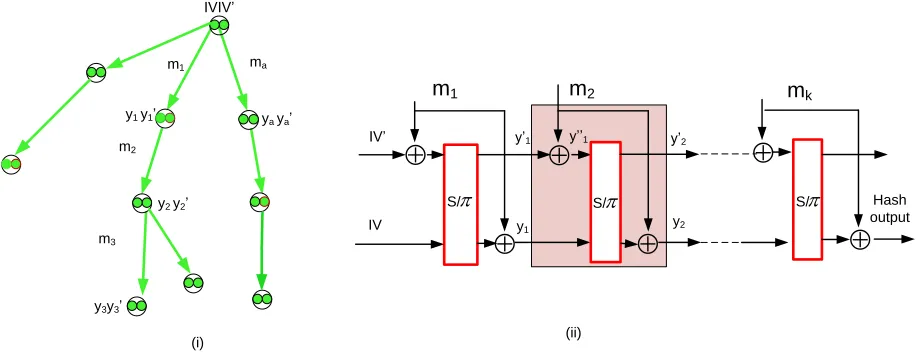
See Figure 4 for the pictorial description of how several components of the graphTs are built. For example, suppose
M pad→ m1m2· · ·mk. Then the pathIV IV0 m1
→y1y01
m2
→y2y02represents the first two-block execution of JHS(M) where,
JH(M)
01. M pad→ m1m2. . . mk−1mk;
02. y0=IV,y00=IV0;
03. for(i= 1,2, . . . k)
yiy0i=π
yi−1||(yi0−1⊕mi)
⊕mi||0;
04. returnyk;
π(x)
11. ifx /∈Dom(Dπ) then
Dπ[x]
$
← {0,1}2n\Rng(D π);
12. returnDπ[x];
π−1(y)
21. ify /∈Rng(Dπ) then
D−1
π [y]
$
← {0,1}2n\Dom(D π);
22. returnD−1π [y];
(a) Game(JH,π,π−1): Global variable is the tableD
π.
RO(M)
001. ifM ∈Dom(Dl) then
returnDl[M];
002. h← {$ 0,1}n; D
l[M] =h;
003. returnh;
MessageRecon(x, Ts)
201. xparse→ yy0;
202. ifFindNode(y) = 0 then returnM=∅; 203. M0=FindBranch(y);
204. M={dePad(Xz)|Xz0∈ M0, z=z0⊕y0};
205. returnM;
S(x)
101. r← {$ 0,1}2n;
102. M=MessageRecon(x, Ts);
103. if|M|= 1 then r[0, n−1] =Dl[M]⊕z;
104. Ds[x] =r;
105. FullGraph(Ds);
106. returnr;
S−1(r)
300. If∃x1, x2∈Dom(Ds) s.t. Ds[x1] =Ds[x2] =r
301. then return “Invalid”; 302. Ifr∈Rng(Ds) then returnDs−1[r];
303. Ifr /∈Rng(Ds) thenx
$
← {0,1}2n;
304. Ifx /∈Dom(Ds) thenDs[x] =r;
305. returnx;
(b) Game(RO,S,S−1): Global variables are the tablesD
landDs, and the graphTs.
MessageRecon(x, Ts). The purpose of this routine is to reconstruct all messagesM such that the final input toSin
JHS(M) is the currents-queryx. Hence JHS(M) =S(x)[0, n−1]⊕z, wherez is the final message-block of M after padding. The subroutine usesTs to find all suchM, by first calling the subroutineFindNode(y=x[0, n−1]) to check
whether there exist nodes inTswith left-coordinatey. If present, then the subroutineFindBranch(y) collects all paths
between the root (IV, IV0) and the nodes yz0. A set Mis returned, containing all the sequences of arrows on those paths – denoted byX – concatenated with z=z0⊕x[n,2n−1]. Notice thatdePad(X||z) =M. If no suchM 6=⊥is found, then the subroutine returns the empty set.
For ans-query x, S assigns a uniformly sampled 2n-bit value to r. The subroutine MessageRecon(x, Ts) is then
invoked, which returns a set of messagesM. If |M| = 1 then r[0, n−1] is assigned the n-bit string RO(M)⊕z, whereM ∈ Mand M pad→ m1m2· · ·mk =X||z. Finally, Ds andTs are updated, and the value of r is returned. In
Appendix C, we show that the worst-case running time of theSon thei-th query isO(i4).
For an s−1-query r, if there exist x1 6= x2 such that Ds[x1] = Ds[x2] = r, then a special string “INVALID” is
returned. If instead there exists a uniquex∈Dom(Ds) such thatDs[x] =rthenxis returned. The last possible case
is ifr /∈Rng(Ds), and thenxis assigned a 2n-bit integer chosen according to the uniform distributionU[0,22n−1].
Ifx /∈Dom(Ds) thenDs[x] is assigned r. Finallyxis returned.
ROworks as follows. Given an l-queryM, ROfirst checks whether M has already been queried by S. In such a case,M already belongs to Dom(Dl) and the ROreturnsDl[M]. Otherwise,Dl[M] is assigned a uniformly sampled
n-bit value, which is eventually returned.
IVIV’
y1 y1’
m1
m2
m3
y2 y2’
y3y3’
ma
ya ya’
(i)
m
1
m
2
m
kIV’
IV
Hash output
y’1 y’’1
y1
y’2
y2
(ii)
S/ S/
S/
Figure 4: All arrows and dots arenbits each. (i) The directed graphTs(or Tπ) which is updated by the subroutine
FullGraphof Game(RO,S,S−1)(or PartialGraphof G1) (see Figures 3(b) and 5). Example: The edge (y1y01, m2, y2y02)
is composed of the head nodey1y10, the arrow m2, and the tail node y2y20. The left and right coordinates of a node
(yaya0) is ya and y0a. (ii) JH mode with M pad
→ m1m2· · ·mk. The shaded region shows the generation of the edge
(y1y01, m2, y2y20) inTsusingS(or inTπ usingπ);
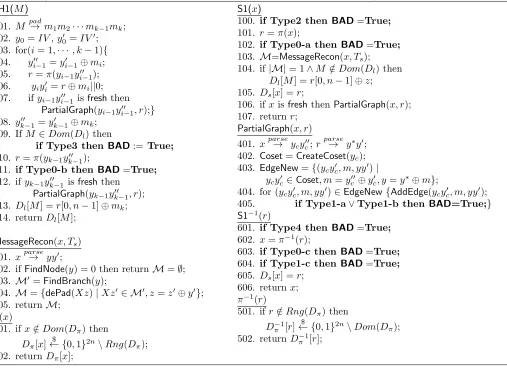
Description ofG1 (Fig. 5). The description of the gameG1 apparently looks a bit artificial in the sense that it was
constructed as a hybridization of the games Game(JH, π, π−1) and Game(RO, S, S−1). The purpose of this game is to be a transit point from Game(JH, π, π−1) to Game(RO, S, S−1) so that their difference in execution can be understood.
First, in the description of this game, we omit the statements where the variable BAD is set, since they do not impact the output and the global data structures. The variable BADis set when certain events occur in the global data structures. Those events will be discussed, when we computePr
AG1 ⇒1−PrARO,S,S−1 ⇒1
in Section 5.
Now we describe the subroutines used by this game.
PartialGraph(x, r): The subroutine builds the graph Tπ in such a way that each directed path originating from the
root (IV, IV0) represents the execution of JHπ(·) on a prefix of some message (depicted in Figure 4). Rather than building all possible paths using the fresh pair (x, r) and the old pairs in Dπ, thePartialGraph augments theTπ in at
most one phase; hence the namePartialGraph. The details are as follows.
First, the subroutineCreateCoset(yc =x[0, n−1]) is invoked, that returns a setCoset containing all nodes in Tπ
whose left-coordinate is yc. The size of Coset determines the number of fresh nodes to be added to Tπ in the the
Figure 5: GameG1: Global variables are the tablesDl,DsandDπ, and the graphsTπ andTs.
JH1(M)
001. M pad→ m1m2· · ·mk−1mk;
002. y0=IV,y00 =IV0;
003. for(i= 1,· · ·, k−1){
004. yi00−1=y0i−1⊕mi;
005. r=π(yi−1y00i−1);
006. yiy0i=r⊕mi||0;
007. ifyi−1y00i−1 isfreshthen
PartialGraph(yi−1yi00−1, r);}
008. yk00−1=yk0−1⊕mk;
009. IfM ∈Dom(Dl) then
if Type3 then BAD:= True; 010. r=π(yk−1yk00−1);
011. if Type0-b then BAD=True; 012. ifyk−1y00k−1 isfreshthen
PartialGraph(yk−1y00k−1, r);
013. Dl[M] =r[0, n−1]⊕mk;
014. returnDl[M];
MessageRecon(x, Ts)
201. xparse→ yy0;
202. ifFindNode(y) = 0 then returnM=∅; 203. M0=FindBranch(y);
204. M={dePad(Xz)|Xz0∈ M0, z=z0⊕y0};
205. returnM; π(x)
301. ifx /∈Dom(Dπ) then
Dπ[x]
$
← {0,1}2n\Rng(D π);
302. returnDπ[x];
S1(x)
100. if Type2 then BAD=True; 101. r=π(x);
102. if Type0-a then BAD=True; 103. M=MessageRecon(x, Ts);
104. if|M|= 1∧M /∈Dom(Dl) then
Dl[M] =r[0, n−1]⊕z;
105. Ds[x] =r;
106. ifxis freshthenPartialGraph(x, r); 107. returnr;
PartialGraph(x, r)
401. xparse→ ycy00c;r parse
→ y∗y0; 402. Coset=CreateCoset(yc);
403. EdgeNew={(ycyc0, m, yy0)|
ycyc0 ∈Coset, m=yc00⊕yc0, y=y∗⊕m};
404. for (ycy0c, m, yy0)∈EdgeNew{AddEdge(ycy0c, m, yy0);
405. if Type1-a∨Type1-b thenBAD=True;}
S1−1(r)
601. if Type4 then BAD=True; 602. x=π−1(r);
603. if Type0-c then BAD=True; 604. if Type1-c then BAD=True; 605. Ds[x] =r;
606. returnx; π−1(r)
501. ifr /∈Rng(Dπ) then
D−1π [r]← {$ 0,1}2n\Dom(D π);
502. returnDπ−1[r];
MessageRecon(x, Ts): The graph Ts is the maximally connected subgraph (of Tπ) with the root-node (IV, IV0),
generated by the s/s−1-queries and responses stored in Ds; x is the current s-query. This subroutine has been
described already in game Game(RO,S,S−1).
For ans-queryx,r is assigned the value ofπ(x). The ideal permutationπis implemented through lazy sampling. Then the subroutineMessageReconis called with (x, Ts) that returns a set of messagesM. If|M|= 1, and ifM ∈ M
is not a previousl-query then Dl[M] is assigned the value ofr[0, n−1]⊕z, whereM pad
→ Xz. ThenDsis updated. If
xisfresh then the routinePartialGraph is invoked on (x, r) to update the graphTπ. Finally,ris returned.
For ans−1 queryr,xis assigned the value ofπ−1(r). Finally,D
s[x] is updated andxis returned.
If anl-queryM has already been queried byS1, then Dl[M] is returned. Otherwise, JH1 mimics JH, in addition
to updating the graphTs whenever a fresh intermediate input is generated. Afterwards, the Dl[M] is assigned the
value ofr[0, n−1]⊕mk. Finally,Dl[M] is returned.
With the above description of the games at our disposal, now we are well equipped to state and prove an easy but important result.
Proposition 3.1 For any distinguishing adversaryA, Game(RO,S,S−1)≡G1.
Proof. From the description of S1, and S1−1, we observe that, for allx∈ {0,1}2n, S1(x) =π(x), and S1−1(x) = π−1(x). Likewise, from the descriptions of JH1 and JH, for allM ∈ {0,1}∗, JH1(M) = JH(M). 2
The events Type0, Type1, Type2, Type3, and Type4 ofG1are still not defined. These events finally tell apart the
gameG1 from the game Game(RO,S,S−1). We describe them in the following sections.
4
Definition of the events:
BAD
i,
GOOD
iand a few more
For an s-query: For the gameG1, a round spans the lines 100 through 106 (Fig. 5). For the game Game(RO, S,
S−1), a round spans the lines 101 through 106 (Fig. 3(b)).
For ans−1-query:For the gameG1, a round spans the lines 601 through 606. For Game(RO,S,S−1) a round spans
the lines 300 through 305.
For anl-query: LetM pad→ m1m2· · ·mk. For the gameG1, the lines 004 through 007 form a round for the
message-blocksm1,m2,· · · andmk−1. For the last block,mk, the round is between the lines 008 and 014. For the Game(RO,
S, S−1), it is not specified how the random oracle RO(·) processes the individual message-blocks mj (1 ≤ j ≤ k)
internally. We assume that it processes the message-blocks sequentially and the time taken to process each block is equal.
The sum of the numbers of message-blocks,s-queries ands−1-queries before thei+ 1st round isi.
Events GOODi and BADi. BADi denotes the event when the variableBADis set during roundiofG1. The event
BADi∗ occurs when Type0, Type2, Type3 or Type4 events occur in the i-th round. Let the symbol GOODi denote the event ¬Wi
j=1BADi. The event GOODi−1
2 is defined asGOODi−1∧ ¬BADi
∗. For brevity, GOOD(i+1)−1
2 will be
denoted byGOODi+1
2. The symbolGOOD0denotes the event when no queries are submitted.
From a high level, the intuition behind the construction of theBADi event is straight-forward: we will show that
ifBADi does not occur, and ifGOODi−1 did occur, then theviews of G1 and Game(RO,S,S−1) (afteri rounds) are
identically distributed foranyattackerA. Using the above fact the following theorem can be established.
Theorem 4.1 (Computational Paradigm) LetAbe an indifferentiability adversary interacting with the gamesG1 and Game(RO,S,S−1). IfA is limited byσ queries, then
Pr
AG1 ⇒1−PrARO,S,S−1 ⇒1
≤Pr
¬GOODσ−1 2
≤
σ
X
i=1
PrBADi|GOODi−1.
Proof. We postpone the proof until Section 4.3. 2
In the next few subsections, we concretely define the Type0, Type1, Type2, Type3 and Type4 events of the gameG1
(see Figure 5).
4.1
Events Type0 and Type1: current
π/π
−1-query is fresh (total 6 cases)
4.1.1 Event Type0: Distance of random permutation from the uniform (3 cases)
Type0 event occurs when the output of a freshπ/π−1-query isdistinguishablefrom the uniform distributionU[0,22n−1]. A Type0 event can be of three types: event Type0-a occurs when a freshπ-query is ans-query; event Type0-b occurs when a freshπ-query is the finalπ-query of anl-query; event Type0-c occurs when ans−1-query is a freshπ−1-query.
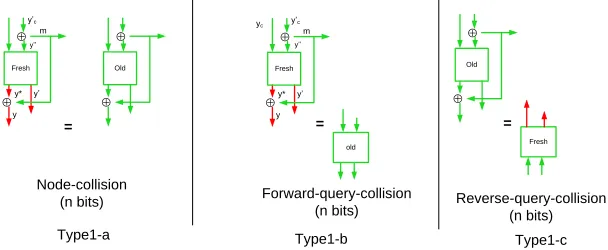
4.1.2 Event Type1: Collision onTπ (3 cases)
Fresh
y* y’
= y
y’c yc
Node-collision (n bits)
Old
m
Fresh
y* y’
= y
y’c
yc
m
old
Old
=
Fresh
Forward-query-collision
(n bits) Reverse-query-collision(n bits)
Type1-a Type1-b Type1-c
y’’ y’’
Figure 6: Type1 events of gameG1 defined inFigure 5. All arrows arenbits each. Red arrow denotes freshnbits of
output from the ideal permutationπ/π−1. The symbol “=” denotesn-bit equality.
Let (x, r) be a fresh pair of π-query and response generated at round i. Observe that such a fresh pair always
invokes the subroutinePartialGraph. Type1 events – that are due toπ-query and its response – are shown in Figure 6. We divide this type into two subcases. Suppose (ycy0c, m, yy0) is a new edge generated from a new π-query/response
(x, r).
• Event Type1-b (Figure 6(Type1-b)): This event occurs if y collides with the least-significant n bits of a query already inDπ.
Type1 event, which is due to a freshπ−1-query and its response is denoted by Type1-c.
• Event Type1-c (Figure 6(Type1-c)): This event occurs, if the least-significant n bits of output of a π−1-query matches with the left-coordinate of a node already inTs.
4.2
Events Type2, 3 and 4: current
π/π
−1-query is old (total 16 cases)
Before we define this event, we first classify all the old query-response pairs for the oraclesπ/π−1 stored in Dπ,
ac-cording to itsknownand unknown parts. The knownpart of a query-response pair is the part that is present in the viewof the gameG1, while theunknownpart is not present in theview. We observe that there are seven types of such
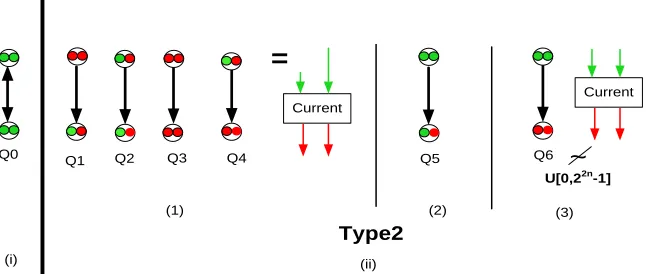
a pair, and we denote them by Q0, Q1, Q2, Q3, Q4, Q5 and Q6 in Figure 7(a)(i) and (ii); the head and tail nodes in each type denote the input and output, each of size 2nbits. Two-sided arrowhead indicates that the corresponding input-output pair is generated from either aπ-query or aπ−1-query. The red andgreen circles denote the unknown and theknownparts of sizenbits each. The queries of type Q0 are the olds/s−1-queries already present in the table Dπ (i.e., theπ/π−1-queries submitted to the simulatorsS1/S1−1); since this query-response is present in the view,
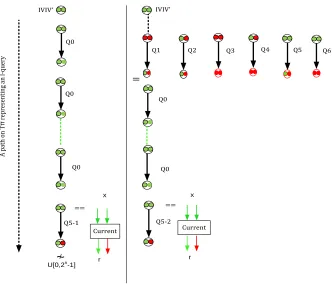
it has nored circles. The remaining six types are generated due to the intermediate πcalls during the processing of l-queries; these queries have at least one redcircle. The Q5 type can be further divided into two subtypes Q5-1 and Q5-2 according to its position in the graphTπ(see Figure 9 of Appendix E.1): if all the query-response pairs preceding
the Q5 query are of type Q0 then it is Q5-1, otherwise it is type Q5-2.
4.2.1 Event Type2: current s-query is old (total 7 cases)
This event is presented in Fig. 7(a). A Type2 event occurs when one of the following conditions occurs. There are three subcases Type2-1,-2 and-3 (see Fig. 7(a)(ii)).
Type2-1: If the currents-query is equal to an old query which is one of the types Q1, Q2, Q3 and Q4.
Type2-2:This event occurs in relation to an old query of type Q5. This case is divided into two subcases as described in Figure 9 of Appendix E.1. (i) If the currents-query is equal to an old query of type Q5-1 and the most significant nbits of output aredistinguishablefrom the uniform distribution U[0,2n−1]. (ii) If the current s-query is equal to
an old query of type Q5-2.
Type2-3: If the current s-query is equal to an old query of type Q6 and the 2nbits output aredistinguishablefrom the uniform distributionU[0,22n−1].
4.2.2 Event Type3: current l-query forms a red branch (total 3 cases)
A red branch. LetM be the current l-query such that M pad→ m1m2· · ·mk was already present as a branch inTπ,
but not inTs(see Fig. 7(b)(i) to (iii)); such a branch is called ared branch since it has at leastnbits ofunknownpart.
We divide ared branch into three types, according to the finalπ-query – denoted byyk−1yk00−1 –in the computation
ofJ Hπ(M). The three types of ared branch are below: (i)y
k−1y00k−1is one of types Q1, Q2 and Q5; (ii)yk−1y00k−1is
one of types Q3, Q4 and Q6; (iii)yk−1y00k−1is of type Q0, and one of the intermediate query-response pairs on thered
branch is not of type Q0.
Event Type3-1/-2/-3. There are three types of a Type3 event: (Type3-1) If the currentπ-query is the finalπ-query of ared branch of type (i).2 (Type3-2) If the currentπ-query is the finalπ-query of ared branch of type (ii), as well
as the most significantnbits of output beingdistinguishable from the uniform distributionU[0,2n−1]. (Type3-3) If
the currentπ-query is the finalπ-query of ared branch of type(iii).
4.2.3 Event Type4: current s−1-query is old (total 6 cases)
This event is shown in Figure 7(c). The Type4 event occurs, if the currents−1-query is equal to an old query of type Q1, Q2, Q3, Q4, Q5, or Q6.
4.3
Proof of Theorem 4.1
With the help of the events described in Sections 4.1.2, 4.2.1, 4.2.2 and 4.2.3 we are equipped to prove Theorem 4.1. Recall we need to show two things:
Pr
AG1 ⇒1−PrARO,S,S−1 ⇒1
≤Pr
¬GOODσ−1 2
, (1)
2Observe that this case implies a node-collision inT
Q4
Q1 Q2 Q3 Q5 Q6
Q0
Current
Type2
~
U[0,22n-1]
=
Current
(1) (2) (3)
(i) (ii)
(a) (i) and (ii): Q0, Q1, Q2, Q3, Q4, Q5 and Q6 denote seven types ofπ/π−1-query and response; Type Q5 has further been divided into Q5-1 and Q5-2 in Figure 9 of Appendix E.1. The corresponding Type2 events are also shown.
A
p
a
th
o
n
T
π
r
e
p
re
s
e
n
ti
n
g
a
n
l
-q
u
e
ry
(ii)
~
U[0,22n-1]
(iii) Q3/Q4/Q6
=
Q1/Q2/Q5
(i)
Q0 Q0
Q0 Q0
Q0
(iv)
Type3
A
p
a
th
o
n
T
s
r
e
p
re
s
e
n
ti
n
g
a
n
l
-q
u
e
ry
Q4 Q3 Q2
Q1 Q5 Q6
yk-1y’’k-1 yk-1y’’k-1
yk-1y’’k-1
(b) Different types of a branch in the graphTπ. (i), (ii) and (iii) are calledredbranches since
they exist inTπ, but not inTs; the corresponding Type3 events associated withredbranches
are described in Sect. 4.2.2. (iv) Agreenbranch is a branch in the graphTs. The final input
toπis denoted byyk−1yk00−1 in all cases.
Q4
Q1 Q2 Q3 Q5 Q6
Q0
Current
=
(c) Type4 events of gameG1.
Figure 7: Pictorial description of Type2, Type3 and Type4 events of the gameG1 (Figure 5). Green circle, or green
arrow denotesnbits of information present in theviewof the game. Redcircle orredarrow denotesnbits of information
Pr¬GOODσ−1 2
≤
σ
X
i=1
PrBADi|GOODi−1. (2)
The proof of (2) is straight-forward. To prove (1), we proceed in the following way. Observe
Pr
AG1⇒1−PrARO,S,S−1⇒1
=
PrAG1 ⇒1|GOOD
σ−1 2
−PrARO,S,S−1⇒1|GOOD
σ−1 2
·PrGOODσ−1 2
+Pr
AG1 ⇒1| ¬GOOD
σ−1 2
−Pr
ARO,S,S−1 ⇒1| ¬GOODσ−1 2
·Pr
¬GOODσ−1 2
. (3)
If we can show that
Pr
AG1 ⇒1|GOOD
σ−1 2
= Pr
ARO,S,S−1 ⇒1|GOOD
σ−1 2
, (4)
then (3) reduces to (1), since
Pr
AG1 ⇒1 | ¬GOOD
σ−1 2
−PrARO,S,S−1
⇒1 | ¬GOODσ−1 2
≤1. As a result, we
focus on establishing (4). Let Vi
1 and V2i denote the views of the games G1 and Game(RO,S,S−1) respectively, after i queries have been
processed. To prove (4), it suffices to show that givenGOODσ−1
2, the viewsV
σ
1 and V2σ are identically distributed.
We do this by induction on the number of queriesi =σ. When i= 0, then no query has been made; therefore the views are identical. We now assume the induction hypothesis holds, where the hypothesis is givenGOODi−1
2, thenV
i
1
andVi
2 are identically distributed. We have to show that ifGOODi+1
2 occurred, thenV
i+1 1 andV
i+1
2 are identically
distributed. We do so by examining all possible cases based on a set of conditions for the gameG1. As the details are
quite technical, we move the 17 cases to the Appendix D. The main idea is that if nobadevents have occurred, then the graphsTs are isomorphic, as indicated in the following lemma. From the isomorphism, the identical distribution
of the views is an easy consequence. The proof of the lemma is given in Appendix D.1.
Lemma 4.2 (Graph Isomorphism Lemma) Given GOODi and V1i = V2i, the graphs Ts for the games G1 and Game(RO,S,S−1)are isomorphic after i rounds.
5
Estimation of
Pr
A
G1⇒
1
−
Pr
A
RO,S,S−1⇒
1
We individually compute the probabilities of each of the events described in Sections 4.1 and 4.2. We need the help of the following lemma to provide a rigorous analysis for the upper-bounds we compute in this section.
Lemma 5.1 (Correction Factor) Let ε be a negligible function in the security parameter n >0. If the advantage of an indifferentiable adversaryAfor the games G1 and Game(RO,S), limited by σ queries, is bounded byε, then
Pr
GOODi
≥ 1
C
for some constantC >0, for all 0≤i≤σ.
Proof. Since ε < 1 for all n > 0, PrAsets BADin G1
≤ ε ≤ 1− 1
C for some constant C > 0. Noting that
PrGOODi
is a decreasing function ini, the result follows. 2
The Type1-a event guarantees that ifTπ is GOODi−1, then it hasO(i) nodes. Assumingi≤2n/2, from Figure 6
we obtain,
PrhType1i|GOODi−1 i
≤3i/(2n−i),
=O i
2n
, (5)
since fori≤2n/2, then (2n−i)≥1 22
n.
Using the definition of Type2, Type3, Type4, and Type0 events in Section 4, it is straightforward to deduce:
Pr
Type2i|GOODi−1=O
i
2n
Pr
Type3i|GOODi−1=O
1
2n
,
PrType4i|GOODi−1=O
i
2n
,
and fori≤2n/2
PrType0i|GOODi−1
≤1/(22n−i) =O 1
22n
.
Note that the constantC from Lemma 5.1 is absorbed by theO notation.
We conclude by combining the above bounds into the following inequality which holds for 1≤i≤σ:
PrBADi|GOODi−1≤PrType0i|GOODi−1+ PrType1i|GOODi−1
+ PrType2i|GOODi−1
+ PrType3i|GOODi−1
+ PrType4i|GOODi−1
=O i
2n
. (6)
Therefore, by Theorem 4.1, for allA,
Pr
AG1 ⇒1−PrAGame(RO,S,S−1)⇒1
≤
σ
X
i=1
Pr
BADi|GOODi−1
≤
σ
X
i=1
O i
2n
=Oσ
2
2n
. (7)
Using (7) and that the advantageis less than 1, we see that the adversary must use at least 2n/2queries to distinguish
between the gamesG1and Game(RO,S,S−1) (or between the games Game(JH,π,π−1) and Game(RO,S,S−1), since
G1≡Game(JH,π,π−1) by Proposition 3.1). This yields the indifferentiability bound ofn/2 bits for the JH mode.
6
Experimental Results
We performed a series of experiments verifying our theoretical framework. Our simple C implementation of the game G1 simulated the ideal permutation, π, with randomness supplied by cstdlib>rand(), by maintaining a database of
input/output pairs, assuring thatπ is a permutation. The experiments were performed allowing varying proportions of reverse queries to determine the optimal adversarial strategy.
For each of these experiments, we collected data providing accurate estimates for the values of the probabilities of Type1 events, Pr
Type1i|GOODi−1, described in Section 4. Our experiments included as a parameter the proportion
of reverse queries,R, allowed in the hopes that if an optimal adversarial strategy including reverse queries uses a positive proportion of reverse queries that we may discover a spike in performance near this proportion. Compiling these data we conclude that, as one would expect, when the proportion,R, approaches zero, the Type1-a event becomes dominant; whereas, whenR approaches 1, the Type1-c event dominates.
In addition to these event probabilities, we calculated security bounds for several values ofnand R. The compu-tation was achieved by randomly generating a large number of graphs,Ts, and determining the number of queries,σ,
required to causePσ
i=1Pr
Type1i|GOODi−1≥0.5.
We did not consider the Type0, Type2, Type3, and Type4 events, since, their probabilities are dominated by that of the Type1 events, for any efficient adversary. We found that choosing the values at which to place the 1st query uniformly at random from among all possible nodes was the most advantageous strategy for an adversary.
The results of the experiments following this method are summarized in Figure 10 of Appendix E.2. The data support the theoretically obtained bound ofσ= Ω(2n/2) (see (7)). Some of the values in the graph are slightly lower
than 1/2, due to the effect of constants. We expect the data to asymptotically approach 1/2.
The data indicate that the optimal adversarial strategy for game G1 does not include the use of reverse queries.
For each fixedR <1, however, we observe that the data asymptotically approach 1/2. Although it is the case that forR= 1,σ has an expected value of 2n−1, the data support out result that, for our definition of Type1 bad events
7
Conclusion and Open Problems
JH hash function is one of the finalist algorithms in the NIST SHA-3 hash function competition. In this paper we improve the indifferentiability security bound of the JH hash mode of operation fromn/3 bits ton/2 bits, when it is used with a 2n-bit permutation; this bound isoptimal for JH-256, and the best, so far, for JH-512. Our experimental results strongly indicate that the bound could be further improved, and it is likely to be close tonbits.
Our work leaves room for more research into the JH mode. It is somewhat remarkable that despite the absence of generic attacks with work-factor significantly lower thannbits, the proven 1st/2nd pre-image and indifferentiability bounds for the JH mode areonly up ton/2 bits. In future work we plan to use the proof technique from this paper to narrow the exponential gap between the upper and lower bounds of JH’s indifferentiability security. Also, the complexity for the simulator could be improved.
Acknowledgment
We would like to thank Donghoon Chang, Lily Chen, Yi-Kai Liu, Mridul Nandi, Tom Shrimpton, Meltem S¨onmez Turan, and the Keccak team for their suggestions and remarks which helped a lot to improve the quality of the paper.
References
[1] Elena Andreeva, Charles Bouillaguet, Pierre-Alain Fouque, Jonathan J. Hoch, John Kelsey, Adi Shamir, and S´ebastien Zimmer. Second preimage attacks on dithered hash functions. In Nigel P. Smart, editor,EUROCRYPT, volume 4965 of Lecture Notes in Computer Science, pages 270–288. Springer, 2008. (Cited on page 1.)
[2] Elena Andreeva, Atul Luykx, and Bart Mennink. Provable Security of BLAKE with Non-Ideal Compression Function.3rd SHA-3 Candidate Conference, 2012. (Cited on page 1.)
[3] Elena Andreeva, Bart Mennink, and Bart Preneel. On the Indifferentiability of the Grøstl Hash Function. In Juan A. Garay and Roberto De Prisco, editors,SCN, volume 6280 ofLecture Notes in Computer Science, pages 88–105. Springer, 2010. (Cited on page 4.)
[4] Elena Andreeva, Bart Mennink, and Bart Preneel. Security Reductions of the Second Round SHA-3 Candidates. In Mike Burmester, Gene Tsudik, Spyros S. Magliveras, and Ivana Ilic, editors,ISC, volume 6531 of Lecture Notes in Computer Science, pages 39–53. Springer, 2010. (Cited on page 2.)
[5] Elena Andreeva, Bart Mennink, Bart Preneel, and Marjan ˘Skrbot. Security Analysis and Comparison of the SHA-3 Finalists BLAKE, Grøstl, JH, Keccak, and Skein. 3rd SHA-3 Candidate Conference, 2012. (Cited on page 2.)
[6] Mihir Bellare and Thomas Ristenpart. Multi-Property-Preserving Hash Domain Extension and the EMD Transform. In Xuejia Lai and Kefei Chen, editors,ASIACRYPT 2006, volume 4284 ofLecture Notes in Computer Science, pages 299–314. Springer, 2006. (Cited on page 4.)
[7] Guido Bertoni, Joan Daemen, Micha¨el Peeters, and Gilles Van Assche. Sponge Functions. ECRYPT 2007, 2007. http:
//sponge.noekeon.org/SpongeFunctions.pdf. (Cited on page 1.)
[8] Rishiraj Bhattacharyya, Avradip Mandal, and Mridul Nandi. Security Analysis of the Mode of JH Hash Function. In Seokhie Hong and Tetsu Iwata, editors,FSE, volume 6147 ofLecture Notes in Computer Science, pages 168–191. Springer, 2010. (Cited on pages 1 and 2.)
[9] Donghoon Chang, Mridul Nandi, and Moti Yung. Indifferentiability of the Hash Algorithm BLAKE. Cryptology ePrint Archive, Report 2011/623, 2011. http://eprint.iacr.org/. (Cited on page 1.)
[10] Jean-S´ebastien Coron, Yevgeniy Dodis, C´ecile Malinaud, and Prashant Puniya. Merkle-Damg˚ard Revisited: How to Construct a Hash Function. In Victor Shoup, editor,CRYPTO 2005, volume 3621 ofLecture Notes in Computer Science, pages 430–448. Springer, 2005. (Cited on pages 1 and 3.)
[11] Ewan Fleischmann, Michael Gorski, and Stefan Lucks. Some Observations on Indifferentiability. In Ron Steinfeld and Philip Hawkes, editors,ACISP, volume 6168 ofLecture Notes in Computer Science, pages 117–134. Springer, 2010. (Cited on page 2.)
[12] Jonathan J. Hoch and Adi Shamir. Breaking the ICE - Finding Multicollisions in Iterated Concatenated and Expanded (ICE) Hash Functions. In Matthew J. B. Robshaw, editor,FSE, volume 4047 ofLecture Notes in Computer Science, pages 179–194. Springer, 2006. (Cited on page 1.)
[13] Antoine Joux. Multicollisions in Iterated Hash Functions: Application to Cascaded Constructions. In Matthew K. Franklin, editor, CRYPTO 2004, volume 3152 of Lecture Notes in Computer Science, pages 306–316. Springer, 2004. (Cited on page 1.)
[15] John Kelsey and Bruce Schneier. Second Preimages on n-Bit Hash Functions for Much Less than 2n Work. In Ronald Cramer, editor,EUROCRYPT 2005, volume 3494 of Lecture Notes in Computer Science, pages 474–490. Springer, 2005. (Cited on page 1.)
[16] Jooyoung Lee and Deukjo Hong. Collision resistance of the jh hash function. Cryptology ePrint Archive, Report 2011/019, 2011. http://eprint.iacr.org/. (Cited on page 2.)
[17] Ueli M. Maurer, Renato Renner, and Clemens Holenstein. Indifferentiability, impossibility results on reductions, and applications to the random oracle methodology. In Moni Naor, editor,TCC, volume 2951 ofLecture Notes in Computer Science, pages 21–39. Springer, 2004. (Cited on pages 1 and 3.)
[18] Mridul Nandi and Douglas R. Stinson. Multicollision Attacks on Some Generalized Sequential Hash Functions. IEEE Transactions on Information Theory, 53(2):759–767, 2007. (Cited on page 1.)
[19] Thomas Ristenpart, Hovav Shacham, and Thomas Shrimpton. Careful with Composition: Limitations of the Indifferen-tiability Framework. In Kenneth G. Paterson, editor,EUROCRYPT, volume 6632 ofLecture Notes in Computer Science, pages 487–506. Springer, 2011. (Cited on page 2.)
[20] Hongjun Wu. The JH Hash Function. The 1st SHA-3 Candidate Conference. (Cited on pages 2 and 3.)
A
Definitions
Definition A.1 (Random oracle) A random oracle is a functionRO:X →Y chosen uniformly at random from the set of all|Y||X|
functions that mapX→Y. In other words, a functionRO:X→Y is a random oracle if and only if, for eachx∈X, the value ofRO(x)is chosen uniformly at random fromY.
B
Equivalence of Games
Definition B.1 (Equivalence of games) Denote theviews of the gamesG1 andG2 afteriqueries byV1iandV2i, when they
are interacting with the adversaryA. The gamesG1 andG2 are said to be equivalent with respect to the adversaryAif and only
ifV1i∼V2i for alli >0. Equivalence between the gamesG1 andG2 with respect to the adversaryAis denoted byG1
A ≡ G2, or
simplyG1≡ G2, when the adversary is clear from the context.
C
Time Complexity of the Simulator
S
Since there areiqueries afterirounds, the maximum number of nodes inTsisi2. Therefore, to constructTsat thei-th round, the amount of time required isO(i4). Now, if the adversary submitsσqueries, then the time complexity is O(σ5). Since the
time to constructTsdominates over others, the simulator time complexity is alsoO(σ5).
D
Proof of the Induction Step
We need to show that givenGOODσ−1
2, theviewsV
σ
1 andV2σ are identically distributed. We do this by induction on the number
of queriesi=σ. Wheni= 0, then no query has been made; therefore the views are identical. We now assume the induction hypothesis holds, where the hypothesis is givenGOODi−1
2, thenV
i
1 andV2iare identically distributed. We have to show that if
GOODi+1
2 occurred, thenV
i+1
1 andV
i+1
2 are identically distributed. Let (I
i+1
1 , O
i+1 1 ) and (I
i+1
2 , O
i+1
2 ) denote the input-output
pairs for the gamesG1 and Game(RO,S,S−1) respectively in thei+ 1st round.
Notice that ifV1i=V2i, then the input viewsI1i+1andI
i+1
2 are identically distributed. We also have Lemma 4.2 which shows
that the graphsTs in two games are isomorphic.
A little reflection shows that proving the induction step is now equivalent to showing that ifI1i+1=I
i+1
2 then the output-views
Oi+1
1 andO
i+1
2 are identically distributed. LetI
i+1denote the shared query inputIi+1
1 =I
i+1
2 .
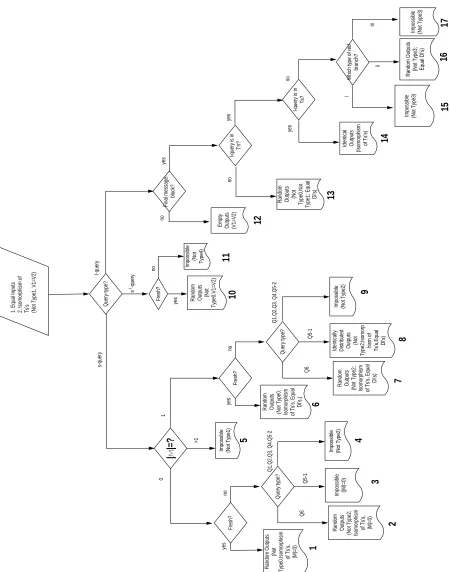
We continue by considering all possible cases based on a set of conditions for the game G1 in the i+ 1st round; cases 1
through 9 consider whenIi+1is ans-query, cases 10 and 11 considerIi+1to be ans−1-query, while cases 12 through 17 consider
whenIi+1 is part of an l-query. Our decision tree produced the above 17 cases, which have been derived from a sequence of
questions (see Figure 8). The reader is invited to verify that all cases are considered. Case 1: s-query,|M|= 0, and Fresh:
Implication. The condition implies thatO1i+1follows the uniform distributionU[0,2
2n−
1] (Fig. 5), since a Type0 event did not occur in thei+ 1st round. Since the graphsTsare isomorphic in both gamesG1and Game(RO,S,S−1) by Lemma 4.2,|M|= 0
for Game(RO,S,S−1) (Fig. 3(b)). This implies thatO2i+1follows the uniform distributionU[0,2
2n−
1] (Fig. 3(b)).
Case 2: s-query,|M|= 0, not Fresh, and type Q6: Implication. The event GOODi+1
2 implies that Type2 event did not occur forG1 in the currenti+ 1th round; therefore, since
|M|= 0,O1i+1follows the uniform distributionU[0,2
2n−
1]. As the graphsTsof the gamesG1 and Game(RO,S,S−1) are
iso-morphic by Lemma 4.2,|M|= 0 for Game(RO,S,S−1). This implies thatOi+1
2 =rfollows the uniform distributionU[0,2
Case 3: s-query,|M|= 0, not Fresh, and type Q5-1:
Implication. This case is impossible since|M|= 0 andIi+1being of type Q5-1 contradict each other.
Case 4: s-query,|M|= 0, not Fresh, and type Q1, Q2, Q3, Q4, or Q5-2: Implication. This case is impossible sinceGOODi+1
2 implies that Type2 event did not occur forG1in the currenti+ 1st round.
The given conditions create a Type2 event.
Case 5: s-query,|M|>1:
Implication. If|M|>1 then we would have a node-collision inTs. However, this is impossible sinceGOODi+1
2 ensures that a
Type1 event did not occur forG1 in the previousirounds, and a node-collision inTsis a Type1 event.
Case 6: s-query,|M|= 1, and Fresh:
Implication. Since Ii+1 is fresh,Oi1+1 follows the uniform distributionU[0,2
2n−
1], since a Type0 event did not occur in the i+ 1st round. Now, forG1,M ∈ Mimplies thatM /∈Dom(Dl) in the firstirounds, since the currents-query Ii+1is fresh.
Also note that, becauseV1
i =Vi2 and theTs’s are isomorphic, we have that theDl’s in both games are identical. Therefore, for Game(RO,S,S−1),M /∈Dom(Dl) in the firstirounds. This implies thatOi2+1 follows the uniform distributionU[0,2
2n−
1].
Case 7: s-query,|M|= 1, not Fresh, and type Q6: Implication. The eventGOODi+1
2 implies that a Type2 event did not occur in the i+ 1st round ofG1; therefore,O
i+1 1 follows
the uniform distributionU[0,22n−1]. InG1,M∈ Mimplies thatM /∈Dom(Dl) in the firstirounds, since the currents-query
Ii+1 is either of type Q3 or Q4, while the finalπ-query of anyl-query cannot be of type Q3 or Q4. As in the previous case,
Vi1 =Vi2 and the isomorphicTs’s together imply that the Dl in both games are identical. Therefore, for Game(RO,S,S−1), M /∈Dom(Dl) in the firstirounds. This implies thatOi2+1follows the uniform distributionU[0,2
2n−
1].
Case 8: s-query,|M|= 1, not Fresh, and type Q5-1: Implication. The eventGOODi+1
2 implies that Type2 event did not occur in thei+ 1st round ofG1; therefore,O
i+1
1 [n,2n−1]
follows the uniform distributionU[0,2n−1], andOi+1
1 [0, n−1] is a fixed value. Now, forG1,M∈ Mimplies thatM∈Dom(Dl)
after the firstirounds, since the currents-queryIi+1is of type Q5-1; also note thatOi1+1[0, n−1] =Dl[M]⊕z, wherezis final
block ofM after padding. As in the previous case,Vi1 =V
2
i and the isomorphism ofTs’s together imply thatDlare identical in both games. Therefore,Oi2+1[0, n−1] =Dl[M]⊕z (line 103 of Fig. 3(b)); also note thatO
i+1
2 [n,2n−1] follows the uniform
distributionU[0,2n−1]. In conclusion,Oi1+1andO
i+1
2 are identically distributed.
Case 9: s-query,|M|= 0, not Fresh, and type Q1, Q2, Q3, Q4, or Q5-2:
Implication. This case is impossible since event Type2 did not occur in the currenti+ 1st round, and, therefore,Ii+1 cannot
be of type Q1, Q2, Q3, Q4 or Q5-2.
Case 10: s−1-query and Fresh:
Implication. The condition implies thatO1i+1follows the uniform distributionU[0,2
2n−
1], since a Type0 event did not occur in the currenti+ 1st round. BecauseVi
1 =V2i+1, we have that thes
−1-query is also a fresh query for Game(RO,S,S−1). Also
note that the tablesDsof both games are an identical permutation.Therefore,O2i+1follows the uniform distributionU[0,2
2n−
1].
Case 11: s−1-query and not Fresh:
Implication. A Type4 event and the above condition contradict each other.
Case 12: l-query and not Final Block: Implication. IfVi1+1=Vi2+1thenOi1+1=O
i+1
2 =λ, whereλis the empty string.
Case 13: l-query, Final Block,l-query not inTπ:
Implication. Let M be the l-query in question. Since the event GOODi+1
2 implies that a Type1 event did not occur in the
previousirounds ofG1, there are no node-collisions in the graphTπ. Therefore, the finalπ-query is fresh, and soOi1+1 follows
the uniform distributionU[0,2n−1], since a Type0 event did not occur in thei+ 1st round. Now notice, the tablesDlin both games were identical when thel-queryM was submitted; therefore, at that time of submission,M /∈Dom(Dl) for both games. This ensures thatO2i+1=RO(M) follows the uniform distributionU[0,2
n− 1].
Case 14: l-query, Final Block,l-query inTπ, l-query in Ts:
Implication. The graphsTsin both games are isomorphic by Lemma 4.2. It follows thatOi+1
1 =O
i+1
2 .
Cases 15, 16 and 17: l-query, Final Block,l-query inTπ, l-query not inTs:
Ii+1is the final message-block of the currentl-query (denoted byM) which forms ared branch (three types of aredbranch are defined in Section 4.2.2). Let the finalπ-query while processing thel-queryM be denoted byyk−1yk00−1.
Case 15: Finalπ-query is type Q1, Q2, or Q5:
contra-diction.
Case 16: Finalπ-query is type Q3, Q4, or Q6:
Implication. Since a Type3-2 event did not occur in thei+ 1st round,O1i+1follows the uniform distributionU[0,2
n− 1]. Also observe, forG1, thel-queryM did notbelongtoDom(Dl) (whenMwas submitted), since the finalπ-query of anyl-query cannot
be of type Q3, Q4 or Q6. As the tablesDlof both games are identical, then for Game(RO,S,S−1) we have thatM /∈Dom(Dl) (whenM was submitted). Therefore,O2i+1=RO(M), which follows the uniform distributionU[0,2
n− 1].
Case 17: Finalπ-query is type Q0 and an intermediate query is type Q1, Q2, Q3, Q4, Q5, or Q6: Implication. This case is impossible since Type3-3 in thei+ 1st round did not occur.
In summary, for each of the 17 cases above we have shown that the outputsO1i+1 andOi2+1 are identically distributed if the variableBAD is not set. This completes the proof of the induction step of Theorem 4.1.
D.1
Proof of Graph Isomorphism Lemma
Proof. For each fresh π/π−1-query, the graph Tπ for game G1 is augmented in one phase (see the subroutine PartialGraph
of Figure 5). In that phase, all possible nodes generated from a freshπ-query are added to the graphTπ. A straightforward analysis of the Type1-a, b and c events shows that if these events do not occur then no nodes can be added beyond this phase. In other words, if Type1-a , b and c events do not occur inirounds then the graph Tπcontains all possible paths generated from all elements stored in the tableDπ inirounds with root (IV, IV0). Note that the graphTs is the maximally connected subgraph ofTπrooted at (IV, IV0), generatedonly by thes-queries and responses stored inDs. Also recall that, due to absence of a Type-c event,nos−1 query can be added to the graphTπ. This implies that the graphTs of the gameG
1 contains all
paths generated from alls/s−1-queries and responses with root (IV, IV0).
We note that the graphTs for Game(RO,S,S−1) also contains all paths generated from alls/s−1-queries and responses with root (IV, IV0). SinceVi
1 =V2i, the graphsTsforG1 and Game(RO,S,S−1) are isomorphic afterirounds. 2
E
Graphics
E.1
Two subcases of Type2-2
Q ue ry -t yp e? | M |= ? 0 1 Im po ss ib le (N ot T yp e1 ) > 1 s-qu er y l-q ue ry F in al m es sa ge -bl oc k? E m pt y O ut pu ts (V 1= V 2) no ye s l-q ue ry is in T π? ye s no l-q ue ry is in T s? R an do m O ut pu ts (N ot T yp e0 ,N ot T yp e1 ; E qu al D l’s ) ye s no Id en tic al O ut pu ts (I so m or ph is m of T s’ s) R an do m O ut pu ts (N ot T yp e0 , Is om or ph is m of T s’ s, E qu al D l’s ,) 1. E qu al In pu ts 2. Is om or ph is m o f Ts ’s (N ot T yp e1 , V 1= V 2) F re sh ? Id en tic al ly D is tr ib ut ed O ut pu ts (N ot T yp e2 ;Is om or p hi sm o f Ts ’s ,E qu al D l’s ) ye s no Q ue ry ty pe ? R an do m O ut pu ts (N ot T yp e2 ; Is om or ph is m of T s’ s, E qu al D l’s ) Q 5-1 Q 6 Im po ss ib le (N ot T yp e2 ) R an do m O ut pu ts (N ot T yp e0 ,Is om or ph is m of T s’ s, |M |= 0) F re sh ? Im po ss ib le (| M |= 0) ye s no Q ue ry ty pe ? R an do m O ut pu ts (N ot T yp e2 ; Is om or ph is m of T s’ s, |M |= 0) Q 5-1 Q 6 Q 1, Q 2, Q 3, Q 4, Q 5-2 Im po ss ib le (N ot T yp e2 ) W hi ch ty pe o f re d br an ch ? i ii iii Im po ss ib le (N ot T yp e3 ) R an do m O ut pu ts (N ot T yp e3 ; Eq ua l D l’s ) Im po ss ib le (N ot T yp e3 ) 1 2 3 4 5 6 7 8 9 12 13 14 15 16 17 s -1-q ue ry F re sh ? ye s no Im po ss ib le (N ot T yp e4 ) R an do m O ut pu ts (N ot T yp e0 ,V 1= V 2) Q 1, Q 2, Q 3, Q 4, Q 5-2 10 11
Figure 8: The decision tree for the proof of the induction step of Theorem 4.1. The conditions for the gameG1 are
shown inside the diamonds of the decision tree. The text in each leaf-node shows the implications of the conditions to the outputs of gamesG1 and Game(RO,S,S−1), while the reasons for such implications are described in brief inside
IVIV’
Q1 Q2 Q3 Q5
Q0 Q0
Q5-1 Q5-2 Q0
Q0
A
pa
th
o
n
T
π
re
pr
es
en
tin
g
an
l-qu
er
y
IVIV’
Q0
Current ==
Current == =
x x
r r
U[0,2
~
n-1]/
Q4 Q6
Figure 9: A query of type Q5-1 and Q5-2; the corresponding Type2-2 events are also shown.
Figure 10: Plot of experimental data of value ofnversus the normalized logarithm ofσ, log2(σ)/n, for the gameG1