System Construction by Content-Based Classification on Metadata by
Classification Adaptive Policy Prediction
B. NAGA PRAGNA1&A.GEETHAVANI2
1
M-Tech, Dept. of CSE P.V.K.K INSTITUTE OF TECHNOLOGY
Sanapa Road, Rudrampeta, Anantpaur, AP
Mail Id: - [email protected]
2
Assistant Professor, Dept. of CSE P.V.K.K INSTITUTE OF TECHNOLOGY
Sanapa Road, Rudrampeta, Anantpaur, AP
Mail Id:- [email protected]
Abstract
With the incrementing volume of images users share through convivial sites, maintaining privacy
has become a major quandary, as demonstrated by a recent wave of publicized incidents where
users inadvertently shared personal information. In light of these incidents, the desideratum of
implements to avail users control access to their shared content is ostensible. Toward addressing
this need, we propose an Adaptive Privacy Policy Prognostication (A3P) system to avail users
compose privacy settings for their images. We examine the role of convivial context, image
content, and metadata as possible designators of users’ privacy predilections. We propose a two-level framework which according to the user’s available history on the site, determines the best
available privacy policy for the user’s images being uploaded. Our solution relies on an image
relegation framework for image categories which may be associated with kindred policies, and
on a policy presage algorithm to automatically engender a policy for each incipiently uploaded
image, additionally according to users’ convivial features. Over time, the engendered policies will follow the evolution of users’ privacy posture. We provide the results of our extensive
evaluation over 5,000 policies, which demonstrate the efficacy of our system, with presage
accuracies over 90 percent.
Keywords: -System Construction, Content-Based Classification, Metadata-Based Classification,
Adaptive Policy Prediction
1. INTRODUCTION
Images are now one of the key enablers of
users’ connectivity. Sharing takes place both
among antecedently established groups of
kenned people or convivial circles (e. g.,
Google+, Flickr or Picasa), and withal
increasingly with people outside the users
revelation-to avail them identify incipient
peers and learn about peers fascinates and
convivial circumventions. However,
semantically affluent images may reveal
content sensitive information Consider a
photo of a student’s 2012 graduation
ceremony, for example. It could be shared
within a Google+ circle or Flickr group, but
may unnecessarily expose the students
Bipods family members and other friends.
Sharing images within online content
sharing sites, consequently, may
expeditiously lead to unwanted disclosure
and privacy infringements [3], [4]. Further,
the sedulous nature of online media makes it
possible for other users to amass opulent
aggregated information about the owner of
the published content and the subjects in the
published content [3], [2], [4]. The
aggregated information can result in
unexpected exposure of one’s gregarious environment and lead to abuse of one’s
personal information. Most content sharing
websites sanction users to enter their privacy
predilections. Haplessly, recent studies have
shown that users struggle to establish and
maintain such privacy settings [1], [10], [2],
[3]. One of the main reasons provided is that
given the amount of shared information this
process can be tedious and error-prone.
Ergo, many have acknowledged the
desideratum of policy recommendation
systems which can avail users to facilely and
felicitously configure privacy settings [7],
[8], [10]. However, subsisting proposals for
automating privacy settings appear to be
inadequate to address the unique privacy
desiderata of images [3], [5] due to the
amount of information implicitly carried
within images, and their relationship with
the online environment wherein they are
exposed. In this paper, we propose an
Adaptive Privacy Policy Prognostication
(A3P) system which aims to provide users a
hassle free privacy settings experience by
automatically engendering personalized
policies.
2. RELATED WORK
Subsisting system
Most content sharing websites sanction
users to enter their privacy predilections.
Infelicitously, recent studies have shown
that users struggle to establish and maintain
such privacy settings. One of the main
reasons provided is that given the amount of
shared information this process can be
tedious and error-prone. Ergo, many have
acknowledged the desideratum of policy
recommendation systems which can avail
users to facilely and congruously configure
privacy settings.
Disadvantages of subsisting system
Sharing images within online content
to unwanted disclosure and privacy
contravention. Further, the sedulous nature
of online media makes it possible for other
users to amass affluent aggregated
information about the owner of the
published content and the subjects in the
published content. The aggregated
information can result in unexpected
exposure of one’s convivial environment and lead to abuse of one’s personal
information.
Proposed system
In this paper, we propose an Adaptive
Privacy Policy Presage (A3P) system which
aims to provide users a hassle free privacy
settings experience by automatically
engendering personalized policies. The A3P
system handles utilizer uploaded images,
and factors in the following criteria that
influence one’s privacy settings of images
The impact of gregarious environment and
personal characteristics. Gregarious context
of users, such as their profile information
and relationships with others may provide
subsidiary information regarding users’
privacy predilections. For example, users
intrigued with photography may relish to
apportion their photos with other neophyte
photographers. The role of image’s content
and metadata. In general, homogeneous
images often incur homogeneous privacy
predilections, especially when people appear
in the images. For example, one may upload
several photos of his kids and designate that
only his family members are sanctioned to
optically discern these photos.
Advantages of proposed system
The A3P-core fixates on analyzing each
individual user’s own images and metadata,
while the A3P-Convivial offers a
community perspective of privacy setting
recommendations for a user’s potential
privacy amendment. We design the
interaction flows between the two building
blocks to balance the benefits from meeting
personal characteristics and obtaining
community advice.
3. IMPLEMENTATION
System Construction
The A3P system consists of two main
components: A3P-core and A3P-gregarious.
The overall data flow is the following. When
a utilizer uploads an image, the image will
be first sent to the A3P-core. The A3P-core
relegates the image and determines whether
there is a desideratum to invoke the
A3P-gregarious. In most cases, the A3P-core
presages policies for the users directly
predicated on their historical demeanor. If
one of the following two cases is verified
true, A3P-core will invoke A3Psocial: (i)
The utilizer does not have enough data for
the type of the uploaded image to conduct
recent major changes among the user’s
community about their privacy practices
along with user’s increase of gregarious
networking activities (additament of
incipient friends, incipient posts on one’s
profile etc).
Content-Predicated Relegation
To obtain groups of images that may be
associated with homogeneous privacy
predilections, we propose a hierarchical
image relegation which relegates images
first predicated on their contents and then
refine each category into subcategories
predicated on their metadata. Images that do
not have metadata will be grouped only by
content. Such a hierarchical relegation gives
a higher priority to image content and
minimizes the influence of missing tags.
Note that it is possible that some images are
included in multiple categories as long as
they contain the typical content features or
metadata of those categories.
Our approach to content-predicated
relegation is predicated on an efficient and
yet precise image homogeneous attribute
approach. Concretely, our relegation
algorithm compares image signatures
defined predicated on quantified and
sanitized version of Haar wavelet
transformation. For each image, the wavelet
transform encodes frequency and spatial
information cognate to image color, size,
invariant transform, shape, texture,
symmetry, etc. Then, a minute number of
coefficients are culled to compose the
signature of the image. The content
homogeneous attribute among images is
then determined by the distance among their
image signatures.
Metadata-Predicated Relegation
The metadata-predicated relegation groups
images into subcategories under
aforementioned baseline categories. The
process consists of three main steps. The
first step is to extract keywords from the
metadata associated with an image. The
metadata considered in our work are tags,
captions, and comments. The second step is
to derive a representative hypernym
(denoted as h) from each metadata vector.
The third step is to find a subcategory that
an image belongs to. This is an incremental
procedure. At the commencement, the first
image forms a subcategory as itself and the
representative hypernyms of the image
becomes the subcategory’s representative
hypernyms.
Adaptive Policy Presage
The policy prognostication algorithm
provides a soothsaid policy of an incipiently
uploaded image to the utilizer for his/her
reference. More importantly, the presaged
policy will reflect the possible changes of a
process consists of three main phases: (i)
policy normalization; (ii) policy mining; and
(iii) policy prognostication.
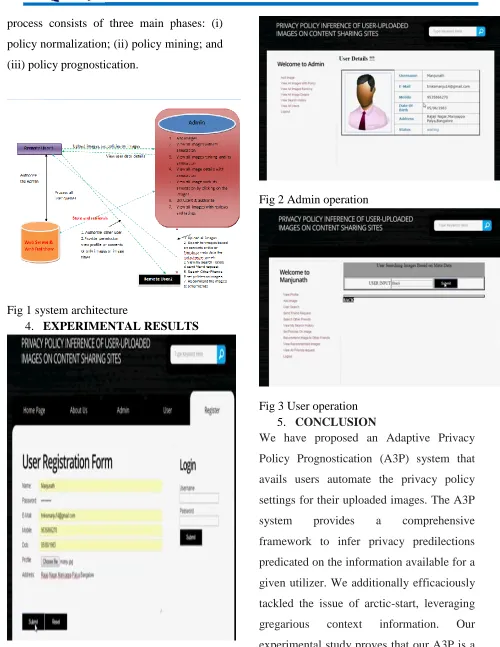
Fig 1 system architecture
4. EXPERIMENTAL RESULTS
Fig 2 Authentication and Authorization
Fig 2 Admin operation
Fig 3 User operation
5. CONCLUSION
We have proposed an Adaptive Privacy
Policy Prognostication (A3P) system that
avails users automate the privacy policy
settings for their uploaded images. The A3P
system provides a comprehensive
framework to infer privacy predilections
predicated on the information available for a
given utilizer. We additionally efficaciously
tackled the issue of arctic-start, leveraging
gregarious context information. Our
experimental study proves that our A3P is a
Amendments over current approaches to
privacy.
6. REFERENCES
[1] A. Acquisti and R. Gross, “Imagined
communities: Awareness, information
sharing, and privacy on the facebook,” in
Proc. 6th Int. Conf. Privacy Enhancing
Technol. Workshop, 2006,
pp. 36–58.
[2] R. Agrawal and R. Srikant,“Fast
algorithms for mining association rules in
large databases,” in Proc. 20th Int. Conf.
Very Large Data Bases, 1994, pp. 487–499.
[3] S. Ahern, D. Eckles, N. S. Good, S.
King, M. Naaman, and R. Nair,
“Over-exposed?: Privacy patterns and
considerations in online and mobile photo
sharing,” in Proc. Conf. Human Factors
Comput. Syst., 2007, pp. 357–366.
[4] M. Ames and M. Naaman, “Why we tag:
Motivations for annotation in mobile and
online media,” in Proc. Conf. Human
Factors Comput. Syst., 2007, pp. 971–980.
[5] A. Besmer and H. Lipford, “Tagged
photos: Concerns, perceptions, and
protections,” in Proc. 27th Int. Conf.
Extended Abstracts Human Factors Comput.
Syst., 2009, pp. 4585–4590.
[6] D. G. Altman and J. M. Bland ,“Multiple significance tests: The bonferroni method,”
Brit. Med. J., vol. 310, no. 6973, 1995.
[7] J. Bonneau, J. Anderson, and L. Church,
“Privacy suites: Shared privacy for social networks,” in Proc. Symp. Usable Privacy
Security, 2009.
[8] J. Bonneau, J. Anderson, and G.
Danezis, “Prying data out of a social network,” in Proc. Int. Conf. Adv. Soc.
Netw. Anal. Mining., 2009, pp.249–254.
[9] H.-M. Chen, M.-H. Chang, P.-C. Chang,
M.-C. Tien, W. H. Hsu, and J.-L. Wu,
“Sheepdog: Group and tag recommendation
for flickr photos by automatic search-based
learning,” in Proc. 16th
ACM Int. Conf.
Multimedia, 2008, pp. 737–740.
[10] M. D. Choudhury, H. Sundaram, Y.-R.
Lin, A. John, and D. D. Seligmann,
“Connecting content to community in social
media via image content, user tags and user
communication,” in Proc. IEEE Int. Conf.