International Journal of Research (IJR) Vol-1, Issue-9, October 2014 ISSN 2348-6848
Artificial Neural Network Sumeet Singh, Varun Vashishtha, Tapodhan Singla
Artificial Neural Network
Sumeet Singh1 , Varun Vashishtha2 & Tapodhan Singla3 Computer Science and Engineering Department
Maharshi Dayanand University, Rohtak, Haryana, India [email protected]
Abstract
Artificial neural networks (ANNs) are computationalmodelsinspired by an animal'scentral nervous system(in particular thebrain) which is capable ofmachine learningas well aspattern recognition. Artificial neural networks are generally presented as systems of interconnected "neurons" which can compute values from inputs. The key element of this paradigm is the novel structure of the information number of highly interconnected processing elements (neurons) working in unison to solve specific problems. ANNs, like people, learn by example. An ANN is configured for a specific application, such as pattern recognition or data classification, through a learning process. Learning in biological systems involves adjustments to the synaptic connections that exist between the neurons. This is true of ANNs as well. This paper gives overview of Artificial Neural Network, working & training of ANN. It also explains the application and advantages of ANN.
Keywords
ANN(Artificial Neural Network); Neurons; Pattern Recognition.
Introduction
Neural networks are typically organized in layers. Layers are made up of a number of interconnected 'nodes' which contain an 'activation function'. Patterns are presented to the network via the 'input layer', which communicates to one or more 'hidden layers' where the actual processing is done via a system of weighted 'connections'. The hidden layers then link to an 'output layer' where the answer is output as shown in the graphic below.
Most ANNs contain some form of 'learning rule' which modifies the weights of the connections according to the input patterns that it is presented with. In a sense, ANNs learn by example as do their biological counterparts; a child learns to recognize dogs from examples of dogs.
Although there are many different kinds of learning rules used by neural networks, this demonstration is concerned only with one; the delta rule. The delta rule is often utilized by the most common class of ANNs called 'back propagation neural networks' (BPNNs). Backpropagation is an abbreviation for the backwards propagation of error.
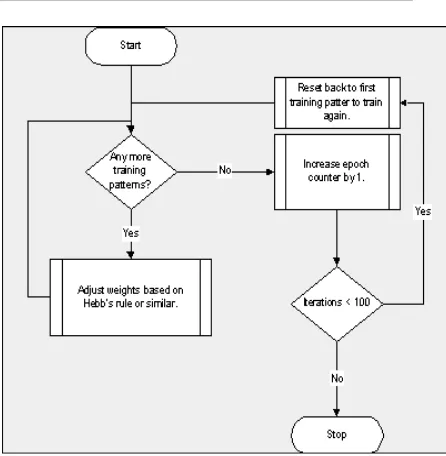
With the delta rule, as with other types of backpropagation, 'learning' is a supervised process that occurs with each cycle or 'epoch' (i.e. each time the network is presented with a new input pattern) through a forward activation flow of outputs, and the backwards error propagation of weight adjustments. More simply, when a neural network is initially presented with a pattern it makes a random 'guess' as to what it might be. It then sees how far its answer was from the actual one and makes an appropriate adjustment to its connection weights.
International Journal of Research (IJR) Vol-1, Issue-9, October 2014 ISSN 2348-6848
Artificial Neural Network Sumeet Singh, Varun Vashishtha, Tapodhan Singla They models a simple neural network with
electrical circuits. Neural networks, with their
remarkable ability to derive meaning
fromcomplicated or imprecise data, can be used to extract patterns and detect trends that are too complex to be noticed by either humans or other computer techniques. A trained neural network can be thought of as an "expert" in the category of information it has been given to analyse performance. However, some network capabilities may be retained even with major network damage.
Neural networks take a different approach to problem solving than that of conventional computers. Conventional computers use an algorithmic approach i.e. the computer follows a set of instructions in order to solve a problem. Unless the specific steps that the computer needs to follow are known the computer cannot solve the problem. That restricts the problem solving capability of
conventional computers to problems that we already understand and know how to solve. But computers would be so much more useful if they could do things that we don't exactly know how to do. Neural networks process information in a similar way the human brain does. The network is composed of a large number of highly interconnected processing elements (neurons) working in parallel to solve a specific problem. Neural networks
learn by example. They cannot be
programmed to perform a specific task. The examples must be selected carefully otherwise useful time is wasted or even worse the network might be functioning incorrectly. The disadvantage is that because the network finds out how to solve the problem by itself, its operation can be unpredictable. On the other hand, conventional computers use a cognitive approach to problem solving; the way the problem is to solved must be known and stated
in small unambiguous instructions.
The problems are converted to a high level language program and then into machine code that the computer can understand. These machines are totally predictable; if anything goes wrong is due to a software or hardware fault. Neural networks and conventional algorithmic computers are not in competition but complement each other. There are tasks are more suited to an algorithmic approach like arithmetic operations and tasks that are more suited to neural networks. Even more, a large number of tasks, require systems that use a combination of the two approaches (normally a conventional computer is used to supervise the neural network) in order to perform at maximum efficiency. What is Artificial Neural Network? Artificial Neural Networks are relatively crude electronic models based on the neural structure of the brain. The brain basically learns from experience. It is natural proof that some problems that are beyond the scope of current computers are indeed solvable by small energy efficient packages. This brain also models promises a less technical way to develop machine solutions. This new approach to computing also provides a more graceful degradation during system overload than its
more traditional counterparts. These
biologically inspired methods of computing are thought to be the next major advancement in the computing industry. Even simple animal brains are capable of functions that are
currently impossible for computers.
Computers do rote things well, like keeping ledgers or performing complex math. But computers have trouble recognizing even simple patterns much less generalizing those patterns of the past into actions of the future. Now, advances in biological research promise an initial understanding of the natural thinking mechanism. This research shows that brains store information as patterns. Some of these patterns are very complicated and allow us the ability to recognize individual faces from many different angles. This process of storing information as patterns, utilizing those
patterns, and then solving problems
encompasses a new field in computing. This field, as mentioned before, does not utilize traditional programming but involves the creation of massively parallel networks and the training of those networks to solve specific problems. This field also utilizes words very different from traditional computing, words ANN includes factors like behave, react, self-organize, learn, generalize, and forget. Whenever we talk about a neural network, we
should more popularly say ―Artificial Neural
Network (ANN)ǁ, ANN are computers whose
International Journal of Research (IJR) Vol-1, Issue-9, October 2014 ISSN 2348-6848
Artificial Neural Network Sumeet Singh, Varun Vashishtha, Tapodhan Singla network or circuit of biological neurones, but
modern usage of the term often refers to ANN. ANN is mathematical model or computational model, an information processing paradigm i.e. inspired by the way biological nervous system, such as brain information system. ANN is made up ofinterconnecting artificial neurones which are programmed like to mimic the properties of m biological neurons. These neurons works in unison to solve specific problems. ANN is configured for solving
artificial intelligence problems without
creating a model of real biological system. ANN is used for speech recognition, image
analysis, adaptive control etc. These
applications are done through a learning process, like learning in biological system, which involves the adjustment between neurones through synaptic connection. Same happen in the ANN.
Working of ANN
The other parts of the ―artǁ of using neural networks revolve around the myriad of ways these individual neurons can be clustered together. This clustering occurs in the human mind in such a way that information can be processed in a dynamic, interactive, and self-organizing way. Biologically, neural networks are constructed in a three-dimensional world from microscopic components. These neurons
seem capable of nearly unrestricted
interconnections. That is not true of any proposed, or existing, man-made network. Integrated circuits, using current technology, are two-dimensional devices with a limited number of layers for interconnection. This physical reality restrains the types, and scope, of artificial neural networks that can be implemented in silicon. Currently, neural networks are the simple clustering of the primitive artificial neurons. This clustering occurs by creating layers which are then connected to one another. How these layers connect is the other part of the "art" of engineering networks to resolve real world problems.
Figure 1:- A Simple Neural Network Diagram. Basically, all artificial neural networks have a similar structure or topology as shown in Figure1. In that structure some of the neurons interfaces to the real world to receive its inputs. Other neurons provide the real world with the network's outputs. This
output might be the particular character that the network thinks that it has scanned or the particular image it thinks is being viewed. All the rest of the neurons are hidden from view. But a neural network is more than a bunch of neurons. Some early researchers tried to simply connect neurons in a random manner, without much success. Now, it is known that even the brains of snails are structured devices. One of the easiest ways to design a structure is to create layers of elements. It is the grouping of these neurons into layers, the connections between these layers, and the
summation and transfer functions that
International Journal of
of a character being a "P" is .85 and the probability of the character being an "F" is .65, the network wants to choose the highest probability and inhibit all the others. It can do that with lateral inhibition. This concept is also
called competition. Another type of
connection is feedback. This is where th output of one layer routes back to a previous layer. An example of this is shown in Figure 2.
Figure 2:- Simple Network with Feedback and Competition. The way that the neurons are connected to each other has
impacton the operation of the
larger, more professional
softwaredevelopment packages the user is
allowed to add, delete, and control
theseconnections at will. By "tweaking" parameters these connections can be made toeither excite or
the initial weights are chosen randomly. Then, the training, or learning, begins. There are two approaches to training
unsupervised. Supervised training involves a mechanism of providing the network with the desired output either by manually "gr the network's performance or by providing the desired outputs with the inputs. Unsupervised training is where the network has to make sense of the inputs without outside help. The vast bulk of netwo
training inputs. However, i
sense of being truly self learning, it is still just a shining promise that is not fully understood, does not completely work, and thus is relegated to the lab.
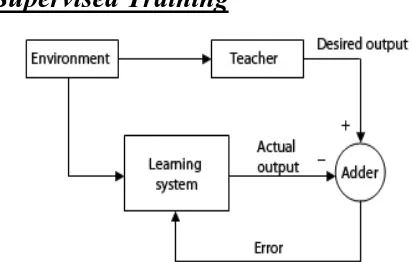
Supervised Training
In this, we are given a set of example pairs
function
functions that matches the examples. In other words, we wish to
by the data; the cost function is related to the mismatch between our mapping and the data
International Journal of Research (IJR) Vol
Artificial Neural Network Sumeet Singh, Varun Vashishtha, Tapodhan Singla of a character being a "P" is .85 and the
of the character being an "F" is .65, the network wants to choose the highest probability and inhibit all the others. It can do that with lateral inhibition. This concept is also
called competition. Another type of
connection is feedback. This is where the output of one layer routes back to a previous layer. An example of this is shown in Figure 2.
Simple Network with Feedback and Competition. The way that the neurons are connected to each other has a significant cton the operation of the network. In the
larger, more professional
softwaredevelopment packages the user is
allowed to add, delete, and control
theseconnections at will. By "tweaking" parameters these connections can be made toeither excite or inhibit. To start this process itial weights are chosen randomly. Then, the training, or learning, begins. There are two approaches to training - supervised and unsupervised. Supervised training involves a mechanism of providing the network with the desired output either by manually "grading" the network's performance or by providing the desired outputs with the inputs. Unsupervised training is where the network has to make sense of the inputs without outside help. The vast bulk of networks utilize supervise
inputs. However, in the full blown sense of being truly self learning, it is still just a shining promise that is not fully understood, does not completely work, and thus is relegated to the lab.
Supervised Training
, we are given a set of example and the aim is to find a in the allowed class of functions that matches the examples. In other words, we wish to infer the mapping implied by the data; the cost function is related to the mismatch between our mapping and the data
Research (IJR) Vol-1, Issue-9, October 2014 ISSN 2348
Sumeet Singh, Varun Vashishtha, Tapodhan Singla and it implicitly contains prior knowledge about the problem domain.
A commonly used cost is the
error which tries to minimize the average squared error between the network's output, f(x), and the target value y over all the example pairs. When one tries to minimize this cost using gradient descent
neural networks called multilayer perceptrons one obtains the common and well
propagation algo for training neural networks. Tasks that fall within the paradigm of supervised learning are pattern reognition known as classification) and regression known as function approximation). The
supervised learning paradigm is also
applicable to sequential data (e.g., for speech and gesture recognition). This can be thought of as learning with a "teacher," in the form of a function that provides continuous feedback on the quality of solutions obtained thus far.
In order to solve a given problem of supervised learning, one has to perform the following steps:
Determine the type of training examples. Before doing anything else, the user should decide what kind of data is to be used as a training set. In the case of handwriting analysis, for example, this might be a single handwritten character, an entire handwritten word, or an entire line of handwrit
Gather a training set. The training set needs to be representative of the real-world use of the function. Thus, a set of input objects is gathered and corresponding outputs are also gathered, either from human experts or from measurements.
Determine the input feature representation of the learned function. The accuracy of the learned function depends strongly on how the input object is represented. Typically, the input object is transformed into a feature vector, which contains a number of features that are descriptive of the object. The number of features should not be too large, because of the curse of dimensionality; but should contain enough information to accurately predict the output.
Determine the structure of the learned function and corresponding learning algorithm. For example, the engineer may choose to use support vector machines or decision trees Complete the design. Run the learning algorithm on the gathered training set. Some supervised learning algorithms require the user
ISSN 2348-6848
Sumeet Singh, Varun Vashishtha, Tapodhan Singla ins prior knowledge
A commonly used cost is the mean square which tries to minimize the average squared error between the network's output, f(x), and the target value y over all the example pairs. When one tries to minimize for the class of multilayer perceptrons, one obtains the common and well-knownback for training neural networks. Tasks that fall within the paradigm of
reognition (also regression (also known as function approximation). The
supervised learning paradigm is also
applicable to sequential data (e.g., for speech gesture recognition). This can be thought teacher," in the form of a function that provides continuous feedback on the quality of solutions obtained thus far.
In order to solve a given problem of supervised learning, one has to perform the
Determine the type of training examples. Before doing anything else, the user should decide what kind of data is to be used as a training set. In the case of handwriting analysis, for example, this might be a single handwritten character, an entire handwritten word, or an entire line of handwriting.
Gather a training set. The training set needs to world use of the function. Thus, a set of input objects is gathered and corresponding outputs are also gathered, either from human experts or from
he input feature representation of the learned function. The accuracy of the learned function depends strongly on how the input object is represented. Typically, the input object is transformed into a feature vector, which contains a number of features t are descriptive of the object. The number of features should not be too large, because of ; but should contain enough information to accurately predict the
International Journal of
to determine certain control parameters. These parameters may be adjusted by optimizing
performance on a subset (called
a validation set) of the training set, or via validation.
Evaluate the accuracy of the learned function. After parameter adjustment and learning, the performance of the resulting function should be measured on a test set that is separate from the training set.
A wide range of supervised learning algorithms is available, each with its strengths and weaknesses. There is no single learning algorithm that works best on all supervised learning problems.
Unsupervised, or Adaptive Training
The other type of
unsupervised training. In unsupervised
training, the network is provided with inputs but not with desired outputs.
In unsupervised learning, some data
and the cost function to be minimized, that can be any function of the data
network's output,
The cost function is dependent on the task (what we are trying to model) and our
priori assumptions (the implicit properties of our model, its parameters and the observed variables).
As a trivial example, consider the
model where
cost
will give us a value of
mean of the data. The cost function can be much more complicated. Its form depends on the application: for example, in compression it
could be related to the
International Journal of Research (IJR) Vol
Artificial Neural Network Sumeet Singh, Varun Vashishtha, Tapodhan Singla to determine certain control parameters. These
parameters may be adjusted by optimizing
performance on a subset (called
set) of the training set, or via cross
Evaluate the accuracy of the learned function. After parameter adjustment and learning, the performance of the resulting function should be measured on a test set that is separate from
A wide range of supervised learning algorithms is available, each with its strengths and weaknesses. There is no single learning algorithm that works best on all supervised
.
, or Adaptive Training
The other type of training is called
unsupervised training. In unsupervised
training, the network is provided with inputs h desired outputs.
unsupervised learning, some data is given and the cost function to be minimized, that can be any function of the data and the
.
The cost function is dependent on the task
(what we are trying to model) and our a
assumptions (the implicit properties of our model, its parameters and the observed
As a trivial example, consider the
where is a constant and the . Minimizing this cost will give us a value of that is equal to the mean of the data. The cost function can be much more complicated. Its form depends on the application: for example, in compression it
related to the mutual
Research (IJR) Vol-1, Issue-9, October 2014 ISSN 2348
Sumeet Singh, Varun Vashishtha, Tapodhan Singla information between and
statistical modeling, it could be related to the posterior probability of the model given the data. (Note that in both of those examples those quantities would be maximized rather than minimized).
Tasks that fall within the paradigm of
unsupervised learning are in
general estimation problems; the applications include clustering, the estimation of
distributions,compression and filtering. 3.3 Pattern Recognition - an example
An important application of neural networks is pattern recognition. Pattern recognition can be implemented by using a feed-forward (figure 1) neural network that has been trained accordingly. During training, the network is trained to associate outputs with i
When the network is used, it identifies the input pattern and tries to output the associated output pattern. The power of neural networks comes to life when a pattern that has no output associated with it, is given as an input. In this case, the network gives the output that corresponds to a taught input pattern that is least different from the given pattern.
Figure 1.
For example:
The network of figure 1 is trained to recognise the patterns T and H. The associated patterns are all black and all white respectively as shown below.
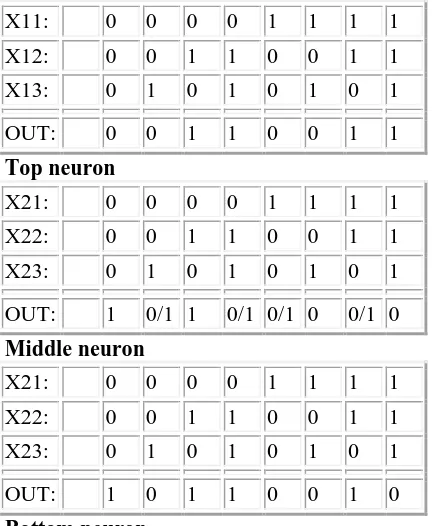
If we represent black squares with 0 and white squares with 1 then the truth tables for the 3 neurones after generalisation are;
ISSN 2348-6848
Sumeet Singh, Varun Vashishtha, Tapodhan Singla , whereas in statistical modeling, it could be related to of the model given the data. (Note that in both of those examples those quantities would be maximized rather
Tasks that fall within the paradigm of
unsupervised learning are in
problems; the applications clustering, the estimation of statistical
filtering. an example
important application of neural networks is pattern recognition. Pattern recognition can be forward (figure 1) neural network that has been trained accordingly. During training, the network is trained to associate outputs with input patterns. When the network is used, it identifies the input pattern and tries to output the associated output pattern. The power of neural networks comes to life when a pattern that has no output associated with it, is given as an input. In this the network gives the output that corresponds to a taught input pattern that is least different from the given pattern.
For example:
The network of figure 1 is trained to recognise the patterns T and H. The associated patterns nd all white respectively as
International Journal of Research (IJR) Vol-1, Issue-9, October 2014 ISSN 2348-6848
Artificial Neural Network Sumeet Singh, Varun Vashishtha, Tapodhan Singla
X11: 0 0 0 0 1 1 1 1
X12: 0 0 1 1 0 0 1 1
X13: 0 1 0 1 0 1 0 1
OUT: 0 0 1 1 0 0 1 1
Top neuron
X21: 0 0 0 0 1 1 1 1
X22: 0 0 1 1 0 0 1 1
X23: 0 1 0 1 0 1 0 1
OUT: 1 0/1 1 0/1 0/1 0 0/1 0
Middle neuron
X21: 0 0 0 0 1 1 1 1
X22: 0 0 1 1 0 0 1 1
X23: 0 1 0 1 0 1 0 1
OUT: 1 0 1 1 0 0 1 0
Bottom neuron
From the tables it can be seen the following associasions can be extracted:
In this case, it is obvious that the output should be all blacks since the input pattern is almost the same as the 'T' pattern.
Here also, it is obvious that the output should be all whites since the input pattern is almost the same as the 'H' pattern.
Here, the top row is 2 errors away from the a T and 3 from an H. So the top output is black. The middle row is 1 error away from both T and H so the output is random. The bottom row is 1 error away from T and 2 away from
H. Therefore the output is black. The total output of the network is still in favour of the T shape.
PERCEPTRON
The most influential work on neural nets in the 60's went under the heading of 'perceptrons' a term coined by Frank Rosenblatt. The perceptron (figure 4.4) turns out to be an MCP model ( neuron with weighted inputs ) with some additional, fixed, pre--processing. Units labelled A1, A2, Aj , Ap are called association units and their task is to extract specific, localised featured from the input images. Perceptrons mimic the basic idea behind the mammalian visual system. They were mainly used in pattern recognition even though their capabilities extended a lot more.
Figure 4.4
In 1969 Minsky and Papert wrote a book in which they described the limitations of single layer Perceptrons. The impact that the book had was tremendous and caused a lot of neural network researchers to loose their interest. The book was very well written and showed mathematically that single layer perceptrons could not do some basic pattern recognition operations like determining the parity of a shape or determining whether a shape is connected or not. What they did not realised, until the 80's, is that given the appropriate training, multilevel perceptrons can do these operations.
Application
:-International Journal of Research (IJR) Vol-1, Issue-9, October 2014 ISSN 2348-6848
Artificial Neural Network Sumeet Singh, Varun Vashishtha, Tapodhan Singla Given this description of neural networks and
how they work, what real world applications are they suited for? Neural networks have broad applicability to real world business problems. In fact, they have already been successfully applied in many industries. Since neural networks are best at identifying patterns or trends in data, they are well suited for prediction or forecasting needs including:
• sales forecasting
• industrial process control
• customer research
• data validation
• risk management
• target marketing
But to give you some more specific examples; ANN are also used in the following specific
paradigms: recognition of speakers in
communications; diagnosis of hepatitis;
recovery of telecommunications from faulty software; interpretation of multi-meaning Chinese words; undersea mine detection; texture analysis; three-dimensional object recognition; hand-written word recognition; and facial recognition.
2 Neural networks in medicine
Artificial Neural Networks (ANN) are currently a 'hot' research area in medicine and it is believed that they will receive extensive application to biomedical systems in the next few years. At the moment, the research is mostly on modelling parts of the human body and recognising diseases from various scans (e.g. cardiograms, CAT scans, ultrasonic scans, etc.).
Neural networks are ideal in recognising diseases using scans since there is no need to provide a specific algorithm on how to identify the disease. Neural networks learn by example so the details of how to recognise the disease are not needed. What is needed is a set of examples that are representative of all the variations of the disease. The quantity of examples is not as important as the 'quantity'. The examples need to be selected very carefully if the system is to perform reliably and efficiently.
2.1 Modelling and Diagnosing the
Cardiovascular System
Neural Networks are used experimentally to model the human cardiovascular system. Diagnosis can be achieved by building a model of the cardiovascular system of an individual and comparing it with the real time physiological measurements taken from the patient. If this routine is carried out regularly, potential harmful medical conditions can be detected at an early stage and thus make the process of combating the disease much easier. A model of an individual's cardiovascular system must mimic the relationship among physiological variables (i.e., heart rate, systolic and diastolic blood pressures, and breathing rate) at different physical activity levels. If a model is adapted to an individual, then it becomes a model of the physical condition of that individual. The simulator will have to be able to adapt to the features of any individual without the supervision of an expert. This calls for a neural network.
Another reason that justifies the use of ANN technology, is the ability of ANNs to provide sensor fusion which is the combining of values from several different sensors. Sensor fusion
enables the ANNs to learn complex
relationships among the individual sensor values, which would otherwise be lost if the values were individually analysed. In medical modelling and diagnosis, this implies that even though each sensor in a set may be sensitive only to a specific physiological variable, ANNs are capable of detecting complex medical conditions by fusing the data from the individual biomedical sensors.
2.2 Electronic noses
ANNs are used experimentally to implement electronic noses. Electronic noses have several
potential applications in telemedicine.
Telemedicine is the practice of medicine over long distances via a communication link. The electronic nose would identify odours in the remote surgical environment. These identified
odours would then be electronically
transmitted to another site where an door generation system would recreate them. Because the sense of smell can be an important sense to the surgeon, telesmell would enhance telepresent surgery.
2.3 Instant Physician
International Journal of Research (IJR) Vol-1, Issue-9, October 2014 ISSN 2348-6848
Artificial Neural Network Sumeet Singh, Varun Vashishtha, Tapodhan Singla autoassociative memory neural network to
store a large number of medical records, each of which includes information on symptoms, diagnosis, and treatment for a particular case. After training, the net can be presented with input consisting of a set of symptoms; it will then find the full stored pattern that represents the "best" diagnosis and treatment.
3 Neural Networks in business
Business is a diverted field with several general areas of specialisation such as accounting or financial analysis. Almost any neural network application wouldfit into one
business area or financial analysis.
There is some potential for using neural networks for business purposes, including resource allocation and scheduling. There is also a strong potential for using neural networks for database mining, that is, searching for patterns implicit within the
explicitly stored information in databases.
Most of the funded work in this area is classified as proprietary. Thus, it is not possible to report on the full extent of the work going on. Most work is applying neural networks, such as the Hopfield-Tank network for optimization and scheduling.
3.1 Marketing
There is a marketing application which has been integrated with a neural network system. The Airline Marketing Tactician (a trademark abbreviated as AMT) is a computer system made of various intelligent technologies including expert systems. A feedforward neural network is integrated with the AMT and was trained using back-propagation to assist
the marketing control of airline seat
allocations. The adaptive neural approach was amenable to rule expression. Additionaly, the application's environment changed rapidly and constantly, which required a continuously adaptive solution. The system is used to monitor and recommend booking advice for each departure. Such information has a direct impact on the profitability of an airline and can provide a technological advantage for users of the system.
While it is significant that neural networks have been applied to this problem, it is also
important to see that this intelligent
technology can be integrated with expert systems and other approaches to make a
functional system. Neural networks were used to discover the influence of undefined interactions by the various variables. While these interactions were not defined, they were used by the neural system to develop useful conclusions. It is also noteworthy to see that neural networks can influence the bottom line.
Advantages
1. Adaptive learning:-An ability to learn how to do tasks based on the data given for training or initial experience.
2. Self-Organisation:-An ANN can create its own organisation or representation of the information it receives during learning time. 3. Real Time Operation:-ANN computations may be carried out in parallel, and special hardware devices are being designed and manufactured which take advantage of this capability.
4. Pattern recognition is a powerful technique for harnessing the information in the data and generalizing about it. Neural nets learn to recognize the patterns which exist in the data set.
5. The system is developed through learning rather than programming.. Neural nets teach themselves the patterns in the data freeing the analyst for more interesting work.
6. Neural networks are flexible in a changing environment. Although neural networks may take some time to learn a sudden drastic change they are excellent at adapting to constantly changing information.
7. Neural networks can build informative models whenever conventional approaches fail. Because neural networks can handle very complex interactions they can easily model data which is too difficult to model with traditional approaches such as inferential statistics or programming logic.
8. Performance of neural networks is at least as good as classical statistical modelling, and better on most problems. The neural networks build models that are more reflective of the structure of the data in significantly less time.
Conclusion
International Journal of Research (IJR) Vol-1, Issue-9, October 2014 ISSN 2348-6848
Artificial Neural Network Sumeet Singh, Varun Vashishtha, Tapodhan Singla approaches. Depending on the nature of the
application and the strength of the internal data patterns you can generally expect a network to train quite well. The computing world has a lot to gain fron neural networks. Their ability to learn by example makes them very flexible and powerful. Furthermore there is no need to devise an algorithm in order to perform a specific task; i.e. there is no need to understand the internal mechanisms of that task. They are also very well suited for real time systems because of their fast responseand computational times which are due to their parallel architecture.This applies to problems where the relationships may be quite dynamic or non-linear. ANNs provide an analytical alternative to conventional techniques which are often limited by strict assumptions of normality, linearity, variable independence etc. Because an ANN can capture many kinds of relationships it allows the user to quickly and relatively easily model phenomena which otherwise may have been very difficult or impossible to explain otherwise. Today, neural
networks discussions are occurring
everywhere. Their promise seems very bright as nature itself is the proof that this kind of thing works. Yet, its future, indeed the very key to the whole technology, lies in hardware development. Currently most neural network development is simply proving that the principal works.
References
[1] Bradshaw, J.A Carden, K.J., Riordan, D.,
1991. Ecological ―Applications Using a
Novel Expert System Shellǁ. Comp. Appl.
Biosci. 7, 79–83.
[2] Lippmann, R.P., 1987. A introduction to computing with neural nets. IEEE Accost. Speech Signal Process. Mag., April: 4-22. [3] N. Murata, S. Yoshizawa, and S. Amari,
―Learning curves, model selection and
complexity of neural networks,ǁ in Advances