International Journal of Research (IJR)
e-ISSN: 2348-6848, p- ISSN: 2348-795X Volume 2, Issue 06, June 2015Available at http://internationaljournalofresearch.org
Simulation of a Banking Queue with Varying Servers and
Customers with Calculation, Optimization and Automation
of Banking System using Simulink
Neeru
1& Ms. Garima Garg
21M. Tech scholar, SGI, Samalkha, Haryana
2Assistant Professor, Computer Science deptt, SGI Samlkha ABSTRACT
Purpose – Many models have been proposed
to counter Bulk customer congestion. Most of them are inefficient and does not reduce load on the main server. Proposed model calculates performance of a customer queue under varying servers and optimizes the performance of a queuing system. It also provides with a tool to automate the whole system.
Methodology used - Simulating system
response to randomly generated customers with varying servers
Findings – Proposed model gives methods
that can be used to optimize the queue length and manage the average queue length of the costumers. It automates the behavior of queue according to varying servers for processing the customers. Model not only simulates a random and variable queue of customers but it also calculates average queue length of customers.
CHAPTER – 1
INTRODUCTION
Queuing system with vacations has been attracted considerable attention to many authors. It has effectively been applied in computers and communication systems production/inventory system. It is presented an excellent survey of queuing system with server vacations. One of the important
International Journal of Research (IJR)
e-ISSN: 2348-6848, p- ISSN: 2348-795X Volume 2, Issue 06, June 2015Available at http://internationaljournalofresearch.org
introduced by which is a control policy turning the server on whenever N (a predetermined value) or more customers in the system, turning off the server when system is empty. it is successfully combined the batch arrival queue with N-policy and obtained the analytical solutions. Later, it is analyzed in detail a batch arrival Mx/G/1 queue under N-policy with a single vacation and repeated vacation respectively. It is to be noted that few authors involved above considered the probability distribution of the number of customers in the system for batch arrival queue under N-policy with different vacations policies. Recently, it is analyzed the behaviors of queue length distributions of a batch arrival queue with server vacations and breakdowns based on a maximum entropy approach it is also used the maximum entropy solutions for batch arrival queue with anun-reliable server and delaying vacations. They all derived the approximate formula for the probability distribution of the number of customers in the system. For example, the queue-length distribution has been applied for the communication system buffer design (Yu et. Al., 2010) . Morse considers discouragement in which the arrival rate falls according to a negative exponential law. We consider a single-server queuing system in which the customers arrive in a Poisson fashion with rate depending on the number of customers present in the system at that time i.e. (n +1)λ. (Kumar et al., 2014) An impatient customer (due to reneging) may be convinced to stay in the service system for his service by utilizing certain convincing mechanisms. Such customers are termed as retained customers. When a customer gets impatient (due to reneging), he may leave the queue with some probability, say and may remain in the queue
International Journal of Research (IJR)
e-ISSN: 2348-6848, p- ISSN: 2348-795X Volume 2, Issue 06, June 2015Available at http://internationaljournalofresearch.org
CHAPTER – 2
LITERATURE SURVEY
RESEARCHE R
OBJECTIVE METHODOLO GY
FINDINGS
Abazi et al. (2014)
to propose a
methodology for
designing a
central maintenance workshop,
enabling the
evaluation of
performance in
terms of cost and sojourn time, for a given budget.
modeling
framework based on
queue networks
leads to a maintenance decision support tool enabling to give the structure of the MW, performing at a higher level, but at a reasonable configuration cost.
La (2013) to focus on the ED's operational
level and
determine an
optimal fast track
strategy to
improve performance measures
analysis of
scenarios for
optimizing fast track.
Length of stay and queue length were most significantly reduced when there was an increased physician presence in the fast track system, followed by an additional emergency nurse practitioner in the system. Finally, the implementation of See‐and‐treat had a negligible effect on both performance measures for fast‐tracked patients
Church (2006) . Waiting time and the impact it has on customer
perceptions of
service quality is considered
alongside a
typology of
customers, based on their waiting characteristics. A number of critical components that affect customer queuing and crowding emerge
International Journal of Research (IJR)
e-ISSN: 2348-6848, p- ISSN: 2348-795X Volume 2, Issue 06, June 2015Available at http://internationaljournalofresearch.org
as an inherent part
of the
production‐line service system
Lam (2004) describes a restructuring effort of a Hong Kong‐based company, which provides technical support services
in office
equipment,
computer and
system products
explore the
different options and to evaluate the results for restructuring the
existing call
centers.
results have confirmed that the greatest improvement opportunity is to merge the existing resources into a single call center. Assured by the simulation findings, management is able to evaluate different tangible and
intangible benefits before
implementing the restructuring plan.
Lehaney (1996)
Suggests that
hospitals are
faced with
variable demand
patterns, and
simulation provides
managers with a powerful means
to access the
demands on
resources created by different case scenarios
Case study Outlines the iterative development of a case study of patient flows at one clinic in an out‐patients department, describing the software used ‐ a Windows‐based simulation environ ment called SIMUL8.
Blosch (1999) Royal Navy’s manpower
planning system
represents a
highly complex
queue which aims
to provide
sufficient
manpower to
meet both
operational and structural
commitments
Experimental design
illustrates how computer
International Journal of Research (IJR)
e-ISSN: 2348-6848, p- ISSN: 2348-795X Volume 2, Issue 06, June 2015Available at http://internationaljournalofresearch.org
Doloi (2002) focuses on a conceptual
methodology for
an integrated
simulation model
dubbed as
dynamic
simulation modeli
ng system
(DSMS) for
proactive and
optimal decision making within a project
management framework.
simulation model Possible extensions are outlined. The C++ programming language in association with the object‐oriented database management system is used to achieve the aforementioned objectives.
Proctor, (1996) Proposes discrete event
simulation as an effective tool in the search for more efficient
health care
systems.
Case study shows how efficiency might be improved by moderating available resources and times taken to complete tasks. Maintains that the principles expounded here are applicable to many different aspects of health care management
Work done by different researchers on queue simulation over the years.
CHAPTER -3
SCOPE OF THE PAPER
1. Simulation of a real time queuing system
2. Simulating average queue length of customer
3. Determining average queue length of the customer
4. Changing system from single server to multiple servers to manage server load
5. Optimizing the queuing system
CHAPTER – 4
METHODOLOGY USED IN THE PAPER
1. DERIVING A RANDOM NUMBER GENERATOR TO GENERATE N - RANDOM CUSTOMRS ARRIVING AT ANY INSTANT OF TIMES.
2. GENERAING A ODERED QUEUE
3. USING A SINGLE SERVER TO PROCESS N CUSTOMESRS 4. SIMULATING THE SYSTEM
International Journal of Research (IJR)
e-ISSN: 2348-6848, p- ISSN: 2348-795X Volume 2, Issue 06, June 2015Available at http://internationaljournalofresearch.org
NUMBER OF CUSTOMERS WITH SINGLE SERVER USING SIMULINK.
5. DETERMINING AVERAGE QUEUE LENGHTH AT A GIVEN INSTANT OF TIME USING SIMULINK
6. PLOTTING THE SIMULATION OUTPUT WITH SINGLE SERVER
7. VARYING SINGLE SERVER TO MULTIPLE SERVER TO REDUCE THE AVERAGE QUEUE LENGTH AND LOAD ON THE SERVER
8. SIMULATING THE SYSTEM RESPONSE TO INCREASING NUMBER OF CUSTOMERS WITH MULTIPLE SERVERS. 9. PLOTTING THE OPTIMIZED
OUTPUT USING SIMULINK 10.USING MATLAB CODE TO
AUTOMATE THE SYSTEM
CHAPTER – 5
RESULTS AND CONCLUSION
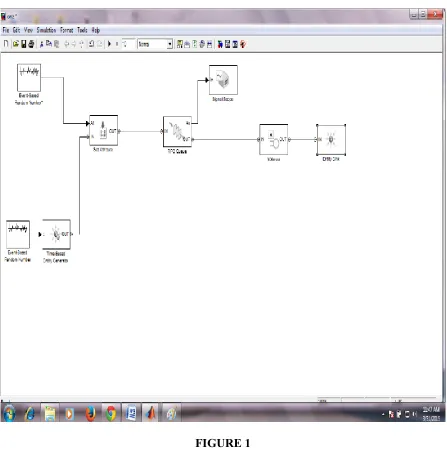
1. A discrete event system is presented in the model.
2. The model is implemented with a FIFO queue.
3. Here we are measuring the average queue length of customers in a queue per unit of time
4. The model is ready to run as presented in the figure 1
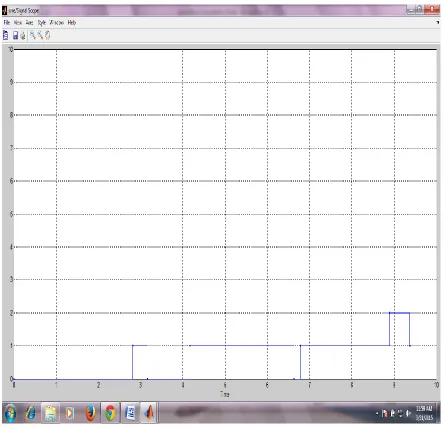
5. Model is run for time unit t=10 units
6. Here we see queue length is steady in the beginning then it is rising high up to 2 customers in a queue (Fig 2)
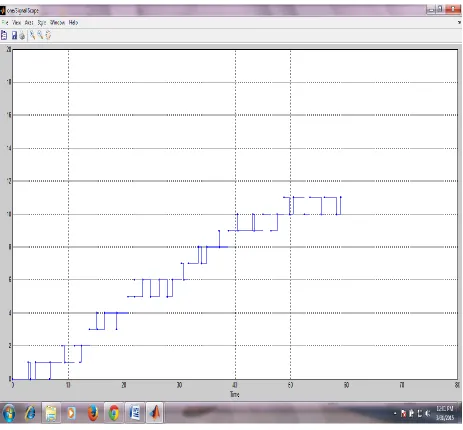
7. Now when we stress test the system and run the system for time t=60 units (Fig 3), we see queue length rapidly increases to 11 customers per queue with time
8. In above cases we were dealing with single server only. It is evident that using single server a queue processing system cant run efficiently and queue length increases rapidly with increasing stress of customers.
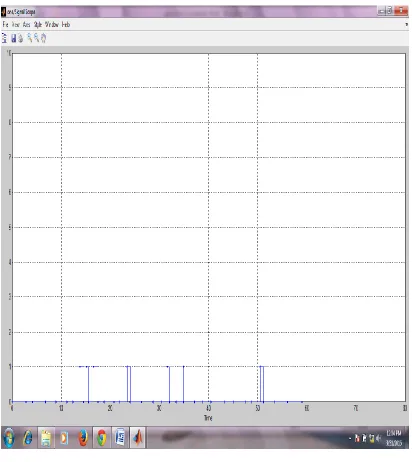
9. To overcome this problem and optimize our system we are increasing the number of servers from 1 to 2.
10.Now we see average number of customers reduces to 1 from 12 with increasing servers. (Fig. 4)
11.Thus we are modeling and optimizing a discrete event system with Sim Events library in real time.
CHAPTER – 6
REFERENCES
[1.]Baruah et. Al. (2013), A Two Stage Batch Arrival Queue with Reneging during Vacation and Breakdown Periods , American Journal of Operations Research, 3, 570-580 [2.]Brill et. Al.(2013), Server Workload
in an M/M/1 Queue with Bulk Arrivals and Special Delays , Applied Mathematics, 2012, 3, 2174-2177
International Journal of Research (IJR)
e-ISSN: 2348-6848, p- ISSN: 2348-795X Volume 2, Issue 06, June 2015Available at http://internationaljournalofresearch.org
[4.]Gandole (2011), Computer Modeling and Simulation of Ultrasonic System for Material Characterization, Modeling and Numerical Simulation of Material Science, 1, 1-13
[5.]Hemanta Doloi, Ali Jaafari, (2002) "Conceptual simulation model for strategic decision evaluation in project management", Logistics Information Management, Vol. 15 Iss: 2, pp.88 - 104
[6.]Jennifer La, Elizabeth M. Jewkes, (2013) "Defining an optimal ED fast track strategy using simulation", Journal of Enterprise Information Management, Vol. 26 Iss: 1/2, pp.109 - 118
[7.]Kokin Lam, R.S.M. Lau, (2004) "A simulation approach to restructuring call centers", Business Process Management Journal, Vol. 10 Iss: 4, pp.481 – 494
[8.]Kukla (2008), Rationalization of foundry processes on the basis of simulation experiment, Archives of foundry engineering, Volume 8 Issue 3
[9.]Kumar (2014), A single server markovian queuing sytem with discouraged arrivals and retention of reneged coustumers, Yugoslav Journal of Operations Research 24 , Number 1, 119-126
[10.] Marcus Blosch, Jiju Antony, (1999) "Experimental design and computer based simulation: a case study with the Royal Navy", Managing Service Quality: An International Journal, Vol. 9 Iss: 5, pp.311 – 320
[11.] Peschansky et. Al. (2011), Stationary Characteristics of the
Single-Server Queue System with Losses and Immediate Service Quality Control Applied Mathematics, 2011, 2, 403-409 [12.] Tony Proctor, (1996)
"Simulation in hospitals", Health Manpower Management, Vol. 22 Iss: 5, pp.40 - 44
[13.] vor Church, Andrew J. Newman, (2000) "Using simulations in the optimisation of fast food service delivery",British Food Journal, Vol. 102 Iss: 5/6, pp.398 - 405
[14.] Wang et. Al. (2009), On the Scalable Fairness and Efficient Active Queue Management of RED, I. J. Communications, Network and System Sciences, 1, 1-89
[15.] Yu (2010), Steady-State Queue Length Analysis of a Batch Arrival Queue under N-Policy with Single Vacation and Setup Times, Intelligent Information Management, 2010, 2, 365-374
[16.] Zadeh et al. (2012), A Batch Arrival Queue System with Coxian-2 Server Vacations and Admissibility Restricted, American Journal of Industrial and Business Management, 2, 47-54
International Journal of Research (IJR)
e-ISSN: 2348-6848, p- ISSN: 2348-795X Volume 2, Issue 06, June 2015Available at http://internationaljournalofresearch.org
FIGURES USED IN THE PAPER
International Journal of Research (IJR)
e-ISSN: 2348-6848, p- ISSN: 2348-795X Volume 2, Issue 06, June 2015Available at http://internationaljournalofresearch.org
International Journal of Research (IJR)
e-ISSN: 2348-6848, p- ISSN: 2348-795X Volume 2, Issue 06, June 2015Available at http://internationaljournalofresearch.org
International Journal of Research (IJR)
e-ISSN: 2348-6848, p- ISSN: 2348-795X Volume 2, Issue 06, June 2015Available at http://internationaljournalofresearch.org