c
Owned by the authors, published by EDP Sciences, 2016
Searches for BSM physics in dilepton, multilepton and
lepton+MET final states at CMS
L. Benato1,2,aon behalf of CMS Collaboration 1Università degli Studi di Padova
2INFN sezione di Padova
Abstract.Numerous new physics models, e.g., theories with extra dimensions and vari-ous gauge-group extensions of the standard model, predict the existence of new particles decaying to dilepton, multilepton, and lepton+MET final states. This talk presents the recent results from searches for new physics in the leptonic final states at CMS.
1 Introduction
Many Beyond Standard Model (BSM) physics models foresee the appearance of particles at high mass range, decaying into dilepton, multilepton and lepton+neutrino final states. Leptons considered
in these searches are electrons and muons; neutrinos are revealed as missing transverse energy in the detector (Emiss
T ). The leptonic final states are historically channels of discovery and precision measurements, because they show very clean signatures; dealing with high energetic leptons coming from heavy resonances, however, implies careful studies of the objects and their properties. Generally these models predict very small branching ratio for leptonic decays: as a consequence, the statistical uncertainties dominate, so it is necessary to accurately evaluate the backgrounds. Results obtained from the LHC Run 2 data collected in 2015 by the CMS experiment [1] are presented: going up to √s
=13 TeV makes the parton luminosities of processesqq¯→Xincrease substantially, especially at
high mass region, improving the previous limits set on these models by LHC Run 1 data. [2]-[5]
2 CMS detector
CMS is a multi-purpose experiment composed of many sub-systems enclosed in a superconducting magnet. Informations coming from different sub-detectors can be used together to improve the energy
and momentum determination of the particles involved.
3 High energy objects
As a general approach, isolation requirements are applied to charged leptons, in order to reduce back-grounds coming from objects (mainly jets) misidentified as leptons. A lepton is isolated if the ratio of the energy deposits around its track divided by its transverse momentum (pT) is below a certain threshold.
3.1 Muons
Muons are challenging objects to reconstruct at high energy values: in these conditions, their trajec-tory in the magnetic field is almost straight, complicating the determination of theirpT and charge. The precision of theirpT measurement, furthermore, is strongly influenced by the alignment of the external muon gas detectors and the inner silicon tracker. In addition, high energetic muons radiate in the detector materials, causing a loss of resolution at increasingpT. Many studies in this sense have been performed on the cosmic muons collected by CMS. Different high-pT muon reconstruction al-gorithms have been exploited: they generally combine informations from muon chambers and tracker, in order to improve the identification efficiency as much as possible and to discard the segments in the
muon chambers where radiactive phenomena occurred.
3.2 Electrons
Electrons are reconstructed using informations coming from all the sub-detectors. Dedicated selec-tions for high-pT electrons are applied in these analyses, in order to achieve the highest detection efficiency. Unlike muons, electron energy andpT resolutions are approximatively constant at increas-ing energy.
3.3 Emiss T
The experimental signature of the presence of a non-interacting particle, the neutrino, is represented by the missing transverse energy,Emiss
T . The quantity pmissT is defined as the negative sum−ΣpT of all reconstructed particles;Emiss
T is the modulus ofpmissT . Its magnitude is influenced by all the other objects, including jets and their corrections.
4 Heavy spin-1 BSM bosons searches in dilepton and lepton plus
E
missT
final states
A common feature of models admitting new physics consists into enlarging the Standard Model gauge symmetry group,S U(3)×S U(2)×U(1), into a larger one that, once broken into the SM group, will result into new residual groups: new spin-1 heavy bosons are expected to appear. The most naïf extension is the Sequential Standard Model [6], in which twoW
S S Mand aZ
S S Mare expected to be the
heavy replicas ofWandZbosons, with the same couplings to leptons as their standard model partners. More exotic spin-1 heavy bosons predicted by super string inspired models, like aZ
Ψcoming from
E(6) breaking [7]-[8], are searched for in the following analysis.
4.1 Z
→+−[9]
The analysis strategy consists into reconstructing the invariant mass of the heaviest+− pair,
af-ter applying adequate selections to all the leptonic candidates, in order to suppress the background contributions in favour of the expected signal. The main source of irreducible background events is represented by the Drell-Yan process,Z/γ∗→+−, that is well estimated by Monte Carlo simulated
events. Monte Carlo simulations also work for the second category of backgrounds, which contains real prompt leptons coming from processes likett¯, tW, WW,WZ, ZZ; these predictions are vali-dated on data ineµcontrol region, where no signal is expected. Non-prompt backgrounds, that are
3.1 Muons
Muons are challenging objects to reconstruct at high energy values: in these conditions, their trajec-tory in the magnetic field is almost straight, complicating the determination of theirpT and charge. The precision of theirpT measurement, furthermore, is strongly influenced by the alignment of the external muon gas detectors and the inner silicon tracker. In addition, high energetic muons radiate in the detector materials, causing a loss of resolution at increasingpT. Many studies in this sense have been performed on the cosmic muons collected by CMS. Different high-pT muon reconstruction al-gorithms have been exploited: they generally combine informations from muon chambers and tracker, in order to improve the identification efficiency as much as possible and to discard the segments in the
muon chambers where radiactive phenomena occurred.
3.2 Electrons
Electrons are reconstructed using informations coming from all the sub-detectors. Dedicated selec-tions for high-pT electrons are applied in these analyses, in order to achieve the highest detection efficiency. Unlike muons, electron energy andpT resolutions are approximatively constant at increas-ing energy.
3.3 Emiss T
The experimental signature of the presence of a non-interacting particle, the neutrino, is represented by the missing transverse energy,Emiss
T . The quantity pmissT is defined as the negative sum−ΣpT of all reconstructed particles;Emiss
T is the modulus ofpmissT . Its magnitude is influenced by all the other objects, including jets and their corrections.
4 Heavy spin-1 BSM bosons searches in dilepton and lepton plus
E
missT
final states
A common feature of models admitting new physics consists into enlarging the Standard Model gauge symmetry group,S U(3)×S U(2)×U(1), into a larger one that, once broken into the SM group, will result into new residual groups: new spin-1 heavy bosons are expected to appear. The most naïf extension is the Sequential Standard Model [6], in which twoW
S S Mand aZ
S S Mare expected to be the
heavy replicas ofWandZbosons, with the same couplings to leptons as their standard model partners. More exotic spin-1 heavy bosons predicted by super string inspired models, like aZ
Ψcoming from
E(6) breaking [7]-[8], are searched for in the following analysis.
4.1 Z
→+−[9]
The analysis strategy consists into reconstructing the invariant mass of the heaviest+− pair,
af-ter applying adequate selections to all the leptonic candidates, in order to suppress the background contributions in favour of the expected signal. The main source of irreducible background events is represented by the Drell-Yan process,Z/γ∗→+−, that is well estimated by Monte Carlo simulated
events. Monte Carlo simulations also work for the second category of backgrounds, which contains real prompt leptons coming from processes like tt¯, tW, WW, WZ, ZZ; these predictions are vali-dated on data ineµcontrol region, where no signal is expected. Non-prompt backgrounds, that are
objects (mainly jets) misidentified as leptons, are predicted via data-driven methods. Cosmic muons
are suppressed applying a cut on the impact parameter with respect to the primary vertex of the hard interaction and on the 3D angle between the muons.
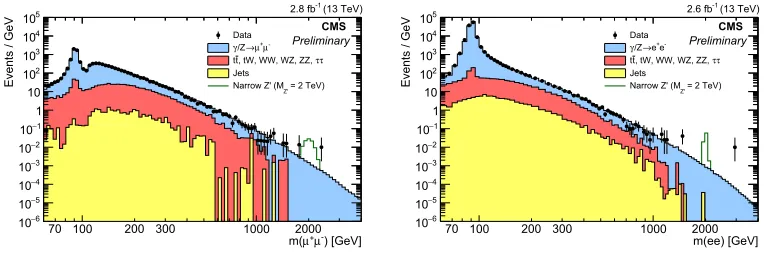
The observed and the predicted SM backgrounds invariant mass spectra are shown in Fig. 1 for muons (left) and electrons (right). No discrepancy is seen among the two distributions. The highest mass event is observed in the electron channel, and it is located at 2.9 TeV. The expected number of events above 2.8 TeV is 0.036±0.009ee, 1 is seen. The local p-value for the null-hypothesis calculated as the Poisson probability to observe at least one event in the electron channel above 2.8 TeV is 0.036.
) [GeV] -µ + µ m(
70 100 200 300 1000 2000
Events / GeV
6 − 10 5 − 10 4 − 10 3 − 10 2 − 10 1 − 10 1 10 2 10 3 10 4 10 5 10 Data -µ + µ → /Z γ τ τ
, tW, WW, WZ, ZZ, tt
Jets
= 2 TeV)
Z'
Narrow Z' (M
(13 TeV) -1 2.8 fb CMS Preliminary m(ee) [GeV]
70 100 200 300 1000 2000
Events / GeV
6 − 10 5 − 10 4 − 10 3 − 10 2 − 10 1 − 10 1 10 2 10 3 10 4 10 5 10 Data -e + e → /Z γ τ τ
, tW, WW, WZ, ZZ, tt
Jets
= 2 TeV)
Z'
Narrow Z' (M
(13 TeV) -1 2.6 fb
CMS Preliminary
Figure 1. Z →+−search. The invariant mass spectrum ofµ+µ−(left) ande+e−(right) events. The points
with error bars represent the data. The histograms represent the expectations from standard model processes: Drell-Yan, other sources of prompt leptons (tt¯,tW,WW,WZ,ZZ,Z→ττ), and non-prompt backgrounds. The green curve represents an hypotheticalZ
of mass 2 TeV.
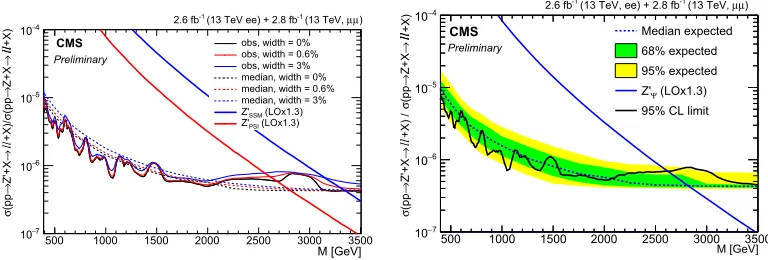
Limits at 95% confidence level on the ratio between the cross-section times branching ratio for theZ
divided by the same quantity for theZare extracted:
σ(pp→Z
+X→+X) σ(pp→Z/γ∗+X→+X).
The ratio cancels the luminosity uncertainties. A Bayesian unbinned likelihood approach is applied; the likelihood is integrated using the Metropolis-Hastings algorithm. The main uncertainties related to signal efficiency and cross-section are due to lepton identification (6% for electrons, 7% for muons).
The background uncertainty comes mainly from PDF uncertainties (up to 20% at 3 TeV). A mass scale uncertainty (1% fore, 3% forµ) is applied while combining the channels. The signal is modelled as the convolution of a Breit-Wigner and a Gaussian distribution, under the narrow width approximation: this means that only the on-shell region of the resonance is considered, because the interference is strongly model-dependent. In Fig. 2 (left), expected and observed limits for different signal widths
are shown, ranging from 0%, to 0.6% of the expected resonance mass (as predicted byZ
Ψ), to 3% of the mass (as predicted byZ
S S M), combining theeandµchannel. The final expected and observed
M [GeV]
500 1000 1500 2000 2500 3000 3500
+X)
→
Z+X
→
(pp
σ
+X)/
→
Z'+X
→
(pp
σ
7
− 10
6
− 10
5
− 10
4
− 10
obs, width = 0% obs, width = 0.6% obs, width = 3% median, width = 0% median, width = 0.6% median, width = 3%
(LOx1.3) SSM Z'
(LOx1.3) PSI Z'
) µ µ (13 TeV, -1 (13 TeV ee) + 2.8 fb -1
2.6 fb
CMS Preliminary
ll
llll
M [GeV]
500 1000 1500 2000 2500 3000 3500
+X)
→
Z+X
→
(pp
σ
+X) /
→
Z'+X
→
(pp
σ
7
− 10
6
− 10
5
− 10
4
− 10
Median expected 68% expected 95% expected (LOx1.3) Ψ Z' 95% CL limit
)
µ µ
(13 TeV,
-1
(13 TeV, ee) + 2.8 fb
-1
2.6 fb
CMS
Preliminary
ll
llll
Figure 2.Z
→+−search.Left: 95% confidence level observed and expected limits on the cross-section ratio
for different resonance widths; they are obtained combining the electron and muon channels. Right: limits set at 95% confidence level for aZ
whose natural width is the 0.6% of its mass. The theoretical curves of the discussed models are included in the plots.
Table 1.Z
→+−search.Observed limits on the mass ofZ ΨandZ
S S Mfor each channel and for the
combination.
Channel Z
Ψ Z
S S M
ee 2.40 TeV 2.75 TeV
µµ 2.40 TeV 3.00 TeV
combination 2.60 TeV 3.15 TeV
4.2 W
→ν[10]
In this analysis, since a neutrino is expected in the final state, the discriminant variable is the transverse invariant mass, which takes into account only the transverse quantities:
MT =
2p
TEmissT
1−cos∆φ(p
T, pmissT )
.
In order to achieve a back-to-back topology between the lepton and the neutrino, a cut is applied on their azimuthal angles,|∆φ(p
T, pmissT )| > 2.5. A further selection, 0.4 < pT/EmissT < 1.5, allows to reject background contamination.
The dominant source of background is represented by the standard modelW → νprocess, and
it is fully predicted by Monte Carlo simulations. Secondary backgrounds like Drell-Yan processes,
tt¯, singlet,WW,WZ,ZZare also taken from simulations. QCD multijet backgrounds are estimated from data. Cosmic muons contamination is suppressed with a cut on impact parameter with regards to the primary vertex, like in the previous analysis.
In Fig. 3, the transverse mass distributions are shown for muon (left) and electron (right) channel. Data and Monte Carlo spectra are in agreement.
Limits at 95% confidence level on cross-sectionσ(pp→W
+X→ν+X) are extracted via the
M [GeV]
500 1000 1500 2000 2500 3000 3500
+X) → Z+X → (pp σ +X)/ → Z'+X → (pp σ 7 − 10 6 − 10 5 − 10 4 − 10
obs, width = 0% obs, width = 0.6% obs, width = 3% median, width = 0% median, width = 0.6% median, width = 3%
(LOx1.3) SSM Z' (LOx1.3) PSI Z' ) µ µ (13 TeV, -1 (13 TeV ee) + 2.8 fb -1 2.6 fb CMS Preliminary ll llll M [GeV]
500 1000 1500 2000 2500 3000 3500
+X) → Z+X → (pp σ +X) / → Z'+X → (pp σ 7 − 10 6 − 10 5 − 10 4 − 10 Median expected 68% expected 95% expected (LOx1.3) Ψ Z' 95% CL limit
)
µ µ
(13 TeV,
-1
(13 TeV, ee) + 2.8 fb
-1 2.6 fb CMS Preliminary ll llll
Figure 2.Z
→+−search.Left: 95% confidence level observed and expected limits on the cross-section ratio
for different resonance widths; they are obtained combining the electron and muon channels. Right: limits set at 95% confidence level for aZ
whose natural width is the 0.6% of its mass. The theoretical curves of the discussed models are included in the plots.
Table 1.Z
→+−search.Observed limits on the mass ofZ
ΨandZ
S S Mfor each channel and for the combination.
Channel Z
Ψ Z
S S M
ee 2.40 TeV 2.75 TeV
µµ 2.40 TeV 3.00 TeV
combination 2.60 TeV 3.15 TeV
4.2 W
→ν[10]
In this analysis, since a neutrino is expected in the final state, the discriminant variable is the transverse invariant mass, which takes into account only the transverse quantities:
MT =
2p
TETmiss
1−cos∆φ(p
T, pmissT )
.
In order to achieve a back-to-back topology between the lepton and the neutrino, a cut is applied on their azimuthal angles,|∆φ(p
T, pmissT )| >2.5. A further selection, 0.4 < pT/EmissT < 1.5, allows to
reject background contamination.
The dominant source of background is represented by the standard modelW → νprocess, and it is fully predicted by Monte Carlo simulations. Secondary backgrounds like Drell-Yan processes,
tt¯, singlet,WW,WZ,ZZare also taken from simulations. QCD multijet backgrounds are estimated from data. Cosmic muons contamination is suppressed with a cut on impact parameter with regards to the primary vertex, like in the previous analysis.
In Fig. 3, the transverse mass distributions are shown for muon (left) and electron (right) channel. Data and Monte Carlo spectra are in agreement.
Limits at 95% confidence level on cross-sectionσ(pp→W
+X→ν+X) are extracted via the modified frequentist approach (CLsmethod [11]-[12]). Limits are provided in a region over 1 TeV,
where Run 2 data are more sensitive due to the increased center of mass energy and, consequently, increased cross-section for the considered process. The main uncertainties in the muon channel arise
(GeV) T M 3 10 Events 1 − 10 1 10 2 10 3 10 4 10 5 10 6 10 Data ν µ → W tt * γ Z/ Diboson SSM W' 2.4 TeV SSM W' 3.6 TeV
CMS Preliminary miss T +E µ (13 TeV) -1 2.2 fb (GeV) T M 2 10 ×
2 3×10² 103 2×10³ 3×10³
Data/MC 0 0.5 1 1.5 2
Systematic uncertainty band
Figure 3.W
→νsearch.The transverse mass spectrum ofµν(left) andeν(right) events. The points with error bars represent the data. The histograms represent the expectations from standard model processes: Wdecays, other sources of prompt leptons (Z/γ∗,tt¯,tW,WW,WZ,ZZ,Z→ττ), and non-prompt backgrounds. The dark
orange and black curves represent two hypotheticalW
of mass 2.4 and 3.6 TeV.
from the muon momentum scale and pT resolution, that both propagate to ETmiss, as pointed out in
Sec. 3.1 and 3.3. The electron channel is mainly affected by PDF uncertainties, especially at highMT.
The expected and observed limits for the cross-section obtained combining the two channels are shown in Fig. 4; the final limits on theW
S S Mmass for each channel are summarized in Tab. 2.
[GeV]
W'
M 1000 1500 2000 2500 3000 3500 4000 4500 5000 5500
B (fb) × σ 1 − 10 1 10 2 10 3 10 4 10 5
10 σ SSM W' NNLO ⊗ PDF+ αs Observed Expected σ 1 ± σ 2 ± miss T +E µ e, (13 TeV) -1 2.2 fb CMS Preliminary
Figure 4.W
→νsearch.95% confidence level observed and expected limits on the cross-section compared to the theoretical curve predicted for aW
Table 2.W→νsearch.Observed limits on the mass of aWS S M for each channel and for the combination.
Channel W
S S M
e 3.8 TeV
µ 4.0 TeV
combination 4.4 TeV
5 Seesaw type-III mechanism search in multilepton final states [13]
A remarkable puzzle left unsolved by the Standard Model is related to neutrino masses. An appealing possibility is represented by the seesaw mechanism: it introduces new heavy particles coupling to leptons and to Higgs doublets, accounting for both the neutrino masses and their smallness (six or more orders of magnitude smaller than that of the electron). In particular, in the type-III seesaw model [14], the neutrino is considered a Majorana particle whose mass arises via the mediation of a massive fermionic triplet, composed by the heavy Dirac chargedΣ±, and the heavy Majorana neutral Σ0. In high energy proton-proton collisions, the heavy fermions may be produced in pairs through
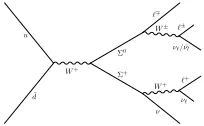
electroweak interactions. In this search, a final state with at least three charged leptons (electrons or muons) is considered: the heavy triplet can decay into leptons via electroweak or Higgs bosons. In Fig. 5, one of the 27 possible decay modes is pictured. The decay rate of aΣto a particular flavour
is proportional to √ V
|Ve|2+|Vµ|2+|Vτ|2, where eachV represents the coupling of the heavy fermion to the
considered leptonic flavour. In the flavour democratic scenario,Vis the same fore,µandτ.
¯
d u
W+
Σ0
Σ+
∓
W±
W+
ν
±
ν/ν¯l
+
ν
Figure 5.Seesaw type-III search.Feynman diagram example of the fermionΣproduction and decay in leptonic final states in the context of the type-III seesaw model.
The analysis strategy is based on grouping the final states in categories, depending on the number of reconstructed leptons, the number of opposite sign same flavour pairs (OSSF), zero, one or two, and on the invariant mass of the pair, on or under-above the nominal mass of theZboson. A promising cut that has been studied to reject backgrounds is the scalar sum of thepT of all the considered leptons,
LT, added toEmissT , requiringLT+EmissT >350 GeV: this guarantees high efficiency for both channels involving decays where the momentum is carried by leptons, likeΣ±→Z±→±+−
, and decays where there is a large amount of missing transverse energy, likeΣ0 → Hν → WWν. Considering the most significant channels in terms of expected signal given the luminosity, the analysis consists in keeping 4 distributions, depending on the lepton properties: 3 leptons without an OSSF pair, 3 leptons with one OSSF pair on-Z, 3 leptons with one OSSF pair above-Z, and 4 leptons with at least one OSSF pair. In left Fig.6, the spectrum ofLT+EmissT for the category 1 OSSF pair, 3 leptons,m+− above-Z is displayed, whilst in right Fig.6 there is the spectrum for the category where there is at least 1 OSSF, 4 leptons, no requirements onm+−: it is noticeable that the statistics is very low. Data and Monte Carlo spectra are in agreement.
Table 2.W→νsearch.Observed limits on the mass of aWS S M for each channel and for the combination.
Channel W
S S M
e 3.8 TeV
µ 4.0 TeV
combination 4.4 TeV
5 Seesaw type-III mechanism search in multilepton final states [13]
A remarkable puzzle left unsolved by the Standard Model is related to neutrino masses. An appealing possibility is represented by the seesaw mechanism: it introduces new heavy particles coupling to leptons and to Higgs doublets, accounting for both the neutrino masses and their smallness (six or more orders of magnitude smaller than that of the electron). In particular, in the type-III seesaw model [14], the neutrino is considered a Majorana particle whose mass arises via the mediation of a massive fermionic triplet, composed by the heavy Dirac chargedΣ±, and the heavy Majorana neutral Σ0. In high energy proton-proton collisions, the heavy fermions may be produced in pairs through
electroweak interactions. In this search, a final state with at least three charged leptons (electrons or muons) is considered: the heavy triplet can decay into leptons via electroweak or Higgs bosons. In Fig. 5, one of the 27 possible decay modes is pictured. The decay rate of aΣto a particular flavour
is proportional to √ V
|Ve|2+|Vµ|2+|Vτ|2, where eachV represents the coupling of the heavy fermion to the
considered leptonic flavour. In the flavour democratic scenario,Vis the same fore,µandτ.
¯ d u W+ Σ0 Σ+ ∓ W± W+ ν ±
ν/ν¯l
+
ν
Figure 5.Seesaw type-III search.Feynman diagram example of the fermionΣproduction and decay in leptonic final states in the context of the type-III seesaw model.
The analysis strategy is based on grouping the final states in categories, depending on the number of reconstructed leptons, the number of opposite sign same flavour pairs (OSSF), zero, one or two, and on the invariant mass of the pair, on or under-above the nominal mass of theZboson. A promising cut that has been studied to reject backgrounds is the scalar sum of thepT of all the considered leptons,
LT, added toEmissT , requiringLT+ETmiss>350 GeV: this guarantees high efficiency for both channels involving decays where the momentum is carried by leptons, likeΣ±→Z±→±+−
, and decays where there is a large amount of missing transverse energy, likeΣ0 → Hν → WWν. Considering the most significant channels in terms of expected signal given the luminosity, the analysis consists in keeping 4 distributions, depending on the lepton properties: 3 leptons without an OSSF pair, 3 leptons with one OSSF pair on-Z, 3 leptons with one OSSF pair above-Z, and 4 leptons with at least one OSSF pair. In left Fig.6, the spectrum ofLT+EmissT for the category 1 OSSF pair, 3 leptons,m+− above-Z is displayed, whilst in right Fig.6 there is the spectrum for the category where there is at least 1 OSSF, 4 leptons, no requirements onm+−: it is noticeable that the statistics is very low. Data and Monte Carlo spectra are in agreement.
Backgrounds strongly depend on the categories considered. 51% of the total expected background is represented by the standard model decayWZ→, that is predicted by Monte Carlo simulations
[GeV] miss T + E T L 400 500 600 700 800 900 1000 1100 1200 1300
Events / 200 GeV
1 − 10 1 10 2
10 Total background: 18.0Data
Misidentified [6.0] ttbar [5.8] WZ [4.8] Rare MC [1.0] ZZ [0.5] Higgs [0.0]
= 420 GeV) Σ (m Seesaw [4.6] CMS Preliminary (13 TeV) -1 2.3 fb [GeV] miss T + E T L 400 500 600 700 800 900 1000 1100 1200 1300
Events / 200 GeV
2 − 10 1 − 10 1 10
Total background: 1.8 Data Rare MC [1.0] ZZ [0.7] Misidentified [0.1] WZ [0.0] Higgs [0.0] ttbar [0.0]
= 420 GeV) Σ (m Seesaw [1.6] CMS Preliminary (13 TeV) -1 2.3 fb
Figure 6. Seesaw type-III search.Left: spectrum ofLT+EmissT for the category 1 OSSF pair, 3 leptons,m+− above-Z. Right: spectrum ofLT +ETmissfor the category at least 1 OSSF pair, 4 leptons, no requirements on m+−. The points with error bars represent the data. The histograms represent the expectations from standard model processes:WZ,t¯t,ZZ, Higgs decays, rare processes and misidentified leptons. The red points represent an hypotheticalΣof mass 420 GeV.
and validated on data. The kinematics of the leptonictt¯decays, with a misidentified lepton from a b-jet, is predicted by Monte Carlo samples; the misidentification rate, instead, is measured in data control region.Z →plus a misidentified lepton in jet is predicted with a data-driven method. Other processes, likeZZ →4,ttZ¯ ,ttW¯ ,H→4, are evaluated via Monte Carlo simulations.
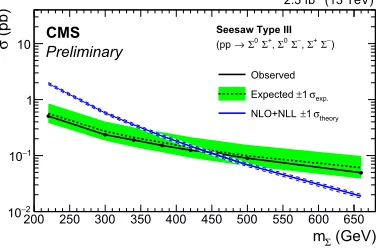
Limits at 95% confidence level on the cross-section sum for the production of seesaw heavy fermionic pairsΣ0Σ+,Σ0Σ−,Σ+Σ−and on their mass are extracted with the asymptoticCLs method,
under the assumptions of a degeneratemΣ, and of the flavour democratic scenario, whereVe=Vµ= Vτ=10−6. They are reported in Fig. 7 and in Tab. 3. The p-value for the observation in all the
con-sidered channels, assuming there is no new physics, is 0.93. The uncertainties are strongly dominated by statistics; systematic uncertainties are small and mainly due to PDF and to renormalization and factorization uncertainties related toEmiss
T range in the dominant WZ background.
(GeV)
Σ
m
200 250 300 350 400 450 500 550 600 650
(pb) σ 2 − 10 1 − 10 1 10 (13 TeV) -1 2.3 fb CMS
Preliminary (pp→Σ0Σ+,Σ0Σ−,Σ+Σ−)
Seesaw Type III
Observed exp. σ 1 ± Expected theory σ 1 ± NLO+NLL
Figure 7. Seesaw type-III search. Expected and observed limits at 95% confidence level on the cross-section sum for the production of seesaw heavy fermion pairsΣ0Σ+,Σ0Σ−,Σ+Σ−. The theoretical curve of the discussed
Table 3.Seesaw type-III search.Observed limit on the mass of the seesaw type-III mediators.
Channel mΣ
combination 440 GeV
6 Quantum black holes search in
e
µ
final state [15]
Many extensions of the Standard Model predict the existence of heavy resonances decaying into lepton flavour violating final states, likeeµ. If a fundamental Planck scale could be observable at TeV, the production of microscopic black holes decaying into couples of particles should be possible at the LHC, once the production mass thresholdMthis reached. In particular, in the considered models [16]-[17], quantum black holes (QBH) are spin-0, colourless, neutral particles, and lepton flavour violation is allowed. A search in this sense has been performed; the interpretation of the results depends on the number of extra-dimensionsninvolved: forn =1, a Randall-Sundrum scenario is considered, while
forn≥2, we lay in the ADD scenarios.
The analysis strategy consists in reconstructing the invariant mass distribution of theeµ pairs,
without requiring to the leading leptons to be opposite sign, in order to avoid an efficiency loss due to
the wrong assignment of the electron charge in high energy range. The misidentification of the objects involved is reduced by rejecting all the electrons close (in a cone∆R <0.1) to muons that produce bremsstrahlung. In left Fig.8, the invariant mass spectrum of theeµpairs is presented; the right plot is the cumulative distribution of the previous one. Data and Monte Carlo spectra are in agreement.
The backgrounds contributing to the final state can be divided into two categories: the first com-prises events with at least two prompt, isolated leptons; the second includes jets and photons misiden-tified as isolated leptons or jets with non-prompt leptons coming from heavy-flavour decays. In the former category, processes likett¯,WW,WZ,ZZ, singlet, Drell-Yan are included, and they are esti-mated from Monte Carlo samples; in the latter category, the dominant contribution is represented by
W+jets processes, and all these backgrounds are predicted with data-driven methods.
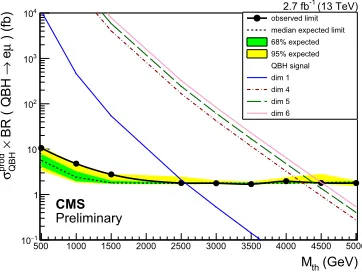
An upper limit at 95% confidence level on the cross-section times branching ratio is determined using a binned likelihood Bayesian approach, and it is shown in Fig. 9. The non-resonant signal is modelled as a broad shape smeared by the detector resolution, with a sharper edge atMth. The uncertainties, entering the limit extraction as nuisance parameters, are modelled with log-normal dis-tributions. The uncertainty on the muon momentum scale (10% per TeV) propagates to an uncertainty on the background yield of 30% at 3 TeV. The dominant uncertainty in the background yield predic-tion is due to the uncertainty on the shape of theeµdistribution in thett¯background, that ranges up to
31% at 2 TeV. The final limits on the threshold mass of the QBH are reported in Tab. 4, as a function of the extra-dimensions considered in the theoretical model.
Table 4.Quantum black holes in eµsearch.Observed limits on the production mass threshold of a quantum black hole, considering a different number of extra-dimensions involved, fromn=1 (Randall-Sundrum
scenario), up ton=6 (ADD scenarios).
n Mth
1 (RS) 2.5 TeV
Table 3.Seesaw type-III search.Observed limit on the mass of the seesaw type-III mediators.
Channel mΣ
combination 440 GeV
6 Quantum black holes search in
e
µ
final state [15]
Many extensions of the Standard Model predict the existence of heavy resonances decaying into lepton flavour violating final states, likeeµ. If a fundamental Planck scale could be observable at TeV, the production of microscopic black holes decaying into couples of particles should be possible at the LHC, once the production mass thresholdMthis reached. In particular, in the considered models
[16]-[17], quantum black holes (QBH) are spin-0, colourless, neutral particles, and lepton flavour violation is allowed. A search in this sense has been performed; the interpretation of the results depends on the number of extra-dimensionsninvolved: forn=1, a Randall-Sundrum scenario is considered, while forn≥2, we lay in the ADD scenarios.
The analysis strategy consists in reconstructing the invariant mass distribution of the eµ pairs, without requiring to the leading leptons to be opposite sign, in order to avoid an efficiency loss due to the wrong assignment of the electron charge in high energy range. The misidentification of the objects involved is reduced by rejecting all the electrons close (in a cone∆R <0.1) to muons that produce bremsstrahlung. In left Fig.8, the invariant mass spectrum of theeµpairs is presented; the right plot is the cumulative distribution of the previous one. Data and Monte Carlo spectra are in agreement.
The backgrounds contributing to the final state can be divided into two categories: the first com-prises events with at least two prompt, isolated leptons; the second includes jets and photons misiden-tified as isolated leptons or jets with non-prompt leptons coming from heavy-flavour decays. In the former category, processes likett¯,WW,WZ,ZZ, singlet, Drell-Yan are included, and they are esti-mated from Monte Carlo samples; in the latter category, the dominant contribution is represented by
W+jets processes, and all these backgrounds are predicted with data-driven methods.
An upper limit at 95% confidence level on the cross-section times branching ratio is determined using a binned likelihood Bayesian approach, and it is shown in Fig. 9. The non-resonant signal is modelled as a broad shape smeared by the detector resolution, with a sharper edge atMth. The
uncertainties, entering the limit extraction as nuisance parameters, are modelled with log-normal dis-tributions. The uncertainty on the muon momentum scale (10% per TeV) propagates to an uncertainty on the background yield of 30% at 3 TeV. The dominant uncertainty in the background yield predic-tion is due to the uncertainty on the shape of theeµdistribution in thett¯background, that ranges up to 31% at 2 TeV. The final limits on the threshold mass of the QBH are reported in Tab. 4, as a function of the extra-dimensions considered in the theoretical model.
Table 4.Quantum black holes in eµsearch.Observed limits on the production mass threshold of a quantum black hole, considering a different number of extra-dimensions involved, fromn=1 (Randall-Sundrum
scenario), up ton=6 (ADD scenarios).
n Mth
1 (RS) 2.5 TeV 4 (ADD) 4.2 TeV 5 (ADD) 4.3 TeV 6 (ADD) 4.5 TeV
Figure 8.Quantum black holes in eµsearch. Left: invariant mass spectrum of theeµpairs. Right: cumulative distribution of the invariant mass spectrum of theeµpairs. The points with error bars represent the data. The
histograms represent the expectations from standard model processes:W+jets,Wγ,tt¯,WW,WZ,ZZ, singlet, Drell-Yan. The red curve in the left plot represents an hypothetical QBH of mass 1 TeV in a Randall-Sundrum scenario (n=1).
(GeV)
th
M
500 1000 1500 2000 2500 3000 3500 4000 4500 5000
) (fb)
µ
e
→
BR ( QBH
×
QBH
prodσ
1
− 10 1 10
2
10
3
10
4
10 observed limit
median expected limit 68% expected 95% expected QBH signal dim 1 dim 4 dim 5 dim 6
CMS
Preliminary
(13 TeV)
-1
2.7 fb
Figure 9.Quantum black holes in eµsearch.Expected and observed limits at 95% confidence level on the cross-section times branching ratio for the quantum black hole production. The theoretical curves of the discussed models are included in the plot.
7 Conclusions
considered states. These searches are being repeated in 2016 data: more luminosity is expected and more interesting results are coming soon.
References
[1] CMS Collaboration, “The CMS experiment at the CERN LHC”, JINST3, S08004 (2008) [2] CMS Collaboration, “Search for physics beyond the standard model in dilepton mass spectra in
proton-proton collisions at √s=8 TeV”, JHEP04, 025 (2015)
[3] CMS Collaboration, “Search for physics beyond the standard model in final states with a lepton and missing transverse energy in proton-proton collisions at √s=8 TeV”, Phys. Rev.D91, 092005
(2015)
[4] CMS Collaboration, “Search for heavy lepton partners of neutrinos in proton-proton collisions in the context of the type III seesaw mechanism”, Phys. Lett.D718, 348 (2012)
[5] CMS Collaboration, “Search for lepton flavour violating decays of heavy resonances and quantum black holes to an e-mu pair in proton-proton collisions at √s=8 TeV”, Eur. Phys. J.C76, 317
(2016)
[6] G. Altarelli, B. Mele, and M. Ruiz-Altaba, “Searching for new heavy vector bosons inpp¯ collid-ers”, Z. Phys.C45, 109 (1989)
[7] A. Leike, “The phenomenology of extra neutral gauge bosons”, Phys. Rept.317, 143 (1999) [8] J. L. Hewett and T. G. Rizzo, “Low-energy phenomenology of superstring-inspired E6 models”,
Physics Reports183, 193 (1989)
[9] CMS Collaboration, “Search for a Narrow Resonance Produced in 13 TeV pp collisions decaying to electron pair or muon pair final states”, CMS Physics Analysis Summary CMS-PAS-EXO-15-005, 2015
[10] CMS Collaboration, “Search for SSM W’ production, in the lepton+MET final state at a
center-of-mass energy of 13 TeV”, CMS Physics Analysis Summary CMS-PAS-EXO-15-006, 2015 [11] A. L. Read, “Presentation of search results: the CL s technique”, J. Phys. G: Nucl. Part. Phys.
28, 2693 (2002)
[12] T. Junk, “Confidence level computation for combining searches with small statistics”, Nucl. Instrum. Meth.A434, 435 - 443 (1999)
[13] CMS Collaboration, “Search for type-III seesaw heavy fermions with multilepton final states using 2.3 fb−1of √s=13 TeV proton–proton collision data”, CMS Physics Analysis Summary
CMS-PAS-EXO-16-002, 2016
[14] R. Foot, H. Lew, X. He, and G. Joshi, “See-saw neutrino masses induced by a triplet of leptons”, Z. Phys.C44, (1989)
[15] CMS Collaboration, “Search for high-mass resonances and quantum black holes in theeµfinal state in proton-proton collisions at √s=13 TeV”, CMS Physics Analysis Summary
CMS-PAS-EXO-16-001, 2016
[16] P. Meade and L. Randall, “Black Holes and Quantum Gravity at the LHC”, JHEP05, 003 (2008) [17] X. Calmet, W. Gong, and S. D. H. Hsu, “Colorful quantum black holes at the LHC”, Phys. Lett.