433 | P a g e
CONTENT BASED IMAGE RETRIEVAL USING
TEXTURE STRUCTURE HISTOGRAM AND COLOR
Rinsi S.
1, Nisy John Panicker
21
PG Scholar,
2Assistant Professor, Department of Computer Science and Engineering,
College of Engineering Munnar, (India)
ABSTRACT
Interests to accurately retrieve required images from databases of digital images are growing day by day. In this paper, a novel image feature descriptor, namely texture structure histogram (TSH) for content-based image retrieval is proposed. This method uses the color and edge orientation information to describe the image texture structure information. Considering the HSV color space conforms to humans' visual perception mechanism, the feature extraction is conducted in the HSV color space. This puts forward the non-equal interval quantization scheme that makes the expression of the image information to be more reasonable. Images are represented by certain features to facilitate accurate retrieval of the required images. These features include Texture, Color, Shape and Region.In feature representation phase, the feature fusion mechanism is used that made the color and shape information merge together and get a better result. The experiment results demonstrate that the proposed method is more efficient and have a high retrieval performance.
Keywords: Color, Feature Fusion, HSV Color Space, Image Retrieval, Texture Structure
Histogram, Similarity Measures
I INTRODUCTION
In recent years, with the rapid development of digital image processing technology, helping the user to find the
multimedia information what they need quickly and effectively becomes a hot research topic at present. Image
retrieval is a major component of multimedia information retrieval technology, and also one of the basic theory
of video information retrieval, it play a significant role in the field of information retrieval. Image retrieval is
based on users' query requests, extract an image or image set that related to the query image from the image
dataset. Generally, three categories of methods for image retrieval are used: text-based, content-based and
semantic-based [1]. The content-based image retrieval (CBIR) has been proposed in the early 1990’s [2]. This
approach is to retrieve images using low-level features like color, texture and shape that can represent an image.
Color is a very important visual cue for image retrieval and object recognition. Color histograms are invariant to
434 | P a g e
image retrieval is easy to implement and widely used in CBIR systems. Some of the commonly used color
descriptors include compact color moments, the color coherence vector, and color correlo-gram [3].
Texture is one of the most important characteristics of an image. Texture features are also widely used in CBIR
systems. Various algorithms have been designed for texture analysis, such as gray level co-occurrence matrices
[4], the Tamura texture feature [5], the Markov random field model [6], Gabor filtering [7], and local binary
patterns [8]. Tamura et al., based on human visual psychology research put forward some different methods to
describe the texture feature, give a description of several different terms: coarseness contrast and directionality,
line-likeness, regularity, roughness, etc.
In addition to color and texture features, shape feature is the most essential characteristics of depicting objects.
But it is also most difficult to describe. The major difficulty is the segmentation of interested target. Currently
commonly used to describe the shape of image retrieval methods mainly include two categories: based on edge
and based on the shape of the area. The former using the edge information of images, while the latter using the
area of gray level distribution information. Classical methods of describing shape features include the use of
moment invariants, Fourier transforms coefficients, edge curvature and arc length [3,9].
This project uses the color and edge orientation feature that describe the texture information correctly. The rest
of this describe the HSV color space and the color and edge orientation quantization scheme in the HSV color
space. In section 3, we describe the feature extract and feature fusion.
II RELATED WORKS
Research on CBIR could be bifurcated into two groups on the basis of the features used to retrieve the required
image. Early approaches used a single feature out of the available features namely shape, texture, color and
region for retrieval of the required image. Results of single feature based retrieval systems were not satisfactory
because generally image contains several visual features.
The shape descriptor also provides dominant information in image retrieval because shape is the only source
through which humans can recognize objects. The shape feature can be retrieved by two methods boundary
based shape feature extraction and region based shape extraction.
An efficient CBIR system with better performance is presented by using the wavelets decomposition of image;
they have generated the composite sub-band gradient and the energy distribution pattern string from the sub
images of are generated by means of wavelet decomposition to the input image . For filtering out the undesired
images a technique based on energy distribution pattern strings fuzzy matching is used.
Texture has no formal definition but intuitively it provides measure of properties such as coarseness, regularity
and smoothness. It plays a role in human visual perception and interpretation. Texture describes in three
approaches, namely, structural, statistical and spectral. In structural approach the texture is formed of small
texture elements called ’texels’ by following placement rules. The statistical method assumes texture by means
of statistical grey level features of image pixels. The spectral approach is based on filtering theory in frequency
domain and power density function. The structural approach is not so prevalent because majority of the natural
435 | P a g e
III PROPOSED SYSTEM
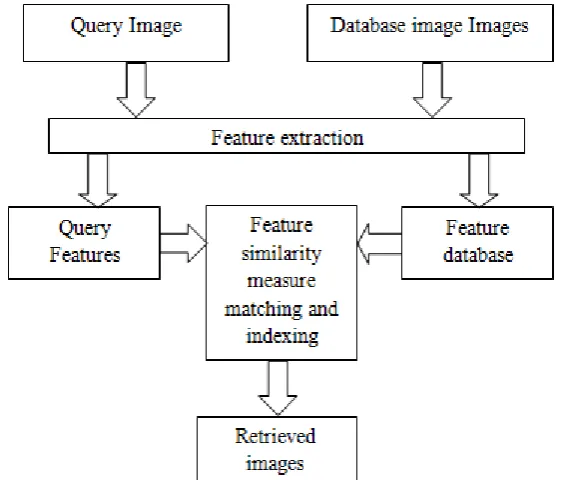
It is proposed to implement “Content –Based Image Retrieval” using different features like Color,
Texture, Shape and, Objects and their relationships. The proposed system will produce the output
as images which are relevant to the query Image. The proposed system flowchart is as shown in
Fig. 1.
Fig.1. Proposed System Flowchart
3.1 Retrieval Based on Colour
Several methods for retrieving images on the basis of colour similarity are being used. Each image added to the
database is analyzed and a colour histogram is computed which shows the proportion of pixels of each colour
within the image. Then this colour histogram for each image is stored in the database. During the search time,
the user can either specify the desired proportion of each colour (75% olive green and 25% red, for example), or
submit a reference image from which a colour histogram is calculated.
3.2 Retrieval Based on Structure
The ability to match on texture similarity can often be useful in distinguishing between areas of images with
similar colour. A variety of techniques has been used for measuring texture similarity in which the best
established rely on comparing values of what are known as second order statistics calculated from query and
stored images. Essentially, these calculate the relative brightness of selected pairs of pixels from each image.
From these it is possible to calculate measures of image texture such as the degree of contrast, coarseness,
directionality and regularity, or periodicity, directionality and randomness. Alternative methods of texture
436 | P a g e
manner to colour queries, by selecting examples of desired textures from a palette, or by supplying an example
query image. A recent extension of the technique is the texture thesaurus, which retrieves textured regions in
images on the basis of similarity to automatically-derived code words representing important classes of texture
within the collection.
3.3 Retrieval Based on Shape
The ability to retrieve by shape is perhaps the most obvious requirement at the primitive level. Unlike texture,
shape is a fairly well-defined concept and there is considerable evidence that natural objects are primarily
recognized by their shape. A number of features characteristic of object shape (but independent of size or
orientation) are computed for every object identified within each stored image. Queries are then answered by
computing the same set of features for the query image, and retrieving those stored images whose features most
closely match those of the query.
IV HSV COLOR MODEL
HSV colour model stands for Hue Saturation Value colour model. This model describes colours in terms of their
shades and brightness (Luminance) and offers a more intuitive representation of relationship between colours.
Basically a colour model is the specification of coordinate system and a subspace within that, where each colour
is represented in single point.
Hue represents the dominant wavelength in light. It is the term for the pure spectrum colours. Hue is expressed
from 0º to 360º. It represents hues of red (starts at 0º), yellow (starts at 60º), green (starts at 120º), cyan (starts at
180º), blue (starts at 240º) and magenta (starts at 300º). Eventually all hues can be mixed from three basic hues
known as primaries.
Saturation represents the dominance of hue in colour. It can also be thought as the intensity of the colour. It is
defined as the degree of purity of colour. A highly saturated colour is vivid, whereas a low saturated colour is
muted. When there is no saturation in the image, then the image is said to be a grey image.
It describes the brightness or intensity of the colour. In other words value is defined as a relative lightness or
darkness of colour.
437 | P a g e
4.1 HSV Color Space and Quantization
Color information is the bottom and intuitive physical characteristics. Because color is robust to the effects of
noise, size and orientation of image, so color feature is most commonly used in content-based image retrieval.
Color quantization is closely related to the color space. Many kinds of color spaces have been proposed and
used for image retrieval. However, different color space has different application, we usually hard to decide
which kind of color space is most suitable for our image retrieval algorithm. The HSV color space could mimic
human color perception well [12].
4.1.1 Color Non-Equal Interval Quantization in HSV Color Space
In order to cut down the computing complexity and extract the color features in efficient way, we use HSV color
space and quantize it into non-equal interval 72 bins, thus we get the color index image C(x, y). As is known to all, quantizing the H, S and V channels uniformly is not suitable for human’s visual perception and recognition.
(a) (b) (c)
Fig.3. HSV quantization scheme: (a) RGB Image (b) Equal Interval Quantization (c) Non-Equal Interval
Quantization
4.1.2 Edge Orientation Quantization in HSV Color Space
Edge orientation also plays an important role in content-based image retrieval. Edge orientation information can
represent the object’s shape and boundaries perfectly. In this paper, we use a simple and effective method for
edge orientation detection.
Let a = ( Hx, Sx, Vx ) and b = (Hy, Sy, Vy) , where Hx, Sx and Vx denotes the gradient in H, S and V channel along horizontal direction respectively, and Hy, Sy and Vy denotes the gradient in H, S and V channel along vertical direction respectively. Here we use the Sobel operator. After the edge orientation of each pixel has been
computed, the orientations are uniformly quantized into 18 bins with each corresponding to angle of 20°. It is
most reasonable according to the experiments. Thus we get the edge orientation index image.
4.2 Feature Extraction
4.2.1 Structure Map Construction and Feature Representation
According to the color index image, we build the color structure map. Similarly, we can build the edge
orientation structure map and we omit it here. The details of the process are illustrated in Fig.4. For the color
index image, a 3×3 block filter throughout the image from left to right and top to bottom with 3-step length.
438 | P a g e
value of central point equals to that of its four neighbourhoods, then the values of the 3×3 block will be
remained, otherwise, the values will be set to zero. Finally, we get the color structure map T(x, y). Similarly, the edge orientation structure map O(x, y). Fig.5 shows the processing of the color information detection. After previous operation, we can obtain the color structure map T(x, y) and its index value.
Fig.4.The Process of Color Structure Map Constructing
4.3 Feature Fusion
For some images, its texture information is very rich. However, for some kinds of images, its edge orientation
information seems to be much richer. Thus we give different weights to the two features according to the
attribute of images. According to the experiment, we train the parameters to get the most suitable one whose
precision is the highest. We combine Hcolor (T (x, y)) and Hori (O(x, y)) as the final feature vector H, namely, texture structure histogram (TSH, for short) [12].
V SIMILARITY MEASURES
The retrieval process is performed by different similarity measuring techniques. The result of the query may not
be a single image. It is a series of images categorized by the similarity of retrieved image with the query image.
Similarity measures are used to find the correspondence of the query image with the image stored in the
database.
An image may contain visual information or semantic information. The visual information can be represented
in form of shape, color, texture and spatial relations. The extracted visual features are considered as feature
vector that are kept in feature database. Retrieval performance of the CBIR systems is affected by similarity
measures. Here I denote the query image, J is the image in database, fi (I) represents the number of pixels in ith
439 | P a g e
5.1 Minkowski-Form Distance
The Minkowski-form distance La is apt for the computation of distance between two images when each of the
image feature vectors having equal importance and are independent from each other. It is defined as:
1)
(
)
(
)
,
(
i ai
f
i
f
J
I
D
(1)5.2 Mahalanobis Distance
Another metric suitable for all dimensions of image feature vector is defined as:
(
1
)(
)
)
,
(
I
J
FI
FJ
C
FIFJ
D
T
(2)5.3 Cosine Similarity
Cosine similarity is a measure of similarity between two vectors of an inner product space that measures the
cosine of the angle between them. The cosine of 0° is 1, and it is less than 1 for any other angle. It is thus a
judgment of orientation and not magnitude: two vectors with the same orientation have a cosine similarity of 1,
two vectors at 90° have a similarity of 0, and two vectors diametrically opposed have a similarity of -1,
independent of their magnitude. Cosine similarity is particularly used in positive space, where the outcome is
neatly bounded in [0, 1]. The equation is given by:
b
a
b
a
.
cos
(3)VI MODULE DESCRIPTION
The system is implemented using MATLAB. Following are the modules used in the system:
1) RGB Projection: The RGB color model is an additive color model in which red, green, and blue light are
added together in various ways to reproduce a broad array of colors. The name of the model comes from the
initials of the three additive primary colors, red, green, and blue. The main purpose of the RGB color model is
for the sensing, representation, and display of images in electronic systems, such as conventional photography.
In this module the RGB Projections is used to find the size of the image vertically and horizontally.
2) Image Utility: Whenever minimizing the error of classification is interesting for CBIR, this criterion does not
completely reflect the user satisfaction. Other utility criteria closer to this, such as precision, should provide
more efficient selections.
3) Comparable Image: In this module a reselection technique to speed up the selection process, which leads to a
computational complexity negligible compared to the size of the database for the whole active learning process.
440 | P a g e
images, and they are compared to the current classification. If the user mostly gives relevant labels, the system
should propose new images for labelling around a higher rank to get more irrelevant labels.
4) Similarity Image: The results in terms of mean average precision according to the training set size (we omit
the KFD which gives results very close to inductive SVMs) for both ANN and Corel databases. One can see that
the classification-based methods give the best results, showing the power of statistical methods over geometrical
approaches, like the one reported here (similarity refinement method).
5) Result: Finally, the image will take the relevant image what the user search. One can see that we have
selected concepts of different levels of complexities. The performances go from few percentages of Mean
average precision to 89%. The concepts that are the most difficult to retrieve are very small and/or have a much
diversified visual content. The method which aims at minimizing the error of generalization is the less efficient
active learning method. The most efficient method is the precision- oriented method.
VII EXPERIMENTAL RESULTS
Fig.5. Similar Images of Query Image Retrieved
441 | P a g e
VIII APPLICATIONS AND CONCLUSION
CBIR finds application in art collections, medical image databases, scientific databases, textile industry etc.
Texture Structure Histogram (TSH) is a novel image feature representation method. The non-equal interval
quantization scheme of HSV color space is used, because HSV color space conforms to people's subjective
judgment of color similarity.TSH integrates the advantages of both color and texture features, and shows a good
retrieval performance.
REFERENCES
1. Liu G H, Yang J Y. Content-based image retrieval using color difference histogram [J]. Pattern Recognition, 2013, 46(1): 188-198.
2. R.C. Gonzalez, R.E. Woods, Digital Image Processing, third ed., Prentice Hall, 2007.
3. J. Huang, S.R. Kumar, M. Mitra, et al., Image indexing using color correlograms, IEEE Conference on Computer Vision and Pattern Recognition, 1997, pp. 762–768.
4. R.M. Haralick, K. Shangmugam, I. Dinstein, Textural feature for image classification, IEEE Transactions on Systems, Man and Cybernetics SMC-3 (6) (1973) 610–621.
5. H. Tamura, S. Mori, T. Yamawaki, Texture features corresponding to visual perception, IEEE Transactions on Systems, Man, and Cybernetics 8 (6) (1978) 460–473.
6. G. Cross, A. Jain, Markov random field texture models, IEEE Transactions on Pattern Analysis and Machine Intelligence 5 (1) (1983) 25–39.
7. B.S. Manjunathi, W.Y. Ma, Texture features for browsing and retrieval of image data, IEEE Transactions on Pattern Analysis and Machine Intelligence 18 (8) (1996) 837–842.
8. T. Ojala, M. Pietikanen, T. Maenpaa, Multi-resolution gray-scale and rotation invariant texture classification
with local binary patterns, IEEE Transactions on Pattern Analysis and Machine Intelligence 24 (7) (2002) 971–987.
9. W. Burger, M.J. Burge, Principles of Digital image processing: Core Algorithms, Springer, 2009.
10. Liu G H, Zhang L, Hou Y K, et al. Image retrieval based on multi-texton histogram[J]. Pattern Recognition,
2010, 43(7): 2380-2389.
11. Liu G H, Li Z Y, Zhang L, et al. Image retrieval based on micro-structure descriptor[J]. Pattern Recognition,
2011, 44(9): 2123-2133.
12. Gang Hou, Qinghe Feng, et al. Content-Based Image Retrieval Using Texture Structure Histogram, ICMT
2013.
13. Syed Hamad Shirazi, Noor ul Amin Khan, et al. Content-Based Image Retrieval Using Texture Color Shape