272 | P a g e
EFFECT OF STRUCTURAL SHAPE ON WIND
ANALYSIS OF MULTISTORIED RCC STRUCTURES
Alkesh Bhalerao ¹, S.B. Shinde ²
¹
PG Student, Department of civil Engineering, J.N.E.C, Aurangabad, Maharashtra, (India)
²
Associate Professor and Head, Department of civil Engineering,
J.N.E.C, Aurangabad, Maharashtra, (India)
ABSTRACT
The recent advancement in building system has structural shape and vertical growth impact. Though the
aesthetic view of structure plays an important role but lateral stability also has its vital importance. In this study
Multi-storey (G+25) structure with different shape is modelled in the ETABS 2015 software, to check its lateral
load stability in concern with the wind load. Four models having different structural shape is analysed for
displacement and story drift and the effect of wind is analysed for different structural shape. The wind prone
zone area is considered and parameters regarding the case have selected to analyse the model. All considered
structure is compiled using RCC frame design system. The aim of this study is to obtain the best suitable
structural shape for stability in wind prone area.
Keyword: Different structural shape, ETABS, RCC structure, Story Drift, Wind analysis.
I INTRODUCTION
1.1 General
The recent trends in construction have given most importance to vertical growth, as the city grows in vertical
aspect there is need to design structure which has given more importance to vertical growth. The vertical growth
in structure can be fulfilled by constructing the high rise structure.The study involves different high rise
structures used generally for residential, commercial and hospital building, which is typically square shape,
rectangular shape, U-shaped building and Bundled tube symmetric RCC structure. Generally square,
rectangular, U-shaped building is used for high rise structure but symmetric bundled tube structure is used to
construct typical high rise structure in which special provision are made for wind, in these structure wind can
easily pass by though the openings provided in the intermittent floor. These spacing for wind is provided for
273 | P a g e
The lateral load generally applied to the building by earthquake and wind load in this study (G+25) RCC
building analysed for characteristic wind load for extent of diaphragm and applied on extent of each story.
Based on these load combination load taken by IS: [875 Part (5)] that is 1) Imposed load2) Dead load 3) Wind
load is applied in all cases, on the behalf optimisation made for effect cause by different load combination and
the effective load pattern causing most displacement and drift is calculated. The direct relation is adapted to
design optimistic section for building structure to have proper sustainable design which can easily withstand
against the wind load.
1.2 Litraure Review
Shaikh Muffassir, L.G. Kalurkar (1) Presented the work on comparative study on both RCC and Composite
structure analysed for different plan configuration found that U-shape building is not preferable for wind prone
zone for (G+5) (G+15) (G+25) structure. The comparative study concluded that composite structure are ductile
than RCC structure therefore Composite structure are preferred in wind prone zone.
Alfa Rasikan, M.G. Rajendran (2) presented the work regarding wind behaviour of building with and without
shear wall, concluded fifteenth storyand twentieth story building when analysed for wind in presence and
absence of shear wall. The percentile displacement in fifteenth story to twentieth is less for provision of shear
wall, mean the shear wall structure gives the less displacement due resisting lateral wind load displacement.
Abhay Guleria (3) presented the earthquake lateral load effect on high rise building system as per (IS 1893: part
1:2002). The modelling and analysis carried out by ETABS and different plan configuration, found that L-shape
and I-shape structure perform same in overturning moment, story drift and story displacement in earthquake
analysis, study also involves the shape importance in effect of earthquake prone zone.
Sanhik Kar Mjumdar, Priyabrata Guha (4) Presented both effect seismic and RCC on (G+5) structure by using
STADD PRO. Study carried out for bending moment due to earthquake and wind load found that the bending
moment due to earthquake in G+ 5 structures is greater as compared to bending moment caused by wind lateral
loads.
1.3 Objective
The study is focused for G+ 25 structures built in RCC material, the object of study to find displacement in
structure and story drift in all the structure mentioned. The displacement and drifts performance in wind prone
zone. The study also important to design proper section using ETABS software. Result are analysed for
Effective structure in wind lateral load prone zone.
II SYSTEM DEVELOPMENT
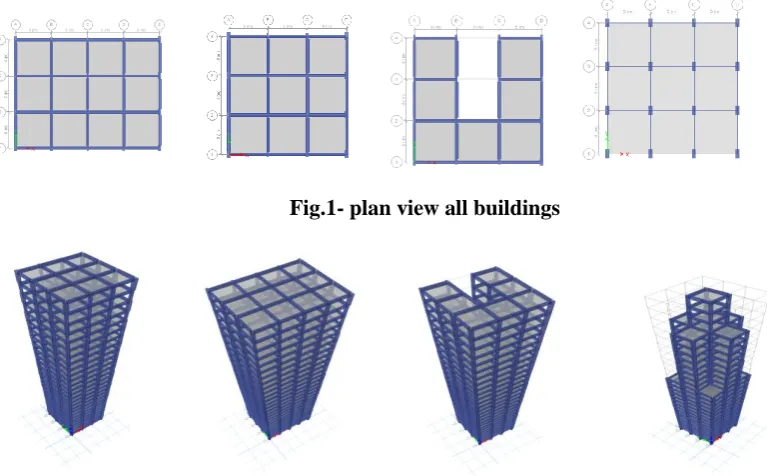
In this study the square shape, Rectangular shape, U shaped and bundled tube symmetric structure is considered
for modelling. In addition RCC structure is analysed for different load combination such as dead load , live load
274 | P a g e
Fig.1- plan view all buildings
Fig. 2- 3d view of square, rectangular-shape, U-shape, bundled tube symmetric RCC building
Table 1: Material Properties Table 2: General Specification of Building
Table 3: Section for RCC Building Table 4: Specification of Loading
Plan dimension 15mx15m
(G+25) 83.1 m
Storey Height 3.1 m
Bottom Storey Height 2.5 m
Thickness of wall 230 mm
Grade of Concrete M25
Grade of Reinforcing steel Fe 415
Density of Concrete 25 KN/m³
Density of Brick masonry 20 KN/m³
Damping ratio 5%
Floor load 1 KN/m²
Live load 4 KN/m²
Wall load 12 KN/m²
Structural class B
Basic wind speed 50 m/s
Risk coefficient (K1) 1
Topography factor (K3) 1
Wind design code IS 875:1987 (Part 3)
RCC design code IS 456:2000
Steel design code IS 800:2007
RCC Section
Beam 350X700
Column up to 16th story
Column 1 900x1100
Column 2 700x1100
Column 3 500x1000
Column from 16th to 27th story
Column 4 450x1000
Column 5 400x900
275 | P a g e
All these structural shape and section properties are analysed in the area like structural class B; typically can be
indicated in Coastal region of India and Madras and nearby topographical area. The basic speed in such region is
about 50 m/s. Bottom story aspect is considered as of 2.5m for deep foundation to have foundation stability.
III RESULT AND DISCUSSION
The analysis which carried out for G+25(Square, Rectangular, U-Shape and Bundled symmetrical shape) shows
that the two parametric variation. First is the story displacement and second is the story drift. Story displacement
is the movement of each floor due to lateral forces of wind in either X or Y direction. The maximum impact of
the displacement is found in the X direction.
Fig.3- story displacement for G+25 RCC structure
Amongst the displacement result it has found that RCC U-shape structure is more prone to displace by 260mm
and followed by RCC bundled symmetric shape. Comparing this result RCC rectangular shape is more reluctant
for displacement found out to be 138mm.
276 | P a g e
The analysis for story drift shows that story drift is irregular in RCC bundled symmetric shape because its
structural irregularity at regular interval height. The RCC Square and Rectangular structure has less drift as
indicated in graphs.
IV CONCLUSION
1) RCC structure is preferred for stiffness and durability in high rise structure.
2) The study concluded that the effective shape for to resist wind lateral load is rectangular shape
structure for G+25 consideration.
3) Generally symmetrical structure is preferred for high rise structure but in this case square shape found
to be less stiff compare to rectangular structure in wind load consideration.
4) The structure in RCC made bulky and less economical but more rigid and durable in nature.
5) U-shape structure is not preferred as it gives the maximum displacement and maximum drift due to its
geometric shape most susceptible for wind load.
6) Bundled tube symmetric RCC structure is need to analysed for special provision and improved
cladding surface to attain optimised result.
REFERENCES
[1] Shaikh Muffassir, L.G. Kalurkar,Comparative Study on Wind Analysis of Multi-story RCC and Composite
Structure for Different Plan Configuration, IOSR Journal of mechanical and civil engineering, Vol. 13, Issue
4, Ver. VII, Jul- Aug 2016, PP 42-49.
[2] Alfa Rasikan, M.G. Rajendran, Wind Behaviour of Buildings with and Without Shear Wall, International
Journal of Engineering Research and Applications (IJERA), Vol.3, Issue 2, March-April 2013, PP 480-485.
[3]Sanhik Kar Majumder and Priyabrata Guha, Comparison between Wind and Seismic Load on different types
of Structures, International journal of engineering science invention, 3(4), 2014, 42-54.
[4] Abhay Guleria, Structural Analysis of a Multi-Storeyed Building using ETABS for different Plan
Configurations, International Journal of Engineering Research & Technology (IJERT), 3(5), May 2014,PP
1481-1487.
[5]IS: 875(Part 3)-1987, Indian Standard Code of Practice for Design loads (other than Earthquake) for
Buildings and Structures, Bureau of Indian Standards, New Delhi.
[6] IS: 456(2000), Indian Standard Code of Practice for Plain and Reinforcement concrete (Fourth Revisions),