351 |
P a g e
A NEW APPROACH OF DIGITAL IMAGE COPYRIGHT
PROTECTION USING MULTI-LEVEL DWT
ALGORITHM
Siva Prasad K
1, Ganesh Kumar N
2 1PG Student [DECS],
2Assistant professor, Dept. of ECE,
Thandrapaparaya Institute of science & technology, Bobbili, A.P, (India)
ABSTRACT
This paper presents a Digital Image copyright protection using 4-Level DWT for ownership authentication. LL4
sub-band is used for insert the information in the original image using modulus hiding Algorithm. Original image or hidden
information is not necessary for extracting the binary watermark. Proposed algorithm is robust to common image
processing attacks like JPEG, median filtering and Gaussian filtering. Experimental results show that there is a
significant improvement with the proposed algorithm over the existing schemes in terms of Normalized Correlation
Coefficient (NCC) and Peak Signal to Noise Ratio (PSNR).
Keywords: Digital Copyright protection (information hiding process), Discrete Wavelet Transform,
Haarwavelet, Modulus Hiding, Normalized Correlation coefficient (NCC), Peak to Signal Ratio (PSNR).
I INTRODUCTION
The rapid growth of the Internet and digital media manifests itself in widespread public forms such as the digital image, the MPEG, and so on, because digital media are easy to copy and transmit. Many researchers are aware of the issues of copyright protection, image authentication, proof of ownership, etc. Hence, there are many solutions that have been proposed. The copyright protection technique is one of the solutions. This technique embeds information so that it is not easily perceptible; that is, the viewer cannot see any information embedded in the contents. There are several important issues in the copyright protection system. First, the embedded watermark should not degrade the quality of the image and should be perceptually invisible to maintain its protective secrecy. Second, the watermark must be robust enough to resist common image processing attacks and not be easily removable; only the owner of the image ought to be able to extract the watermark. Third, the blindness is necessary if it is difficult for us to obtain the original image and watermark. A copyright protection technique is referred to as blind if the original image and watermark are not needed during recovery.
352 |
P a g e
original data perceptually unchanged, yet should impose modifications which can be detected by using an appropriate recovery algorithm. Common types of signals to watermark are images, music clips and digital video. In this work, application of the digital copyright protection to still images is considered. The major technical challenge is to design a highly robust digital copyright protection technique, which discourages copyright infringement by making the process of copyright protection removal tedious and costly [1]. Current techniques described in the literature for the copyright protection of images can be grouped into two classes: transform domain methods [2, 3] which embed the data by modulating the transform domain coefficients and spatial domain techniques [1, 4] which embed the data by directly modifying the pixel values of the original image.
To achieve robustness, data should be embedded in the regions that contain some important characteristics information of the cover image [5]. This is based on the basic assumption that so long as the important characteristics of the different regions in the cover image are not drastically changed, hidden data can be extracted faithfully. Some of the major characteristics of a gray level image are edge, texture and high gray level curvature points, etc. [6]. Robustness is further improved if the watermark information is embedded in the suitable transform coefficients of the image characteristics. Several digital image copyright protection schemes using discrete Fourier transform (DFT) [7], Fourier–Mellin [8], discrete cosine transform (DCT) [9, 10], and discrete wavelet transform (DWT) [10, 11] have already been reported in the literature.
In this work, a robust copyright protection algorithm based on DWT is presented to embed a 32 x 32 binary watermark into a 512 x 512 gray scale host image using the modulus hiding scheme. Fourth level approximation sub band (LL4) is
selected for hiding the watermark. Each coefficient in the selected sub band is modified according to the watermark bit during hiding process. A modulus decoder is used to extract the watermark bits from possibly attacked image. Experimental results show that the proposed method decreases the distortion of the host image and is effectively robust against JPEG compression, average filtering, Gaussian filtering and the PSNR value of the watermarked image is greater than 40dB.
The rest of the paper is organized as follows: In section 2, a brief background material about DWT is presented. In section 3, information hiding and recovery is described. Experimental results are presented in section 4 to demonstrate the much improved performance of the proposed method in comparison with the existing techniques. Robustness against the most common attacks is also presented. Finally, the conclusions are given in section5.
II DISCRETE WAVELET TRANSFORM
Wavelets are special functions which, in a form analogous to sines and cosines in Fourier analysis, are used as basal functions for representing signals [12]. For 2-D images, applying DWT corresponds to processing the image by 2-D filters in each dimension. The filters divide the input image into four non-overlapping multi-resolution sub-bands LL1,
LH1, HL1 and HH1. The sub-band LL1 represents the coarse-scale DWT coefficients while the sub-bands LH1, HL1 and
HH1 represent the fine-scale of DWT coefficients. To obtain the next coarser scale of wavelet coefficients, the sub-band
LL1 is further processed until some final scale N is reached. When N is reached we will have 3N+1 sub-bands
consisting of the multi-resolution sub-bands LLN and LHx, HLx and HHx where x ranges from 1 until N.
353 |
P a g e
masking effect of the human visual system such that if a DWT coefficient is modified, only the region corresponding to that coefficient will be modified. In general most of the image energy is concentrated at the lower frequency sub-band LLN and therefore hiding watermarks in that sub-band may degrade the image significantly. Hiding in the low
frequency sub-band, however, could increase robustness significantly. On the other hand, the high frequency sub-bands HHx include the edges and textures of the image and the human eye is not generally sensitive to changes in such
sub-bands. This allows the watermark to be embedded without being perceived by the human eye. The compromise adopted by many DWT-based copyright protection algorithms, is to embed the watermark in the middle frequency sub-bands LHx and HLx where acceptable performance of imperceptibility and robustness could be achieved [13, 14, 15].
III HAAR WAVELET TRANSFORMATION:
Wavelets are a special kind of functions which exhibits oscillatory behavior for a short period of time and then dissappear. The oldest and most basic wavelet system is named Haar wavelet that is a group of square waves with magnitude of ±1 in the interval [0, 1) [10, 11]. Haar wavelet has Haar two functions namely Haar scaling equation and wavelet function, they are represented as,
1
,
0
1
,
0
)
(
0
t
for
otherwise
t
(1)
2 1 2 10
,
1
,
0
1
,
1
)
(
1
t
for
otherwise
t
for
t
(2)All the other subsequent functions are generated from
1(
t
)
1(
2
jt
k
)
(3)Where
0
,
2
k
j
i
j And0
k
2
j. All the Haar wavelets are orthogonal to each other. From the Haar functions, the scale equation and wavelet equations are obtained as follows
(
2
)
(
2
1
)
2
)
(
t
12
t
12
t
(
2
)
(
2
1
)
2
)
(
t
21
t
12
t
354 |
P a g e
From the equations 4 and 5, we get low pass components as 1 2 1
0
h
h
and high pass components as 1 2,
0
g
2 1
1
g
. Using these filter components Haar wavelet decomposition over one-dimension digital signals can be expressed as),
1
(
.
)
(
)
(
j
C
T
j
D
j
C
And (4)From the equation (6), we can compute the approximation coefficients vector C(j) and detail coefficients vector D(j), through operating Haar wavelet decomposition over the vector C(j+1).
IV INFORMATION HIDING AND RECOVERY ALGORITHM
a) A host image is specified by an m X n matrix. This matrix is the “original image” to be watermarked. The digital
information hiding process is divided into three steps and is briefly described below.
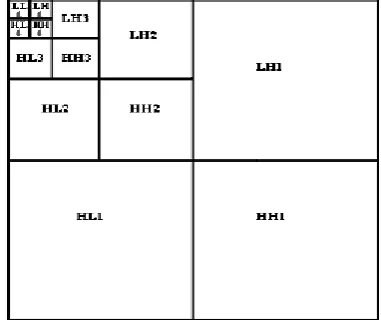
Step 1 – Discrete 2-D Wavelet Transform:The single level discrete periodic 2-D wavelet transform is applied to the original image and the coefficient matrices are stored. This operation is reapplied to the resulting LL band for three more iterations, producing a four-level DWT with several coefficient matrices. Figure 1 shows the layout of the resulting coefficient matrices.
Step 2 – Embed the first watermark in the LL4 band: The watermark, denoted by X, is embedded into the LL4 band,
denoted by C, according to (1) developed by Kang et al. [1], where C(i,j) and C'(i,j) denote the amplitude of the (i,j) th
element in C and C', respectively, C' being the watermarked LL4 band; α is a parameter related to the watermark
embedding strength; and xi,j denotes the (i,j)th element in X. Note that C and X must have the same dimensions.
Step 3 – Perform inverse DWT to obtain the watermarked image:The distinct sub bands of the image are broken up and the inverse DWT is performed in a reverse manner, to recompose the LL4, LH4, HL4, and HH4 bands first, then
those of the third level, the second level, and finally the lowest level transform, back to achieve a watermarked image. (b) The recovery is blind with respect to the original image. Recovery is completed with two steps, as follows:
Step 1 – Perform DWT on the watermarked image:The watermarked image is transformed into wavelet sub bands in as many levels as in the hiding, i.e. four.
Step 2 – Extract the watermark:In the LL4 sub band, Ccontaining the watermark, each coefficient c(i,j) is marked.
If c(i,j) mod α > (α/2), then the recovered binary
355 |
P a g e
Figure 1: Four-Level Wavelet Decomposition.
C’(i,j) = C(i,j) – (C(i,j) mod α) + 0.75α, if xi,j = 1 and (C(i,j) mod α) ≥ 0.25α
C’(i,j) = [C(i,j) – 0.25α] – [(C(i,j) – 0.25) mod α] + 0.75α, if xi,j = 1 and (C(i,j) mod α) < 0.25α (5)
C’(i,j) = C(i,j) – (C(i,j) mod α) + 0.25α, if xi,j = 0 and (C(i,j) mod α) ≤ 0.75α
C’(i,j) = [C(i,j) + 0.5α] – [(C(i,j) – 0.5α) mod α] + 0.25α, if xi,j = 0 and (C(i,j) mod α) > 0.75α bit x(i,j) = 1; otherwise x(i,j) = 0. Recompose the binary watermark in the order of the elements c(i,j).
c) PSNR is used to evaluate the quality between an attacked image and the original image. It is defined as follows:
255 255 PSNR 10log
10 1 M N 2
f(x,y)-g(x,y) M N 1 y=1
dB
x
Where M and N are the height and width of the image, respectively. f(x, y) and g(x, y) are the values located at coordinates (x, y) of the original image, and the attacked image, respectively. After extracting the watermark, the normalized correlation coefficient (NCC) is computed using the original watermark and the extracted watermark to judge the existence of the watermark and to measure the correctness of an extracted watermark. It is defined as
1
NCC ( , ) '( , )
m n 1 1
m n
w i j w i j
i j
Where m and n are the height and width of the watermark, respectively. w(i, j) and w׀(i, j) are the watermark bits located at coordinates (i, j) of the original watermark and the extracted watermark
V EXPERIMENTAL RESULTS
In this section some experiments are carried out to determine the effectiveness of the proposed algorithm. Three host images are used for the experiments namely Lena, Barbara and Peppers (512 X 512 pixels, 8 bits/pixel). (32x32) binary watermark is used. Hiding strength parameter, α was set to 90. if α increases the cover image is the capacity of the robustness reduces and also perceptually the embed image quality detoriate. The original Lena and it’s watermarked images are shown in figures 2 and 3, respectively.
356 |
P a g e
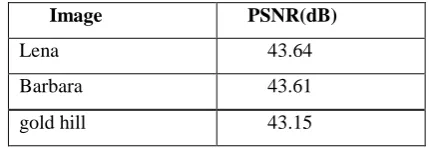
the peak signal to noise ratios (PSNR) between the original and watermarked images were calculated and are shown in
Table 1.
The average PSNR is 43.58 dB. JPEG is one of the most frequently used formats on the Internet and in digital cameras. The JPEG quality factor is a number between 0 and 100 and associates a numerical value with a particular compression level. The original and extracted watermarks for some specified quality factors are shown in figure 4 for Lena image. The Recovery information is proved the robustness of the algorithm, even after the JPEG compression with different quality factor .
Image PSNR(dB)
Lena 43.64 Barbara 43.61 gold hill 43.15
Table 1 .PSNR values of the three watermarked images
Figure 2: Host image Figure 3: Watermarked image
(Here the Images are look like same but the correlation between Host image &Watermarked is not same, means that information is inserted in the host image)
a b c d e
Figure 4: (a) original watermark (b) extracted watermark without attack (c) to (e) extracted watermarks from JPEG compressed Lena watermarked images with quality factors 70, 50, and 20 respectively
357 |
P a g e
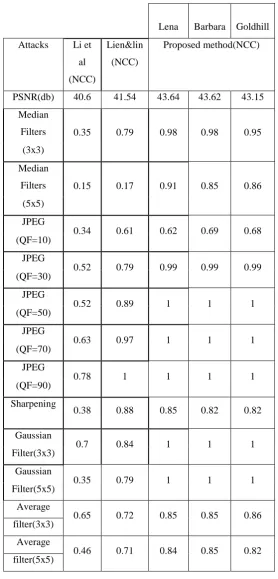
Lena Barbara Goldhill Attacks Li et
al (NCC)
Lien&lin (NCC)
Proposed method(NCC)
PSNR(db) 40.6 41.54 43.64 43.62 43.15 Median
Filters 0.35 0.79 0.98 0.98 0.95 (3x3)
Median
Filters 0.15 0.17 0.91 0.85 0.86 (5x5)
JPEG
0.34 0.61 0.62 0.69 0.68 (QF=10)
JPEG
0.52 0.79 0.99 0.99 0.99 (QF=30)
JPEG
0.52 0.89 1 1 1 (QF=50)
JPEG
0.63 0.97 1 1 1 (QF=70)
JPEG
0.78 1 1 1 1
(QF=90) Sharpening
0.38 0.88 0.85 0.82 0.82
Gaussian
0.7 0.84 1 1 1 Filter(3x3)
Gaussian
0.35 0.79 1 1 1 Filter(5x5)
Average
0.65 0.72 0.85 0.85 0.86 filter(3x3)
Average
0.46 0.71 0.84 0.85 0.82 filter(5x5)
358 |
P a g e
VI CONCLUSIONS
In this paper, a novel oblivious copyright protection method based on the 4-level DWT(Haar wavelet) based information hiding algorithm is proposed. LL4 sub band of the host image is used for hiding the binary watermark.
Perceptual quality of the watermarked image is good and the watermark can effectively resist JPEG compression (with a quality factor greater than 15) attack. The proposed method is more robust in resisting common attacks such as median filter 3x3 and Gaussian filter and for JPEG Compression. In addition to copyright protection, the proposed scheme can also be applied to data hiding and image authentication. this is very useful in mobile communication and satellite images to protect the data because while transferring the data from one device to another the specifications may not be same in terms of memory ,in that aspect the data is compressed obviously even though the information is secured and robust.
REFERENCES
[1] J. Zhao, “Look, it’s not there,” Byte, January 1997,IEEE Trans. Circuits Syst. Video Technol., vol. 13, pp. 776–786, August 2003.
[2] I. J. Cox, J. Killian, T. Leighton, and T. Shamoon, “Secure spread spectrum copyright protection for multimedia,” Tech. Rep. 95–10, NEC Research Institute, 1995.
[3] J. Ohnishi and K. Matsui, “embedding a seal into a picture under orthogonal wavelet transform,” in Proc. Int. Conferenceon Multimedia Computing and Systems, pp. 514–521, June 1996.
[4] R. G. van Schyndel, A. Z. Tirkel, and C. F. Osborne, “A digital watermark,” in Proc. Int. Conference in Image Processing, vol. 2, pp. 86–90, 1994.
[5] M. Kutter, S. K. Bhattacharjee, T.Ebrahimi, “Towards second generation copyright protection schemes,” in Proceedings of the 6th international conference on image processing, Japan, 1999. p. 320–3.
[6] A. Nikolaidis, I. Pitas, “Region-based image copyright protection ,” IEEE Transaction on Image Processing 2001; 10:1726.
[7] J. O. Ruanaidh, T. Pun, “Rotation, scale and translation invariant digital image copyright protection ,” in Proceedings of IEEE ICIP, Atlanta, GA, 1997 p. 536–9.
[8] J. O. Ruanaidh, T. Pun, “Rotation, scale and translation invariant spread spectrum digital image copyright protection,” Signal Processing 1998; 66:303–17.
[9] I. J. Cox, J. Killian, T. Leighton, and T. Shamoon, “Secure spread spectrum copyright protection for multimedia,” IEEE Transaction on Image Processing 1997; 6:1673–87.
[10] C. I. Podilchuk, W. Zeng, “Image adaptive copyright protection using visual models,” IEEE Journal on Selected Areas in Communications 1998; 16: 525–39.
[11] A. H. Paquet, R. K. Ward, I. Pitas, “Wavelet packet-based digital copyright protection for image verification and authentication,” Signal Processing 2003; 83: 2117–32.
[12] M.Vetterli, and J.Kova_evi_, 1995, “Wavelets and Sub band Coding,” Prentice Hall, USA.
359 |
P a g e
[14] A. Reddy and B. Chatterji, 2005, "A New Wavelet Based Logo-copyright protection Scheme," Pattern Recognition Letters, 26(7): 1019-1027.
[15] P. Tay and J. Havlicek, 2002. "Image Copyright protection Using Wavelets," in Proc. of the IEEE Midwest Symposium on Circuits and Systems, pp: 258-261, Oklahoma, USA.
[16] X. Kang, J. Huang, Y. Q. Shi, and Y. Lin, “A DWT-DFT Composite Copyright protection Scheme Robust to Both Affine Transform and JPEG Compression,” IEEE Trans. Circuits Syst. Video Technol., vol. 13, pp. 776–786, August 2003.
[17]Aditi Agrwal,Ruchika Bhadana and Satish Kumar Charan,"A Robust Video Copyright protection scheme using Dwt and DCT",IJCSIT,Vol.2(4),2011.