659 | P a g e
POWER QUALITY IMPROVEMENT USING
IMPROVED UNIFIED POWER QUALITY
CONTROLLER
Ms. Vishakha.A.Chavan
1, Prof.S.G.Khadilkar
21,2
Electrical Engineering, R H Sapat College, Pune University (India)
ABSTRACT
Now a day’s power electronics devices are used because of technological improvement..The increasing number of power electronics loads generally used in industry because of this load power quality problem arises. According to this consideration of power electronic load require ideal sinusoidal supply voltage for proper system operation. They are responsible for abnormal condition in distribution system. According to this scenario different mitigating technique are implemented over the years. Some of solution involves flexible compensator known as improved unified power quality controller .by using this controller we can compensate voltage sag/swell. also provide reactive power .this paper presents new control technique for iupqc. In that pulse width modulation control is used in it .it is achieved by using voltage and current sinusoidal references. The experimental results verified by using improved unified power quality controller. The grid-voltage regulation was achieved by taking different load conditions. These results have demonstrated a suitable performance of voltage regulation at both sides of the iUPQC, even while compensating harmonic current and voltage imbalances.
Keywords: iupqc, power quality voltage sag, voltage swell.
I. INTRODUCTION
The use of electronic equipment, such as information technology equipment, power electronics such as variable
speed drives, programmable logic controllers, and energy efficient lighting LED, static rectifier, converters to a
complete change of electric loads nature .according to this consideration , poor power quality may arises that
result into increased power losses, abnormal and undesirable performance of equipment’s. In power system
numbers of power quality problems are occurred such as voltage disturbance, current disturbance, voltage sag,
voltage swell, harmonics and reactive power disturbance. So consumer’s premises it is necessary to minimize
these problems. . improve the voltage profile, stability of system, enhancement of power quality and reliability
of power etc. the various flexible alternating current transmission system are come in electrical network. The
FACTS based application of power electronic devices effective for the power distribution systems to enhance
the quality and the reliability of power fed to the consumers. The FACTS technology consists of high power
electronics devices. By using this Facts device we can implement system stability. So iupqc is one of the best
solutions of degrading above problem.
The circuit of a iupqc consists of a combination of a shunt active filter and a series active filter connected in a
660 | P a g e
voltage. Here we consider electrical system with two buses i.e., bus A and bus B. Bus A is a bus of the powersystem .Bus B is a bus of the micro grid, where nonlinear loads are connected, which requires premium-quality
power supply. Our aim is to get the voltages at buses A and B must be regulated in order to properly supply the
sensitive loads and the nonlinear loads.
II. IUPQC CONFIGURATION
The improved unified power quality conditioner consists of Shunt active filter and series active filter. It is
nothing but the integration of series ad shunt active power filters, which are connected in back to back by a
common DC capacitor
.
Fig 1.iUPQC configuration [19]
Fig.1 shows the circuit of iupqc, for input signals we have to consider the voltages and currents measurements
for iUPQC controller. The iUPQC controller is composed of two PWM converters connected back-to-back
through a common dc link. Three single-phase transformers are employed to insert the series converter between
the power system and the load. The convenience of using or not shunt transformer is more related to economical
issues regarding voltage/current levels and power ratings of the system and power converters of the iUPQC the
iUPQC has a simpler controller and reduced number of measurements. Only the system voltage, the dc-link
voltage and the load current are necessary as inputs to the iUPQC controller.
III. OPERATING PRINCIPLE
661 | P a g e
Fig.2 shows the principles of the iUPQC. The shunt active filter generates a fundamental positive-sequencevoltage at nominal value. the compensated load is supplied under regulated, sinusoidal and balanced voltage
conditions (vL). On the other hand, the series active filter imposes a fundamental positive-sequence current (iS) to be drained from the network. In steady state, the series active filter drains a positive-sequence current in
phase with the fundamental positive-sequence component of the supply voltage vS. The magnitude of iS
correspond to the average active power demanded by the load, plus an active current component to compensate
for losses inside the iUPQC. Since the shunt active filter of the iUPQC behaves as an ideal voltage source, it
offers ideally null impedance for harmonic currents, whereas the series active filter offers ideally infinite
impedance, according to this consideration all harmonic current injected by nonlinear load will be forced to
follow in to shunt active filter of iupqc and it supplies reactive power of the load, series filter drains only active
portion of load current.[2]
IV. IUPQC CONTROLLER
The controller of the iUPQC is very simple. It is based on the p-q Theory. A fundamental part of this controller
is the synchronizing control circuit based on a Phase Locked-Loop (PLL), which tracks accurately the frequency
and phase angle of the fundamental positive-sequence component of the supply voltage Vs. Fig. shows the
complete control block diagram of the iUPQC controller. Since the present approach of iUPQC is designed for
application in three-phase three-wire systems (without neutral conductor), zero-sequence components are out of
interest. Hence, simplified 2x2 matrixes of the Clarke Transformations and a reduced numbers of measurements
can be employed as input signals for the iUPQC controller.
662 | P a g e
V.
RESULT
AND
DISCUSSION
Simulation Diagram Of System Without Iupqc At Different Load Condition.
1. Resistive load
Fig.4 output waveform of resistive load a] Load current (Ib) ,b] source current (Ia)
c] Load voltage (VL) d] source voltage (Va).
2. Non Linear Load
Fig5 output waveform of nonlinear load
[a] Load current (Ib) [b] source current (Ia) [c] Load voltage (VL) [d] source voltage (Va).
663 | P a g e
1. No Load Condition
Fig.6. iUPQC response at no load condition: (a) grid voltages
VA
, (b)
load voltages
VB
, and (c) grid currents
2.iupqc with 3 phase diode rectifier
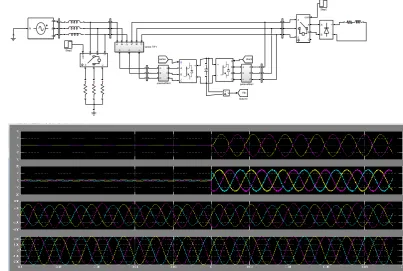
Fig.7 iUPQC transitory response during the connection of a three phase diode rectifier: (a) load
currents, (b) grid currents, (c) load voltages and (d) grid voltages.
664 | P a g e
iUPQCis able to regulate the voltages at both sides of the iUPQC, simultaneously. Even after the loadconnection, at t = 0 s, the voltages are still regulated, and the currents drawn from bus A.
3 .iupqc with two phase diode rectifier
Fig.8 iUPQC transitory response during the connection of a two phase Diode rectifier: (a) load
currents, (b) grid currents, (c) load Voltages and (d) grid voltages
.Fig. 8. iUPQC transitory response during the connection of a two phase diode rectifier: load currents, source
currents, load voltages, and source voltages. are almost sinusoidal. Hence, the iUPQC can perform all the
power-quality compensations, as mentioned before, including the grid-voltage regulation
VI. CONCLUSION
The objective of this topic is to improve the power quality in an electrical network using iupqc fact device. This
new feature enhances the applicability of the iupqc and provides new solutions in future scenarios involving
smart grids and micro grids, including distributed generation .The grid-voltage regulation was achieved with no
load, as well as when supplying a three-phase nonlinear load. These results have demonstrated a suitable
performance of voltage regulation at both sides of the iupqc, even while compensating harmonic current and
voltage imbalances. From this project it is clear that the performance in the voltage profile or waveform gets
improved using improved unified power quality conditioner
REFERENCES
[1] Hideaki Fujita, and Hirofumi Akagi, Fellow, The Unified Power Quality Conditioner: The Integration of Series- and Shunt-Active Filters IEEE TRANSACTIONS ON POWER ELECTRONICS, VOL. 13,
665 | P a g e
[2] Alok Kumar Mohanty, Amar Kumar Barik Power System Stability Improvement Using FACTSDevices International Journal of Modern Engineering Research (IJMER) Vol.1, Issue.2, pp-666-672
ISSN: 2249-6645
[3] Ranjit Kumar Bindal A Review of Benefits of FACTS Devices in Power System International Journal
of Engineering and Advanced Technology (IJEAT)ISSN: 2249 – 8958, Volume-3, Issue-4, April 2014
[4] V. khadkikar, A. Chan dr, A.O. Barry and T. D.Nguyen conceptual study of unified power quality
conditioner . B. Han, Senior Member, IEEE, B. Bae, Student Member, IEEE, S. Baek, and G. Jan
Member, IEEE New Configuration of UPQC for Medium-Voltage Application IEEE TRANSACTIONS ON POWER DELIVERY, VOL. 21, NO. 3, JULY 2006
[6] Yashomani Y. Kolhatkar, Student Member, IEEE, and Shyama P. Das, Senior Member, IEEE
Experimental Investigation of a Single-Phase UPQC With Minimum VA Loading IEEE
TRANSACTIONS ON POWER DELIVERY, VOL. 22, NO. 1, JANUARY 2007
[7] Vinod Khadkikar, Student Member, IEEE, and Ambrish Chandra, Senior Member, IEEEA New Control Philosophy for a Unified Power Quality Conditioner (UPQC) to Coordinate Load-Reactive Power
Demand Between Shunt and Series Inverters IEEE TRANSACTIONS ON POWER DELIVERY, VOL.
23, NO. 4, OCTOBER 2008
[8] Consalva J. Msigwa, Beda J. Kundy and Bakari M.M. Mwinyiwiwa, Control Algorithm for Shunt Active
Power Filter using Synchronous Reference Frame Theory International Journal of Electrical, Computer,
Energetic, Electronic and Communication Engineering Vol:3, No:10, 2009
[9] R V D Rama Rao ,Dr. Subhransu Sekhar Dash Enhancement of Power Quality by using Unified Power
Quality Conditioner with PID and Fuzzy Logic Controller International Journal of Computer
Applications (0975 – 8887) Volume 5– No.7, August 2010
[10] D. C. Bhonsle R. B. Kelkar Design and Simulation of Single Phase Shunt Active Power
Filter using MATLAB2011 International Conference on Recent Advancements in Electrical, Electronics
and Control Engineering.
[11] Nikita Hari K.Vijayakumar Subhranshu Sekhar Dash A Versatile Control Scheme for UPQC for Power
Quality Improvement ICETECT 2011.
[12] ad paper
[13] Quoc-Nam Trinh and Hong-Hee Lee† Novel Control Strategy for a UPQC under Distorted Source and
Nonlinear Load Conditions Journal of Power Electronics, Vol. 13, No. 1, January 2013
[14] Vinita Vasundhara, Rintu Khanna, Manoj Kuma Improvement of Power Quality by UPQC Using
Different Intelligent Controls: A Literature Review International Journal of Recent Technology and
Engineering (IJRTE) ISSN: 2277-3878, Volume-2, Issue-1, March 2013
[15] Aakash S. Shah1, Professor Vishnu Patel2, Professor Manish Patel Different Control Strategies for
Unified Power Quality Conditioner – A Review.International journal of innovative research in electrical,
electronics, instrumentation and control engineering Vol. 2, Issue 3, March 2014.
[16] Raphael J. Millnitz dos Santos, Jean Carlo da Cunha, and Marcello Mezaroba, Member, IEEE A Simplified Control Technique for a Dual Unified Power Quality Conditioner IEEE transactions on
666 | P a g e
[17] Prasad P. Kulkarni voltage sag/swell and load reactive power compensation using upqc InternationalJournal of Electrical and Electronics Engineers ISSN- 2321-2055 IJEEE, Volume 07, Issue 01, Jan- June
2015.
[18] Maurício Aredes and Rodrigo M. Fernandes a unified power quality conditioner with voltage sag/swell
compensation capability.
[19] Bruno W. França, Student Member, IEEE, Leonardo F. Da Silva, Maynara A. Aredes, Student Member,
IEEE, and Maurício Aredes, Member, IEEE an Improved iupqc Controller to provide additional
Grid-Voltage Regulation as a STATCOM IEEE TRANSACTIONS ON INDUSTRIAL ELECTRONICS,
![Fig 1.iUPQC configuration [19]](https://thumb-us.123doks.com/thumbv2/123dok_us/7774581.1281543/2.595.153.442.250.464/fig-iupqc-configuration.webp)