CSEIT183385 | Received : 12 March 2018 | Accepted : 24 March 2018 | March-April-2018 [ (3 ) 3 : 660-664 ]
M-Commerce Using NFC Tags
Reshma Karvir, Rutuja Patankar, Chaitanya Bendre, Neha Chankhore.
Information Technology,Vidyalankar institute of Technology, Mumbai, Maharashtra, India
ABSTRACT
This paper presents a novel method to create an Android based M-commerce application usingNFC. It would require Mobile Devices which support NFC technology. NFC stands for Near Field Communication technology which is a short-range, high frequency, low bandwidth radio technology that allows transferring data within few centimetres. In traditional shopping, the customer needs to physically pick up the items to be purchased and carry cash or credit/debit cards with them to make payments. The application mentioned here would read the NFC tag’s of the product’s and add it to the shopping cart in our application. It would also provide methods to change the quantity of product/s purchased and edit the cart. Along with this the customer would be informed about the on-going offers in the store. Payment could be made through cash or online using existing payment methods. The paper would also throw light on NFC based payments.
Keywords : NFC(Near Field Communication),NFC tags(Near Field Communication) tags.
I.
INTRODUCTION
Since the late 1990s, people have enjoyed a comfortable lifestyle because of mobile devices. By the early 2000's, wireless networks have been developed in Europe and Asia. Currently, the penetration rate of mobile devices in many developed countries is around 80-90%. Mobile devices supported by the development of wireless networks have spread throughout the world. Mobile commerce applications have become the most popular application for mobile device users who want to do business and financial transactions easily and securely, anytime and anywhere. Today the use of physical cash is experiencing a decline in popularity in the business world, because it is being replaced by electronic money (e-money). An important upcoming technology behind mobile payments is Near Field Communication (NFC). As an indication that the NFC has tremendous business potential, leading companies like Nokia, Microsoft, Visa Inc., MasterCard Worldwide and NXP Semiconductors, are actively engaged on them. Payment processing with NFC technology based
A. MOBILE COMMERCE
Mobile commerce is doing shopping of goods or services through wireless devices such as mobile phones, smart phones and other handheld devices. Mobile commerce is also described as any transaction with monetary value which conducted through mobile telecommunications networks. Mobile commerce is all about the wireless ecommerce using mobile devices to conduct business on the internet. It can also be defined as the exchange value or the purchase and sale of financial products, services or information on the internet using mobile devices. Mobile commerce seen globally is very helpful and very
beneficial for users but also has its advantages and disadvantages. The advantages of mobile commerce are:
1.Customer satisfaction, cost savings and new business opportunities,
2.Transactions can be done anywhere and anytime, 3.Owner has control over the data while the
mobile device can be synchronized, 4.Allow for considerable profit,
5.Relations with customers become closer.
B. Near Field Communication
Near Field Communication (NFC) is a new wireless connectivity technology to the radius of short range, which evolved from the combination of contactless identification and interconnection technologies (RFID). NFC operates at a frequency of 13.56 MHz and has a data transfer rate of up to 424 Kbps. Effective communication and optimal between two NFC-enabled devices occurs when they are at a distance of 0 to 10 cm. Simple movement as twist or swing will establish connections between devices and can initiate NFC, which will also be compatible with Bluetooth or Wi-Fi . NFC technology is a combination between the smartcard and reader that is planted in a single device, such as mobile phones or smart phones. With the NFC device planted on a mobile device, then the transaction activities such as retrieving information through NFC tags,
micro-payments or payment transactions can be done by juxtaposing it to the NFC reader, which is in the user’s mobile device and for payments at terminal point of sale (POS) at the location of the transaction. With a feature like this then NFC referred to as device that supports the contactless transaction.
II.
EXISTING SYSTEM.
NFC isn't a fundamentally groundbreaking technology. Like Bluetooth and Wi-Fi, it's a wireless radio communications standard. In the wireless world, NFC's closest relative is actually RFID (radio frequency identification). Retailers and parcel shipping companies in particular love RFID as a way to keep tabs on inventory supplies and shipments. biography in the form of a text file and image. Or, at your favorite restaurants, you can hold your phone to an NFC tagged menu andin fractions of second you have the entire menu on your phone, along with allthe information and descriptions of the ingredients of your favorite dishes. You can call them smart tags, information tags or, NFC tags, but their basic idea is similar to RFID tags. They both have a bit of storage memory which stores data and also an antenna.
III.
AIM AND OBJECTIVES
Our first aim is to convert a shopping cart into a virtual shopping cart.
There will be no need of picking up the products personally so less man power.
Owner has control over the data while the mobile device can be synchronized.
The products whose NFC tags were tapped (read) will be stored in a shopping list/cart. Users will be able to perform editing of existing products in the cart such as the process of addition, subtraction of quantity or deletion of the product all together from the cart.
The user will be informed about the ongoing offers in the store and could avail them right from the application itself. The user at all times would be aware of the expenditure made by them and could verify the same.
The user will checkout and confirm the same to the Merchant by performing a handshake with the merchant device. The shopping cart consisting of selected items will be processed and the same will be recorded in the merchant and user history.
IV.
PROBLEM STATEMENT
Today’s systems are traditional commerce or ecommerce systems of retail which have a lot of disadvantages in themselves like every commerce system has. The prototype application’s aim is to remove as many inconsistencies as possible from these systems and to make a system which is consumer friendly and high performing. The system’s ultimate aim would be consumer to the mall and roams around in the outlet for the search of their desired goods. They physically pick up the desired items, place them in a trolley/cart and then carry the trolley all around. Once done with the shopping they need to stand in queues to
get the billing done, which is a time consuming process. And ultimately carry the shopping bags back home. Using M-commerce application this entire process could be simplified and made more user-friendly.
V.
PROPOSED SYSTEM
The proposed application system will be using
Androidbased mobile phones which are
advancements in NFC based payments, the same could be applied for the prototype application.
VI.
SCOPE
M-commerce using NFC application is beneficial for the customers because smart-phones and NFC are most recently used technology nowadays. In the future we can enhance the application further by adding new products and updating the existing products information depending upon market scenario, in the application’s database. The merchant could come up with new offers depending on market conditions, festival offers etc. and the same could be displayed within the application itself. The application could also have a loyalty based incentive program which would enable the merchant to provide special discount offers to select few customers based on their previous purchases. The technology used and the application developed would be scalable and would be capable enough to adapt to the future demands of the consumer enhancing the futuristic scope of this application. Also NFC based payments could be used for the application It’s the same technology but whereas here it is about using NFC to transfer a web address or the essential data for payment purposes. NFC based payments are a lot more complicated and involve a mobile wallet on consumer’s phone and a similar wallet at merchant’s end too. Applications such as NFC Mobile Payment would utilize information that users want to keep private. Personal data and financial transactions must then be protected by the usage of NFC Secure Elements utilizing robust security concept similar to the security levels provided by certified credit cards.
VII.
METHODOLOGY
Methodology implemented for our software development is “Incremental”. The waterfall model derives its name due to the cascading effect from one phase to the other as is. In this model each phase well defined starting and ending point, with
identifiable deliveries to the next phase. This model is sometimes referred to as the linear sequential model or the software lifecycle.
A)Working of NFC tags:
1) NFC tags are considered passive devices, which means that they operate without a power supply of their own and are reliant on an active device to come into range before they are activated. The trade-off here is that these devices can’t really do any processing of their own instead they are simply used to transfer information to an active device, such as a smart phone. In order to power these NFC tags, electromagnetic induction is used to create a current in the passive device. We won’t get too technical on this, but the basic principle is that coils of wire can be used to produce electromagnetic waves, which can then be picked up and turned back into current by another coil of wire. This is very similar to the techniques used for wireless charging technologies, such as Qi or A4WP.
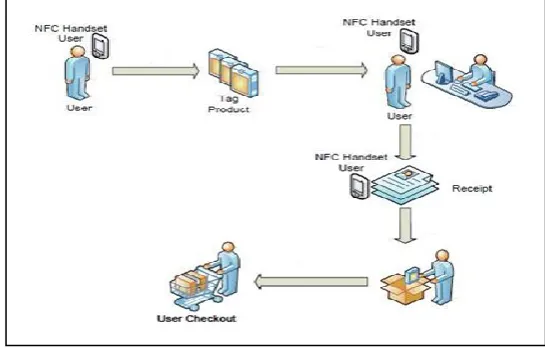
Figure 1. architecture diagram.
VIII.
CONCLUSION
make it more effective and user friendly. Thus making it easier & convenient for the users to do the entire shopping process with the use of this application, as compared to the existing systems.
IX.
REFERENCES
[1].Near field communication forum.
http://www.nfc-forum.org.
[2].A Secure NFC Application for Credit Transfer Among Mobile Phones by David M. Monteiro, Joel Rodrigues and Jaime Lloret [Computer Engineering and Applications Vol. 1, No. 1, June 2012]