An
r
−
process macronova/kilonova in GRB 060614: evidence for
the merger of a neutron star-black hole binary
Zhi-Ping, Jin1,a, Yi-Zhong, Fan1,b, and Da-Ming, Wei1,c
1Key Laboratory of Dark Matter and Space Astronomy, Purple Mountain Observatory, Chinese Academy of
Sciences, Nanjing 210008, China
Abstract.After the jet break att∼1.4 days, the optical afterglow emission of the long-short burst GRB 060614 can be divided into two components. One is the power-law decaying forward shock afterglow emission. The other is an excess of flux in several multi-band photometric observations, which emerges at∼4 days after the burst, signif-icantly earlier than that observed for a supernova associated with a long-duration GRB. Att>13.6 days, the F814W-band flux drops faster thant−3.2. Moreover, the spectrum of
the excess component is very soft and the luminosity is extremely low. These observed signals are incompatible with those from weak supernovae, but the ejection of∼0.1M
ofr−process material from a black hole-neutron star merger, as recently found in some numerical simulations, can produce it. If this interpretation is correct, it represents the first time that a multi-epoch/band lightcurve of a Li-Paczynski macronova (also known as kilonova) has been obtained and black hole-neutron star mergers are sites of significant production ofr−process elements.
1 Introduction
Recently, the Laser Interferometer Gravitational-wave Observatory (LIGO) was replaced with ad-vanced detectors, the new version known as "Adad-vanced LIGO" has been in operation. The most promising detections of gravitational waves are expected from collisions and coalescences of neu-tron stars (NSs) or black holes (BHs). People paid special attentions on the short-duration (<2s) gamma-ray bursts (GRBs), because they are believed to originate from coalescences of NS binaries or NS−BH binaries, and can be precisely localized if their prompt-emission/afterglows are detected. The evidence for the compact-object merger origin of short GRBs are growing [1]. Before the successful detection of the gravitational wave radiation, a “smoking-gun" signature for the compact-binary origin of a GRB would be the detection of the so-called Li-Paczynski macronova (also called a kilonova), which is a near-infrared/optical transient powered by the radioactive decay ofr−process material syn-thesized in the ejecta that is launched during the merger event [e.g., 2–4]. Before 2015, just one macronova candidate had been detected in GRB 130603B and such a detection was mainly based on an single epoch observation of Hubble Space Telescope (HST) [5, 6].
Table 1. The excess component of GRB 060614 (adopted from Jin et al. [14])
Time from GRB Filter Magnitudea
(days) (Vega)
7.828 VLTV (25.6±0.6)
3.869 VLTR (25.3±0.6)
4.844 VLTR 24.9±0.3
6.741 VLTR 25.3±0.3
10.814 VLTR (26.5±0.8)
14.773 VLTR (27.2±1.0)
3.858 VLTI 23.7±0.4
7.841 VLTI 24.6±0.4
13.970 HST F606W (∼R) 26.9±0.4 13.571 HST F814W (∼I) 25.05±0.12
Note: a. The magnitudes of the extracted excess component. The observations with errors larger than 0.5 mag have been bracketed.
With a duration shorter than 0.2 seconds and without any hint for an extended emission, GRB 130603B is a classical short hard GRB and its association with a macronova is anticipated. However, the situation of GRB 060614 is much more complicated. It is a nearby burst with a duration of 102 seconds at a redshiftz=0.125 [7], and has been classified as a long burst according to its duration. However extensive searches did not find any supernova (SN)-like emission down to limit hundreds of times fainter than SN 1998bw [8], the archetypal hypernova that accompanied long GRBs [9–11]. Moreover, the temporal lag and peak luminosity of GRB 060614 fall within the short duration subclass and the properties of the host galaxy distinguish it from other long-duration GRB hosts [7, 11]. Hence a new classification scheme seems to be needed and it has been called a long-short burst. The physical origin of this type burst has been debated over years [9, 12].
Recently, a significantF814W-band excess component was reported in a re-analysis of the late time optical afterglow data [13] of the peculiar event GRB 060614 and has been interpreted as a Li-Paczynski macronova. Like GRB 130603B, such a candidate was mainly based on a single epoch HST observation. In a very recent work by Jin et al. [14], the analysis has been improved by considering a possible time evolution of the macronova component and modeling the entire afterglow dataset accordingly. Assuming that only the data in the interval of 1.7- 3.0 days are due solely to the forward shock (FS) emission, and using these data to determine the single power-law decline of the afterglow, the FS component is subtracted from the observational data, a significant excess appeared in multi-wavelength bands att > 3 days [14]. In this proceeding paper we summarize the findings made in [13, 14] and discuss their implications.
2 The data analysis result and the excess component
The public VLT imaging data of GRB060614 are available from ESO Science Archive Facility (http://archive.eso.org) while the HST archive data of GRB060614 are available from the Mikulski Archive for Space Telescopes (MAST; http://archive.stsci.edu) including one visit with WFPC2 and four visits with ACS in F606W and F814W bands. The details of the analysis of the these raw data can be found in theMethodsof [13] and the results are summarized in their Supplementary Table 1.
to the forward shock (FS) and subsequently fitted all VLT V/R/I-band data att > 1.7 day with the same decline rate. In such an analysis, only one F814W-band point att ∼ 13.6 days was found to be significantly in excess of (i.e., the significance is above 3σ) the fitted FS emission. However, the fitted residuals in Fig. 1 of [13] display an intriguing general trend: the earlier data (t<4 days) were usually negative (with respect to the FS afterglow model), while the later data were positive, strongly suggesting that the intrinsic FS emission decline was likely quicker than that assumed in their model, and there was very likely to be an excess of emission att<13.6 days. Motivated by such a fact, we have performed an improved analysis of the data. The main assumption is that only the VLT data in the interval of 1.7−3.0 days are due to only FS emission, and we used these data to determine the single power-law decline of the afterglow. The physical arguments in support of such an assumption are the following: (i) there was a jet break att ≈1.4 days [10, 15, 16], hence the data collected at later times need be considered; (ii) att∼1.8 days a single power-law spectrum can well describe the optical to X-ray data [10, 15, 16], suggesting that any macronova contribution to the observed flux is still unimportant; (iii) in the interval of 1.7−3.0 days there were three measurements in VLTRband and two measurements in VLTV/Ibands, with which a reliable estimate of the FS emission decline is plausible. When we subtracted this (best-fitted) FS component from the observational data we found a significant excess in multi-wavelength bands att>3 days (see Table 1 that is adopted from [14]). Although the dataset is still relatively sparse, some valuable information can be extracted:
• The I-band (R-band) flux can reach∼24th mag (∼25th mag), corresponding to an extremely-low luminosity∼1041erg s−1, and the excess component likely peaked att4 days.
• The excess component has a very soft spectrum that can be roughly approximated by a thermal one with a temperature∼2700 K.
• In the time interval oft∼6−13.6 days the R-band (VLT R and HST F606W) flux dropped with time much faster than that in I-band. Fort>13.6 days the I-band (HST F814W) flux decline got remarkably steepened and the decline was quicker thant−3.2, which clearly did not trace the possible flattening in X-ray band.
3 The excess component: a very weak supernova or a macronova?
After the discovery of GRB 060614, one widely discussed possibility/mode is that such an event was formed in a new type of a collapsar which produces an energeticγ-ray burst that is not accompanied by a bright SN [9–11]. The detection of a few very weak SNe (for example, SN 2008ha [17, 18]) with peak bolometric luminosities as low as∼1041erg s−1is indeed encouraging for such a model.
-20
-19
-18
-17
-16
-15
-14
-13
-12
-11
-10
0 10 20 30 40 50 60
Absolute magnitude (Vega)
Time in rest frame (days)
SN 1998bw R SN 2010bh Rc
SN 2008ha R VLT R excess HST F606W excess
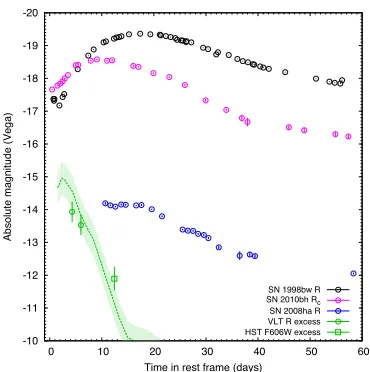
Figure 1.The excess component in the afterglow of GRB 060614 compared with some core-collapse SNe. The data of excess in GRB 060614 are adopted from [14]. The data of SN 1998bw, the prototype of SN associated with GRB, is taken from [8]; the data of SN 2010bh, the most rapid to reach the peak SN associated with GRB, is taken from [19]; and the data of SN 2008ha, the weakest core-collapse SN known so far, is taken from [18]. The dashed lines are macronova model lightcurves generated from numerical simulation for the ejecta from a BH−NS merger, with a velocity∼0.2cand massMej∼0.1M, by [4], with shadows represent a possible uncertainties of
0.5 magnitudes. The light curve of the excess component is reasonably in agreement with the macronova model, however are quite different to those core-collapse SNe.
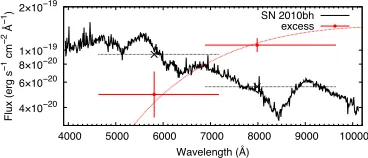
In Figure 2 we compare the spectrum of the excess component in GRB 060614 att∼13.6 days with that of SN 2010bh. Fitted by a blackbody spectrum, the temperature of the excess component is estimated to be ∼ 2700−+500700 K. It is much lower than SNe at the same time scale, typically∼ 5000−10000 K[10, 19], but it is similar to that expected at the photosphere for the recombination of Lanthanides, which isT ∼2500 K [3].
All the above facts strongly suggest that the excess component in GRB 060614 is incompatible with being a weak supernova. In the rest of this work we focus on the other possibility, i.e., it is a Li-Paczynski macronova.
4 Macronova: from the merger of a neutron star binary or a neutron
star
−
black hole binary?
observa-4×10⁻²⁰ 6×10⁻²⁰ 8×10⁻²⁰ 1×10⁻¹⁹ 2×10⁻¹⁹
4000 5000 6000 7000 8000 9000 10000
Flux (erg s
−1
cm
−2
Å
−1
)
Wavelength (Å) SN 2010bh
excess
Figure 2. The observed SED of the excess component in GRB 060614 compared with the observed spectrum of SN 2010bh. The excess component in GRB 060614 [14] and the spectrum of SN 2010bh [20] is taken at 12.1 days and 12.7 days in rest frame, respectively. The spectrum of SN 2010bh has been shifted toz=0.125 and rescaled to match the flux of the excess component. AT =2700 K blackbody spectrum is also plotted for comparison (red dotted line), here the small extinction from the Galaxy (AV=0.07) and the host galaxy (SMC
like, AV=0.05) has been considered to fit for observations.
tion. As shown in Figure 1, a macronova model lightcurve generated from numerical simulation for the ejecta from a BH−NS merger, with a velocity∼0.2cand massMej ∼0.1M, by [4], can
reason-ably reproduce the data. To account for the excess component (in particular the F814W-band excess att∼13.6 days after the burst) in the NS-NS merger scenario, aMej0.2Mis needed. Such a large Mejis well beyond the ejecta mass range found in the NS-NS mergers [21] and is thus disfavored.
Therefore, the macronova associated with GRB 060614 is likely from an NS−BH merger with very high ejecta mass, while an NS binary merger seems unable to account for the blue SED as well as the long-duration of the macronova [13, 14]. For the macronova signal in GRB 130603B, due to the absence of a multi-epoch/band lightcurve, either a NS-NS merger or a NS-BH merger model can reproduce the data [21].
5 Discussion
GRB 060614 was a unique burst straddling both long- and short-duration GRBs and its physical origin was heavily debated over the years [7, 9–12]. Recently, a very-soft F814W-band excess at t∼13.6 days after the burst was identified in a joint-analysis of VLT and HST optical afterglow data of GRB 060614 [13]. It is thefirsttime to identify a macronova signature in a long-short GRB. An improved analysis of the same set of data reveals a significant excess component emerges at∼4 days after the burst, and present in several late multi-band photometric observations [14]. Such a signal is clearly incompatible with a very weak supernova (see Figure 1). Instead the ejection of∼0.1M
ofr−process material from a black hole-neutron star merger, as recently found in some numerical simulations, can produce it. The binary neutron star merger model is also found to be in tension with the data, either. Therefore we suggest that the excess component identified in [13, 14] represent the firstmulti-epoch/band lightcurve of a Li-Paczynski macronova.
The black hole-neutron star merger interpretation has quite a few far reaching implications [13, 14]:
prospect for detecting the gravitational wave radiation from compact object mergers by upcoming advanced detectors, i.e., the rate isRGW∼0.5+−00..525(D/200 Mpc)
3yr−1.
• A black hole-neutron star merger is favored over the binary neutron star merger in explaining the excess component, favoring the presence of such binary systems.
• The so-called ‘long-short’ burst arose from a merger and not from a collapsar. It was in fact ‘short’ in nature. The fact that a black hole-neutron star merger generates a∼100 s longγ−ray activity is intriguing by itself.
• The energy source of the Li-Paczynski macronovae is the decay of some unstabler−process mate-rial. The successful detection of macronovae strongly suggest that such events contribute a signifi-cant fraction of ther−process material, which is in support of the model of [22, 23].
Acknowledgments
This work was supported in part by National Basic Research Programme of China (No. 2013CB837000 and No. 2014CB845800), NSFC under grants 11361140349, 11103084, 11273063, 11433009 and U1231101, the Foundation for Distinguished Young Scholars of Jiangsu Province, China (Grant No. BK2012047) and the Strategic Priority Research Program (Grant No. XDB09000000).
References
[1] Berger, E., 2014,Ann. Rev. Astron. Astrophys., 52, 43 [2] Li, L.-X., & Paczy´nski, B. 1998,ApJL, 507, L59 [3] Barnes, J. & Kasen, D. 2013,ApJ, 773, 18.
[4] Tanaka, M., Hotokezaka, K., Kyutoku, K. et al. 2014,Astrophys. J., 780, 31 [5] Tanvir, N. R., Levan, A. J., Fruchter, A. S. et al. 2013,Nature, 500, 547 [6] Berger, E., Fong, W., & Chornock, R. 2013,Astrophys. J. Lett., 744, L23 [7] Gehrels, N., Norris, J. P., Barthelmy, S. D., et al. 2006,Nature, 444, 1044 [8] Galama, T. J., Vreeswijk, P. M., van Paradijs, J. et al. 1998,Nature, 395, 670 [9] Fynbo, J. P. U., Watson, D., Thöne, C. C., et al. 2006,Nature, 444, 1047 [10] Della Valle, M., Chincarini, G., Panagia, N., et al. 2006,Nature, 444, 1050 [11] Gal-Yam, A., Fox, D. B., Price, P. A., et al. 2006,Nature, 444, 1053
[12] Zhang, B., Zhang, B. B., Liang, E. W. et al. 2007,Astrophys. J. Lett., 655, L25 [13] Yang, B., Jin, Z. P., Li, X. et al. 2015,Nature Communications, 6, 7323 [14] Jin, Z. P., Li, X., Cano, Z. et al. 2015,Astrophys. J. Lett., 811, L22
[15] Mangano, V., Holland, S. T., Malesani, D. et al. 2007,Astron. Astrophys., 470, 105 [16] Xu, D., Starling, R. L. C., Fynbo, J. P. U. et al. 2009,Astrophys. J., 696, 971 [17] Valenti, S., Pastorello, A., Cappellaro, E. et al. 2009,Nature, 459, 674 [18] Foley, R. J., Chornock, R., Filippenko, A. V. et al. 2009,Astron. J., 138, 376 [19] Cano, Z., Bersier, D., Guidorzi, C., et al. 2011,Astrophys. J., 740, 41 [20] Bufano, F., Pian, E., Sollerman, J., et al. 2012,Astrophys. J., 753, 67
[21] Hotokezaka, K., Kyutoku, K., Tanaka, M., et al. 2013,Astrophys. J. Lett., 778, L16
[22] Lattimer, J. M. & Schramm, D. N. Black-hole-neutron-star collisions. 1974,Astrophys. J. Lett. 192, L145
![Table 1. The excess component of GRB 060614 (adopted from Jin et al. [14])](https://thumb-us.123doks.com/thumbv2/123dok_us/8168458.1363332/2.482.130.351.105.246/table-excess-component-grb-adopted-jin-et-al.webp)