Kinect Based Classification of Accessibility
from Natural Body Language
Diksha A. Shende, Dr. R. S. Kawitkar
Department of E & TC, Sinhgad College of Engineering, Pune, India
ABSTRACT: Microsoft Kinect is widely used in indoor application. It is mainly used in field robotics. An accurate 3D depth map is necessary to generate stable movements of robots.Kinect sensor is used to generate depth images. It is used in application like human maschine interaction. Human machine interface is the interaction of machine with human or consider a machine as a robot to socially interact with human. The social robot are accepted in a society when they have the capacity to decipher human expressive gesture, so in this paper our main challenge is classification of human accessibility level from body language that is used in such fields such as human robot interaction. To retrieve these things we are implementing technique which uses Kinect based classification for accessibility with NISA baseline coding for pose detection.Here SURF algorithm is used for feature extraction. The research in this field is for the development of automated affect from static body language classification system.
KEYWORDS: Kinect, body language, social robot, HRI.
I. INTRODUCTION
Microsoft Kinect, to measure distances to an object. Kinect is a motion sensing device by capturing both RGB and depth data. Due to its low cost and simple usage, Kinect is used for human pose identification and full body tracking in indoor environment. Kinect can also extract human’s skeletal structure and full body actions from 3D depth map in realtime.An accurate 3D depth map is necessary to generate stable movements of robots.From the 3D depth map, planes on the object are extracted by the surface extraction algorithm.
The classification of accessibility level from body language is use in certain fields such as Human machine interface and Human–robot interface. Human robot interaction is the investigation of cooperation’s amongst people and robots. These three laws of mechanical autonomy decide the possibility of safe connection. The nearer the human and the robot get and the more complicated the relationship turns into, the more the danger of a person harmed rises. These days in cutting edge social orders, makers utilizing robots illuminate this issue by not giving people and robots a chance to share the workspace whenever. The research in this field is only for the development of an automated affect. It is develop from static body language classification system. Static body language is an important source for information gathering for affect and this is directly helps to understand how affect is expressed through body language. It is advantageous of taking static body language because it is unconscious and unintentionally displays so it is consider as not intentional or forced. Here we are investigating that how the automatic affect is integrated from body language recognition system and this is used in robotic application.
Accessibility refers to the openness and connectedness. Where in previous research there is significant relationship between the accessibility and person body pose. We are trying to build a certain relation between the person’s natural body language and accessibility by increasing the performance of the system. For that Kinect sensory system is used for classification in different accessibility levels. Levels states how much percent the system is open and connected to human. Here nonverbal interaction and state analysis is done.
One primary preferred standpoint to utilizing static non-verbal communication is that a man for the most part shows these unknowingly and unexpectedly, and thusly, they are normal and not constrained.
A. MOTIVATION
• Multimodal sensing and perception • Design and human factors.
• Developmental robotics.
• Social, service, and assistive robotics. • Educational robotics.
B. OBJECTIVE
The objectives of the proposed systems are listed below
1. Determine the performance of our automated system in being able to recognize and classify a person’s accessibility levels.
2.Recognize actions from depth maps.
II. LITERATURE SURVEY
A) In this paper[3], introduced a structure that backings the transmission of haptic prompts from the controlled UAVs to the tele administrator's controller. Haptic signals can be intended to build the teleoperator's moving execution of the UAVs and impression of the remote environment. For this reason, this proposed three conceivable sorts of haptic signals and three reciprocal teleoperation controllers in view of surely understood routine teleoperation control. These three plans depended on the accompanying: 1) the UAVs' deterrent evasion constrain; 2) the UAVs' speed data; and 3) a mix of the two.
B) In this paper[4], a novel MAXQ HRL-based semi-self-sufficient control engineering was displayed for automated investigation of obscure and jumbled USAR situations. The controller's goal is to give a safeguard robot the capacity to gain from its past encounters so as to enhance its execution in exploring and investigating a calamity scene to discover however many casualties as could reasonably be expected. This permits a human administrator to profit by the robot's capacity to persistently gain from its environment and adjust to more mind boggling situations.
C) This paper[6], contributes a coordinated system for leading human–robot community oriented control errands. We built up a two-stage learning structure, which joins impersonation learning and support learning. Utilizing impersonation taking in the robot could connect and hold the finish of the table. Through support taking in, the robot can figure out how to team up with human for the table-lifting undertaking. With the guided investigation system for Q-taking in, the learning velocity is made strides. Utilizing the whole structure, the robot could figure out how to play out the collective table-lifting errand rapidly and effectively.
D) In this paper[11], explore full of feeling body signal investigation in recordings, a generally understudied issue. Spatial-fleeting components are abused for demonstrating of body motions. Additionally present to breaker outward appearance and body signal at the element level utilizing Canonical Correlation Analysis. The current spatial-worldly components based video depiction does not consider the position relations of cuboids identified. By including the relative position data between the cuboid sorts, the representation will be substantially more discriminative. This will be contemplated in our future work
III. PROPOSEDSYSTEM
A. Human body language recognition
A form of non-verbal communication –Body posture
–Gestures
–Facial expressions
–Eye movements (eye gaze)
Humans send and interpret such signals almost entirely subconsciously.
It is very difficult task to build up such a machine. Since this sort of non-verbal communication is viewed as key in uncovering a man's feelings or dispositions, it would be helpful for a robot to see, decipher, and react to connectors while associating in social HRI to make all the more captivating collaborations. Mean to create and incorporate a tactile framework that permits a social robot to viably perceive a man's full of feeling nonverbal practices amid continuous social HRI via independently distinguishing and sorting a man's connector style non-verbal communication. Using this tactile framework a robot will have the capacity to give errand help utilizing its own particular proper expressive practices in light of a client's full of feeling verbal communication. We will likely actualize a noncontact non-verbal communication ID and classification framework fit for deciding influence in view of a man's abdominal area dialect. Non-verbal communication is characterized, in this paper, as static body postures displayed by a person amid HRI. NISA is used to distinguish an individual's level of availability toward a robot in light of his/her non-verbal communication.
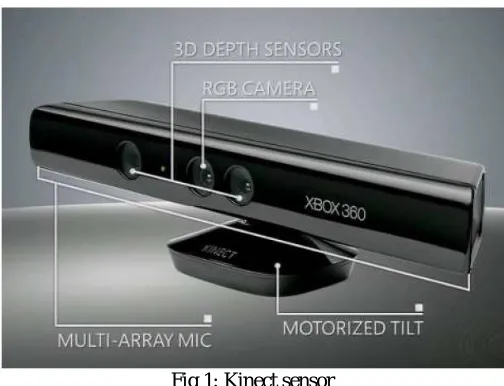
Fig 1: Kinect sensor
B. automated accessibility from body language classification technique
The recognition of non-verbal communication is trying as there exists numerous designs in a high dimensionality look space. This task is made more troublesome when it is expected for a robot that participates progressively social HRI utilizing just locally available sensors. Thus, we depict our robotized availability acknowledgment and arrangement framework that distinguishes a man's static body postures using tangible data from the Kinect sensor. The proposed approach uses both a Kinect 2-D color picture, to recognize uncovered skin areas, and Kinect profundity information to create a 3-D ellipsoid model of a man's static pose.
• Kinect Sensor
light source and caught with a CMOS IR indicator. The profundity of a point in the scene is ascertained by measuring the even dislodging of a spot in the anticipated example. The working scope of the profundity sensor is around 0.5–4 m. The Kinect sensor was aligned for this paper using a 3-D checkerboard design comprising of the light squares raised regarding the dim squares. The Kinect sensor is shown in fig 1.
• Human Static Body Poses
A person can show a different scope of static body postures amid association. These static postures contain data with respect to varieties in the individual's anxiety, affinity, inclusion, and emotional quality and power. The represents that are recognized in this paper are adjusted from the position openness size of the NISA. With the goal for NISA to view a stance as static, it must be held for no less than 4 s. Static body positions are a game plan of trunk introductions and inclines, and arm positions which we use to distinguish a man's availability level toward a robot
• Multimodal Static Body Pose Estimation Approach
2- D pictures and profundity information procured by the Kinect sensor are utilized by the human body extraction and body part division modules to first concentrate a man from the foundation and after that to recognize every particular body part. The body parts are utilized to recognize static body postures by means of the static stance ID module. The switch tree structure ellipsoid model module then decides the 3-D postures of each of the body parts in these static stances. Ultimately, the body posture estimation module decides the introductions and inclines of every static body posture.
IV. IMPLEMENTATION
The implementation contains the accessibility levels from first to last show the improvement in the performance. Firstly it takes the Kinect depth image as an input image which doesn’t recognize anything. Certain steps apply for the recognition of the body language in which at the last step it is more accessible which helps in recognize the body pose.
From top to bottom different accessibility increases from top to bottom. At last step performance is greater due to the implementation of the SURF algorithm which is applied on the raw image taken from the Kinect sensor. It is Kinect based classification is done.
Feature Extraction
Feature is extracted with the help of Speeded up Robust Feature (SURF) algorithm. It is used for interest point detection which allows to detect interest points within the image i.e depth image taken with the help of Kinect 2D sensor. Classification is done and from that Static body pose is estimated. The search for discrete image point correspondences is divided into three main steps. First, `interest points'are selected at different locations in the image, like corners, blobs, and T-junctions. The most important property of an interest point detector is its repeatability. The repeatability expresses the reliability of a detector for Finding the same physical interest points under different viewing conditions. Next, the neighborhood of every interest point is represented by a feature vector. This descriptor has to be distinctive and at the same time robust to noise, detection displacements and geometric and photometric deformations. Finally, the descriptor vectors are matched between different images.
Fig 3: Block diagram for Feature extraction and classification
V. RESULT
The Image Gradient measures that how image is changing. It consists of two sets of information magnitude and direction. Magnitude tells how quickly image change and direction of gradient tells in which image is changing. The Gradient has direction and magnitude which helps to encode the information in the form of vector. Then thekeypoints are extracted which gives information regarding their position and about their area with the help of SURF algorithm. Fig 3 shows the Image gradient and Keypoint descriptor.
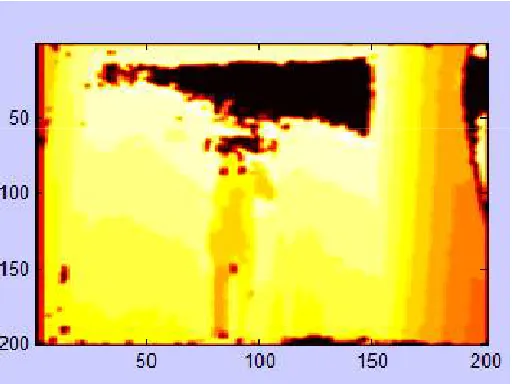
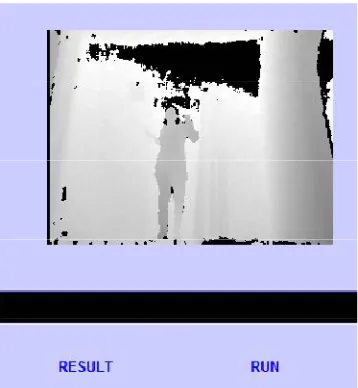
Input image taken is from Kinect Sensor it is a depth image
Depth image with lower accessibility level takes 4 sec in processing. Whereas the depth resolution of that of the Kinectsensor is about 1 cm and the interaction distance from the participant is about 0.5 to 4 m.
Fig 5: Preprocess Image with accessibility level 2
The average preprocessing time for recognition and classification of the body poses is 25 ms
The average enhancement time is about 22 ms
Fig 6: Feature Extraction with accessibility level 4
For feature extraction it takes about 19ms
Fig 7: Recognition of the body pose
Acurracy is calculated with the help of confusion matrix
Acc= =
VI. ADVANTAGES
The advantages of the proposed system is given below
• Human and machine interface involves investigating the design and performance of machine which are used by humans in theirs work areas.
• Performance of an automated system is determined which being able to classify and recognize accessibility levels of a person.
• Interact to a greater extent with people who do not have disabilities.
VI. DISADVANTAGES
The disadvantages of the system is given below
• One main disadvantage is that a machine with good performance may result that person lose there job.
VII. APPLICATION
The application of the proposed algorithm is given below • Entertainment
• Education
• Field robotics
• Home and companion robotics • Hospitality
• Rehabilitation and Elder Care
VIII. CONCLUSION
Here we shows the Kinect based classification through which it classify in different accessibility levels, increase in performance from first to last level. Generally, our outcomes show the potential of integrating an accessibility identification and categorization system into a social robot, allowing the robot or machine to interpret, classify, and respond to adaptor style body language during social interactions. SURF algorithm with Knn classifier is used for the recognition of the body pose. Here the system accuracy is calculated in terms of accessibility, the overall performance of the system.
REFERENCES
1] M. A. Goodrich and A. C. Schultz, “Human–robot interaction,” Found. Trends Human Comput.Interact., vol. 1, no. 3, pp. 203–275, 2007.
2] A. Tapus, C. Tapus, and M. J. Mataric, “Hands-off therapist robot behavior adaptation to user personality for post-stroke rehabilitation therapy,” in Proc. IEEE Int. Conf. Robot.Autom., Rome, Italy, 2007, pp. 1547–1553.
3] M. A. Goodrich and A. C. Schultz, “Human–robot interaction,” Found. Trends Human Comput.Interact., vol. 1, no. 3, pp. 203–275, 2007.
4] B. Doroodgar, Y. Liu, and G. Nejat, “A learning-based semi-autonomous controller for robotic exploration of unknown disaster scenes while searching for victims,” IEEE Trans. Cybern., vol. 44, no. 12, pp. 2719–2732, Dec. 2014.
5] R. Heliot, A. L. Orsborn, K. Ganguly, and J. M. Carmena, “System architecture for stiffness control in brain–machine interfaces,” IEEE Trans. Syst., Man, Cybern. A, Syst., Humans, vol. 40, no. 4, pp. 732–742, Jul. 2010.
6] W. Sheng, A. Thobbi, and Y. Gu, “An integrated framework for human– robot collaborative manipulation,” IEEE Trans. Cybern., vol. 45, no. 10, pp. 2030– 2041, Oct. 2015.
7] G. Nejat and M. Ficocelli, “Can I be of assistance? The intelligence behind an assistive robot,” in Proc. IEEE Int. Conf. Robot.Autom., Pasadena, CA, USA, 2008, pp. 3564–356.
8] D. McColl and G. Nejat, “Meal-time with a socially assistive robot and older adults at a long-term care facility,” J. Human Robot Interact., vol. 2, no. 1, pp. 152–171, 2013.
9] W. G. Louie, D. McColl, and G. Nejat, “Playing a memory game with a socially assistive robot: A case study at a long-term care facility,” in Proc. IEEE Int. Symp. Robot Human Interact. Commun., Paris, France, 2012, pp. 345–350.
10] D. McColl, J. Chan, and G. Nejat, “A socially assistive robot for mealtime cognitive interventions,” J. Med. Devices Trans. ASME, vol. 6, no. 1, 2012, Art. ID 017559.
11] S. Gong, P. W. McOwan, and C. Shan, “Beyond facial expressions: Learning human emotion from body gestures,” in Proc. British Mach.Vis. Conf., Warwick, U.K., 2007, pp. 1–10.