Real-Time Vision Based Sign Language
Recognition System
Akanksha Medhi, Mitali Doshi, Prajkta Pawar, Apurva Kesarkar, Prof. Rupali Dalvi
B. E Student, Department of Computer Engineering, Marathwada Mitra Mandal’s College of Engineering, Karvenagar Pune, India
Professor, Department of Computer Engineering, Marathwada Mitra Mandal’s College of Engineering, Karvenagar Pune, India
ABSTRACT:This paper presents a novel system to aid in communicating with those having vocal and hearing disabilities. It discusses an improved method for sign language recognition and conversion of speech to signs. The algorithm devised is capable of extracting signs from video sequences under minimally cluttered and dynamic background using skin color segmentation. It distinguishes between static and dynamic gestures and extracts the appropriate feature vector. These are classified using Support Vector Machines. Speech recognition is built upon standard module Sphinx. Experimental results show satisfactory segmentation of signs under diverse backgrounds and relatively high accuracy in gesture and speech recognition.
KEYWORDS: Computer and information processing, Feature extraction, Gesture recognition, Image processing, Sign Language Recognition, Speech recognition
I. INTRODUCTION
a. MOTIVATION
Sign language is the basic means of communication for those with hearing and vocal disabilities. Those disadvantaged have difficulty in their day to day lives. We aim to develop a system that would ease this difficulty incommunication.Sign language consists of making shapes or movements with your hands with respect to the head or other body parts along with certain facial cues. A recognition system would thus have to identify specifically the head and hand orientation or movements, facial expression and even body pose.We propose the design for a basic yet extensible system that is able to recognize static and dynamic gestures of American Sign Language, specifically the letters a-z (where j and z are dynamic with hand or fingertip movement while the rest are static). American Sign Language was chosen since it is utilized by a majority of those disabled.The system is able to perform in dynamic and minimally cluttered background with satisfactory result as it relies on skin color segmentation [3] to separate the gestures, i.e. focus on the hands and face. Since the lexicon under consideration (letters a-z) does not involve facial cues, we eliminate the face using Viola-Jones face detection followedby subtraction of the detected region. We classify the gesture as static or dynamic by measuring the distance moved by the hand in subsequent frames.For static gestures,
we use Zernike moments, a well known shape descriptor in image processing as shown in [4]For dynamic gestures we
b. BACKGROUND
Hand gesture recognition is a rapidly growing field invarious applications, such as sign language, computer vision, natural language processing, biomedical, biometrics, pattern recognition, and much more [15]. Hand Gesture Recognition can be seen as a way for computers to understand the intentions of the human being, creating an interface between machines and humans. With the advent of technologies such as smartphones, Hand Gesture Recognition is expected to add new ways of interacting with mobile devices. Thus, gestures captured by the camera of the mobile can be analyzed to place orders without having to touch the screen. In our paper, we chose to make our system on an Android smartphone. The choice of the Android operating system is not arbitrary but for several technical and non-technical reasons. Among the non-non-technical reasons is that Android is the world's most popular operating system for mobile phones and the majority of smartphone users use the android system [1]. And for technical reasons, we have chosen to work with Android platform because it allows integrating libraries for image processing. In our case, we have chosen to integrate a free graphics library specializes in real time image processing named Open CV (Open Computer Vision) library [2] to perform image processing. And then we have chosen to integrate the SVM classifier (Support Vector Machine) which can model real-world problems such as image classification, hand-writing recognition, text, bioinformatic and bio sequence analysis. Our system, unlike systems realized before, is designed to perform all necessary operations in order to recognize hand gestures, by the smartphone and without the need to use another device. Some applications that use gestures as an Human-Machine Interface were first imposed in game consoles (Microsoft Kinect and PlayStation Eye for Sony) and could now be used in other areas such as smart television and smartphone
II. RELATED WORK
tracking algorithm, Hausdorf object tracker is used to extract frames from a live video feed that will best encompass the translation an object has gone through.
III. SYSTEM OVERVIEW
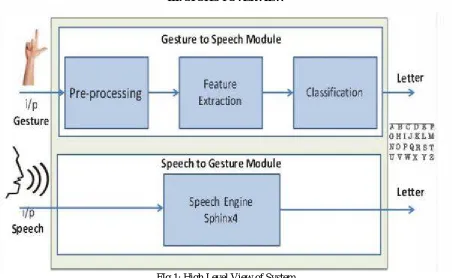
FIg 1: High Level View of System
On a high level the system comprises of two independent modules as shown in the above diagram. The two modules being the 'Gesture to Speech Module' and 'Speech to Gesture Module'. The Gesture to Speech Module takes a gesture as an input in the form of an image/video and produces the speech corresponding to the sign as the output, while the second module does the vice-versa where it takes speech from the user as the input and produces the corresponding image/video as the output. Here the image input/output is meant for a static gesture while a video in the same case is used for a dynamic gesture.
IV. GESTURE RECOGNITION
The input can be a static or dynamic gesture, so to make it as general as possible a video recording of two seconds is passed as the input at the rate of 6fps. The flow diagram of the gesture to speech module is shown below (Fig 2). The gesture is extracted and depending on its type (static/dynamic) certain features are extracted. These are then classified using pre-trained SVM classifiers. The details of image extraction and classification is explained in the below section.
A. SKIN - COLOR SAMPLING
B. IMAGE PRE-PROCESSING AND HAND SEGMENTATION
Since skin color segmentation is used to detect the hand we have to make sure that there is no other prominent skin colored regions in the frame. The face is often more prominent than the hand. Hence the first step in image preprocessing is the detection and removal of face using Viola and Jones algorithm.
C. POST PROCESSING AFTER HAND SEGMENTATION
After the image preprocessing, we get a binary image of the hand (Fig 6) which we invert (Fig 7). To be able to recognize dynamic gestures we need to detect and track the fInger-tips and COG to know whether they are moving.
D. THRESHOLD COMPARISON
Now that we have detected the CoG and fingertips we can identify if the gesture is static or dynamic by tracking the distance they move. In this paper the entire class of ASL gestures has be divided into three. First there is the basic classification of Static gestures and Dynamic gesture. Dynamic gestures are then further subdivided into dynamic gestures with significant hand movement and dynamic gestures with significant fingertip movement. Significant movement of the hand means substantial movement of the CoG of the hand while in the other class CoG almost remains stationary but the fingertip moves substantially.
E. FEATURE EXTRACTION
For static gestures, we use Zernike moments to identify the orientation of the hand. From experimental results and [10] we were able to deduce Zernike moments up to the seventh order and hence a seven feature vector is sufficient to identify a static gesture. For dynamic gesture involving the tracking of CoG or a particular fingertip we characterize the path traced by a curve feature vector of 5 elements. To do this we first identify Key points or representative points on the path. As demonstrated below a circle would require more key points to characterize the path whereas a square would only require four. Next we extract the features which are
1) Trajectory Length/Location feature:
The total length of the trajectory can be calculated by computing the distance between the key-points and summing them up. It is translation invariant as even if there is a shift the location where the gesture is drawn the length of the gesture will not change. Location feature is the distance between the center of gravity of the trajectory and the key-points. Since there are a number of key points the average of the sum is considered. It is also translation invariant as distance between center of gravity and key points would not vary even if there is a shift in location of the gesture. Thus the ratio, (Trajectory length/Location feature) would be a scale and translation invariant ratio.
2) Number of significant changes in hand orientation:
The orientation change (i.e. the angle formed) along the set of three key-points is considered, if it is greater than a predefined threshold say, an angular displacement >= 45 it is counted as one significant change, else ignored. The total count of such changes is accounted here.
3) Average velocity: It is the average velocity over the whole trajectory.
4) Standard deviation of the speed: Variation of the speed over the whole trajectory length indicates the smoothness of the trajectory.
5) Number of minima velocity points: Number of points that have a speed below some threshold T-v(min).This indicates turns in the trajectory and hence the smoothness of the trajectory.
F. CLASSIFICATION
V. SPEECH RECOGNITION
Speech Recognition (SR) is the conversion of spoken words into text, also known as "Automatic Speech Recognition" (ASR). There are two types of SR Systems, Speaker independent[12] and Speaker-dependent systems, where the latter has a training phase which uses a person's specific voice for the recognition purpose. A number of Speech applications are available in the market like Dragon NS [13]. For experimental purposes of this paper the Speech recognition module was setup in two ways, first using a speech engine (Sphinx 4), where a restricted set of grammar for alphabets from A-Z was used, just like a command recognition system. The SPHINX Speech Recognition Engine of CMU [14] was utilized. A SPHINX engine just like any other Speech Engine requires two files as input an Acoustic Model and a Language model or a Grammar File.
This general model of SPHINX is depicted in below diagram (Fig 9). Its working is based on Hidden Markov Models (HMM).
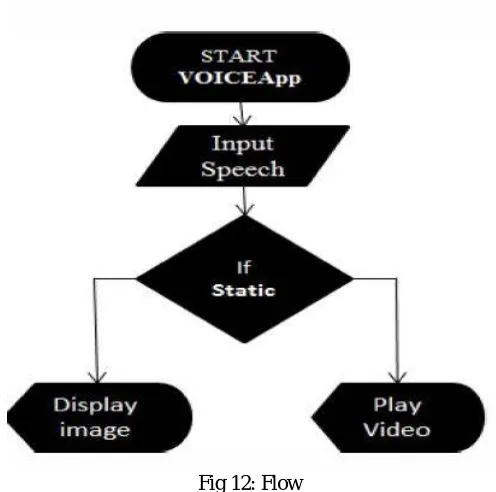
Fig 12: Flow
The SPEAK button (Fig. 1 1) can be used to give a speech input to the system and the output is either an image or a video corresponding to the gesture depending on whether it is static or dynamic. The accuracy shows huge variation based on the type of usage and the amount of background noise.
VI. CONLCUSION
REFERENCES
[I] Nasser H. Dardas and Nicolas D. Georganas. Real-time handGesturedetection and recognition using bag-of-features and support vector machine techniques. IEEE
[2] Emil M. Petriu Qing Chen, Nicolas D. Georganas. Real-time visionbasedhand gesture recognition using haar-like features, 2007.
[3] P.K. Bora M.K. Bhuyan and D. Ghosh. Trajectory guided recognition of hand gestures having only global motions. International Science Index, 2008.
[4] Michael Vorobyov. Shape class i_cation using zernike moments, 2011.
[5] Thad Eugene Starner. Visual recognition of american sign language using hidden markov models.Master's thesis, Massachusetts Institute of Technology, Cambridge MA, 1995.
[6] P.K. Bora M.K. Bhuyan and D. Ghosh. Trajectory guided recognition of hand gestures having only global motions. International Science Index, 2008.
[7] Emil M. Petriu Qing Chen, Nicolas D. Georganas. Feature extraction from 2d gesture trajectory in dynamic hand gesture recognition, 2006. [8] Manisha M. Ingle Neelam K. Gilorkar. A review on feature extraction for indian and american sign language, 2014.
[9] Chih-Chung Chang and Chih-Jen Lin. A review on feature extraction for indian and american sign language, 2013.
[10] ATHIRA P K ALEENA K RAJ and DEEPA I K. Sign language conversion software for people with hearing and vocal disabilities,20 13. [12] Fifth Generation Computer Corporation-"Speaker Independent Connected Speech Recognition" [Online]-Available: Fifthgen.com [13] NUANCE. Dragon Speech Recognition Software [Online].Availabe:http://www.dragonsys.com
[14] Kai-Fu Lee, Hsiao-Wuen Hon, and Raj Reddy, An Overview of the SPHINX Speech Recognition System. IEEE Transactions on Acoustics, Speech and Signal Processing.