An Efficient Approach for Routing in Mobile
Adhoc Network (A Review Paper)
Nisha Bhadana, Geetanjali Gandhi
M.Tech, Dept. of Computer Science, BSAITM, Faridabad, Haryana under the Affiliation of Maharshi Dayanand
University, Rohtak, India
Assistant Professor, Dept. of Computer Science, BSAITM, Faridabad, Haryana under the Affiliation of Maharshi
Dayanand University, Rohtak, India
ABSTRACT: Wireless Network is very attracted area for researchers for providing new capabilities. One important challenge is to design sensor networks that have long system lifetimes. In recent years, a broad research has been done in the domain of Mobile Ad-hoc Networks(MANETs). Due to the bounded resources in MANETs, to develop a reliable and efficient routing approaches still a threat or issues. There are distinct aspects appropriate for research like synchronization, power consumption, routing, bandwidth consideration, etc. This paper concentrates on routing approach which is the major challenging concern due to the change in topology of ad-hoc networks. Under a number of network scheme, such as network topology and size, it is difficult to figure out which routing protocol may perform well. In this paper we contribute an outline of broad range of the current routing approaches, with aspecial focus on their comparison, functionality and characteristics.
KEYWORDS:Introduction, Routing, comparison of algorithms, challenges, conclusion.
I.INTRODUCTION
Manet is a continuously self configuring, infrastructure less network of mobile devices which are connected without wires.Wireless network is divided into two categories:- Infrastructured network and Adhoc network .A mobile ad hoc network is an autonomous system of various mobile routers connected by wireless links . There are various Sensor nodes which consist of sensing, data processing, and communication components and typically form ad hoc networks.MANETs are mainly constructed to support cooperative work in environments without network infrastructures. The main challenge in building a MANET is equipping each device to continuously maintain the information required to properly route traffic. The objective of Manet is to support robust and efficient operation in mobile . Ado network does not rely on any certain topology and coordination point. Routers may be move freely so wireless topology can be change rapidly, so it is a very difficult task to sending and receiving a packet to the destination node. Manet works on the dynamic topology ,it is having limited source of energy.
II. LITERATURE REVIEW
2.1 Characteristics of Manet:-
Manet is having various features and characteristics’ which makes it popular among all. some of them are:
Nodes can perform the task of both host and the routers. No need to make the routers and host different.
It basically work on the dynamic topology. Manet can move in any direction independently.
Communication via wireless, no need to take the burden of wires.
Network can be extended to that places which cannot be wired
It provide more flexibility and the adapt easily to change in configuration of the network.
Limited physical security: More prone to physical security threats than fixed cable networks.
2.2 Application:
Virtual navigation: Data from a remote database is transmitted periodically in small relevant blocks using
links present in the path of the automobile. This database may contain the graphical representation of streets, buildings, maps and the latest traffic information, which may be used by the driver to decide on a route.
Tele-medicine: Conference assistance from a surgeon for an emergency intervention.
Tele-Geo processing: Queries regarding location information of the users.
Crisis-management: Natural disasters, where the entire communication infrastructure is in disarray.
Education via the internet is the main application
2.3Broadcasting Techniques Used In Manet:
Unicasting: In this techniques the information(data) is send from source to single destination.
Multicasting: In this techniques the information is send from source to assets of destination.
Broadcasting: in this technique the messages are flooded from a source to all other nodes in the specified Adhoc networks.
Geocasting: In this technique the information is send from the source to all other nodes inside a geographical region.
2.4Routing in MANETS – Goals:
To provide the maximum possible reliability - use alternative routes if an intermediate node fails.
To choose a route with the least cost metric.
Give the nodes the best possible response time and throughput.
Route computation must be distributed. Centralized routing in a dynamic network is usually very expensive.
Routing computation should not be involve the maintenance of global state.
Every node must have quick access to routes on demand.
Each node must be only concerned about the routes to its destination.
Broadcasts should be avoided (highly unreliable).
It is desirable to have a backup route when the primary route has become stale.
2.5Types of wireless networks:
Infrastructured network:-A network with fixed and wired gateways. When a mobile unit goes out of range of one base station, it connects with new base station.
Infrastructureless (ad hoc) networks:-All nodes of these networks behave as routers and take part in discovery and maintenance of routes to other nodes.
Two Main categories of Protocols:
III. RELATED WORK
1. ROUTING CLASSIFICATION
The family tree:
DSDV WRP AODV DSR LMR ABR .
. .
Adhoc routing protocols
Proactive Protocol Reactive Protocol
.
Hybrid Protocol
Ad-hoc Routing Protocols
TABLE 1: COMPARISON OF PROACTIVE ROUTING PROTOCOLS
Parameters DSDV WRP OLSR
Route Updates Periodic Periodic Periodic
Loop Free Yes Yes Yes
Routing Overhead
High High Low
Caching Overhead
Medium High High
Throughput Low Low Medium
Routing Tables 2 4 4
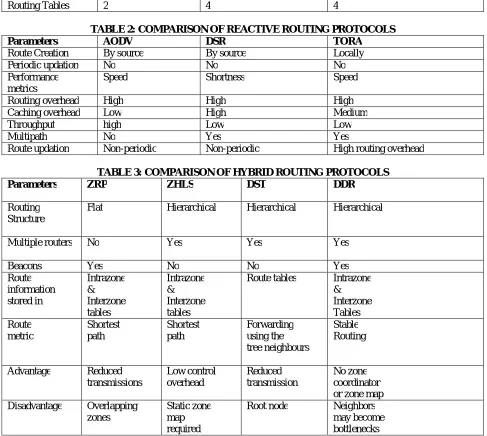
TABLE 2: COMPARISON OF REACTIVE ROUTING PROTOCOLS
Parameters AODV DSR TORA
Route Creation By source By source Locally
Periodic updation No No No
Performance metrics
Speed Shortness Speed
Routing overhead High High High
Caching overhead Low High Medium
Throughput high Low Low
Multipath No Yes Yes
Route updation Non-periodic Non-periodic High routing overhead
TABLE 3: COMPARISON OF HYBRID ROUTING PROTOCOLS
Parameters ZRP ZHLS DST DDR
Routing Structure
Flat Hierarchical Hierarchical Hierarchical
Multiple routers No Yes Yes Yes
Beacons Yes No No Yes
Route information stored in Intrazone & Interzone tables Intrazone & Interzone tables
Route tables Intrazone & Interzone Tables Route metric Shortest path Shortest path Forwarding using the tree neighbours Stable Routing
Advantage Reduced
transmissions Low control overhead Reduced transmission No zone coordinator or zone map Disadvantage Overlapping
zones
Static zone map required
Root node Neighbors
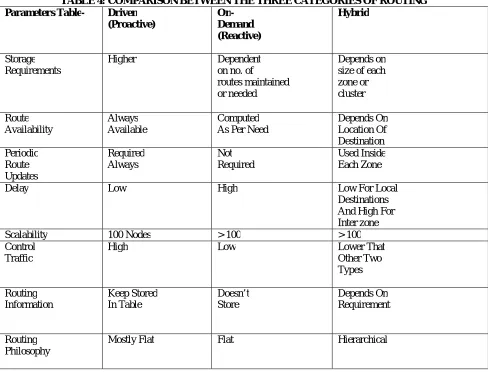
TABLE 4: COMPARISON BETWEEN THE THREE CATEGORIES OF ROUTING Parameters Table- Driven
(Proactive) On- Demand (Reactive) Hybrid Storage Requirements
Higher Dependent
on no. of
routes maintained or needed
Depends on size of each zone or cluster Route Availability Always Available Computed As Per Need
Depends On Location Of Destination Periodic Route Updates Required Always Not Required Used Inside Each Zone
Delay Low High Low For Local
Destinations And High For Inter zone
Scalability 100 Nodes > 100 > 100
Control Traffic
High Low Lower That
Other Two Types Routing Information Keep Stored In Table Doesn’t Store Depends On Requirement Routing Philosophy
Mostly Flat Flat Hierarchical
Comparisons Of Protocol
In this section we have presented a comparison between existing routing protocols. TABLE 4 below provides an overall comparison of the three categories of routing protocols. The hybrid routing protocols employ both reactive and proactive properties by maintaining intra-zone information proactively and inter-zone information reactively. Another way to reduce routing overheads is by using conditional updates rather than periodic ones. In on demand routing protocols, the flooding-based routing protocols such as DSR and AODV will also have scalability problems. Hybrid routing protocols such as the ZHLS may also perform well in large networks. ZRP is another hybrid routing protocol which is designed to increase the scalability of MANETs. It maintains strong network connectivity (proactively) within the routing zones while determining remote route (outside the routing zone) quicker than flooding. Table 4 shows the comparison of all the three categories of ad hoc routing protocols.
IV.FUTURERESEARCHAREA
Each node will send a DR packet to the source node .First check the type of a node, whether it is gateway node or a normal node. If, it is a normal node mark it as a sleep node ,and if it is a Gateway node then it will broadcast a message until the destination is achieved and path is incremented by +1. Also check the each node weather they are destination node or not. If the path Count will be same from both the path then we will consider the path having the shortest distance from the source to destination. We can also consider the path which covers the less no of nodes.
V.CONCLUSION
In this paper, we have presented and discussed the taxonomy of routing protocols in mobile ad hoc networks and provided comparisons between them. The protocols are divided into three main categories: (i) source-initiated(reactive or on-demand), (ii) table-driven (pro-active), (iii) hybrid protocols. The analysis of the different proposals has demonstrated that the inherent characteristics of ad hoc networks, such as lack of infrastructure and rapidly changing topologies, introduce additional difficulties to the already complicated problem of secure routing. Still mobile ad hoc networks have posed a great challenge for the researchers due to changing topology and security attacks, and none of the protocols is fully secured and research is going on around the globe.
REFERENCES
[1] Anuj K. Gupta, Harsh Sadawarti, and Anil K. Verma,” Review of Various Routing Protocols for MANETs”.,International Journal of Information and Electronics Engineering, Vol. 1, No. 3, November 2011.
[2]Nawneet Raj1, Priyanka Bharti2, Sanjeev Thakur3,” Qualitative and Quantitative Based Comparison of Proactive and Reactive”IJCSMC, Vol. 4, Issue. 12, December 2015.
[3] Pawan1, Rajendra K.Sharma2, 1Department of Computer Science & Engineering, “A New Approach for Power Aware Routing for Mobile Adhoc Network “,American International Journal of Research in Science, Technology, Engineering & Mathematics, 10(1), March-May 2015. [4]Rashmi Gupta , Mr. Ramesh Chandra Sahoo, “A Survey on Routing Protocols of MANET in Wireless Sensor Network”, IJCSMC, Vol. 4, Issue. 4, April 2015,
[5]E.Sivajothi#1, N.Vijayalakshmi #2, A.Swaminathan#3,“An Overview of Route Discovery Mechanisms of Multicast Routing Protocols for MANETs”, International Journal of Engineering and Technology (IJET), Vol 5 No 5 Oct-Nov 2013.
[6] Harvaneet Kaur ,ECE Department , ITM University, Gurgaon,“A Survey on Manet Routing Protocols”, IJARCSSE, Volume 5, Issue 1, January 2015.