Xin-jie ZHAO, Tao WANG
Department of Computer Engineering, Ordnance Engineering College, Shijiazhuang
050003, China, [email protected]
Abstract. This paper presents an improved Cache trace attack on AES and
CLEFIA by considering Cache miss trace information and S-box misalignment. In 2006, O. Acıiçmez et al. present a trace driven Cache attack on AES first two rounds, and point out that if the Cache element number of the Cache block is 16, at most 48-bit of AES key can be obtained in the first round attack. Their attack is based on the ideal case when S-box elements are perfected aligned in the Cache block. However, this paper discovers that, the S-box elements are usually misaligned, and due to this feature and by considering Cache miss trace information, about 200 samples are enough to obtain full 128-bit AES key within seconds. In 2010, Chester Rebeiro et al. present the first trace driven Cache attack on C LEFIA by considering Cache hit information and obtain 128-bit key with 243 CLEFIA encryptions. In this paper, we present a new attack on
CLEFIA by considering Cache miss information and S-box misalignment features, finally successfully obtain CLEFIA-128 key for about 220 samples within seconds.
Keywords: Driven; Cache Attack; AES; CLEFIA; Cache Miss; S-box
Misalignment.
1
Introduction
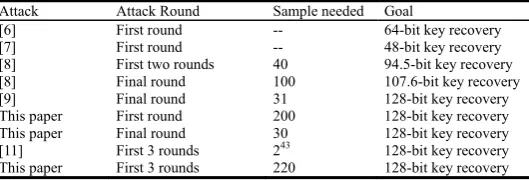
There are many papers on Cache based side channel attacks. According to the different information of the measuring stage, it can be classified into timing driven, access driven, and trace driven three types. We present an improved trace driven Cache based attack on AES and CLEFIA in this paper. In trace driven attacks, there are already some attacks on AES[ ][ ][ ][ ]6 7 8 9 and CLEFIA[ ]11. However, none of the publish papers described to recover AES initial key and CLEFIA round key in the first round attack. Our analysis model is much like [9] by considering Cache miss trace information, the attacks in this paper show that: due to the feature of S-box misalignment in Cache, it’s possible to break AES initial key and CLEFIA round key by first round attack within limited samples, and this is much more effective that any previous studies. Table 1 demonstrates the improvements of the attacks in this paper over several previous attacks.
Table 1. Overview of Cache trace attacks on AES-128 and CLEFIA-128.
Attack Attack Round Sample needed Goal
[6] First round -- 64-bit key recovery
[7] First round -- 48-bit key recovery
[8] First two rounds 40 94.5-bit key recovery
[8] Final round 100 107.6-bit key recovery
[9] Final round 31 128-bit key recovery
This paper First round 200 128-bit key recovery This paper Final round 30 128-bit key recovery
[11] First 3 rounds 243 128-bit key recovery
This paper First 3 rounds 220 128-bit key recovery
This work is organized as follows. Section 2 presents the background of Cache trace attacks. Section 3 and Section 4 present the improved Cache trace attack on AES and CLEFIA respectively. Finally, the work is concluded in Section 5.
2
Background
2.1 Cache Information Leakage and Cache Analysis model
Modern microprocessors and microcomputers use memory Cache to solve the speed bottleneck between CPU and bus bandwidth. The “Cache hit” and “Cache miss” can brought time and power consumption differences, and most block ciphers usually use S-box lookup to access Cache. Cache access patterns can be measured through timing and power measurement. Cache provides the source of time and power information leakage for cipher process.
attacker abilities, Cache attack can be classified into three types: timing driven attacks[ ][ ][ ][ ]12 13 14 15, access driven attacks[ ][ ][ ]16 17 18, trace driven attacks[ ][ ][ ][ ][ ]6 7 8 9 11. 1. Timing driven Cache attack needs to measure the whole encryption or decryption
time of cipher and usually requires millions of samples, its off-line analysis method is more complicated.
2. Access driven Cache attack requires knowledge of the cipher Cache set access pattern by a spy process. Comparing with timing driven Cache attack, its measuring methods are more comparatively complicated, but the analysis methods are much simple.
3. Trace-driven analysis is of high efficiency, but it need to measure every Cache access hit or miss information during the encrypt process, generally speaking, it is usually acquires to gather the Cache hit and miss information by monitoring the power consumption.
2.2 Cache Trace Driven Analysis Model
Trace driven attack is first presented in on AES[ ]6, and researchers make some further studies in [7][8][9]. In 2010, Chester[ ]11 proposes a differential Cache trace attack on CLEFIA, the technique used in this paper is the same as [7] by utilizing Cache hit trace information.
In trace driven Cache attacks, the adversary obtains the traces of Cache hits and misses for some samples of encryptions and recovers the secret key of ciphers using this data. We define a trace as a sequence of Cache hits and misses. For example, MHHM, MMHH, MHHH, MHMH are examples of the 16 Cache access traces of AES first round. The letter M and H denotes a Cache miss Cache hit respectively. In such condition, the adversary has the ability to determine whether a particular Cache S-box lookup to access Cache is a Cache hit or miss.
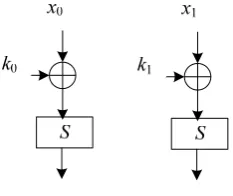
Fig. 1. Trace driven attack model
Fig. 1 shows two access to S-box with indices (x0⊕k0) and (x1⊕k1). If (x0⊕k0) is the first time to access Cache, it can always generate a Cache miss. As to the second time to access Cache, it has two cases:
1. (x0⊕k0)= (x1⊕k1)
2. (x0⊕k0)≠ (x1⊕k1)
A Cache miss occurs in this case. This result in more execution time and more power consumption, also reveals some impossible candidates for the Xor of the key bits (k0⊕k1) ≠(x0⊕x1).
From above, it seems to generate only one guess on the possible k0⊕k1 candidate. However, modern Caches do not store individual bytes, but groups of bytes from consecutive “lines” of main memory. Line size varies, the two common values are 32 bytes for a Pentium III and 64 bytes for Athlon 3000+ CPU. Since the usual size of common block ciphers like AES, Camellia, CLEFIA table entries is 4 bytes; groups of 16 consecutive table entries share a line in the Cache on the Athlon 3000+ CPU. This value we define it as δ. In general, it will hold that δ=l/b where l is the process’s Cache line size and b is the block size of S-box table entries.
The value of δ is critically important to Cache bases attacks because for any address a, b which are equal (<a>=<b>) ignoring the lower log2δbits, looking up address a will cause an ensuing access to b a hit in Cache. Under this precondition, if the second Cache access generates a Cache hit, it will hold <x0⊕k0>= <x1⊕k1> (the lower log2δbits may not identical), so <k0⊕k1>=<x0⊕x1>, as to 8-bit value k0, using more samples, the 8-log2δbits of k0⊕k1 can be obtained, but the log2δbits of k0⊕k1 is still unknown.
Also, if the second Cache access generates a Cache miss, it will hold that <x0⊕k0>≠ <x1⊕k1>,so <k0⊕k1>≠<x0⊕x1>, if x0 and x1 is known, as to one of 256 candidates k0, the second Cache miss will eliminate δ candidates for k1, ideally speaking, if k0 is guessed correctly, about 256/δ Cache miss samples are enough to obtain δ un-eliminated k1 candidates, the correct key byte is always among them, but if k0 is guessed wrongly, using more samples, it will always eliminate all 256 k1 candidates and have a empty candidate set. So the adversary can at most recover 8-log2δbits value of k0.
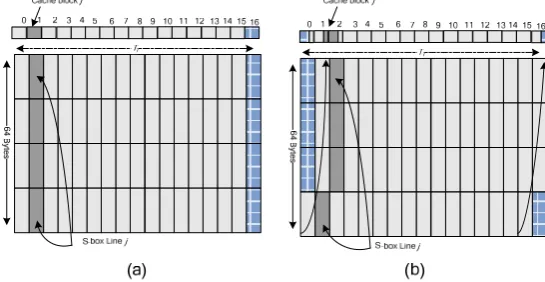
2.3 S-box alignment in Cache
Fig. 2. Alignment of S-box in Cache
2.4 Assumptions
(1) The Cache trace data is gathered through software simulations. We have simulated this process by augmenting the encryption code to keep a record of every S-box lookup access Cache hits and misses during the encryption operation.
(2) Unlike the cache trace attacks described by [7], [8] and [10], we do not assume the cache is completely clean prior to encryption.
(3) We do assume that any cache line loaded during encryption will remain there for the duration of the encryption.
3
Improved Attack on AES
3.1 AES Algorithm
A full description of the AES cipher is provided in [19], but below is a brief description of the cipher’s properties that are utilized in this study. This paper will focus exclusively on AES with 128-bit key.
close relationship with the encryption key, as long as we gather enough information of AES table lookup indices, one round expanded key can be calculated. Also, AES key expansion structure is explicitly chosen to be invertible given any 16 consecutive bytes of the expanded key. This is useful to an attacker in that recovery of any 16 bytes expand key is equivalent to the recovery of original key. So Cache, AES table lookup index, invertible key expansion structure provides good points for attacker.
3.2 Related Work
Bertoni et. al. [ ]6 showed that power profiles of the cache reveal secret information about the cryptographic algorithm being executed. Their attack was the first trace driven Cache attack simulated on a power analysis tool and targeted on a single table AES implementation. A first round cache trace attack[ ] 7 on the standard software implementation of AES was presented by O. Acıiçmez and extended to the second round[ ]8 by exploring Cache hit trace information, Joseph Bonneau[ ]9 extends this work to a final round attack by exploring Cache miss trace information, and recovers AES-128 bit key for about 31 samples. However, none of the published papers except [20] and [21] present the Cache timing attacks by utilizing Cache misalignment feature, which great improves the attack efficiency, but [20] and [21] are belonged to access driven type attack, in this Section, we present an improved trace driven Cache attack using this misalignment feature and Cache miss trace information.
3.3 First Round Attack
The AES we analyze is implemented in OpenSSL v. 0.9.8.(a). It employs 4 different lookup tables in the first 9 rounds, and a different one in the final round.
The AES first 9 rounds encryption principle is shown in equation (1). It’s clear to see that in each round, there are 16 S-box lookups to access Cache, and 4 S-box lookups for T0,T1,T2,T3 S-boxes.
1 1 1 1
0 1 2 3 0 0 1 5 2 10 3 15 0 1 2 3
1 1 1 1
4 5 6 7 0 4 1 9 2 14 3 3 4 5 6 7
1 1 1 1
8 9 10 11 0 8 1 13 2
( , , , ) [ ] [ ] [ ] [ ] ( , , , )
( , , , ) [ ] [ ] [ ] [ ] ( , , , )
( , , , ) [ ] [ ]
r r r r r r r r r r r r
r r r r r r r r r r r r
r r r r r r
x x x x T x T x T x T x K K K K
x x x x T x T x T x T x K K K K
x x x x T x T x T
+ + + +
+ + + +
+ + + +
= ⊕ ⊕ ⊕ ⊕
= ⊕ ⊕ ⊕ ⊕
= ⊕ ⊕ 2 3 7 8 9 10 11
1 1 1 1
12 13 14 15 0 12 1 1 2 6 3 11 12 13 14 15
[ ] [ ] ( , , , )
( , , , ) [ ] [ ] [ ] [ ] ( , , ,
r r r r r r
r r r r r r r r r r r r
x T x K K K K
)
x x x x+ + + + T x T x T x T x K K K K
⎧ ⎪ ⎪ ⎨
⊕ ⊕
⎪
⎪ = ⊕ ⊕ ⊕ ⊕
⎩
(1)
The first round S-box lookup can be expressed by equation (2),
0 0
i i i i i i
x = ⊕P K ⇒K = ⊕P x (2)
Pi and Ki are the ith byte of the plaintext and the initial key respectively, and i∈ [0,15]. The indices of the first 4 references to the first table T0 are:
0 0 0 0
0 0 0 4 4 4 8 8 8 12 12 12
The Cache hit and miss result of the second T0 lookup, i.e., the one with the index P4⊕K4, gives information about K0 and K4. This paper just explores the Cache miss information. If the second T0 lookup generates a Cache miss, it will hold:
0 0 4 4 4 4 { 0 0 }
P K P K K P P K
< ⊕ >≠< ⊕ >⇒ ≠ ⊕ < ⊕ > (4)
From Section 2,we know that a Cache miss means that the high 8-log2δbit of the second S-box lookup index is not equal to the high 8-log2δbit of the first S-box lookup index, so K4 is impossible to be equal to P4 Xored with δ candidates has the same high 8-log2δbit value. As to Athlon 3000+ CPU, the Cache line size is 64 bytes, the S-box element size is 4 bytes, δ=16.
If the Cache S-box is perfected aligned in the Cache, each S-box row 16 bytes can perfectly be mapped into one Cache line, which means that, every Cache miss block is related with 16 high 4-bit identical, and low 4-bit distinct bytes. If P0=0x61, P4=0x73, suppose K0=0x00, the second T0 Cache miss will eliminate 16 candidates whose high 4-bit identical, and low 4-bit distinct bytes as follows:
4 4 { 0 0 } 0 73 { 0 61 0 00} 0 73 { 0 61 }
0 73 {0 60,0 61,0 62,0 63,...0 6 } {0 13,0 12,0 11,0 10,...0 1 }
{0 10,0 11,0 12,0 13,...0 1 }
K P P K x x x x x
x x x x x x f
x x x x x c
x x x x x f
≠ ⊕ < ⊕ > ≠ ⊕ < > ⊕ ≠ ⊕ < >
≠ ⊕
≠ ≠
Using more Cache miss samples, if K0 is guessed right, as the correct K4 candidate and the other 15 candidates has the same high 4-bit value as K0 are impossible to be eliminated, so at most 16 K4 candidates can be obtained, but if K0 is guessed wrongly, all the K4 candidates can be eliminated.
However, if the Cache S-box is dis-aligned in the Cache, just like Fig .1, it depicts that the offset is 12. The second T0 Cache miss will eliminate 16 candidates as follows:
0 0 4 4 4 4 { 0 0 }
P K P K K P P K
< ⊕ >≠< ⊕ >⇒ ≠ ⊕ < ⊕ >
4 4 { 0 0 } 0 73 { 0 61 0 00} 0 73 { 0 61 }
0 73 {0 54,0 55,0 56,0 57,...0 5 ,0 60,0 61,0 62,0 63}
{0 27,0 26,0 25,0 24,...0 2 ,0 13,0 12,0 11,0 10} {0 10,0 11,0 12,0 13,0 24,0 25,0 2
K P P K x x x x x
x x x x x x f x x x x
x x x x x c x x x x
x x x x x x x
≠ ⊕ < ⊕ > ≠ ⊕ < > ⊕ ≠ ⊕ < >
≠ ⊕
≠
≠ 6,...0 2 }x f
It’s clear to see that we can eliminate 16 candidates, among of which both high 4-bit and low 4-4-bit are not identical, also 12 high 4-4-bit identical and 4 high 4-4-bit identical. Using more samples, if K0 is guessed correct we can eliminate all wrong 255 candidates, and obtain the unique K4, if K0 is guessed wrongly, we can eliminate all 256 wrong candidates and obtain an empty candidate set for K4.
3.4 Final Round Attack
In OpenSSL v. 0.9.8.(a) AES implementation, only T4 table is used in the final round. There are 16 S-box lookups T4 lookups to access Cache. The AES final round encryption principle is shown in equation (5):
0 1 2 3
4 5 6 7
8 9 10 11
9 10 9 10 9 10 9 10
4 0 0 4 5 1 4 10 2 4 15 3
9 10 9 10 9 10 9 10
4 4 4 4 9 5 4 14 6 4 3 7
9 10 9 10 9 10
4 8 8 4 13 9 4 2 10 4 7
( , , , ) ( [ ] , [ ] , [ ] , [ ] )
( , , , ) ( [ ] , [ ] , [ ] , [ ] )
( , , , ) ( [ ] , [ ] , [ ] , [
C C C C T x K T x K T x K T x K
C C C C T x K T x K T x K T x K
C C C C T x K T x K T x K T x
= ⊕ ⊕ ⊕ ⊕
= ⊕ ⊕ ⊕ ⊕
= ⊕ ⊕ ⊕
12 13 14 15
9 10
11
9 10 9 10 9 10 9 10
4 12 12 4 1 13 4 6 14 4 11 15
] )
( , , , ) ( [ ] , [ ] , [ ] , [ ] )
K
C C C C T x K T x K T x K T x K
⎧ ⎪ ⎪⎪ ⎨
⊕ ⎪
⎪
= ⊕ ⊕ ⊕ ⊕
⎪⎩
(5)
If the second T4 access generates a Cache miss, it will have:
1 10 1 10 10 1 10
4 [ 0 0 ] 4 [ 1 5 ] 5 1 { [4 4 [ 0 0 ]
T− C K T− C K K C T T− C K
< ⊕ >≠< ⊕ >⇒ ≠ ⊕ < ⊕ >]}
}
>
(6)
No matter is 16 consecutive high 4-bit identical, or 16 consecutive high 4-bit may not identical, after the function, they can be transferred to 16 non-consecutive and
1 10
4 0 0
{<T−[C ⊕K ]
4
T
divergent candidates which both high 4-bit and low 4-bit are not equal. As there are 16 table lookups to the same table T, so the eliminate efficiency are much better than first round’s 4 lookup of each T(i∈[0,3]). As to the 16 T table lookup, it can at most eliminate 240 wrong candidates ideally speaking, but as the precondition is to predict other 15 K bytes correctly.
4 i th
4
10
3.5 Experiment Results
0 16 32 48 64 80 96 112 128
0 30 40 50 60 70 80 90 100 110 120 150 200 250 300 500
Sample size
A
E
S K
ey
s
earch
in
g s
pace
ℓ=7
ℓ=5
ℓ=3
ℓ=1
ℓ=0
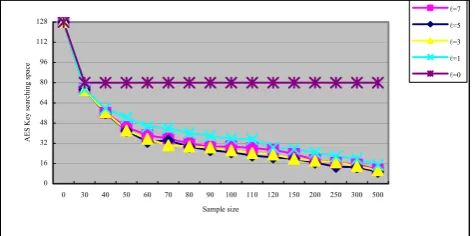
Fig. 3. Sample size and AES key searching space for different offset ℓ
0 10 20 30 40 50 60
8 16 32 64
Cache block size
A
tta
ck
in
g S
uc
ce
ss
fu
lly
S
am
ple
s s
iz
e
ℓ=0
ℓ=7
Fig. 4. Cache block size and successfully attacking sample size
During the final round attack on AES, the relations between Cache block element size and attacking successfully sample size for different offset ℓ is shown in Fig.4. It’s clear to see that no matter the AES S-box is perfectly aligned or misaligned, it’s possible to recover AES-128 key within very limited samples. And due to the perfect avalanche feature of AES S-box, the final round elimination effect is much better than the first round attack.
4
Improved Attack on CLAFIA
4.1 CLAFIA Algorithm
CLEFIA[ ]22 is a block cipher that has a block length of 128 bits and key lengths of 128, 192, and 256 bits. The data processing part is a four-branch generalized Feistel structure with two parallel F functions (F0, F1) per round. The number of respective rounds r for 128-bit, 192-bit and 256-bit keys are 18, 22 and 26. The encryption function ENCr generates 128-bit ciphertext from 128-bit plaintext, 2r 32-bit round keys (RK0(32), … ,RK2r−1(32)), and four 32-bit whitening keys (WK0,… ,WK3). The structure of ENCr is shown in Fig. 3. ENCr is defined as follows.
Step 1. T0 | T1 | T2 |T3← x{0,0} | (x{0,1} ⊕ WK0) | x{0,2} | (x{0,3} ⊕ WK1) Step 2. For i=0 to r − 1 do the following:
Step 2.1. T1← T1⊕ F0(RK2i, T0), T3← T3⊕ F1(RK2i+1, T2) Step 2.2. T0 | T1 | T2 | T3← T1 | T2 | T3 | T0
Step 3. C{r,0} |C{r,1} |C{r,2} |C{r,3}← T
3 | (T0⊕WK2) | T1 | (T2⊕WK3)
The two F functions, F0 and F1, have 32-bit data x and 32-bit key RK as input; they output the 32-bit data y. F0 is defined as follows.
F0:
Step 1. T ← RK ⊕ x
Step 2. Let T = T0(8) | T1(8) | T2(8) | T3(8)
T0←S0 (T0), T1← S1(T1), T2← S0(T2), T3← S1(T3) Step 3. Let y = y0(8) | y1(8) | y2(8) | y3(8)
t[y
0, y1, y2, y3] = M0 t[T0, T1, T2, T3]
F1 is defined by replacing the terms in F0 as follows: S0 is replaced with S1, S1 with S0, and M0 with M1. The structures of F0 and F1 are shown in Fig. 6. S0 and S1 are non-linear 8-bit S-boxes. The two matrices M0 and M1 are defined as
0
01 02 04 06 02 01 06 04 04 06 01 02 06 04 02 01
M
⎛ ⎞
⎜ ⎟
⎜ ⎟
= ⎜ ⎟
⎜ ⎟
⎜ ⎟
⎝ ⎠
1
01 08 02 0 08 01 0 02 02 0 01 08 0 02 08 01
a a M
a a
⎛ ⎞
⎜ ⎟
⎜ ⎟
= ⎜ ⎟
⎜ ⎟
⎜ ⎟
Fig. 5. CLEFIA encryption procedure
The key scheduling generates whitening keys WKi(0 ≤ i < 4), and round keys RKj(0 ≤ j < 2r). Let K be a k-bit key, where k is 128, 192 or 256. The key scheduling is divided into the following two sub-parts.
(1) Generating an intermediate key L from K. (2) Expanding K and L to generate WKi and RKj.
The key scheduling is explained according to the sub-parts.
For the 128-bit key scheduling, the 128-bit intermediate key L is generated by applying GFN4,12 which takes twenty-four 32-bit constant values CONi128 , 0≤i<24 as round keys and K = K0|K1|K2|K3 as an input. Then K and L are used to generate WKi(0≤i<4) and RKj(0≤j<36) in the following steps.
Step 1. L ← GFN4,12(CON0(128) , ...,CON23(128) ,K0, ...,K3) Step 2. WK0|WK1|WK2|WK3← K
Step 3. For i= 0 to 8 do the following:
(128) (128 ) (128) (128) 24 4 24 4 1 24 4 2 24 4 3
( i| i | i | i );L
T ← ⊕L CON + CON + + CON + + CON + + =
∑
( );Lif i is odd. T = ⊕T K RK; 4i|RK4 1i+ |RK4i+2|RK4i+3←T
The DoubleSwap function ∑: {0, 1}128→ {0, 1}128 (X
128→ Y128) is defined as follows:
Y = X[7 − 63] | X[121−127] | X[0 − 6] | X[64 − 120]
4.2 Related Work
machine. In earlier 2010, Chester et al. present an trace driven Cache timing attack[ ]11 on CLEFIA using the same technique as the basic trace driven attack of Bertoni et. al.[ ]6 by exploring the Cache hit trace information, successfully obtain the entire 128-bit key with 243 encryptions and requires around 1 hour and 30 minutes for the complete attack. In this Section, we present a new trace driven Cache timing attack on CLEFIA by exploring both the Cache miss trace information and S-box misalignment feature, our attack are much more efficient than[10] and [11], 1000 encryptions are enough to obtain 128-bit CLEFIA key within 3 seconds.
4.3 Attack Procedure
In order to obtain CLEFIA, the attacker needs to obtain RK0 and RK1 through first round attack, RK2 ⊕WK0 and RK3 ⊕WK1 through the second round attack, RK4 and RK5 through the third round attack, and using the key expansion algorithm to reduce the CLEFIA key search space from 2128 to 27.
4.3.1 Determining RK0 and RK1
Each CLEFIA round has 4 times S0 table lookups and 4 S1 table lookups, the 8 table lookup index is given by equation (7).
1,0 1,1
0,0 0 0,0 1,0 1 0,1
1,2 1,3
0,1 2 0,2 1,1 3 0,3
1,4 1,5
1,2 8 1,0 0,2 9 1,1
1,6 1,7
1,3 10 1,2 0,3 11 1,3
S S
S S
S S
S S
I P RK I P RK
I P RK I P RK
I P RK I P RK
I P RK I P RK
= ⊕ = ⊕
= ⊕ = ⊕
= ⊕ = ⊕
= ⊕ = ⊕
(7)
Note that , denotes the index to the i
,
r i Sj m
I th (0≤i) access to CLEFIA table lookups, and specifically the mth access to Sj table in round r.
When the mth (1≤m<4)access to Sj table generates a Cache miss, at most 16m key candidates can be eliminated. Using the attack models in Section 2.2, RK0,0,RK0,2,RK1,0,RK1,2 can be guessed in sequence together, RK0,1,RK0,3,RK1,1,RK1,3 can be guessed in sequence together.
4.3.2 Determining RK2 ⊕WK0 and RK3 ⊕WK1
2,8 2,9
0,4 4 0,0 2,0 0 0 (0 3) 0 1,4 5 0,1 2,1 0 0 (0 3) 1
2,10 2,11
0,5 6 0,2 2,0 0 0 (0 3) 2 1,5 7 0,3 2,3 0 0 (0 3) 3
2,12 1,6 12 ( ) ( , ) ( ) ( , ) ( ) ( , ) ( ) ( , ) ( S S S S S
I P WK RK F RK P I P WK RK F RK P
I P WK RK F RK P I P WK RK F RK P
I P W
− −
− −
= ⊕ ⊕ ⊕ = ⊕ ⊕ ⊕
= ⊕ ⊕ ⊕ = ⊕ ⊕ ⊕
= ⊕ 2,13
1,0 3,0 1 1 (8 11) 0 0,6 13 1,1 3,1 1 1 (8 11) 1
2,14 2,15
1,7 14 1,2 3,2 1 1 (8 11) 2 0,7 15 1,3 3,3 1 1 (8 11) 3
) ( , ) ( ) ( , )
( ) ( , ) ( ) ( , )
S
S S
K RK F RK P I P WK RK F RK P
I P WK RK F RK P I P WK RK F RK P
− −
− −
⊕ ⊕ = ⊕ ⊕ ⊕
= ⊕ ⊕ ⊕ = ⊕ ⊕ ⊕
(8)
When the mth (4≤m<8) access to Sj table generates a Cache miss, at most 16m key candidates can be eliminated. Using the attack model in Section 2.2, after analysis with 4 times S0 lookup,WK0,0⊕RK2,0,WK0,2⊕RK2,2,WK1,1⊕RK3,1,WK1,3⊕RK3,3 can be
guessed in sequence together, after analysis with 4 times S1 table lookup,WK0,1⊕RK2,1 ,WK0,3⊕RK2,3 ,WK1,0⊕RK3,0,WK1,2⊕RK3,2 can be guessed in
sequence together. Note that the key recovery efficiency of the second round attack is much better than the first round due to the increase of m.
4.3.3 Determining RK4 and RK5
As RK0, RK1, RK2⊕WK0, RK3⊕WK1 can be recovered in Section 4.3.1 and 4.3.2, the 8 table lookup index of the third CLEFIA round is given by equation (9):
3,16
0,8 0 0 0 (0 3) (4 7) 0 2 8 4,0
3,17
1,8 0 0 0 (0 3) (4 7) 0 2 9 4,1
3,18
0,9 0 0 0 (0 3) (4 7) 0 2 10 4,2
3,19
1,9 0 0 0 (0 3) (4 7)
( ( , ) , ) ( ( , ) , ) ( ( , ) , ) ( ( , ) S S S S
I F F RK P P WK RK P RK
I F F RK P P WK RK P RK
I F F RK P P WK RK P RK
I F F RK P P WK
− − − − − − − − = ⊕ ⊕ ⊕ ⊕ = ⊕ ⊕ ⊕ ⊕ = ⊕ ⊕ ⊕ ⊕
= ⊕ ⊕ 0 2 11 4,3
3,20
1,10 1 1 1 (8 11) (12 15) 1 3 0 5,0
3,21
0,10 1 1 1 (8 11) (12 15) 1 3 1 5,1
3,22
1,11 1 1 1 (8 11) (12 15) 1 3 2 5,2
3, 0,11 , ) ( ( , ) , ) ( ( , ) , ) ( ( , ) , ) S S S S
RK P RK
I F F RK P P WK RK P RK
I F F RK P P WK RK P RK
I F F RK P P WK RK P RK
I − − − − − − ⊕ ⊕ = ⊕ ⊕ ⊕ ⊕ = ⊕ ⊕ ⊕ ⊕ = ⊕ ⊕ ⊕ ⊕ 23
1 1( ( 1 (8 11), ) (12 15) 1, 3) 3 5,3
F F RK P− P− WK RK P RK
= ⊕ ⊕ ⊕ ⊕
(9)
When the mth (8≤m<12) access to Sj table generates a Cache miss, at most 16m key candidates can be eliminated. Using the attack model in Section 2.2, after analysis with 4 times S0 lookup,WK0,0⊕RK2,0,WK0,2⊕RK2,2,WK1,1⊕RK3,1,WK1,3⊕RK3,3 can be
guessed in sequence together, after analysis with 4 times S1 table lookup,WK0,1⊕RK2,1 ,WK0,3⊕RK2,3 ,WK1,0⊕RK3,0,WK1,2⊕RK3,2 can be guessed in
4.3.4 Recover Initial Key K
L0 CON0
T0
L1
RK0 RK1 RK2 RK3
7 57 57 7
57 77 57 CON1
T1
RK4 RK5 RK6 RK7
K T2
RK0 RK1
T0
CON0
L0
7 57 57 7
L1
CON1
T1
RK4 RK5 RK6 RK7
T2
WK0 WK1(0-24)
WK0⊕RK2 WK1⊕RK3
T0
RK0 RK1 RK2 RK3(0-24)
GFN4INV
K RK0 RK1
T0
RK4 RK5 RK6 RK7
T2
WK0⊕RK2 WK1⊕RK3
(a)Key Schedule
(b)First 3 Rounds Attack Result
(c)Deduce K K
GFN4 CON
CON
57 7
57 7
57
111
Fig. 6. CLEFIA-128 key recovery procedure
According to the key expansion algorithm, the initial key K can be obtained as shown as shown in Fig .7 and also as follows:
Step 1. Recover L0(0,63) by Xor between CON0 and (RK0,RK1)
Step 2. Recover L1(0,56) by the ReveseDoubleSwap function ∑-1(L0(0,63) Step 3. Recover T1(0,56) by Xor between CON1 and L1(0,56)
Step 4. Recover WK0,WK1(0,24) by Xor between T1(0,56) and (RK4,RK5)
Step 5. Recover RK2,RK3(0,24) by Xor between WK0,WK1(0,24) and (WK0⊕RK2, WK1⊕RK3)
Step 6. Recover 111bitof K by GFN4INV(RK0,RK1,RK2,RK3(0,24),CON)
4.5 Experiment Results
0 8 16 24 32 40 48 56 64
0 30 40 50 60 70 80 90 100 110 120 150 200 250 300 500 Sample size
F
ir
st
r
ound ke
y s
ea
rc
hi
ng s
pa
ce
ℓ=7
ℓ=5
ℓ=3
ℓ=1
ℓ=0
Fig. 7. Sample size and first round key searching space for different offset ℓ
Fig.8 depicts the relationship between sample size and first two rounds key searching space. It’s clear to see that, 100 and 200 samples are enough to reduce first two rounds key(RK0, RK1, RK2 ⊕WK0, RK3 ⊕WK1 ) searching space from 2128 to 216 and 210 respectively.
0 4 8 12 16
100 120 140 160 180 200 250 300 400 500 Sample size
Fi
rs
t t
w
o round ke
y s
ea
rc
h s
pac
e
ℓ=7
Fig. 8. Sample size and first two rounds key searching space for ℓ=7
0 2 4 6 8 10 12 14 16
100 150 200 220 240 260 280 300 350 400 450 500 Sample size
F
ir
st
t
hr
ee
r
ound ke
y s
ea
rc
h s
pa
ce
ℓ=7
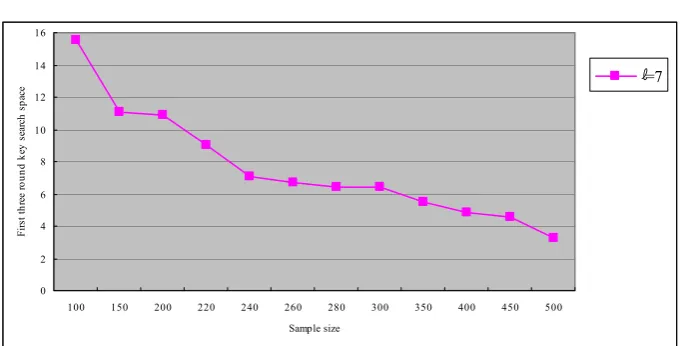
Fig. 9. Sample size and first three rounds key searching space for ℓ=7
As there is only one trace driven Cache attack on CLEFIA in [11]. Compared with [11], our attack has follow advantages:
(1) We do not assume the cache is completely clean prior to encryption, while attack in [11] assumes a completely “clean” cache prior to encryption. Attack in [11] means that no CLEFIA table entries are already loaded into cache. If an attacker can run code on the target machine between encryptions, this can be achieved by reading enough garbage data from memory. However, if the attacker cannot run code, there may be no way to ensure all CLEFIA tables are out of cache. A single table entry left in cache is enough to foil the attack in [11] if it assumes hits are generated only from the encryption itself, this is a significant limitation. This paper does not make a clean cache assumption and explores the effects of a partially pre-loaded cache. In particular, this means ignoring hits in the cache trace, since it is unknown whether or not they are “false hits” due to a pre-loaded cache.
(2)Attack in [11] is only applicable to the case that the S-box elements are perfect aligned case, while the attack in this paper are applicable to all the cases.
(3) Attack in [11] utilized the Cache hit information in the CLEFIA encryption to analyze the key, while the attack in this paper is focus on the Cache miss information, requires fewer samples than [11]. Compared with the 243 encryptions samples in [11], only 220 samples are needed in this paper to obtain full 128-bit CLEFIA key within seconds.
5
Conclusion
CLEFIA-128 key. Detailed analysis and experimentation have been performed on an Athlon 3000+ CPU single core processor to establish that the AES-128 and CLEFIA-128 key can be revealed.
Acknowledgements
The authors would like to thank the anonymous reviewers for many helpful comments and suggestions. The research presented in this paper was supported by National Natural Science Foundation of China (Grant No. 60772082) and the Natural Science Foundation of Hebei Province. China (Grant No. 08M010).
References
1. Paul C. Kocher. Timing Attacks on Implementations of Diffie-Hellman, RSA, DSS, and Other Systems. CRYPTO, volume 1109 of Lecture Notes in Computer Science, 1996, pages: 104– 113, Springer. (1996).
2. P. Kocher, J.Jaffe, B. Jun. Differential power analysis[A]. Proc. of Advances in Cryptology - CRYPTO '99 (M. Wiener, ed.), Springer-Verlag, 1999, LNCS 1666: 388-397.(1999)
3. J.J. Quisquater, D. Samyde. Electromagnetic analysis (EMA): measures and countermeasures for smart cards, Smart cards programming and security (e-Smart 2001), Lectures Notes in Computer Science, vol. 2140: 200-210. Springer. (2001)
4. Shamir, A. and Tromer, E. (2004). Acoustic cryptanalysis: On nosy people and noisy
machines. Rump session of EuroCrypt 2004. Available on line: http://www.wisdom.weizmann.ac.il/~tromer/acoustic/. (2004)
5. Boneh, D., DeMillo, R.A., Lipton, R.J. On the importance of checking cryptographic
protocols for faults. In: Fumy, W. (ed.) EUROCRYPT 1997. LNCS, vol. 1233, pp. 37–51. Springer, Heidelberg (1997).
6. Bertoni, G., Zaccaria, V., Breveglieri, L., Monchiero, M., Palermo, G.: AES Power Attack Based on Induced Cache Miss and Countermeasure. In: ITCC (1). pp. 586–591. IEEE Computer Society (2005)
7. Acıi¸cmez, O., C¸ etin Kaya Ko¸c: Trace-driven cache attacks on aes. Cryptology ePrint Archive, Report 2006/138, Available online at http://eprint.iacr.org/2006/138.pdf. (2006)
8. O. Acıiçmez, Ç.K. Koç, Trace driven cache attack on AES (short paper), in Proc. International Conference on Information and Communications Security (ICICS) 2006. LNCS, vol. 4296, pp. 112–121. Springer, Heidelberg. (2006)
9. Joseph Bonneau. Robust Final-Round Cache-Trace Attacks Against AES. Cryptology ePrint
Archive, Report 2006/374, Available online at http://eprint.iacr.org/2006/374.pdf. (2006)
11. Chester Rebeiro and Debdeep Mukhopadhyay. Differential Cache Trace Attack Against CLEFIA. Cryptology ePrint Archive, Report 2010/012, Available online at http://eprint.iacr.org/2010/012.pdf. (2010)
12. Dan Page. Theoretical use of cache memory as a cryptanalytic side-channel. Technical Report CSTR-02-003, Department of Computer Science, University of Bristol, 2002. 1-47.
13. Yukiyasu Tsunoo, Teruo Saito, Tomoyasu Suzaki, Maki Shigeri, and Hiroshi Miyauchi.
Cryptanalysis of DES Implemented on Computers with Cache. In: Proc. of the Cryptographic Hardware and Embedded Systems - CHES 2003. Lecture Notes in Computer Science 2779. Berlin: Springer-Verlag, 2003. 62-76.
14. Daniel J. Bernstein. Cache-timing attacks on AES, 2005. Available online at
http://cr.yp.to/papers.html\#cachetiming
15. Joseph Bonneau and Ilya Mironov. Cache-collision timing attacks against AES. In Louis
Goubin and Mitsuru Matsui eds. Cryptographic Hardware and Embedded Systems - CHES 2006. Lecture Notes in Computer Science 4249. Berlin: Springer-Verlag, 2006. 201-215. 16. Colin Percival. Cache missing for fun and profit. In: Proc. of the Technical BSD Conference
2005, Ottawa, 2005. 1-13.
17. Dag Arne Osvik, Adi Shamir, and Eran Tromer. Cache attacks and Countermeasures: the Case of AES. In: Proc. of the Topics in Cryptology - CT-RSA 2006. Lecture Notes in Computer Science 3860. Berlin: Springer-Verlag, 2006. 1-20.
18. Michael Neve and J.-P. Seifert, Advances on Access-Driven Cache Attacks on AES. In: Proc. of the Selected Areas in Cryptography - SAC2006. Lecture Notes in Computer Science. Berlin: Springer-Verlag, 2007. 147-162.
19. Joan Daemen and Vincent Rijmen. The design of Rijndael: AES—the advanced encryption
standard. Springer-Verlag, 2002.
20. Xin-jie ZHAO, Tao WANG, Dong MI. Robust First Two Rounds Access Driven Cache
Timing Attack on AES. In: Proc. of the International Conference on Computer Science and Software Engineering - CSSE 2008. Volume 3 December 2008:785-788.
21. Xin-jie ZHAO, Tao WANG, Yuan-yuan ZHENG. Cache Timing Attacks on Camellia Block
Cipher. Cryptology ePrint Archive, Report 2009/354, Available online at http://eprint.iacr.org/2009/354.pdf. (2009)