1693
EXPLORING THE GENERAL AWARENESS OF YOUNG USERS
ACCORDING TO AIDA MODEL APPLIED TO SOCIAL
NETWORKING ADS
1 OSAMA AHMED ABDELKADER, 2 MOHAMED HASSAN RABIE
1 Professor of Marketing, Department of Marketing, College of Applied Studies and Community Service,
Imam Abdulrahman Bin Faisal University, Saudi Arabia. E-mail: [email protected] (and) [email protected]
2 Assistant Professor of Marketing, Department of Marketing, College of Applied Studies and Community
Service, Imam Abdulrahman Bin Faisal University, Saudi Arabia.
E-mail: [email protected] (and) [email protected]
ABSTRACT
The information revolution represents an essential feature of the era that the world is currently living in. Social Networking is one of the important elements of this revolution. According to the literature review, previous studies focused on measuring of the model elements depending on specific perceptions toward determined ads. This study presents a contemporary application of AIDA model stages; Attention, Interest, Desire and Action on Social Networking Advertise (SNA), with the impact analysis of gender and SNA-image. This paper reviews the literature need of measuring the general awareness of SN users according to AIDA model applied to SNAs. Additionally, it explores the perceptions of youth who represent the largest sector among SN users, especially universities' students. A proposed questionnaire was contributed as a research instrument, the reliability and validity of the questionnaire were tested by a group of statistical measures included Cronbach's α and Exploratory Factor Analysis (EFA). Data were collected based on snowball sampling. There are 738 participants in this survey; 570 females and 168 males. After data collection, the goodness fit of the proposed model was examined and ensured by seven fit indicates. The main contributions of this study are exploring the general perception of young users about AIDA stages applying on SNA. Moreover, the influences of SNA-image and gender on AIDA stages were tested. These contributions enable marketers and advertisers to predict the effectiveness of their advertising campaigns through social networking sites (SNSs). Findings discussion, limitations of the study and suggested future researches were provided to extend the applicability of its contributions.
Keywords: Marketing, Social Networking Advertise, AIDA, Forecasting, Ad Effectiveness.
1. INTRODUCTION
The internet community has expanded to serve more than 3.8 billion active users (Alexa, 2017; Statista, 2017). The worldwide internet usage rate in 2017 reached: male 50.9% and female 44.9%. However, in developed countries: male 82.2% and female 79.9% and in developing countries: male 44.7% and female 37.5% (Statista, 2017). Over the last two decades, SNSs have
1694
Omoush et al., 2012). Day-by-day, people turn
into virtual world to become as a parallel entity that cannot be ignored (Mir, 2017). The most four popular SNSs are (Facebook, Instagram, Twitter and Snapchat). Up to September 2017, the number of worldwide-active-users for these SNSs (by millions) as follows: Facebook 2061, Instagram 700, Twitter 328 and Snapchat 255 (Statista, 2017). Nowadays marketers and advertisers give more interests for SNA (Mir, 2017; Jazayeri et al., 2017). Understandably, not all users who show ads make purchasing decisions. AIDA model is considered one of the most popular theories that explain the hierarchy of response stages towards ads (Sunuantari, 2017; Montazeribarforoushiet al., 2017; Su et al., 2016; Hassan et al., 2015), it is a great tool to measure the ad effectiveness (Ghirvu, 2013).
Literature still in need for more interest in forecasting of the estimated practical actions by audiences toward the various types of advertising; especially among universities' students who represent the largest sector of internet users (Brown et al., 2017; Srivastav & Gupta, 2017; Naqshbandi et al., 2017; Campisi et al., 2017; Al Omoush et al., 2012). The main advantage of the use of advertising through social networks that it reaches the largest number of consumers, whether in the local or international markets (Tucker,2014). This is happening through the adoption of modern technological tools and accessibility to large segments of society, especially young users who are characterized by the impact of a class used for social media (Livingstone & Brake, 2010). Majority of start-ups and small and medium companies primarily use social networks to advertise their products, because of social networks attract a large number of users and the Rapid propagation and low costs compared to the use of traditional methods of advertising (Pentina et al., 2012).
2. LITERATURE
2.1 The powerful of SNA
The main core of SNSs is to communicate with others; some of them focus on closed connections only (e.g. WhatsApp) (Gever, 2017; Su et al., 2016), however, the others are used in both opened/closed relations (e.g. Facebook, Twitter, Instagram and Snapchat). The agencies of mass-advertising prefer that approaches which enable them to use the second type of SNSs (Brown et al., 2017; Jazayeri et al., 2017). These
four SNSs were created at the following dates:
Facebook2004, Twitter2006, Instagram2010 and
Snapchat2013. However, users usually log on at a
particular-SNS for a specific - intentions, for
example; Facebook: for connecting with friends, Twitter: for presenting their short points of views, Instagram: for sharing photos and Snapchat: for publishing private short videos clips.
Recent time, governments, companies, organizations or even individuals are abler to study the public opinion towards specific issues through SNSs (Johansson, 2017). In the time that traditional methods have limited opportunities of spreading, SNAs population are growing continuously with unlimited chances of access to larger numbers of users (Gever, 2017; Bodroža & Jovanović, 2016). The power of SNA is not only the widespread of its accessibility but also, its reach to targeted and selective audiences (Jazayeri et al., 2017). SNA enables advertiser to choose the suitable time, for selective users, through the right time (Johansson, 2017). Young people represent the largest segment of SNSs users. Furthermore, they spend more online-time than others. Therefore, most previous studies focused on this category (Brown et al., 2017; Srivastav & Gupta, 2017; Naqshbandi et al., 2017; Campisi et al., 2017; Al Omoush et al., 2012). Gender differences were reported by a set of previous studies in the context of SNSs: how long time they use? and what are issues they interested in?
2.2 AIDA model and measuring of SNA-effectiveness
1695
number of individuals who exposed to ad in this
stage represents the highest ratio of response among the other stages. Interest: is the first
affective stage (Stepaniuk, 2017;
Montazeribarforoushi et al., 2017; Su et al., 2016), it means paying more attention to get additional information about marketed products, prices and many other details.
Interest refers to collect more information about product features and benefits. Desire: represents the second affective stage (Stepaniuk, 2017; Montazeribarforoushi et al., 2017; Su et al., 2016), it indicates to the extent of the individuals' intentions and decisions to purchase the advertised products.
Desire means persuading customers that product fulfils their needs to take their end decision of purchasing. Finally, action: represents the behavioral stage (Su et al., 2016), it refers to the practical steps to buy products.
Furthermore, action means let customers end their final process of purchasing. Usually, the rates of responses decrease gradually during the four stages of AIDA model. The effective ad is that one which minimizes the gap between attention and action. Stepaniuk (2017) estimated the weights of AIDA stages towards some selective ads; attention 74%, interest 12%, desire 5% and action 9%. But, the estimated weights of that study related to a specific group of adverts through blogs only, not to measure the audience's response in general. Different weights were reported by Enjolras and others (2015) through an experiment processed before/after a limited group of traditional ads; 65%, 32%, 25% and 19% respectively, while the rates before their experiment were 45%, 8%, 5% and 8% respectively.
In fact, AIDA model was addressed through previous marketing studies from various aspects. A set of them focused on the customer perspective and how were their responses? while others focused on the marketer perspective and how were their managing? (e.g. Stepaniuk, 2017; Enjolras et al., 2015; Hassan et al., 2015; Petit et al., 2011; Lin & Huang, 2006). All these previous literatures based on studying audience's responses toward a limited set of traditional advertisements, while marketing literature is in a real need to more studies discuss the expected weights of AIDA stages applying on contemporary media for
different cultures, products, services and demographic segmentations.
2.3 The impacts of SNA-image and gender The image refers to the picture of something in someone's mind, it means the perceived features from the people perspective (Mir, 2017; Liaw et al., 2017; Pornsakulvanich, 2017). Therefore, SNA-image refers to the picture of SNA in the users' mind (Mir, 2017; Dehghani & Tumer, 2015). Many previous researchers gave high interesting to study the relation between image and purchase decision (Pornsakulvanich, 2017; Mir, 2017; Liaw et al., 2017; Dehghani & Tumer, 2015). Buyers may have positive or negative image about particular-products, that influences purchasing decisions (Liaw et al., 2017; Dehghani & Tumer, 2015). Therefore, the impact of SNA-image on AIDA model stages should be studied to answer the question: does SNA-image influence purchasing decisions? Many previous studies confirmed that there are gender differences in a lot of applied areas. On the context of social networking through internet, females and males are different in the length of a time they spend on the internet or social media. Furthermore, there are differences between women and men in the areas of interest when they utilize SNSs.
Marketers and advertisers need more studies covering the gender influences on AIDA stages of SNA in general, not for a limited group of products, services or advertisements. So, the research gap is many studies adopted AIDA model on traditional advertising. To the best of our knowledge, there is no many studies measured the general awareness of social network users and there are very little studies investigated young users' awareness but with different models and theories rather than AIDA model. Existing research, extracting from the previous studies on this study variable subset assortment, has not yet done this in a purpose to massive this study terminology.
2.4 Research questions
This study aims to answer three main questions about SNAs from the perspective of universities students' users, as follows:
What is the estimated measure of their
general perception about AIDA-SNAs stages?
Is there gender difference influence
1696
To what extent the SNA-image impact on
the AIDA-SNA?
2.5 Research hypotheses
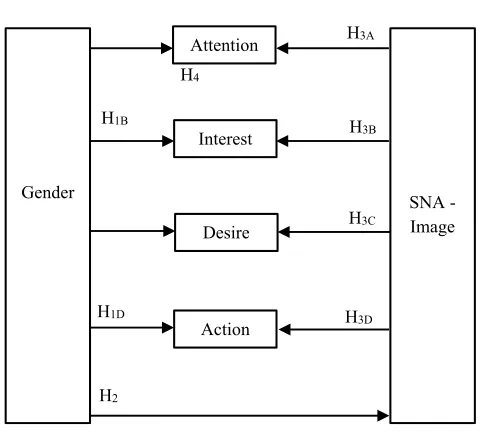
Fig. 1 shows hypotheses structure of the proposed model, which is used to answer the research questions. The study aims to present significant contributions to literature by estimating the influence of AIDA elements according to the general perception of youth, applying on SNAs. The hypotheses are categorized in three groups as follows:
Group 1, (Gender effect → AIDA
elements/SNA-image):
H1a: Gender has a significant impact on Attention towards SNA.
H1b: Gender has a significant impact on Interest towards SNA.
H1c: Gender has a significant impact on Desire towards SNA.
H1d: Gender has a significant impact on Action towards SNA.
H2: Gender has a significant impact on Action
towards SNA-image.
Group 2, (SNA-image → AIDA elements):
H3a: SNA-image has a significant impact on Attention towards SNA.
H3b: SNA-image has a significant impact on Interest towards SNA.
H3c: SNA-image has a significant impact on Desire towards SNA.
H3d: SNA-image has a significant impact on Action towards SNA.
Group 3, (Differences among users' awareness toward AIDA elements):
H4: There are no significant differences in the
general awareness among young users about the Attention toward SNA.
H5: There are no significant differences in the
general awareness among young users about the Interest toward SNA.
H6: There are no significant differences in the
general awareness among young users about the Desire toward SNA.
H7: There are no significant differences in the
general awareness among young users about the Action toward SNA.
3. METHOD
3.1 Participants
There are 738 universities' students participated in this study, aged 18-24. This category of age represents the largest segment of SNSs' users (Brown et al., 2017; Srivastav & Gupta, 2017; Naqshbandi et al., 2017; Campisi et al., 2017; Al Omoush et al., 2012). Females are 570 (77.2%) and males are 168 (22.8%).
3.2 Instrument Building and Validity
The instrument of this study is questionnaire based. Three stages were followed to build the research instrument to ensure its validity. First, previous studies were reviewed to explore the main constructs and items. Second, the first form of the questionnaire was reviewed by 14 experts belonging to related fields. Third, after data collecting, Exploratory Factor Analysis (EFA) deleted 8 items of the questionnaire and grouped the other 12 items in 5 constructs. Appendix 1 shows the confirmed questionnaire with referring to the deleted items. Validated form includes: Attention (4 items), Interest (2 items), Desire (2 items), Action (2 items) and SNA-image (2 items). All items were designed on 5 points of Likert Scale (1= Strongly disagree to 5= Strongly agree).
3.3 Data Collection
Data was collected electronically through an e-questionnaire built on Google-form. The link of the e-form was available for two months
H2 H1D
H1B
H4
H3B H3A
H3D H3C
SNA -Image Attention
Interest
Desire
Action
Fig. 1. Research hypotheses structure of AIDA-SNA model
[image:4.612.308.548.93.313.2]1697
through October/November 2017. The applications
of SPSS22 and AMOS22 were used to perform the
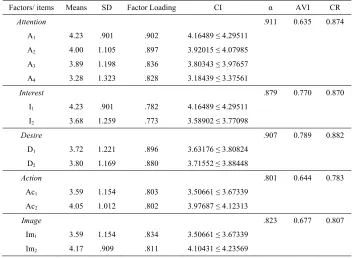
statistical analysis of this study. Table 1 shows the descriptive statistics and the result of EFA. The total value of reliability test Cronbach's α is .923, the range of α values for items between .801 and .911. All α values exceeded the recommended
value (≥.7), which indicates that the scale is
well-constructed. Furthermore, table 1 shows the following significant values; Means, Standard Deviation SD, Confidence Interval CI, Average
Variance Extracted AVE (≥.5) and Composite
Reliability CR (≥.7) that confirmed the instrument
[image:5.612.129.481.220.478.2]reliability and the constructs validity.
Table 1: Descriptive statistics, construct validity and reliability estimates.
Factors/ items Means SD Factor Loading CI α AVI CR
Attention .911 0.635 0.874
A1 4.23 .901 .902 4.16489 ≤ 4.29511
A2 4.00 1.105 .897 3.92015 ≤ 4.07985
A3 3.89 1.198 .836 3.80343 ≤ 3.97657
A4 3.28 1.323 .828 3.18439 ≤ 3.37561
Interest .879 0.770 0.870
I1 4.23 .901 .782 4.16489 ≤ 4.29511
I2 3.68 1.259 .773 3.58902 ≤ 3.77098
Desire .907 0.789 0.882
D1 3.72 1.221 .896 3.63176 ≤ 3.80824
D2 3.80 1.169 .880 3.71552 ≤ 3.88448
Action .801 0.644 0.783
Ac1 3.59 1.154 .803 3.50661 ≤ 3.67339
Ac2 4.05 1.012 .802 3.97687 ≤ 4.12313
Image .823 0.677 0.807
Im1 3.59 1.154 .834 3.50661 ≤ 3.67339
Im2 4.17 .909 .811 4.10431 ≤ 4.23569
4. RESULTS
4.1 Confirmatory Factor Analysis CFA
CFA was used in current study to test the
validity of the proposed research model. Table 2 shows the fit statistics and recommended value for each one. It includes; Chi-square (X2)/df (≤ 3.0),
Normal Fit Index NFI (≥.9, Comparative Fit Index
CFI (≥.9), Goodness-of-Fit Index GFI (≥.9),
Adjusted Goodness-of-Fit Index AGFI (≥.8),
Standard Root Mean Square Residual SRMR
(≤.08), Root Mean Square Error of Approximation
RMSEA (≤.08), depending on the recommended
values; the construct validity of the study model was confirmed.
Table 2: Fit indicates for the measurement model.
Fit Statistics Study Model Recommended Value
X2/df 1.678 ≤3.0
NFI .963 ≥0.9
CFI .974 ≥0.9
GFI .938 ≥0.9
AGFI .918 ≥0.8
SRMR .034 ≤0.08
[image:5.612.159.456.605.719.2]1698
4.2 Hypotheses Test Results
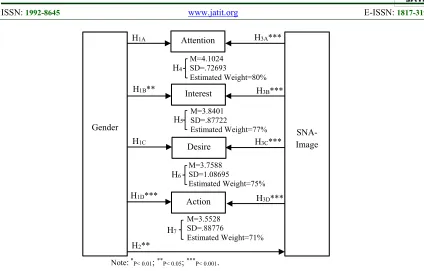
Fig. 3 shows the results of tested hypotheses according to the proposed model. It explains the significant impact of gender factor on Interest, Action and SNA-image. The model confirms that impact of gender on Attention and Desire is not significant at any level of
significance (.05, .01 or .001). Moreover, it confirms
the significant influence of SNA-image on Attention, Interest, Desire and Action. Depending on the valid items of the research instrument, results reports the following weights of the
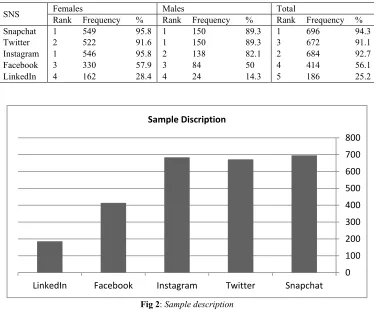
proposed model SNA-AIDA stages: Attention 80%, Interest 77%, Desire 75% and Action 71%. Furthermore, the statistical tests confirmed the significant differences among the four stages of AIDA-SNA model. Table 3 shows the Sample description of having active accounts on SNSs according to gender. Around 94.3% of participants have an active account on Snapchat, it represents the most one for both females and males. Furthermore, fig.2 shows the rank of each SNS for females and males according to the sample description.
Table 3: Sample description about having accounts on SNSs.
Total Males
Females
SNS Rank Frequency % Rank Frequency % Rank Frequency %
94.3 696
1 89.3 150
1 95.8 549
1 Snapchat
91.1 672
3 89.3 150
1 91.6 522
2 Twitter
92.7 684
2 82.1 138
2 95.8 546
1 Instagram
56.1 414
4 50 84
3 57.9 330
3 Facebook
25.2 186
5 14.3 24
4 28.4 162
4 LinkedIn
Fig 2: Sample description
0 100 200 300 400 500 600 700 800
Snapchat Twitter
Instagram Facebook
1699
5. DISCUSSION
The results of this study can be categorized in three main categories. First, set of them are combatable with the findings of some previous studies about the significant influence of the gender factor on the using of SNSs. Many studies confirmed the gender differences between females and males in optimistic about purchasing decision through mobiles or high technologies (Kotze et al., 2016; Goh and Sun, 2014), Commercial experiments on SNSs (Lin et al., 2017; Cordero-Gutierrez et al., 2016) and the practicing of online shopping (Liu et al., 2013). Second, another group of results did not support the same findings of some other previous studies.
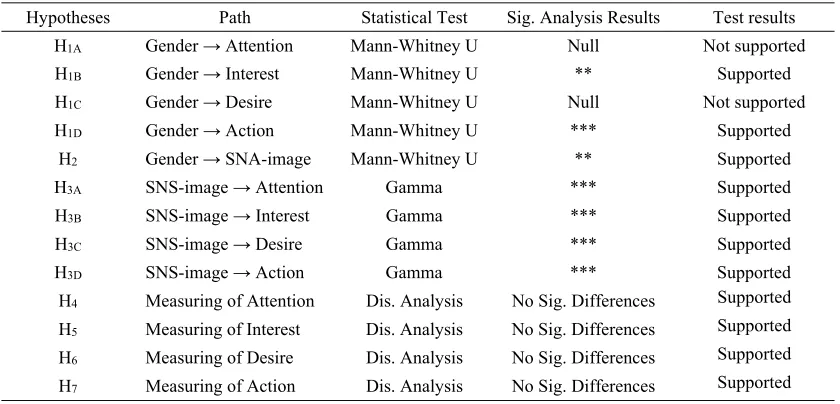
This study reported that males favored females at Interest and Action, while a different result was reported in some other studies (Lin et al., 2017; Cordero-Gutierrez et al., 2016; Kotze et al., 2016; Goh and Sun, 2014; Liu et al., 2013). Third category of this study results are presented to support academics, planners, advertisers and marketers. This category includes two main contributions; the proposed model of AIDA-SNA and the significance test among the variables of the hypotheses structure applied on universities' students. The analysis results of the research hypotheses were summarized at table 4, with referring to the used statistical test for each
hypothesis. All of them were supported except H1A
and H1C, which were rejected. The study
confirmed that there is a significant influence of gender factor on SNA-image, Interest and Action, but it did not report the significance for Attention and Desire. Moreover, the study indicated the significant effect of SNA-image on Attention, Interest, Desire and Action.
On the other hand, the findings supported the hierarchical response of AIDA model applying on SNAs. Statistical analysis shows high effect of SNSs on the universities' students, with low gap between the first and the last stages; Attention and Action (80%-71%). Stepaniuk (2017) reported (74%-9%), while Enjolras with some other authors
(2015) indicated (45%-8%) before their
experiment of promotion and (65%-19%) after the experiment. Advertising agencies who target students of universities should care about the findings of this study about the preferred SNSs among them, and the differences between females and males in using SNSs. While Facebook represents the largest platform on the worldwide level 67.8% (Chua, 2017; Bodroža & Jovanović, 2016; Al Omoush et al., 2012), (Salem, 2017; Alexa, 2017; Statista, 2017), the results of this study indicated that Snapchat is the first favored SNS among participants represented 94.3%. Moreover, Snapchat, Instagram and Twitter are the most preferred SNSs among the participant's sample, as shown at table 3.
H7 H1C H1A
H6 H5
H2** H1D***
H1B** H4
M=4.1024 SD=.72693
Estimated Weight=80%
M=3.5528 SD=.88776
Estimated Weight=71% M=3.7588
SD=1.08695
Estimated Weight=75% M=3.8401
SD=.87722
Estimated Weight=77%
H3B*** H3A***
H3D*** H3C***
SNA-Image Attention
Interest
Desire
Action
Note: *P< 0.01; **P< 0.05; ***P< 0.001.
Fig. 3. Results of hypotheses testing of AIDA-SNA model
[image:7.612.89.513.66.337.2]1700
[image:8.612.97.517.119.321.2]
Table 4: Hypotheses Test Results.
Hypotheses Path Statistical Test Sig. Analysis Results Test results H1A Gender → Attention Mann-Whitney U Null Not supported
1B H
Gender → Interest Mann-Whitney U ** Supported
1C H
Gender → Desire Mann-Whitney U Null Not supported
1D H
Gender → Action Mann-Whitney U *** Supported H2 Gender → SNA-image Mann-Whitney U ** Supported H3A SNS-image → Attention Gamma *** Supported
3B H
SNS-image → Interest Gamma *** Supported
3C H
SNS-image → Desire Gamma *** Supported
3D H
SNS-image → Action Gamma *** Supported
H4 Measuring of Attention Dis. Analysis No Sig. Differences Supported H5 Measuring of Interest Dis. Analysis No Sig. Differences Supported H6 Measuring of Desire Dis. Analysis No Sig. Differences Supported H7 Measuring of Action Dis. Analysis No Sig. Differences Supported Note: *
P< 0.01; **P< 0.05; ***P< 0.001
6. CONCLUSION
The main objective of this study is to present a proposed model for supporting marketers and advertisers in the forecasting of the final response of their audience on SNAs. The study introduced a validated and detailed model to explore the weights of AIDA-SNA stages from the general perspective of SNSs-users, not toward a specific set of ads. Additionally, the influence of SNA-image and gender on AIDA-SNA stages was examined. Academics, marketers, advertisers and advertising agencies can benefit from this study finding in implementing/evaluating of ads effectiveness. Future researchers can generalize the contributions of current study through cross-cultural and cross-national studies.
REFERENCES
[1] Alexa, (2017). Alexa: An amazon.com
company, http://www.alexa.com, 8:00PM, 14/02/2018.
[2] Al Omoush, K. S., Yaseen, S. G., &
Alma’Aitah, M. A. (2012). The impact of Arab cultural values on online social
networking: The case of Facebook. Computers
in Human Behavior, 28(6), 2387-2399.
[3] Bodroža, B., & Jovanović, T. (2016).
Validation of the new scale for measuring behaviors of Facebook users: Psycho-Social Aspects of Facebook Use (PSAFU). Computers in Human Behavior, 54, 425-435.
[4] Brown, G., Michinov, N., & Manago, A. M.
(2017). Private message me s' il vous plait: Preferences for personal and mass personal
communications on Facebook among
American and French students. Computers in
Human Behavior, 70, 143-152.
[5] Campisi, J., May, J., Burch, K., Larson, K.,
Doscher, J., Doherty, S., ... & Gahan, A. (2017). Anxiety-inducing Facebook behavior is associated with higher rates of upper respiratory infection in college-aged users. Computers in Human Behavior, 76, 211-217.
[6] Chua, Y. P., & Chua, Y. P. (2017). Do
computer-mediated communication skill,
knowledge and motivation mediate the relationships between personality traits and
attitude toward Facebook? Computers in
Human Behavior, 70, 51-59.
[7] Cordero-Gutiérrez, R., Cordero-Gutiérrez, R.,
Santos-Requejo, L., & Santos-Requejo, L. (2016). attention to participate in online commercial experiments by social network’s users: Differences in gender and age.
Management Research Review, 39(4),
378-398.
[8] Dehghani, M., & Tumer, M. (2015). A
research on effectiveness of Facebook advertising on enhancing purchase intention
of consumers. Computers in Human Behavior,
49, 597-600.
[9] Enjolras, M., Galvez, D., Camargo, M., &
pre-1701
diagnosis through the use of the AIDA
approach. World Patent Information, 40,
21-29.
[10]Gever, C. V. (2017). Testing the AIDA Model
Hypothesis Vis-À-Vis Subscribers’ Response
to Unsolicited SMS Adverts. International
Journal of Communication, 20(1).
[11]Ghirvu, A. I. (2013). The AIDA model for
advergames. The USV Annals of Economics
and Public Administration, 13(1 (17)), 90-98.
[12]Goh, T. T., & Sun, S. (2014). Exploring
gender differences in Islamic mobile banking
acceptance. Electronic Commerce Research,
14(4), 435-458.
[13]Hassan, S., Nadzim, S. Z. A., & Shiratuddin,
N. (2015). Strategic use of social media for small business based on the AIDA model.
Procedia-Social and Behavioral Sciences,
172, 262-269.
[14]Jazayeri, Z., & Arbatani, T. R. (2017).
Discerning and Ranking Advertising Media in Order to Have Effective Relationship with
Customers-Case Study: In Export
Development Bank of Iran. Journal of
Administrative Management, Education and Training, 13(2), 119-134.
[15]Johansson, S. (2017). May I Interest You in a
Freshly Brewed Presidential Candidate? An Analysis of Presidential Campaign Television Advertisements in the United States, 1952-2016.
[16]Kotzé, T. G., Anderson, O., & Summerfield,
K. (2016). Technophobia: Gender differences in the adoption of high-technology consumer
products. South African Journal of Business
Management, 47(1), 21-28.
[17]Liaw, S. Y., & Le, T. M. (2017). Comparing
Mediation Effect of Functional and Emotional Value in the Relationship between Pros of Applying Big Data Analytics and Consumers’
Responses. International Journal of
Marketing Studies, 9(4), 66.
[18]Lin, X., Featherman, M., & Sarker, S. (2017).
Understanding factors affecting users’ social networking site continuance: A gender
difference perspective. Information &
Management, 54(3), 383-395.
[19]Lin, Y. S., & Huang, J. Y. (2006). Internet blogs as a tourism marketing medium: A case
study. Journal of Business Research, 59(10),
1201-1205.
[20]Livingstone, S., & Brake, D. R. (2010). On
the rapid rise of social networking sites: New findings and policy implications. Children & society, 24(1), 75-83.
[21]Liu, W. Y., Lin, C. C., Lee, Y. S., & Deng, D.
J. (2013). On gender differences in consumer behavior for online financial transaction of
cosmetics. Mathematical and Computer
Modelling, 58(1), 238-253.
[22]Montazeribarforoushi, S., Keshavarzsaleh, A.,
& Ramsøy, T. Z. (2017). On the hierarchy of choice: An applied neuroscience perspective
on the AIDA model. Cogent Psychology, 4(1),
1363343.
[23]Mir, I. A. (2017). Users on Social Network
Sites—Flight from Reality and Its Effects on Acceptance of Social Network Advertising: A
Gratification Perspective. Journal of Creative
Communications, 12(2), 98-121.
[24]Naqshbandi, M. M., Ainin, S., Jaafar, N. I., &
Shuib, N. L. M. (2017). To Facebook or to Face Book? An investigation of how academic performance of different personalities is affected through the intervention of Facebook
usage. Computers in Human Behavior, 75,
167-176.
[25]Pentina, I., Koh, A. C., & Le, T. T. (2012). Adoption of social networks marketing by SMEs: exploring the role of social influences
and experience in technology
acceptance. International Journal of Internet Marketing and Advertising, 7(1), 65-82.
[26]Petit, C., Dubois, C., Harand, A., & Quazzotti,
S. (2011). A new, innovative and marketable IP diagnosis to evaluate, qualify and find insights for the development of SMEs IP practices and use, based on the AIDA
approach. World Patent Information, 33(1),
42-50.
[27]Pornsakulvanich, V. (2017). Personality,
attitudes, social influences, and social networking site usage predicting online social
support. Computers in Human Behavior, 76,
255-262.
[28]Salem, F. (2017). Social Media and the
Internet of Things towards Data-Driven Policymaking in the Arab World: Potential, Limits and Concerns.
[29]Srivastav, G., & Gupta, A. (2017). Going
Private in Public: A study on shift in
behavioral trend using Facebook. Computers
in Human Behavior, 73, 55-63.
[30]
Statista, (2017). The Statistics Portal:Statistics and Studies from more than 18000 sources, http://www.statista.com.
[31]Stepaniuk, K. (2017). Blog content
management in shaping pro recreational
attitudes. Journal of Business Economics and
1702
[32]Sunuantari, M. (2017). Tourism
Communication in Community Based
Tourism in Ding Community, Central Java,
Indonesia. Binus Business Review, 8(2),
149-156.
[33]Su, K. W., Huang, P. H., Chen, P. H., & Li, Y.
T. (2016). The impact of formats and interactive modes on the effectiveness of
mobile advertisements. Journal of Ambient
Intelligence and Humanized Computing, 7(6), 817-827.
[34]Tucker, C. E. (2014). Social networks,
1703
APPENDIXES:
Appendix 1. : Factors/items of AIDA-SNA model and the deleted items after EFA.
Factors and (confirmed/deleted items) Factor Loading Reference
Attention: The following items attract me to SNAs: (.911)
A1. Copy Text .902 Author
A2. Videos .897 Author
A3. Photos .836 Author
A4. Design .828 Author
A5. Colors Deleted Author
A6. Headlines Deleted Author
Interest: SNAs drive me to follow with interest the following: (.879)
I1. Product .782 (Hassan et al., 2015)
I2. Company .773 (Hassan et al., 2015)
I3. Prices Deleted (Hassan et al., 2015)
I4. Payment Methods Deleted (Hassan et al., 2015) Desire: SNAs influence my ……… (.907)
D1. Intention of buying. .896 Author
D2. Purchasing Decision. .880 Author
Action: SNAs always impact me to the following: (.801)
Ac1. Visit the company location for buying. .803 (Lin & Huang, 2006) Ac2. Visit the company website for online purchasing. .802 Author
Ac3.Say Words-Of-Mouth about products. Deleted (Liaw et al., 2017) Ac4.Call the company for making purchasing order. Deleted Author
Image: I think that ads have the following features: (.823)
Im1. Useful. .834 Author
Im2. Trusted .811 Author
Im3. Required Deleted Author