Multiple Defoliation Effects on Herbage Yield,
Vigor, and Total Nonstructural Carbohydrates
of Five Range Species
M. BUWAI AND M. J. TRLICA
Highlight: Western wheatgrass (Agropyron smithii), blue grama (Bouteloua gracilis), and fourwing saltbush (Atriplex canescens) were subjected to multiple defoliations at moderate and heavy in- tensities during a a-year period. Most heavy defoliation treatments drastically reduced herbage yield, vigor, and total nonstructural carbohydrates (TNC) of western wheatgrass. Multiple defoli- ations were detrimental to vigor and herbage yield of blue grama; however, defoliation treatments did not detrimentally affect root TNC levels. All defoliation treatments severely reduced the num- ber of seedstalks, live crown cover, and TNC of fourwing saltbush, but seedstalk length and live crown diameter were less affected by the defoliation treatments. Both fringed sagewort (Artemisiufrigi- &2) and antelope bitterbrush (Purshia tridbntata) subjected to two moderate defoliations during quiescence and rapid growth (or flowers developing) remained in fair to good vigor at the end of the growing season. However, both species were detrimentally af- fected if utilized during the later part of the growing season. De- foliation effects were generally more severe when plants were de- foliated at a heavy intensity than when defoliated at a moderate intensity during the same phenological stages. Five- and six- pasture rest-rotation grazing systems were proposed to ensure that grazed plants would receive rest following critical late summer foliage utilization.
Factors that reduce the capacity of a plant to manufacture food will cause a depletion of stored total nonstructural carbo- hydrates (TNC) and might lead to changes in range condition. Frequent and severe clippings or grazing depletes TNC and lowers herbage yield and plant vigor. The season of grazing or clipping often influences the success or failure of a grazing practice. Therefore, it is necessary to know the period when key forage species are less susceptible to foliage removal (Heady 1974). This study was undertaken to determine the effects of tiequency, intensity, and season of defoliations on herbage yield, vigor, and TNC levels of blue grarna (Bouteloua gracilis), western wheatgrass (Agropyron smithii), fourwing saltbush (Atriplex canescens), antelope bitterbrush (Purshia tri- dentata), and fringed sagewort (Artemisia frigida).
Literature Review
Defoliation of plants during susceptible periods can reduce the ability of plants to maintain growth and vigor. Intensive
Authors at the time of the research were graduate research assistant and associate professor, Range Science Department, Colorado State University, Fort Collins 80523. Buwai is now with the Ministry of Agriculture and Natural Resources, Sokoto, Nigeria. The study is a cooperative research project between Bureau of Land Management and CoZodo State University Experiment Station. Experiment Station Journal Paper No.
Manuscript received July 12, 1976.
defoliation often lowers the TNC levels in the storage organs (Cook 1966; Everson 1966; Willard and McKell 1973; Perry and Chapman 1974; Owensby et al. 1974). Trlica and Cook (197 1) reported that TNC levels were a good indicator of the effects of clipping on many desert plants.
The time of defoliation can significantly influence the severi- ty of a clipping treatment. Trlica and Cook ( 197 1) found that salt desert plants defoliated late in the spring and at a near maturity phenological stage made little regrowth and stored little TNC. Cook ( 197 1) stated that defoliation was more detrimental in the late spring or mid-summer than in the fall, winter, or early spring for several salt desert species. McCarty and Price (1942) reported that defoliation was most detrimental from flowerstalk formation through the seed ripening stage for some mountain
forage species. Laycock and Conrad (1969) reported that
defoliation of tall bluebell (Mertensia arizonica) was most detri- mental during the flowering and fruit developing stages. Currie (1970) found that spring or spring and fall grazing of a seeded
crested wheatgrass (Agropyron cristatum) pasture caused
greater invasion by other species than did fall grazing. Frequent clippings of blue grama greatly reduced herbage yields (Reed and Dwyer 197 1). Dwyer et al. ( 1963) reported that frequent defoliations greatly reduced herbage yields of several Oklahoma range grasses. Holscher (1945) found fre- quent, intensive defoliations reduced herbage yields of blue grama and western wheatgrass.
Methods and Procedures
The study was carried out from 1972 through 1974 at two locations in northern Colorado: the Central Plains Experiment Range (CPER), located about 50 km northeast of Fort Collins, and the Maybe11 location, about 6 km west of Maybell. The CPER location is typical of the shortgrass type of the Central Great Plains region. The Maybe11 location is in the intermountain sandhills region of northwestern Colorado. This location is characterized by gently rolling hills with occasional steeper slopes. The climate at both study locations is semi- arid with warm summers and cold winters. A more detailed site description was given by Trlica et al. (1977).
Three exclosures were built in the fall of 1972 at the CPER to exclude livestock grazing. Blue grama, western wheatgrass, and four- wing saltbush included within these exclosures were clipped from the fall of 1972 through the late summer of 1974. Antelope bitterbrush and tinged sagewort were enclosed within three exclosures that were built in the spring of 1973 at the Maybe11 location. Clipping of these two species was from the fall of 1973 through the late summer of 1974. The current photosynthetic tissues of the five species were clipped at two intensities, heavy (90% of the current year’s growth removed) and moderate (60% of the current year’s growth removed). Small twigs
supporting the foliage of antelope bitterbrush and fourwing saltbush were also clipped.
Four replications at each exclosure and for both clipping intensities were used for each defoliation treatment of the three species at the CPER location. A replication was defined for the two grasses, blue grama and western wheatgrass, as a 0.23 m* plot. Replications of fourwing saltbush were defined as the individual plants included in a defoliation treatment for each intensity at each exclosure. In each Maybe11 exclosure, four antelope bitterbrush plants and eight fringed sagewort plants were clipped under each clipping intensity for each multiple defoliation treatment. All treatments were randomly assigned to each species.
Since species grow at different times and rates, clippings were made at certain phenological stages. Clipping of plants at the CPER location was made at quiescence (November 1-25); rapid growth (May 6-June 4); and seedset (August 1-18). Fringed sagewort and antelope bitter- brush at the Maybe11 location were defoliated during two of the following phenological stages: quiescence (in late October); rapid growth or flowers developing (in early June); and near maturity or seed shatter in early August). Plants were clipped when the desired phenological stage of unclipped control plants was attained. The responses of all species to the clipping treatments were evaluated in the fall of 1974 by obtaining data on herbage yield, vigor, and TNC levels.
Data were obtained on both clipped and unclipped plants. Little regrowth occurred for plants clipped late in the 1974 growing season, as indicated by reduced herbage yields and vigor at the end of the growing season.
Vigor of the two grasses was evaluated using percentage basal cover, plant height, and plant vigor category. Vigor for the browse and suffretescent species was measured by percentage live crown cover (ocular estimate), number and length of seedstalks (or twig lengths), live crown diameter, average plant height, and plant vigor category. Vigor measurements were made on all replications for each species. Plant vigor category was visually estimated and categorized by assigning numbers as follows: 1 = very high vigor; 2 = high vigor; 3 = medium vigor; 4 = low vigor; and 5 = very low vigor. The plant vigor category integrated other vigor observations into a single number. In other words, plants with a large number of seedstalks, high live crown cover, and good plant height would be rated as having very high vigor ( 1). If some of these vigor measurements were low, a lower vigor category would have been assigned.
Herbage yield data for both grasses and fringed sagewort were collected in the fall of 1974 by clipping the standing biomass to ground level. For fourwing saltbush, herbage yield represented the total dry weight of seeds, leaves, and current twig growth. Herbage yield of antelope bitterbrush represented the total weight of leaves and current twig growth. A double sampling technique (Pechanec and Pickford 1937) was used to obtain herbage yields of antelope bitterbrush and fourwing saltbush. Actual herbage yields were obtained for one-half of the clipped and unclipped plants of both species, while herbage yields of the remaining plants were estimated. All herbage samples were dried at 70°C for 24 hours and then weighed.
Roots of blue grama, western wheatgrass, and fringed sagewort and live basal stems of 0.5 to 1 cm diameter of antelope bitterbrush and fourwing saltbush were sampled to determine the TNC levels in both clipped and unclipped plants. Rhizomes were included in the western wheatgrass root samples. Roots were excavated to a depth of 30 cm. Samples were washed with water, covered with 95% ethanol to reduce enzyme activity, dried at 70°C for approximately 10 days, and then ground to pass through a 40-mesh screen. Extraction and determina- tion of total nonstructural carbohydrates were made using procedures previously described by Heinze and Mumeek (1940), Smith et al. (1964), and Trlica and Cook ( 197 l), with modifications as described by the Association of Official Agricultural Chemists (1965). A total of six replications (two per exclosure) for each defoliation treatment and each clipping intensity were used for TNC determinations for all species.
All data were analyzed using standard analysis of variance tech- niques (Steel and Torrie 1960). Significant differences were accepted
at the 0.05 level of probability. When significant F-values were found, Duncan’s new multiple range test was utilized to separate significant (p<O .OS) mean differences.
Results and Discussion
Effects of multiple defoliations on western wheatgrass, blue grama, and four-wing saltbush were evaluated by obtaining data on herbage yield, vigor, and TNC levels during the fall of 1974. Treatment 1 refers to the undefoliated control plants; whereas defoliation treatments 2 through 8 refer to the phenological stages at which the species were defoliated during 1972, 1973, and 1974. These treatments are defined in the column for phenological stages when defoliated as shown in the tables. Western Wheatgrass
All multiple defoliation treatments drastically reduced herb- age yield and vigor of western wheatgrass below that of the control plants (Table 1). Root and rhizome TNC levels were depressed by all the heavy defoliation treatments, but most
moderately defoliated western wheatgrass plants had TNC
levels that were similar to those of the undefoliated control plants.
Basal cover of western wheatgrass was severely reduced below that of the control plants by both moderate and heavy defoliations (Table 1). Western wheatgrass defoliated at the moderate intensity had greater basal cover than did plants defoliated heavily during the same phenological stages, but the differences were not always significant. Defoliated plants had 20 to 60% less basal cover than did undefoliated plants. Basal cover was most affected by heavy defoliations over a 2-year period during the rapid growth and seedset phenological stages (defoliation treatment 7).
All multiple defoliation treatments reduced plant heights of western wheatgrass (Table 1). Defoliation effects on plant heights were most pronounced when western wheatgrass plants were defoliated at a heavy intensity during the seedset period of the second growing season (treatments 4, 5, and 7) since little time remained between clipping and data collection. Holscher (1945) reported that frequent intensive defoliations of western wheatgrass severely reduced plant height. Goebel and Cook (1960) showed that a decline in range condition was usually accompanied by a decrease in leaf and stem length. The present study showed that multiple defoliations greatly reduced height of western wheatgrass plants.
Undefoliated western wheatgrass plants had good vigor at the end of the 1974 growing season (Table 1). Plants moderately defoliated in defoliation treatments 3, 6, and 8 remained in fair vigor at the end of the growing season. However, all heavily defoliated western wheatgrass plants had poor plant vigor category values at the end of the 1974 growing season. Drawe et al. (1972) showed that vigor of crested wheatgrass decreased with increased intensity of defoliation.
Herbage yields of western wheatgrass were drastically lowered by the 2-year multiple defoliations (Table 1). Defoli- ated plants showed more than a 60% reduction in herbage yields below that of the undefoliated control plants. Herbage yields of western wheatgrass were generally less affected by moderate defoliations in defoliation treatments 3, 6, and 8.
Defoliation effects on root and rhizome TNC levels were most pronounced when western wheatgrass plants were heavily defoliated (Table I). Kinsinger and Hopkins (1961) earlier reported that frequent heavy defoliations of western wheatgrass for two consecutive years drastically reduced root TNC levels below that of the undefoliated control plants. In the present
Table 1. Average berbage yield, vigor, and total nonstructural carbohydrates (TNC) for western wheatgrass (Agropyron smifhii) subjected to multiple defoliations during various phenological stages and at two intensities during 1972,1973, and 1974. Measurements and collections were made during the fall of 1974.
Vigor Intensity of Basal Plant
Treatment Phenological stages foliage cover height
number when defoliated removal (%) (cm)
1 Control (undefoliated) None 19,la* 24a
2 Quiescence, 1972; Moderate lode 13cd
Rapid growth and quiescence, 1973;
Rapid growth, 1974. Heavy 9e 13cd
3 Quiescence, 1972; Moderate 14b 17b
Seedset and quiescence, 1973;
Rapid growth, 1974. Heavy 9e 12de
4 Quiescence, 1972; Moderate 11 cde IOef
Seedset and quiescence, 1973;
Seedset, 1974. Heavy 9e 8 fg
5 Quiescence, 1972; Moderate 11 cde 1Oef
Rapid growth, 1973;
Rapid growth and seedset, 1974. Heavy 9e 7g
6 Rapid growth, seedset, and quiescence, 1973; Moderate 12 bed 14cd
Rapid growth, 1974. Heavy 9e 13cd
7 Rapid growth and seedset, 1973; Moderate 14b 14cd
Rapid growth and seedset, 1974. Heavy 6f 6g
8 Rapid growth, seedset, and quiescence, 1973. Moderate 13bc 15bc
Heavy lode 14cd
’ Means in the same column followed by a similar letter are not significantly different at the 0.05 level of probability.
Plant vigor category
1.8a 3.5 cd
3.8 cde 2.8b
4.0de
3.8 cde
4.8g
3.9de
5.og 3.3 bc 4.1 e
3.6 cde 5.og
2.8b 3.7 cde
Herbage TNC in roots yield and rhizomes (g/m2) (mg/g) -
212a 128 a
40 bed 116abc 17d 105 bcde
79b 124 ab
26 cd 83 f
40 bed 114abc
12d 89 ef
38 bed 106 bcde 21 cd 92 def 67 bc 109 bcde 31cd 106 bcde
40 bed 111 abed
7d 103 cde
65 bc 124 ab 38 bed 106bcd
study, moderately defoliated western wheatgrass plants had slightly higher TNC levels than did heavily defoliated plants when clippings were made during the same phenological stages. However, the differences in TNC levels among moderately and heavily defoliated plants were not always significant. The only moderate intensity defoliations to severely reduce western wheatgrass TNC levels below that of the control plants were treatments 5 and 6.
Most defoliated blue grama plants were in low vigor at the end of the 1974 growing season (Table 2). Plant vigor category was less affected by moderate defoliations in defoliation treat- ments 2, 3, 6, and 8.
Blue Grama
All multiple defoliation treatments reduced herbage yield and vigor of blue grama below that of the undefoliated control plants (Table 2). However, root TNC levels were not severely reduced by any of the defoliation treatments.
Herbage yields of blue grama were reduced by all the 2-year multiple defoliations below that of the control plants (Table 2). Herbage yields were reduced more by heavy defoliations than by moderate defoliations during the same phenological stages, but the differences were not always significant. Lang and Barnes (1942) reported that herbage yields of frequently de- foliated blue grama plants were drastically reduced below that of the control plants. Similar results were reported by Branson (1956) and Bekele et al. (1974).
Defoliated blue grama plants had less basal cover than that of the control plants (Table 2). In general, basal cover was less for heavily defoliated plants than for moderately defoliated plants. Most moderately defoliated plants had about 30% more basal cover than plants that were heavily defoliated during the same phenological stages. All heavily defoliated blue grama plants had at least a 50% reduction in basal cover as compared with the undefoliated control plants.
Undefoliated blue grama plants were taller than were the defoliated plants (Table 2). Defoliation treatments reduced plant heights 40 to 80% below that of the undefoliated control plants. In general, plant heights were most affected by defoli- ation during the seedset period of the second growing season. This was anticipated, as blue grama plants defoliated late in the growing season had little chance for regrowth prior to fall collection. Albertson et al. (1953) reported that frequent, intensive defoliations reduced blue grama leaf length more than 40% below that of control plants.
Root TNC levels of blue grama were little affected by any of the defoliation treatments (Table 2). However, blue grama plants defoliated three times at a moderate intensity in de- foliation treatment 8 had higher root TNC levels than did the un- defoliated control plants. Fisher (1966) had also found TNC levels of blue grama roots to be little affected by clipping treat- ments. The failure of the defoliation treatments to severely reduce blue grama root TNC levels might be related to the ability of the defoliated plants to remain in a semidormant stage throughout most of the growing season, while unclipped control plants were utilizing their stored TNC for growth. Defoliated plants, therefore, may not attain the same phenological stage as the unclipped control plants.
Cook (1966) suggested that species that grew slowly and did not extensively utilize stored TNC were probably more resistant to grazing or defoliation damage than were those species that grew rapidly and utilized stored TNC extensively. It appeared that blue grama may follow this pattern and did not make any
Table 2. Average herbage yield, vigor, and total nonstructural carbohydrates (TNC) for blue grama (Bourelouu grucilis) subjected to multiple defoliations during various phenological stages and at two intensities during 1972,1973, and 1974. Measurements and collections were made during the fall of 1974.
Treatment number
Phenological stages when defoliated
Vigor
Intensity of Basal Plant Plant Herbage TNC
foliage cover height vigor yield in roots
removal - W) (cm) category (g/m2) (mg/g)
None 28 a1 9a 2.0a 116a 47 bcde
1 Control (undefoliated)
2 Quiescence, 1972;
Rapid growth and quiescence, 1973; Rapid growth, 1974.
Moderate
Heavy 3 Quiescence, 1972;
Seedset and quiescence, 1973; Rapid growth, 1974.
Moderate
Heavy 4 Quiescence, 1972;
Seedset and quiescence, 1973; Seedset, 1974.
Moderate
Heavy 5 Quiescence, 1972;
Rapid growth, 1973;
Moderate Rapid growth and seedset, 1974. Heavy
6 Rapid growth, seedset, and quiescence, 1973; Rapid growth, 1974.
Moderate Heavy 7 Rapid growth and seedset, 1973;
Rapid growth and seedset, 1974.
Moderate Heavy 8 Rapid growth, seedset, and quiescence, 1973. Moderate
Heavy
35 cde 43 de
15cd 5b 3.7 bc
48 abcde
14d 4bc 4.0 cde 31de
21b 48 bc
25 ef
48 abcde
5b 3.5b
44de
13de 3cd 4.8h
46 bc 55 abc
19b 4bc 4.0 cde
12 def 3cd 4.7 gh 13f 53 abed
30 de 45 cde
15cd 3cd 4.3 efg
4.9h
13de 2d 25 ef 41 e
18bc 4bc
1Oef 3cd
3.8 bed 4.8 h
43 bed 29e
43e 42e
15cd 3cd
9f 2d
4.6 fgh 5.0h
30 de 15f
49 abcde 43e
58a 56 ab
18bc 5b
14d 4bc
3.8bcd 4.2 def
51b 37 cde I Means in the same column followed by a similar letter are not significantly different at the 0.05 level of probability.
Table 3. Average herbage yield, vigor, and total nonstructural carbohydrates (TNC) for fourwing saltbush (Atriplex cunescem) subjected to multiple defoliations during various phenological stages and at two intensities during 1972,1973, and 1974. Measurements and collections were made during the fall of 1974.
Vigor
Treatment number
Phenological stages when defoliated
Intensity of Live crown Number seed- Twig or seed- Plant Live crown Plant Herbage TNC in basal foliage cover stalks per stalk length heght diameter vigor yield stems removal (%) plant (cm) (cm) (cm) category (g/plant) (mg/g)
.pp_
Control (undefoliated) None 74 a1 102a 1Oa 59a 74a 1.8a 240 a 41 a
Quiescence, 1972;
Rapid growth and quiescence, 1973; Rapid growth, 1974.
Moderate 45 cd 18b 6b
9ab 44 bed 47 cd 3.6cd 80 bcde 74 def
38abc 29 abcde
Heavy 42 de 8 abc 38 def 50 bed 4.3 ef
Moderate 15b
Quiescence, 1972;
Seedset and quiescence, 1973; Rapid growth, 1974.
43 de 9ab 42 bed
39 cde
54 abed 3.9de 4.2e
78 cde 58 efg
36 abed 23 de
Heavy 40de 5b 1Oa 51 bed
Quiescence, 1972;
Seedset and quiescence, 1973; Seedset, 1974.
Moderate 37e 7b 6cd 37 def 50 bed 4.7 fg 35fg
23g 42 efg
32 abcde
Heavy 30f Ob
16b 5d 6cd 32 ef 39 cde 31f 45d 55 abed 4.9g
4.1 e
26 bcde 33 abcde Quiescence, 1972;
Rapid growth, 1973;
Rapid growth and seedset, 1974.
Rapid gro&h, seedset, and quiescence, 1973;
Rapid growth, 1974.
Rapid growth and seedset, 1973; Rapid growth and seedset, 1974. Rapid growth, seedset, and quiescence,
1973.
Moderate 4Ode
Heavy 26f lb 5d 68 abc 4.9g 278 24 cde
Moderate 52b
40 de 41de 27f 55b 51bc
21b 9ab 46 bc 66 abed 3.4c 1OObcd 3 1 abcde
Heavy Moderate Heavy Moderate Heavy Ob 6b lb 23b 6b 9ab 7 bed 6cd 9ab 8 abc 39 cde 43 bed 39 cde 49b 43 bed
58 abed 4.2e
60 abed 4.3 ef 54 abed 4.8g 64 abed 2.8b 69 ab 3.4c
55 efg 75 def 21g 120b 116bc
24 bcde 38 abc 19e 29 ab 35 abed
__- -___
’ Means in the same column followed by a similar letter are not significantly different at the 0.05 level of probability.
substantial regrowth following severe defoliations during later phenological stages.
Fourwing Saltbush
Most multiple defoliation treatments lowered herbage yield, vigor, and basal stem TNC levels of four-wing saltbush plants below that of the undefoliated control plants (Table 3). Defoli- ation effects were less severe on basal stem TNC levels than they were on herbage yield and vigor of fourwing saltbush.
All the defoliated fourwing saltbush plants had less live crown cover than did the undefoliated control plants (Table 3). However, live crown diameters for some of the defoliated plants were similar to that of the control plants. Live crown cover was less affected by four moderate defoliations in defoliation treatment 6 or three defoliations at both intensities in defoliation treatment 8. Heavy defoliations during the seedset period of the second growing season (defoliation treatments 4, 5, and 7) caused the greatest reductions in live crown cover of fourwing saltbush among the various defoliation treatments. This was anticipated, as little chance for regrowth remained following the last late summer defoliation.
All multiple defoliation treatments severely reduced the number of seedstalks for fourwing saltbush (Table 3). Twig or seedstalk lengths, however, were less affected by defoliation treatments than were seedstalk numbers. Twig or seedstalk lengths were reduced below that of the control plants only when four-wing saltbush plants were defoliated during the seedset period of the second growing season (defoliation treatments 4, 5, and 7). Mueggler (1967) reported that 3 years of consecutive defoliations resulted in an 80% reduction in the number of flowerstalks produced by
Aster intergifolius
andPotentilla
grucilis.
Garrison (1953) also found that the number of seed- stalks produced in clipped browse plants was greatly reduced below those of unclipped plants.Defoliated fourwing saltbush plants were shorter than were the undefoliated control plants (Table 3). Heavily defoliated plants were usually shorter than were plants that were moderate- ly defoliated during the same phenological stages, but the differences were not always significant.
Plant vigor category was better for the control plants than it was for any of the defoliated plants (Table 3). Four-wing saltbush plants defoliated at a moderate intensity during rapid growth, seedset, and quiescence (defoliation treatment 8) were in a good state of vigor at the end of the 1974 growing season. In
general, plant vigor was reduced most by heavy defoliations during the later part of the 1974 growing season (defoliation treatments 4, 5, and 7).
Herbage yields of fourwing saltbush were lower for all defoliated plants than they were for the control plants (Table 3). Multiple defoliations were less detrimental to herbage yields when plants were given four moderate defoliations in defoli- ation treatments 2 and 6 or given three defoliations at both intensities during rapid growth, seedset, and quiescence (defoli- ation treatment 8).
All defoliated fourwing saltbush plants had lower basal stem TNC levels than did the control plants, but the differences were not always significant (Table 3). Heavy defoliations drastically reduced basal stem TNC levels below that of the undefoliated control plants, except for heavy defoliations in defoliation treat- ments 2 and 8.
Antelope Bitterbrush
Both live crown cover and live crown diameter were lower for defoliated antelope bitterbrush plants as compared with control plants (Table 4). Live crown cover was most severely reduced by heavy defoliation during the flowers developing and seed shatter stages, or by defoliation at quiescence and seed shatter. Live crown diameter of antelope bitterbrush plants was most affected by defoliation at the flowers developing and seed shatter stages.
Antelope bitterbrush plants defoliated during quiescence and flower developing had longer twigs than did the control plants (Table 4). Twig length was reduced most by heavy defoliations during the flowers developing and seed shatter stages or defoli- ations at both moderate and heavy intensities during the quiescence and seed shatter phenological stages. Garrison (1953) found single defoliation treatments to remove tips of twigs during inactive growth periods stimulated several browse species to produce longer twigs.
All defoliated antelope bitterbrush plants were shorter than were control plants (Table 4). Plant heights were most drastical- ly reduced by heavy defoliations during the flowers developing and seed shatter or quiescence and seed shatter stages. Antelope bitterbrush plants heavily defoliated in 1974 during the seed shatter phenological stage showed about 40% reduction in plant height below that of control plants.
Plant vigor categories were detrimentally affected by all the defoliation treatments (Table 4). Antelope bitterbrush plants
Table 4. Average berbage yield, vigor, and total nonstructural carbohydrates (TNC) for antelope bitterbrush (Purshiu tridentutu) subjected to two defoliations during various phenological stages and at two intensities during 1973 and 1974. Measurements and collections were made during the fall of 1974.
Vigor Phenological
stages when defoliated Control (not defoliated)
Intensity of foliage
removal None
Live crown cover
(%) 72 a’
Twig length (cm) 12 b
Plant height (cm) 60 a
Live crown diameter
(cm) 82 a
Plant vigor category
2.0 a
Quiescence, 1973 flowers develop- ing, 1974 Quiescence, 1973 and seed shatter,
1974
Moderate Heavy
Moderate Heavy
54 b 16 a 48 bc 61 b 2.6 b
46 c 15 a 48 bc 56 bc 3.3 c
46 c 6c 51 b 60 b 4.1 d
31 d 5C 37 de 54 bc 5.0 e
Flowers develop- Moderate 47 c 10b 42 cd 50 c 3.6 c
ing and seed Heavy 33 d 5c 34 e 48 c 4.9 e
shatter, 1974
Herbage TNC in yield basal stems (gjplant)
273 a
(w/g)
45 a
121 b 84 bc
21 b 29 b
63 cde 27 e
25 b 28 b
69 cd 32 de
28 b 32 b
’ Means in the same column followed by a similar letter are not significantly different at the 0.05 level of probability.
defoliated at the heavy intensity during the flower developing and seed shatter stages had very poor vigor at the end of the 1974 growing season. Vigor of antelope bitterbrush was fair when plants were moderately defoliated during quiescence and flower developing phenological stages. Shepherd (197 1) reported that heavy defoliations greatly reduced antelope bitterbrush vigor. Several other workers have shown intensive defoliations re- duced plant vigor (Goebel and Cook 1960; Julander 1968). Herbage yields of all defoliated antelope bitterbrush plants were lower than those of control plants (Table 4). However, yields of antelope bitterbrush plants defoliated at moderate and heavy intensities during the same phenological stages were not found to be significantly different. As expected, herbage yields were most affected by defoliations made during the seed shatter period.
Basal stem TNC levels of antelope bitterbrush were severely reduced below that of the control plants by all the defoliation treatments (Table 4). The TNC levels, however, were similar among the various defoliation treatments. Willard and McKell (1973) also found TNC levels of clipped little rabbitbrush (Chrysothumnus vicidiflorus) to be below those of unclipped control plants.
Fringed Sagewort
Fringed sagewort was detrimentally affected by any two multiple defoliation treatments (Table 5). Plants were most affected by heavy defoliations during rapid growth and near maturity. Defoliations were least severe when fringed sagewort plants were moderately defoliated during the quiescence and rapid growth phenological stages.
All of the defoliation treatments reduced live crown cover of fringed sagewort below that of the control plants, but live crown diameter was detrimentally affected by only some defoliation treatments (Table 5). Both live crown diameter and live crown cover of fringed sagewort were reduced most by two heavy defoliations during quiescence and near maturity, or during rapid growth and near maturity stages. Heavily defoliated fringed sagewort plants had less live crown cover and live crown diameter than did plants moderately defoliated during the same phenological stages. Fringed sagewort plants that were moder- ately defoliated during quiescence and rapid growth or during quiescence and near maturity had live crown diameters similar to those of the undefoliated plants.
Defoliated fringed sagewort plants were shorter than were the undefoliated control plants (Table 5). All multiple defoliations at the heavy intensity resulted in more than a 75% reduction in plant heights. Defoliation effects on plant height were less pronounced when fringed sagewort was defoliated at the moder- ate intensity during quiescence and rapid growth, or quiescence
and near maturity phenological stages.
Plant vigor category was much better for the control fringed sagewort plants than it was for any defoliated plants (Table 5). Vigor of fringed sagewort was poor at the end of the 1974 growing season for all defoliated plants, except when plants were defoliated at a moderate intensity during quiescence and rapid growth or quiescence and near maturity stages. Plants defoliated under these two treatments had a fair vigor rating at the end of the growing season.
Herbage yields of fringed sagewort plants were less for all defoliated plants than they were for the control plants (Table 5). Herbage yield was reduced 40 to 90% below that of the control plants by the various defoliation treatments. Defoliations were more detrimental when plants were defoliated at a heavy intensity than when they were defoliated at a moderate intensity during the same phenological stages.
Root TNC levels of fringed sagewort were reduced by the multiple defoliations, except when plants were defoliated at a moderate intensity during quiescence and rapid growth (Table 5). Some fringed sagewort plants defoliated at the heavy intensity had TNC levels similar to plants defoliated at the moderate intensity.
It appeared that fringed sagewort could withstand multiple defoliations at a moderate intensity only during quiescence and rapid growth. Therefore, complete rest from grazing or clipping during later phenological stages during some years may be required to maintain fringed sagewort vigor, production, and carbohydrate reserve levels.
Grazing Systems
Grazing management should be based on important forage species of an area. Although some species can withstand heavy utilization, it may be necessary to give some important forage species periodic rest to ensure that these species are not replaced by less desirable species that might be capable of withstanding intensive, frequent defoliations or that might not be utilized as heavily by the grazing animals. Several workers have discussed various rotation grazing systems (Hyder and Sawyer 195 1;
Smoliak 1960; Freeman 196 1; Hormay and Talbot 196 1;
Hormay 1970; Ratliff and Repper 1974). A six-pasture and a five-pasture rest-rotation grazing system are proposed for possi- ble use on these semiarid ranges (Figs. 1 and 2).
In the six-pasture grazing system, pastures would be grazed
during the fall (September through mid-December), winter
(mid-December through March), spring (April through May), early summer (June through mid-July), and late summer (mid-
July
through August) periods. This system would ensure thatplants grazed during the early summer or late summer period would receive two consecutive summer seasons of rest follow- Table 5. Average herbage yield, vigor, and total nonstructural carbohydrates (TNC) for fringed sagewort (Arremisiafrigiu’u) subjected to two defoliations
during various phenological stages and at two intensities during 1973 and 1974. Measurements and collections were made during the fall of 1974.
Phenological stages when defoliated Control (not defoliated)
Intensity Live crown
of foliage cover
removal (So)
None 73 a’
Vigor
Plant Live crown Plant Herbage TNC
height diameter vigor yield in roots
(cm) (cm) category (g/plant) (mg/g)
31a 5a 1.6a 10a 140a
Quiescence, 1973 and rapid growth, 1974
Moderate Heavy
51b 27 c
17b 6a
7c 3b
3.3b 4.7 c
6b 118a
2cd 44C
Quiescence, 1973 and near maturity, 1974
Moderate Heavy
44b 17d
14b 5a
5C 2bc
3.7b 5.oc
4bc 83b
2cd 28~
Rapid growth and Moderate 28c 6c 3b 4.6~ 4bc 47c
near maturity, 1974 Heavy lld 3c lc 4.9c Id 27c
* Means in the same column followed by a similar letter are not significantly different at the 0.05 level of probability.
PASTURES PASTURES
YEARS ' 2 3 4 5 6 YEARS ' 2 3 4 5
1 Rest Late Spring Winter Early Fall Rest Late Spring Early Fall
summer summer 1 Sumner summer &
winter
2 Fall Rest Late
summer
Spring Winter Early
summer Fall
& winter
Rest Late
summer
Spring Early summer
3 Early Sumner
Fall Rest Late
Sumner Spring Winter
4 Winter Early Fall
summer Rest summer Late
Spring
Early summer
Fall Rest Late
Sumner
Spring
Spring Early Fall Rest Late
5 Spring Winter Early Fall Rest Late 4 summer & Sumner
Sumner Sumner winter
6 Late Spring Winter Early Fall Rest Late Spring Early Fall Rest
Sumner summer 5 summer summer &
winter
Fig. 1. A proposed six-pasture rest-rotation grazing system designed to give
plants a restperiodfollowing grazing during the critical late summer period. Fig. 2. A proposed five-pasture rest-rotation grazing system designed to give
ing the summer grazing. plants a rest period following grazing during the critical late summer period.
In the five-pasture system, plants would be grazed during quiescence (September through March), early spring growth (April through May), rapid growth (June through mid-July), and near maturity (mid-July through August) phenological stages. Pastures grazed in the early summer in one year (June through mid-July) would be rested during the next summer period. Two consecutive summer seasons of rest following critical late summer grazing (mid-July through August) would be attained by utilizing this five-pasture grazing system.
Trlica et al. ( 1977) reported that several species made good recovery after one year of rest following a single, heavy defoliation. Therefore, the rest periods illustrated in Figures 1 and 2 should be adequate to restore herbage yield, vigor, and TNC levels of moderately grazed plants. These grazing systems might, however, require a great deal of fencing, water develop- ment, and animal movement. In addition, supplemental feeding would probably be required during the fall and winter extended grazing period under the five-pasture system to avoid over utilization of plants. However, the long-term benefits to the vegetation resource through use of one of these grazing systems might outweigh the possible capital expenditures and labor costs necessary to utilize these rest-rotation plans. In addition, use of one of these rest-rotation grazing systems might result in improved range condition through time.
Summary and Conclusions
The effects of foliage removal on herbage yield, vigor, and TNC levels of fringed sagewort and antelope bitterbrush were studied on an intermountain shrubland range near Maybell, Colo. Blue grama, western wheatgrass, and four-wing saltbush were studied on a shortgrass prairie site at the Central Plains
Experimental Range (CPER) in northeastern Colorado. All
species were defoliated at 60% (moderate) and 90% (heavy) foliage removal during several phenological stages. Plants were clipped three or four times over a 2-year period at the CPER; plants at the Maybe11 location were clipped only twice.
Three moderate defoliations during rapid growth, seedset, and quiescence were less severe for fourwing saltbush than they were for western wheatgrass and blue grama. Fourwing saltbush subjected to three moderate defoliatibns remained in good vigor at the end of the 1974 growing season. However, four multiple defoliations during several phenological stages were extremely detrimental to vigor of fourwing saltbush.
Fourwing saltbush given three moderate defoliations during rapid growth, seedset, and quiescence resulted in stimulations of twig growth. Herbage yields of fourwing saltbush plants moderately defoliated three times over a 2-year period were 20 to 80% greater than were herbage yields of plants that had received four defoliations during the 2-year period. Moderate utilization during the fall and spring or fall and early summer may have little effect on fourwing saltbush plants. However, fourwing saltbush could not withstand four heavy defoliations. Continuous use at this intensity and frequency might kill the plants. The present study indicated that fourwing saltbush would probably benefit from rotation grazing that would allow for complete rest during some growing seasons.
In general, live crown cover of fourwing saltbush was severely reduced by heavy defoliations during the seedset period of the second growing season. However, live crown diameters for most defoliated fourwing saltbush plants were similar to those of the control plants. All defoliation treatments severely reduced the number of seedstalks, but seedstalk lengths were less affected by multiple defoliation treatments.
Undefoliated blue grama and western wheatgrass plants were taller and had greater basal cover than did any of the defoliated plants. Plant heights were severely reduced by all multiple defoliation treatments. Defoliations made late in the growing season of the second year were most detrimental to herbage yield and vigor of blue grama and western wheatgrass. The data indicated that both basal cover and plant height were good indicators of the effects of defoliation treatments on the welfare of these two species.
All heavy defoliations drastically reduced TNC levels of western wheatgrass and fourwing saltbush, except when four- wing saltbush received three heavy defoliations during rapid growth, seedset, and quiescence. The effects of the multiple defoliations on the TNC levels of these two species were less severe when plants were defoliated at a moderate intensity. Blue grama root TNC levels were not severely reduced by any multiple defoliation treatment. The resistence of\blue grama to defoliations may be related to its ability to remain semidormant when environmental conditions are unfavorable following de- foliation, thereby reducing grazing or clipping effects.
Results of the study showed that fringed sagewort and antelope bitterbrush were most detrimentally affected when defoliated during the later part of the growing season. Little
possibility existed for regrowth at that time. In general, heavy defoliations resulted in greater reductions of herbage yield and vigor than did moderate defoliations during the same pheno- logical stages. However, differences among heavy and moder- ate defoliation intensities were small when defoliations were made during the later part of the growing season.
Antelope bitterbrush plants defoliated at a moderate intensity during quiescence and flowers developing remained in good vigor at the end of the growing season. Twigs of antelope bitterbrush defoliated at a moderate intensity during those phenological stages were longer than twigs of the undefoliated control plants. In general, herbage yield and vigor measure- ments were lower for antelope bitterbrush defoliated during flowers developing and seed shatter or during quiescence and seed shatter. All defoliation treatments severely reduced basal stem TNC levels of antelope bitterbrush.
Most defoliation treatments greatly reduced herbage yields, vigor, and TNC levels of fringed sagewort below that of the control plants. Defoliation effects, however, were less severe when fringed sagewort was moderately defoliated during qui- escence and rapid growth than at other phenological stages. The TNC levels in roots of fringed sagewort defoliated at a moderate intensity during quiescence and rapid growth were similar to those of the control plants. It appeared that fringed sagewort could only withstand multiple defoliations during quiescence and rapid growth at a moderate intensity.
Five- and six-pasture rest-rotation grazing systems were proposed for possible use on these semiarid ranges. These grazing systems would insure that plants utilized during the critical late summer period would receive two consecutive summer seasons of rest following grazing.
Fisher, A. G. 1966. Seasonal trends of root reserves in blue grama and western wheatgrass. MS Thesis. Colorado State Univ., Fort Collins. 55 p.
Freeman, J. D. 1961. Society members developing grazing plan. J. Range Manage. 14:70-7 1.
Garrison, G. A. 1953. Effects of clipping on some range shrubs. J. Range Manage. 6:309-317.
Goebel, C. J., and C. W. Cook. 1960. Effect of range condition on plant vigor, production and nutritive value of forage. J. Range Manage. 13: 307-3 13.
Heady, H. F. 1974. Theory of seasonal grazing. Rangeman’s J. 1:37-38.
Heinze, P. H., and A. E. Murneek. 1940. Comparative accuracy and efficiency in determination of carbohydrates in plant material. Missouri Agr. Exp. Sta. Res. Bull. 314. 23 p.
Holscher, C. E. 1945. The effects of clipping bluestem wheatgrass and blue grama at different heights and frequency. Ecology 26: 148- 156.
Hormay, A. L. 1970. Principles of rest-rotation grazing and multiple-use land management. U.S. Dep. Agr. Training Text 4. 26 p.
Hormay, A. L., and M. W. Talbot. 1%1. Rest rotation grazing-a new management system for perennial bunchgrass ranges. U.S. Dep. Agr. Prod. Res. Rep. 51. 43 p.
Hyder, D. N., and W. A. Sawyer. 1951. Rotation-deferred grazing as com- pared to season-long grazing on sagebrush-bunchgrass ranges in Oregon. J. Range Manage. 4:30-34.
Literature Cited
Albertson, F. W., A. Riegel, and J. L. Launchhaugh, Jr. 1953. Effects of different intensities of clipping on shortgrass in westcentral Kansas. Ecology 34: l-20.
Julander, 0.196& Effect of clipping on herbage and flower stalk production of three summer range forbs. J. Range Manage. 2 1:74-79.
Kinsinger, F. E., and H. H. Hopkins. 1961. Carbohydrate content of under- ground parts of grasses as affected by clipping. J. Range Manage. 14:9-12.
Lang, R., and 0. K. Barnes. 1942. Range forage production in relation to time and frequency of harvesting. Wyoming Agr. Exp. Sta. Bull. 253.29 p.
Laycock, W. A., and P. W. Conrad. 1%9. How time and intensity of clipping affect tall bluebell. J. Range Manage. 22:299-303.
McCarty, E. C., and R. Price. 1942. Growth and carbohydrate content of important mountain forage plants in central Utah as affected by clipping and grazing. U.S. Dep. Agr. Tech. Bull. 818. 5 1 p.
Mueggler, W. F. 1967. Response of mountain grassland vegetation to clipping in southwestern Montana. Ecology 48:942-949.
Owensby, C. E., J. R. Rains, and J. D. McKendrick. 1974. Effects of one year of intensive clipping on big bluestem. J. Range Manage. 27:341-343.
Pechanec, J. F., and G. D. Pickford. 1937. A comparison of some methods used in determining percentage utilization of range grasses. J. Agr. Res. 54:753-765.
Association of Official Agricultural Chemists. 1965. Official Methods of Analysis of the Association of Official Agricultural Chemists. 10th ed. Washington, D.C. p. 498-499.
Bekele, E., R. D. Pieper, and D. D. Dwyer. 1974. Clipping height and frequency influence growth response of nitrogen-fertilized blue grama. J. Range Manage. 27:308-309.
El
Perry, L. J., Jr., and S. R. Chapman. 1974. Effects of clipping on carbo- hydrate reserves in basin wildrye. Agron. J. 66:67-69.
Ratliff, R. D., and J. N. Reppert. 1974. Vigor of Idaho fescue grazed under rest-rotation and continuous grazing. J. Range Manage. 27447449.
Reed, J. L., and D. D. Dwyer. 1971. Blue grama response to nitrogen and clipping under two soil moisture levels. J. Range Manage. 24:47-51.
Shepherd, H. R. 1971. Effects of clipping on key browse species in south- western Colorado. State of Colorado, Div. Game, Fish, and Parks Tech. Pub. 28. 104 p.
Branson, F. A. 1956. Quantitative effects of clipping treatments on five range grasses. J. Range Manage. 9:86-88.
Cook, C. W. 1966. Carbohydrate reserves in plants. Utah Agr. Exp. Sta. Res. Series 3 1. 47 p.
Smith, D., G. M. Paulsen, and C. A. Raguse. 1964. Extraction of total available carbohydrates from grass and legume tissue. Plant Physiol. 39: 960-962.
Cook, C. W. 1971. Effects of season and intensity of use on desert vegetation. Utah Agr. Exp. Sta. Bull. 483. 57 p.
Smoliak, S. 1960. Effects of deferred-rotation and continuous grazing on yearling steer gains and shortgrass prairie vegetation of southeastern Alberta. J. Range Manage. 13:239-243.
Currie, P. 0.1970. Influence of spring, fall and spring-fall grazing on crested wheatgrass range. J. Range Manage. 23:103-108.
Drawe, D. L., J. B. Grumbles, and J. F. Hooper. 1972. Clipping effects on seeded foothill ranges in Utah. J. Range Manage. 25426-429.
Dwyer, D. D., W. C. Elder, and G. Singh. 1963. Effects of height and frequency of clipping on pure stands of range grasses in north central Oklahoma. Oklahoma Agr. Exp. Sta. Bull. B-614. 10 p.
Ever-son, A. C. 1966. Effects of frequent clipping at different stubble heights on western wheatgrass (Agropyron smithii Rydb.). Agron. J. 58:33-35.
Steel, R. G. D., and J. H. Torrie. 1960. Principles and Procedures of Statistics. McGraw-Hill Book Co., Inc., New York. 481 p.
TrIIcn, M. J., M. Buwai, and J. W. Menke. 1977. Effects of rest following defoliation on the recovery of several range species. J. Range Manage. 30:2 l-27.
Trlica, M. J., and C. W. Cook. 1971. Defoliation effects on carbohydrate reserves of desert species. J. Range Manage. 24:4 18-425.
Willard, E. E., and C. M. McKell. 1973. Simulated grazing management systems in relation to shrubgrowth responses. J. Range Manage. 26: 17 I- 174.
Root Phenology as
a Factor of Competition
Among Grass Seedlings
GRANT A. HARRIS
Highlight: Roots of plants express phenology significant to readily invade and become established on disturbed sites. competitive relationships, as do aerial parts. The following devel- Favorable root phenology is one of the adaptive strategies opmental stages of root phenology are proposed: (1) germination, allowing this superior competitive ability. (Perhaps the same (2) initial root growth, (3) rapid extension of root-soil contact, (4)
dormancy, and (5) death. Examples of root phenological develop- principles apply to annual and perennial forbs.) The following ment in seedlings of three grass species are given to demonstrate discussion relates primarily to competition between seedlings of
&ects on competition. annual and perennial grasses.
Range plants universally compete with each other for the limited resources (light, water, nutrients, soil, air) of their eco- system, Lacking human or biological interference, competition is a major factor in the determination of composition in a given plant community. Plants have many adaptations (morphologi- cal, anatomical, physiological, and phenological) suiting them to a place in the ecosystem. Among these is a characteristic phenology or response to seasonal change. Timing of the developmental stages of aerial plant parts (vegetative, reproduc- tive, and dormant) has significant survival value in competition situations; timing of phenological development in roots, though less obvious, similarly has important survival value. A recent literature search failed to disclose any reference to studies of toot phenology, or to the development of theories of the function of variations in root phenology in plant competition.
The author has conducted a line of research over the years, aimed at discovering the controlling factors in competition between seedlings of important native and introduced perennial and annual grasses of intermountain west rangelands. This work has led to investigations of rooting habits, including phenology, which have significance in understanding plant competition. Published results of seleL_ed experiments are recounted here in the development of conclusions
principle of plant competition.
regarding root phenology as a
Stands of perennial grasses have a natural competitive advantqe over annual grasses. It is not necessary for them to begin ,T;~o seed following each aormant period. However, once mature plants are removed, and reestablishment from seed required; perennials are at a disadvantage. Seedlings of annuals
Author is chairman and professor, Department of Forestry and Range Management, Washington State University, Pullman 99163.
The study is Washington State University Agricultural Research Center Scientific Paper No. 4130, Project 0139. Cooperative research was supported in part by Bureau of Land Management, U.S. Department of the Interior, and Research Branch, Forest Service, U.S. Dep. Agr.
Grateful acknowledgement is made to coworkers and research assistants who have con- tributed materially to results reported herein, Dr. A. M. Wilson, Dr. J. R. Nelson, Dr. G. S. Campbell, and Dr. C. J. Goebel, as well as research assistants F. P. Dewitt, T. A. Brannon, and C. E. McKinney have all been involved in the investigations supporting this paver.
Experimental Evidence
Plant species used were from the semiarid rangelands of southeast Washington but occur over much of the western United States having similar environments. Field soils are generally of medium texture, pH 7 to 7.5 (nonsaline, nonalkaline), shallow, rocky, and often on steep topography. Precipitation is of the winter pattern, averaging 25 to 45 cm per year. Temperatures vary from a maximum of about 35°C in the warmest months (occasionally 40°C) to a minimum of about -5°C in the coldest months (occasionally to -30°C). Relative humidities average about 15% during the hot months. The ecosystem studied included bluebunch wheatgrass/little bluegrass and big sagebrush/ bluebunch wheatgrass communities (Agropyron spicatum/Poa sand- bergii Vasey and the Artemisia tridentata Nutt. JAgropyron spicatum habitat types).
Bluebunch wheatgrass [Agropyron spicatum (Pursh) Scrib. and Smith], a native perennial grass commonly of caespitose habit, historically dominated much of the rangeland area. Farming and ranching activities of European settlers in the late 19th and early 20th centuries modified vast areas of the native vegetation.
Cheatgrass (Bromus tectorum L.), a winter annual grass introduced to the western United States from Europe in the late 19th century, largely replaced bluebunch wheatgrass in noncultivated areas wher- ever it had been destroyed. Once established, cheatgrass effectively delayed the reestablishment of bluebunch wheatgrass.
Medusahead [Taeniatherum asperum (Simonkai) Nevski], a winter annual grass introduced from the Mediterranean region in the late 19th century, did not spread rapidly until the 1950’s, but is now displacing cheatgrass on the more mesic sites. It is less desirable as a range plant than cheatgrass, itself a plant of low forage value except for a short period in spring.
Crested wheatgrass [Agropyron desertorum (Fisch.) Schult] is a perennial cool-season grass introduced from Russia and widely used in rangeland seeding. It is drought resistant, withstands grazing use well, and is productive, nutritious, and palatable, especially for spring grazing use.
A laboratory experiment tested germination responses of bluebunch wheatgrass, cheatgrass, and medusahead seeds to a range of tempera- tures and water potentials (Table 1). Although medusahead germi- nation was delayed by low temperature and low water potential, it occurred more rapidly than in the other species. In general, germi- nation increased with increases in temperature and in water potential. Cheatgrass germination was much slower than medusahead but _ Manuscript received August 23, 1976.
Table 1. Influence of temperature (SC and water potential (bars) on early germination (%) of bluebunch wheatgrass, cheatgrass, and medusahead seeds.
Germination
Water
potential Temperature
Bluebunch wheatgrass
4 days
Cheatgrass Medusahead
Bluebunch wheatgrass
6 days
Cheatgrass Medusahead
0 10
20 30
-6.2 10
20 30
-11.4 10
20 30
0
33 31 0 14 16 0
0
36 26 0 20 11 0 4 3
39 2 23 73
78 66 51 87
85 50 33 87
3 0 12 52
81 44 37 88
73 30 14 77
0 0 0 22
41 14 11 60
45 2 6 49
slightly faster than bluebunch wheatgrass. Cheatgrass germination decreased at the highest temperature. These data indicate the ad- vantage medusahead has over the other species in early fall establish- ment.
Rates of primary root elongation of bluebunch wheatgrass, cheat- grass, and medusahead were compared in a field study by Harris (1967). It is characteristic of bluebunch wheatgrass primary roots to branch near the surface, while cheatgrass and medusahead primary roots grow rapidly to 18 to 20 cm before branching.
Primary root growth rates differed considerably between the annu- als and bluebunch wheatgrass (Fig. 1). Bluebunch wheatgrass roots grew slowly from October 11 until mid-November, when growth practically ceased. Soil temperature at the average depth of bluebunch wheatgrass root tips was 0°C on December 13 and remained near freezing until late March, during which time the average maximum root length increased only about 5 cm.
Cheatgrass and medusahead seedling roots began post-germination growth at a more rapid rate than bluebunch wheatgrass and continued thus all winter. At growing root tip depths, soil temperatures were 2 to 3°C higher for cheatgrass and up to 4°C higher for medusahead than for bluebunch wheatgrass. Medusahead roots grew slightly faster than cheatgrass roots. Primary root growth of cheatgrass had practically stopped by late March, with little additional growth in April and early May. Many medusahead roots had reached the lower ends of the growth medium by February 9.
Primary roots of cheatgrass and medusahead grew mostly during winter when leaves showed little growth. However, primary roots of bluebunch wheatgrass grew most rapidly during the summer months, when adventitious root and stem growth was occurring in that species. Dense stands of the annual grasses exhausted available soil water at shallow depths where bluebunch wheatgrass roots were growing when soils warmed up after winter (Harris 1967). This was demonstrated in the laboratory by growing bluebunch wheatgrass and cheatgrass
sa
5 40
6 30
PO
0 IO
0 IO
M Bluebunch Wheatgrass
M Cheatgrass
M Medusahead
Fig. 1. Seasonal leaf and root growth of bluebunch wheatgrass, cheatgrass, and medusahead in glass tubes in the field (1963454). Leaf heights represent tallest leaf; root depths represent longest visible primary root tip. Used by permission of the Ecological Society of America;from Harris, 1967, medusa- head added .)
seedlings in boxes. Seedlings were arranged on a l-cm grid so that each of 49 bluebunch wheatgrass seedlings was surrounded by several of the 244 cheatgrass seedlings.
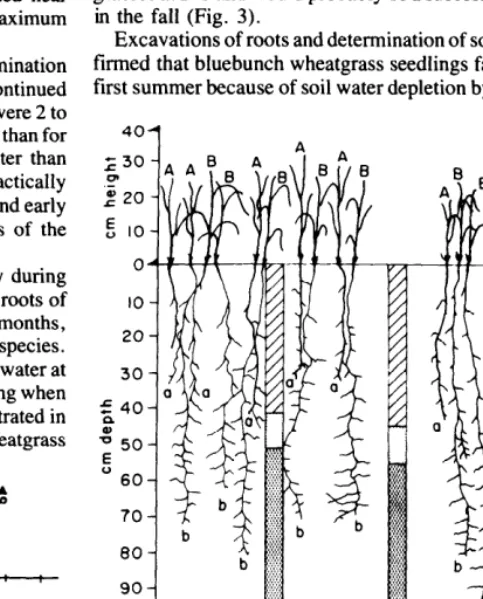
Cheatgrass roots grew deeper than the bluebunch wheatgrass roots and reduced soil water to potentials less than - 15 bars in the upper soil levels where bluebunch wheatgrass roots were growing (Fig. 2). Cheatgrass root tips were growing at depths where soil water potential was less than - 1 bar, and readily available.
A similar experiment included medusahead and crested wheatgrass (Harris and Wilson 1970). The earlier results were confirmed, and in addition it was shown that (a) medusahead behaved similarly to cheatgrass in reducing surface layer soil water, and (b) the growth rate of primary roots of crested wheatgrass was similar to that of the annual grasses at 2°C and would probably be a successful competitor if seeded in the fall (Fig. 3).
Excavations of roots and determination of soil water in the field con- firmed that bluebunch wheatgrass seedlings failed to live through the first summer because of soil water depletion by winter-growing cheat-
SC
b ---Box 3 Box 4 Box 33 Box 34
56 Days 141 Days
Ave Temp 21-27 OC Ave Temp 8-10°C
Legend, a -A wheatgrass
b-B cheatgrass ---- Soul moisture - tension
Fig. 2. Development of bluebunch wheatgrass and cheatgrass seedlings in relation to available soil water. Two replications of each run at room temperature and winter temperature in high density cheatgrass. (Used by permission of the Ecological Society of America; from Harris, 1967.)